
Red Dulse Seaweed Leaf Vanilla Flavor Ingredients & Drug Interactions
by TerraVita
What is this page for?
First and foremost: checking Red Dulse Seaweed Leaf Vanilla Flavor against your medications. The heart of this page is the interaction checker and the full interaction report — how this product’s ingredients may interact with prescription and over-the-counter medicines you may be taking.
Around that, we add a pharmacist’s high-level view of the product as a whole — what’s inside, the evidence for its stated use, how transparent the label is, and what safety data exists — so you can see the full picture in one place. It’s educational information from our licensed clinical databases and the clinical staff at HelloPharmacist — not medical advice — and we don’t sell or endorse products. Our editorial policy
Red Dulse Seaweed Leaf Vanilla Flavor is a dietary supplement by TerraVita with 1 active ingredient. Its ingredients are commonly taken for nutritional supplement (iodine, minerals), source of plant protein, general wellness.Based on those ingredients, 85 medications have a known interaction with it, the most serious rated moderate. The ingredients most likely to interact are Red Dulse Seaweed Leaf Glycerite Liquid Extract. Use the checker below to test your specific medication, or read the full HelloPharmacist Interaction Report.
Check Your Meds Against Red Dulse Seaweed Leaf Vanilla Flavor by TerraVita
Ask about any prescription or over-the-counter medication and we check it for interactions with Red Dulse Seaweed Leaf Vanilla Flavor by TerraVita — and tell you which ingredient is responsible.
AI summaries are generated from our interaction database for education only — always confirm with your pharmacist. How we use AI
Ask the Pharmacist
A licensed pharmacist will answer your question by email — free, usually within 24 hours.
Got it — thank you!
A licensed pharmacist will answer within 24 hours. Keep an eye on your email (worth checking spam, just in case).
HelloPharmacist Scorecard of Red Dulse Seaweed Leaf Vanilla Flavor by TerraVita
Our pharmacy team’s full take, with four database checks built into the cards below — a summary of what is known, not a grade of the product itself.
What’s inside
Full disclosure
This product contains one active ingredient: red dulse seaweed leaf as a glycerite liquid extract. Dulse is a type of red seaweed that's eaten as a food in many cultures and also used as a supplement for its mineral content — it's especially high in iodine and potassium.
The extract is mixed with glycerin (a common liquid sweetener and preservative) and vanilla flavor.
Does it work?
Couldn't assess
The data we hold on dulse's effectiveness is incomplete. For lowering cholesterol and treating iodine deficiency — two uses this product might be marketed for — we have insufficient reliable evidence to rate whether it actually works.
That doesn't mean it doesn't; it means the studies aren't strong enough yet to say one way or the other.
How safe is it?
Some data gaps
Dulse is generally well tolerated as a food in normal amounts, but supplements — especially concentrated extracts like this one — come with caution flags. The main concern is unpredictable iodine and potassium levels in supplement form, which can vary a lot from batch to batch.
Because this is a liquid extract, the dose is easier to control than with loose seaweed, but iodine levels are still not reliably consistent. If you're pregnant or breastfeeding, avoid this supplement.
Excess iodine can pass into breast milk and affect your baby's thyroid. We don't have enough safety data to say it's okay in pregnancy either, so talk with your doctor or pharmacist before taking it if you're pregnant, planning to become pregnant, or nursing.
Meds to double-check
Moderate interaction found
Before taking this product, check with your doctor or pharmacist if you take thyroid hormone, antithyroid drugs, digoxin, amiodarone, potassium-sparing diuretics, ACE inhibitors, or angiotensin receptor blockers. All of these have documented theoretical interactions with dulse's iodine and potassium content.
The bottom line
Scorecard at a glanceFully disclosed formula with no assessable stated purpose. Moderate medication interactions have been identified, and some safety-information gaps remain.
This product is best avoided if you take any thyroid medications, heart rhythm drugs like digoxin or amiodarone, or blood pressure medications in the ACE inhibitor or ARB families. If you take potassium-sparing diuretics or have a history of high potassium levels, be cautious too.
Talk it over with your doctor or pharmacist before adding this to your routine — they know your full medication list and can tell you whether it's safe for you.
Educational only — not medical advice; always confirm with your pharmacist. Our editorial policy · How we use AI
Assessment coverage: 1 of 1 active ingredient matched to our full ingredient reviews (monographs). Based on the product label dated Nov 22, 2022.
This Scorecard evaluates available label information, ingredient evidence, and known medication-safety considerations. It does not independently verify product identity, purity, potency, contamination, or manufacturing quality. How these ratings are computed
General information
Key facts about Red Dulse Seaweed Leaf Vanilla Flavor, straight from the product label.
Everything in this section is reproduced from the manufacturer’s own product label — it’s the label speaking, not HelloPharmacist. We show it so you can see exactly what the maker states; we don’t verify or endorse those statements.
Supplement Facts
The label details for Red Dulse Seaweed Leaf Vanilla Flavor by TerraVita, sourced from the NIH Dietary Supplement Label Database.
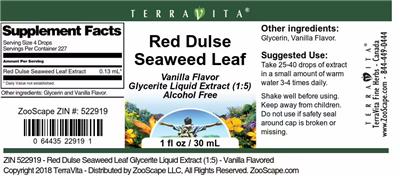
Supplement Facts
| Ingredient | Amount | % DV |
|---|---|---|
| Red Dulse Seaweed Leaf Glycerite Liquid Extract | 0.13 mL | -- |
Other ingredients: Glycerin, Vanilla flavor
Tap any ingredient to jump to its full detail below.
These statements are the manufacturer’s wording, reproduced from the product label — the label is saying it, not HelloPharmacist. We don’t verify or endorse them.
Brand IP Statement(s)
Copyright 2018 TerraVita - Distributed by ZooScape LLC, All Rights Reserved.
Formula
Glycerite liquid extract (1:5)
Formulation
Alcohol free
Suggested/Recommended/Usage/Directions
Suggested Use: Take 25-40 drops of extract in a small amount of warm water 3-4 times daily. Shake well before using.
Precautions
Keep away from children.
Do not use if safety seal around cap is broken or missing.
Is this label outdated? Report a formula or label change and our pharmacy team will review it.
Red Dulse Seaweed Leaf Vanilla Flavor by TerraVita label
The label scan from the NIH Dietary Supplement Label Database. Tap to enlarge.
Label images are published by the NIH Dietary Supplement Label Database for the version of this product on file. Always read your actual product label.
View the full label (PDF)The Ingredients in Red Dulse Seaweed Leaf Vanilla Flavor by TerraVita
This is the 1 active ingredient this product is made of. Select it to open its full monograph.
Serving size25 Drop(s) Dosage formLiquid Servings per container227 Amounts shown are per serving.
Red Dulse Seaweed Leaf Glycerite Liquid Extract
Interacts with85 drugs
Dulse is a red seaweed eaten as a food in many coastal cultures and is a natural source of iodine, potassium, protein, and antioxidant compounds. As a...
Red Dulse Seaweed Leaf Glycerite Liquid Extract monograph & interactionsOther (inactive) ingredients: Glycerin, Vanilla flavor. These complete the product’s ingredient list but are not active constituents.
Red Dulse Seaweed Leaf Vanilla Flavor by TerraVita Drug Interactions
HelloPharmacist Interaction Report
TerraVita Red Dulse Seaweed Leaf Vanilla Flavor interacts with several medication types through its red dulse seaweed content.
The most serious concerns are moderate-severity interactions with thyroid hormone, antithyroid drugs, digoxin (a heart rhythm medication), and amiodarone (another heart drug). Dulse is rich in both iodine and potassium, which can shift how these medications work in your body.
Read the full breakdown — every affected drug type, severity by severity
Because dulse contains high iodine, it may interfere with thyroid hormone replacement or antithyroid medications — iodine at high doses can trigger either an overactive or underactive thyroid depending on your history. It can also theoretically increase iodine to dangerous levels if you're taking amiodarone, which itself contains a large amount of iodine.
Dulse's potassium content raises a minor but real concern with digoxin, potassium-sparing diuretics (water pills that spare potassium), ACE inhibitors (blood pressure drugs), and angiotensin receptor blockers (ARBs, also for blood pressure). These combinations could theoretically push your blood potassium (serum potassium levels) too high, though human cases haven't been documented.
Altogether, these interactions span 85 individual medications.
None of these interactions have been proven in actual people, but the theory is sound enough that you'll want to check your exact medications with the search tool below before you start.
Check your own medications below · Editorial policy · How we use AI
Want to check YOUR meds against Red Dulse Seaweed Leaf Vanilla Flavor?
Ask about interactions with your drugs in plain English — “Can I take it with lisinopril?” — and we find you the answer in seconds, ingredient by ingredient.
Go to the checkerIngredients driving the most interactions
Individual Drug Interactions
The ingredients in Red Dulse Seaweed Leaf Vanilla Flavor interact with 85 drugs. Click any drug to see the details.
1 of the 1 ingredient in Red Dulse Seaweed Leaf Vanilla Flavor interact with drugs. Each result below shows which ingredient is responsible. Red Dulse Seaweed Leaf Glycerite Liquid Extract
AmiodaroneCordarone, Pacerone
How Amiodarone interacts with Red Dulse Seaweed Leaf Vanilla Flavor — through 1 ingredient. Tap an ingredient for the detail:
Red Dulse Seaweed Leaf Glycerite Liquid ExtractAmiodarine (cordarone) Moderate
Interaction Summary
Theoretically, combining dulse with amiodarone might cause excessively high iodine levels.
Read the full Red Dulse Seaweed Leaf Glycerite Liquid Extract + Amiodarone interactionCarbimazoleNeo-Mercazole
How Carbimazole interacts with Red Dulse Seaweed Leaf Vanilla Flavor — through 1 ingredient. Tap an ingredient for the detail:
Red Dulse Seaweed Leaf Glycerite Liquid ExtractAntithyroid Drugs Moderate
Interaction Summary
Theoretically, due to its iodine content, dulse might alter the effects of antithyroid drugs.
Read the full Red Dulse Seaweed Leaf Glycerite Liquid Extract + Carbimazole interactionConjugated EstrogensCenestin, Enjuvia, Premarin, Premarin Vaginal Cream
How Conjugated Estrogens interacts with Red Dulse Seaweed Leaf Vanilla Flavor — through 1 ingredient. Tap an ingredient for the detail:
Red Dulse Seaweed Leaf Glycerite Liquid ExtractThyroid Hormone Moderate
Interaction Summary
Theoretically, due to its iodine content, dulse might alter the effects of thyroid hormone.
Read the full Red Dulse Seaweed Leaf Glycerite Liquid Extract + Conjugated Estrogens interactionDesiccated Thyroid ExtractWesthroid, WP Thyroid
How Desiccated Thyroid Extract interacts with Red Dulse Seaweed Leaf Vanilla Flavor — through 1 ingredient. Tap an ingredient for the detail:
Red Dulse Seaweed Leaf Glycerite Liquid ExtractThyroid Hormone Moderate
Interaction Summary
Theoretically, due to its iodine content, dulse might alter the effects of thyroid hormone.
Read the full Red Dulse Seaweed Leaf Glycerite Liquid Extract + Desiccated Thyroid Extract interactionDesiccated Thyroid Extract (prescription Drug)Nature-Throid, Thyrar
How Desiccated Thyroid Extract (prescription Drug) interacts with Red Dulse Seaweed Leaf Vanilla Flavor — through 1 ingredient. Tap an ingredient for the detail:
Red Dulse Seaweed Leaf Glycerite Liquid ExtractThyroid Hormone Moderate
Interaction Summary
Theoretically, due to its iodine content, dulse might alter the effects of thyroid hormone.
Read the full Red Dulse Seaweed Leaf Glycerite Liquid Extract + Desiccated Thyroid Extract (prescription Drug) interactionDextrothyroxineCholoxin
How Dextrothyroxine interacts with Red Dulse Seaweed Leaf Vanilla Flavor — through 1 ingredient. Tap an ingredient for the detail:
Red Dulse Seaweed Leaf Glycerite Liquid ExtractThyroid Hormone Moderate
Interaction Summary
Theoretically, due to its iodine content, dulse might alter the effects of thyroid hormone.
Read the full Red Dulse Seaweed Leaf Glycerite Liquid Extract + Dextrothyroxine interactionDigoxinDigitek, Lanoxicaps, Lanoxin
How Digoxin interacts with Red Dulse Seaweed Leaf Vanilla Flavor — through 1 ingredient. Tap an ingredient for the detail:
Red Dulse Seaweed Leaf Glycerite Liquid ExtractDigoxin (lanoxin) Moderate
Interaction Summary
Theoretically, dulse might increase the risk of hyperkalemia when taken with digoxin.
Read the full Red Dulse Seaweed Leaf Glycerite Liquid Extract + Digoxin interactionHuman Chorionic Gonadotropin (hcg)Pregnyl
How Human Chorionic Gonadotropin (hcg) interacts with Red Dulse Seaweed Leaf Vanilla Flavor — through 1 ingredient. Tap an ingredient for the detail:
Red Dulse Seaweed Leaf Glycerite Liquid ExtractThyroid Hormone Moderate
Interaction Summary
Theoretically, due to its iodine content, dulse might alter the effects of thyroid hormone.
Read the full Red Dulse Seaweed Leaf Glycerite Liquid Extract + Human Chorionic Gonadotropin (hcg) interactionLevothyroxineEltroxin, Estre, Euthyrox, Levo-T, Levolet, Levothroid +5 more
How Levothyroxine interacts with Red Dulse Seaweed Leaf Vanilla Flavor — through 1 ingredient. Tap an ingredient for the detail:
Red Dulse Seaweed Leaf Glycerite Liquid ExtractThyroid Hormone Moderate
Interaction Summary
Theoretically, due to its iodine content, dulse might alter the effects of thyroid hormone.
Read the full Red Dulse Seaweed Leaf Glycerite Liquid Extract + Levothyroxine interactionLevothyroxine SodiumErmez, Thyquidity, Tirosint-Sol
How Levothyroxine Sodium interacts with Red Dulse Seaweed Leaf Vanilla Flavor — through 1 ingredient. Tap an ingredient for the detail:
Red Dulse Seaweed Leaf Glycerite Liquid ExtractThyroid Hormone Moderate
Interaction Summary
Theoretically, due to its iodine content, dulse might alter the effects of thyroid hormone.
Read the full Red Dulse Seaweed Leaf Glycerite Liquid Extract + Levothyroxine Sodium interactionLevothyroxine, LiothyronineArmour Thyroid
How Levothyroxine, Liothyronine interacts with Red Dulse Seaweed Leaf Vanilla Flavor — through 1 ingredient. Tap an ingredient for the detail:
Red Dulse Seaweed Leaf Glycerite Liquid ExtractThyroid Hormone Moderate
Interaction Summary
Theoretically, due to its iodine content, dulse might alter the effects of thyroid hormone.
Read the full Red Dulse Seaweed Leaf Glycerite Liquid Extract + Levothyroxine, Liothyronine interactionLiothyronineCytomel
How Liothyronine interacts with Red Dulse Seaweed Leaf Vanilla Flavor — through 1 ingredient. Tap an ingredient for the detail:
Red Dulse Seaweed Leaf Glycerite Liquid ExtractThyroid Hormone Moderate
Interaction Summary
Theoretically, due to its iodine content, dulse might alter the effects of thyroid hormone.
Read the full Red Dulse Seaweed Leaf Glycerite Liquid Extract + Liothyronine interactionLiotrixEuthroid 1, Euthroid 1/2, Euthroid 3
How Liotrix interacts with Red Dulse Seaweed Leaf Vanilla Flavor — through 1 ingredient. Tap an ingredient for the detail:
Red Dulse Seaweed Leaf Glycerite Liquid ExtractThyroid Hormone Moderate
Interaction Summary
Theoretically, due to its iodine content, dulse might alter the effects of thyroid hormone.
Read the full Red Dulse Seaweed Leaf Glycerite Liquid Extract + Liotrix interactionLiotrix, T4/t3Euthroid 2
How Liotrix, T4/t3 interacts with Red Dulse Seaweed Leaf Vanilla Flavor — through 1 ingredient. Tap an ingredient for the detail:
Red Dulse Seaweed Leaf Glycerite Liquid ExtractThyroid Hormone Moderate
Interaction Summary
Theoretically, due to its iodine content, dulse might alter the effects of thyroid hormone.
Read the full Red Dulse Seaweed Leaf Glycerite Liquid Extract + Liotrix, T4/t3 interactionMenotropinsMenopur, Repronex
How Menotropins interacts with Red Dulse Seaweed Leaf Vanilla Flavor — through 1 ingredient. Tap an ingredient for the detail:
Red Dulse Seaweed Leaf Glycerite Liquid ExtractThyroid Hormone Moderate
Interaction Summary
Theoretically, due to its iodine content, dulse might alter the effects of thyroid hormone.
Read the full Red Dulse Seaweed Leaf Glycerite Liquid Extract + Menotropins interactionMethenamine MandelateMandelamine, Methimazole
How Methenamine Mandelate interacts with Red Dulse Seaweed Leaf Vanilla Flavor — through 1 ingredient. Tap an ingredient for the detail:
Red Dulse Seaweed Leaf Glycerite Liquid ExtractAntithyroid Drugs Moderate
Interaction Summary
Theoretically, due to its iodine content, dulse might alter the effects of antithyroid drugs.
Read the full Red Dulse Seaweed Leaf Glycerite Liquid Extract + Methenamine Mandelate interactionMethimazoleTapazole
How Methimazole interacts with Red Dulse Seaweed Leaf Vanilla Flavor — through 1 ingredient. Tap an ingredient for the detail:
Red Dulse Seaweed Leaf Glycerite Liquid ExtractAntithyroid Drugs Moderate
Interaction Summary
Theoretically, due to its iodine content, dulse might alter the effects of antithyroid drugs.
Read the full Red Dulse Seaweed Leaf Glycerite Liquid Extract + Methimazole interactionOspemifeneOsphena
How Ospemifene interacts with Red Dulse Seaweed Leaf Vanilla Flavor — through 1 ingredient. Tap an ingredient for the detail:
Red Dulse Seaweed Leaf Glycerite Liquid ExtractThyroid Hormone Moderate
Interaction Summary
Theoretically, due to its iodine content, dulse might alter the effects of thyroid hormone.
Read the full Red Dulse Seaweed Leaf Glycerite Liquid Extract + Ospemifene interactionPotassium Iodide (prescription Drug)Thyro-Block
How Potassium Iodide (prescription Drug) interacts with Red Dulse Seaweed Leaf Vanilla Flavor — through 1 ingredient. Tap an ingredient for the detail:
Red Dulse Seaweed Leaf Glycerite Liquid ExtractAntithyroid Drugs Moderate
Interaction Summary
Theoretically, due to its iodine content, dulse might alter the effects of antithyroid drugs.
Read the full Red Dulse Seaweed Leaf Glycerite Liquid Extract + Potassium Iodide (prescription Drug) interactionPropylthiouracil, PtuPropylthiouracil
How Propylthiouracil, Ptu interacts with Red Dulse Seaweed Leaf Vanilla Flavor — through 1 ingredient. Tap an ingredient for the detail:
Red Dulse Seaweed Leaf Glycerite Liquid ExtractAntithyroid Drugs Moderate
Interaction Summary
Theoretically, due to its iodine content, dulse might alter the effects of antithyroid drugs.
Read the full Red Dulse Seaweed Leaf Glycerite Liquid Extract + Propylthiouracil, Ptu interactionTestosterone UndecanoateAndriol, Aveed, Jatenzo, Kyzatrex
How Testosterone Undecanoate interacts with Red Dulse Seaweed Leaf Vanilla Flavor — through 1 ingredient. Tap an ingredient for the detail:
Red Dulse Seaweed Leaf Glycerite Liquid ExtractThyroid Hormone Moderate
Interaction Summary
Theoretically, due to its iodine content, dulse might alter the effects of thyroid hormone.
Read the full Red Dulse Seaweed Leaf Glycerite Liquid Extract + Testosterone Undecanoate interactionThyroglobulinProloid
How Thyroglobulin interacts with Red Dulse Seaweed Leaf Vanilla Flavor — through 1 ingredient. Tap an ingredient for the detail:
Red Dulse Seaweed Leaf Glycerite Liquid ExtractThyroid Hormone Moderate
Interaction Summary
Theoretically, due to its iodine content, dulse might alter the effects of thyroid hormone.
Read the full Red Dulse Seaweed Leaf Glycerite Liquid Extract + Thyroglobulin interactionThyroid HormoneEtwon
How Thyroid Hormone interacts with Red Dulse Seaweed Leaf Vanilla Flavor — through 1 ingredient. Tap an ingredient for the detail:
Red Dulse Seaweed Leaf Glycerite Liquid ExtractThyroid Hormone Moderate
Interaction Summary
Theoretically, due to its iodine content, dulse might alter the effects of thyroid hormone.
Read the full Red Dulse Seaweed Leaf Glycerite Liquid Extract + Thyroid Hormone interactionAmilorideAmilamont, Midamor
How Amiloride interacts with Red Dulse Seaweed Leaf Vanilla Flavor — through 1 ingredient. Tap an ingredient for the detail:
Red Dulse Seaweed Leaf Glycerite Liquid ExtractPotassium-sparing Diuretics Minor
Interaction Summary
Theoretically, dulse might increase the risk of hyperkalemia when taken with potassium-sparing diuretics.
Read the full Red Dulse Seaweed Leaf Glycerite Liquid Extract + Amiloride interactionAmiloride, HydrochlorothiazideAmil-Co, Amilzide, Moduret 25, Moduretic
How Amiloride, Hydrochlorothiazide interacts with Red Dulse Seaweed Leaf Vanilla Flavor — through 1 ingredient. Tap an ingredient for the detail:
Red Dulse Seaweed Leaf Glycerite Liquid ExtractPotassium-sparing Diuretics Minor
Interaction Summary
Theoretically, dulse might increase the risk of hyperkalemia when taken with potassium-sparing diuretics.
Read the full Red Dulse Seaweed Leaf Glycerite Liquid Extract + Amiloride, Hydrochlorothiazide interactionAmlodipine Besylate, BenazeprilLotrel
How Amlodipine Besylate, Benazepril interacts with Red Dulse Seaweed Leaf Vanilla Flavor — through 1 ingredient. Tap an ingredient for the detail:
Red Dulse Seaweed Leaf Glycerite Liquid ExtractAce Inhibitors (aceis) Minor
Interaction Summary
Theoretically, dulse might increase the risk of hyperkalemia when taken with ACEIs.
Read the full Red Dulse Seaweed Leaf Glycerite Liquid Extract + Amlodipine Besylate, Benazepril interactionAzilsartanEdarbi
How Azilsartan interacts with Red Dulse Seaweed Leaf Vanilla Flavor — through 1 ingredient. Tap an ingredient for the detail:
Red Dulse Seaweed Leaf Glycerite Liquid ExtractAngiotensin Receptor Blockers (arbs) Minor
Interaction Summary
Theoretically, dulse might increase the risk of hyperkalemia when taken with ARBs.
Read the full Red Dulse Seaweed Leaf Glycerite Liquid Extract + Azilsartan interactionAzilsartan, ChlorthalidoneEdarbyclor
How Azilsartan, Chlorthalidone interacts with Red Dulse Seaweed Leaf Vanilla Flavor — through 1 ingredient. Tap an ingredient for the detail:
Red Dulse Seaweed Leaf Glycerite Liquid ExtractAngiotensin Receptor Blockers (arbs) Minor
Interaction Summary
Theoretically, dulse might increase the risk of hyperkalemia when taken with ARBs.
Read the full Red Dulse Seaweed Leaf Glycerite Liquid Extract + Azilsartan, Chlorthalidone interactionBenazeprilLotensin
How Benazepril interacts with Red Dulse Seaweed Leaf Vanilla Flavor — through 1 ingredient. Tap an ingredient for the detail:
Red Dulse Seaweed Leaf Glycerite Liquid ExtractAce Inhibitors (aceis) Minor
Interaction Summary
Theoretically, dulse might increase the risk of hyperkalemia when taken with ACEIs.
Read the full Red Dulse Seaweed Leaf Glycerite Liquid Extract + Benazepril interactionBenazepril, HydrochlorothiazideLotensin HCT
How Benazepril, Hydrochlorothiazide interacts with Red Dulse Seaweed Leaf Vanilla Flavor — through 1 ingredient. Tap an ingredient for the detail:
Red Dulse Seaweed Leaf Glycerite Liquid ExtractAce Inhibitors (aceis) Minor
Interaction Summary
Theoretically, dulse might increase the risk of hyperkalemia when taken with ACEIs.
Read the full Red Dulse Seaweed Leaf Glycerite Liquid Extract + Benazepril, Hydrochlorothiazide interactionEach ingredient & the kinds of drugs it affects
For each ingredient in Red Dulse Seaweed Leaf Vanilla Flavor with known interactions, here are the types of medications it can affect. Open any type for the detail — or search your exact drug in the checker above.
Red Dulse Seaweed Leaf Glycerite Liquid Extract
Amiodarine (Cordarone)
Theoretically, combining dulse with amiodarone might cause excessively high iodine levels.
Dulse is rich in iodine, and amiodarone contains 37.3% iodine and can increase iodine levels.
Antithyroid Drugs
Theoretically, due to its iodine content, dulse might alter the effects of antithyroid drugs.
Dulse is rich in iodine. Iodine in high doses has been reported to cause both hyperthyroidism and hypothyroidism, depending on the individual's past medical history.
Digoxin (Lanoxin)
Theoretically, dulse might increase the risk of hyperkalemia when taken with digoxin.
Dulse is rich in potassium, and digoxin can increase potassium levels in the blood. This interaction has not been demonstrated in humans.
Thyroid Hormone
Theoretically, due to its iodine content, dulse might alter the effects of thyroid hormone.
Dulse is rich in iodine. Iodine in high doses has been reported to cause both hyperthyroidism and hypothyroidism, depending on the individual's past medical history. Although dulse has been associated with a statistically significant increase in thyroid stimulating hormone (TSH) levels in clinical research, clinically significant increases have not been documented.
Ace Inhibitors (Aceis)
Theoretically, dulse might increase the risk of hyperkalemia when taken with ACEIs.
Dulse is rich in potassium. ACEIs block the actions of the renin-angiotensin-aldosterone system and reduce potassium excretion. Concomitant use of these drugs with moderate dietary potassium intake (about 3775-5200 mg daily) does not increase serum potassium levels. However, using these drugs while consuming dulse in quantities that provide larger amounts of potassium daily might increase the risk of hyperkalemia. Additionally, in vitro research suggests that dulse protein hydrolysates inhibit the activity of ACE. However, these effects have not been demonstrated in humans.
Angiotensin Receptor Blockers (Arbs)
Theoretically, dulse might increase the risk of hyperkalemia when taken with ARBs.
Dulse is rich in potassium. ARBs block the actions of the renin-angiotensin-aldosterone system and reduce potassium excretion. Concomitant use of these drugs with moderate dietary potassium intake (about 3775-5200 mg daily) does not increase serum potassium levels. However, using these drugs while consuming dulse in quantities that provide higher amounts of potassium daily might increase the risk of hyperkalemia. Additionally, in vitro research suggests that dulse protein hydrolysates inhibit the activity of angiotensin converting enzyme (ACE). However, these effects have not been demonstrated in humans.
Potassium-Sparing Diuretics
Theoretically, dulse might increase the risk of hyperkalemia when taken with potassium-sparing diuretics.
Dulse is rich in potassium, and potassium-sparing diuretics can increase potassium levels in the blood. This interaction has not been shown in humans.
Brand information
Manufacturer and brand details for Red Dulse Seaweed Leaf Vanilla Flavor, from the product label.
TerraVita
See all TerraVita products- Name
- ZooScape LLC
- Phone Number
- 844-449-0444
- Web Address
- www.ZooScape.com
Red Dulse Seaweed Leaf Vanilla Flavor by TerraVita: Common Questions
Does Red Dulse Seaweed Leaf Vanilla Flavor by TerraVita interact with any medications?
How can one product interact with so many drugs?
Where does this information come from?
What is red dulse seaweed, and why is it in supplements?
Can I take this if I have thyroid problems?
Is this safe if I'm pregnant or breastfeeding?
Why does the label say to be cautious about iodine and potassium levels?
Does this actually lower cholesterol or fix iodine deficiency?
Written and reviewed by the HelloPharmacist editorial staff. Our editorial policy
Not sure if Red Dulse Seaweed Leaf Vanilla Flavor is safe with your meds?
Our pharmacists answer your medication & supplement questions — free.
Label information is sourced from the NIH Dietary Supplement Label Database and reflects the product version on file; always read your actual product label. This page is for education only and is not a substitute for professional medical advice. Confirm with your pharmacist or doctor before combining supplements and medications.
The Full Monographs Behind Red Dulse Seaweed Leaf Vanilla Flavor’s Ingredients
Every ingredient we hold a full HelloPharmacist monograph for — uses, evidence, safety, and the complete interaction list.
Sources & How We Checked
Red Dulse Seaweed Leaf Vanilla Flavor's label data comes from the NIH Dietary Supplement Label Database; the ingredient interaction data is from the Natural Medicines database, reviewed by our pharmacists.
- NIH Dietary Supplement Label Database (DSLD) — The official product label on file for this supplement.
- Natural Medicines (Therapeutic Research Center) — Evidence-graded clinical reference behind the ingredient interaction data.
Content is written and reviewed by licensed HelloPharmacist pharmacists. See our data sources and editorial standards for how this information is built and checked.
The 5 references behind this product’s interaction data
Every citation that drives the interaction findings for this product’s ingredients, from the evidence-graded Natural Medicines (TRC Healthcare) database. Open an ingredient to browse its citations — links open the study on PubMed or the publisher’s site.
Dulse 5 references
- Malta D, Arcand J, Ravindran A, Floras V, Allard JP, Newton GE. Adequate intake of potassium does not cause hyperkalemia in hypertensive individuals taking medications that antagonize the renin angiotensin aldosterone system. Am J Clin Nutr 2016 Oct;104(4 PubMed
- Allsopp P, Crowe W, Bahar B, et al. The effect of consuming Palmaria palmata-enriched bread on inflammatory markers, antioxidant status, lipid profile and thyroid function in a randomised placebo-controlled intervention trial in healthy adults. Eur J Nutr PubMed
- McGrath BM, Harmon JP, Bishop G. Palmaria palmata (Dulse) as an unusual maritime aetiology of hyperkalemia in a patient with chronic renal failure: a case report. J Med Case Rep. 2010;4:301. PubMed
- Furuta T, Miyabe Y, Yasui H, Kinoshita Y, Kishimura H. Angiotensin I converting enzyme inhibitory peptides derived from phycobiliproteins of dulse Palmaria palmata. Mar Drugs. 2016;14(2):32. PubMed
- Takase T, Nakamura A, Miyoshi H, et al. Effects of Palmaria palmata on lipid metabolism and glycemic control in participants with hypercholesterolemia in a randomized double-blind placebo-controlled trial. Phytother Res. 2020.
Parts of this content are provided by the Therapeutic Research Center, LLC.
DISCLAIMER: Currently this does not check for drug-drug interactions. This is not an all-inclusive comprehensive list of potential interactions and is for informational purposes only. Not all interactions are known or well-reported in the scientific literature, and new interactions are continually being reported. Input is needed from a qualified healthcare provider including a pharmacist before starting any therapy. Application of clinical judgment is necessary.
© 2021 Therapeutic Research Center, LLC