
Red Marine Algae 375 mg Ingredients & Drug Interactions
by Solaray
What is this page for?
First and foremost: checking Red Marine Algae 375 mg against your medications. The heart of this page is the interaction checker and the full interaction report — how this product’s ingredients may interact with prescription and over-the-counter medicines you may be taking.
Around that, we add a pharmacist’s high-level view of the product as a whole — what’s inside, the evidence for its stated use, how transparent the label is, and what safety data exists — so you can see the full picture in one place. It’s educational information from our licensed clinical databases and the clinical staff at HelloPharmacist — not medical advice — and we don’t sell or endorse products. Our editorial policy
Red Marine Algae 375 mg is a dietary supplement by Solaray with 1 active ingredient. Its ingredients are commonly taken for nutritional supplement (iodine, minerals), source of plant protein, general wellness.Based on those ingredients, 85 medications have a known interaction with it, the most serious rated moderate. The ingredients most likely to interact are Dulse Seaweed. Use the checker below to test your specific medication, or read the full HelloPharmacist Interaction Report.
Check Your Meds Against Red Marine Algae 375 mg by Solaray
Ask about any prescription or over-the-counter medication and we check it for interactions with Red Marine Algae 375 mg by Solaray — and tell you which ingredient is responsible.
AI summaries are generated from our interaction database for education only — always confirm with your pharmacist. How we use AI
Ask the Pharmacist
A licensed pharmacist will answer your question by email — free, usually within 24 hours.
Got it — thank you!
A licensed pharmacist will answer within 24 hours. Keep an eye on your email (worth checking spam, just in case).
HelloPharmacist Scorecard of Red Marine Algae 375 mg by Solaray
Our pharmacy team’s full take, with four database checks built into the cards below — a summary of what is known, not a grade of the product itself.
What’s inside
Full disclosure
This product contains one active ingredient: dulse seaweed (375 mg per capsule). Dulse is a red marine algae that's naturally high in potassium and iodine.
The capsule also holds several inactive ingredients — cellulose, silica, magnesium stearate, and rice extract blend — which help hold the supplement together and make it easier to swallow.
Does it work?
Couldn't assess
The evidence for dulse on high cholesterol and iodine deficiency is insufficient to rate. The data we hold doesn't establish that this supplement works for those purposes.
If you're considering it for one of those reasons, talk with your pharmacist about what the research actually shows and whether it's the right choice for you.
How safe is it?
Some data gaps
Dulse seaweed is generally well tolerated as a food. However, this supplement delivers concentrated amounts of potassium and iodine — much higher than you'd get eating dulse seaweed in normal meals — so caution is needed.
The iodine levels in supplements can be unpredictable, and safety data in humans is limited. If you're breastfeeding, avoid supplement doses of dulse, since excess iodine can pass into breast milk; talk with your doctor for guidance.
No adverse effects have been documented in our data.
Meds to double-check
Moderate interaction found
Before you start, check with your pharmacist if you take digoxin, any thyroid medication, antithyroid drugs, amiodarone, ACE inhibitors, ARBs, or potassium-sparing diuretics. These are the drug types most likely to interact with the potassium and iodine in dulse.
The bottom line
Scorecard at a glanceFully disclosed formula with no assessable stated purpose. Moderate medication interactions have been identified, and some safety-information gaps remain.
If you take heart medications (especially digoxin), thyroid medications, amiodarone, or blood pressure drugs that spare potassium, you should check with your pharmacist before taking this product. The risks are theoretical but documented.
This supplement isn't clearly shown to work for the conditions it's marketed for.
Educational only — not medical advice; always confirm with your pharmacist. Our editorial policy · How we use AI
Assessment coverage: 1 of 1 active ingredient matched to our full ingredient reviews (monographs). Based on the product label dated Mar 25, 2025.
This Scorecard evaluates available label information, ingredient evidence, and known medication-safety considerations. It does not independently verify product identity, purity, potency, contamination, or manufacturing quality. How these ratings are computed
General information
Key facts about Red Marine Algae 375 mg, straight from the product label.
Everything in this section is reproduced from the manufacturer’s own product label — it’s the label speaking, not HelloPharmacist. We show it so you can see exactly what the maker states; we don’t verify or endorse those statements.
Supplement Facts
The label details for Red Marine Algae 375 mg by Solaray, sourced from the NIH Dietary Supplement Label Database.
Supplement Facts
| Ingredient | Amount | % DV |
|---|---|---|
| Dulse Seaweed | 375 mg | -- |
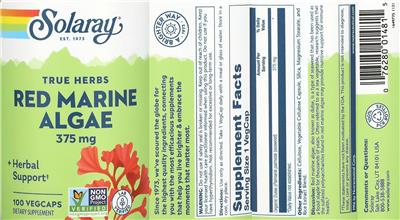
Other ingredients: Cellulose, Silica, Magnesium Stearate, Rice extract Blend
Tap any ingredient to jump to its full detail below.
These statements are the manufacturer’s wording, reproduced from the product label — the label is saying it, not HelloPharmacist. We don’t verify or endorse them.
Brand IP Statement(s)
Solaray Est. 1973 A Brighter Way 1973
Formulation
+ Herbal Support
Non GMO Project Verified nongmoproject.org
FDA Statement of Identity
Dietary Supplement
Seals/Symbols
Non GMO Project Verified nongmoproject.org Lab Verified
General Statements
Since 1973, we've scoured the globe for the highest quality ingredients, connection you with the most efficacious supplements that help you live brighter & embrace the moments that matter most.
100% PCR Bottles
Precautions
Warning: Do not use if safety seal is broken or missing.
Keep out of reach of children.
Keep your licensed health care practitioner informed when using this product. Do not use if you have hyperthyroidism. Not recommended for excessive or long-term use.
Suggested/Recommended/Usage/Directions
Directions: Use only as directed. Take 1 vegcap daily with a meal or glass of water.
Storage
Store in a cool, dry place.
Formula
Discussion: Red marine algae, also known as dulse, is a type of seaweed that has been used as a food staple for thousands of years. Often referred to as a sea vegetable, research suggests that the sulfated polysaccharides found in red marine algae may provide nutritive support for immune health.
True Herbs
FDA Disclaimer Statement
These statements have not been evaluated by the FDA. This product is not intended to diagnose, treat, cure or prevent any disease.
Is this label outdated? Report a formula or label change and our pharmacy team will review it.
Red Marine Algae 375 mg by Solaray label
The label scan from the NIH Dietary Supplement Label Database. Tap to enlarge.
Label images are published by the NIH Dietary Supplement Label Database for the version of this product on file. Always read your actual product label.
View the full label (PDF)The Ingredients in Red Marine Algae 375 mg by Solaray
This is the 1 active ingredient this product is made of. Select it to open its full monograph.
Serving size1 VegCap(s) Dosage formCapsule Servings per container100 Amounts shown are per serving.
Dulse Seaweed
Interacts with85 drugs
Dulse is a red seaweed eaten as a food in many coastal cultures and is a natural source of iodine, potassium, protein, and antioxidant compounds. As a...
Dulse Seaweed monograph & interactionsOther (inactive) ingredients: Cellulose, Silica, Magnesium Stearate, Rice extract Blend. These complete the product’s ingredient list but are not active constituents.
Red Marine Algae 375 mg by Solaray Drug Interactions
HelloPharmacist Interaction Report
Red Marine Algae by Solaray contains dulse seaweed, which has documented interactions with several medication types.
The most serious concern is with digoxin (Lanoxin), a heart medication: dulse is rich in potassium, and digoxin can raise your blood potassium levels already, so combining them might push potassium too high. This hasn't been tested in humans, but it's a real theoretical risk.
Read the full breakdown — every affected drug type, severity by severity
Dulse is also high in iodine, which can interfere with thyroid medications and antithyroid drugs — the iodine might shift how your thyroid behaves in unpredictable ways. If you take amiodarone (Cordarone), another heart drug, dulse could push your iodine levels too high, since amiodarone itself is about 37% iodine.
You should also be cautious if you're on blood pressure or heart drugs that reduce potassium loss — ACE inhibitors, ARBs, or potassium-sparing water pills — because dulse's potassium content could add up. These risks are Minor, but they're real.
Altogether, these interactions span 85 individual medications. Check your exact prescriptions with the search tool on this page before starting.
Check your own medications below · Editorial policy · How we use AI
Want to check YOUR meds against Red Marine Algae 375 mg?
Ask about interactions with your drugs in plain English — “Can I take it with lisinopril?” — and we find you the answer in seconds, ingredient by ingredient.
Go to the checkerIngredients driving the most interactions
Individual Drug Interactions
The ingredients in Red Marine Algae 375 mg interact with 85 drugs. Click any drug to see the details.
1 of the 1 ingredient in Red Marine Algae 375 mg interact with drugs. Each result below shows which ingredient is responsible. Dulse Seaweed
AmiodaroneCordarone, Pacerone
How Amiodarone interacts with Red Marine Algae 375 mg — through 1 ingredient. Tap an ingredient for the detail:
Dulse SeaweedAmiodarine (cordarone) Moderate
Interaction Summary
Theoretically, combining dulse with amiodarone might cause excessively high iodine levels.
Read the full Dulse Seaweed + Amiodarone interactionCarbimazoleNeo-Mercazole
How Carbimazole interacts with Red Marine Algae 375 mg — through 1 ingredient. Tap an ingredient for the detail:
Dulse SeaweedAntithyroid Drugs Moderate
Interaction Summary
Theoretically, due to its iodine content, dulse might alter the effects of antithyroid drugs.
Read the full Dulse Seaweed + Carbimazole interactionConjugated EstrogensCenestin, Enjuvia, Premarin, Premarin Vaginal Cream
How Conjugated Estrogens interacts with Red Marine Algae 375 mg — through 1 ingredient. Tap an ingredient for the detail:
Dulse SeaweedThyroid Hormone Moderate
Interaction Summary
Theoretically, due to its iodine content, dulse might alter the effects of thyroid hormone.
Read the full Dulse Seaweed + Conjugated Estrogens interactionDesiccated Thyroid ExtractWesthroid, WP Thyroid
How Desiccated Thyroid Extract interacts with Red Marine Algae 375 mg — through 1 ingredient. Tap an ingredient for the detail:
Dulse SeaweedThyroid Hormone Moderate
Interaction Summary
Theoretically, due to its iodine content, dulse might alter the effects of thyroid hormone.
Read the full Dulse Seaweed + Desiccated Thyroid Extract interactionDesiccated Thyroid Extract (prescription Drug)Nature-Throid, Thyrar
How Desiccated Thyroid Extract (prescription Drug) interacts with Red Marine Algae 375 mg — through 1 ingredient. Tap an ingredient for the detail:
Dulse SeaweedThyroid Hormone Moderate
Interaction Summary
Theoretically, due to its iodine content, dulse might alter the effects of thyroid hormone.
Read the full Dulse Seaweed + Desiccated Thyroid Extract (prescription Drug) interactionDextrothyroxineCholoxin
How Dextrothyroxine interacts with Red Marine Algae 375 mg — through 1 ingredient. Tap an ingredient for the detail:
Dulse SeaweedThyroid Hormone Moderate
Interaction Summary
Theoretically, due to its iodine content, dulse might alter the effects of thyroid hormone.
Read the full Dulse Seaweed + Dextrothyroxine interactionDigoxinDigitek, Lanoxicaps, Lanoxin
How Digoxin interacts with Red Marine Algae 375 mg — through 1 ingredient. Tap an ingredient for the detail:
Dulse SeaweedDigoxin (lanoxin) Moderate
Interaction Summary
Theoretically, dulse might increase the risk of hyperkalemia when taken with digoxin.
Read the full Dulse Seaweed + Digoxin interactionHuman Chorionic Gonadotropin (hcg)Pregnyl
How Human Chorionic Gonadotropin (hcg) interacts with Red Marine Algae 375 mg — through 1 ingredient. Tap an ingredient for the detail:
Dulse SeaweedThyroid Hormone Moderate
Interaction Summary
Theoretically, due to its iodine content, dulse might alter the effects of thyroid hormone.
Read the full Dulse Seaweed + Human Chorionic Gonadotropin (hcg) interactionLevothyroxineEltroxin, Estre, Euthyrox, Levo-T, Levolet, Levothroid +5 more
How Levothyroxine interacts with Red Marine Algae 375 mg — through 1 ingredient. Tap an ingredient for the detail:
Dulse SeaweedThyroid Hormone Moderate
Interaction Summary
Theoretically, due to its iodine content, dulse might alter the effects of thyroid hormone.
Read the full Dulse Seaweed + Levothyroxine interactionLevothyroxine SodiumErmez, Thyquidity, Tirosint-Sol
How Levothyroxine Sodium interacts with Red Marine Algae 375 mg — through 1 ingredient. Tap an ingredient for the detail:
Dulse SeaweedThyroid Hormone Moderate
Interaction Summary
Theoretically, due to its iodine content, dulse might alter the effects of thyroid hormone.
Read the full Dulse Seaweed + Levothyroxine Sodium interactionLevothyroxine, LiothyronineArmour Thyroid
How Levothyroxine, Liothyronine interacts with Red Marine Algae 375 mg — through 1 ingredient. Tap an ingredient for the detail:
Dulse SeaweedThyroid Hormone Moderate
Interaction Summary
Theoretically, due to its iodine content, dulse might alter the effects of thyroid hormone.
Read the full Dulse Seaweed + Levothyroxine, Liothyronine interactionLiothyronineCytomel
How Liothyronine interacts with Red Marine Algae 375 mg — through 1 ingredient. Tap an ingredient for the detail:
Dulse SeaweedThyroid Hormone Moderate
Interaction Summary
Theoretically, due to its iodine content, dulse might alter the effects of thyroid hormone.
Read the full Dulse Seaweed + Liothyronine interactionLiotrixEuthroid 1, Euthroid 1/2, Euthroid 3
How Liotrix interacts with Red Marine Algae 375 mg — through 1 ingredient. Tap an ingredient for the detail:
Dulse SeaweedThyroid Hormone Moderate
Interaction Summary
Theoretically, due to its iodine content, dulse might alter the effects of thyroid hormone.
Read the full Dulse Seaweed + Liotrix interactionLiotrix, T4/t3Euthroid 2
How Liotrix, T4/t3 interacts with Red Marine Algae 375 mg — through 1 ingredient. Tap an ingredient for the detail:
Dulse SeaweedThyroid Hormone Moderate
Interaction Summary
Theoretically, due to its iodine content, dulse might alter the effects of thyroid hormone.
Read the full Dulse Seaweed + Liotrix, T4/t3 interactionMenotropinsMenopur, Repronex
How Menotropins interacts with Red Marine Algae 375 mg — through 1 ingredient. Tap an ingredient for the detail:
Dulse SeaweedThyroid Hormone Moderate
Interaction Summary
Theoretically, due to its iodine content, dulse might alter the effects of thyroid hormone.
Read the full Dulse Seaweed + Menotropins interactionMethenamine MandelateMandelamine, Methimazole
How Methenamine Mandelate interacts with Red Marine Algae 375 mg — through 1 ingredient. Tap an ingredient for the detail:
Dulse SeaweedAntithyroid Drugs Moderate
Interaction Summary
Theoretically, due to its iodine content, dulse might alter the effects of antithyroid drugs.
Read the full Dulse Seaweed + Methenamine Mandelate interactionMethimazoleTapazole
How Methimazole interacts with Red Marine Algae 375 mg — through 1 ingredient. Tap an ingredient for the detail:
Dulse SeaweedAntithyroid Drugs Moderate
Interaction Summary
Theoretically, due to its iodine content, dulse might alter the effects of antithyroid drugs.
Read the full Dulse Seaweed + Methimazole interactionOspemifeneOsphena
How Ospemifene interacts with Red Marine Algae 375 mg — through 1 ingredient. Tap an ingredient for the detail:
Dulse SeaweedThyroid Hormone Moderate
Interaction Summary
Theoretically, due to its iodine content, dulse might alter the effects of thyroid hormone.
Read the full Dulse Seaweed + Ospemifene interactionPotassium Iodide (prescription Drug)Thyro-Block
How Potassium Iodide (prescription Drug) interacts with Red Marine Algae 375 mg — through 1 ingredient. Tap an ingredient for the detail:
Dulse SeaweedAntithyroid Drugs Moderate
Interaction Summary
Theoretically, due to its iodine content, dulse might alter the effects of antithyroid drugs.
Read the full Dulse Seaweed + Potassium Iodide (prescription Drug) interactionPropylthiouracil, PtuPropylthiouracil
How Propylthiouracil, Ptu interacts with Red Marine Algae 375 mg — through 1 ingredient. Tap an ingredient for the detail:
Dulse SeaweedAntithyroid Drugs Moderate
Interaction Summary
Theoretically, due to its iodine content, dulse might alter the effects of antithyroid drugs.
Read the full Dulse Seaweed + Propylthiouracil, Ptu interactionTestosterone UndecanoateAndriol, Aveed, Jatenzo, Kyzatrex
How Testosterone Undecanoate interacts with Red Marine Algae 375 mg — through 1 ingredient. Tap an ingredient for the detail:
Dulse SeaweedThyroid Hormone Moderate
Interaction Summary
Theoretically, due to its iodine content, dulse might alter the effects of thyroid hormone.
Read the full Dulse Seaweed + Testosterone Undecanoate interactionThyroglobulinProloid
How Thyroglobulin interacts with Red Marine Algae 375 mg — through 1 ingredient. Tap an ingredient for the detail:
Dulse SeaweedThyroid Hormone Moderate
Interaction Summary
Theoretically, due to its iodine content, dulse might alter the effects of thyroid hormone.
Read the full Dulse Seaweed + Thyroglobulin interactionThyroid HormoneEtwon
How Thyroid Hormone interacts with Red Marine Algae 375 mg — through 1 ingredient. Tap an ingredient for the detail:
Dulse SeaweedThyroid Hormone Moderate
Interaction Summary
Theoretically, due to its iodine content, dulse might alter the effects of thyroid hormone.
Read the full Dulse Seaweed + Thyroid Hormone interactionAmilorideAmilamont, Midamor
How Amiloride interacts with Red Marine Algae 375 mg — through 1 ingredient. Tap an ingredient for the detail:
Dulse SeaweedPotassium-sparing Diuretics Minor
Interaction Summary
Theoretically, dulse might increase the risk of hyperkalemia when taken with potassium-sparing diuretics.
Read the full Dulse Seaweed + Amiloride interactionAmiloride, HydrochlorothiazideAmil-Co, Amilzide, Moduret 25, Moduretic
How Amiloride, Hydrochlorothiazide interacts with Red Marine Algae 375 mg — through 1 ingredient. Tap an ingredient for the detail:
Dulse SeaweedPotassium-sparing Diuretics Minor
Interaction Summary
Theoretically, dulse might increase the risk of hyperkalemia when taken with potassium-sparing diuretics.
Read the full Dulse Seaweed + Amiloride, Hydrochlorothiazide interactionAmlodipine Besylate, BenazeprilLotrel
How Amlodipine Besylate, Benazepril interacts with Red Marine Algae 375 mg — through 1 ingredient. Tap an ingredient for the detail:
Dulse SeaweedAce Inhibitors (aceis) Minor
Interaction Summary
Theoretically, dulse might increase the risk of hyperkalemia when taken with ACEIs.
Read the full Dulse Seaweed + Amlodipine Besylate, Benazepril interactionAzilsartanEdarbi
How Azilsartan interacts with Red Marine Algae 375 mg — through 1 ingredient. Tap an ingredient for the detail:
Dulse SeaweedAngiotensin Receptor Blockers (arbs) Minor
Interaction Summary
Theoretically, dulse might increase the risk of hyperkalemia when taken with ARBs.
Read the full Dulse Seaweed + Azilsartan interactionAzilsartan, ChlorthalidoneEdarbyclor
How Azilsartan, Chlorthalidone interacts with Red Marine Algae 375 mg — through 1 ingredient. Tap an ingredient for the detail:
Dulse SeaweedAngiotensin Receptor Blockers (arbs) Minor
Interaction Summary
Theoretically, dulse might increase the risk of hyperkalemia when taken with ARBs.
Read the full Dulse Seaweed + Azilsartan, Chlorthalidone interactionBenazeprilLotensin
How Benazepril interacts with Red Marine Algae 375 mg — through 1 ingredient. Tap an ingredient for the detail:
Dulse SeaweedAce Inhibitors (aceis) Minor
Interaction Summary
Theoretically, dulse might increase the risk of hyperkalemia when taken with ACEIs.
Read the full Dulse Seaweed + Benazepril interactionBenazepril, HydrochlorothiazideLotensin HCT
How Benazepril, Hydrochlorothiazide interacts with Red Marine Algae 375 mg — through 1 ingredient. Tap an ingredient for the detail:
Dulse SeaweedAce Inhibitors (aceis) Minor
Interaction Summary
Theoretically, dulse might increase the risk of hyperkalemia when taken with ACEIs.
Read the full Dulse Seaweed + Benazepril, Hydrochlorothiazide interactionEach ingredient & the kinds of drugs it affects
For each ingredient in Red Marine Algae 375 mg with known interactions, here are the types of medications it can affect. Open any type for the detail — or search your exact drug in the checker above.
Dulse Seaweed
Amiodarine (Cordarone)
Theoretically, combining dulse with amiodarone might cause excessively high iodine levels.
Dulse is rich in iodine, and amiodarone contains 37.3% iodine and can increase iodine levels.
Antithyroid Drugs
Theoretically, due to its iodine content, dulse might alter the effects of antithyroid drugs.
Dulse is rich in iodine. Iodine in high doses has been reported to cause both hyperthyroidism and hypothyroidism, depending on the individual's past medical history.
Digoxin (Lanoxin)
Theoretically, dulse might increase the risk of hyperkalemia when taken with digoxin.
Dulse is rich in potassium, and digoxin can increase potassium levels in the blood. This interaction has not been demonstrated in humans.
Thyroid Hormone
Theoretically, due to its iodine content, dulse might alter the effects of thyroid hormone.
Dulse is rich in iodine. Iodine in high doses has been reported to cause both hyperthyroidism and hypothyroidism, depending on the individual's past medical history. Although dulse has been associated with a statistically significant increase in thyroid stimulating hormone (TSH) levels in clinical research, clinically significant increases have not been documented.
Ace Inhibitors (Aceis)
Theoretically, dulse might increase the risk of hyperkalemia when taken with ACEIs.
Dulse is rich in potassium. ACEIs block the actions of the renin-angiotensin-aldosterone system and reduce potassium excretion. Concomitant use of these drugs with moderate dietary potassium intake (about 3775-5200 mg daily) does not increase serum potassium levels. However, using these drugs while consuming dulse in quantities that provide larger amounts of potassium daily might increase the risk of hyperkalemia. Additionally, in vitro research suggests that dulse protein hydrolysates inhibit the activity of ACE. However, these effects have not been demonstrated in humans.
Angiotensin Receptor Blockers (Arbs)
Theoretically, dulse might increase the risk of hyperkalemia when taken with ARBs.
Dulse is rich in potassium. ARBs block the actions of the renin-angiotensin-aldosterone system and reduce potassium excretion. Concomitant use of these drugs with moderate dietary potassium intake (about 3775-5200 mg daily) does not increase serum potassium levels. However, using these drugs while consuming dulse in quantities that provide higher amounts of potassium daily might increase the risk of hyperkalemia. Additionally, in vitro research suggests that dulse protein hydrolysates inhibit the activity of angiotensin converting enzyme (ACE). However, these effects have not been demonstrated in humans.
Potassium-Sparing Diuretics
Theoretically, dulse might increase the risk of hyperkalemia when taken with potassium-sparing diuretics.
Dulse is rich in potassium, and potassium-sparing diuretics can increase potassium levels in the blood. This interaction has not been shown in humans.
Brand information
Manufacturer and brand details for Red Marine Algae 375 mg, from the product label.
Red Marine Algae 375 mg by Solaray: Common Questions
Does Red Marine Algae 375 mg by Solaray interact with any medications?
How can one product interact with so many drugs?
Where does this information come from?
What exactly is in this supplement?
Does dulse actually work for high cholesterol?
Is this safe if I'm pregnant?
What if I'm breastfeeding?
Can I take this with my blood pressure medication?
What are the side effects?
Written and reviewed by the HelloPharmacist editorial staff. Our editorial policy
Not sure if Red Marine Algae 375 mg is safe with your meds?
Our pharmacists answer your medication & supplement questions — free.
Label information is sourced from the NIH Dietary Supplement Label Database and reflects the product version on file; always read your actual product label. This page is for education only and is not a substitute for professional medical advice. Confirm with your pharmacist or doctor before combining supplements and medications.
The Full Monographs Behind Red Marine Algae 375 mg’s Ingredients
Every ingredient we hold a full HelloPharmacist monograph for — uses, evidence, safety, and the complete interaction list.
Sources & How We Checked
Red Marine Algae 375 mg's label data comes from the NIH Dietary Supplement Label Database; the ingredient interaction data is from the Natural Medicines database, reviewed by our pharmacists.
- NIH Dietary Supplement Label Database (DSLD) — The official product label on file for this supplement.
- Natural Medicines (Therapeutic Research Center) — Evidence-graded clinical reference behind the ingredient interaction data.
Content is written and reviewed by licensed HelloPharmacist pharmacists. See our data sources and editorial standards for how this information is built and checked.
The 5 references behind this product’s interaction data
Every citation that drives the interaction findings for this product’s ingredients, from the evidence-graded Natural Medicines (TRC Healthcare) database. Open an ingredient to browse its citations — links open the study on PubMed or the publisher’s site.
Dulse 5 references
- Malta D, Arcand J, Ravindran A, Floras V, Allard JP, Newton GE. Adequate intake of potassium does not cause hyperkalemia in hypertensive individuals taking medications that antagonize the renin angiotensin aldosterone system. Am J Clin Nutr 2016 Oct;104(4 PubMed
- Allsopp P, Crowe W, Bahar B, et al. The effect of consuming Palmaria palmata-enriched bread on inflammatory markers, antioxidant status, lipid profile and thyroid function in a randomised placebo-controlled intervention trial in healthy adults. Eur J Nutr PubMed
- McGrath BM, Harmon JP, Bishop G. Palmaria palmata (Dulse) as an unusual maritime aetiology of hyperkalemia in a patient with chronic renal failure: a case report. J Med Case Rep. 2010;4:301. PubMed
- Furuta T, Miyabe Y, Yasui H, Kinoshita Y, Kishimura H. Angiotensin I converting enzyme inhibitory peptides derived from phycobiliproteins of dulse Palmaria palmata. Mar Drugs. 2016;14(2):32. PubMed
- Takase T, Nakamura A, Miyoshi H, et al. Effects of Palmaria palmata on lipid metabolism and glycemic control in participants with hypercholesterolemia in a randomized double-blind placebo-controlled trial. Phytother Res. 2020.
Parts of this content are provided by the Therapeutic Research Center, LLC.
DISCLAIMER: Currently this does not check for drug-drug interactions. This is not an all-inclusive comprehensive list of potential interactions and is for informational purposes only. Not all interactions are known or well-reported in the scientific literature, and new interactions are continually being reported. Input is needed from a qualified healthcare provider including a pharmacist before starting any therapy. Application of clinical judgment is necessary.
© 2021 Therapeutic Research Center, LLC