
ReGrow Plus by Native Remedies Ingredients, Side Effects and Drug Interactions
Dietary Supplement Liquid Botanical
ReGrow Plus by Native Remedies is a dietary supplement with seven active ingredients, including oats, rosemary and ginkgo. It is marketed for hair follicle nourishment and circulation.
UPC 8 10845 01332 1 Match it to the barcode on your bottle

Medically reviewed by Dr. Brian Staiger, PharmD, BCPS
Also reviewed by the HelloPharmacist Editorial Team
Updated Details about this page
- Label on file from the NIH Dietary Supplement Label Database, dated Jun 25, 2025.
- The interaction, evidence and safety records come from the Natural Medicines database, which we license, read against this label by our own system; the pharmacy team’s sections are written from those records.
- Dr. Brian Staiger, PharmD, BCPS, is a clinical pharmacist and pharmacotherapy specialist.
- Editorial policy Our sources
AI is used only to summarize verified clinical information, never the open internet. Our AI policy
Summary: The HelloPharmacist Team’s Take
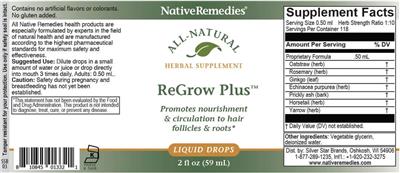
This summary is for ReGrow Plus by Native Remedies
- Form
- Liquid
- Serving Size
- 0.5 mL
- Servings
- 118 per container
- Container Holds
- 2 Fluid Ounces; 59 mL
- What is ReGrow Plus?A supplement from Native Remedies with seven active ingredients, in liquid form.
- Active Ingredients OatstrawRosemaryGinkgoEchinacea purpureaPrickly AshHorsetailYarrow Seven active ingredients. Each one can interact with drugs or cause side effects on its own, so we check every one. The full Supplement Facts
- Drug Interactions 1,433 drugs have a documented interaction with this supplement; the most serious is rated major. Of those, 983 are single drugs and 450 are combination products (two or more drugs in one), each listed under its own name. Ask your pharmacist first if you take a drug in any of these categories, the most serious of the 42 on record:
- TalinololMajor · 1 drug
- Moderate · 645 drugs
- Moderate · 418 drugs
- Moderate · 202 drugs
- Possible Side EffectsStomach upset 4 ingredientsGasHeadacheIncreased urinationBloatingNausea +8 moreCombined from five of its seven active ingredients. Not studied in this exact product.
- Well documented Why
Does ReGrow Plus work?
What It Is Marketed For
Hair follicle nourishment and circulation
From the claims on the product’s label.
The Closest Use the Research Grades
Horsetail
There isn’t enough good research to say either way.
Its ingredients have stronger research for other uses:
- Dyslipidemia Oats
- Oats
- Rosemary
- Ginkgo
- Ginkgo
- Oats
These grades are for each ingredient, not this exact product, and never a promise it will work for you.
And 1 more graded use, in what the research says- AllergensNone of its ingredient names point to a major food allergen
- Barcode (UPC)8 10845 01332 1Match it to the barcode on your bottle to be sure this is your product. Not your product? Search for it here
Who Might Consider It
- People looking for hair follicle nourishment and circulation, which is what it is marketed for. For androgenic alopecia, the closest use the research grades, there is not enough good research to say either way.
- People who want it for dyslipidemia, coronary heart disease (CHD), memory, anxiety or another graded use: the other uses with research behind them. See each grade
Who Should Be Careful
- People curious about ReGrow Plus should first review the interaction section, since several ingredients carry documented drug interactions, including one rated Major.
- If you have diabetes, bleeding problems, or take blood thinners, lithium, or other prescription medicines, talk it over with your own doctor or pharmacist first.
- Anyone who is pregnant, breastfeeding, or planning a pregnancy should also get individual advice before using it.
More Before You Take It Show both answersHide Pregnancy and Breastfeeding The Label’s Directions
-
Pregnant or breastfeeding?
- Pregnancy Yarrow
- ! When used orally; yarrow is believed to be an abortifacient and affect the menstrual cycle.
- Breastfeeding Yarrow
- Insufficient reliable information available; avoid use.
- Pregnancy Rosemary
- ! When used orally in medicinal amounts.
- Breastfeeding Rosemary
- There is insufficient reliable information available about the safety of using rosemary in medicinal amounts during lactation; avoid using.
- Pregnancy Ginkgo
- ! When used orally.
- Breastfeeding Ginkgo
- Insufficient reliable information available; avoid using.
-
How does the label say to take it?
“Suggested use: Dilute drops in a small amount of water or juice or drop directly into mouth 3 times daily. Adults: 0.50 mL.”
The maker’s words. Your pharmacist or doctor may advise differently.
Everything the label says
From the label dated Jun 25, 2025: all seven of its active ingredients were checked against our records. A summary of what is known, not a grade or a test of the product. How these ratings are computed
Ask Anything About This Supplement
Name a drug you take, or ask about side effects, ingredients or pregnancy.
There’s a lot of information about this supplement on this page! Ask anything in plain English for a quick answer drawn from it.
AI answers come from this label and our own records, never the open internet. AI can make mistakes, so always check with your doctor or pharmacist. How we use AI
Ask the Pharmacist
A licensed pharmacist will answer your question by email — free, as soon as they can.
Got it — thank you!
A licensed pharmacist will answer as soon as they can. Keep an eye on your email (worth checking spam, just in case).
What’s Inside ReGrow Plus by Native Remedies
Seven Active Ingredients
In the order the label lists them, each with its own card below.
The label gives an exact amount for 0 of its 7 active ingredients. Seven are inside one proprietary blend, “Proprietary Formula”, and the label gives one total for it, not how much of each ingredient is in it.
- 0 state an exact amount
- 7 have no amount of their own
- Proprietary Formula 0.50 mL in total · 7 ingredients, no amount for each
This rates what the label tells you, not the quality of the product.
Supplement Facts
| Amount Per Serving | % Daily Value | |
|---|---|---|
| Proprietary Formula | 0.5 mL | † |
| Oatstraw | † | |
| Rosemary | † | |
| Ginkgo | † | |
| Echinacea purpurea | † | |
| Prickly Ash | † | |
| Horsetail | † | |
| Yarrow | † | |
Other ingredients: Glycerin, Water, Deionized
† Daily Value not established.
Daily Values for adults and children 4 or more years of age.
As the label prints it, from the NIH Dietary Supplement Label Database.
Each Ingredient and Its Drug Interactions
Tap one for more about it and its full guide. A drug can interact with this supplement through any one of them.
ReGrow Plus is a liquid with seven active ingredients: oatstraw, echinacea purpurea, yarrow, rosemary, prickly ash, horsetail, and ginkgo.
-
Proprietary Formula 0.5 mL It also contains a proprietary formula blend, and we have no ingredient-level information for that blend. Seven ingredients inside it, each checked on its own
- Oatstraw 86 drugs
- Rosemary 372 drugs
- Ginkgo 1,267 drugs
- Echinacea purpurea 818 drugs
- Prickly Ash 36 drugs
- Horsetail 188 drugs
- Yarrow 1 drug
Other Ingredients (Inactive)
The capsule or tablet itself, fillers, coatings and flavors. Not part of the drug interaction check; the allergen check below reads them.
- Glycerin
- Water, Deionized
Allergens in ReGrow Plus
None of its ingredient names point to a major food allergen.
Not named in the ingredients
- Milk
- Egg
- Fish
- Shellfish
- Tree nuts
- Peanuts
- Wheat or other gluten grains
- Soy
- Sesame
- Made without, the label says“Contains no artificial flavors or colorants. · No gluten added.”
From the label text and ingredient names on file; we do not test products. With a serious allergy, check your bottle and ask the maker or your pharmacist.
What the Label Says
The maker’s own words, from the label. We do not verify or endorse them.
- Formulation
-
“Contains no artificial flavors or colorants. No gluten added.”
“All Native Remedies health products are especially formulated by experts in the field of natural health and are manufactured according to the highest pharmaceutical standards for maximum safety and effectiveness.”
2 more from the label
“All-Natural Promotes nourishment & circulation to hair follicles & roots Liquid drops”
“K Parve (Kosher) K-1604”
- Seals and symbols
-
“K Parve (Kosher) K-1604”
- FDA Statement of Identity
-
“Herbal Supplement”
- General statements
-
“Int'l.: +1-920-232-3275”
The ReGrow Plus Label on File
The label scan on file at the NIH Dietary Supplement Label Database, dated June 2025. Always read the label on the bottle you have.
Product Facts
- Brand
- Native Remedies
- Barcode (UPC)
- 810845013321
- Net contents
- 2 Fluid Ounces; 59 mL
- Market status
- On market
- Date entered into DSLD
- Jun 25, 2025
- DSLD ID
- 331837
- Product type
- Botanical
- Supplement form
- Liquid
- Dietary claims / uses
- All Other, Structure/Function
- Intended target group(s)
- Adult (18 - 50 Years), Kosher
Is this label outdated? Report a formula or label change and our pharmacy team will review it.
HelloPharmacist Score ReGrow Plus by Native Remedies
Up to 10 points for research, amount, label and outside testing. Not a safety rating. How this one adds up
for androgenic alopecia
It is marketed for hair follicle nourishment and circulation. There is no graded research on that exact use, so we scored the closest one: there is too little good research to say whether horsetail, one of its ingredients, helps with androgenic alopecia.
- Research0 of 5 points
- Amount0 of 2 points
- Label0 of 2 points
- Outside testing0 of 1 point
Major drug interactions. The score does not count drug interactions. Check them against any drugs you take. See them
How It Earns Its 0
Score: 0 out of 10. Unproven for androgenic alopecia.
Too little research on horsetail for androgenic alopecia.
Graded “Insufficient Reliable Evidence to Rate” in the Natural Medicines database, which we license. A related use, not the one it is marketed for, counts for at most 3 of 5 research points.
0 of 5 points
Amount
The label does not say how much horsetail is in it.
0 of 2 points
Label
It states the amount of none of its seven active ingredients; seven are inside blends that give only a total.
0 of 2 points
Outside testing
We found no mark from an outside testing program, such as USP Verified or NSF Certified, on the label we have on file.
0 of 1 point
ReGrow Plus by Native Remedies Side Effects
Why this rating?
We look for three kinds of safety information on each ingredient: side effects reported in studies, a pregnancy and breastfeeding rating, and a safety write-up from our pharmacy team. Of the seven ingredients we could check, six have side-effect reports, all seven have a pregnancy rating and all seven have a safety write-up.
So this rates how much is known, not whether ReGrow Plus is right for you.
Reported with seven of its ingredients
- Most often
- Stomach upset, gas, headache, increased urination, bloating and nausea
- !Rare but serious
- Irregular heartbeat, bleeding and Stevens-Johnson syndrome See details
HelloPharmacist Team Summary: ReGrow Plus by Native Remedies Side Effects
You are most likely to notice gas and bloating from the oatstraw, stomach upset and nausea from the echinacea, and dizziness from the ginkgo, and seeing how dizziness affects you before driving is a sensible step.
- Rare but serious reactions, such as severe allergic reactions from echinacea, are worth knowing about, so call your doctor right away if you notice rash, swelling, or trouble breathing.
- If you have diabetes, a bleeding disorder, asthma or allergies, a seizure history, or you are pregnant or breastfeeding, please talk with your own doctor or pharmacist before starting ReGrow Plus.
Side Effects, Ingredient by Ingredient
A supplement’s side effects come from its ingredients. Here is what is reported with each one.
Oats
Most reported
- Gas
- Bloating
- Changes in bowel habits
Ginkgo
Most reported
- Headache
- Upset stomach or nausea
- Dizziness
- Constipation or diarrhea
Echinacea
Most reported
- Stomach upset
- Nausea
- Unpleasant taste
Horsetail
Most reported
- Increased urination
- Stomach upset or mild digestive complaints
Yarrow
Most reported
- Stomach upset
- Drowsiness
Rosemary has side-effect reports, but no list of the most common ones. Read them in the Rosemary guide
ReGrow Plus Warnings: Who Should Be Careful
ReGrow Plus has seven active ingredients, and each can carry warnings of its own. We checked all seven, and each warning below names the ingredient it comes from. If any of these apply to you, talk to your doctor or pharmacist before you start it.
- Oats3 warnings below
- Rosemary3 warnings below
- Ginkgo2 warnings below
- Echinacea3 warnings below
- Northern Prickly Ash3 warnings below
- Horsetail3 warnings below
- Yarrow3 warnings below
-
Bleeding Problems or Surgery
- RosemaryThose with bleeding disorders or who are scheduled for surgery should also use caution with concentrated products.
- Northern Prickly AshPeople with stomach ulcers, inflammatory bowel conditions, bleeding disorders, or who are scheduled for surgery should talk to a healthcare provider before using it.
- YarrowUse caution if you have a bleeding disorder, are scheduled for surgery, or have gallbladder or liver problems.
-
Diabetes or Low Blood Sugar
- HorsetailWho should be cautious: People with kidney problems, heart conditions, low potassium, or diabetes should talk to a healthcare provider first, partly because of horsetail's diuretic action.
-
Stomach or Bowel Problems
- OatsPeople with swallowing problems or a history of bowel narrowing should be careful with large amounts of bran.
-
Autoimmune Conditions
- EchinaceaPeople with autoimmune conditions or weakened immune systems should talk to their doctor before using echinacea, since its effects on the immune system are not well understood.
-
Seizure Disorders
- RosemaryPeople with seizure disorders should be cautious, as high doses of rosemary or its oil have been associated with seizures.
- GinkgoPeople with a history of seizures should be careful, as some reports suggest ginkgo could lower the seizure threshold, especially if a product is contaminated with ginkgo seeds.
-
Allergies
- EchinaceaPeople with asthma or a history of allergies should be especially careful.
- Northern Prickly AshPeople with a known allergy to plants in the citrus (Rutaceae) family should be careful.
- YarrowPeople who are allergic to ragweed, chrysanthemums, marigolds, or other related plants may also react to yarrow and should avoid it.
-
Children
- GinkgoNever eat raw or roasted ginkgo seeds (nuts), which can be toxic, especially in children.
- EchinaceaSafety in young children is also uncertain, so check with a pediatrician first.
-
If You Take Other Drugs
- Northern Prickly AshAlways check with your pharmacist or doctor first, especially if you take prescription medicines or have a chronic health condition.
- YarrowTalk with your pharmacist or doctor before starting it, especially if you take other medicines or have a chronic health condition.
-
Other Cautions
- OatsPeople with celiac disease or gluten sensitivity should choose products labeled certified gluten-free.
- OatsConcentrated oat straw supplements have not been well studied in these groups, so it is best to stick to food forms or check with your doctor or pharmacist before using supplements.
- RosemaryConcentrated supplements, large medicinal doses, and the undiluted essential oil are different and require more caution.
- HorsetailSome products are labeled 'thiaminase-free,' but caution is still wise.
Show 2 more
- HorsetailHeavy alcohol users and people with poor diets may be at higher risk of thiamine deficiency.
- There isn't enough data to know more, so please talk with your own doctor or pharmacist for personalized advice.
-
What the Label Warns
- “Tamper resistant for your protection. Use only if safety seal is intact.”
- “Caution: Safety during pregnancy and breastfeeding has not yet been established.”
The maker’s wording, from the product label.
-
Pregnant or Breastfeeding
Each ingredient’s rating for pregnancy and for breastfeeding, and what it covers.
Pregnancy
-
When used orally; yarrow is believed to be an abortifacient and affect the menstrual cycle.
Breastfeeding
-
Insufficient reliable information available; avoid use.
Pregnancy
-
When used orally in medicinal amounts.
Rosemary might have uterine and menstrual flow stimulant effects, and might increase metabolism of estradiol and estrone; avoid using.
There is insufficient reliable information available about the safety of rosemary when used topically during pregnancy.
Breastfeeding
-
There is insufficient reliable information available about the safety of using rosemary in medicinal amounts during lactation; avoid using.
Show 5 more ingredients
Pregnancy
-
When used orally.
There is concern that ginkgo might have labor-inducing and hormonal effects.
2 more points on this rating
- There is also concern that the antiplatelet effects of ginkgo could prolong bleeding time if taken around the time of labor and delivery.
- Theoretically, ginkgo might adversely affect pregnancy outcome; avoid using during pregnancy.
Breastfeeding
-
Insufficient reliable information available; avoid using.
Pregnancy
-
When the bark is used orally; avoid using.
There is insufficient reliable information available about the safety of the berry or root during pregnancy; avoid using.
Breastfeeding
-
Insufficient reliable information available; avoid using.
Pregnancy
-
When used orally, short-term.
There is preliminary evidence that mothers can safely use echinacea in the form of E. purpurea or E. angustifolia solid dosage forms, 250-1000 mg daily, or tinctures, up to 30 drops daily, for 5 days to 7 days during the first trimester without adversely affecting the fetus.
There is insufficient reliable information available about the safety of echinacea when used for longer than 7 days.
Breastfeeding
-
Insufficient reliable information available; avoid using.
Pregnancy and Breastfeeding The record rates both the same
-
Insufficient reliable information available; avoid using.
Pregnancy and Breastfeeding The record rates both the same
-
When used orally in food amounts.
Our pharmacy team’s notes
- YarrowYarrow is rated Likely Unsafe in pregnancy, so it is best avoided, and our pharmacists advise avoiding it while breastfeeding.
- Rosemary and prickly ash are rated Possibly Unsafe in pregnancy, and ginkgo is too, with its safety notes advising avoidance while breastfeeding.
Ratings and the words beside them are from the Natural Medicines database, which we license.
-
Rare but Serious Side Effects
-
!
Oats
Topical oatmeal products are generally gentle, but as with any skin product, a small number of people may have irritation or an allergic reaction.
-
!
Rosemary
Taking large amounts of rosemary or its extracts may cause stomach upset, nausea, or, in rare cases, more serious effects.
-
!
Ginkgo
More serious but rare concerns include increased bleeding or bruising.
Orally: Arrhythmia, bleeding, Stevens-Johnson syndrome.
-
!
Echinacea
The most important risk is an allergic reaction, which can include rash, itching, swelling, or trouble breathing.
Orally: Severe allergic reactions and hepatitis have been reported.
-
!
Northern Prickly Ash
As with any plant product, allergic reactions are possible.
-
!
Horsetail
Allergic reactions are possible but uncommon.
When to get help: a serious allergic reaction, with trouble breathing or swelling of the face, lips or throat, needs emergency care: call 911. For any other side effect that worries you, call your doctor or pharmacist.
These reports describe each ingredient, not studies of this exact product. Not medical advice: a side effect you notice after starting a supplement is worth a word with your pharmacist or doctor.
ReGrow Plus by Native Remedies Drug Interactions
We checked all seven active ingredients in this supplement against every drug in our records. A drug can interact with it through any one of them.
A major interaction on record
3 of 3, on a scale from Minor or none to Major.Why this rating?
We rate this by the most serious interaction on record, not by how many there are. For Northern Prickly Ash, Yarrow, Rosemary, Ginkgo and Oats, the most serious is rated major, which means the combination is best avoided, or used only under close supervision. Some involve kinds of drugs where a small change can matter, such as blood thinners, seizure drugs and transplant drugs.
1,434 drugs are on the full list. What matters is whether one you take is on it, so check yours with the interaction checker on this page.
From the HelloPharmacist Team
Stepping back from the single ingredients, here is the picture across the whole supplement.
- ReGrow Plus from Native Remedies can interact with medications through its oatstraw, echinacea, yarrow, rosemary, prickly ash, horsetail, and ginkgo content.
- Interactions rated Moderate are the next tier.
- Ginkgo may increase bleeding risk with warfarin, and rosemary may do so with anticoagulant (blood thinner) and antiplatelet drugs.
All seven of its active ingredients have drug interactions on record. The ones below matter most.
- Interacts with
- 1,267 drugs
- Most serious
- Major
- The most serious interaction is rated Major: ginkgo can increase blood levels of talinolol.
- Interacts with
- 818 drugs
- Most serious
- Moderate
- Most of its records involve Cytochrome P450 3A4 (CYP3A4) Substrates, Cytochrome P450 1A2 (CYP1A2) Substrates and Immunosuppressants.
- Interacts with
- 372 drugs
- Most serious
- Moderate
- Most of its records involve Cytochrome P450 1A2 (CYP1A2) Substrates, Anticoagulant/Antiplatelet Drugs and Antidiabetes Drugs.
Show three more ingredients
- Interacts with
- 188 drugs
- Most serious
- Moderate
- Most of its records involve Antidiabetes Drugs, Diuretic Drugs and Nucleoside Reverse Transcriptase Inhibitors (NRTIs).
- Interacts with
- 86 drugs
- Most serious
- Moderate
- Most of its records involve Antidiabetes Drugs and Insulin.
- Interacts with
- 36 drugs
- Most serious
- Minor
- Most of its records involve Antacids, Proton Pump Inhibitors (PPIs) and H2-BLOCKERS.
And one more ingredient with records, each in the cards below.
Summarized by the HelloPharmacist pharmacy team from the interaction records below. How it is written How we use AI
Why ReGrow Plus Interacts, Ingredient by Ingredient
A product interacts through its ingredients. Each card: how many drugs, the most serious rating, and the kinds of drugs it affects most (tap a kind for what it means).
The ingredients driving the most interactions
-
Ginkgo 1,267 drugs
Most serious: Major23 interaction records on file
The kinds of drugs it affects most
- 645 drugs
- 418 drugs
- 202 drugs
- 186 drugs
Every Ginkgo drug interaction, 23 records The Ginkgo records cite 97 references, listed in the Ginkgo guide.
-
Echinacea purpurea 818 drugs
Most serious: Moderate12 interaction records on file
The kinds of drugs it affects most
- 645 drugs
- 186 drugs
- 121 drugs
- 29 drugs
Every Echinacea drug interaction, 12 records The Echinacea records cite 51 references, listed in the Echinacea guide.
-
Rosemary 372 drugs
Most serious: Moderate6 interaction records on file
The kinds of drugs it affects most
- 186 drugs
- 122 drugs
- 86 drugs
- 35 drugs
Every Rosemary drug interaction, 6 records The Rosemary records cite 20 references, listed in the Rosemary guide.
-
Horsetail 188 drugs
Most serious: Moderate5 interaction records on file
The kinds of drugs it affects most
- 86 drugs
- 75 drugs
- Nucleoside Reverse Transcriptase Inhibitors (NRTIs) 25 drugs
- Efavirenz (SUSTIVA) 3 drugs
Every Horsetail drug interaction, 5 records The Horsetail records cite 14 references, listed in the Horsetail guide.
-
Oatstraw 86 drugs
Most serious: Moderate2 interaction records on file
The kinds of drugs it affects most
- 86 drugs
- 13 drugs
Every Oats drug interaction, 2 records The Oats records cite 13 references, listed in the Oats guide.
-
Prickly Ash 36 drugs
Most serious: Minor3 interaction records on file
The kinds of drugs it affects most
- 16 drugs
- 14 drugs
- 6 drugs
Every Northern Prickly Ash drug interaction, 3 records The Northern Prickly Ash records cite 2 references, listed in the Northern Prickly Ash guide.
-
Yarrow 1 drug
Most serious: Moderate1 interaction record on file
The kinds of drugs it affects most
- 1 drug
Every Yarrow drug interaction, 1 record The Yarrow records cite 8 references, listed in the Yarrow guide.
The Breakdown by Severity
Each drug counted once, at its most serious rating. Tap a tile to list those drugs.
Find Your Drug
Type a drug or brand name to see whether it is on the list.
- Only drugs with a documented interaction are listed, the most serious first.
- A drug with no known interaction is not listed, but searching its name tells you so.
- Open a drug to see which ingredient is responsible. Of those, 983 are single drugs and 450 are combination products (two or more drugs in one), each listed under its own name.
-
Glipizide and MetforminMetaglip Moderate
The 4 ingredients responsible:
-
Ginkgo Moderate Glipizide and Metformin is in these Cytochrome P450 2C9 (CYP2C9) Substrates, Antidiabetes Drugs categories.
Theoretically, ginkgo might increase levels of drugs metabolized by CYP2C9.
The full Ginkgo + Glipizide and Metformin interaction -
Rosemary Moderate Glipizide and Metformin is in the Antidiabetes Drugs category.
Theoretically, taking rosemary with antidiabetes drugs might increase the risk of hypoglycemia.
The full Rosemary + Glipizide and Metformin interaction -
Horsetail Moderate Glipizide and Metformin is in the Antidiabetes Drugs category.
Theoretically, taking horsetail with antidiabetes drugs might increase the risk of hypoglycemia.
The full Horsetail + Glipizide and Metformin interaction -
Oatstraw Moderate Glipizide and Metformin is in the Antidiabetes Drugs category.
Theoretically, oats may have additive effects with antidiabetic agents and might increase the risk of hypoglycemia.
The full Oatstraw + Glipizide and Metformin interaction
-
-
Famotidine and IbuprofenDuexis Moderate
The 3 ingredients responsible:
-
Rosemary Moderate Famotidine and Ibuprofen is in the Anticoagulant/Antiplatelet Drugs category.
Theoretically, rosemary may increase the risk of bleeding if used with anticoagulant or antiplatelet drugs.
The full Rosemary + Famotidine and Ibuprofen interaction -
Ginkgo Moderate It contains ibuprofen, the drug this record is about. Famotidine and Ibuprofen is in these Seizure Threshold Lowering Drugs, Cytochrome P450 2C9 (CYP2C9) Substrates, Anticoagulant/Antiplatelet Drugs categories.
Theoretically, taking ginkgo with drugs that lower the seizure threshold might increase the risk for convulsions.
The full Ginkgo + Famotidine and Ibuprofen interaction -
Prickly Ash Minor Famotidine and Ibuprofen is in the H2-BLOCKERS category.
Theoretically, northern prickly ash might decrease the effectiveness of H2-blockers.
The full Prickly Ash + Famotidine and Ibuprofen interaction
-
-
Dapagliflozin Propanediol and MetforminXigduo XR Moderate
The 4 ingredients responsible:
-
Rosemary Moderate Dapagliflozin Propanediol and Metformin is in the Antidiabetes Drugs category.
Theoretically, taking rosemary with antidiabetes drugs might increase the risk of hypoglycemia.
The full Rosemary + Dapagliflozin Propanediol and Metformin interaction -
Ginkgo Moderate Dapagliflozin Propanediol and Metformin is in the Antidiabetes Drugs category.
Theoretically, taking ginkgo with antidiabetes drugs might alter the response to antidiabetes drugs.
The full Ginkgo + Dapagliflozin Propanediol and Metformin interaction -
Oatstraw Moderate Dapagliflozin Propanediol and Metformin is in the Antidiabetes Drugs category.
Theoretically, oats may have additive effects with antidiabetic agents and might increase the risk of hypoglycemia.
The full Oatstraw + Dapagliflozin Propanediol and Metformin interaction -
Horsetail Moderate Dapagliflozin Propanediol and Metformin is in the Antidiabetes Drugs category.
Theoretically, taking horsetail with antidiabetes drugs might increase the risk of hypoglycemia.
The full Horsetail + Dapagliflozin Propanediol and Metformin interaction
-
-
Aspirin and PentazocineTalwin Compound Moderate
The 3 ingredients responsible:
-
Rosemary Moderate Aspirin and Pentazocine is in these Anticoagulant/Antiplatelet Drugs, Cytochrome P450 1A2 (CYP1A2) Substrates categories.
Theoretically, rosemary may increase the risk of bleeding if used with anticoagulant or antiplatelet drugs.
The full Rosemary + Aspirin and Pentazocine interaction -
Ginkgo Moderate Aspirin and Pentazocine is in these Cytochrome P450 1A2 (CYP1A2) Substrates, Seizure Threshold Lowering Drugs, Anticoagulant/Antiplatelet Drugs categories.
Theoretically, ginkgo might increase levels of drugs metabolized by CYP1A2.
The full Ginkgo + Aspirin and Pentazocine interaction -
Echinacea Purpurea Moderate Aspirin and Pentazocine is in the Cytochrome P450 1A2 (CYP1A2) Substrates category.
Echinacea might inhibit the metabolism of CYP1A2 and increase plasma levels of some drugs.
The full Echinacea Purpurea + Aspirin and Pentazocine interaction
-
-
Enalapril Maleate and HydrochlorothiazideVaseretic Moderate
The ingredient responsible:
-
Horsetail Moderate Enalapril Maleate and Hydrochlorothiazide is in the Diuretic Drugs category.
Theoretically, taking horsetail with diuretic drugs might increase potassium loss and the risk of hypokalemia.
The full Horsetail + Enalapril Maleate and Hydrochlorothiazide interaction
-
-
Carbidopa and LevodopaDhivy, Rytary, Sinemet, Sinemet CR Moderate
The ingredient responsible:
-
Ginkgo Moderate Carbidopa and Levodopa is in the Seizure Threshold Lowering Drugs category.
Theoretically, taking ginkgo with drugs that lower the seizure threshold might increase the risk for convulsions.
The full Ginkgo + Carbidopa and Levodopa interaction
-
-
Amitriptyline and ChlordiazepoxideLimbitrol DS Moderate
The 3 ingredients responsible:
-
Echinacea Purpurea Moderate Amitriptyline and Chlordiazepoxide is in these Cytochrome P450 3A4 (CYP3A4) Substrates, Cytochrome P450 1A2 (CYP1A2) Substrates categories.
Echinacea may induce hepatic CYP3A4 and inhibit intestinal CYP3A4.
The full Echinacea Purpurea + Amitriptyline and Chlordiazepoxide interaction -
Ginkgo Moderate Amitriptyline and Chlordiazepoxide is in these Cytochrome P450 1A2 (CYP1A2) Substrates, Cytochrome P450 2C9 (CYP2C9) Substrates, Cytochrome P450 3A4 (CYP3A4) Substrates and 1 more categories.
Theoretically, ginkgo might increase levels of drugs metabolized by CYP1A2.
The full Ginkgo + Amitriptyline and Chlordiazepoxide interaction -
Rosemary Minor Amitriptyline and Chlordiazepoxide is in the Cytochrome P450 1A2 (CYP1A2) Substrates category.
Theoretically, rosemary might decrease the levels and clinical effects of CYP1A2 substrates.
The full Rosemary + Amitriptyline and Chlordiazepoxide interaction
-
-
Bismuth Subsalicylate, Metronidazole, and TetracyclineHelidac Moderate
The ingredient responsible:
-
Ginkgo Moderate Bismuth Subsalicylate, Metronidazole, and Tetracycline is in the Seizure Threshold Lowering Drugs category.
Theoretically, taking ginkgo with drugs that lower the seizure threshold might increase the risk for convulsions.
The full Ginkgo + Bismuth Subsalicylate, Metronidazole, and Tetracycline interaction
-
-
Levonorgestrel and Ethinyl EstradiolLogynon ED, Microgynon 30, Nordette, Ovranette, Quartette and 2 more Moderate
The 3 ingredients responsible:
-
Ginkgo Moderate Levonorgestrel and Ethinyl Estradiol is in these Cytochrome P450 3A4 (CYP3A4) Substrates, Cytochrome P450 1A2 (CYP1A2) Substrates, P-glycoprotein Substrates categories.
Theoretically, ginkgo might decrease levels of drugs metabolized by CYP3A4.
The full Ginkgo + Levonorgestrel and Ethinyl Estradiol interaction -
Echinacea Purpurea Moderate Levonorgestrel and Ethinyl Estradiol is in these Cytochrome P450 3A4 (CYP3A4) Substrates, Cytochrome P450 1A2 (CYP1A2) Substrates categories.
Echinacea may induce hepatic CYP3A4 and inhibit intestinal CYP3A4.
The full Echinacea Purpurea + Levonorgestrel and Ethinyl Estradiol interaction -
Rosemary Minor Levonorgestrel and Ethinyl Estradiol is in the Cytochrome P450 1A2 (CYP1A2) Substrates category.
Theoretically, rosemary might decrease the levels and clinical effects of CYP1A2 substrates.
The full Rosemary + Levonorgestrel and Ethinyl Estradiol interaction
-
-
Canagliflozin and Metformin HydrochlorideInvokamet XR Moderate
The 4 ingredients responsible:
-
Rosemary Moderate Canagliflozin and Metformin Hydrochloride is in the Antidiabetes Drugs category.
Theoretically, taking rosemary with antidiabetes drugs might increase the risk of hypoglycemia.
The full Rosemary + Canagliflozin and Metformin Hydrochloride interaction -
Horsetail Moderate Canagliflozin and Metformin Hydrochloride is in the Antidiabetes Drugs category.
Theoretically, taking horsetail with antidiabetes drugs might increase the risk of hypoglycemia.
The full Horsetail + Canagliflozin and Metformin Hydrochloride interaction -
Ginkgo Moderate Canagliflozin and Metformin Hydrochloride is in the Antidiabetes Drugs category.
Theoretically, taking ginkgo with antidiabetes drugs might alter the response to antidiabetes drugs.
The full Ginkgo + Canagliflozin and Metformin Hydrochloride interaction -
Oatstraw Moderate Canagliflozin and Metformin Hydrochloride is in the Antidiabetes Drugs category.
Theoretically, oats may have additive effects with antidiabetic agents and might increase the risk of hypoglycemia.
The full Oatstraw + Canagliflozin and Metformin Hydrochloride interaction
-
-
Linagliptin and Metformin HydrochlorideJentadueto XR Moderate
The 4 ingredients responsible:
-
Rosemary Moderate Linagliptin and Metformin Hydrochloride is in the Antidiabetes Drugs category.
Theoretically, taking rosemary with antidiabetes drugs might increase the risk of hypoglycemia.
The full Rosemary + Linagliptin and Metformin Hydrochloride interaction -
Horsetail Moderate Linagliptin and Metformin Hydrochloride is in the Antidiabetes Drugs category.
Theoretically, taking horsetail with antidiabetes drugs might increase the risk of hypoglycemia.
The full Horsetail + Linagliptin and Metformin Hydrochloride interaction -
Ginkgo Moderate Linagliptin and Metformin Hydrochloride is in these P-glycoprotein Substrates, Antidiabetes Drugs categories.
Theoretically, taking ginkgo with P-glycoprotein substrates might increase the levels and adverse effects of these substrates.
The full Ginkgo + Linagliptin and Metformin Hydrochloride interaction -
Oatstraw Moderate Linagliptin and Metformin Hydrochloride is in the Antidiabetes Drugs category.
Theoretically, oats may have additive effects with antidiabetic agents and might increase the risk of hypoglycemia.
The full Oatstraw + Linagliptin and Metformin Hydrochloride interaction
-
-
Bellafoline, Caffeine, Ergotamine Tartrate, and PentobarbitalCafergot PB Moderate
The 3 ingredients responsible:
-
Ginkgo Moderate Bellafoline, Caffeine, Ergotamine Tartrate, and Pentobarbital is in these Anticonvulsants, Cytochrome P450 3A4 (CYP3A4) Substrates, Cytochrome P450 1A2 (CYP1A2) Substrates categories.
Theoretically, ginkgo might reduce the effectiveness of anticonvulsants.
The full Ginkgo + Bellafoline, Caffeine, Ergotamine Tartrate, and Pentobarbital interaction -
Echinacea Purpurea Moderate Bellafoline, Caffeine, Ergotamine Tartrate, and Pentobarbital is in these Cytochrome P450 3A4 (CYP3A4) Substrates, Caffeine, Cytochrome P450 1A2 (CYP1A2) Substrates categories.
Echinacea may induce hepatic CYP3A4 and inhibit intestinal CYP3A4.
The full Echinacea Purpurea + Bellafoline, Caffeine, Ergotamine Tartrate, and Pentobarbital interaction -
Rosemary Minor Bellafoline, Caffeine, Ergotamine Tartrate, and Pentobarbital is in the Cytochrome P450 1A2 (CYP1A2) Substrates category.
Theoretically, rosemary might decrease the levels and clinical effects of CYP1A2 substrates.
The full Rosemary + Bellafoline, Caffeine, Ergotamine Tartrate, and Pentobarbital interaction
-
-
Metronidazole, Tetracyline, and Bismuth Subcitrate PotassiumPylera Moderate
The ingredient responsible:
-
Ginkgo Moderate Metronidazole, Tetracyline, and Bismuth Subcitrate Potassium is in the Seizure Threshold Lowering Drugs category.
Theoretically, taking ginkgo with drugs that lower the seizure threshold might increase the risk for convulsions.
The full Ginkgo + Metronidazole, Tetracyline, and Bismuth Subcitrate Potassium interaction
-
-
Hydrochlorothiazide and PropranololInderide Moderate
The 4 ingredients responsible:
-
Ginkgo Moderate Hydrochlorothiazide and Propranolol is in these Seizure Threshold Lowering Drugs, Cytochrome P450 2C19 (CYP2C19) Substrates, Cytochrome P450 1A2 (CYP1A2) Substrates categories.
Theoretically, taking ginkgo with drugs that lower the seizure threshold might increase the risk for convulsions.
The full Ginkgo + Hydrochlorothiazide and Propranolol interaction -
Horsetail Moderate Hydrochlorothiazide and Propranolol is in the Diuretic Drugs category.
Theoretically, taking horsetail with diuretic drugs might increase potassium loss and the risk of hypokalemia.
The full Horsetail + Hydrochlorothiazide and Propranolol interaction -
Echinacea Purpurea Moderate Hydrochlorothiazide and Propranolol is in the Cytochrome P450 1A2 (CYP1A2) Substrates category.
Echinacea might inhibit the metabolism of CYP1A2 and increase plasma levels of some drugs.
The full Echinacea Purpurea + Hydrochlorothiazide and Propranolol interaction -
Rosemary Minor Hydrochlorothiazide and Propranolol is in the Cytochrome P450 1A2 (CYP1A2) Substrates category.
Theoretically, rosemary might decrease the levels and clinical effects of CYP1A2 substrates.
The full Rosemary + Hydrochlorothiazide and Propranolol interaction
-
-
Acetaminophen, Dextromethorphan, Guaifenesin, and PhenylpropanolamineAnatuss Moderate
The 3 ingredients responsible:
-
Ginkgo Moderate Acetaminophen, Dextromethorphan, Guaifenesin, and Phenylpropanolamine is in these Cytochrome P450 1A2 (CYP1A2) Substrates, Cytochrome P450 3A4 (CYP3A4) Substrates categories.
Theoretically, ginkgo might increase levels of drugs metabolized by CYP1A2.
The full Ginkgo + Acetaminophen, Dextromethorphan, Guaifenesin, and Phenylpropanolamine interaction -
Echinacea Purpurea Moderate Acetaminophen, Dextromethorphan, Guaifenesin, and Phenylpropanolamine is in these Cytochrome P450 1A2 (CYP1A2) Substrates, Cytochrome P450 3A4 (CYP3A4) Substrates categories.
Echinacea might inhibit the metabolism of CYP1A2 and increase plasma levels of some drugs.
The full Echinacea Purpurea + Acetaminophen, Dextromethorphan, Guaifenesin, and Phenylpropanolamine interaction -
Rosemary Minor Acetaminophen, Dextromethorphan, Guaifenesin, and Phenylpropanolamine is in the Cytochrome P450 1A2 (CYP1A2) Substrates category.
Theoretically, rosemary might decrease the levels and clinical effects of CYP1A2 substrates.
The full Rosemary + Acetaminophen, Dextromethorphan, Guaifenesin, and Phenylpropanolamine interaction
-
-
Esomeprazole and NaproxenVimovo Moderate
The 4 ingredients responsible:
-
Ginkgo Moderate Esomeprazole and Naproxen is in these Cytochrome P450 3A4 (CYP3A4) Substrates, Anticoagulant/Antiplatelet Drugs, Cytochrome P450 2C19 (CYP2C19) Substrates and 2 more categories.
Theoretically, ginkgo might decrease levels of drugs metabolized by CYP3A4.
The full Ginkgo + Esomeprazole and Naproxen interaction -
Echinacea Purpurea Moderate Esomeprazole and Naproxen is in these Cytochrome P450 1A2 (CYP1A2) Substrates, Cytochrome P450 3A4 (CYP3A4) Substrates categories.
Echinacea might inhibit the metabolism of CYP1A2 and increase plasma levels of some drugs.
The full Echinacea Purpurea + Esomeprazole and Naproxen interaction -
Rosemary Moderate Esomeprazole and Naproxen is in these Cytochrome P450 1A2 (CYP1A2) Substrates, Anticoagulant/Antiplatelet Drugs categories.
Theoretically, rosemary might decrease the levels and clinical effects of CYP1A2 substrates.
The full Rosemary + Esomeprazole and Naproxen interaction -
Prickly Ash Minor Esomeprazole and Naproxen is in the Proton Pump Inhibitors (PPIs) category.
Theoretically, northern prickly ash might decrease the effectiveness of PPIs.
The full Prickly Ash + Esomeprazole and Naproxen interaction
-
-
Acetaminophen, Dextromethorphan, and PseudoephedrineAlka-Seltzer PLUS Flu Liquid Gels, Non Aspirin Cold Caps, Tylenol Cold, Tylenol Flu Daytime Ex Strength, Tylenol Flu Ex Strength Moderate
The 3 ingredients responsible:
-
Ginkgo Moderate Acetaminophen, Dextromethorphan, and Pseudoephedrine is in these Cytochrome P450 3A4 (CYP3A4) Substrates, Cytochrome P450 1A2 (CYP1A2) Substrates categories.
Theoretically, ginkgo might decrease levels of drugs metabolized by CYP3A4.
The full Ginkgo + Acetaminophen, Dextromethorphan, and Pseudoephedrine interaction -
Echinacea Purpurea Moderate Acetaminophen, Dextromethorphan, and Pseudoephedrine is in these Cytochrome P450 1A2 (CYP1A2) Substrates, Cytochrome P450 3A4 (CYP3A4) Substrates categories.
Echinacea might inhibit the metabolism of CYP1A2 and increase plasma levels of some drugs.
The full Echinacea Purpurea + Acetaminophen, Dextromethorphan, and Pseudoephedrine interaction -
Rosemary Minor Acetaminophen, Dextromethorphan, and Pseudoephedrine is in the Cytochrome P450 1A2 (CYP1A2) Substrates category.
Theoretically, rosemary might decrease the levels and clinical effects of CYP1A2 substrates.
The full Rosemary + Acetaminophen, Dextromethorphan, and Pseudoephedrine interaction
-
-
Aspirin and OxycodonePercodan Moderate
The 2 ingredients responsible:
-
Ginkgo Moderate Aspirin and Oxycodone is in these Anticoagulant/Antiplatelet Drugs, Seizure Threshold Lowering Drugs categories.
Ginkgo has been shown to increase the risk of bleeding in some people when taken with warfarin.
The full Ginkgo + Aspirin and Oxycodone interaction -
Rosemary Moderate Aspirin and Oxycodone is in the Anticoagulant/Antiplatelet Drugs category.
Theoretically, rosemary might have additive effects with salicylate-containing drugs such as aspirin.
The full Rosemary + Aspirin and Oxycodone interaction
-
-
Acetaminophen, Chlorpheniramine, and PhenylpropanolamineAlumadrine, Conex, Sinadrin Max Strength, Sinulin Moderate
The 3 ingredients responsible:
-
Echinacea Purpurea Moderate Acetaminophen, Chlorpheniramine, and Phenylpropanolamine is in these Cytochrome P450 1A2 (CYP1A2) Substrates, Cytochrome P450 3A4 (CYP3A4) Substrates categories.
Echinacea might inhibit the metabolism of CYP1A2 and increase plasma levels of some drugs.
The full Echinacea Purpurea + Acetaminophen, Chlorpheniramine, and Phenylpropanolamine interaction -
Ginkgo Moderate Acetaminophen, Chlorpheniramine, and Phenylpropanolamine is in these Cytochrome P450 1A2 (CYP1A2) Substrates, Cytochrome P450 3A4 (CYP3A4) Substrates, Seizure Threshold Lowering Drugs categories.
Theoretically, ginkgo might increase levels of drugs metabolized by CYP1A2.
The full Ginkgo + Acetaminophen, Chlorpheniramine, and Phenylpropanolamine interaction -
Rosemary Minor Acetaminophen, Chlorpheniramine, and Phenylpropanolamine is in the Cytochrome P450 1A2 (CYP1A2) Substrates category.
Theoretically, rosemary might decrease the levels and clinical effects of CYP1A2 substrates.
The full Rosemary + Acetaminophen, Chlorpheniramine, and Phenylpropanolamine interaction
-
-
Canagliflozin and MetforminInvokamet Moderate
The 4 ingredients responsible:
-
Ginkgo Moderate Canagliflozin and Metformin is in the Antidiabetes Drugs category.
Theoretically, taking ginkgo with antidiabetes drugs might alter the response to antidiabetes drugs.
The full Ginkgo + Canagliflozin and Metformin interaction -
Oatstraw Moderate Canagliflozin and Metformin is in the Antidiabetes Drugs category.
Theoretically, oats may have additive effects with antidiabetic agents and might increase the risk of hypoglycemia.
The full Oatstraw + Canagliflozin and Metformin interaction -
Horsetail Moderate Canagliflozin and Metformin is in the Antidiabetes Drugs category.
Theoretically, taking horsetail with antidiabetes drugs might increase the risk of hypoglycemia.
The full Horsetail + Canagliflozin and Metformin interaction -
Rosemary Moderate Canagliflozin and Metformin is in the Antidiabetes Drugs category.
Theoretically, taking rosemary with antidiabetes drugs might increase the risk of hypoglycemia.
The full Rosemary + Canagliflozin and Metformin interaction
-
-
Caffeine and Ergotamine Tartrate (prescription Drug)Cafergot, Wigraine Moderate
The 3 ingredients responsible:
-
Ginkgo Moderate Caffeine and Ergotamine Tartrate (prescription Drug) is in these Cytochrome P450 3A4 (CYP3A4) Substrates, Cytochrome P450 1A2 (CYP1A2) Substrates categories.
Theoretically, ginkgo might decrease levels of drugs metabolized by CYP3A4.
The full Ginkgo + Caffeine and Ergotamine Tartrate (prescription Drug) interaction -
Echinacea Purpurea Moderate Caffeine and Ergotamine Tartrate (prescription Drug) is in these Cytochrome P450 1A2 (CYP1A2) Substrates, Cytochrome P450 3A4 (CYP3A4) Substrates categories.
Echinacea can increase plasma levels of caffeine by inhibiting its metabolism.
The full Echinacea Purpurea + Caffeine and Ergotamine Tartrate (prescription Drug) interaction -
Rosemary Minor Caffeine and Ergotamine Tartrate (prescription Drug) is in the Cytochrome P450 1A2 (CYP1A2) Substrates category.
Theoretically, rosemary might decrease the levels and clinical effects of CYP1A2 substrates.
The full Rosemary + Caffeine and Ergotamine Tartrate (prescription Drug) interaction
-
-
Acetaminophen, Butalbital, and CodeineBancap w/ Codeine Moderate
The 3 ingredients responsible:
-
Ginkgo Moderate Acetaminophen, Butalbital, and Codeine is in these Seizure Threshold Lowering Drugs, Cytochrome P450 1A2 (CYP1A2) Substrates categories.
Theoretically, taking ginkgo with drugs that lower the seizure threshold might increase the risk for convulsions.
The full Ginkgo + Acetaminophen, Butalbital, and Codeine interaction -
Echinacea Purpurea Moderate Acetaminophen, Butalbital, and Codeine is in the Cytochrome P450 1A2 (CYP1A2) Substrates category.
Echinacea might inhibit the metabolism of CYP1A2 and increase plasma levels of some drugs.
The full Echinacea Purpurea + Acetaminophen, Butalbital, and Codeine interaction -
Rosemary Minor Acetaminophen, Butalbital, and Codeine is in the Cytochrome P450 1A2 (CYP1A2) Substrates category.
Theoretically, rosemary might decrease the levels and clinical effects of CYP1A2 substrates.
The full Rosemary + Acetaminophen, Butalbital, and Codeine interaction
-
-
Sulfamethoxazole and TrimethoprimBactrim, Bactrim DS, Bactrim IV, Cotrim, Cotrim DS and 10 more Moderate
The ingredient responsible:
-
Ginkgo Moderate Sulfamethoxazole and Trimethoprim is in the Cytochrome P450 2C9 (CYP2C9) Substrates category.
Theoretically, ginkgo might increase levels of drugs metabolized by CYP2C9.
The full Ginkgo + Sulfamethoxazole and Trimethoprim interaction
-
-
Desogestrel and Ethinyl EstradiolDesogen, Marvelon, Marvelon 21, Marvelon 28, Mircette and 3 more Moderate
The 3 ingredients responsible:
-
Ginkgo Moderate Desogestrel and Ethinyl Estradiol is in these P-glycoprotein Substrates, Cytochrome P450 2C9 (CYP2C9) Substrates, Cytochrome P450 1A2 (CYP1A2) Substrates and 1 more categories.
Theoretically, taking ginkgo with P-glycoprotein substrates might increase the levels and adverse effects of these substrates.
The full Ginkgo + Desogestrel and Ethinyl Estradiol interaction -
Echinacea Purpurea Moderate Desogestrel and Ethinyl Estradiol is in these Cytochrome P450 1A2 (CYP1A2) Substrates, Cytochrome P450 3A4 (CYP3A4) Substrates categories.
Echinacea might inhibit the metabolism of CYP1A2 and increase plasma levels of some drugs.
The full Echinacea Purpurea + Desogestrel and Ethinyl Estradiol interaction -
Rosemary Minor Desogestrel and Ethinyl Estradiol is in the Cytochrome P450 1A2 (CYP1A2) Substrates category.
Theoretically, rosemary might decrease the levels and clinical effects of CYP1A2 substrates.
The full Rosemary + Desogestrel and Ethinyl Estradiol interaction
-
-
Simvastatin and SitagliptinJuvisync Moderate
The 5 ingredients responsible:
-
Rosemary Moderate Simvastatin and Sitagliptin is in the Antidiabetes Drugs category.
Theoretically, taking rosemary with antidiabetes drugs might increase the risk of hypoglycemia.
The full Rosemary + Simvastatin and Sitagliptin interaction -
Ginkgo Moderate Simvastatin and Sitagliptin is in these Antidiabetes Drugs, Cytochrome P450 3A4 (CYP3A4) Substrates categories.
Theoretically, taking ginkgo with antidiabetes drugs might alter the response to antidiabetes drugs.
The full Ginkgo + Simvastatin and Sitagliptin interaction -
Oatstraw Moderate Simvastatin and Sitagliptin is in the Antidiabetes Drugs category.
Theoretically, oats may have additive effects with antidiabetic agents and might increase the risk of hypoglycemia.
The full Oatstraw + Simvastatin and Sitagliptin interaction -
Echinacea Purpurea Moderate Simvastatin and Sitagliptin is in the Cytochrome P450 3A4 (CYP3A4) Substrates category.
Echinacea may induce hepatic CYP3A4 and inhibit intestinal CYP3A4.
The full Echinacea Purpurea + Simvastatin and Sitagliptin interaction -
Horsetail Moderate Simvastatin and Sitagliptin is in the Antidiabetes Drugs category.
Theoretically, taking horsetail with antidiabetes drugs might increase the risk of hypoglycemia.
The full Horsetail + Simvastatin and Sitagliptin interaction
-
-
Amlodipine and CelecoxibConsensi Moderate
The 2 ingredients responsible:
-
Echinacea Purpurea Moderate Amlodipine and Celecoxib is in the Cytochrome P450 3A4 (CYP3A4) Substrates category.
Echinacea may induce hepatic CYP3A4 and inhibit intestinal CYP3A4.
The full Echinacea Purpurea + Amlodipine and Celecoxib interaction -
Ginkgo Moderate Amlodipine and Celecoxib is in these Cytochrome P450 3A4 (CYP3A4) Substrates, Cytochrome P450 2C9 (CYP2C9) Substrates categories.
Theoretically, ginkgo might decrease levels of drugs metabolized by CYP3A4.
The full Ginkgo + Amlodipine and Celecoxib interaction
-
-
Ephedrine, Phenobarbital, Potassium Iodide, and TheophyllineMudrane, Quadrinal Moderate
The ingredient responsible:
-
Ginkgo Moderate Ephedrine, Phenobarbital, Potassium Iodide, and Theophylline is in the Seizure Threshold Lowering Drugs category.
Theoretically, taking ginkgo with drugs that lower the seizure threshold might increase the risk for convulsions.
The full Ginkgo + Ephedrine, Phenobarbital, Potassium Iodide, and Theophylline interaction
-
-
Finasteride and TadalafilEntadfi Moderate
The 2 ingredients responsible:
-
Ginkgo Moderate Finasteride and Tadalafil is in the Cytochrome P450 3A4 (CYP3A4) Substrates category.
Theoretically, ginkgo might decrease levels of drugs metabolized by CYP3A4.
The full Ginkgo + Finasteride and Tadalafil interaction -
Echinacea Purpurea Moderate Finasteride and Tadalafil is in the Cytochrome P450 3A4 (CYP3A4) Substrates category.
Echinacea may induce hepatic CYP3A4 and inhibit intestinal CYP3A4.
The full Echinacea Purpurea + Finasteride and Tadalafil interaction
-
-
Belladonna Alkaloids, Ergotamine Tartrate, and PhenobarbitalBel Tabs, Bellamine-S, Bellaphen-S, Duragal S, Phenarbal S and 1 more Moderate
The 2 ingredients responsible:
-
Ginkgo Moderate Belladonna Alkaloids, Ergotamine Tartrate, and Phenobarbital is in the Cytochrome P450 3A4 (CYP3A4) Substrates category.
Theoretically, ginkgo might decrease levels of drugs metabolized by CYP3A4.
The full Ginkgo + Belladonna Alkaloids, Ergotamine Tartrate, and Phenobarbital interaction -
Echinacea Purpurea Moderate Belladonna Alkaloids, Ergotamine Tartrate, and Phenobarbital is in the Cytochrome P450 3A4 (CYP3A4) Substrates category.
Echinacea may induce hepatic CYP3A4 and inhibit intestinal CYP3A4.
The full Echinacea Purpurea + Belladonna Alkaloids, Ergotamine Tartrate, and Phenobarbital interaction
-
-
Codeine and PapaverineCopavin Moderate
The ingredient responsible:
-
Ginkgo Moderate Codeine and Papaverine is in the Seizure Threshold Lowering Drugs category.
Theoretically, taking ginkgo with drugs that lower the seizure threshold might increase the risk for convulsions.
The full Ginkgo + Codeine and Papaverine interaction
-
Does It Work? ReGrow Plus by Native Remedies
What its ingredients have research behind, strongest first, then each ingredient on its own. A grade is the research so far, never an endorsement.
What the Research Supports
Each use one or more of its ingredients is graded for, strongest research first.
- Dyslipidemia Oats
- Oats
- Oats
- Rosemary
- Ginkgo
- Ginkgo
- Vertigo Ginkgo
HelloPharmacist Team Summary: Does ReGrow Plus by Native Remedies Work?
Oatstraw is the only ingredient rated likely effective, for dyslipidemia (abnormal blood fats) and coronary heart disease (CHD).
- Rosemary is rated possibly effective for memory only.
- Echinacea, yarrow, and horsetail are rated insufficient reliable evidence to rate for the uses listed, so their benefits are not established there.
- Prickly ash and the proprietary blend have no effectiveness ratings.
The Evidence, Ingredient by Ingredient
The detail behind the list above: our notes on each ingredient and its graded uses.
Oats
From our Oats guide
- The strongest evidence for oats is for lowering cholesterol.
- The soluble fiber in oats, called beta-glucan, has been shown in many studies to modestly lower LDL ("bad") cholesterol when eaten regularly.
Research suggests a benefit for
- Dyslipidemia and coronary heart disease (CHD)
- Diabetes
Not counted here: one graded use is for a condition treated by a doctor or in a hospital (gastric cancer).
Every graded use, in the Oats guideRosemary
From our Rosemary guide
- People use rosemary for many reasons, but for most of them the scientific evidence is limited or preliminary.
Research suggests a benefit for
- Memory
Ginkgo
From our Ginkgo guide
- Ginkgo is widely marketed for memory and brain function, but the research is mixed.
Research suggests a benefit for
- Anxiety, premenstrual syndrome (PMS) and vertigo
Not counted here: one graded use is for Ginkgo injected or put on the skin (hearing loss), not for a product like this one. Four more are for conditions treated by a doctor or in a hospital (dementia, schizophrenia, stroke and others).
Every graded use, in the Ginkgo guideEchinacea
From our Echinacea guide
- The most common reason people use echinacea is for the common cold and other upper respiratory infections.
- Research on this has been done for many years, but the results are mixed and not very strong.
No use is graded effective, likely effective or possibly effective for it yet.
Every graded use, in the Echinacea guideNorthern Prickly Ash
From our Northern Prickly Ash guide
- Northern Prickly Ash has a strong tradition of use, but high-quality human studies are lacking for nearly all of its purported benefits.
No use is graded effective, likely effective or possibly effective for it yet.
Every graded use, in the Northern Prickly Ash guideHorsetail
From our Horsetail guide
- Horsetail is popular, but solid human research is limited.
- Most claims rest on traditional use, laboratory studies, or small trials.
No use is graded effective, likely effective or possibly effective for it yet.
Every graded use, in the Horsetail guideYarrow
From our Yarrow guide
- Yarrow is popularly used for wounds and minor bleeding, digestive upset, colds and fever, skin problems, and menstrual cramps.
- Most of these uses come from long-standing tradition rather than strong scientific proof.
No use is graded effective, likely effective or possibly effective for it yet.
Every graded use, in the Yarrow guideThe grades are the Natural Medicines database’s, which we license; tap a grade for what it means. They are about each ingredient, not this exact product.
About Native Remedies
Manufacturer and brand details for ReGrow Plus, from the product label.
Native Remedies has 49 products in our supplement database, 48 of them on the market, with labels on file since 2012. Our database is built from the NIH’s Dietary Supplement Label Database and our pharmacy team’s own additions, so it covers the labels filed there, not every product the brand sells.
- Name
- Silver Star Brands
- City
- Oshkosh
- State
- WI
- ZipCode
- 54906
- Phone Number
- 1-877-289-1235
- Web Address
- www.nativeremedies.com
ReGrow Plus by Native Remedies: Common Questions
Does ReGrow Plus by Native Remedies interact with any drugs?
What are the side effects of ReGrow Plus by Native Remedies?
Who should be careful taking ReGrow Plus by Native Remedies?
Can ReGrow Plus by Native Remedies affect the liver?
Can ReGrow Plus by Native Remedies affect the kidneys?
Does ReGrow Plus by Native Remedies contain any common allergens?
Is ReGrow Plus by Native Remedies gluten free?
How can ReGrow Plus by Native Remedies interact with so many drugs?
Where does the information about ReGrow Plus by Native Remedies come from?
Does oatstraw help with cholesterol?
Is ReGrow Plus by Native Remedies recommended during pregnancy?
What is ginkgo used for?
Does echinacea help with migraines or anxiety?
What are the inactive ingredients in ReGrow Plus by Native Remedies?
Written and reviewed by the HelloPharmacist Editorial Team. Our editorial policy
Still Have a Question About ReGrow Plus?
Our pharmacists answer drug and supplement questions, free, by email.
Label information is sourced from the NIH Dietary Supplement Label Database and reflects the product version on file; always read your actual product label. This page is for education only and is not a substitute for professional medical advice. Confirm with your pharmacist or doctor before combining supplements and drugs.
Who Reviews This Page
The pharmacist behind it, and how it is checked.
Dr. Brian Staiger, PharmD, BCPS
Clinical pharmacist and founder of HelloPharmacist
A licensed pharmacist for more than 13 years, he built the system behind this page: it reads the label on file, matches each active ingredient to its record in the Natural Medicines database, checks those records against every drug we cover, and our pharmacy team writes the take and the interaction summary from those records.
- 13+ Years in PharmacyRetail and clinical pharmacy, medication safety and healthcare administration.
- Board Certified (BCPS)A pharmacotherapy specialist, certified by the Board of Pharmacy Specialties.
- Herbalist TrainingCertificates in medical ethnobotany, for the herbs and supplements people take.
Where This Page Comes From
ReGrow Plus’s label data comes from the NIH Dietary Supplement Label Database; the ingredient interaction data is from the Natural Medicines database, reviewed by our pharmacists.
- NIH Dietary Supplement Label Database (DSLD)
- The official product label on file for this supplement.
- Natural Medicines (Therapeutic Research Center)
- The evidence-graded clinical reference behind the ingredient interaction, evidence and safety records, which we license.
- HelloPharmacist Editorial Team
- Content is reviewed by the HelloPharmacist Editorial Team, the pharmacists on our staff and those we contract. See our data sources and editorial standards for how this information is built and checked.
- The Pharmacy Team’s Take and Summaries
- Generated from HelloPharmacist’s pharmacist-curated databases and editorial rules. Clinical methodology reviewed by Dr. Brian Staiger, PharmD, BCPS. Last generated Oct 30, 2026. How we use AI
- The ratings in the Quick Summary
- They summarize available label information, ingredient evidence and known drug-safety records: a summary of what is known, not a grade of the product itself. They do not verify product identity, purity, potency, contamination or manufacturing quality. How these ratings are computed
The References Behind the Interaction Records
Every citation the ingredients’ records rest on is listed in that ingredient’s guide, in context: Oats, 13 references; Rosemary, 20 references; Ginkgo, 97 references; Echinacea, 51 references; Northern Prickly Ash, 2 references; Horsetail, 14 references; Yarrow, 8 references .
Parts of this content are provided by the Therapeutic Research Center, LLC.
DISCLAIMER: Currently this does not check for drug-drug interactions. This is not an all-inclusive comprehensive list of potential interactions and is for informational purposes only. Not all interactions are known or well-reported in the scientific literature, and new interactions are continually being reported. Input is needed from a qualified healthcare provider including a pharmacist before starting any therapy. Application of clinical judgment is necessary.
© 2021 Therapeutic Research Center, LLC
Keep Exploring
- Supplement interaction checkerCheck any supplement or product against your drugs
- Drug–drug interactionsCheck two or more of your drugs against each other
- Browse drugs A to ZEvery drug we have checked against herbs and supplements
- NDC and pricing lookupFind a drug’s NDCs, packaging and costs
- Ask a pharmacistA free, personal answer from our licensed team