
Riboflavin (Vitamin B2) Ingredients & Drug Interactions
What is this page for?
First and foremost: checking Riboflavin (Vitamin B2) against your medications. The heart of this page is the interaction checker and the full interaction report — how this product’s ingredients may interact with prescription and over-the-counter medicines you may be taking.
Around that, we add a pharmacist’s high-level view of the product as a whole — what’s inside, the evidence for its stated use, how transparent the label is, and what safety data exists — so you can see the full picture in one place. It’s educational information from our licensed clinical databases and the clinical staff at HelloPharmacist — not medical advice — and we don’t sell or endorse products. Our editorial policy
Riboflavin (Vitamin B2) is a dietary supplement by BulkSupplements.com with 1 active ingredient. Its ingredients are commonly taken for riboflavin deficiency, migraine prevention, general energy and metabolism support.Based on those ingredients, 20 medications have a known interaction with it, the most serious rated moderate. The ingredients most likely to interact are Riboflavin. Use the checker below to test your specific medication, or read the full HelloPharmacist Interaction Report.
Check Your Meds Against Riboflavin (Vitamin B2) by BulkSupplements.com
Ask about any prescription or over-the-counter medication and we check it for interactions with Riboflavin (Vitamin B2) by BulkSupplements.com — and tell you which ingredient is responsible.
AI summaries are generated from our interaction database for education only — always confirm with your pharmacist. How we use AI
Ask the Pharmacist
A licensed pharmacist will answer your question by email — free, usually within 24 hours.
Got it — thank you!
A licensed pharmacist will answer within 24 hours. Keep an eye on your email (worth checking spam, just in case).
HelloPharmacist Scorecard of Riboflavin (Vitamin B2) by BulkSupplements.com
Our pharmacy team’s full take, with four database checks built into the cards below — a summary of what is known, not a grade of the product itself.
What’s inside
Full disclosure
This is a straightforward single-ingredient supplement: riboflavin (also called vitamin B2), a water-soluble B vitamin. It comes as a powder with no other active ingredients added.
Your body uses riboflavin to convert food into energy and to support your eyes, nerves, and skin.
Does it work?
Strong evidence
We don't have effectiveness ratings on file for riboflavin in the data we hold, so we can't tell you how well it works for specific conditions from our records.
How safe is it?
Well-documented data
Riboflavin is considered very safe — any excess your body doesn't use is simply cleared through your urine, which may turn bright yellow at higher doses. The most common side effects are nausea and that urine discoloration; rarely, diarrhea or increased urination (polyuria) has been reported at higher doses.
Riboflavin is needed during pregnancy and breastfeeding and is generally safe at recommended amounts. If you're thinking about taking a high-dose supplement while pregnant or nursing, check with your doctor or pharmacist first to be sure the amount is right for you.
Meds to double-check
Moderate interaction found
If you take tetracycline antibiotics (such as doxycycline, minocycline, or tetracycline itself), double-check with your pharmacist before adding riboflavin, since lab data suggests it may reduce how well these antibiotics work — though this hasn't been proven in actual patients.
The bottom line
Scorecard at a glanceFully disclosed formula with strong clinical evidence behind its ingredients' uses. Moderate medication interactions have been identified, and safety information is well characterized.
Riboflavin is a well-tolerated B vitamin that works well as a basic supplement for most people. The main thing to watch for is a possible interaction with tetracycline antibiotics — so check your prescription list before starting.
Talk with your doctor or pharmacist about whether this product fits your situation, especially if you're on antibiotics, pregnant, or nursing.
Educational only — not medical advice; always confirm with your pharmacist. Our editorial policy · How we use AI
Assessment coverage: 1 of 1 active ingredient matched to our full ingredient reviews (monographs). Based on the product label dated May 23, 2024.
This Scorecard evaluates available label information, ingredient evidence, and known medication-safety considerations. It does not independently verify product identity, purity, potency, contamination, or manufacturing quality. How these ratings are computed
General information
Key facts about Riboflavin (Vitamin B2), straight from the product label.
| Brand | BulkSupplements.com |
|---|---|
| Barcode (UPC) | X000HUJJU1 |
| Net contents | 1 KG(s); 35.3 Ounce(s) |
| Market status | On market |
| Date entered into DSLD | May 23, 2024 |
| DSLD ID | 312323 |
| Product type | Vitamin |
| Supplement form | Powder |
| Dietary claims / uses | All Other, Structure/Function |
| Intended target group(s) | Adult (18 - 50 Years), Gluten Free, Dairy Free |
Everything in this section is reproduced from the manufacturer’s own product label — it’s the label speaking, not HelloPharmacist. We show it so you can see exactly what the maker states; we don’t verify or endorse those statements.
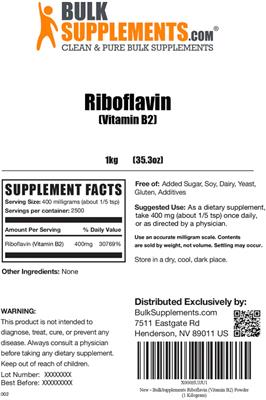
Supplement Facts
The label details for Riboflavin (Vitamin B2) by BulkSupplements.com, sourced from the NIH Dietary Supplement Label Database.
Supplement Facts
| Ingredient | Amount | % DV |
|---|---|---|
| Riboflavin | 400 mg | 30769% |
Tap any ingredient to jump to its full detail below.
These statements are the manufacturer’s wording, reproduced from the product label — the label is saying it, not HelloPharmacist. We don’t verify or endorse them.
Brand IP Statement(s)
BulkSupplements.com Clean & pure bulk supplements
FDA Disclaimer Statement
Warning: This product is not intended to diagnose, treat, cure, or prevent any disease.
Precautions
Always consult a physician before taking any dietary supplement.
Keep out of reach of children.
Formulation
Free of: Added sugar, soy, dairy, yeast, gluten, additives
Suggested/Recommended/Usage/Directions
Suggested use: As a dietary supplement, take 400 mg (about 1/5 tsp) once daily, or as directed by a physician.
Storage
Contents are sold by weight, not volume. Settling may occur. Store in a dry, cool, dark place.
General Statements
Use an accurate milligram scale. New
Is this label outdated? Report a formula or label change and our pharmacy team will review it.
Riboflavin (Vitamin B2) by BulkSupplements.com label
The label scan from the NIH Dietary Supplement Label Database. Tap to enlarge.
Label images are published by the NIH Dietary Supplement Label Database for the version of this product on file. Always read your actual product label.
View the full label (PDF)The Ingredients in Riboflavin (Vitamin B2) by BulkSupplements.com
This is the 1 active ingredient this product is made of. Select it to open its full monograph.
Serving size400 mg Dosage formPowder Servings per container2500 Amounts shown are per serving.
Riboflavin
Interacts with20 drugs
Riboflavin (vitamin B2) is an essential nutrient your body needs to turn food into energy and to keep skin, eyes, and nerves healthy. It is generally...
Riboflavin monograph & interactionsRiboflavin (Vitamin B2) by BulkSupplements.com Drug Interactions
HelloPharmacist Interaction Report
Riboflavin (Vitamin B2) by BulkSupplements.com has a documented interaction with tetracycline antibiotics (a class of bacterial infection medications).
Lab research suggests riboflavin may reduce how well these antibiotics work, but this hasn't been confirmed in people — so it's not yet clear if it matters in real life. The interaction is rated Moderate.
Read the full breakdown — every affected drug type, severity by severity
Although the concern is theoretical rather than proven in humans, it's worth checking if you're taking any tetracycline-type antibiotics before starting this supplement. Altogether, these interactions span 20 individual medications.
Use the search tool on this page to look up your exact antibiotics, and run it by your doctor or pharmacist before adding riboflavin to your routine.
Check your own medications below · Editorial policy · How we use AI
Want to check YOUR meds against Riboflavin (Vitamin B2)?
Ask about interactions with your drugs in plain English — “Can I take it with lisinopril?” — and we find you the answer in seconds, ingredient by ingredient.
Go to the checkerIngredients driving the most interactions
Individual Drug Interactions
The ingredients in Riboflavin (Vitamin B2) interact with 20 drugs. Click any drug to see the details.
1 of the 1 ingredient in Riboflavin (Vitamin B2) interact with drugs. Each result below shows which ingredient is responsible. Riboflavin
Amphotericin, TetracyclineMysteclin-F
How Amphotericin, Tetracycline interacts with Riboflavin (Vitamin B2) — through 1 ingredient. Tap an ingredient for the detail:
RiboflavinTetracycline Antibiotics Moderate
Interaction Summary
Theoretically, taking riboflavin with tetracycline antibiotics may decrease the potency of these antibiotics.
Read the full Riboflavin + Amphotericin, Tetracycline interactionBismuth Subsalicylate, Metronidazole, TetracyclineHelidac
How Bismuth Subsalicylate, Metronidazole, Tetracycline interacts with Riboflavin (Vitamin B2) — through 1 ingredient. Tap an ingredient for the detail:
RiboflavinTetracycline Antibiotics Moderate
Interaction Summary
Theoretically, taking riboflavin with tetracycline antibiotics may decrease the potency of these antibiotics.
Read the full Riboflavin + Bismuth Subsalicylate, Metronidazole, Tetracycline interactionChlortetracyclineAureomycin
How Chlortetracycline interacts with Riboflavin (Vitamin B2) — through 1 ingredient. Tap an ingredient for the detail:
RiboflavinTetracycline Antibiotics Moderate
Interaction Summary
Theoretically, taking riboflavin with tetracycline antibiotics may decrease the potency of these antibiotics.
Read the full Riboflavin + Chlortetracycline interactionDemeclocyclineDeclomycin
How Demeclocycline interacts with Riboflavin (Vitamin B2) — through 1 ingredient. Tap an ingredient for the detail:
RiboflavinTetracycline Antibiotics Moderate
Interaction Summary
Theoretically, taking riboflavin with tetracycline antibiotics may decrease the potency of these antibiotics.
Read the full Riboflavin + Demeclocycline interactionDoripenemDoribax
How Doripenem interacts with Riboflavin (Vitamin B2) — through 1 ingredient. Tap an ingredient for the detail:
RiboflavinTetracycline Antibiotics Moderate
Interaction Summary
Theoretically, taking riboflavin with tetracycline antibiotics may decrease the potency of these antibiotics.
Read the full Riboflavin + Doripenem interactionDoxycyclineDoryx, Doxy, Doxy-D, Doxycin, Doxycycline Injection, Doxylin +6 more
How Doxycycline interacts with Riboflavin (Vitamin B2) — through 1 ingredient. Tap an ingredient for the detail:
RiboflavinTetracycline Antibiotics Moderate
Interaction Summary
Theoretically, taking riboflavin with tetracycline antibiotics may decrease the potency of these antibiotics.
Read the full Riboflavin + Doxycycline interactionDoxycycline HyclateActiclate, Acticlate Cap, Lymepak
How Doxycycline Hyclate interacts with Riboflavin (Vitamin B2) — through 1 ingredient. Tap an ingredient for the detail:
RiboflavinTetracycline Antibiotics Moderate
Interaction Summary
Theoretically, taking riboflavin with tetracycline antibiotics may decrease the potency of these antibiotics.
Read the full Riboflavin + Doxycycline Hyclate interactionDoxycycline MonohydrateErfacea
How Doxycycline Monohydrate interacts with Riboflavin (Vitamin B2) — through 1 ingredient. Tap an ingredient for the detail:
RiboflavinTetracycline Antibiotics Moderate
Interaction Summary
Theoretically, taking riboflavin with tetracycline antibiotics may decrease the potency of these antibiotics.
Read the full Riboflavin + Doxycycline Monohydrate interactionDoxycylineDoxychel
How Doxycyline interacts with Riboflavin (Vitamin B2) — through 1 ingredient. Tap an ingredient for the detail:
RiboflavinTetracycline Antibiotics Moderate
Interaction Summary
Theoretically, taking riboflavin with tetracycline antibiotics may decrease the potency of these antibiotics.
Read the full Riboflavin + Doxycyline interactionEravacyclineXerava
How Eravacycline interacts with Riboflavin (Vitamin B2) — through 1 ingredient. Tap an ingredient for the detail:
RiboflavinTetracycline Antibiotics Moderate
Interaction Summary
Theoretically, taking riboflavin with tetracycline antibiotics may decrease the potency of these antibiotics.
Read the full Riboflavin + Eravacycline interactionMetronidazole, Tetracyline, Bismuth Subcitrate PotassiumPylera
How Metronidazole, Tetracyline, Bismuth Subcitrate Potassium interacts with Riboflavin (Vitamin B2) — through 1 ingredient. Tap an ingredient for the detail:
RiboflavinTetracycline Antibiotics Moderate
Interaction Summary
Theoretically, taking riboflavin with tetracycline antibiotics may decrease the potency of these antibiotics.
Read the full Riboflavin + Metronidazole, Tetracyline, Bismuth Subcitrate Potassium interactionMinocyclineAcnamino MR, Aknemin, Amzeeq, Arestin Miscrosperes, Dynacin, Minocin +6 more
How Minocycline interacts with Riboflavin (Vitamin B2) — through 1 ingredient. Tap an ingredient for the detail:
RiboflavinTetracycline Antibiotics Moderate
Interaction Summary
Theoretically, taking riboflavin with tetracycline antibiotics may decrease the potency of these antibiotics.
Read the full Riboflavin + Minocycline interactionMinocycline HydrochlorideMinolira, Ximino
How Minocycline Hydrochloride interacts with Riboflavin (Vitamin B2) — through 1 ingredient. Tap an ingredient for the detail:
RiboflavinTetracycline Antibiotics Moderate
Interaction Summary
Theoretically, taking riboflavin with tetracycline antibiotics may decrease the potency of these antibiotics.
Read the full Riboflavin + Minocycline Hydrochloride interactionOmadacycline (iv)Nuzyra
How Omadacycline (iv) interacts with Riboflavin (Vitamin B2) — through 1 ingredient. Tap an ingredient for the detail:
RiboflavinTetracycline Antibiotics Moderate
Interaction Summary
Theoretically, taking riboflavin with tetracycline antibiotics may decrease the potency of these antibiotics.
Read the full Riboflavin + Omadacycline (iv) interactionOmadacycline (oral)Nuzyra
How Omadacycline (oral) interacts with Riboflavin (Vitamin B2) — through 1 ingredient. Tap an ingredient for the detail:
RiboflavinTetracycline Antibiotics Moderate
Interaction Summary
Theoretically, taking riboflavin with tetracycline antibiotics may decrease the potency of these antibiotics.
Read the full Riboflavin + Omadacycline (oral) interactionOxytetracyclineTerramycin
How Oxytetracycline interacts with Riboflavin (Vitamin B2) — through 1 ingredient. Tap an ingredient for the detail:
RiboflavinTetracycline Antibiotics Moderate
Interaction Summary
Theoretically, taking riboflavin with tetracycline antibiotics may decrease the potency of these antibiotics.
Read the full Riboflavin + Oxytetracycline interactionOxytetracycline, Phenazopyridine, SulfamethizoleUrobiotic
How Oxytetracycline, Phenazopyridine, Sulfamethizole interacts with Riboflavin (Vitamin B2) — through 1 ingredient. Tap an ingredient for the detail:
RiboflavinTetracycline Antibiotics Moderate
Interaction Summary
Theoretically, taking riboflavin with tetracycline antibiotics may decrease the potency of these antibiotics.
Read the full Riboflavin + Oxytetracycline, Phenazopyridine, Sulfamethizole interactionRetapamulinAltabax, Altargo
How Retapamulin interacts with Riboflavin (Vitamin B2) — through 1 ingredient. Tap an ingredient for the detail:
RiboflavinTetracycline Antibiotics Moderate
Interaction Summary
Theoretically, taking riboflavin with tetracycline antibiotics may decrease the potency of these antibiotics.
Read the full Riboflavin + Retapamulin interactionTetracyclineAchromycin, Achromycin V, Nor-Tet, Robitet, Sumycin, Sumycin 250 +6 more
How Tetracycline interacts with Riboflavin (Vitamin B2) — through 1 ingredient. Tap an ingredient for the detail:
RiboflavinTetracycline Antibiotics Moderate
Interaction Summary
Theoretically, taking riboflavin with tetracycline antibiotics may decrease the potency of these antibiotics.
Read the full Riboflavin + Tetracycline interactionTigecyclineTygacil
How Tigecycline interacts with Riboflavin (Vitamin B2) — through 1 ingredient. Tap an ingredient for the detail:
RiboflavinTetracycline Antibiotics Moderate
Interaction Summary
Theoretically, taking riboflavin with tetracycline antibiotics may decrease the potency of these antibiotics.
Read the full Riboflavin + Tigecycline interactionEach ingredient & the kinds of drugs it affects
For each ingredient in Riboflavin (Vitamin B2) with known interactions, here are the types of medications it can affect. Open any type for the detail — or search your exact drug in the checker above.
Riboflavin
Tetracycline Antibiotics
Theoretically, taking riboflavin with tetracycline antibiotics may decrease the potency of these antibiotics.
In vitro research suggests that riboflavin may inhibit the potency of tetracycline antibiotics. It is not clear if this effect is clinically significant, as this interaction has not been reported in humans.
Brand information
Manufacturer and brand details for Riboflavin (Vitamin B2), from the product label.
BulkSupplements.com
See all BulkSupplements.com products- Name
- BulkSupplements.com
- Street Address
- 7511 Eastgate Rd
- City
- Henderson
- State
- NV
- ZipCode
- 89011
- Web Address
- bulksupplements.com
Riboflavin (Vitamin B2) by BulkSupplements.com: Common Questions
Does Riboflavin (Vitamin B2) by BulkSupplements.com interact with any medications?
How can one product interact with so many drugs?
Where does this information come from?
Will riboflavin turn my urine yellow?
Can I take riboflavin if I'm pregnant?
What are the most common side effects?
Is riboflavin safe to take every day?
Written and reviewed by the HelloPharmacist editorial staff. Our editorial policy
Not sure if Riboflavin (Vitamin B2) is safe with your meds?
Our pharmacists answer your medication & supplement questions — free.
Label information is sourced from the NIH Dietary Supplement Label Database and reflects the product version on file; always read your actual product label. This page is for education only and is not a substitute for professional medical advice. Confirm with your pharmacist or doctor before combining supplements and medications.
The Full Monographs Behind Riboflavin (Vitamin B2)’s Ingredients
Every ingredient we hold a full HelloPharmacist monograph for — uses, evidence, safety, and the complete interaction list.
Sources & How We Checked
Riboflavin (Vitamin B2)'s label data comes from the NIH Dietary Supplement Label Database; the ingredient interaction data is from the Natural Medicines database, reviewed by our pharmacists.
- NIH Dietary Supplement Label Database (DSLD) — The official product label on file for this supplement.
- Natural Medicines (Therapeutic Research Center) — Evidence-graded clinical reference behind the ingredient interaction data.
Content is written and reviewed by licensed HelloPharmacist pharmacists. See our data sources and editorial standards for how this information is built and checked.
The 5 references behind this product’s interaction data
Every citation that drives the interaction findings for this product’s ingredients, from the evidence-graded Natural Medicines (TRC Healthcare) database. Open an ingredient to browse its citations — links open the study on PubMed or the publisher’s site.
Riboflavin 5 references
- Schoenen J, Jacquy J, Lenaerts M. Effectiveness of high-dose riboflavin in migraine prophylaxis. A randomized controlled trial. Neurology 1998;50:466-70. PubMed
- Yates AA, Schlicker SA, Suitor CW. Dietary reference intakes: The new basis for recommendations for calcium and related nutrients, B vitamins, and choline. J Am Diet Assoc 1998;98:699-706. PubMed
- Leeson LJ, Weidenheimer JF. Stability of tetracycline and riboflavin. J Pharm Sci. 1969;58(3):355-7. PubMed
- MacLennan, S. C., Wade, F. M., Forrest, K. M., Ratanayake, P. D., Fagan, E., and Antony, J. High-dose riboflavin for migraine prophylaxis in children: a double-blind, randomized, placebo-controlled trial. J Child Neurol. 2008;23(11):1300-1304.
- Dietary reference intakes (DRIs): estimated average requirements. Food and Nutrition Board, Institute of Medicine, National Academics. https://www.nal.usda.gov/sites/default/files/fnic_uploads//recommended_intakes_individuals.pdf Accessed July 24, 2017.
Parts of this content are provided by the Therapeutic Research Center, LLC.
DISCLAIMER: Currently this does not check for drug-drug interactions. This is not an all-inclusive comprehensive list of potential interactions and is for informational purposes only. Not all interactions are known or well-reported in the scientific literature, and new interactions are continually being reported. Input is needed from a qualified healthcare provider including a pharmacist before starting any therapy. Application of clinical judgment is necessary.
© 2021 Therapeutic Research Center, LLC