
Safflowers Ingredients & Drug Interactions
What is this page for?
First and foremost: checking Safflowers against your medications. The heart of this page is the interaction checker and the full interaction report — how this product’s ingredients may interact with prescription and over-the-counter medicines you may be taking.
Around that, we add a pharmacist’s high-level view of the product as a whole — what’s inside, the evidence for its stated use, how transparent the label is, and what safety data exists — so you can see the full picture in one place. It’s educational information from our licensed clinical databases and the clinical staff at HelloPharmacist — not medical advice — and we don’t sell or endorse products. Our editorial policy
Safflowers is a dietary supplement by Nature's Sunshine with 1 active ingredient. Its ingredients are commonly taken for heart and cholesterol support, skin moisturizing, menstrual cramps.Based on those ingredients, 208 medications have a known interaction with it, the most serious rated moderate. The ingredients most likely to interact are Safflower. Use the checker below to test your specific medication, or read the full HelloPharmacist Interaction Report.
Check Your Meds Against Safflowers by Nature's Sunshine
Ask about any prescription or over-the-counter medication and we check it for interactions with Safflowers by Nature's Sunshine — and tell you which ingredient is responsible.
AI summaries are generated from our interaction database for education only — always confirm with your pharmacist. How we use AI
Ask the Pharmacist
A licensed pharmacist will answer your question by email — free, usually within 24 hours.
Got it — thank you!
A licensed pharmacist will answer within 24 hours. Keep an eye on your email (worth checking spam, just in case).
HelloPharmacist Scorecard of Safflowers by Nature's Sunshine
Our pharmacy team’s full take, with four database checks built into the cards below — a summary of what is known, not a grade of the product itself.
What’s inside
Full disclosure
This product contains one active ingredient: safflower, the flower of a plant traditionally used in herbal medicine. The capsule also contains gelatin and water as inactive ingredients.
Does it work?
Not established
The evidence we have isn't established. The product facts show insufficient reliable evidence to rate safflower for unstable angina, coronary heart disease, cystic fibrosis, diabetes, and diabetic kidney damage.
That means research to date isn't robust enough to say whether it works for these uses.
How safe is it?
Well-documented data
Safflower oil in food amounts is generally well tolerated, but concentrated flower extracts and high-dose supplements have less safety data backing them. There's a serious concern in the adverse-effects data: at least seven case reports link high-dose safflower oil to acute liver failure requiring transplant, usually in people taking it for weight loss.
It's unclear what exact dose or how long someone needs to take it to cause liver failure, but the risk is real enough to take seriously. If you're pregnant, medicinal amounts of safflower should be avoided — the flower has traditionally been used to trigger menstruation and may stimulate the uterus.
If you're breastfeeding, there isn't enough reliable data, so it's best to stick to safflower in food rather than supplements.
Meds to double-check
Moderate interaction found
Before you take this product, check with your pharmacist if you're on blood thinners or antiplatelet drugs — high doses of safflower increase bleeding risk, and warfarin users have experienced bleeding and elevated blood-thinning levels. Also double-check if you're on diabetes medications, since safflower may raise blood sugar.
The bottom line
Scorecard at a glanceFully disclosed formula with no established evidence rating for its marketed use. Moderate medication interactions have been identified, and safety information is well characterized.
Safflower is best considered by people without diabetes or blood-clotting disorders who aren't pregnant or breastfeeding. If you're on warfarin, antiplatelet drugs like aspirin or clopidogrel, or diabetes medications, talk to your pharmacist before taking this — the interaction risk is real.
The liver-failure cases are rare but serious, so avoid high doses and don't take it long-term for weight loss.
Educational only — not medical advice; always confirm with your pharmacist. Our editorial policy · How we use AI
Assessment coverage: 1 of 1 active ingredient matched to our full ingredient reviews (monographs). Based on the product label dated Sep 25, 2024.
This Scorecard evaluates available label information, ingredient evidence, and known medication-safety considerations. It does not independently verify product identity, purity, potency, contamination, or manufacturing quality. How these ratings are computed
General information
Key facts about Safflowers, straight from the product label.
| Brand | Nature's Sunshine |
|---|---|
| Barcode (UPC) | 099904006003 |
| Net contents | 100 Capsule(s) |
| Market status | On market |
| Date entered into DSLD | Sep 25, 2024 |
| DSLD ID | 313133 |
| Product type | Botanical |
| Supplement form | Capsule |
| Dietary claims / uses | All Other, Structure/Function |
| Intended target group(s) | Adult (18 - 50 Years), Kosher |
Everything in this section is reproduced from the manufacturer’s own product label — it’s the label speaking, not HelloPharmacist. We show it so you can see exactly what the maker states; we don’t verify or endorse those statements.
Supplement Facts
The label details for Safflowers by Nature's Sunshine, sourced from the NIH Dietary Supplement Label Database.
Tap any ingredient to jump to its full detail below.
These statements are the manufacturer’s wording, reproduced from the product label — the label is saying it, not HelloPharmacist. We don’t verify or endorse them.
FDA Disclaimer Statement
These statements have not been evaluated by the Food and Drug Administration. This product is not intended to diagnose, treat, cure, or prevent any disease.
General Statements
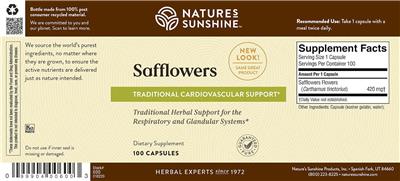
Bottle made from 100% post consumer recycled material. We are committed to you and our planet. Scan to learn more. We source the world's purest ingredients, no matter where they are grown, to ensure the active nutrients are delivered just as nature intended.
New look! Same great product
Formula
Ko Kosher Service Pareve
Seals/Symbols
Ko Kosher Service Pareve
Guaranteed pure
Formulation
Do not use if inner seal is missing or damaged.
Traditional cardiovascular support Traditional herbal support for the respiratory and glandular systems
FDA Statement of Identity
Dietary Supplement
Brand IP Statement(s)
Natures Sunshine Herbal experts since 1972
Suggested/Recommended/Usage/Directions
Recommended Use: Take 1 capsule with a meal twice daily.
Is this label outdated? Report a formula or label change and our pharmacy team will review it.
Safflowers by Nature's Sunshine label
The label scan from the NIH Dietary Supplement Label Database. Tap to enlarge.
Label images are published by the NIH Dietary Supplement Label Database for the version of this product on file. Always read your actual product label.
View the full label (PDF)The Ingredients in Safflowers by Nature's Sunshine
This is the 1 active ingredient this product is made of. Select it to open its full monograph.
Serving size1 Capsule(s) Dosage formCapsule Servings per container100 Amounts shown are per serving.
Safflower
Interacts with208 drugs
Safflower is a thistle-like plant used mainly for its seed oil (a common cooking oil) and its colorful flowers. Safflower oil is a reasonable source o...
Safflower monograph & interactionsOther (inactive) ingredients: Gelatin, Water. These complete the product’s ingredient list but are not active constituents.
Safflowers by Nature's Sunshine Drug Interactions
HelloPharmacist Interaction Report
Nature's Sunshine Safflower is a single-ingredient product that does interact with medications.
The most serious concern is with blood thinners (anticoagulants) and antiplatelet drugs — safflower oil at high doses can increase your bleeding risk. Warfarin in particular warrants attention: one case report documented bleeding and a dangerously elevated blood-thinning level after someone took a safflower extract at 20 grams daily for two weeks.
Read the full breakdown — every affected drug type, severity by severity
Safflower also affects diabetes medications (Moderate severity). Some research shows that 10 grams daily for three weeks raised fasting blood sugar in people with type 2 diabetes, which could theoretically work against your diabetes control.
The interaction isn't certain — other studies show mixed results — but it's worth watching if you're on diabetes drugs.
Altogether, these interactions span 207 individual medications. Before you start this product, run your exact blood thinners and diabetes medications through the interaction checker below.
Check your own medications below · Editorial policy · How we use AI
Want to check YOUR meds against Safflowers?
Ask about interactions with your drugs in plain English — “Can I take it with lisinopril?” — and we find you the answer in seconds, ingredient by ingredient.
Go to the checkerIngredients driving the most interactions
Individual Drug Interactions
The ingredients in Safflowers interact with 208 drugs. Click any drug to see the details.
1 of the 1 ingredient in Safflowers interact with drugs. Each result below shows which ingredient is responsible. Safflower
ErtugliflozinSteglatro
How Ertugliflozin interacts with Safflowers — through 1 ingredient. Tap an ingredient for the detail:
SafflowerAntidiabetes Drugs Moderate
Interaction Summary
Theoretically, safflower oil might alter the effects of antidiabetes drugs.
Read the full Safflower + Ertugliflozin interactionErtugliflozin, Metformin HydrochlorideSegluromet
How Ertugliflozin, Metformin Hydrochloride interacts with Safflowers — through 1 ingredient. Tap an ingredient for the detail:
SafflowerAntidiabetes Drugs Moderate
Interaction Summary
Theoretically, safflower oil might alter the effects of antidiabetes drugs.
Read the full Safflower + Ertugliflozin, Metformin Hydrochloride interactionEsomeprazole, NaproxenVimovo
How Esomeprazole, Naproxen interacts with Safflowers — through 1 ingredient. Tap an ingredient for the detail:
SafflowerAnticoagulant/antiplatelet Drugs Moderate
Interaction Summary
High doses of safflower oil might increase the risk of bleeding when taken with anticoagulant or antiplatelet drugs.
Read the full Safflower + Esomeprazole, Naproxen interactionExenatideBydureon, Byetta
How Exenatide interacts with Safflowers — through 1 ingredient. Tap an ingredient for the detail:
SafflowerAntidiabetes Drugs Moderate
Interaction Summary
Theoretically, safflower oil might alter the effects of antidiabetes drugs.
Read the full Safflower + Exenatide interactionExenatide SyntheticBydureon BCISE
How Exenatide Synthetic interacts with Safflowers — through 1 ingredient. Tap an ingredient for the detail:
SafflowerAntidiabetes Drugs Moderate
Interaction Summary
Theoretically, safflower oil might alter the effects of antidiabetes drugs.
Read the full Safflower + Exenatide Synthetic interactionFamotidine, IbuprofenDuexis
How Famotidine, Ibuprofen interacts with Safflowers — through 1 ingredient. Tap an ingredient for the detail:
SafflowerAnticoagulant/antiplatelet Drugs Moderate
Interaction Summary
High doses of safflower oil might increase the risk of bleeding when taken with anticoagulant or antiplatelet drugs.
Read the full Safflower + Famotidine, Ibuprofen interactionFish Oil TriglyceridesOmegaven
How Fish Oil Triglycerides interacts with Safflowers — through 1 ingredient. Tap an ingredient for the detail:
SafflowerAnticoagulant/antiplatelet Drugs Moderate
Interaction Summary
High doses of safflower oil might increase the risk of bleeding when taken with anticoagulant or antiplatelet drugs.
Read the full Safflower + Fish Oil Triglycerides interactionFondaparinuxArixtra
How Fondaparinux interacts with Safflowers — through 1 ingredient. Tap an ingredient for the detail:
SafflowerAnticoagulant/antiplatelet Drugs Moderate
Interaction Summary
High doses of safflower oil might increase the risk of bleeding when taken with anticoagulant or antiplatelet drugs.
Read the full Safflower + Fondaparinux interactionGliclazideDiamicron
How Gliclazide interacts with Safflowers — through 1 ingredient. Tap an ingredient for the detail:
SafflowerAntidiabetes Drugs Moderate
Interaction Summary
Theoretically, safflower oil might alter the effects of antidiabetes drugs.
Read the full Safflower + Gliclazide interactionGlimepirideAmaryl
How Glimepiride interacts with Safflowers — through 1 ingredient. Tap an ingredient for the detail:
SafflowerAntidiabetes Drugs Moderate
Interaction Summary
Theoretically, safflower oil might alter the effects of antidiabetes drugs.
Read the full Safflower + Glimepiride interactionGlipizideGlucotrol, Glucotrol XL
How Glipizide interacts with Safflowers — through 1 ingredient. Tap an ingredient for the detail:
SafflowerAntidiabetes Drugs Moderate
Interaction Summary
Theoretically, safflower oil might alter the effects of antidiabetes drugs.
Read the full Safflower + Glipizide interactionGlipizide, MetforminMetaglip
How Glipizide, Metformin interacts with Safflowers — through 1 ingredient. Tap an ingredient for the detail:
SafflowerAntidiabetes Drugs Moderate
Interaction Summary
Theoretically, safflower oil might alter the effects of antidiabetes drugs.
Read the full Safflower + Glipizide, Metformin interactionGlucagonBaqsimi, Glucagon
How Glucagon interacts with Safflowers — through 1 ingredient. Tap an ingredient for the detail:
SafflowerAntidiabetes Drugs Moderate
Interaction Summary
Theoretically, safflower oil might alter the effects of antidiabetes drugs.
Read the full Safflower + Glucagon interactionGlucoseIV Glucose
How Glucose interacts with Safflowers — through 1 ingredient. Tap an ingredient for the detail:
SafflowerAntidiabetes Drugs Moderate
Interaction Summary
Theoretically, safflower oil might alter the effects of antidiabetes drugs.
Read the full Safflower + Glucose interactionGlyburideAlbert Glyburide, Diabeta, Glycron, Glynase, Glynase PresTab, Micronase +1 more
How Glyburide interacts with Safflowers — through 1 ingredient. Tap an ingredient for the detail:
SafflowerAntidiabetes Drugs Moderate
Interaction Summary
Theoretically, safflower oil might alter the effects of antidiabetes drugs.
Read the full Safflower + Glyburide interactionGlyburide, MetforminGlucovance
How Glyburide, Metformin interacts with Safflowers — through 1 ingredient. Tap an ingredient for the detail:
SafflowerAntidiabetes Drugs Moderate
Interaction Summary
Theoretically, safflower oil might alter the effects of antidiabetes drugs.
Read the full Safflower + Glyburide, Metformin interactionHeparinHeparin
How Heparin interacts with Safflowers — through 1 ingredient. Tap an ingredient for the detail:
SafflowerAnticoagulant/antiplatelet Drugs Moderate
Interaction Summary
High doses of safflower oil might increase the risk of bleeding when taken with anticoagulant or antiplatelet drugs.
Read the full Safflower + Heparin interactionHydrocodone, IbuprofenVicoprofen
How Hydrocodone, Ibuprofen interacts with Safflowers — through 1 ingredient. Tap an ingredient for the detail:
SafflowerAnticoagulant/antiplatelet Drugs Moderate
Interaction Summary
High doses of safflower oil might increase the risk of bleeding when taken with anticoagulant or antiplatelet drugs.
Read the full Safflower + Hydrocodone, Ibuprofen interactionIbrutinibImbruvica
How Ibrutinib interacts with Safflowers — through 1 ingredient. Tap an ingredient for the detail:
SafflowerAnticoagulant/antiplatelet Drugs Moderate
Interaction Summary
High doses of safflower oil might increase the risk of bleeding when taken with anticoagulant or antiplatelet drugs.
Read the full Safflower + Ibrutinib interactionIbuprofenAdvil, Arthrofen, Brufen, Brufen Retard, Calodor, Calprofen +14 more
How Ibuprofen interacts with Safflowers — through 1 ingredient. Tap an ingredient for the detail:
SafflowerAnticoagulant/antiplatelet Drugs Moderate
Interaction Summary
High doses of safflower oil might increase the risk of bleeding when taken with anticoagulant or antiplatelet drugs.
Read the full Safflower + Ibuprofen interactionIbuprofen LysineNeoProfen
How Ibuprofen Lysine interacts with Safflowers — through 1 ingredient. Tap an ingredient for the detail:
SafflowerAnticoagulant/antiplatelet Drugs Moderate
Interaction Summary
High doses of safflower oil might increase the risk of bleeding when taken with anticoagulant or antiplatelet drugs.
Read the full Safflower + Ibuprofen Lysine interactionIbuprofen, AcetaminophenAdvil Dual Action
How Ibuprofen, Acetaminophen interacts with Safflowers — through 1 ingredient. Tap an ingredient for the detail:
SafflowerAnticoagulant/antiplatelet Drugs Moderate
Interaction Summary
High doses of safflower oil might increase the risk of bleeding when taken with anticoagulant or antiplatelet drugs.
Read the full Safflower + Ibuprofen, Acetaminophen interactionIbuprofen, HydrocodoneIbucodone
How Ibuprofen, Hydrocodone interacts with Safflowers — through 1 ingredient. Tap an ingredient for the detail:
SafflowerAnticoagulant/antiplatelet Drugs Moderate
Interaction Summary
High doses of safflower oil might increase the risk of bleeding when taken with anticoagulant or antiplatelet drugs.
Read the full Safflower + Ibuprofen, Hydrocodone interactionIbuprofen, OxycodoneCombunox
How Ibuprofen, Oxycodone interacts with Safflowers — through 1 ingredient. Tap an ingredient for the detail:
SafflowerAnticoagulant/antiplatelet Drugs Moderate
Interaction Summary
High doses of safflower oil might increase the risk of bleeding when taken with anticoagulant or antiplatelet drugs.
Read the full Safflower + Ibuprofen, Oxycodone interactionIbuprofen, PseudoephedrineDristan
How Ibuprofen, Pseudoephedrine interacts with Safflowers — through 1 ingredient. Tap an ingredient for the detail:
SafflowerAnticoagulant/antiplatelet Drugs Moderate
Interaction Summary
High doses of safflower oil might increase the risk of bleeding when taken with anticoagulant or antiplatelet drugs.
Read the full Safflower + Ibuprofen, Pseudoephedrine interactionIcosapent Ethyl (prescription Drug)Vascepa
How Icosapent Ethyl (prescription Drug) interacts with Safflowers — through 1 ingredient. Tap an ingredient for the detail:
SafflowerAnticoagulant/antiplatelet Drugs Moderate
Interaction Summary
High doses of safflower oil might increase the risk of bleeding when taken with anticoagulant or antiplatelet drugs.
Read the full Safflower + Icosapent Ethyl (prescription Drug) interactionIloprostAurlumyn, Ventavis
How Iloprost interacts with Safflowers — through 1 ingredient. Tap an ingredient for the detail:
SafflowerAnticoagulant/antiplatelet Drugs Moderate
Interaction Summary
High doses of safflower oil might increase the risk of bleeding when taken with anticoagulant or antiplatelet drugs.
Read the full Safflower + Iloprost interactionInhaled InsulinExubera
How Inhaled Insulin interacts with Safflowers — through 1 ingredient. Tap an ingredient for the detail:
SafflowerAntidiabetes Drugs Moderate
Interaction Summary
Theoretically, safflower oil might alter the effects of antidiabetes drugs.
Read the full Safflower + Inhaled Insulin interactionInotersenTegsedi
How Inotersen interacts with Safflowers — through 1 ingredient. Tap an ingredient for the detail:
SafflowerAnticoagulant/antiplatelet Drugs Moderate
Interaction Summary
High doses of safflower oil might increase the risk of bleeding when taken with anticoagulant or antiplatelet drugs.
Read the full Safflower + Inotersen interactionInsulinNovoRapid Insulin
How Insulin interacts with Safflowers — through 1 ingredient. Tap an ingredient for the detail:
SafflowerAntidiabetes Drugs Moderate
Interaction Summary
Theoretically, safflower oil might alter the effects of antidiabetes drugs.
Read the full Safflower + Insulin interactionEach ingredient & the kinds of drugs it affects
For each ingredient in Safflowers with known interactions, here are the types of medications it can affect. Open any type for the detail — or search your exact drug in the checker above.
Safflower
Anticoagulant/Antiplatelet Drugs
High doses of safflower oil might increase the risk of bleeding when taken with anticoagulant or antiplatelet drugs.
Small clinical studies show that taking safflower oil, approximately 55 grams daily for 2-3 weeks, decreases platelet aggregation. However, taking lower doses of safflower oil, such as 5 grams daily for 4 weeks, does not seem to affect platelet function. In one case report, a 74-year-old male stabilized on warfarin developed urinary tract bleeding and an elevated INR after taking a safflower extract 20 grams daily for 14 days.
Antidiabetes Drugs
Theoretically, safflower oil might alter the effects of antidiabetes drugs.
Some clinical research shows that taking safflower oil 10 grams daily for 3 weeks can increase fasting blood glucose in patients with type 2 diabetes. However, clinical research in patients with metabolic syndrome with or without impaired glucose tolerance shows that taking safflower oil 8 grams daily for 12 weeks reduces fasting glucose levels by around 8 mg/dL. Some clinical research also shows that taking safflower oil 8 grams daily for 16 weeks does not affect fasting glucose levels in patients with type 2 diabetes.
Warfarin
Theoretically, safflower oil might increase the risk of bleeding when taken with warfarin.
In one case report, a 74-year-old male stabilized on warfarin developed urinary tract bleeding and an elevated INR after taking a safflower extract 20 grams daily for 14 days.
Brand information
Manufacturer and brand details for Safflowers, from the product label.
Nature's Sunshine
See all Nature's Sunshine products- Name
- Nature's Sunshine Products, Inc.
- City
- Spanish Fork
- State
- UT
- ZipCode
- 84660
- Phone Number
- (800) 223-8225
- Web Address
- naturessunshine.com
Safflowers by Nature's Sunshine: Common Questions
Does Safflowers by Nature's Sunshine interact with any medications?
How can one product interact with so many drugs?
Where does this information come from?
Can I take Safflower while I'm pregnant?
Is it safe to take while breastfeeding?
What are the side effects?
Does this actually work for anything?
Why is this just one ingredient?
Written and reviewed by the HelloPharmacist editorial staff. Our editorial policy
Not sure if Safflowers is safe with your meds?
Our pharmacists answer your medication & supplement questions — free.
Label information is sourced from the NIH Dietary Supplement Label Database and reflects the product version on file; always read your actual product label. This page is for education only and is not a substitute for professional medical advice. Confirm with your pharmacist or doctor before combining supplements and medications.
The Full Monographs Behind Safflowers’s Ingredients
Every ingredient we hold a full HelloPharmacist monograph for — uses, evidence, safety, and the complete interaction list.
Sources & How We Checked
Safflowers's label data comes from the NIH Dietary Supplement Label Database; the ingredient interaction data is from the Natural Medicines database, reviewed by our pharmacists.
- NIH Dietary Supplement Label Database (DSLD) — The official product label on file for this supplement.
- Natural Medicines (Therapeutic Research Center) — Evidence-graded clinical reference behind the ingredient interaction data.
Content is written and reviewed by licensed HelloPharmacist pharmacists. See our data sources and editorial standards for how this information is built and checked.
The 14 references behind this product’s interaction data
Every citation that drives the interaction findings for this product’s ingredients, from the evidence-graded Natural Medicines (TRC Healthcare) database. Open an ingredient to browse its citations — links open the study on PubMed or the publisher’s site.
Safflower 14 references
- The Review of Natural Products by Facts and Comparisons. St. Louis, MO: Wolters Kluwer Co., 1999.
- Leung AY, Foster S. Encyclopedia of Common Natural Ingredients Used in Food, Drugs and Cosmetics. 2nd ed. New York, NY: John Wiley & Sons, 1996.
- McGuffin M, Hobbs C, Upton R, Goldberg A, eds. American Herbal Products Association's Botanical Safety Handbook. Boca Raton, FL: CRC Press, LLC 1997.
- Borkman M, Chisholm DJ, Furler SM, et al. Effects of fish oil supplementation on glucose and lipid metabolism in NIDDM. Diabetes 1989;38:1314-9.. PubMed
- Amato, P. and Quercia, R. A. A historical perspective and review of the safety of lipid emulsion in pregnancy. Nutr Clin Pract. 1991;6(5):189-192. PubMed
- Demke, D. M., Peters, G. R., Linet, O. I., Metzler, C. M., and Klott, K. A. Effects of a fish oil concentrate in patients with hypercholesterolemia. Atherosclerosis 1988;70(1-2):73-80. PubMed
- Kaji, K., Yoshida, S., Nagata, N., Yamashita, T., Mizukoshi, E., Honda, M., Kojima, Y., and Kaneko, S. An open-label study of administration of EH0202, a health-food additive, to patients with chronic hepatitis C. J Gastroenterol. 2004;39(9):873-878. PubMed
- Kwon, J. S., Snook, J. T., Wardlaw, G. M., and Hwang, D. H. Effects of diets high in saturated fatty acids, canola oil, or safflower oil on platelet function, thromboxane B2 formation, and fatty acid composition of platelet phospholipids. Am.J.Clin.Nutr. PubMed
- Lloyd-Still, J. D., Simon, S. H., Wessel, H. U., and Gibson, L. E. Negative effects of oral fatty acid supplementation on sweat chloride in cystic fibrosis. Pediatrics 1979;64(1):50-52. DOI
- Challen, A. D., Branch, W. J., and Cummings, J. H. The effect of aspirin and linoleic acid on platelet aggregation, platelet fatty acid composition and haemostasis in man. Hum Nutr Clin Nutr 1983;37(3):197-208.
- Asp ML, Collene AL, Norris LE, Cole RM, Stout MB, Tang SY, Hsu JC, Belury MA. Time-dependent effects of safflower oil to improve glycemia, inflammation and blood lipids in obese, post-menopausal women with type 2 diabetes: a randomized, double-masked, cro
- Liu Y, Liu S, Shi Y, et al. Effects of safflower injection on the pharmacodynamics and pharmacokinetics of warfarin in rats. Xenobiotica. 2017 Oct 25:1-6. [Epub ahead of print] PubMed
- de Ataide EC, Reges Perales S, de Oliveira Peres MA, et al. Acute liver failure induced by Carthamus tinctorius oil: Case reports and literature review. Transplant Proc. 2018;50(2):476-477. PubMed
- Ruyvaran M, Zamani A, Mohamadian A, et al. Safflower (Carthamus tinctorius L.) oil could improve abdominal obesity, blood pressure, and insulin resistance in patients with metabolic syndrome: a randomized, double-blind, placebo-controlled clinical trial. PubMed
Parts of this content are provided by the Therapeutic Research Center, LLC.
DISCLAIMER: Currently this does not check for drug-drug interactions. This is not an all-inclusive comprehensive list of potential interactions and is for informational purposes only. Not all interactions are known or well-reported in the scientific literature, and new interactions are continually being reported. Input is needed from a qualified healthcare provider including a pharmacist before starting any therapy. Application of clinical judgment is necessary.
© 2021 Therapeutic Research Center, LLC