
Siberian Rhubarb Extract 2500 mg Ingredients & Drug Interactions
by NusaPure
What is this page for?
First and foremost: checking Siberian Rhubarb Extract 2500 mg against your medications. The heart of this page is the interaction checker and the full interaction report — how this product’s ingredients may interact with prescription and over-the-counter medicines you may be taking.
Around that, we add a pharmacist’s high-level view of the product as a whole — what’s inside, the evidence for its stated use, how transparent the label is, and what safety data exists — so you can see the full picture in one place. It’s educational information from our licensed clinical databases and the clinical staff at HelloPharmacist — not medical advice — and we don’t sell or endorse products. Our editorial policy
Siberian Rhubarb Extract 2500 mg is a dietary supplement by NusaPure with 1 active ingredient. Its ingredients are commonly taken for constipation, digestive upset, menopausal symptoms.Based on those ingredients, 658 medications have a known interaction with it, the most serious rated moderate. The ingredients most likely to interact are Siberian Rhubarb Root Extract. Use the checker below to test your specific medication, or read the full HelloPharmacist Interaction Report.
Check Your Meds Against Siberian Rhubarb Extract 2500 mg by NusaPure
Ask about any prescription or over-the-counter medication and we check it for interactions with Siberian Rhubarb Extract 2500 mg by NusaPure — and tell you which ingredient is responsible.
AI summaries are generated from our interaction database for education only — always confirm with your pharmacist. How we use AI
Ask the Pharmacist
A licensed pharmacist will answer your question by email — free, usually within 24 hours.
Got it — thank you!
A licensed pharmacist will answer within 24 hours. Keep an eye on your email (worth checking spam, just in case).
HelloPharmacist Scorecard of Siberian Rhubarb Extract 2500 mg by NusaPure
Our pharmacy team’s full take, with four database checks built into the cards below — a summary of what is known, not a grade of the product itself.
What’s inside
Full disclosure
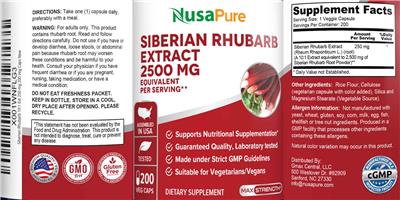
This product contains one active ingredient: Siberian rhubarb root extract at 2,500 mg per capsule. Rhubarb is a plant with both food and medicinal uses — you may know it as the stalk in pies — but the root extract in supplements is a stimulant laxative, meaning it directly triggers your bowels to move.
The capsule also contains inactive ingredients (rice flour, cellulose, silica, and magnesium stearate), which are standard fillers and binders.
Does it work?
Moderate evidence
The evidence for rhubarb root is limited depending on what you're using it for. It's rated possibly effective for pancreatitis (inflammation of the pancreas) and menopausal symptoms based on available studies.
For constipation, nonalcoholic fatty liver disease (NAFLD), appendicitis, and nasopharyngeal cancer, the evidence in our data is insufficient to rate whether it works — we can't tell you one way or the other.
How safe is it?
Well-documented data
Rhubarb root is generally well tolerated in typical doses, but it does cause side effects in many people: cramping, diarrhea, gastrointestinal discomfort, nausea, and vomiting are common. In rare cases, anaphylaxis (a severe allergic reaction) has been reported.
The real concern is long-term use — chronic or excessive rhubarb can lead to potassium depletion, electrolyte loss, dehydration, kidney damage, and protein or blood in the urine. The safety data advises against medicinal rhubarb during pregnancy because it may stimulate the uterus, and against nursing because laxative compounds can pass into breast milk.
Don't use this supplement long-term without guidance.
Meds to double-check
Moderate interaction found
Before you take this, run your medications through the checker below — especially if you take drugs that affect your kidneys or liver, blood thinners like warfarin, heart medications such as digoxin, corticosteroids, diuretics, cyclosporine (an immunosuppressant), or other laxatives. All carry moderate-risk interactions with rhubarb.
The bottom line
Scorecard at a glanceFully disclosed formula with some supporting evidence for its stated purpose. Moderate medication interactions have been identified, and safety information is well characterized.
Rhubarb root extract is a stimulant laxative, not a general wellness supplement — it's for occasional bowel support, not daily use. If you take any medication for your heart, kidneys, liver, or blood pressure, or if you're on blood thinners or immunosuppressants, talk to your pharmacist before starting.
Pregnant or nursing? Skip it.
And if you're considering long-term use, check in with us first.
Educational only — not medical advice; always confirm with your pharmacist. Our editorial policy · How we use AI
Assessment coverage: 1 of 1 active ingredient matched to our full ingredient reviews (monographs). Based on the product label dated Jun 20, 2024.
This Scorecard evaluates available label information, ingredient evidence, and known medication-safety considerations. It does not independently verify product identity, purity, potency, contamination, or manufacturing quality. How these ratings are computed
General information
Key facts about Siberian Rhubarb Extract 2500 mg, straight from the product label.
| Brand | NusaPure |
|---|---|
| Barcode (UPC) | X001WNFLG3 |
| Net contents | 200 Veg Cap(s) |
| Market status | On market |
| Date entered into DSLD | Jun 20, 2024 |
| DSLD ID | 307393 |
| Product type | Botanical |
| Supplement form | Capsule |
| Dietary claims / uses | All Other, Structure/Function |
| Intended target group(s) | Vegan, Vegetarian, Adult (18 - 50 Years), Gluten Free, Dairy Free |
Everything in this section is reproduced from the manufacturer’s own product label — it’s the label speaking, not HelloPharmacist. We show it so you can see exactly what the maker states; we don’t verify or endorse those statements.
Supplement Facts
The label details for Siberian Rhubarb Extract 2500 mg by NusaPure, sourced from the NIH Dietary Supplement Label Database.
Supplement Facts
| Ingredient | Amount | % DV |
|---|---|---|
| Siberian Rhubarb Root Extract | 250 mg | -- |
Other ingredients: Rice Flour, Cellulose, Silica, Magnesium Stearate
Tap any ingredient to jump to its full detail below.
These statements are the manufacturer’s wording, reproduced from the product label — the label is saying it, not HelloPharmacist. We don’t verify or endorse them.
Formula
Siberian Rhubarb 10:1 ext 250mg
Siberian Rhubarb Extract 2500mg equivalent per serving
General Statements
New
Please recycle.
Suggested/Recommended/Usage/Directions
Directions: Take one (1) capsule daily, preferably with a meal. Read and follow directions carefully.
Precautions
Warning: For adults only.
Do not use if you have or develop diarrhea, loose stools, or abdominal pain because rhubarb root may worsen these conditions and be harmful to your health. Do not eat freshness packet. Keep in bottle.
Consult a physician if you have frequent diarrhea or if you are pregnant, nursing, taking medication, or have a medical condition.
Allergen information: Not manufactured with yeast, wheat, gluten, soy, corn, milk, egg, fish, shellfish or tree nut ingredients. Produced in a GMP facility that processes other ingredients containing these allergens.
Storage
Store in a cool dry place after opening.
FDA Disclaimer Statement
This statement has not been evaluated by the Food and Drug Administration. This product is not intended to diagnose, treat, cure or prevent any disease.
Seals/Symbols
Premium quality Assembled in USA GMO free Made with Non-GMO ingredients Gluten free FDA Registered Facility
Manufactured in a cGMP inspected facility
Formulation
GMO free Made with Non-GMO ingredients Gluten free FDA Registered Facility
Assembled in USA Tested Supports normals nutritional supplementation Guaranteed quality, laboratory tested Made under strict GMP guidelines Max strength
Allergen information: Not manufactured with yeast, wheat, gluten, soy, corn, milk, egg, fish, shellfish or tree nut ingredients.
Natural color variation may occur in this product.
FDA Statement of Identity
Dietary Supplement
Is this label outdated? Report a formula or label change and our pharmacy team will review it.
Siberian Rhubarb Extract 2500 mg by NusaPure label
The label scan from the NIH Dietary Supplement Label Database. Tap to enlarge.
Label images are published by the NIH Dietary Supplement Label Database for the version of this product on file. Always read your actual product label.
View the full label (PDF)The Ingredients in Siberian Rhubarb Extract 2500 mg by NusaPure
This is the 1 active ingredient this product is made of. Select it to open its full monograph.
Serving size1 Veggie Capsule(s) Dosage formCapsule Servings per container200 Amounts shown are per serving.
Siberian Rhubarb Root Extract
Interacts with658 drugs
Rhubarb root has a long history of use as a laxative and in traditional Chinese medicine, and its edible stalks are a common food. Most medicinal clai...
Siberian Rhubarb Root Extract monograph & interactionsOther (inactive) ingredients: Rice Flour, Cellulose, Silica, Magnesium Stearate. These complete the product’s ingredient list but are not active constituents.
Siberian Rhubarb Extract 2500 mg by NusaPure Drug Interactions
HelloPharmacist Interaction Report
Siberian Rhubarb Extract 2500 mg by NusaPure contains one active ingredient — rhubarb root extract — which carries several documented interactions with medications.
The most serious concern is with drugs that damage the kidneys (nephrotoxic drugs): the anthraquinones in rhubarb have shown kidney-damaging potential in animal studies, and there's a case report of kidney failure in a patient who took rhubarb and then started a nephrotoxic painkiller. The same goes for drugs that damage the liver (hepatotoxic drugs) — rhubarb has been linked to at least 24 cases of liver injury in the medical literature.
Read the full breakdown — every affected drug type, severity by severity
Rhubarb's laxative action also creates a moderate risk with several other drug classes. It can worsen potassium loss if you're taking corticosteroids, diuretics (water pills), or the heart medication digoxin — overuse of rhubarb might lead to dangerous low potassium (hypokalemia).
It can boost the effects of the blood thinner warfarin and raise your bleeding risk because diarrhea amplifies how your body handles the drug. Rhubarb may also lower levels of the immunosuppressant cyclosporine, making it less effective.
Taking it with other stimulant laxatives compounds the risk of fluid and electrolyte loss.
Altogether, these interactions span 642 individual medications. Check your exact prescriptions below before you start.
Check your own medications below · Editorial policy · How we use AI
Want to check YOUR meds against Siberian Rhubarb Extract 2500 mg?
Ask about interactions with your drugs in plain English — “Can I take it with lisinopril?” — and we find you the answer in seconds, ingredient by ingredient.
Go to the checkerIngredients driving the most interactions
Individual Drug Interactions
The ingredients in Siberian Rhubarb Extract 2500 mg interact with 658 drugs. Click any drug to see the details.
1 of the 1 ingredient in Siberian Rhubarb Extract 2500 mg interact with drugs. Each result below shows which ingredient is responsible. Siberian Rhubarb Root Extract
6-mercaptopurinePurinethol
How 6-mercaptopurine interacts with Siberian Rhubarb Extract 2500 mg — through 1 ingredient. Tap an ingredient for the detail:
Siberian Rhubarb Root ExtractHepatotoxic Drugs Moderate
Interaction Summary
Theoretically, concomitant use of rhubarb with potentially hepatotoxic drugs might increase the risk of developing liver damage.
Read the full Siberian Rhubarb Root Extract + 6-mercaptopurine interactionAbacavir Sulfate, Dolutegravir, LamivudineTriumeq
How Abacavir Sulfate, Dolutegravir, Lamivudine interacts with Siberian Rhubarb Extract 2500 mg — through 1 ingredient. Tap an ingredient for the detail:
Siberian Rhubarb Root ExtractHepatotoxic Drugs Moderate
Interaction Summary
Theoretically, concomitant use of rhubarb with potentially hepatotoxic drugs might increase the risk of developing liver damage.
Read the full Siberian Rhubarb Root Extract + Abacavir Sulfate, Dolutegravir, Lamivudine interactionAbacavir, LamivudineEpzicom
How Abacavir, Lamivudine interacts with Siberian Rhubarb Extract 2500 mg — through 1 ingredient. Tap an ingredient for the detail:
Siberian Rhubarb Root ExtractHepatotoxic Drugs Moderate
Interaction Summary
Theoretically, concomitant use of rhubarb with potentially hepatotoxic drugs might increase the risk of developing liver damage.
Read the full Siberian Rhubarb Root Extract + Abacavir, Lamivudine interactionAbiraterone
How Abiraterone interacts with Siberian Rhubarb Extract 2500 mg — through 1 ingredient. Tap an ingredient for the detail:
Siberian Rhubarb Root ExtractHepatotoxic Drugs Moderate
Interaction Summary
Theoretically, concomitant use of rhubarb with potentially hepatotoxic drugs might increase the risk of developing liver damage.
Read the full Siberian Rhubarb Root Extract + Abiraterone interactionAbiraterone AcetateYonsa, Zytiga
How Abiraterone Acetate interacts with Siberian Rhubarb Extract 2500 mg — through 1 ingredient. Tap an ingredient for the detail:
Siberian Rhubarb Root ExtractHepatotoxic Drugs Moderate
Interaction Summary
Theoretically, concomitant use of rhubarb with potentially hepatotoxic drugs might increase the risk of developing liver damage.
Read the full Siberian Rhubarb Root Extract + Abiraterone Acetate interactionAcarboseGlucobay, Prandase, Precose
How Acarbose interacts with Siberian Rhubarb Extract 2500 mg — through 1 ingredient. Tap an ingredient for the detail:
Siberian Rhubarb Root ExtractHepatotoxic Drugs Moderate
Interaction Summary
Theoretically, concomitant use of rhubarb with potentially hepatotoxic drugs might increase the risk of developing liver damage.
Read the full Siberian Rhubarb Root Extract + Acarbose interactionAcebutololRhotral, Sectral
How Acebutolol interacts with Siberian Rhubarb Extract 2500 mg — through 1 ingredient. Tap an ingredient for the detail:
Siberian Rhubarb Root ExtractHepatotoxic Drugs Moderate
Interaction Summary
Theoretically, concomitant use of rhubarb with potentially hepatotoxic drugs might increase the risk of developing liver damage.
Read the full Siberian Rhubarb Root Extract + Acebutolol interactionAcetaminophenChildren's Tylenol, Children's Tylenol Meltaways, Tylenol, Tylenol Ex Strength
How Acetaminophen interacts with Siberian Rhubarb Extract 2500 mg — through 1 ingredient. Tap an ingredient for the detail:
Siberian Rhubarb Root ExtractHepatotoxic Drugs, Nephrotoxic Drugs Moderate
Interaction Summary
Theoretically, concomitant use of rhubarb with potentially hepatotoxic drugs might increase the risk of developing liver damage.
Read the full Siberian Rhubarb Root Extract + Acetaminophen interactionAcetaminophen, AspirinGemnisyn
How Acetaminophen, Aspirin interacts with Siberian Rhubarb Extract 2500 mg — through 1 ingredient. Tap an ingredient for the detail:
Siberian Rhubarb Root ExtractNephrotoxic Drugs, Hepatotoxic Drugs Moderate
Interaction Summary
Theoretically, long-term use of anthraquinones from rhubarb might increase the risk of nephrotoxicity when used with nephrotoxic drugs.
Read the full Siberian Rhubarb Root Extract + Acetaminophen, Aspirin interactionAcetaminophen, Aspirin, CaffeineExcedrin, Excedrin Extra Strength, Excedrin Migraine
How Acetaminophen, Aspirin, Caffeine interacts with Siberian Rhubarb Extract 2500 mg — through 1 ingredient. Tap an ingredient for the detail:
Siberian Rhubarb Root ExtractHepatotoxic Drugs, Nephrotoxic Drugs Moderate
Interaction Summary
Theoretically, concomitant use of rhubarb with potentially hepatotoxic drugs might increase the risk of developing liver damage.
Read the full Siberian Rhubarb Root Extract + Acetaminophen, Aspirin, Caffeine interactionAcetaminophen, Brompheniramine, PhenylpropanolamineDimetapp Cold and Flu
How Acetaminophen, Brompheniramine, Phenylpropanolamine interacts with Siberian Rhubarb Extract 2500 mg — through 1 ingredient. Tap an ingredient for the detail:
Siberian Rhubarb Root ExtractNephrotoxic Drugs, Hepatotoxic Drugs Moderate
Interaction Summary
Theoretically, long-term use of anthraquinones from rhubarb might increase the risk of nephrotoxicity when used with nephrotoxic drugs.
Read the full Siberian Rhubarb Root Extract + Acetaminophen, Brompheniramine, Phenylpropanolamine interactionAcetaminophen, ButalbitalAxocet, Bancap, Bucet, Butex Forte, Esgic CF, Orbivan CF +5 more
How Acetaminophen, Butalbital interacts with Siberian Rhubarb Extract 2500 mg — through 1 ingredient. Tap an ingredient for the detail:
Siberian Rhubarb Root ExtractHepatotoxic Drugs, Nephrotoxic Drugs Moderate
Interaction Summary
Theoretically, concomitant use of rhubarb with potentially hepatotoxic drugs might increase the risk of developing liver damage.
Read the full Siberian Rhubarb Root Extract + Acetaminophen, Butalbital interactionAcetaminophen, Butalbital, CaffeineEsgic, Esgic Plus, Fiogesic, Fioricet, Repan, Tecnal +1 more
How Acetaminophen, Butalbital, Caffeine interacts with Siberian Rhubarb Extract 2500 mg — through 1 ingredient. Tap an ingredient for the detail:
Siberian Rhubarb Root ExtractNephrotoxic Drugs, Hepatotoxic Drugs Moderate
Interaction Summary
Theoretically, long-term use of anthraquinones from rhubarb might increase the risk of nephrotoxicity when used with nephrotoxic drugs.
Read the full Siberian Rhubarb Root Extract + Acetaminophen, Butalbital, Caffeine interactionAcetaminophen, Butalbital, Caffeine, CodeineEsgic with Codeine, Fioricet w/ Codeine
How Acetaminophen, Butalbital, Caffeine, Codeine interacts with Siberian Rhubarb Extract 2500 mg — through 1 ingredient. Tap an ingredient for the detail:
Siberian Rhubarb Root ExtractHepatotoxic Drugs, Nephrotoxic Drugs Moderate
Interaction Summary
Theoretically, concomitant use of rhubarb with potentially hepatotoxic drugs might increase the risk of developing liver damage.
Read the full Siberian Rhubarb Root Extract + Acetaminophen, Butalbital, Caffeine, Codeine interactionAcetaminophen, Butalbital, CodeineBancap w/ Codeine
How Acetaminophen, Butalbital, Codeine interacts with Siberian Rhubarb Extract 2500 mg — through 1 ingredient. Tap an ingredient for the detail:
Siberian Rhubarb Root ExtractNephrotoxic Drugs, Hepatotoxic Drugs Moderate
Interaction Summary
Theoretically, long-term use of anthraquinones from rhubarb might increase the risk of nephrotoxicity when used with nephrotoxic drugs.
Read the full Siberian Rhubarb Root Extract + Acetaminophen, Butalbital, Codeine interactionAcetaminophen, Butalbital, Codeine PhosphatePhrenilin #3
How Acetaminophen, Butalbital, Codeine Phosphate interacts with Siberian Rhubarb Extract 2500 mg — through 1 ingredient. Tap an ingredient for the detail:
Siberian Rhubarb Root ExtractHepatotoxic Drugs, Nephrotoxic Drugs Moderate
Interaction Summary
Theoretically, concomitant use of rhubarb with potentially hepatotoxic drugs might increase the risk of developing liver damage.
Read the full Siberian Rhubarb Root Extract + Acetaminophen, Butalbital, Codeine Phosphate interactionAcetaminophen, Caffeine, Chlorpheniramine, Hydrocodone, PhenylephrineHycomine Compound
How Acetaminophen, Caffeine, Chlorpheniramine, Hydrocodone, Phenylephrine interacts with Siberian Rhubarb Extract 2500 mg — through 1 ingredient. Tap an ingredient for the detail:
Siberian Rhubarb Root ExtractNephrotoxic Drugs, Hepatotoxic Drugs Moderate
Interaction Summary
Theoretically, long-term use of anthraquinones from rhubarb might increase the risk of nephrotoxicity when used with nephrotoxic drugs.
Read the full Siberian Rhubarb Root Extract + Acetaminophen, Caffeine, Chlorpheniramine, Hydrocodone, Phenylephrine interactionAcetaminophen, Caffeine, CodeineGesic C15, Gesic C30, Gesic C8, Lenoltec 1, Lenoltec 2, Lenoltec 3 +1 more
How Acetaminophen, Caffeine, Codeine interacts with Siberian Rhubarb Extract 2500 mg — through 1 ingredient. Tap an ingredient for the detail:
Siberian Rhubarb Root ExtractHepatotoxic Drugs, Nephrotoxic Drugs Moderate
Interaction Summary
Theoretically, concomitant use of rhubarb with potentially hepatotoxic drugs might increase the risk of developing liver damage.
Read the full Siberian Rhubarb Root Extract + Acetaminophen, Caffeine, Codeine interactionAcetaminophen, Caffeine, Codeine, SalicylamideCodalan No.1, Codalan No.2, Codalan No.3
How Acetaminophen, Caffeine, Codeine, Salicylamide interacts with Siberian Rhubarb Extract 2500 mg — through 1 ingredient. Tap an ingredient for the detail:
Siberian Rhubarb Root ExtractNephrotoxic Drugs, Hepatotoxic Drugs Moderate
Interaction Summary
Theoretically, long-term use of anthraquinones from rhubarb might increase the risk of nephrotoxicity when used with nephrotoxic drugs.
Read the full Siberian Rhubarb Root Extract + Acetaminophen, Caffeine, Codeine, Salicylamide interactionAcetaminophen, Caffeine, DihydrocodeineDHC Plus, Panlor DC, Panlor SS
How Acetaminophen, Caffeine, Dihydrocodeine interacts with Siberian Rhubarb Extract 2500 mg — through 1 ingredient. Tap an ingredient for the detail:
Siberian Rhubarb Root ExtractHepatotoxic Drugs, Nephrotoxic Drugs Moderate
Interaction Summary
Theoretically, concomitant use of rhubarb with potentially hepatotoxic drugs might increase the risk of developing liver damage.
Read the full Siberian Rhubarb Root Extract + Acetaminophen, Caffeine, Dihydrocodeine interactionAcetaminophen, Caffeine, IsomethepteneMigralam
How Acetaminophen, Caffeine, Isometheptene interacts with Siberian Rhubarb Extract 2500 mg — through 1 ingredient. Tap an ingredient for the detail:
Siberian Rhubarb Root ExtractNephrotoxic Drugs, Hepatotoxic Drugs Moderate
Interaction Summary
Theoretically, long-term use of anthraquinones from rhubarb might increase the risk of nephrotoxicity when used with nephrotoxic drugs.
Read the full Siberian Rhubarb Root Extract + Acetaminophen, Caffeine, Isometheptene interactionAcetaminophen, Caffeine, PyrilamineMidol Max Strength Menstrual
How Acetaminophen, Caffeine, Pyrilamine interacts with Siberian Rhubarb Extract 2500 mg — through 1 ingredient. Tap an ingredient for the detail:
Siberian Rhubarb Root ExtractHepatotoxic Drugs, Nephrotoxic Drugs +1 Moderate
Interaction Summary
Theoretically, concomitant use of rhubarb with potentially hepatotoxic drugs might increase the risk of developing liver damage.
Read the full Siberian Rhubarb Root Extract + Acetaminophen, Caffeine, Pyrilamine interactionAcetaminophen, Chlorpheniramine Maleate, Dextromethorphan HbrVicks Formula 44M Cough, Cold & Flu Relief
How Acetaminophen, Chlorpheniramine Maleate, Dextromethorphan Hbr interacts with Siberian Rhubarb Extract 2500 mg — through 1 ingredient. Tap an ingredient for the detail:
Siberian Rhubarb Root ExtractNephrotoxic Drugs, Hepatotoxic Drugs Moderate
Interaction Summary
Theoretically, long-term use of anthraquinones from rhubarb might increase the risk of nephrotoxicity when used with nephrotoxic drugs.
Read the full Siberian Rhubarb Root Extract + Acetaminophen, Chlorpheniramine Maleate, Dextromethorphan Hbr interactionAcetaminophen, Chlorpheniramine, Codeine, PhenylephrineColrex
How Acetaminophen, Chlorpheniramine, Codeine, Phenylephrine interacts with Siberian Rhubarb Extract 2500 mg — through 1 ingredient. Tap an ingredient for the detail:
Siberian Rhubarb Root ExtractHepatotoxic Drugs, Nephrotoxic Drugs Moderate
Interaction Summary
Theoretically, concomitant use of rhubarb with potentially hepatotoxic drugs might increase the risk of developing liver damage.
Read the full Siberian Rhubarb Root Extract + Acetaminophen, Chlorpheniramine, Codeine, Phenylephrine interactionAcetaminophen, Chlorpheniramine, DextromethorphanCoricidin II Extra Strength Cold and Flu
How Acetaminophen, Chlorpheniramine, Dextromethorphan interacts with Siberian Rhubarb Extract 2500 mg — through 1 ingredient. Tap an ingredient for the detail:
Siberian Rhubarb Root ExtractHepatotoxic Drugs, Nephrotoxic Drugs Moderate
Interaction Summary
Theoretically, concomitant use of rhubarb with potentially hepatotoxic drugs might increase the risk of developing liver damage.
Read the full Siberian Rhubarb Root Extract + Acetaminophen, Chlorpheniramine, Dextromethorphan interactionAcetaminophen, Chlorpheniramine, Dextromethorphan HydrobromideCoricidin HBP Maximum Strength Flu
How Acetaminophen, Chlorpheniramine, Dextromethorphan Hydrobromide interacts with Siberian Rhubarb Extract 2500 mg — through 1 ingredient. Tap an ingredient for the detail:
Siberian Rhubarb Root ExtractNephrotoxic Drugs, Hepatotoxic Drugs Moderate
Interaction Summary
Theoretically, long-term use of anthraquinones from rhubarb might increase the risk of nephrotoxicity when used with nephrotoxic drugs.
Read the full Siberian Rhubarb Root Extract + Acetaminophen, Chlorpheniramine, Dextromethorphan Hydrobromide interactionAcetaminophen, Chlorpheniramine, Dextromethorphan, PhenylpropanolamineMulti Symptom Cold Relief
How Acetaminophen, Chlorpheniramine, Dextromethorphan, Phenylpropanolamine interacts with Siberian Rhubarb Extract 2500 mg — through 1 ingredient. Tap an ingredient for the detail:
Siberian Rhubarb Root ExtractNephrotoxic Drugs, Hepatotoxic Drugs Moderate
Interaction Summary
Theoretically, long-term use of anthraquinones from rhubarb might increase the risk of nephrotoxicity when used with nephrotoxic drugs.
Read the full Siberian Rhubarb Root Extract + Acetaminophen, Chlorpheniramine, Dextromethorphan, Phenylpropanolamine interactionAcetaminophen, Chlorpheniramine, Dextromethorphan, PseudoephedrineChildren's Tylenol Cold Plus Cough, Tylenol Cold Ex Strength
How Acetaminophen, Chlorpheniramine, Dextromethorphan, Pseudoephedrine interacts with Siberian Rhubarb Extract 2500 mg — through 1 ingredient. Tap an ingredient for the detail:
Siberian Rhubarb Root ExtractHepatotoxic Drugs, Nephrotoxic Drugs Moderate
Interaction Summary
Theoretically, concomitant use of rhubarb with potentially hepatotoxic drugs might increase the risk of developing liver damage.
Read the full Siberian Rhubarb Root Extract + Acetaminophen, Chlorpheniramine, Dextromethorphan, Pseudoephedrine interactionAcetaminophen, Chlorpheniramine, Guaifenesin, Phenylephrine, SalicylamideRhinogesic GG
How Acetaminophen, Chlorpheniramine, Guaifenesin, Phenylephrine, Salicylamide interacts with Siberian Rhubarb Extract 2500 mg — through 1 ingredient. Tap an ingredient for the detail:
Siberian Rhubarb Root ExtractNephrotoxic Drugs, Hepatotoxic Drugs Moderate
Interaction Summary
Theoretically, long-term use of anthraquinones from rhubarb might increase the risk of nephrotoxicity when used with nephrotoxic drugs.
Read the full Siberian Rhubarb Root Extract + Acetaminophen, Chlorpheniramine, Guaifenesin, Phenylephrine, Salicylamide interactionAcetaminophen, Chlorpheniramine, PhenylephrineAlka-Seltzer PLUS, Histex SR, Protid
How Acetaminophen, Chlorpheniramine, Phenylephrine interacts with Siberian Rhubarb Extract 2500 mg — through 1 ingredient. Tap an ingredient for the detail:
Siberian Rhubarb Root ExtractNephrotoxic Drugs, Hepatotoxic Drugs Moderate
Interaction Summary
Theoretically, long-term use of anthraquinones from rhubarb might increase the risk of nephrotoxicity when used with nephrotoxic drugs.
Read the full Siberian Rhubarb Root Extract + Acetaminophen, Chlorpheniramine, Phenylephrine interactionEach ingredient & the kinds of drugs it affects
For each ingredient in Siberian Rhubarb Extract 2500 mg with known interactions, here are the types of medications it can affect. Open any type for the detail — or search your exact drug in the checker above.
Siberian Rhubarb Root Extract
Corticosteroids
Theoretically, frequent and high doses of rhubarb might increase the risk of hypokalemia when taken with corticosteroids.
Rhubarb has stimulant laxative effects. Overuse of rhubarb might compound corticosteroid-induced potassium loss.
Cyclosporine (Neoral, Sandimmune)
Theoretically, taking rhubarb with cyclosporine might reduce cyclosporine levels.
Animal research shows that co-administration of rhubarb decoction 0.25 or 1 gram/kg with cyclosporine 2.5 mg/kg, decreases cyclosporine maximum plasma concentration and overall exposure levels when compared with taking cyclosporine alone. The authors theorize that rhubarb might reduce cyclosporine bioavailability by inducing of P-glycoprotein and/or cytochrome P450 3A4. However, since rhubarb was administered as a single oral dose and enzyme induction usually occurs after multiple doses, it is possible that cyclosporine absorption was actually reduced via rhubarb's stimulant laxative effects. Also, the composition of the rhubarb decoction was not described.
Digoxin (Lanoxin)
Theoretically, overuse of rhubarb might increase the risk of adverse effects when taken with digoxin.
Rhubarb has stimulant laxative effects. Overuse of rhubarb might cause potassium depletion, increasing the risk of digoxin toxicity.
Diuretic Drugs
Theoretically, frequent and high doses of rhubarb might increase the risk of hypokalemia.
Rhubarb has stimulant laxative effects. Overuse of rhubarb might cause potassium depletion and compound diuretic-induced potassium loss.
Hepatotoxic Drugs
Theoretically, concomitant use of rhubarb with potentially hepatotoxic drugs might increase the risk of developing liver damage.
Some animal research suggests that anthraquinones in rhubarb might have hepatotoxic effects. Also, rhubarb use has been linked to at least 24 cases of liver injury, although details on the dose of rhubarb and duration of use in these cases is unclear.
Nephrotoxic Drugs
Theoretically, long-term use of anthraquinones from rhubarb might increase the risk of nephrotoxicity when used with nephrotoxic drugs.
The anthraquinone constituents of rhubarb have been shown to induce nephrotoxicity in animal research. Additionally, in a case report, a 23-year old female presented with kidney failure after taking 6 tablets of a proprietary slimming agent (found to contain the anthraquinones emodin and aloe-emodin from rhubarb) daily for 6 weeks and then adding diclofenac 25 mg 4 times daily for 2 days. The authors postulate that the anthraquinone constituents of rhubarb contributed to the renal dysfunction, and the addition of diclofenac, a nephrotoxic drug, led to renal failure. Until more is known, advise patients to avoid taking rhubarb if they are taking other potentially nephrotoxic drugs.
Stimulant Laxatives
Theoretically, rhubarb might increase the risk for fluid and electrolyte loss when taken with other stimulant laxatives.
Rhubarb has stimulant laxative effects. Concomitant use with stimulant laxatives might compound fluid and electrolyte loss.
Warfarin (Coumadin)
Theoretically, excessive use of rhubarb might increase the risk of bleeding when taken with warfarin.
Rhubarb has stimulant laxative effects and can cause diarrhea. Diarrhea can increase the effects of warfarin, increase international normalized ratio (INR), and increase the risk of bleeding. Advise patients who take warfarin not to take excessive amounts of rhubarb.
Brand information
Manufacturer and brand details for Siberian Rhubarb Extract 2500 mg, from the product label.
NusaPure
See all NusaPure products- Name
- Gmax Central, LLC
- Street Address
- 500 Westover Dr. #92909
- City
- Sanford
- State
- NC
- ZipCode
- 27330
Siberian Rhubarb Extract 2500 mg by NusaPure: Common Questions
Does Siberian Rhubarb Extract 2500 mg by NusaPure interact with any medications?
How can one product interact with so many drugs?
Where does this information come from?
Can I take this while I'm pregnant or nursing?
What side effects should I expect?
Can I use this long-term for constipation?
Does this product actually work for what I want to use it for?
What's the difference between rhubarb stalk and rhubarb root in this supplement?
Is it safe to combine this with other laxatives?
Written and reviewed by the HelloPharmacist editorial staff. Our editorial policy
Not sure if Siberian Rhubarb Extract 2500 mg is safe with your meds?
Our pharmacists answer your medication & supplement questions — free.
Label information is sourced from the NIH Dietary Supplement Label Database and reflects the product version on file; always read your actual product label. This page is for education only and is not a substitute for professional medical advice. Confirm with your pharmacist or doctor before combining supplements and medications.
The Full Monographs Behind Siberian Rhubarb Extract 2500 mg’s Ingredients
Every ingredient we hold a full HelloPharmacist monograph for — uses, evidence, safety, and the complete interaction list.
Sources & How We Checked
Siberian Rhubarb Extract 2500 mg's label data comes from the NIH Dietary Supplement Label Database; the ingredient interaction data is from the Natural Medicines database, reviewed by our pharmacists.
- NIH Dietary Supplement Label Database (DSLD) — The official product label on file for this supplement.
- Natural Medicines (Therapeutic Research Center) — Evidence-graded clinical reference behind the ingredient interaction data.
Content is written and reviewed by licensed HelloPharmacist pharmacists. See our data sources and editorial standards for how this information is built and checked.
The 20 references behind this product’s interaction data
Every citation that drives the interaction findings for this product’s ingredients, from the evidence-graded Natural Medicines (TRC Healthcare) database. Open an ingredient to browse its citations — links open the study on PubMed or the publisher’s site.
Rhubarb 20 references
- Blumenthal M, ed. The Complete German Commission E Monographs: Therapeutic Guide to Herbal Medicines. Trans. S. Klein. Boston, MA: American Botanical Council, 1998.
- McGuffin M, Hobbs C, Upton R, Goldberg A, eds. American Herbal Products Association's Botanical Safety Handbook. Boca Raton, FL: CRC Press, LLC 1997.
- Gruenwald J, Brendler T, Jaenicke C. PDR for Herbal Medicines. 1st ed. Montvale, NJ: Medical Economics Company, Inc., 1998.
- Brinker F. Herb Contraindications and Drug Interactions. 2nd ed. Sandy, OR: Eclectic Medical Publications, 1998.
- Nusko G, Schneider B, Schneider I, et al. Anthranoid laxative use is not a risk factor for colorectal neoplasia: results of a prospective case control study. Gut 2000;46:651-5. PubMed
- Kwan TH, Tong MK, Leung KT, et al. Acute renal failure associated with prolonged intake of slimming pills containing anthraquinones. Hong Kong Med J 2006;12:394-7.
- Fairbairn JW. The anthraquinone laxatives. Biological assay and its relation to chemical structure. Pharmacology 1976;14:48-61. PubMed
- Siegers, C. P., Hertzberg-Lottin, E., Otte, M., and Schneider, B. Anthranoid laxative abuse--a risk for colorectal cancer? Gut 1993;34(8):1099-1101. PubMed
- Fan, J. G. Evaluating the efficacy and safety of Danning Pian in the short-term treatment of patients with non-alcoholic fatty liver disease: a multicenter clinical trial. Hepatobiliary.Pancreat.Dis.Int 2004;3(3):375-380.
- Yan, M., Zhang, L. Y., Sun, L. X., Jiang, Z. Z., and Xiao, X. H. Nephrotoxicity study of total rhubarb anthraquinones on Sprague Dawley rats using DNA microarrays. J Ethnopharmacol. 4-15-2006; PubMed
- Zhang, J. H., Li, L. S., and Zhang, M. Clinical effects of rheum and captopril on preventing progression of chronic renal failure. Chin Med J (Engl.) 1990;103(10):788-793.
- Mitsuma, T., Yokozawa, T., Oura, H., and Terasawa, K. [Rhubarb therapy in patients with chronic renal failure (Part 2)]. Nippon Jinzo Gakkai Shi 1987;29(2):195-207.
- Wu, C. X. [A preliminary study on the effect of a single Rheum officinale in heavy doses in the treatment of acute icteric hepatitis]. Zhong.Xi.Yi.Jie.He.Za Zhi.(Chinese Journal of Modern Developments in Traditional Medicine) 1984;4(2):88-89.
- Jiao, D. H. [Clinical research on the hemostatic effect of rhubarb on peptic ulcer with acute bleeding]. Zhong.Xi.Yi.Jie.He.Za Zhi.(Chinese Journal of Modern Developments in Traditional Medicine) 1984;4(10):597-600, 579.
- Jiao, D. H., Ma, Y. H., Chen, S. J., Liu, C. T., Shu, H. N., and Chu, C. M. Resume of 400 cases of acute upper digestive tract bleeding treated by rhubarb alone. Pharmacology 1980;20 Suppl 1:128-130.
- Zhang, JH, Yao, XD, Song, Y, and et al. [Long-term treating effects of rhubarb and captopril in delaying the progression of renal failure]. Chinese Kidney Disease Journal 1993;9(4):197-201.
- Rehman H, Begum W, Anjum F, Tabasum H, Zahid S. Effect of rhubarb (Rheum emodi) in primary dysmenorrhoea: a single-blind randomized controlled trial. J Complement Integr Med. 2015 Mar;12(1):61-9.
- Yu CP, Lin HJ, Lin SP, Shia CS, Chang PH, Hou YC, Hsieh YW. Rhubarb decreased the systemic exposure of cyclosporine, a probe substrate of P-glycoprotein and CYP 3A. Xenobiotica. 2016 Aug;46(8):677-82. PubMed
- Byeon JH, Kil JH, Ahn YC, Son CG. Systematic review of published data on herb induced liver injury. J Ethnopharmacol 2019;233:190-6. PubMed
- Zhao D, Feng SX, Zhang HJ, et al. Pharmacokinetics, tissue distribution and excretion of five rhubarb anthraquinones in rats after oral administration of effective fraction of anthraquinones from rheum officinale. Xenobiotica. 2021;51(8):916-925. PubMed
Parts of this content are provided by the Therapeutic Research Center, LLC.
DISCLAIMER: Currently this does not check for drug-drug interactions. This is not an all-inclusive comprehensive list of potential interactions and is for informational purposes only. Not all interactions are known or well-reported in the scientific literature, and new interactions are continually being reported. Input is needed from a qualified healthcare provider including a pharmacist before starting any therapy. Application of clinical judgment is necessary.
© 2021 Therapeutic Research Center, LLC