
Sinutol Extra Strength Ingredients & Drug Interactions
by EuroMedica
What is this page for?
First and foremost: checking Sinutol Extra Strength against your medications. The heart of this page is the interaction checker and the full interaction report — how this product’s ingredients may interact with prescription and over-the-counter medicines you may be taking.
Around that, we add a pharmacist’s high-level view of the product as a whole — what’s inside, the evidence for its stated use, how transparent the label is, and what safety data exists — so you can see the full picture in one place. It’s educational information from our licensed clinical databases and the clinical staff at HelloPharmacist — not medical advice — and we don’t sell or endorse products. Our editorial policy
Sinutol Extra Strength is a dietary supplement by EuroMedica with 3 active ingredients. Its ingredients are commonly taken for cough and chest congestion, colds and flu symptoms, stuffy nose.Based on those ingredients, 878 medications have a known interaction with it, the most serious rated moderate. The ingredients most likely to interact are Eucalyptus (Eucalyptus radiata) leaf oil, Lemon (Citrus limon) zest Oil. Use the checker below to test your specific medication, or read the full HelloPharmacist Interaction Report.
Check Your Meds Against Sinutol Extra Strength by EuroMedica
Ask about any prescription or over-the-counter medication and we check it for interactions with Sinutol Extra Strength by EuroMedica — and tell you which ingredient is responsible.
AI summaries are generated from our interaction database for education only — always confirm with your pharmacist. How we use AI
Ask the Pharmacist
A licensed pharmacist will answer your question by email — free, usually within 24 hours.
Got it — thank you!
A licensed pharmacist will answer within 24 hours. Keep an eye on your email (worth checking spam, just in case).
HelloPharmacist Scorecard of Sinutol Extra Strength by EuroMedica
Our pharmacy team’s full take, with four database checks built into the cards below — a summary of what is known, not a grade of the product itself.
What’s inside
Low disclosure
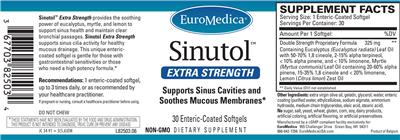
Sinutol Extra Strength contains 3 active ingredients: eucalyptus leaf oil, myrtle leaf oil, and lemon zest oil — all in a proprietary formula blend. The softgel capsule also contains several inactive ingredients that help deliver and protect the oils: olive oil, gelatin, glycerol, and several stabilizing agents like sodium alginate and medium-chain triglycerides.
Does it work?
Not established
The evidence we hold on the active ingredients in this product shows insufficient reliable evidence to rate how well they work for any of the conditions they're marketed toward — whether that's respiratory issues, infections, or other uses. That doesn't mean they don't work; it means the research backing them isn't established enough in our data to make a claim either way.
If you're considering this product, talk with your doctor or pharmacist about whether there's evidence supporting it for your specific situation.
How safe is it?
Well-documented data
Eucalyptus oil is generally well tolerated in small, diluted amounts, but the undiluted oil can be toxic if swallowed — causing nausea, diarrhea, vomiting, and in rare cases serious effects like central nervous system depression, seizures, and even coma at doses as low as 1 mL. Topically it may cause burning, itching, or redness.
Myrtle leaf oil has limited safety data; serious rare side effects reported orally include low blood pressure and respiratory failure. Lemon oil in food amounts is well tolerated, but concentrated forms aren't well studied — regular fresh lemon juice at higher doses has caused heartburn and stomach upset in a meaningful number of trial participants.
Eucalyptus is rated likely safe in pregnancy and lactation. Myrtle, however, is rated likely unsafe in pregnancy and lactation — the safety data advises against it during these times.
Lemon has insufficient data for pregnancy and lactation, so there isn't enough information to know either way; talk with your doctor or pharmacist for personalized advice.
Meds to double-check
Moderate interaction found
Before taking this product, double-check with your pharmacist or doctor if you're on any medications processed through CYP1A2, CYP2C19, CYP2C9, or CYP3A4 enzymes (a large group including many heart, psychiatric, and pain medications). Also flag it if you take blood sugar medications, amphetamines, pentobarbital, or itraconazole.
Eucalyptus oil's effects on these pathways are theoretical but documented enough to warrant confirmation.
The bottom line
Scorecard at a glanceFormula with limited ingredient disclosure with no established evidence rating for its marketed use. Moderate medication interactions have been identified, and safety information is well characterized.
Sinutol Extra Strength is marketed for respiratory and sinus support, but we don't hold evidence that its ingredients work for those uses. More importantly, eucalyptus can interact with a wide range of medications through how your liver processes them, and the product also carries safety concerns if you're pregnant, breastfeeding, or taking certain drugs.
Check your medications on this page before starting, and talk it over with your doctor or pharmacist to see if it's right for you.
Educational only — not medical advice; always confirm with your pharmacist. Our editorial policy · How we use AI
Assessment coverage: 3 of 3 active ingredients matched to our full ingredient reviews (monographs). Based on the product label dated Apr 11, 2022.
This Scorecard evaluates available label information, ingredient evidence, and known medication-safety considerations. It does not independently verify product identity, purity, potency, contamination, or manufacturing quality. How these ratings are computed
General information
Key facts about Sinutol Extra Strength, straight from the product label.
| Brand | EuroMedica |
|---|---|
| Barcode (UPC) | 367703825034 |
| Net contents | 30 Enteric-Coated Softgel(s) |
| Market status | On market |
| Date entered into DSLD | Apr 11, 2022 |
| DSLD ID | 261771 |
| Product type | Botanical |
| Supplement form | Softgel Capsule |
| Dietary claims / uses | All Other, Structure/Function |
| Intended target group(s) | Adult (18 - 50 Years), Gluten Free, Dairy Free, Sugar Free |
Everything in this section is reproduced from the manufacturer’s own product label — it’s the label speaking, not HelloPharmacist. We show it so you can see exactly what the maker states; we don’t verify or endorse those statements.
Supplement Facts
The label details for Sinutol Extra Strength by EuroMedica, sourced from the NIH Dietary Supplement Label Database.
Supplement Facts
| Ingredient | Amount | % DV |
|---|---|---|
| Eucalyptus (Eucalyptus radiata) leaf oil | 0 NP | -- |
| Myrtle (Myrtus communis cineole) leaf oil | 0 NP | -- |
| Double Strength Proprietary Formula | 325 mg | -- |
| Lemon (Citrus limon) zest Oil | 0 NP | -- |
Other ingredients: extra virgin Olive Oil, Gelatin, Glycerol, Water, Water, Purified, Ethylcellulose, Sodium Alginate, Ammonium Hydroxide, Medium Chain Triglyceride, Oleic Acid, Stearic Acid
Tap any ingredient to jump to its full detail below.
These statements are the manufacturer’s wording, reproduced from the product label — the label is saying it, not HelloPharmacist. We don’t verify or endorse them.
Formula
Sinutol Extra Strength provides the soothing power of eucalyptus, myrtle, and lemon to support sinus health and maintain clear bronchial passages.
Formulation
Sinutol Extra Strength supports sinus cilia activity for healthy mucous drainage. This unique enteric-coated softgel is gentle for those with gastrointestinal sensitivities or those who need a high potency formula.
Supports sinus cavities and soothes mucous membranes
Non-GMO
No sugar, salt, yeast, wheat, gluten, corn, soy, dairy products, artificial coloring, artificial flavoring, or artificial preservatives.
Product of Belgium
Suggested/Recommended/Usage/Directions
Recommendations: 1 enteric-coated softgel, up to 3 times daily, or as recommended by your healthcare practitioner.
Precautions
If pregnant or nursing, consult a healthcare practitioner before using.
Do not chew
FDA Disclaimer Statement
These statements have not been evaluated by the Food and Drug Administration. This product is not intended to diagnose, treat, cure or prevent any disease.
FDA Statement of Identity
Dietary Supplement
Is this label outdated? Report a formula or label change and our pharmacy team will review it.
Sinutol Extra Strength by EuroMedica label
The label scan from the NIH Dietary Supplement Label Database. Tap to enlarge.
Label images are published by the NIH Dietary Supplement Label Database for the version of this product on file. Always read your actual product label.
View the full label (PDF)The Ingredients in Sinutol Extra Strength by EuroMedica
These are the 3 active ingredients this product is made of. Select any to open its full monograph.
Serving size1 Enteric Coated Softgel(s) Dosage formSoftgel Capsule Servings per container30 Amounts shown are per serving.
Most supplement products combine several ingredients, and a medication can interact with the product through any one of them. Each ingredient below shows whether it has known drug interactions.
Double Strength Proprietary Formula
Other (inactive) ingredients: Extra virgin Olive Oil, Gelatin, Glycerol, Water, Water, Purified, Ethylcellulose, Sodium Alginate, Ammonium Hydroxide, Medium Chain Triglyceride, Oleic Acid, Stearic Acid. These complete the product’s ingredient list but are not active constituents.
Sinutol Extra Strength by EuroMedica Drug Interactions
HelloPharmacist Interaction Report
Sinutol Extra Strength by EuroMedica may interact with medications through its eucalyptus and lemon oil content.
The most serious concern involves eucalyptus's theoretical effect on how your liver processes several classes of drugs — it may slow the breakdown of medications metabolized by CYP1A2, CYP2C19, CYP2C9, and CYP3A4 enzymes, potentially raising drug levels in your blood. These are in vitro findings not yet reported in humans, but the concern is real enough to warrant checking before you start.
Read the full breakdown — every affected drug type, severity by severity
Eucalyptus also carries Moderate-level risks with blood sugar medications (theoretically increasing low blood sugar risk), amphetamines (possibly reducing their effect), and pentobarbital, a sedating medication. Lemon oil has a Minor interaction with itraconazole, an antifungal — the acid in lemon may increase how much of the drug your body absorbs.
Myrtle leaf oil, the third active ingredient, has no interactions documented in our data. Altogether, these interactions span 879 individual medications.
Because many common drugs — from heart medications to psychiatric drugs to pain relievers — are processed through those liver pathways, it's important you check your exact medications with the search tool on this page before taking this product.
Check your own medications below · Editorial policy · How we use AI
Want to check YOUR meds against Sinutol Extra Strength?
Ask about interactions with your drugs in plain English — “Can I take it with lisinopril?” — and we find you the answer in seconds, ingredient by ingredient.
Go to the checkerIngredients driving the most interactions
Individual Drug Interactions
The ingredients in Sinutol Extra Strength interact with 878 drugs. Click any drug to see the details.
2 of the 3 ingredients in Sinutol Extra Strength interact with drugs. Each result below shows which ingredient is responsible. Eucalyptus (Eucalyptus radiata) leaf oil Lemon (Citrus limon) zest Oil
Ado-trastuzumab EmtansineKadcyla
How Ado-trastuzumab Emtansine interacts with Sinutol Extra Strength — through 1 ingredient. Tap an ingredient for the detail:
Eucalyptus (eucalyptus Radiata) Leaf OilCytochrome P450 3a4 (cyp3a4) Substrates Moderate
Interaction Summary
Theoretically, eucalyptus might increase the levels of CYP3A4 substrates.
Read the full Eucalyptus (eucalyptus Radiata) Leaf Oil + Ado-trastuzumab Emtansine interactionAbemaciclibVerzenio
How Abemaciclib interacts with Sinutol Extra Strength — through 1 ingredient. Tap an ingredient for the detail:
Eucalyptus (eucalyptus Radiata) Leaf OilCytochrome P450 3a4 (cyp3a4) Substrates Moderate
Interaction Summary
Theoretically, eucalyptus might increase the levels of CYP3A4 substrates.
Read the full Eucalyptus (eucalyptus Radiata) Leaf Oil + Abemaciclib interactionAbiraterone
How Abiraterone interacts with Sinutol Extra Strength — through 1 ingredient. Tap an ingredient for the detail:
Eucalyptus (eucalyptus Radiata) Leaf OilCytochrome P450 3a4 (cyp3a4) Substrates Moderate
Interaction Summary
Theoretically, eucalyptus might increase the levels of CYP3A4 substrates.
Read the full Eucalyptus (eucalyptus Radiata) Leaf Oil + Abiraterone interactionAbiraterone AcetateYonsa, Zytiga
How Abiraterone Acetate interacts with Sinutol Extra Strength — through 1 ingredient. Tap an ingredient for the detail:
Eucalyptus (eucalyptus Radiata) Leaf OilCytochrome P450 3a4 (cyp3a4) Substrates Moderate
Interaction Summary
Theoretically, eucalyptus might increase the levels of CYP3A4 substrates.
Read the full Eucalyptus (eucalyptus Radiata) Leaf Oil + Abiraterone Acetate interactionAbrocitinibCibinqo
How Abrocitinib interacts with Sinutol Extra Strength — through 1 ingredient. Tap an ingredient for the detail:
Eucalyptus (eucalyptus Radiata) Leaf OilCytochrome P450 2c19 (cyp2c19) Substrates, Cytochrome P450 2c9 (cyp2c9) Substrates Moderate
Interaction Summary
Theoretically, eucalyptus might increase the levels of CYP2C19 substrates.
Read the full Eucalyptus (eucalyptus Radiata) Leaf Oil + Abrocitinib interactionAcalabrutinibCalquence
How Acalabrutinib interacts with Sinutol Extra Strength — through 1 ingredient. Tap an ingredient for the detail:
Eucalyptus (eucalyptus Radiata) Leaf OilCytochrome P450 3a4 (cyp3a4) Substrates Moderate
Interaction Summary
Theoretically, eucalyptus might increase the levels of CYP3A4 substrates.
Read the full Eucalyptus (eucalyptus Radiata) Leaf Oil + Acalabrutinib interactionAcarboseGlucobay, Prandase, Precose
How Acarbose interacts with Sinutol Extra Strength — through 1 ingredient. Tap an ingredient for the detail:
Eucalyptus (eucalyptus Radiata) Leaf OilAntidiabetes Drugs Moderate
Interaction Summary
Theoretically, eucalyptus leaf might increase the risk of hypoglycemia.
Read the full Eucalyptus (eucalyptus Radiata) Leaf Oil + Acarbose interactionAcetaminophenChildren's Tylenol, Children's Tylenol Meltaways, Tylenol, Tylenol Ex Strength
How Acetaminophen interacts with Sinutol Extra Strength — through 1 ingredient. Tap an ingredient for the detail:
Eucalyptus (eucalyptus Radiata) Leaf OilCytochrome P450 1a2 (cyp1a2) Substrates Moderate
Interaction Summary
Theoretically, eucalyptus might increase the levels of CYP1A2 substrates.
Read the full Eucalyptus (eucalyptus Radiata) Leaf Oil + Acetaminophen interactionAcetaminophen, AspirinGemnisyn
How Acetaminophen, Aspirin interacts with Sinutol Extra Strength — through 1 ingredient. Tap an ingredient for the detail:
Eucalyptus (eucalyptus Radiata) Leaf OilCytochrome P450 1a2 (cyp1a2) Substrates Moderate
Interaction Summary
Theoretically, eucalyptus might increase the levels of CYP1A2 substrates.
Read the full Eucalyptus (eucalyptus Radiata) Leaf Oil + Acetaminophen, Aspirin interactionAcetaminophen, Aspirin, CaffeineExcedrin, Excedrin Extra Strength, Excedrin Migraine
How Acetaminophen, Aspirin, Caffeine interacts with Sinutol Extra Strength — through 1 ingredient. Tap an ingredient for the detail:
Eucalyptus (eucalyptus Radiata) Leaf OilCytochrome P450 1a2 (cyp1a2) Substrates, Cytochrome P450 3a4 (cyp3a4) Substrates Moderate
Interaction Summary
Theoretically, eucalyptus might increase the levels of CYP1A2 substrates.
Read the full Eucalyptus (eucalyptus Radiata) Leaf Oil + Acetaminophen, Aspirin, Caffeine interactionAcetaminophen, Brompheniramine, PhenylpropanolamineDimetapp Cold and Flu
How Acetaminophen, Brompheniramine, Phenylpropanolamine interacts with Sinutol Extra Strength — through 1 ingredient. Tap an ingredient for the detail:
Eucalyptus (eucalyptus Radiata) Leaf OilCytochrome P450 1a2 (cyp1a2) Substrates Moderate
Interaction Summary
Theoretically, eucalyptus might increase the levels of CYP1A2 substrates.
Read the full Eucalyptus (eucalyptus Radiata) Leaf Oil + Acetaminophen, Brompheniramine, Phenylpropanolamine interactionAcetaminophen, ButalbitalAxocet, Bancap, Bucet, Butex Forte, Esgic CF, Orbivan CF +5 more
How Acetaminophen, Butalbital interacts with Sinutol Extra Strength — through 1 ingredient. Tap an ingredient for the detail:
Eucalyptus (eucalyptus Radiata) Leaf OilCytochrome P450 1a2 (cyp1a2) Substrates Moderate
Interaction Summary
Theoretically, eucalyptus might increase the levels of CYP1A2 substrates.
Read the full Eucalyptus (eucalyptus Radiata) Leaf Oil + Acetaminophen, Butalbital interactionAcetaminophen, Butalbital, CaffeineEsgic, Esgic Plus, Fiogesic, Fioricet, Repan, Tecnal +1 more
How Acetaminophen, Butalbital, Caffeine interacts with Sinutol Extra Strength — through 1 ingredient. Tap an ingredient for the detail:
Eucalyptus (eucalyptus Radiata) Leaf OilCytochrome P450 1a2 (cyp1a2) Substrates, Cytochrome P450 3a4 (cyp3a4) Substrates Moderate
Interaction Summary
Theoretically, eucalyptus might increase the levels of CYP1A2 substrates.
Read the full Eucalyptus (eucalyptus Radiata) Leaf Oil + Acetaminophen, Butalbital, Caffeine interactionAcetaminophen, Butalbital, Caffeine, CodeineEsgic with Codeine, Fioricet w/ Codeine
How Acetaminophen, Butalbital, Caffeine, Codeine interacts with Sinutol Extra Strength — through 1 ingredient. Tap an ingredient for the detail:
Eucalyptus (eucalyptus Radiata) Leaf OilCytochrome P450 1a2 (cyp1a2) Substrates, Cytochrome P450 3a4 (cyp3a4) Substrates Moderate
Interaction Summary
Theoretically, eucalyptus might increase the levels of CYP1A2 substrates.
Read the full Eucalyptus (eucalyptus Radiata) Leaf Oil + Acetaminophen, Butalbital, Caffeine, Codeine interactionAcetaminophen, Butalbital, CodeineBancap w/ Codeine
How Acetaminophen, Butalbital, Codeine interacts with Sinutol Extra Strength — through 1 ingredient. Tap an ingredient for the detail:
Eucalyptus (eucalyptus Radiata) Leaf OilCytochrome P450 1a2 (cyp1a2) Substrates Moderate
Interaction Summary
Theoretically, eucalyptus might increase the levels of CYP1A2 substrates.
Read the full Eucalyptus (eucalyptus Radiata) Leaf Oil + Acetaminophen, Butalbital, Codeine interactionAcetaminophen, Butalbital, Codeine PhosphatePhrenilin #3
How Acetaminophen, Butalbital, Codeine Phosphate interacts with Sinutol Extra Strength — through 1 ingredient. Tap an ingredient for the detail:
Eucalyptus (eucalyptus Radiata) Leaf OilCytochrome P450 1a2 (cyp1a2) Substrates Moderate
Interaction Summary
Theoretically, eucalyptus might increase the levels of CYP1A2 substrates.
Read the full Eucalyptus (eucalyptus Radiata) Leaf Oil + Acetaminophen, Butalbital, Codeine Phosphate interactionAcetaminophen, Caffeine, Chlorpheniramine, Hydrocodone, PhenylephrineHycomine Compound
How Acetaminophen, Caffeine, Chlorpheniramine, Hydrocodone, Phenylephrine interacts with Sinutol Extra Strength — through 1 ingredient. Tap an ingredient for the detail:
Eucalyptus (eucalyptus Radiata) Leaf OilCytochrome P450 1a2 (cyp1a2) Substrates, Cytochrome P450 3a4 (cyp3a4) Substrates Moderate
Interaction Summary
Theoretically, eucalyptus might increase the levels of CYP1A2 substrates.
Read the full Eucalyptus (eucalyptus Radiata) Leaf Oil + Acetaminophen, Caffeine, Chlorpheniramine, Hydrocodone, Phenylephrine interactionAcetaminophen, Caffeine, CodeineGesic C15, Gesic C30, Gesic C8, Lenoltec 1, Lenoltec 2, Lenoltec 3 +1 more
How Acetaminophen, Caffeine, Codeine interacts with Sinutol Extra Strength — through 1 ingredient. Tap an ingredient for the detail:
Eucalyptus (eucalyptus Radiata) Leaf OilCytochrome P450 3a4 (cyp3a4) Substrates, Cytochrome P450 1a2 (cyp1a2) Substrates Moderate
Interaction Summary
Theoretically, eucalyptus might increase the levels of CYP3A4 substrates.
Read the full Eucalyptus (eucalyptus Radiata) Leaf Oil + Acetaminophen, Caffeine, Codeine interactionAcetaminophen, Caffeine, Codeine, SalicylamideCodalan No.1, Codalan No.2, Codalan No.3
How Acetaminophen, Caffeine, Codeine, Salicylamide interacts with Sinutol Extra Strength — through 1 ingredient. Tap an ingredient for the detail:
Eucalyptus (eucalyptus Radiata) Leaf OilCytochrome P450 1a2 (cyp1a2) Substrates, Cytochrome P450 3a4 (cyp3a4) Substrates Moderate
Interaction Summary
Theoretically, eucalyptus might increase the levels of CYP1A2 substrates.
Read the full Eucalyptus (eucalyptus Radiata) Leaf Oil + Acetaminophen, Caffeine, Codeine, Salicylamide interactionAcetaminophen, Caffeine, DihydrocodeineDHC Plus, Panlor DC, Panlor SS
How Acetaminophen, Caffeine, Dihydrocodeine interacts with Sinutol Extra Strength — through 1 ingredient. Tap an ingredient for the detail:
Eucalyptus (eucalyptus Radiata) Leaf OilCytochrome P450 3a4 (cyp3a4) Substrates, Cytochrome P450 1a2 (cyp1a2) Substrates Moderate
Interaction Summary
Theoretically, eucalyptus might increase the levels of CYP3A4 substrates.
Read the full Eucalyptus (eucalyptus Radiata) Leaf Oil + Acetaminophen, Caffeine, Dihydrocodeine interactionAcetaminophen, Caffeine, IsomethepteneMigralam
How Acetaminophen, Caffeine, Isometheptene interacts with Sinutol Extra Strength — through 1 ingredient. Tap an ingredient for the detail:
Eucalyptus (eucalyptus Radiata) Leaf OilCytochrome P450 1a2 (cyp1a2) Substrates, Cytochrome P450 3a4 (cyp3a4) Substrates Moderate
Interaction Summary
Theoretically, eucalyptus might increase the levels of CYP1A2 substrates.
Read the full Eucalyptus (eucalyptus Radiata) Leaf Oil + Acetaminophen, Caffeine, Isometheptene interactionAcetaminophen, Caffeine, PyrilamineMidol Max Strength Menstrual
How Acetaminophen, Caffeine, Pyrilamine interacts with Sinutol Extra Strength — through 1 ingredient. Tap an ingredient for the detail:
Eucalyptus (eucalyptus Radiata) Leaf OilCytochrome P450 3a4 (cyp3a4) Substrates, Cytochrome P450 1a2 (cyp1a2) Substrates Moderate
Interaction Summary
Theoretically, eucalyptus might increase the levels of CYP3A4 substrates.
Read the full Eucalyptus (eucalyptus Radiata) Leaf Oil + Acetaminophen, Caffeine, Pyrilamine interactionAcetaminophen, Chlorpheniramine Maleate, Dextromethorphan HbrVicks Formula 44M Cough, Cold & Flu Relief
How Acetaminophen, Chlorpheniramine Maleate, Dextromethorphan Hbr interacts with Sinutol Extra Strength — through 1 ingredient. Tap an ingredient for the detail:
Eucalyptus (eucalyptus Radiata) Leaf OilCytochrome P450 1a2 (cyp1a2) Substrates, Cytochrome P450 3a4 (cyp3a4) Substrates Moderate
Interaction Summary
Theoretically, eucalyptus might increase the levels of CYP1A2 substrates.
Read the full Eucalyptus (eucalyptus Radiata) Leaf Oil + Acetaminophen, Chlorpheniramine Maleate, Dextromethorphan Hbr interactionAcetaminophen, Chlorpheniramine, Codeine, PhenylephrineColrex
How Acetaminophen, Chlorpheniramine, Codeine, Phenylephrine interacts with Sinutol Extra Strength — through 1 ingredient. Tap an ingredient for the detail:
Eucalyptus (eucalyptus Radiata) Leaf OilCytochrome P450 1a2 (cyp1a2) Substrates, Cytochrome P450 3a4 (cyp3a4) Substrates Moderate
Interaction Summary
Theoretically, eucalyptus might increase the levels of CYP1A2 substrates.
Read the full Eucalyptus (eucalyptus Radiata) Leaf Oil + Acetaminophen, Chlorpheniramine, Codeine, Phenylephrine interactionAcetaminophen, Chlorpheniramine, DextromethorphanCoricidin II Extra Strength Cold and Flu
How Acetaminophen, Chlorpheniramine, Dextromethorphan interacts with Sinutol Extra Strength — through 1 ingredient. Tap an ingredient for the detail:
Eucalyptus (eucalyptus Radiata) Leaf OilCytochrome P450 3a4 (cyp3a4) Substrates, Cytochrome P450 1a2 (cyp1a2) Substrates Moderate
Interaction Summary
Theoretically, eucalyptus might increase the levels of CYP3A4 substrates.
Read the full Eucalyptus (eucalyptus Radiata) Leaf Oil + Acetaminophen, Chlorpheniramine, Dextromethorphan interactionAcetaminophen, Chlorpheniramine, Dextromethorphan HydrobromideCoricidin HBP Maximum Strength Flu
How Acetaminophen, Chlorpheniramine, Dextromethorphan Hydrobromide interacts with Sinutol Extra Strength — through 1 ingredient. Tap an ingredient for the detail:
Eucalyptus (eucalyptus Radiata) Leaf OilCytochrome P450 1a2 (cyp1a2) Substrates, Cytochrome P450 3a4 (cyp3a4) Substrates Moderate
Interaction Summary
Theoretically, eucalyptus might increase the levels of CYP1A2 substrates.
Read the full Eucalyptus (eucalyptus Radiata) Leaf Oil + Acetaminophen, Chlorpheniramine, Dextromethorphan Hydrobromide interactionAcetaminophen, Chlorpheniramine, Dextromethorphan, PhenylpropanolamineMulti Symptom Cold Relief
How Acetaminophen, Chlorpheniramine, Dextromethorphan, Phenylpropanolamine interacts with Sinutol Extra Strength — through 1 ingredient. Tap an ingredient for the detail:
Eucalyptus (eucalyptus Radiata) Leaf OilCytochrome P450 3a4 (cyp3a4) Substrates, Cytochrome P450 1a2 (cyp1a2) Substrates Moderate
Interaction Summary
Theoretically, eucalyptus might increase the levels of CYP3A4 substrates.
Read the full Eucalyptus (eucalyptus Radiata) Leaf Oil + Acetaminophen, Chlorpheniramine, Dextromethorphan, Phenylpropanolamine interactionAcetaminophen, Chlorpheniramine, Dextromethorphan, PseudoephedrineChildren's Tylenol Cold Plus Cough, Tylenol Cold Ex Strength
How Acetaminophen, Chlorpheniramine, Dextromethorphan, Pseudoephedrine interacts with Sinutol Extra Strength — through 1 ingredient. Tap an ingredient for the detail:
Eucalyptus (eucalyptus Radiata) Leaf OilCytochrome P450 1a2 (cyp1a2) Substrates, Cytochrome P450 3a4 (cyp3a4) Substrates Moderate
Interaction Summary
Theoretically, eucalyptus might increase the levels of CYP1A2 substrates.
Read the full Eucalyptus (eucalyptus Radiata) Leaf Oil + Acetaminophen, Chlorpheniramine, Dextromethorphan, Pseudoephedrine interactionAcetaminophen, Chlorpheniramine, Guaifenesin, Phenylephrine, SalicylamideRhinogesic GG
How Acetaminophen, Chlorpheniramine, Guaifenesin, Phenylephrine, Salicylamide interacts with Sinutol Extra Strength — through 1 ingredient. Tap an ingredient for the detail:
Eucalyptus (eucalyptus Radiata) Leaf OilCytochrome P450 3a4 (cyp3a4) Substrates, Cytochrome P450 1a2 (cyp1a2) Substrates Moderate
Interaction Summary
Theoretically, eucalyptus might increase the levels of CYP3A4 substrates.
Read the full Eucalyptus (eucalyptus Radiata) Leaf Oil + Acetaminophen, Chlorpheniramine, Guaifenesin, Phenylephrine, Salicylamide interactionAcetaminophen, Chlorpheniramine, PhenylephrineAlka-Seltzer PLUS, Histex SR, Protid
How Acetaminophen, Chlorpheniramine, Phenylephrine interacts with Sinutol Extra Strength — through 1 ingredient. Tap an ingredient for the detail:
Eucalyptus (eucalyptus Radiata) Leaf OilCytochrome P450 1a2 (cyp1a2) Substrates, Cytochrome P450 3a4 (cyp3a4) Substrates Moderate
Interaction Summary
Theoretically, eucalyptus might increase the levels of CYP1A2 substrates.
Read the full Eucalyptus (eucalyptus Radiata) Leaf Oil + Acetaminophen, Chlorpheniramine, Phenylephrine interactionEach ingredient & the kinds of drugs it affects
For each ingredient in Sinutol Extra Strength with known interactions, here are the types of medications they can affect. Open any type for the detail — or search your exact drug in the checker above.
Eucalyptus (Eucalyptus radiata) leaf oil
Amphetamines
Theoretically, inhaling eucalyptol may reduce the effectiveness of amphetamines.
Animal research suggests that inhaling eucalyptol may reduce the levels of amphetamines in the blood.
Antidiabetes Drugs
Theoretically, eucalyptus leaf might increase the risk of hypoglycemia.
Animal research suggests that eucalyptus leaf might have hypoglycemic activity, and might have additive effects when used with antidiabetes drugs.
Cytochrome P450 1A2 (Cyp1A2) Substrates
Theoretically, eucalyptus might increase the levels of CYP1A2 substrates.
In vitro research suggests that eucalyptus oil might inhibit CYP1A2, although this has not been reported in humans.
Cytochrome P450 2C19 (Cyp2C19) Substrates
Theoretically, eucalyptus might increase the levels of CYP2C19 substrates.
In vitro research suggests that eucalyptus oil might inhibit CYP2C19, although this has not been reported in humans.
Cytochrome P450 2C9 (Cyp2C9) Substrates
Theoretically, eucalyptus might increase the levels of CYP2C9 substrates.
In vitro research suggests that eucalyptus oil might inhibit CYP2C9, although this has not been reported in humans.
Cytochrome P450 3A4 (Cyp3A4) Substrates
Theoretically, eucalyptus might increase the levels of CYP3A4 substrates.
In vitro research suggests that eucalyptus oil might inhibit CYP3A4, although this has not been reported in humans.
Pentobarbital (Nembutal)
Theoretically, inhaling eucalyptol might reduce the effectiveness of pentobarbital.
Animal research suggests that inhaling eucalyptol reduces the level of pentobarbital that reaches the brain.
Lemon (Citrus limon) zest Oil
Itraconazole (Sporanox)
Theoretically, taking itraconazole capsules or tablets with a beverage containing lemon might increase the levels and clinical effects of itraconazole.
In one case report, dissolving itraconazole tablets in a small amount of specific beverages containing lemon prior to administration increased the level of itraconazole in a lung transplant patient. In this case, the increased bioavailability was desirable and was likely due to improved tablet dissolution in the acidic beverage.
Brand information
Manufacturer and brand details for Sinutol Extra Strength, from the product label.
EuroMedica
See all EuroMedica products- Name
- EuroMedica
- Street Address
- 955 Challenger Drive
- City
- Green Bay
- State
- WI
- ZipCode
- 54311
- Phone Number
- 866-842-7256
Sinutol Extra Strength by EuroMedica: Common Questions
Does Sinutol Extra Strength by EuroMedica interact with any medications?
How can one product interact with so many drugs?
Where does this information come from?
Is this product safe to use if I'm pregnant or breastfeeding?
Can eucalyptus in this product affect how my medications work?
What are the main side effects of eucalyptus oil?
Does this product have any fillers or other ingredients besides the active oils?
What is this product supposed to do?
Written and reviewed by the HelloPharmacist editorial staff. Our editorial policy
Not sure if Sinutol Extra Strength is safe with your meds?
Our pharmacists answer your medication & supplement questions — free.
Label information is sourced from the NIH Dietary Supplement Label Database and reflects the product version on file; always read your actual product label. This page is for education only and is not a substitute for professional medical advice. Confirm with your pharmacist or doctor before combining supplements and medications.
The Full Monographs Behind Sinutol Extra Strength’s Ingredients
Every ingredient we hold a full HelloPharmacist monograph for — uses, evidence, safety, and the complete interaction list.
Eucalyptus
Interacts with 878 drugsEucalyptus is best known for its strong-smelling oil used in vapor rubs, inhalants, and lozenges to ease coughs and congestion. It may provide mild, short-term relief of cold symptoms, but t...
Read the full Eucalyptus monograph → Herb & supplement monographMyrtle
Myrtle (Myrtus communis) is a Mediterranean shrub used traditionally for respiratory, digestive, and skin complaints. Modern research is mostly limited to laboratory and small studies, so it...
Read the full Myrtle monograph → Herb & supplement monographLemon
Interacts with 1 drugLemon is a common citrus fruit that is a good source of vitamin C and citric acid, and it is widely used in food, drinks, and home remedies. While it can support hydration and a healthy diet...
Read the full Lemon monograph →Sources & How We Checked
Sinutol Extra Strength's label data comes from the NIH Dietary Supplement Label Database; the ingredient interaction data is from the Natural Medicines database, reviewed by our pharmacists.
- NIH Dietary Supplement Label Database (DSLD) — The official product label on file for this supplement.
- Natural Medicines (Therapeutic Research Center) — Evidence-graded clinical reference behind the ingredient interaction data.
Content is written and reviewed by licensed HelloPharmacist pharmacists. See our data sources and editorial standards for how this information is built and checked.
The 28 references behind this product’s interaction data
Every citation that drives the interaction findings for this product’s ingredients, from the evidence-graded Natural Medicines (TRC Healthcare) database. Open an ingredient to browse its citations — links open the study on PubMed or the publisher’s site.
Eucalyptus 23 references
- Electronic Code of Federal Regulations. Title 21. Part 182 -- Substances Generally Recognized As Safe. Available at: https://www.accessdata.fda.gov/scripts/cdrh/cfdocs/cfcfr/CFRSearch.cfm?CFRPart=182
- Unger M, Frank A. Simultaneous determination of the inhibitory potency of herbal extracts on the activity of six major cytochrome P450 enzymes using liquid chromatography/mass spectrometry and automated online extraction. Rapid Commun Mass Spectrom 2004;1 PubMed
- De Vincenzi M, Silano M, De Vincenzi A, et al. Constituents of aromatic plants: eucalyptol. Fitoterapia 2002;73:269-75. PubMed
- Gray AM, Flatt PR. Antihyperglycemic actions of Eucalyptus globulus (Eucalyptus) are associated with pancreatic and extra-pancreatic effects in mice. J Nutr 1998;128:2319-23. PubMed
- Whitman BW, Ghazizadeh H. Eucalyptus oil: therapeutic and toxic aspects of pharmacology in humans and animals. J Paediatr Child Health 1994;30:190-1. PubMed
- Barker SC and Altman PM. An ex vivo, assessor blind, randomised, parallel group, comparative efficacy trial of the ovicidal activity of three pediculicides after a single application--melaleuca oil and lavender oil, eucalyptus oil and lemon tea tree oil,
- Vilaplana, J. and Romaguera, C. Allergic contact dermatitis due to eucalyptol in an anti-inflammatory cream. Contact Dermatitis 2000;43(2):118.
- Juergens, U. R. [Reducing the need for cortisone. Does eucalyptus oil work in asthma? (interview by Brigitte Moreano]. MMW.Fortschr Med 3-29-2001;143(13):14.
- Tascini, C., Ferranti, S., Gemignani, G., Messina, F., and Menichetti, F. Clinical microbiological case: fever and headache in a heavy consumer of eucalyptus extract. Clin Microbiol.Infect. 2002;8(7):437, 445-437, 446. PubMed
- Galdi, E., Perfetti, L., Calcagno, G., Marcotulli, M. C., and Moscato, G. Exacerbation of asthma related to Eucalyptus pollens and to herb infusion containing Eucalyptus. Monaldi Arch.Chest Dis. 2003;59(3):220-221.
- Spoerke, D. G., Vandenberg, S. A., Smolinske, S. C., Kulig, K., and Rumack, B. H. Eucalyptus oil: 14 cases of exposure. Vet Hum.Toxicol 1989;31(2):166-168.
- Jori, A., Bianchetti, A., Prestini, P. E., and Gerattini, S. Effect of eucalyptol (1,8-cineole) on the metabolism of other drugs in rats and in man. Eur.J Pharmacol 1970;9(3):362-366. PubMed
- Tibballs, J. Clinical effects and management of eucalyptus oil ingestion in infants and young children. Med J Aust 8-21-1995;163(4):177-180. PubMed
- Webb, N. J. and Pitt, W. R. Eucalyptus oil poisoning in childhood: 41 cases in south-east Queensland. J Paediatr.Child Health 1993;29(5):368-371. PubMed
- Gyldenløve M, Menné T, Thyssen JP. Eucalyptus contact allergy. Contact Dermatitis. 2014;71(5):303-304. PubMed
- Higgins C, Palmer A, Nixon R. Eucalyptus oil: contact allergy and safety. Contact Dermatitis. 2015;72(5):344-346. PubMed
- de Groot AC, Schmidt E. Eucalyptus oil and tea tree oil. Contact Dermatitis. 2015;73(6):381-386. PubMed
- Greive KA, Barnes TM. The efficacy of Australian essential oils for the treatment of head lice infestation in children: A randomised controlled trial. Australas J Dermatol. 2018;59(2):e99-e105. PubMed
- Paulsen E, Thormann H, Vestergaard L. Eucalyptus species as a cause of airborne allergic contact dermatitis. Contact Dermatitis. 2018;78(4):301-303.
- Mathew T, John SK, Kamath V, et al. Essential oil related seizures (EORS): A multi-center prospective study on essential oils and seizures in adults. Epilepsy Res. 2021;173:106626. PubMed
- Dudipala SC, Mandapuram P, Ch LK. Eucalyptus Oil-Induced Seizures in Children: Case Reports and Review of the Literature. J Neurosci Rural Pract 2021;12(1):112-115. PubMed
- Panda PK, Sharawat IK, Panda P, Dawman L, Kasinathan A. Clinico-laboratory characteristics and outcome of patients with eucalyptus oil-induced/provoked seizures: A case series and systematic review of the published patients. Trop Doct 2021;51(4):518-522. PubMed
- Sai Chandar D, Prashanthi M, Laxman Kumar C, Amith Kumar C. Eucalyptus Oil-Induced Seizures in Children: A Single-Center Prospective Study. Cureus 2021;13(3):e14109. PubMed
Myrtle 3 references
- Gruenwald J, Brendler T, Jaenicke C. PDR for Herbal Medicines. 1st ed. Montvale, NJ: Medical Economics Company, Inc., 1998.
- Salmanian M, Shirbeigi L, Hashem-Dabaghian F, et al. The Effects of Myrtle (Myrtus communis) and Clindamycin Topical Solution in the Treatment of Mild to Moderate Acne Vulgaris: A Comparative Split-Face Study. J Pharmacopuncture 2020;23(4):220-229.
- Paknejad MS, Eftekhari K, Rahimi R, Vigeh M, Naghizadeh A, Karimi M. Myrtle (Myrtus communis L.) fruit syrup for gastroesophageal reflux disease in children: A double-blind randomized clinical trial. Phytother Res 2021;35(11):6369-6376.
Lemon 2 references
- Ruggenenti P, Caruso MR, Cortinovis M, et al. Fresh lemon juice supplementation for the prevention of recurrent stones in calcium oxalate nephrolithiasis: A pragmatic, prospective, randomised, open, blinded endpoint (PROBE) trial. EClinicalMedicine 2021;4 PubMed
- Umemura K, Katada Y, Nakagawa S, et al. Improved absorption of itraconazole tablet by co-administration with lemon beverages in a lung transplant recipient: A case report. J Infect Chemother 2022;28(8):1203-1207. PubMed
Parts of this content are provided by the Therapeutic Research Center, LLC.
DISCLAIMER: Currently this does not check for drug-drug interactions. This is not an all-inclusive comprehensive list of potential interactions and is for informational purposes only. Not all interactions are known or well-reported in the scientific literature, and new interactions are continually being reported. Input is needed from a qualified healthcare provider including a pharmacist before starting any therapy. Application of clinical judgment is necessary.
© 2021 Therapeutic Research Center, LLC