
Wild Lettuce and Passionflower Ingredients & Drug Interactions
by Herbal Terra
What is this page for?
First and foremost: checking Wild Lettuce and Passionflower against your medications. The heart of this page is the interaction checker and the full interaction report — how this product’s ingredients may interact with prescription and over-the-counter medicines you may be taking.
Around that, we add a pharmacist’s high-level view of the product as a whole — what’s inside, the evidence for its stated use, how transparent the label is, and what safety data exists — so you can see the full picture in one place. It’s educational information from our licensed clinical databases and the clinical staff at HelloPharmacist — not medical advice — and we don’t sell or endorse products. Our editorial policy
Wild Lettuce and Passionflower is a dietary supplement by Herbal Terra with 2 active ingredients. Its ingredients are commonly taken for anxiety and stress, trouble sleeping, restlessness.Based on those ingredients, 926 medications have a known interaction with it, the most serious rated moderate. The ingredients most likely to interact are Passionflower Herb Extract, Dry, Wild Lettuce Herb Extract, Dry. Use the checker below to test your specific medication, or read the full HelloPharmacist Interaction Report.
Check Your Meds Against Wild Lettuce and Passionflower by Herbal Terra
Ask about any prescription or over-the-counter medication and we check it for interactions with Wild Lettuce and Passionflower by Herbal Terra — and tell you which ingredient is responsible.
AI summaries are generated from our interaction database for education only — always confirm with your pharmacist. How we use AI
Ask the Pharmacist
A licensed pharmacist will answer your question by email — free, usually within 24 hours.
Got it — thank you!
A licensed pharmacist will answer within 24 hours. Keep an eye on your email (worth checking spam, just in case).
HelloPharmacist Scorecard of Wild Lettuce and Passionflower by Herbal Terra
Our pharmacy team’s full take, with four database checks built into the cards below — a summary of what is known, not a grade of the product itself.
What’s inside
Low disclosure
This product contains 2 active ingredients: a proprietary extract blend (whose specific components aren't listed on the label), passionflower herb extract, and wild lettuce herb extract. Both extracts are in dry form.
The liquid also contains alcohol, water, and glycerin as inactive ingredients that help hold everything in suspension.
Does it work?
Moderate evidence
Passionflower has been rated possibly effective for insomnia and pre-procedural anxiety — the kind of worry people feel before a medical procedure. For alcohol use disorder and benzodiazepine (prescription anti-anxiety medication) withdrawal, the evidence isn't strong enough to rate it.
Wild lettuce has no effectiveness ratings in our data, so we can't tell you whether it works for any particular use.
How safe is it?
Well-documented data
Passionflower is generally well tolerated when used short-term, though drowsiness is common. The most frequently reported side effects are confusion, dizziness, sensitivity reactions, and sedation.
There's a case report of someone experiencing severe nausea, vomiting, drowsiness, and heart rhythm changes after very high doses, though symptoms resolved once the herb was stopped. Passionflower should be avoided during pregnancy due to lack of safety data and possible effects on the uterus, and it's best avoided while breastfeeding.
Wild lettuce has limited human safety data. Large doses have been linked to sweating, rapid heartbeat, dizziness, ringing in the ears, vision changes, and somnolence.
It should be avoided during pregnancy and while breastfeeding because there isn't enough safety information.
Meds to double-check
Moderate interaction found
Check with us before using this product if you take sedatives, sleep aids, or other drugs that slow your nervous system (moderate interaction with both herbs). If you take anticholinergic medications, wild lettuce poses a moderate risk.
Additionally, passionflower may affect how certain medications are absorbed (minor) and may reduce the effects of some liver-processed drugs (minor). Use the search tool above to verify your specific medications.
The bottom line
Scorecard at a glanceFormula with limited ingredient disclosure with some supporting evidence for its stated purpose. Moderate medication interactions have been identified, and safety information is well characterized.
This product is mainly for people looking for herbal support with sleep or pre-procedure anxiety. If you take any sedative, anticholinergic, or other prescription medications, run them through our interaction checker first — the interaction list is long.
Talk to your pharmacist before starting, especially if you're pregnant, breastfeeding, or taking multiple medications.
Educational only — not medical advice; always confirm with your pharmacist. Our editorial policy · How we use AI
Assessment coverage: 2 of 2 active ingredients matched to our full ingredient reviews (monographs). Based on the product label dated Jan 23, 2025.
This Scorecard evaluates available label information, ingredient evidence, and known medication-safety considerations. It does not independently verify product identity, purity, potency, contamination, or manufacturing quality. How these ratings are computed
General information
Key facts about Wild Lettuce and Passionflower, straight from the product label.
| Brand | Herbal Terra |
|---|---|
| Barcode (UPC) | 7439500534525 |
| Net contents | 2 Fluid Ounce(s); 60 mL |
| Market status | On market |
| Date entered into DSLD | Jan 23, 2025 |
| DSLD ID | 325513 |
| Product type | Botanical |
| Supplement form | Liquid |
| Dietary claims / uses | All Other, Structure/Function |
| Intended target group(s) | Adult (18 - 50 Years), Gluten Free, Sugar Free |
Everything in this section is reproduced from the manufacturer’s own product label — it’s the label speaking, not HelloPharmacist. We show it so you can see exactly what the maker states; we don’t verify or endorse those statements.
Supplement Facts
The label details for Wild Lettuce and Passionflower by Herbal Terra, sourced from the NIH Dietary Supplement Label Database.
Supplement Facts
| Ingredient | Amount | % DV |
|---|---|---|
| Proprietary Extract Blend | 983 mg | -- |
| Passionflower Herb Extract, Dry | 0 NP | -- |
| Wild Lettuce Herb Extract, Dry | 0 NP | -- |
Other ingredients: Alcohol, Water, Glycerin
Tap any ingredient to jump to its full detail below.
These statements are the manufacturer’s wording, reproduced from the product label — the label is saying it, not HelloPharmacist. We don’t verify or endorse them.
Suggested/Recommended/Usage/Directions
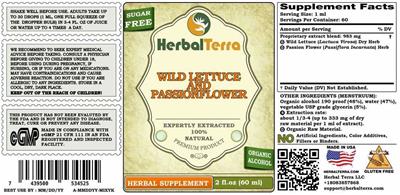
Shake well before use. Adults take up to 30 drops (1 mL, one full squeeze of the dropper bulb) in 3-4 fl. oz. of juice or water up to 4 times a day.
Precautions
We recommend to seek expert medical advice before taking. May have contraindications and cause adverse reaction.
Consult a physician before giving to children under 18, before using during pregnancy, if nursing, or if you are on any medications.
Consult a physician before giving to children under 18, before using during pregnancy, if nursing, or if you are on any medications. Keep out of the reach of children!
Do not use if you are allergic to any ingredients.
Storage
Store in a cool, dry, dark place.
FDA Disclaimer Statement
This product has not been evaluated by the FDA and is not intended to diagnose, treat, cure or prevent any disease.
Formulation
cGMP Made in compliance with cGMP 21 CFR 111 in an FDA registered and inspected facility.
Sugar free
Expertly extracted 100% natural Premium product
Organic alcohol
No artificial ingredients, color additives, fillers or binders.
Natural Gluten free
Formula
Organic alcohol
FDA Statement of Identity
Herbal Supplement
Seals/Symbols
Made in USA
General Statements
Extraction rate: about 1/3-4 (up to 333 mg of dry raw material per 1 ml of extract).
Is this label outdated? Report a formula or label change and our pharmacy team will review it.
Wild Lettuce and Passionflower by Herbal Terra label
The label scan from the NIH Dietary Supplement Label Database. Tap to enlarge.
Label images are published by the NIH Dietary Supplement Label Database for the version of this product on file. Always read your actual product label.
View the full label (PDF)The Ingredients in Wild Lettuce and Passionflower by Herbal Terra
These are the 2 active ingredients this product is made of. Select any to open its full monograph.
Serving size1 mL Dosage formLiquid Servings per container60 Amounts shown are per serving.
Most supplement products combine several ingredients, and a medication can interact with the product through any one of them. Each ingredient below shows whether it has known drug interactions.
Proprietary Extract Blend
Other (inactive) ingredients: Alcohol, Water, Glycerin. These complete the product’s ingredient list but are not active constituents.
Wild Lettuce and Passionflower by Herbal Terra Drug Interactions
HelloPharmacist Interaction Report
Herbal Terra's Wild Lettuce and Passionflower can interact with medications.
The most serious concern is with sedatives and sleep aids — both passionflower and wild lettuce have documented moderate interactions with CNS depressants (drugs that slow your central nervous system). Using them together can add up to extra drowsiness, dizziness, and sedation.
Read the full breakdown — every affected drug type, severity by severity
Passionflower also has minor interactions with two other drug groups. It may reduce how well your body absorbs certain medications that rely on specific transport proteins (OATP substrates), and it might decrease the effects of drugs processed through a particular liver enzyme pathway (CYP3A4 substrates).
Wild lettuce carries an additional moderate interaction with anticholinergic drugs — medications that block a specific nervous-system signal. Though wild lettuce appears to contain only very small amounts of the anticholinergic compound, large doses have been reported to trigger anticholinergic side effects like dry mouth, constipation, and dizziness.
Altogether, these interactions span 915 individual medications. Use the interaction checker on this page to look up your exact prescriptions before you start.
Check your own medications below · Editorial policy · How we use AI
Want to check YOUR meds against Wild Lettuce and Passionflower?
Ask about interactions with your drugs in plain English — “Can I take it with lisinopril?” — and we find you the answer in seconds, ingredient by ingredient.
Go to the checkerIngredients driving the most interactions
Individual Drug Interactions
The ingredients in Wild Lettuce and Passionflower interact with 926 drugs. Click any drug to see the details.
2 of the 2 ingredients in Wild Lettuce and Passionflower interact with drugs. Each result below shows which ingredient is responsible. Passionflower Herb Extract, Dry Wild Lettuce Herb Extract, Dry
AcepromazineAtravet
How Acepromazine interacts with Wild Lettuce and Passionflower — through 2 ingredients. Tap an ingredient for the detail:
Wild Lettuce Herb Extract, DryCns Depressants, Anticholinergic Drugs Moderate
Interaction Summary
Theoretically, concomitant use with drugs with sedative effects might cause additive therapeutic effects and adverse effects.
Read the full Wild Lettuce Herb Extract, Dry + Acepromazine interactionPassionflower Herb Extract, DryCns Depressants Moderate
Interaction Summary
Concomitant use of passion flower with sedative drugs might cause additive effects and side effects.
Read the full Passionflower Herb Extract, Dry + Acepromazine interactionAcetaminophen, Butalbital, Caffeine, CodeineEsgic with Codeine, Fioricet w/ Codeine
How Acetaminophen, Butalbital, Caffeine, Codeine interacts with Wild Lettuce and Passionflower — through 2 ingredients. Tap an ingredient for the detail:
Passionflower Herb Extract, DryCytochrome P450 3a4 (cyp3a4) Substrates, Cns Depressants Moderate
Interaction Summary
Theoretically, passion flower might decrease the effects of CYP3A4 substrates.
Read the full Passionflower Herb Extract, Dry + Acetaminophen, Butalbital, Caffeine, Codeine interactionWild Lettuce Herb Extract, DryCns Depressants Moderate
Interaction Summary
Theoretically, concomitant use with drugs with sedative effects might cause additive therapeutic effects and adverse effects.
Read the full Wild Lettuce Herb Extract, Dry + Acetaminophen, Butalbital, Caffeine, Codeine interactionAcetaminophen, Butalbital, CodeineBancap w/ Codeine
How Acetaminophen, Butalbital, Codeine interacts with Wild Lettuce and Passionflower — through 2 ingredients. Tap an ingredient for the detail:
Wild Lettuce Herb Extract, DryCns Depressants Moderate
Interaction Summary
Theoretically, concomitant use with drugs with sedative effects might cause additive therapeutic effects and adverse effects.
Read the full Wild Lettuce Herb Extract, Dry + Acetaminophen, Butalbital, Codeine interactionPassionflower Herb Extract, DryCns Depressants Moderate
Interaction Summary
Concomitant use of passion flower with sedative drugs might cause additive effects and side effects.
Read the full Passionflower Herb Extract, Dry + Acetaminophen, Butalbital, Codeine interactionAcetaminophen, Butalbital, Codeine PhosphatePhrenilin #3
How Acetaminophen, Butalbital, Codeine Phosphate interacts with Wild Lettuce and Passionflower — through 2 ingredients. Tap an ingredient for the detail:
Passionflower Herb Extract, DryCns Depressants Moderate
Interaction Summary
Concomitant use of passion flower with sedative drugs might cause additive effects and side effects.
Read the full Passionflower Herb Extract, Dry + Acetaminophen, Butalbital, Codeine Phosphate interactionWild Lettuce Herb Extract, DryCns Depressants Moderate
Interaction Summary
Theoretically, concomitant use with drugs with sedative effects might cause additive therapeutic effects and adverse effects.
Read the full Wild Lettuce Herb Extract, Dry + Acetaminophen, Butalbital, Codeine Phosphate interactionAcetaminophen, Caffeine, Chlorpheniramine, Hydrocodone, PhenylephrineHycomine Compound
How Acetaminophen, Caffeine, Chlorpheniramine, Hydrocodone, Phenylephrine interacts with Wild Lettuce and Passionflower — through 2 ingredients. Tap an ingredient for the detail:
Wild Lettuce Herb Extract, DryCns Depressants, Anticholinergic Drugs Moderate
Interaction Summary
Theoretically, concomitant use with drugs with sedative effects might cause additive therapeutic effects and adverse effects.
Read the full Wild Lettuce Herb Extract, Dry + Acetaminophen, Caffeine, Chlorpheniramine, Hydrocodone, Phenylephrine interactionPassionflower Herb Extract, DryCytochrome P450 3a4 (cyp3a4) Substrates, Cns Depressants Moderate
Interaction Summary
Theoretically, passion flower might decrease the effects of CYP3A4 substrates.
Read the full Passionflower Herb Extract, Dry + Acetaminophen, Caffeine, Chlorpheniramine, Hydrocodone, Phenylephrine interactionAcetaminophen, Caffeine, CodeineGesic C15, Gesic C30, Gesic C8, Lenoltec 1, Lenoltec 2, Lenoltec 3 +1 more
How Acetaminophen, Caffeine, Codeine interacts with Wild Lettuce and Passionflower — through 2 ingredients. Tap an ingredient for the detail:
Wild Lettuce Herb Extract, DryCns Depressants Moderate
Interaction Summary
Theoretically, concomitant use with drugs with sedative effects might cause additive therapeutic effects and adverse effects.
Read the full Wild Lettuce Herb Extract, Dry + Acetaminophen, Caffeine, Codeine interactionPassionflower Herb Extract, DryCns Depressants, Cytochrome P450 3a4 (cyp3a4) Substrates Moderate
Interaction Summary
Concomitant use of passion flower with sedative drugs might cause additive effects and side effects.
Read the full Passionflower Herb Extract, Dry + Acetaminophen, Caffeine, Codeine interactionAcetaminophen, Caffeine, Codeine, SalicylamideCodalan No.1, Codalan No.2, Codalan No.3
How Acetaminophen, Caffeine, Codeine, Salicylamide interacts with Wild Lettuce and Passionflower — through 2 ingredients. Tap an ingredient for the detail:
Passionflower Herb Extract, DryCytochrome P450 3a4 (cyp3a4) Substrates, Cns Depressants Moderate
Interaction Summary
Theoretically, passion flower might decrease the effects of CYP3A4 substrates.
Read the full Passionflower Herb Extract, Dry + Acetaminophen, Caffeine, Codeine, Salicylamide interactionWild Lettuce Herb Extract, DryCns Depressants Moderate
Interaction Summary
Theoretically, concomitant use with drugs with sedative effects might cause additive therapeutic effects and adverse effects.
Read the full Wild Lettuce Herb Extract, Dry + Acetaminophen, Caffeine, Codeine, Salicylamide interactionAcetaminophen, Caffeine, DihydrocodeineDHC Plus, Panlor DC, Panlor SS
How Acetaminophen, Caffeine, Dihydrocodeine interacts with Wild Lettuce and Passionflower — through 2 ingredients. Tap an ingredient for the detail:
Wild Lettuce Herb Extract, DryCns Depressants Moderate
Interaction Summary
Theoretically, concomitant use with drugs with sedative effects might cause additive therapeutic effects and adverse effects.
Read the full Wild Lettuce Herb Extract, Dry + Acetaminophen, Caffeine, Dihydrocodeine interactionPassionflower Herb Extract, DryCns Depressants, Cytochrome P450 3a4 (cyp3a4) Substrates Moderate
Interaction Summary
Concomitant use of passion flower with sedative drugs might cause additive effects and side effects.
Read the full Passionflower Herb Extract, Dry + Acetaminophen, Caffeine, Dihydrocodeine interactionAcetaminophen, Caffeine, PyrilamineMidol Max Strength Menstrual
How Acetaminophen, Caffeine, Pyrilamine interacts with Wild Lettuce and Passionflower — through 2 ingredients. Tap an ingredient for the detail:
Wild Lettuce Herb Extract, DryAnticholinergic Drugs Moderate
Interaction Summary
Studies report varying evidence on whether or not wild lettuce contains hyoscyamine, an anticholinergic drug.
Read the full Wild Lettuce Herb Extract, Dry + Acetaminophen, Caffeine, Pyrilamine interactionPassionflower Herb Extract, DryCytochrome P450 3a4 (cyp3a4) Substrates Minor
Interaction Summary
Theoretically, passion flower might decrease the effects of CYP3A4 substrates.
Read the full Passionflower Herb Extract, Dry + Acetaminophen, Caffeine, Pyrilamine interactionAcetaminophen, Chlorpheniramine Maleate, Dextromethorphan HbrVicks Formula 44M Cough, Cold & Flu Relief
How Acetaminophen, Chlorpheniramine Maleate, Dextromethorphan Hbr interacts with Wild Lettuce and Passionflower — through 2 ingredients. Tap an ingredient for the detail:
Wild Lettuce Herb Extract, DryAnticholinergic Drugs Moderate
Interaction Summary
Studies report varying evidence on whether or not wild lettuce contains hyoscyamine, an anticholinergic drug.
Read the full Wild Lettuce Herb Extract, Dry + Acetaminophen, Chlorpheniramine Maleate, Dextromethorphan Hbr interactionPassionflower Herb Extract, DryCytochrome P450 3a4 (cyp3a4) Substrates Minor
Interaction Summary
Theoretically, passion flower might decrease the effects of CYP3A4 substrates.
Read the full Passionflower Herb Extract, Dry + Acetaminophen, Chlorpheniramine Maleate, Dextromethorphan Hbr interactionAcetaminophen, Chlorpheniramine, Codeine, PhenylephrineColrex
How Acetaminophen, Chlorpheniramine, Codeine, Phenylephrine interacts with Wild Lettuce and Passionflower — through 2 ingredients. Tap an ingredient for the detail:
Wild Lettuce Herb Extract, DryAnticholinergic Drugs, Cns Depressants Moderate
Interaction Summary
Studies report varying evidence on whether or not wild lettuce contains hyoscyamine, an anticholinergic drug.
Read the full Wild Lettuce Herb Extract, Dry + Acetaminophen, Chlorpheniramine, Codeine, Phenylephrine interactionPassionflower Herb Extract, DryCytochrome P450 3a4 (cyp3a4) Substrates, Cns Depressants Moderate
Interaction Summary
Theoretically, passion flower might decrease the effects of CYP3A4 substrates.
Read the full Passionflower Herb Extract, Dry + Acetaminophen, Chlorpheniramine, Codeine, Phenylephrine interactionAcetaminophen, Chlorpheniramine, DextromethorphanCoricidin II Extra Strength Cold and Flu
How Acetaminophen, Chlorpheniramine, Dextromethorphan interacts with Wild Lettuce and Passionflower — through 2 ingredients. Tap an ingredient for the detail:
Wild Lettuce Herb Extract, DryAnticholinergic Drugs Moderate
Interaction Summary
Studies report varying evidence on whether or not wild lettuce contains hyoscyamine, an anticholinergic drug.
Read the full Wild Lettuce Herb Extract, Dry + Acetaminophen, Chlorpheniramine, Dextromethorphan interactionPassionflower Herb Extract, DryCytochrome P450 3a4 (cyp3a4) Substrates Minor
Interaction Summary
Theoretically, passion flower might decrease the effects of CYP3A4 substrates.
Read the full Passionflower Herb Extract, Dry + Acetaminophen, Chlorpheniramine, Dextromethorphan interactionAcetaminophen, Chlorpheniramine, Dextromethorphan HydrobromideCoricidin HBP Maximum Strength Flu
How Acetaminophen, Chlorpheniramine, Dextromethorphan Hydrobromide interacts with Wild Lettuce and Passionflower — through 2 ingredients. Tap an ingredient for the detail:
Wild Lettuce Herb Extract, DryAnticholinergic Drugs Moderate
Interaction Summary
Studies report varying evidence on whether or not wild lettuce contains hyoscyamine, an anticholinergic drug.
Read the full Wild Lettuce Herb Extract, Dry + Acetaminophen, Chlorpheniramine, Dextromethorphan Hydrobromide interactionPassionflower Herb Extract, DryCytochrome P450 3a4 (cyp3a4) Substrates Minor
Interaction Summary
Theoretically, passion flower might decrease the effects of CYP3A4 substrates.
Read the full Passionflower Herb Extract, Dry + Acetaminophen, Chlorpheniramine, Dextromethorphan Hydrobromide interactionAcetaminophen, Chlorpheniramine, Dextromethorphan, PhenylpropanolamineMulti Symptom Cold Relief
How Acetaminophen, Chlorpheniramine, Dextromethorphan, Phenylpropanolamine interacts with Wild Lettuce and Passionflower — through 2 ingredients. Tap an ingredient for the detail:
Wild Lettuce Herb Extract, DryAnticholinergic Drugs Moderate
Interaction Summary
Studies report varying evidence on whether or not wild lettuce contains hyoscyamine, an anticholinergic drug.
Read the full Wild Lettuce Herb Extract, Dry + Acetaminophen, Chlorpheniramine, Dextromethorphan, Phenylpropanolamine interactionPassionflower Herb Extract, DryCytochrome P450 3a4 (cyp3a4) Substrates Minor
Interaction Summary
Theoretically, passion flower might decrease the effects of CYP3A4 substrates.
Read the full Passionflower Herb Extract, Dry + Acetaminophen, Chlorpheniramine, Dextromethorphan, Phenylpropanolamine interactionAcetaminophen, Chlorpheniramine, Dextromethorphan, PseudoephedrineChildren's Tylenol Cold Plus Cough, Tylenol Cold Ex Strength
How Acetaminophen, Chlorpheniramine, Dextromethorphan, Pseudoephedrine interacts with Wild Lettuce and Passionflower — through 2 ingredients. Tap an ingredient for the detail:
Wild Lettuce Herb Extract, DryAnticholinergic Drugs Moderate
Interaction Summary
Studies report varying evidence on whether or not wild lettuce contains hyoscyamine, an anticholinergic drug.
Read the full Wild Lettuce Herb Extract, Dry + Acetaminophen, Chlorpheniramine, Dextromethorphan, Pseudoephedrine interactionPassionflower Herb Extract, DryCytochrome P450 3a4 (cyp3a4) Substrates Minor
Interaction Summary
Theoretically, passion flower might decrease the effects of CYP3A4 substrates.
Read the full Passionflower Herb Extract, Dry + Acetaminophen, Chlorpheniramine, Dextromethorphan, Pseudoephedrine interactionAcetaminophen, Chlorpheniramine, Guaifenesin, Phenylephrine, SalicylamideRhinogesic GG
How Acetaminophen, Chlorpheniramine, Guaifenesin, Phenylephrine, Salicylamide interacts with Wild Lettuce and Passionflower — through 2 ingredients. Tap an ingredient for the detail:
Wild Lettuce Herb Extract, DryAnticholinergic Drugs Moderate
Interaction Summary
Studies report varying evidence on whether or not wild lettuce contains hyoscyamine, an anticholinergic drug.
Read the full Wild Lettuce Herb Extract, Dry + Acetaminophen, Chlorpheniramine, Guaifenesin, Phenylephrine, Salicylamide interactionPassionflower Herb Extract, DryCytochrome P450 3a4 (cyp3a4) Substrates Minor
Interaction Summary
Theoretically, passion flower might decrease the effects of CYP3A4 substrates.
Read the full Passionflower Herb Extract, Dry + Acetaminophen, Chlorpheniramine, Guaifenesin, Phenylephrine, Salicylamide interactionAcetaminophen, Chlorpheniramine, PhenylephrineAlka-Seltzer PLUS, Histex SR, Protid
How Acetaminophen, Chlorpheniramine, Phenylephrine interacts with Wild Lettuce and Passionflower — through 2 ingredients. Tap an ingredient for the detail:
Wild Lettuce Herb Extract, DryAnticholinergic Drugs Moderate
Interaction Summary
Studies report varying evidence on whether or not wild lettuce contains hyoscyamine, an anticholinergic drug.
Read the full Wild Lettuce Herb Extract, Dry + Acetaminophen, Chlorpheniramine, Phenylephrine interactionPassionflower Herb Extract, DryCytochrome P450 3a4 (cyp3a4) Substrates Minor
Interaction Summary
Theoretically, passion flower might decrease the effects of CYP3A4 substrates.
Read the full Passionflower Herb Extract, Dry + Acetaminophen, Chlorpheniramine, Phenylephrine interactionAcetaminophen, Chlorpheniramine, Phenylephrine, SalicylamideRhinogesic, Rhinogesic JR
How Acetaminophen, Chlorpheniramine, Phenylephrine, Salicylamide interacts with Wild Lettuce and Passionflower — through 2 ingredients. Tap an ingredient for the detail:
Wild Lettuce Herb Extract, DryAnticholinergic Drugs Moderate
Interaction Summary
Studies report varying evidence on whether or not wild lettuce contains hyoscyamine, an anticholinergic drug.
Read the full Wild Lettuce Herb Extract, Dry + Acetaminophen, Chlorpheniramine, Phenylephrine, Salicylamide interactionPassionflower Herb Extract, DryCytochrome P450 3a4 (cyp3a4) Substrates Minor
Interaction Summary
Theoretically, passion flower might decrease the effects of CYP3A4 substrates.
Read the full Passionflower Herb Extract, Dry + Acetaminophen, Chlorpheniramine, Phenylephrine, Salicylamide interactionAcetaminophen, Chlorpheniramine, PhenylpropanolamineAlumadrine, Conex, Sinadrin Max Strength, Sinulin
How Acetaminophen, Chlorpheniramine, Phenylpropanolamine interacts with Wild Lettuce and Passionflower — through 2 ingredients. Tap an ingredient for the detail:
Wild Lettuce Herb Extract, DryAnticholinergic Drugs Moderate
Interaction Summary
Studies report varying evidence on whether or not wild lettuce contains hyoscyamine, an anticholinergic drug.
Read the full Wild Lettuce Herb Extract, Dry + Acetaminophen, Chlorpheniramine, Phenylpropanolamine interactionPassionflower Herb Extract, DryCytochrome P450 3a4 (cyp3a4) Substrates Minor
Interaction Summary
Theoretically, passion flower might decrease the effects of CYP3A4 substrates.
Read the full Passionflower Herb Extract, Dry + Acetaminophen, Chlorpheniramine, Phenylpropanolamine interactionAcetaminophen, Chlorpheniramine, Phenylpropanolamine, OpiumHista-Derfule
How Acetaminophen, Chlorpheniramine, Phenylpropanolamine, Opium interacts with Wild Lettuce and Passionflower — through 2 ingredients. Tap an ingredient for the detail:
Passionflower Herb Extract, DryCytochrome P450 3a4 (cyp3a4) Substrates, Cns Depressants Moderate
Interaction Summary
Theoretically, passion flower might decrease the effects of CYP3A4 substrates.
Read the full Passionflower Herb Extract, Dry + Acetaminophen, Chlorpheniramine, Phenylpropanolamine, Opium interactionWild Lettuce Herb Extract, DryAnticholinergic Drugs, Cns Depressants Moderate
Interaction Summary
Studies report varying evidence on whether or not wild lettuce contains hyoscyamine, an anticholinergic drug.
Read the full Wild Lettuce Herb Extract, Dry + Acetaminophen, Chlorpheniramine, Phenylpropanolamine, Opium interactionAcetaminophen, Chlorpheniramine, Phenylpropanolamine, PhenyltoloxamineNorel Plus
How Acetaminophen, Chlorpheniramine, Phenylpropanolamine, Phenyltoloxamine interacts with Wild Lettuce and Passionflower — through 2 ingredients. Tap an ingredient for the detail:
Wild Lettuce Herb Extract, DryAnticholinergic Drugs Moderate
Interaction Summary
Studies report varying evidence on whether or not wild lettuce contains hyoscyamine, an anticholinergic drug.
Read the full Wild Lettuce Herb Extract, Dry + Acetaminophen, Chlorpheniramine, Phenylpropanolamine, Phenyltoloxamine interactionPassionflower Herb Extract, DryCytochrome P450 3a4 (cyp3a4) Substrates Minor
Interaction Summary
Theoretically, passion flower might decrease the effects of CYP3A4 substrates.
Read the full Passionflower Herb Extract, Dry + Acetaminophen, Chlorpheniramine, Phenylpropanolamine, Phenyltoloxamine interactionAcetaminophen, Chlorpheniramine, PseudoephedrineAlka-Seltzer PLUS Liquid Gels, Children's Tylenol Cold, Codimal, Comtrex, Extra Strength Tylenol Allergy Sinus, Lorsin +3 more
How Acetaminophen, Chlorpheniramine, Pseudoephedrine interacts with Wild Lettuce and Passionflower — through 2 ingredients. Tap an ingredient for the detail:
Wild Lettuce Herb Extract, DryAnticholinergic Drugs Moderate
Interaction Summary
Studies report varying evidence on whether or not wild lettuce contains hyoscyamine, an anticholinergic drug.
Read the full Wild Lettuce Herb Extract, Dry + Acetaminophen, Chlorpheniramine, Pseudoephedrine interactionPassionflower Herb Extract, DryCytochrome P450 3a4 (cyp3a4) Substrates Minor
Interaction Summary
Theoretically, passion flower might decrease the effects of CYP3A4 substrates.
Read the full Passionflower Herb Extract, Dry + Acetaminophen, Chlorpheniramine, Pseudoephedrine interactionAcetaminophen, Chlorzoxazone, CodeineAcetazone Forte C8, Parafon Forte C8
How Acetaminophen, Chlorzoxazone, Codeine interacts with Wild Lettuce and Passionflower — through 2 ingredients. Tap an ingredient for the detail:
Passionflower Herb Extract, DryCns Depressants Moderate
Interaction Summary
Concomitant use of passion flower with sedative drugs might cause additive effects and side effects.
Read the full Passionflower Herb Extract, Dry + Acetaminophen, Chlorzoxazone, Codeine interactionWild Lettuce Herb Extract, DryCns Depressants Moderate
Interaction Summary
Theoretically, concomitant use with drugs with sedative effects might cause additive therapeutic effects and adverse effects.
Read the full Wild Lettuce Herb Extract, Dry + Acetaminophen, Chlorzoxazone, Codeine interactionAcetaminophen, CodeineTylenol No.3, Tylenol w/ Codeine
How Acetaminophen, Codeine interacts with Wild Lettuce and Passionflower — through 2 ingredients. Tap an ingredient for the detail:
Wild Lettuce Herb Extract, DryCns Depressants Moderate
Interaction Summary
Theoretically, concomitant use with drugs with sedative effects might cause additive therapeutic effects and adverse effects.
Read the full Wild Lettuce Herb Extract, Dry + Acetaminophen, Codeine interactionPassionflower Herb Extract, DryCns Depressants Moderate
Interaction Summary
Concomitant use of passion flower with sedative drugs might cause additive effects and side effects.
Read the full Passionflower Herb Extract, Dry + Acetaminophen, Codeine interactionAcetaminophen, Codeine, DoxylamineMersyndol
How Acetaminophen, Codeine, Doxylamine interacts with Wild Lettuce and Passionflower — through 2 ingredients. Tap an ingredient for the detail:
Passionflower Herb Extract, DryCns Depressants Moderate
Interaction Summary
Concomitant use of passion flower with sedative drugs might cause additive effects and side effects.
Read the full Passionflower Herb Extract, Dry + Acetaminophen, Codeine, Doxylamine interactionWild Lettuce Herb Extract, DryAnticholinergic Drugs, Cns Depressants Moderate
Interaction Summary
Studies report varying evidence on whether or not wild lettuce contains hyoscyamine, an anticholinergic drug.
Read the full Wild Lettuce Herb Extract, Dry + Acetaminophen, Codeine, Doxylamine interactionAcetaminophen, Codeine, MethocarbamolAcetaminophen, Codeine, Methocarbamol, Robaxacet 8
How Acetaminophen, Codeine, Methocarbamol interacts with Wild Lettuce and Passionflower — through 2 ingredients. Tap an ingredient for the detail:
Wild Lettuce Herb Extract, DryCns Depressants Moderate
Interaction Summary
Theoretically, concomitant use with drugs with sedative effects might cause additive therapeutic effects and adverse effects.
Read the full Wild Lettuce Herb Extract, Dry + Acetaminophen, Codeine, Methocarbamol interactionPassionflower Herb Extract, DryCns Depressants Moderate
Interaction Summary
Concomitant use of passion flower with sedative drugs might cause additive effects and side effects.
Read the full Passionflower Herb Extract, Dry + Acetaminophen, Codeine, Methocarbamol interactionAcetaminophen, Dextromethorphan, Doxylamine, PseudoephedrineVicks NyQuil
How Acetaminophen, Dextromethorphan, Doxylamine, Pseudoephedrine interacts with Wild Lettuce and Passionflower — through 2 ingredients. Tap an ingredient for the detail:
Wild Lettuce Herb Extract, DryAnticholinergic Drugs Moderate
Interaction Summary
Studies report varying evidence on whether or not wild lettuce contains hyoscyamine, an anticholinergic drug.
Read the full Wild Lettuce Herb Extract, Dry + Acetaminophen, Dextromethorphan, Doxylamine, Pseudoephedrine interactionPassionflower Herb Extract, DryCytochrome P450 3a4 (cyp3a4) Substrates Minor
Interaction Summary
Theoretically, passion flower might decrease the effects of CYP3A4 substrates.
Read the full Passionflower Herb Extract, Dry + Acetaminophen, Dextromethorphan, Doxylamine, Pseudoephedrine interactionAcetaminophen, Dextromethorphan, Phenylpropanolamine, PyrilamineTheracaps
How Acetaminophen, Dextromethorphan, Phenylpropanolamine, Pyrilamine interacts with Wild Lettuce and Passionflower — through 2 ingredients. Tap an ingredient for the detail:
Wild Lettuce Herb Extract, DryAnticholinergic Drugs Moderate
Interaction Summary
Studies report varying evidence on whether or not wild lettuce contains hyoscyamine, an anticholinergic drug.
Read the full Wild Lettuce Herb Extract, Dry + Acetaminophen, Dextromethorphan, Phenylpropanolamine, Pyrilamine interactionPassionflower Herb Extract, DryCytochrome P450 3a4 (cyp3a4) Substrates Minor
Interaction Summary
Theoretically, passion flower might decrease the effects of CYP3A4 substrates.
Read the full Passionflower Herb Extract, Dry + Acetaminophen, Dextromethorphan, Phenylpropanolamine, Pyrilamine interactionAcetaminophen, Dichloralantipyrine, IsomethepteneAmidrine, Midchlor, Migquin, Migratine
How Acetaminophen, Dichloralantipyrine, Isometheptene interacts with Wild Lettuce and Passionflower — through 2 ingredients. Tap an ingredient for the detail:
Passionflower Herb Extract, DryCns Depressants Moderate
Interaction Summary
Concomitant use of passion flower with sedative drugs might cause additive effects and side effects.
Read the full Passionflower Herb Extract, Dry + Acetaminophen, Dichloralantipyrine, Isometheptene interactionWild Lettuce Herb Extract, DryCns Depressants Moderate
Interaction Summary
Theoretically, concomitant use with drugs with sedative effects might cause additive therapeutic effects and adverse effects.
Read the full Wild Lettuce Herb Extract, Dry + Acetaminophen, Dichloralantipyrine, Isometheptene interactionAcetaminophen, Dichloralphenazone, IsomethepteneMidrin
How Acetaminophen, Dichloralphenazone, Isometheptene interacts with Wild Lettuce and Passionflower — through 2 ingredients. Tap an ingredient for the detail:
Wild Lettuce Herb Extract, DryCns Depressants Moderate
Interaction Summary
Theoretically, concomitant use with drugs with sedative effects might cause additive therapeutic effects and adverse effects.
Read the full Wild Lettuce Herb Extract, Dry + Acetaminophen, Dichloralphenazone, Isometheptene interactionPassionflower Herb Extract, DryCns Depressants Moderate
Interaction Summary
Concomitant use of passion flower with sedative drugs might cause additive effects and side effects.
Read the full Passionflower Herb Extract, Dry + Acetaminophen, Dichloralphenazone, Isometheptene interactionEach ingredient & the kinds of drugs it affects
For each ingredient in Wild Lettuce and Passionflower with known interactions, here are the types of medications they can affect. Open any type for the detail — or search your exact drug in the checker above.
Passionflower Herb Extract, Dry
Cns Depressants
Concomitant use of passion flower with sedative drugs might cause additive effects and side effects.
Research in animals and humans shows that passion flower has sedative effects which can be additive when used with sedative medications like lorazepam.
Cytochrome P450 3A4 (Cyp3A4) Substrates
Theoretically, passion flower might decrease the effects of CYP3A4 substrates.
In vitro research suggests that passion flower can induce CYP3A4 enzymes, albeit to a much lower degree than rifampin, a known CYP3A4 inducer.
Organic Anion-Transporting Polypeptide Substrates (Oatp)
Theoretically, passion flower might reduce the bioavailability of OATP2B1 and OATP1A2 substrates.
In vitro research shows that the passion flower constituents apigenin and vitexin inhibit OATP2B1 and OATP1A2. This inhibition may be dose-dependent. One specific high-flavonoid passion flower extract (Valverde) seems to inhibit OATP2B1 and OATP1A2, while another extract with a lower flavonoid concentration (Arkocaps) shows less potent inhibition. OATPs are responsible for the uptake of drugs and other compounds into the body; however, the specific activities of OATP2B1 and OATP1A2 are not well characterized.
Wild Lettuce Herb Extract, Dry
Anticholinergic Drugs
Studies report varying evidence on whether or not wild lettuce contains hyoscyamine, an anticholinergic drug. If it does, it appears to be in very low amounts. Nevertheless, there have been case reports of individuals consuming large amounts of wild lettuce experiencing anticholinergic-related side effects, such as constipation, dry mouth, dizziness, and sweating. Therefore, if you are already taking a drug with anticholinergic effects, you should be cautious about combining it with wild lettuce as the risk of side effects may be increased.
Cns Depressants
Theoretically, concomitant use with drugs with sedative effects might cause additive therapeutic effects and adverse effects.
Brand information
Manufacturer and brand details for Wild Lettuce and Passionflower, from the product label.
Herbal Terra
See all Herbal Terra products- Name
- Herbal Terra LLC
- Phone Number
- +18083857868
- Web Address
- herbalterra.com
Wild Lettuce and Passionflower by Herbal Terra: Common Questions
Does Wild Lettuce and Passionflower by Herbal Terra interact with any medications?
How can one product interact with so many drugs?
Where does this information come from?
Can I take this while pregnant or breastfeeding?
What are the side effects I might notice?
Is passionflower proven to work for insomnia?
What is wild lettuce supposed to do?
Is this liquid hard to tolerate?
Can I take this with my sleep medication?
Written and reviewed by the HelloPharmacist editorial staff. Our editorial policy
Not sure if Wild Lettuce and Passionflower is safe with your meds?
Our pharmacists answer your medication & supplement questions — free.
Label information is sourced from the NIH Dietary Supplement Label Database and reflects the product version on file; always read your actual product label. This page is for education only and is not a substitute for professional medical advice. Confirm with your pharmacist or doctor before combining supplements and medications.
The Full Monographs Behind Wild Lettuce and Passionflower’s Ingredients
Every ingredient we hold a full HelloPharmacist monograph for — uses, evidence, safety, and the complete interaction list.
Passion Flower
Interacts with 836 drugsPassion flower is a traditional calming herb that many people use for anxiety and sleep. Early studies hint it may help with mild anxiety and restlessness, but the evidence is limited and mo...
Read the full Passion Flower monograph → Herb & supplement monographWild Lettuce
Interacts with 393 drugsWild lettuce is a traditional herb used mainly for sleep, anxiety, and pain, but solid human research supporting these uses is very limited. Because its safety is not well studied, it should...
Read the full Wild Lettuce monograph →Sources & How We Checked
Wild Lettuce and Passionflower's label data comes from the NIH Dietary Supplement Label Database; the ingredient interaction data is from the Natural Medicines database, reviewed by our pharmacists.
- NIH Dietary Supplement Label Database (DSLD) — The official product label on file for this supplement.
- Natural Medicines (Therapeutic Research Center) — Evidence-graded clinical reference behind the ingredient interaction data.
Content is written and reviewed by licensed HelloPharmacist pharmacists. See our data sources and editorial standards for how this information is built and checked.
The 24 references behind this product’s interaction data
Every citation that drives the interaction findings for this product’s ingredients, from the evidence-graded Natural Medicines (TRC Healthcare) database. Open an ingredient to browse its citations — links open the study on PubMed or the publisher’s site.
Passion Flower 19 references
- Newall CA, Anderson LA, Philpson JD. Herbal Medicine: A Guide for Healthcare Professionals. London, UK: The Pharmaceutical Press, 1996.
- The Review of Natural Products by Facts and Comparisons. St. Louis, MO: Wolters Kluwer Co., 1999.
- Fisher AA, Purcell P, Le Couteur DG. Toxicity of Passiflora incarnata L. J Toxicol Clin Toxicol 2000;38:63-6.
- Akhondzadeh S, Naghavi HR, Shayeganpour A, et al. Passionflower in the treatment of generalized anxiety: a pilot double-blind randomized controlled trial with oxazepam. J Clin Pharm Ther 2001;26:363-7. PubMed
- Farnsworth N, Bingel A, Cordell G, et al. Potential value of plants as sources of new antifertility agents I. J Pharm Sci 1975;64:535-98. DOI
- Mori A, Hasegawa K, Murasaki M, et al. Clinical evaluation of Passiflamin (passiflora extract) on neurosis - multicenter double blind study in comparison with mexazolam. Rinsho Hyoka (Clinical Evaluation) 1993;21:383-440.
- Miyasaka LS, Atallah AN, Soares BG. Passiflora for anxiety disorder. Cochrane Database Syst Rev 2007;(1):CD004518. DOI
- Speroni E., Minghetti A. Neuropharmacological activity of extracts from Passiflora incarnata. Planta Med. 1988;54:488-91.
- Capasso A., Sorrentino L. Pharmacological studies on the sedative and hypnotic effect of Kava kava and Passiflora extracts combination. Phytomedicine. 2005;12:39-45. PubMed
- Carrasco MC, Vallejo JR, Pardo-de-Santayana M, et al. Interactions of Valeriana officinalis L. and Passiflora incarnata L. in a patient treated with lorazepam. Phytother Res. 2009 Dec;23:1795-6.
- Smith, G. W., Chalmers, T. M., and Nuki, G. Vasculitis associated with herbal preparation containing Passiflora extract. Br J Rheumatol. 1993;32(1):87-88.
- Soulimani, R., Younos, C., Jarmouni, S., Bousta, D., Misslin, R., and Mortier, F. Behavioural effects of Passiflora incarnata L. and its indole alkaloid and flavonoid derivatives and maltol in the mouse. J Ethnopharmacol. 1997;57(1):11-20. PubMed
- Nojoumi M, Ghaeli P, Salimi S, Sharifi A, Raisi F. Effects of Passion Flower Extract, as an Add-On Treatment to Sertraline, on Reaction Time in Patients ?with Generalized Anxiety Disorder: A Double-Blind Placebo-Controlled Study. Iran J Psychiatry. 2016;1
- Rokhtabnak F, Ghodraty MR, Kholdebarin A, et al. Comparing the Effect of Preoperative Administration of Melatonin and Passiflora incarnata on Postoperative Cognitive Disorders in Adult Patients Undergoing Elective Surgery. Anesth Pain Med. 2016;7(1):e4123 PubMed
- Dantas LP, de Oliveira-Ribeiro A, de Almeida-Souza LM, Groppo FC. Effects of passiflora incarnata and midazolam for control of anxiety in patients undergoing dental extraction. Med Oral Patol Oral Cir Bucal. 2017;22(1):e95-e101. PubMed
- Ozturk Z, Kalayci CC. Pregnancy outcomes in psychiatric patients treated with passiflora incarnata. Complement Ther Med. 2018 Feb;36:30-32. PubMed
- da Cunha RS, Amorim KS, Gercina AC, et al. Herbal medicines as anxiolytics prior to third molar surgical extraction. A randomized controlled clinical trial. Clin Oral Investig. 2020. PubMed
- Schäfer AM, Gilgen PM, Spirgi C, et al. Constituents of Passiflora incarnata, but Not of Valeriana officinalis, Interact with the Organic Anion Transporting Polypeptides (OATP)2B1 and OATP1A2. Planta Med. 2021. PubMed
- Mazzari ALDA, Lacerda MG, Milton FA, et al. In vitro effects of European and Latin-American medicinal plants in CYP3A4 gene expression, glutathione levels, and P-glycoprotein activity. Front Pharmacol 2022;13:826395. PubMed
Wild Lettuce 5 references
- Newall CA, Anderson LA, Philpson JD. Herbal Medicine: A Guide for Healthcare Professionals. London, UK: The Pharmaceutical Press, 1996.
- Gruenwald J, Brendler T, Jaenicke C. PDR for Herbal Medicines. 1st ed. Montvale, NJ: Medical Economics Company, Inc., 1998.
- Brinker F. Herb Contraindications and Drug Interactions. 2nd ed. Sandy, OR: Eclectic Medical Publications, 1998.
- Besharat S, Besharat M, Jabbari A. Wild lettuce (Lactuca virosa) toxicity. BMJ Case Rep. 2009;2009. pii: bcr06.2008.0134.
- Mullins ME, Horowitz BZ. The case of the salad shooters: intravenous injection of wild lettuce extract. Vet Hum Toxicol. 1998;40(5):290-1.
Parts of this content are provided by the Therapeutic Research Center, LLC.
DISCLAIMER: Currently this does not check for drug-drug interactions. This is not an all-inclusive comprehensive list of potential interactions and is for informational purposes only. Not all interactions are known or well-reported in the scientific literature, and new interactions are continually being reported. Input is needed from a qualified healthcare provider including a pharmacist before starting any therapy. Application of clinical judgment is necessary.
© 2021 Therapeutic Research Center, LLC