
Zaza White Ingredients & Drug Interactions
by Zaza
What is this page for?
First and foremost: checking Zaza White against your medications. The heart of this page is the interaction checker and the full interaction report — how this product’s ingredients may interact with prescription and over-the-counter medicines you may be taking.
Around that, we add a pharmacist’s high-level view of the product as a whole — what’s inside, the evidence for its stated use, how transparent the label is, and what safety data exists — so you can see the full picture in one place. It’s educational information from our licensed clinical databases and the clinical staff at HelloPharmacist — not medical advice — and we don’t sell or endorse products. Our editorial policy
Zaza White is a dietary supplement by Zaza with 4 active ingredients. Its ingredients are commonly taken for memory and learning support, age-related cognitive decline, alzheimer's disease and dementia (under study).Based on those ingredients, 553 medications have a known interaction with it, the most serious rated major. The ingredients most likely to interact are Tianeptine, Combretum quadrangulare, Alpha Glycerylphosphorylcholine. Use the checker below to test your specific medication, or read the full HelloPharmacist Interaction Report.
Check Your Meds Against Zaza White by Zaza
Ask about any prescription or over-the-counter medication and we check it for interactions with Zaza White by Zaza — and tell you which ingredient is responsible.
AI summaries are generated from our interaction database for education only — always confirm with your pharmacist. How we use AI
Ask the Pharmacist
A licensed pharmacist will answer your question by email — free, usually within 24 hours.
Got it — thank you!
A licensed pharmacist will answer within 24 hours. Keep an eye on your email (worth checking spam, just in case).
HelloPharmacist Scorecard of Zaza White by Zaza
Our pharmacy team’s full take, with four database checks built into the cards below — a summary of what is known, not a grade of the product itself.
What’s inside
Low disclosure
Zaza White contains four active ingredients in a proprietary blend. Alpha-glycerylphosphorylcholine (alpha-GPC) is a compound that supports brain cell membranes and may help with memory and cognitive function.
Tianeptine is a mood-supporting compound that also has opioid-like effects at higher doses. Cytidine diphosphate-choline (citicoline) is another brain-supporting nutrient that may help with age-related cognitive changes.
The product also contains Combretum quadrangulare, an herbal ingredient. The capsules themselves are made from vegetable material and contain stearate as a binding agent.
Does it work?
Moderate evidence
Alpha-GPC is rated possibly effective for Alzheimer disease; the evidence for cognitive function, vascular dementia, and stroke is insufficient to rate. Tianeptine is rated possibly effective for depression.
Citicoline is rated possibly effective for age-related cognitive decline and glaucoma, though it was rated possibly ineffective for stroke. The evidence for other uses — such as Alzheimer disease, traumatic brain injury, and cardiac arrest — is insufficient to establish whether these ingredients work for those purposes.
How safe is it?
Well-documented data
Alpha-GPC and citicoline are generally well tolerated in studies, though long-term safety is not fully established for either. Alpha-GPC has rarely caused dizziness, headache, insomnia, nausea, vomiting, and diarrhea, and a raised stroke risk has been linked to use for at least 2 months.
Citicoline may cause headache, insomnia, nausea, abdominal pain, constipation, and diarrhea. Tianeptine carries significant safety concerns.
At prescription doses (25–37.5 mg daily) it is generally tolerated but has potential for addiction and abuse. Common side effects include constipation, diarrhea, dizziness, drowsiness, headache, insomnia, and nausea.
Rare serious effects include agitation, confusion, liver damage, high blood pressure, and rapid heartbeat. Recreational use and misuse have been linked to seizures, respiratory depression, and brain damage.
Tianeptine is not FDA-approved in the U.S. when sold in supplements and carries serious risks of overdose and death. For pregnancy and breastfeeding: Alpha-GPC and citicoline lack sufficient safety data and should be avoided unless your doctor directs otherwise.
Tianeptine is unsafe during pregnancy (opioid-like effects and addiction risk) and breastfeeding (safety unknown and opioid-like effects make it unsafe).
Meds to double-check
Major interaction found
Before using Zaza White, check whether you take monoamine oxidase inhibitors (MAOIs) — a Major severity interaction that can cause cardiovascular collapse and death. Also double-check any central nervous system depressants (sedatives, sleep aids, opioids, antihistamines), chronic aspirin use, and your alcohol intake, as these have Moderate severity interactions with tianeptine.
Run all your medications through the tool on this page.
The bottom line
Scorecard at a glanceFormula with limited ingredient disclosure with some supporting evidence behind its ingredients' uses. Major medication interactions have been identified, and safety information is well characterized.
If you take an MAOI, do not use this product — the interaction can be life-threatening. If you take sedating medications, aspirin, or have an alcohol use pattern, talk with your pharmacist before starting.
Tianeptine's addiction potential and misuse risks make this product high-risk outside prescription medical supervision. Anyone considering Zaza White should discuss it with their pharmacist or doctor first.
Educational only — not medical advice; always confirm with your pharmacist. Our editorial policy · How we use AI
Assessment coverage: 4 of 4 active ingredients matched to our full ingredient reviews (monographs). Based on the product label dated Jun 25, 2025.
This Scorecard evaluates available label information, ingredient evidence, and known medication-safety considerations. It does not independently verify product identity, purity, potency, contamination, or manufacturing quality. How these ratings are computed
General information
Key facts about Zaza White, straight from the product label.
Everything in this section is reproduced from the manufacturer’s own product label — it’s the label speaking, not HelloPharmacist. We show it so you can see exactly what the maker states; we don’t verify or endorse those statements.
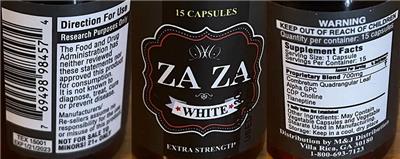
Supplement Facts
The label details for Zaza White by Zaza, sourced from the NIH Dietary Supplement Label Database.
Supplement Facts
| Ingredient | Amount | % DV |
|---|---|---|
| Proprietary Blend | 700 mg | -- |
| Alpha Glycerylphosphorylcholine | 0 NP | -- |
| Tianeptine | 0 NP | -- |
| Combretum quadrangulare | 0 NP | -- |
| Cytidine Diphosphate-Choline | 0 NP | -- |
Other ingredients: Vegetable Capsules, Stearate
Tap any ingredient to jump to its full detail below.
These statements are the manufacturer’s wording, reproduced from the product label — the label is saying it, not HelloPharmacist. We don’t verify or endorse them.
Suggested/Recommended/Usage/Directions
Direction for use
Precautions
Research purposes only
Manufacturers/Re-sellers assume no responsibility for the use or misuse of this product.
Not for sale to minors! 21+ only
Warning Keep out of reach of children
FDA Disclaimer Statement
The Food and Drug Administration has neither reviewed these statements nor approved this product for consumption. It is not known to diagnose, treat, cure or prevent disease.
Formulation
Extra strength
General Statements
Quantity per container: 15 capsules
Storage
Storage: Keep in a cool, dry place
Is this label outdated? Report a formula or label change and our pharmacy team will review it.
Zaza White by Zaza label
The label scan from the NIH Dietary Supplement Label Database. Tap to enlarge.
Label images are published by the NIH Dietary Supplement Label Database for the version of this product on file. Always read your actual product label.
View the full label (PDF)The Ingredients in Zaza White by Zaza
These are the 4 active ingredients this product is made of. Select any to open its full monograph.
Serving size1 Capsule(s) Dosage formCapsule Servings per container15 Amounts shown are per serving.
Most supplement products combine several ingredients, and a medication can interact with the product through any one of them. Each ingredient below shows whether it has known drug interactions.
Proprietary Blend
Other (inactive) ingredients: Vegetable Capsules, Stearate. These complete the product’s ingredient list but are not active constituents.
Zaza White by Zaza Drug Interactions
HelloPharmacist Interaction Report
Zaza White contains ingredients with documented interactions with medications, most notably tianeptine.
The most serious concern is tianeptine's interaction with monoamine oxidase inhibitors (MAOIs) — a class of older antidepressants — which can cause cardiovascular collapse, dangerous changes in blood pressure, fever, seizures, and death. Do not use this product if you take an MAOI.
Read the full breakdown — every affected drug type, severity by severity
Tianeptine also interacts with several other drug types. It can add to the sedative effects (Major severity) of other central nervous system depressants — sedatives, sleep aids, pain relievers, and other drugs that make you drowsy.
Chronic use of aspirin (and aspirin-containing products) may raise tianeptine levels in your blood, increasing its effects; alcohol reduces those levels by about 30% and may weaken its effects. Alpha-GPC may theoretically decrease the benefits of scopolamine patches (Transderm Scop) used for motion sickness, though this is a Minor interaction.
We could not check Combretum quadrangulare — we hold no interaction data for it. Altogether, these interactions span 289 individual medications.
Run your exact medications through the search tool on this page before you start.
Check your own medications below · Editorial policy · How we use AI
Want to check YOUR meds against Zaza White?
Ask about interactions with your drugs in plain English — “Can I take it with lisinopril?” — and we find you the answer in seconds, ingredient by ingredient.
Go to the checkerIngredients driving the most interactions
Individual Drug Interactions
The ingredients in Zaza White interact with 553 drugs. Click any drug to see the details.
3 of the 4 ingredients in Zaza White interact with drugs. Each result below shows which ingredient is responsible. Tianeptine Combretum quadrangulare Alpha Glycerylphosphorylcholine
AmphetamineAdensys XR-ODT, Adzenys ER, Dyanavel XR, Mydayis
How Amphetamine interacts with Zaza White — through 1 ingredient. Tap an ingredient for the detail:
TianeptineMonoamine Oxidase Inhibitors (maois) Major
Interaction Summary
Tianeptine may increase the toxicity of MAOIs.
Read the full Tianeptine + Amphetamine interactionIsocarboxazidMarplan
How Isocarboxazid interacts with Zaza White — through 1 ingredient. Tap an ingredient for the detail:
TianeptineMonoamine Oxidase Inhibitors (maois) Major
Interaction Summary
Tianeptine may increase the toxicity of MAOIs.
Read the full Tianeptine + Isocarboxazid interactionMoclobemideManerix, Moclobemide
How Moclobemide interacts with Zaza White — through 1 ingredient. Tap an ingredient for the detail:
TianeptineMonoamine Oxidase Inhibitors (maois) Major
Interaction Summary
Tianeptine may increase the toxicity of MAOIs.
Read the full Tianeptine + Moclobemide interactionOzanimod HydrochlorideZeposia
How Ozanimod Hydrochloride interacts with Zaza White — through 1 ingredient. Tap an ingredient for the detail:
TianeptineMonoamine Oxidase Inhibitors (maois) Major
Interaction Summary
Tianeptine may increase the toxicity of MAOIs.
Read the full Tianeptine + Ozanimod Hydrochloride interactionPhenelzine SulfateNardil
How Phenelzine Sulfate interacts with Zaza White — through 1 ingredient. Tap an ingredient for the detail:
TianeptineCns Depressants, Monoamine Oxidase Inhibitors (maois) Major
Interaction Summary
Tianeptine has sedative effects; high doses may have additive effects with other CNS depressants.
Read the full Tianeptine + Phenelzine Sulfate interactionRasagilineAzilect
How Rasagiline interacts with Zaza White — through 1 ingredient. Tap an ingredient for the detail:
TianeptineMonoamine Oxidase Inhibitors (maois) Major
Interaction Summary
Tianeptine may increase the toxicity of MAOIs.
Read the full Tianeptine + Rasagiline interactionSafinamide MesylateXadago
How Safinamide Mesylate interacts with Zaza White — through 1 ingredient. Tap an ingredient for the detail:
TianeptineMonoamine Oxidase Inhibitors (maois) Major
Interaction Summary
Tianeptine may increase the toxicity of MAOIs.
Read the full Tianeptine + Safinamide Mesylate interactionSelegilineCarbex, Eldepryl, Emsam, Zelapar
How Selegiline interacts with Zaza White — through 1 ingredient. Tap an ingredient for the detail:
TianeptineMonoamine Oxidase Inhibitors (maois) Major
Interaction Summary
Tianeptine may increase the toxicity of MAOIs.
Read the full Tianeptine + Selegiline interactionTranylcypromineParnate
How Tranylcypromine interacts with Zaza White — through 1 ingredient. Tap an ingredient for the detail:
TianeptineMonoamine Oxidase Inhibitors (maois) Major
Interaction Summary
Tianeptine may increase the toxicity of MAOIs.
Read the full Tianeptine + Tranylcypromine interactionAcarboseGlucobay, Prandase, Precose
How Acarbose interacts with Zaza White — through 1 ingredient. Tap an ingredient for the detail:
Combretum QuadrangulareAntidiabetes Drugs Moderate
Interaction Summary
Theoretically, taking Combretum micranthum leaf with antidiabetes drugs might increase the risk of hypoglycemia.
Read the full Combretum Quadrangulare + Acarbose interactionAcebutololRhotral, Sectral
How Acebutolol interacts with Zaza White — through 1 ingredient. Tap an ingredient for the detail:
Combretum QuadrangulareAntihypertensive Drugs Moderate
Interaction Summary
Theoretically, taking Combretum micranthum leaf with antihypertensive drugs might increase the risk of hypotension.
Read the full Combretum Quadrangulare + Acebutolol interactionAcepromazineAtravet
How Acepromazine interacts with Zaza White — through 1 ingredient. Tap an ingredient for the detail:
TianeptineCns Depressants Moderate
Interaction Summary
Tianeptine has sedative effects; high doses may have additive effects with other CNS depressants.
Read the full Tianeptine + Acepromazine interactionAcetaminophen, AspirinGemnisyn
How Acetaminophen, Aspirin interacts with Zaza White — through 1 ingredient. Tap an ingredient for the detail:
TianeptineAspirin Moderate
Interaction Summary
Chronic use of aspirin might increase the levels and clinical effects of tianeptine.
Read the full Tianeptine + Acetaminophen, Aspirin interactionAcetaminophen, Aspirin, CaffeineExcedrin, Excedrin Extra Strength, Excedrin Migraine
How Acetaminophen, Aspirin, Caffeine interacts with Zaza White — through 1 ingredient. Tap an ingredient for the detail:
TianeptineAspirin Moderate
Interaction Summary
Chronic use of aspirin might increase the levels and clinical effects of tianeptine.
Read the full Tianeptine + Acetaminophen, Aspirin, Caffeine interactionAcetaminophen, Butalbital, Caffeine, CodeineEsgic with Codeine, Fioricet w/ Codeine
How Acetaminophen, Butalbital, Caffeine, Codeine interacts with Zaza White — through 1 ingredient. Tap an ingredient for the detail:
TianeptineCns Depressants Moderate
Interaction Summary
Tianeptine has sedative effects; high doses may have additive effects with other CNS depressants.
Read the full Tianeptine + Acetaminophen, Butalbital, Caffeine, Codeine interactionAcetaminophen, Butalbital, CodeineBancap w/ Codeine
How Acetaminophen, Butalbital, Codeine interacts with Zaza White — through 1 ingredient. Tap an ingredient for the detail:
TianeptineCns Depressants Moderate
Interaction Summary
Tianeptine has sedative effects; high doses may have additive effects with other CNS depressants.
Read the full Tianeptine + Acetaminophen, Butalbital, Codeine interactionAcetaminophen, Butalbital, Codeine PhosphatePhrenilin #3
How Acetaminophen, Butalbital, Codeine Phosphate interacts with Zaza White — through 1 ingredient. Tap an ingredient for the detail:
TianeptineCns Depressants Moderate
Interaction Summary
Tianeptine has sedative effects; high doses may have additive effects with other CNS depressants.
Read the full Tianeptine + Acetaminophen, Butalbital, Codeine Phosphate interactionAcetaminophen, Caffeine, Chlorpheniramine, Hydrocodone, PhenylephrineHycomine Compound
How Acetaminophen, Caffeine, Chlorpheniramine, Hydrocodone, Phenylephrine interacts with Zaza White — through 1 ingredient. Tap an ingredient for the detail:
TianeptineCns Depressants Moderate
Interaction Summary
Tianeptine has sedative effects; high doses may have additive effects with other CNS depressants.
Read the full Tianeptine + Acetaminophen, Caffeine, Chlorpheniramine, Hydrocodone, Phenylephrine interactionAcetaminophen, Caffeine, CodeineGesic C15, Gesic C30, Gesic C8, Lenoltec 1, Lenoltec 2, Lenoltec 3 +1 more
How Acetaminophen, Caffeine, Codeine interacts with Zaza White — through 1 ingredient. Tap an ingredient for the detail:
TianeptineCns Depressants Moderate
Interaction Summary
Tianeptine has sedative effects; high doses may have additive effects with other CNS depressants.
Read the full Tianeptine + Acetaminophen, Caffeine, Codeine interactionAcetaminophen, Caffeine, Codeine, SalicylamideCodalan No.1, Codalan No.2, Codalan No.3
How Acetaminophen, Caffeine, Codeine, Salicylamide interacts with Zaza White — through 1 ingredient. Tap an ingredient for the detail:
TianeptineCns Depressants Moderate
Interaction Summary
Tianeptine has sedative effects; high doses may have additive effects with other CNS depressants.
Read the full Tianeptine + Acetaminophen, Caffeine, Codeine, Salicylamide interactionAcetaminophen, Caffeine, DihydrocodeineDHC Plus, Panlor DC, Panlor SS
How Acetaminophen, Caffeine, Dihydrocodeine interacts with Zaza White — through 1 ingredient. Tap an ingredient for the detail:
TianeptineCns Depressants Moderate
Interaction Summary
Tianeptine has sedative effects; high doses may have additive effects with other CNS depressants.
Read the full Tianeptine + Acetaminophen, Caffeine, Dihydrocodeine interactionAcetaminophen, Caffeine, PyrilamineMidol Max Strength Menstrual
How Acetaminophen, Caffeine, Pyrilamine interacts with Zaza White — through 1 ingredient. Tap an ingredient for the detail:
Combretum QuadrangulareDiuretic Drugs Moderate
Interaction Summary
Theoretically, taking Combretum micranthum leaf with diuretic drugs might increase the risk of hyponatremia.
Read the full Combretum Quadrangulare + Acetaminophen, Caffeine, Pyrilamine interactionAcetaminophen, Chlorpheniramine, Codeine, PhenylephrineColrex
How Acetaminophen, Chlorpheniramine, Codeine, Phenylephrine interacts with Zaza White — through 1 ingredient. Tap an ingredient for the detail:
TianeptineCns Depressants Moderate
Interaction Summary
Tianeptine has sedative effects; high doses may have additive effects with other CNS depressants.
Read the full Tianeptine + Acetaminophen, Chlorpheniramine, Codeine, Phenylephrine interactionAcetaminophen, Chlorpheniramine, Phenylpropanolamine, OpiumHista-Derfule
How Acetaminophen, Chlorpheniramine, Phenylpropanolamine, Opium interacts with Zaza White — through 1 ingredient. Tap an ingredient for the detail:
TianeptineCns Depressants Moderate
Interaction Summary
Tianeptine has sedative effects; high doses may have additive effects with other CNS depressants.
Read the full Tianeptine + Acetaminophen, Chlorpheniramine, Phenylpropanolamine, Opium interactionAcetaminophen, Chlorzoxazone, CodeineAcetazone Forte C8, Parafon Forte C8
How Acetaminophen, Chlorzoxazone, Codeine interacts with Zaza White — through 1 ingredient. Tap an ingredient for the detail:
TianeptineCns Depressants Moderate
Interaction Summary
Tianeptine has sedative effects; high doses may have additive effects with other CNS depressants.
Read the full Tianeptine + Acetaminophen, Chlorzoxazone, Codeine interactionAcetaminophen, CodeineTylenol No.3, Tylenol w/ Codeine
How Acetaminophen, Codeine interacts with Zaza White — through 1 ingredient. Tap an ingredient for the detail:
TianeptineCns Depressants Moderate
Interaction Summary
Tianeptine has sedative effects; high doses may have additive effects with other CNS depressants.
Read the full Tianeptine + Acetaminophen, Codeine interactionAcetaminophen, Codeine, DoxylamineMersyndol
How Acetaminophen, Codeine, Doxylamine interacts with Zaza White — through 1 ingredient. Tap an ingredient for the detail:
TianeptineCns Depressants Moderate
Interaction Summary
Tianeptine has sedative effects; high doses may have additive effects with other CNS depressants.
Read the full Tianeptine + Acetaminophen, Codeine, Doxylamine interactionAcetaminophen, Codeine, MethocarbamolAcetaminophen, Codeine, Methocarbamol, Robaxacet 8
How Acetaminophen, Codeine, Methocarbamol interacts with Zaza White — through 1 ingredient. Tap an ingredient for the detail:
TianeptineCns Depressants Moderate
Interaction Summary
Tianeptine has sedative effects; high doses may have additive effects with other CNS depressants.
Read the full Tianeptine + Acetaminophen, Codeine, Methocarbamol interactionAcetaminophen, Dichloralantipyrine, IsomethepteneAmidrine, Midchlor, Migquin, Migratine
How Acetaminophen, Dichloralantipyrine, Isometheptene interacts with Zaza White — through 1 ingredient. Tap an ingredient for the detail:
TianeptineCns Depressants Moderate
Interaction Summary
Tianeptine has sedative effects; high doses may have additive effects with other CNS depressants.
Read the full Tianeptine + Acetaminophen, Dichloralantipyrine, Isometheptene interactionAcetaminophen, Dichloralphenazone, IsomethepteneMidrin
How Acetaminophen, Dichloralphenazone, Isometheptene interacts with Zaza White — through 1 ingredient. Tap an ingredient for the detail:
TianeptineCns Depressants Moderate
Interaction Summary
Tianeptine has sedative effects; high doses may have additive effects with other CNS depressants.
Read the full Tianeptine + Acetaminophen, Dichloralphenazone, Isometheptene interactionEach ingredient & the kinds of drugs it affects
For each ingredient in Zaza White with known interactions, here are the types of medications they can affect. Open any type for the detail — or search your exact drug in the checker above.
Tianeptine
Monoamine Oxidase Inhibitors (Maois)
Tianeptine may increase the toxicity of MAOIs.
Concomitant use of tianeptine and non-selective MAOIs might increase the risk of cardiovascular collapse, hypertension, fever, convulsions, and death.
Alcohol (Ethanol)
Alcohol increases the clearance and might reduce the levels and clinical effects of tianeptine.
Clinical research shows that alcohol decreases tianeptine absorption rate and lowers tianeptine plasma levels by about 30%. Furthermore, an analysis of alcohol blood levels in 112 patients suggests that alcohol use disorder is associated with a 124% increase in clearance of tianeptine.
Aspirin
Chronic use of aspirin might increase the levels and clinical effects of tianeptine.
Aspirin is converted to salicylic acid in the body. In vitro research shows that salicylic acid binds to the same protein sites as tianeptine, displacing protein-bound tianeptine and leading to higher levels of tianeptine in the blood.
Cns Depressants
Tianeptine has sedative effects; high doses may have additive effects with other CNS depressants.
Higher doses of tianeptine have opioid like effects and may have additive effects with other sedative drugs. In one case report, a 42-year-old male presented with respiratory depression and aspiration pneumonia due to concomitant use of high-dose tianeptine and alprazolam.
Combretum quadrangulare
Antidiabetes Drugs
Theoretically, taking Combretum micranthum leaf with antidiabetes drugs might increase the risk of hypoglycemia.
Some preliminary human and animal research suggests that Combretum micranthum leaf has hypoglycemic effects.
Antihypertensive Drugs
Theoretically, taking Combretum micranthum leaf with antihypertensive drugs might increase the risk of hypotension.
Clinical research suggests that Combretum micranthum leaf reduces blood pressure.
Diuretic Drugs
Theoretically, taking Combretum micranthum leaf with diuretic drugs might increase the risk of hyponatremia.
Combretum micranthum leaf has shown natriuretic effects in preliminary clinical research.
Alpha Glycerylphosphorylcholine
Scopolamine (Transderm Scop)
Theoretically, alpha-GPC might decrease the effects of scopolamine.
A small clinical study shows that alpha-GPC can partially counteract the attention and memory impairment effects caused by scopolamine given intramuscularly. Whether alpha-GPC can decrease the beneficial anti-motion sickness effects of the scopolamine patch (Transderm Scop) is unclear.
Brand information
Manufacturer and brand details for Zaza White, from the product label.
Zaza
See all Zaza products- Name
- M&J Distribution
- City
- Villa Rica
- State
- GA
- ZipCode
- 30180
- Phone Number
- 1-800-693-7123
Zaza White by Zaza: Common Questions
Does Zaza White by Zaza interact with any medications?
How can one product interact with so many drugs?
Where does this information come from?
Is tianeptine approved by the FDA?
Can I take Zaza White if I'm pregnant?
What does alpha-GPC do?
What are the most common side effects?
Does citicoline really help with aging and memory?
Can I take Zaza White with alcohol?
Written and reviewed by the HelloPharmacist editorial staff. Our editorial policy
Not sure if Zaza White is safe with your meds?
Our pharmacists answer your medication & supplement questions — free.
Label information is sourced from the NIH Dietary Supplement Label Database and reflects the product version on file; always read your actual product label. This page is for education only and is not a substitute for professional medical advice. Confirm with your pharmacist or doctor before combining supplements and medications.
The Full Monographs Behind Zaza White’s Ingredients
Every ingredient we hold a full HelloPharmacist monograph for — uses, evidence, safety, and the complete interaction list.
Alpha-gpc
Interacts with 16 drugsAlpha-GPC is a choline-containing compound used mainly for memory, brain health, and as a choline source. There is some evidence it may help cognition in people with dementia, but evidence i...
Read the full Alpha-gpc monograph → Herb & supplement monographTianeptine
Interacts with 277 drugsTianeptine is a prescription antidepressant in some countries, but it is NOT approved by the FDA in the United States and is illegally sold in dietary supplements and 'gas station' products....
Read the full Tianeptine monograph → Herb & supplement monographCombretum Micranthum
Interacts with 265 drugsCombretum micranthum (kinkeliba) is a West African shrub whose leaves are brewed into a traditional tea for digestion, liver complaints, and fever. Solid human studies are lacking, so its be...
Read the full Combretum Micranthum monograph → Herb & supplement monographCiticoline
Citicoline is a naturally occurring compound involved in making brain cell membranes and the messenger chemical acetylcholine. It is popularly taken for memory, focus, and brain aging, and s...
Read the full Citicoline monograph →Sources & How We Checked
Zaza White's label data comes from the NIH Dietary Supplement Label Database; the ingredient interaction data is from the Natural Medicines database, reviewed by our pharmacists.
- NIH Dietary Supplement Label Database (DSLD) — The official product label on file for this supplement.
- Natural Medicines (Therapeutic Research Center) — Evidence-graded clinical reference behind the ingredient interaction data.
Content is written and reviewed by licensed HelloPharmacist pharmacists. See our data sources and editorial standards for how this information is built and checked.
The 37 references behind this product’s interaction data
Every citation that drives the interaction findings for this product’s ingredients, from the evidence-graded Natural Medicines (TRC Healthcare) database. Open an ingredient to browse its citations — links open the study on PubMed or the publisher’s site.
Alpha-gpc 4 references
- Di Perri R, Coppola G, Ambrosio LA, et al. A multicentre trial to the evaluate the efficacy and tolerability of alpha-glycerylphosphorylcholine versus cytosine diphosphocholine in patients with vascular dementia. J Int Med Res 1991;19:330-41.
- Barbagallo Sangiorgi G, Barbagallo M, Giordano M, et al. Alpha-glycerophosphocholine in the mental recovery of cerebral ischemic attacks: An Italian multicenter clinical trial. Ann N Y Acad Sci 1994;717:253-69. PubMed
- Canal N, Franceschi M, Alberoni M, et al. Effect of L-alpha-glyceryl-phosphorylcholine on amnesia caused by scopolamine. Int J Clin Pharmacol Ther Toxicol 1991;29:103-7.
- Lee G, Choi S, Chang J, et al. Association of L-a glycerylphosphorylcholine with subsequent stroke risk after 10 Years. JAMA Netw Open 2021;4(11):e2136008.
Tianeptine 18 references
- Bence C, Bonord A, Rebillard C, et al. Neonatal Abstinence Syndrome Following Tianeptine Dependence During Pregnancy. Pediatrics. 2016;137(1). PubMed
- El Zahran T, Schier J, Glidden E, et al. Characteristics of Tianeptine Exposures Reported to the National Poison Data System - United States, 2000-2017. MMWR Morb Mortal Wkly Rep. 2018;67(30):815-818. PubMed
- Goodnough R, Li K, Fouladkou F, et al. Notes from the Field: Toxic Leukoencephalopathy Associated with Tianeptine Misuse - California, 2017. MMWR Morb Mortal Wkly Rep. 2018;67(27):769-770.
- Grasela TH, Fiedler-Kelly JB, Salvadori C, Marey C, Jochemsen R. Development of a population pharmacokinetic database for tianeptine. Eur J Clin Pharmacol. 1993;45(2):173-9. PubMed
- Guelfi JD, Dulcire C, Le Moine P, Tafani A. Clinical safety and efficacy of tianeptine in 1,858 depressed patients treated in general practice. Neuropsychobiology. 1992;25(3):140-8. PubMed
- Lauhan R, Hsu A, Alam A, Beizai K. Tianeptine Abuse and Dependence: Case Report and Literature Review. Psychosomatics. 2018;59(6):547-553. PubMed
- Le Bricquir Y, Larrey D, Blanc P, Pageaux GP, Michel H. Tianeptine--an instance of drug-induced hepatotoxicity predicted by prospective experimental studies. J Hepatol. 1994;21(5):771-3. PubMed
- Lucaj S, Leo RJ. Tianeptine Sodium: A Nootropic With Potentially Lethal Consequences. Prim Care Companion CNS Disord. 2018;20(4).
- Salvadori C, Ward C, Defrance R, Hopkins R. The pharmacokinetics of the antidepressant tianeptine and its main metabolite in healthy humans--influence of alcohol co-administration. Fundam Clin Pharmacol. 1990;4(1):115-25. PubMed
- Samuels BA, Nautiyal KM, Kruegel AC, et al. The Behavioral Effects of the Antidepressant Tianeptine Require the Mu-Opioid Receptor. Neuropsychopharmacology. 2017;42(10):2052-2063. PubMed
- Voican CS, Corruble E, Naveau S, Perlemuter G. Antidepressant-induced liver injury: a review for clinicians. Am J Psychiatry. 2014;171(4):404-15. PubMed
- Zini R, Morin D, Salvadori C, Tillement JP. The influence of various drugs on the binding of tianeptine to human plasma proteins. Int J Clin Pharmacol Ther Toxicol. 1991;29(2):64-6.
- Summary of Product Characteristics Stablo: Tianeptine. 2008. Available at: https://www.servier.com.ve/sites/default/files/spc-pil/spc-stablon.pdf
- Rushton W, Whitworth B, Brown J, Kurz M, Rivera J. Characteristics of tianeptine effects reported to a poison control center: a growing threat to public health. J. Clin Toxicol (Phila). 2021;59(2):152-7. PubMed
- García-Alberca JM, Gris E, de la Guía P, Mendoza S. Effects of Tianeptine Treatment on Depression and Cognitive Function in Patients with Alzheimer's Disease: A 12-Month Retrospective Observational Study. J Alzheimers Dis 2022;88(2):707-720. PubMed
- AQuadir M, Rine NI, Badeti J, et al. Tianeptine Exposures Reported to United States Poison Centers, 2015-2023. J Med Toxicol 2025;21(1):30-41. PubMed
- Hershey HL, Onyango EM, Durst K, Korona-Bailey J, Mukhopadhyay S. Tianeptine-involved emergency department visits, fatal overdoses, and substance seizures in Tennessee, 2021-2023. Drug Alcohol Depend Rep 2024;12:100272. PubMed
- Ikeri K, Anderson A, Eyal F, Whitehurst R. Neonatal Opioid Withdrawal Syndrome Following Prenatal Use of Supplements Containing Tianeptine. Pediatrics 2024;153(2):e2023062382. PubMed
Combretum Micranthum 4 references
- Bourqui A, Niang EAB, Graz B, et al. Hypertension treatment with Combretum micranthum or Hibiscus sabdariffa, as decoction or tablet: a randomized clinical trial. J Hum Hypertens 2020. PubMed
- Kpemissi M, Potârniche AV, Lawson-Evi P, et al. Nephroprotective effect of Combretum micranthum G. Don in nicotinamide-streptozotocin induced diabetic nephropathy in rats: In-vivo and in-silico experiments. J Ethnopharmacol 2020;261:113133. PubMed
- Chika A, Bello SO. Antihyperglycaemic activity of aqueous leaf extract of Combretum micranthum (Combretaceae) in normal and alloxan-induced diabetic rats. J Ethnopharmacol 2010;129(1):34-7. PubMed
- Seck SM, Doupa D, Dia DG, et al. Clinical efficacy of African traditional medicines in hypertension: A randomized controlled trial with Combretum micranthum and Hibiscus sabdariffa. J Hum Hypertens 2017;32(1):75-81. PubMed
See these in context on the Combretum Micranthum monograph →
Citicoline 11 references
- Spiers PA, Myers D, Hochanadel GS, et al. Citicoline improves verbal memory in aging. Arch Neurol 1996;53:441-8. PubMed
- Fioravanti M, Yanagi M. Cytidinediphosphocholine (CDP-choline) for cognitive and behavioural disturbances associated with chronic cerebral disorders in the elderly. Cochrane Database Syst Rev 2005;(2):CD000269. PubMed
- Conant R, Schauss AG. Therapeutic applications of citicoline for stroke and cognitive function in the elderly: A review of the literature. Altern Med Rev 2004;9:17-31.
- Warach, S., Pettigrew, L. C., Dashe, J. F., Pullicino, P., Lefkowitz, D. M., Sabounjian, L., Harnett, K., Schwiderski, U., and Gammans, R. Effect of citicoline on ischemic lesions as measured by diffusion-weighted magnetic resonance imaging. Citicoline 0 DOI
- Lukas, S. E., Kouri, E. M., Rhee, C., Madrid, A., and Renshaw, P. F. Effects of short-term citicoline treatment on acute cocaine intoxication and cardiovascular effects. Psychopharmacology.(Berl.) 2001;157(2):163-167. PubMed
- Dinsdale, J. R., Griffiths, G. K., Castello, J., Maddock, J., Ortiz, J. A., and Aylward, M. CDP-choline: repeated oral dose tolerance studies in adult healthy volunteers. Arzneimittelforschung. 1983;33(7A):1061-1065.
- Clark BC, Georgekutty J, Berul CI. Myocardial ischemia secondary to synthetic cannabinoid (K2) use in pediatric patients. J Pediatr 2015;167(3):757-61.e1. PubMed
- Ghajar A, Gholamian F, Tabatabei-Motlagh M, et al. Citicoline (CDP-choline) add-on therapy to risperidone for treatment of negative symptoms in patients with stable schizophrenia: a double-blind, randomized placebo-controlled trial. Hum Psychopharmacol. 2
- Castagna A, Manzo C, Fabbo A, Lacava R, Ruberto C, Ruotolo G. The CITIMERIVA Study: CITIcoline plus MEmantina plus RIVAstigmine in Older Patients Affected with Alzheimer's Disease. Clin Drug Investig. 2021 Feb;41(2):177-182. PubMed
- Jeong H, Yoon S, Sung YH, et al. Effects of cytidine-5'-diphosphate choline on gray matter volumes in methamphetamine-dependent patients: A randomized, double-blind, placebo-controlled study. J Psychiatr Res 2021;143:215-221. PubMed
- Nakazaki E, Mah E, Sanoshy K, Citrolo D, Watanabe F. Citicoline and Memory Function in Healthy Older Adults: A Randomized, Double-Blind, Placebo-Controlled Clinical Trial. J Nutr 2021;151(8):2153-2160. PubMed
Parts of this content are provided by the Therapeutic Research Center, LLC.
DISCLAIMER: Currently this does not check for drug-drug interactions. This is not an all-inclusive comprehensive list of potential interactions and is for informational purposes only. Not all interactions are known or well-reported in the scientific literature, and new interactions are continually being reported. Input is needed from a qualified healthcare provider including a pharmacist before starting any therapy. Application of clinical judgment is necessary.
© 2021 Therapeutic Research Center, LLC