
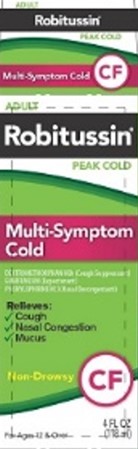
Robitussin Peak Cold Multi-Symptom Cold dextromethorphan hydrobromide, guaifenesin, and phenylephrine hydrochloride 10 mg/5mL; 100 mg/5mL; 5 mg/5mL Liquid
🆔 Identity & classification
Where does this data come from?
🏷️ RxNorm drug class
This medicine belongs to the Uncompetitive N-methyl-D-aspartate Receptor Antagonist class.
Where does this data come from?
🏭 Manufacturer & labeler
Where does this data come from?
🩺 Clinical
Robitussin Peak Cold Multi-Symptom Cold is an over-the-counter oral liquid cold product sold under FDA's OTC monograph rules. It contains three active ingredients commonly found in multi-symptom cold formulas: dextromethorphan, which functions as a cough suppressant; guaifenesin, an expectorant typically used to help thin mucus; and phenylephrine, a decongestant often used to relieve nasal congestion. This combination is typically intended for temporary relief of multiple cold symptoms.
Patient education
Supplement & herbal interactions
Where does this data come from?
Ask a licensed pharmacist directly — free, answered by our team.
💊 What it looks like
Where does this data come from?
🧪 Inactive Ingredients / Excipients
Inactive ingredients, also called excipients, are components of the drug product other than the active ingredient. They may include fillers, dyes, coatings, preservatives, flavors, or other formulation ingredients.
💡 Tap an ingredient (hover on desktop) to see what it is and why it’s used.
-
UNII XF417D3PSL
Anhydrous citric acid is a sour, crystalline powder derived from citric acid with water removed. In medicines, it acts as a buffer to control pH, adds tartness to improve taste, and helps tablets disintegrate.
-
UNII WZB9127XOA
A synthetic red dye used to color medications and make them easier to identify. It serves as a colorant in tablets, capsules, and liquid formulations.
-
UNII PDC6A3C0OX
Glycerin is a clear, thick liquid derived from plant oils or fats. It acts as a humectant to retain moisture, a sweetener, and a solvent in medications.
-
UNII L7T10EIP3A
A cooling compound from mint plants used as a flavoring agent and to create a fresh sensation in medicines. It helps mask bitter tastes and improve how the product feels in the mouth.
-
UNII 6DC9Q167V3
Propylene glycol is a clear liquid derived from petroleum or vegetable sources. It acts as a solvent, humectant, and preservative in medicines, helping dissolve active ingredients and maintain product stability.
-
UNII OJ245FE5EU
Sodium benzoate is a salt derived from benzoic acid, a preservative. It's added to medicines to prevent growth of bacteria, fungi, and other microorganisms that could spoil the product.
-
UNII 1Q73Q2JULR
Sodium citrate is a salt derived from citric acid. It works as a buffer to maintain the medicine's pH level and may also help improve taste or act as a preservative in the formulation.
-
UNII 506T60A25R
Sorbitol is a natural sugar alcohol derived from glucose. It serves as a sweetener, humectant, and bulking agent in medications to improve taste and help maintain moisture in the product.
-
UNII 96K6UQ3ZD4
Sucralose is a synthetic sweetener made from sugar. It's added to medicines to improve taste without adding calories, helping make bitter or unpleasant-tasting drugs easier to take.
-
UNII 059QF0KO0R
Water is a liquid solvent that dissolves and mixes ingredients together in liquid medicines, syrups, and injections. It helps distribute the active drug evenly throughout the product.
10 inactive ingredients listed in the exact product block matched to this NDC.
Label-section wording can be broader than the structured product block and may mention additional formulation ingredients.
Where does this data come from?
ingredient classCode="IACT" elements from the exact product block matched by this NDC. Label-section narrative from DailyMed / the openFDA label index is shown separately when available.Inactive ingredient FAQ
Are inactive ingredients the same for every manufacturer?
Why might an inactive ingredient be missing?
Can inactive ingredients matter?
💲 Pricing
A drug doesn't have one price. Each row is a different public payment system, and none is what you'd pay at the counter — that depends on your insurance. The ⓘ on each row explains what it measures.
| Price system | Per mL | Per package |
|---|---|---|
| Retail pharmacies payNADAC · weekly | Not in the retail survey — common for institutional, discontinued, or low-volume packs. | |
| Medicaid paysCMS SDUD · 12 mo | No recent Medicaid claims on file for this NDC — rare and low-volume NDCs are suppressed in the public data. | |
| Medicare drug plans payPart D · quarterly | No Part D plan price is available for this NDC in our data. | |
Where does this data come from?
🔁 Therapeutic equivalents
Where does this data come from?
⏳ Availability & generic status
We did not find an FDA-approved generic match for this exact strength, form and route.
Where does this data come from?
🔬 Reported adverse events (FAERS)
Top reported reactions
Age at onset
Reporter sex
Serious outcomes
Where does this data come from?
📦 Packaging — all sizes for this product
| Package NDC | Description | Marketing start | Status |
|---|---|---|---|
| 00031-8742-14 | 1 BOTTLE in 1 CARTON (0031-8742-14) / 118 mL in 1 BOTTLE | 2011-06-12 | Active |
| 00031-8742-20 You're viewing this | 1 BOTTLE in 1 CARTON (0031-8742-20) / 237 mL in 1 BOTTLE | 2011-06-12 | Active |
Pack size FAQ
What quantity is in NDC 00031-8742-20?
What NDC number is used to bill for this package of Robitussin Peak Cold Multi-Symptom Cold dextromethorphan hydrobromide, guaifenesin, and phenylephrine hydrochloride 10 mg/5mL; 100 mg/5mL; 5 mg/5mL Liquid?
🧭 About this NDC listing & data coverage
What data is (and isn’t) available for this NDC — tap to expand
| NDC identity (package / product / labeler codes) | ✓ Available |
| Labeler | ✓ Available |
| Product & package description | ✓ Available |
| Marketing category & status | ✓ Available |
| Active ingredient / dosage form / route | ✓ Available |
| FDA label (SPL via DailyMed) | ✓ Available |
| Package photos | ✓ Available |
| Inactive ingredients (structured) | ✓ Available |
| NADAC pharmacy acquisition price (CMS) | — Not published for this NDC CMS publishes NADAC only for NDCs reported in its retail-pharmacy survey. |
| Orange Book / therapeutic-equivalence data | — Not published for this NDC Applies only to products approved under an NDA/ANDA; many listings are out of scope. |
| HCPCS J-code billing crosswalk | — Not published for this NDC Most self-administered / retail products have no J-code — that is normal. |
| Medicaid utilization (CMS SDUD) | — Not published for this NDC CMS reports utilization only for NDCs with Medicaid claims above its privacy threshold. |
Questions about this listing
Is this NDC FDA-approved?
Why is there no price listed?
Is the NDC printed on the package the same as the 11-digit billing NDC?
What do the three segments of this NDC mean?
Is this package still being marketed?
Does this product come in other package sizes?
Who lists this product with the FDA?
Do I need a prescription for this product?
Where does this data come from?
📄 FDA label — Drug Facts FDA SPL
🎯 Indications and Usage ▾
Uses helps loosen phlegm (mucus) and thin bronchial secretions to drain bronchial tubes temporarily relieves these symptoms occurring with a cold: nasal congestion cough due to minor throat and bronchial irritation
⏱️ Dosage and Administration ▾
Directions do not take more than 6 doses in any 24-hour period measure only with dosing cup provided keep dosing cup with product ml = milliliter this adult product is not intended for use in children under 12 years of age age dose adults and children 12 years and over 10 ml every 4 hours children under 12 years do not use
⚠️ Warnings ▾
Warnings Do not use if you are now taking a prescription monoamine oxidase inhibitor (MAOI) (certain drugs for depression, psychiatric, or emotional conditions, or Parkinson's disease), or for 2 weeks after stopping the MAOI drug. If you do not know if your prescription drug contains an MAOI, ask a doctor or pharmacist before taking this product. Ask a doctor before use if you have heart disease high blood pressure thyroid disease diabetes trouble urinating due to an enlarged prostate gland cough that occurs with too much phlegm (mucus) cough that lasts or is chronic such as occurs with smoking, asthma, chronic bronchitis or emphysema Ask a doctor or pharmacist before use if you are taking any other oral nasal decongestant or stimulant.
When using this product do not use more than directed. Stop use and ask a doctor if you get nervous, dizzy, or sleepless symptoms do not get better within 7 days or are accompanied by fever cough lasts more than 7 days, comes back, or is accompanied by fever, rash, or persistent headache. These could be signs of a serious condition.
If pregnant or breast-feeding, ask a health professional before use. Keep out of reach of children. In case of overdose, get medical help or contact a Poison Control Center right away.
📦 Storage and Handling ▾
Other information each 10 ml contains: sodium 6 mg store at 20-25°C (68-77°F). Do not refrigerate.
🧪 Active Ingredient ▾
Active ingredients (in each 10 ml) Dextromethorphan HBr, USP 20 mg Guaifenesin, USP 200 mg Phenylephrine HCl, USP 10 mg
🧪 Inactive Ingredients ▾
Inactive ingredients anhydrous citric acid, FD&C red no. 40, glycerin, menthol, natural & artificial flavor, propylene glycol, purified water, sodium benzoate, sodium citrate, sorbitol solution, sucralose
🎯 Purpose ▾
Purposes Cough suppressant Expectorant Nasal decongestant