
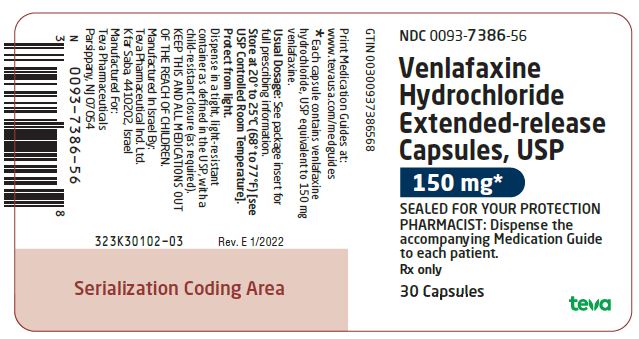
Venlafaxine Hydrochloride 150 mg Capsule, Extended Release, 90-count — NDC 0093-7386-98 (Billing 00093-7386-98)
This is a package of 90 capsules of Venlafaxine Hydrochloride 150 mg Capsule, Extended Release from Teva Pharmaceuticals USA, Inc., marketed since Jul 2010 and currently FDA-listed; retail pharmacies pay about $0.1190 per capsule (NADAC).
NDC database record
One package, one record: these facts belong to NDC 0093-7386-98 alone.
- Record
- FDA NDC Directory package listing · Human prescription drug
- Code segments
- 0093 labeler · 7386 product · 98 package
- Package marketed since
- Jul 1, 2010
- Sample package
- No — commercial package
- Listing certified through
- Dec 31, 2027
- Billing quantity
- 90 EA per package
- Barcode (UPC-A, from the NDC)
- 3 0093738698 8
- Medicaid fills, this package
- 1,782 prescriptions in the last four reported quarters
- FDA record last changed
- Jul 24, 2026
Identity & classification
Regulatory identifiers FDA, NLM and CMS codes for this package
Drug-database identifiers Medi-Span GPI and First Databank GCN / HICL / AHFS classification
- GSN (GCN sequence number): 046405
- GCN: 16818
- GPI-14 (Medi-Span): 58180090107050
- HICL (First Databank): 008847
- AHFS class code: 28:16.04.16
- RxCUI (RxNorm): 313581
Where does this data come from?
- FDA openFDA NDC Directory · synced Oct 1, 2026
- FDA label on DailyMed · label index refreshed Oct 5, 2026
- RxNorm (NLM RxNav) · catalog refreshed Oct 1, 2026
- Medi-Span GPI (licensed)
- First Databank (licensed) · refreshed Oct 1, 2026
RxNorm drug class
This medicine belongs to the Serotonin and Norepinephrine Reuptake Inhibitor class.
Where does this data come from?
- RxClass (NLM) · catalog refreshed Oct 1, 2026
Clinical
- It treats major depressive disorder. Depending on the product, it is also used for social anxiety disorder, generalized anxiety disorder and panic disorder. Your pharmacist can con...
- Take extended-release forms once a day with food, at about the same time each day. Swallow tablets and capsules whole. A capsule can be opened onto applesauce if swallowing is hard...
- Nausea, sleepiness, dry mouth, sweating, constipation and loss of appetite are common. Some people have sexual side effects. Call your doctor if side effects are severe or don’t ea...
- Please don’t stop suddenly. Stopping or cutting the dose quickly can cause dizziness, nausea, anxiety, insomnia and electric-shock feelings. Your prescriber will lower the dose gra...
Patient education
Supplement & herbal interactions
Venlafaxine may be associated with lower levels of 1 nutrient — worth a chat with your pharmacist, not a cause for alarm.
Where does this data come from?
- MedlinePlus (NLM) · refreshed Oct 1, 2026
- FDA label on DailyMed · label index refreshed Oct 5, 2026
Ask a licensed pharmacist directly — free, answered by our team.
Pricing
A drug doesn't have one price. Each row is a different public payment system, and none is what you'd pay at the counter — that depends on your insurance. The ⓘ on each row explains what it measures.
| Price system | Per ea | Per package |
|---|---|---|
| Retail pharmacies payNADAC · weekly | $0.119 | $10.71 / 90 capsules |
| Medicaid paysCMS SDUD · 12 mo | $0.3845 | $34.61 / 90 capsules |
| Medicare drug plans payPart D · Q2 2026 | $0.2146 | $19.31 / 90 capsules |
Where does this data come from?
- CMS NADAC weekly file · file of Sep 30, 2026
- CMS ASP pricing files · refreshed Sep 20, 2026
- CMS Medicaid State Drug Utilization Data · through Q1 2026
- CMS Part D plan pricing files · refreshed Sep 24, 2026
- VA National Acquisition Center price file
Packaging — all sizes for this product
| Package NDC | Description | Per unit | Per pack | Marketing start | Marketing end | Status |
|---|---|---|---|---|---|---|
| 00093-7386-05 0093-7386-05 Main listing | 500 CAPSULE, EXTENDED RELEASE in 1 BOTTLE | $0.1190 / ea | $59.51 | 2012-03-01 | — | Active |
| 00093-7386-56 0093-7386-56 | 30 CAPSULE, EXTENDED RELEASE in 1 BOTTLE | $0.1190 / ea | $3.57 | 2010-07-01 | — | Active |
| 00093-7386-98 You're viewing this | 90 CAPSULE, EXTENDED RELEASE in 1 BOTTLE | $0.1190 / ea | $10.71 | 2010-07-01 | — | Active |
You're viewing one of 3 pack sizes for this product.
This pack effectively ties for the lowest per-ea cost of the 3 priced pack sizes ($0.1190 NADAC).
This pack accounts for about 31% of this product's recent Medicaid fills; the largest share goes to the 500 capsules pack. See all packs ↓
Pack size FAQ
What quantity is in this package?
How does this package differ from NDC 00093-7386-56?
What NDC number is used to bill for this package of Venlafaxine Hydrochloride 150 mg Capsule, Extended Release?
Prices are the latest CMS NADAC pharmacy acquisition cost per NDC; per-pack figures are per-unit × pack quantity, shown only when the pack is denominated in the same measure NADAC prices.
Therapeutic equivalents
| Product | Labeler | Pack | NADAC/unit | TE | Status | Price vs. this |
|---|---|---|---|---|---|---|
| Venlafaxine Hydrochloride 150 mgthis 00093-7386-98 | Teva | 90 capsules | $0.119 | AB | Availability likely | — |
| Venlafaxine Hydrochloride 150 mg 00904-7489-61 | Major | 1 capsule | $0.119 | AB | Availability likely | — |
| Venlafaxine Hydrochloride 150 mg 42806-0603-05 | Epic | 500 capsules | $0.119 | AB | Availability likely | — |
| venlafaxine hydrochloride 150 mg 43598-0002-05 | Dr.Reddys | 500 capsules | $0.119 | AB | Availability likely | — |
| Venlafaxine Hydrochloride 150 mg 50268-0875-15 | AvPAK | 1 capsule | $0.119 | AB | Availability likely | — |
| Venlafaxine Hydrochloride 150 mg 65862-0697-01 | Aurobindo | 100 capsules | $0.119 | — | Availability likely | — |
| Venlafaxine Hydrochloride 150 mg 68084-0713-01 | American | 1 capsule | $0.119 | AB | Availability likely | — |
| Venlafaxine Hydrochloride 150 mg 70010-0186-03 | Granules | 30 capsules | $0.119 | AB | Availability likely | — |
| Venlafaxine Hydrochloride 150 mg 70710-1700-00 | Zydus | 1000 capsules | $0.119 | AB | Availability likely | — |
| Venlafaxine Hydrochloride 150 mg 72603-0749-01 | NorthStar | 90 capsules | $0.119 | AB | Availability likely | — |
| Venlafaxine Hydrochloride 150 mg 82009-0058-05 | QUALLENT | 500 capsules | $0.119 | AB | Availability likely | — |
| Venlafaxine hydrochloride 150 mg 33342-0196-07 | Macleods | 30 capsules | $0.139 | AB | FDA listed | +16% |
| Effexor XR 150 mg 58151-0127-77 | Viatris | 90 capsules | $21.622 | AB | Availability likely | +18068% |
| Effexor XR 150 mg 00008-0836-21 | Wyeth | 30 capsules | $21.625 | AB | Discontinued | +18071% |
| Venlafaxine Hydrochloride 150 mg 00615-8510-39 | NCS | 30 capsules | — | AB | FDA listed | — |
| Venlafaxine Hydrochloride 150 mg 10135-0827-10 | Marlex | 1000 capsules | — | AB | FDA listed | — |
| Venlafaxine Hydrochloride 150 mg 31722-0004-01 | Camber | 10 capsules | — | AB | FDA listed | — |
| Venlafaxine Hydrochloride 150 mg 42291-0899-30 | AvKARE | 30 capsules | — | AB | FDA listed | — |
| Venlafaxine Hydrochloride 150 mg 46708-0794-30 | Alembic | 30 capsules | — | AB | FDA listed | — |
| Venlafaxine Hydrochloride 150 mg 50090-2519-00 | A-S | 30 capsules | — | AB | FDA listed | — |
| Venlafaxine Hydrochloride 150 mg 50090-5890-00 | A-S | 30 capsules | — | AB | FDA listed | — |
| Venlafaxine Hydrochloride 150 mg 50090-6896-00 | A-S | 90 capsules | — | AB | FDA listed | — |
| Venlafaxine Hydrochloride 150 mg 50090-7323-00 | A-S | 30 capsules | — | AB | FDA listed | — |
| Venlafaxine Hydrochloride 150 mg 50090-7324-00 | A-S | 90 capsules | — | AB | FDA listed | — |
| Venlafaxine Hydrochloride 150 mg 50090-7942-00 | A-S | 30 capsules | — | AB | FDA listed | — |
| venlafaxine hydrochloride 150 mg 55111-0455-01 | Dr.Reddy's | 100 capsules | — | AB | FDA listed | — |
| Venlafaxine Hydrochloride 150 mg 62332-0794-30 | Alembic | 30 capsules | — | AB | FDA listed | — |
| Venlafaxine Hydrochloride 150 mg 63187-0420-30 | Proficient | 30 capsules | — | AB | FDA listed | — |
| venlafaxine hydrochloride 150 mg 65841-0753-06 | Zydus | 30 capsules | — | AB | FDA listed | — |
| Venlafaxine Hydrochloride 150 mg 67046-1656-03 | Coupler | 30 capsules | — | AB | FDA listed | — |
| Venlafaxine Hydrochloride 150 mg 68071-3727-09 | NuCare | 90 capsules | — | AB | FDA listed | — |
| venlafaxine hydrochloride 150 mg 68071-4442-09 | NuCare | 90 capsules | — | AB | FDA listed | — |
| Venlafaxine Hydrochloride 150 mg 68071-5020-09 | NuCare | 90 capsules | — | AB | FDA listed | — |
| venlafaxine hydrochloride 150 mg 68382-0036-06 | Zydus | 30 capsules | — | AB | FDA listed | — |
| venlafaxine hydrochloride 150 mg 68788-6806-01 | Preferred | 100 capsules | — | AB | FDA listed | — |
| Venlafaxine Hydrochloride 150 mg 68788-8072-03 | Preferred | 30 capsules | — | AB | FDA listed | — |
| Venlafaxine Hydrochloride 150 mg 68788-8752-03 | Preferred | 30 capsules | — | AB | FDA listed | — |
| Venlafaxine Hydrochloride 150 mg 68788-8774-01 | Preferred | 100 capsules | — | AB | FDA listed | — |
| Venlafaxine Hydrochloride 150 mg 70518-2259-00 | REMEDYREPACK | 90 capsules | — | AB | Discontinued | — |
| Venlafaxine Hydrochloride 150 mg 70518-4154-00 | REMEDYREPACK | 30 capsules | — | AB | FDA listed | — |
| Venlafaxine Hydrochloride 150 mg 70771-1838-00 | Zydus | 1000 capsules | — | AB | FDA listed | — |
| Venlafaxine Hydrochloride 150 mg 71335-1642-01 | Bryant | 30 capsules | — | AB | FDA listed | — |
| Venlafaxine Hydrochloride 150 mg 71335-1812-01 | Bryant | 30 capsules | — | AB | FDA listed | — |
| Venlafaxine Hydrochloride 150 mg 71335-2495-01 | Bryant | 30 capsules | — | AB | FDA listed | — |
| Venlafaxine Hydrochloride 150 mg 71335-2992-01 | Bryant | 30 capsules | — | AB | FDA listed | — |
| Venlafaxine Hydrochloride 150 mg 71785-1008-00 | Annora | 30 capsules | — | AB | FDA listed | — |
| Venlafaxine Hydrochloride 150 mg 72888-0181-30 | Advagen | 30 capsules | — | AB | FDA listed | — |
| Venlafaxine Hydrochloride 150 mg 76420-0632-01 | Asclemed | 100 capsules | — | AB | FDA listed | — |
| Venlafaxine HCL ER 150 mg 80425-0194-02 | Advanced | 60 capsules | — | AB | FDA listed | — |
| Venlafaxine hydrochloride ER 150 mg 80425-0297-01 | Advanced | 30 capsules | — | AB | FDA listed | — |
| Venlafaxine Hydrochloride 150 mg 82804-0038-30 | Proficient | 30 capsules | — | AB | FDA listed | — |
| Venlafaxine Hydrochloride 150 mg 24658-0127-05 | PURACAP | 500 capsules | — | AB | FDA listed | — |
Where does this data come from?
- FDA openFDA NDC Directory · synced Oct 1, 2026
- FDA Orange Book · refreshed Oct 3, 2026
- CMS NADAC weekly file · file of Sep 30, 2026
Availability & generic status
This product is an FDA-approved generic. Other versions of the same drug are listed under Therapeutic equivalents, least expensive first.
Where does this data come from?
- FDA Orange Book · refreshed Oct 3, 2026
What it looks like
Where does this data come from?
- FDA label on DailyMed · label index refreshed Oct 5, 2026
Inactive Ingredients / Excipients
Inactive ingredients, also called excipients, are components of the drug product other than the active ingredient. They may include fillers, dyes, coatings, preservatives, flavors, or other formulation ingredients.
🧪 Avoiding an ingredient? See Venlafaxine inactive ingredients by manufacturer: every current product's list side by side, so you can ask your pharmacy for the version that does not list it.
💡 Tap an ingredient (hover on desktop) to see what it is and why it’s used.
-
UNII 4W5IH7FLNY
A clear, oily liquid derived from sebacic acid and butanol. It works as a plasticizer and solvent in pharmaceutical coatings and films, helping them stay flexible and smooth.
-
UNII H3UP11403C
Ethylcellulose is a plant-derived polymer that thickens and forms protective coatings on tablets and capsules. It slows medicine release into the body and protects the contents from moisture and air.
-
UNII H77VEI93A8
A synthetic yellow dye used to color medications. It helps identify the drug and make it visually distinctive, with no effect on how the medicine works.
-
UNII XM0M87F357
A dark iron oxide compound that gives medicines their black or dark color. It's used as a colorant in tablets and capsules to help identify the product and make it visually distinctive.
-
UNII 2G86QN327L
Gelatin is a protein derived from animal collagen, commonly used in medicines as a gelling agent and capsule material. It helps create soft or hard capsule shells that hold and release medication, and can also thicken liquid formulations.
-
UNII B697894SGQ
Polyethylene glycol 400 is a clear, thick liquid made from petroleum-derived polymers. It acts as a solvent and humectant in medicines, helping dissolve active ingredients and retain moisture in the formulation.
-
UNII WZH3C48M4T
Potassium hydroxide is a strong alkaline chemical used in medicines to adjust and maintain the pH level of liquid formulations, helping keep the product stable and the active ingredients effective.
-
UNII U725QWY32X
Povidone K30 is a synthetic polymer made from petroleum. It acts as a binder to hold tablet ingredients together and as a disintegrant to help the tablet break apart in the stomach so the medicine can be absorbed.
-
UNII 6DC9Q167V3
Propylene glycol is a clear liquid derived from petroleum or vegetable sources. It acts as a solvent, humectant, and preservative in medicines, helping dissolve active ingredients and maintain product stability.
-
UNII 46N107B71O
Shellac is a natural resin secreted by the lac beetle. It's used as a coating on tablets and capsules to control how quickly the medicine dissolves and to improve appearance and stability.
-
UNII O8232NY3SJ
A plant-based carbohydrate derived from corn kernels. It acts as a filler to add bulk, a binder to hold ingredients together, and a disintegrant to help the tablet break apart in your stomach for absorption.
-
UNII C151H8M554
A natural sugar derived from sugar cane or sugar beets. It's used as a sweetener, filler, and binder to improve taste, add bulk, and help hold tablet or capsule ingredients together.
-
UNII 7SEV7J4R1U
A powder made from a naturally occurring mineral. In medicines, talc works as a glidant and anti-caking agent, helping tablets and capsules flow smoothly during manufacturing and preventing clumping.
-
UNII 15FIX9V2JP
Titanium dioxide is a bright white mineral powder commonly used as a colorant and opacifying agent. It makes pills and tablets white or lighter in color and helps make coatings non-transparent.
14 inactive ingredients listed in the exact product block matched to this NDC.
Where does this data come from?
ingredient classCode="IACT" elements from the exact product block matched by this NDC. Label-section narrative from DailyMed / the openFDA label index is shown separately when available.- FDA label on DailyMed · label index refreshed Oct 5, 2026
- FDA openFDA NDC Directory · synced Oct 1, 2026
Inactive ingredient FAQ
Are inactive ingredients the same for every manufacturer?
Why might an inactive ingredient be missing?
Can inactive ingredients matter?
Manufacturer & labeler
More NDCs from Teva Pharmaceuticals USA, Inc. labeler code 00093
- Finasteride 5 mg Tablet, Film Coated NDC 0093-7355-05
- Losartan Potassium and Hydrochlorothiazide 50 mg; 12.5 mg Tablet, Film Coated NDC 0093-7367-10
- Losartan Potassium and Hydrochlorothiazide 100 mg; 25 mg Tablet, Film Coated NDC 0093-7368-10
- Losartan Potassium and Hydrochlorothiazide 100 mg; 12.5 mg Tablet, Film Coated NDC 0093-7369-10
- Venlafaxine Hydrochloride 37.5 mg Capsule, Extended Release NDC 0093-7384-05
- Venlafaxine Hydrochloride 75 mg Capsule, Extended Release NDC 0093-7385-05
- Fluvastatin 20 mg Capsule NDC 0093-7442-01
- Fluvastatin 40 mg Capsule NDC 0093-7443-01
- Fluvastatin Sodium 80 mg Tablet, Film Coated, Extended Release NDC 0093-7446-01
- Glipizide and Metformin Hydrochloride 2.5 mg; 250 mg Tablet, Film Coated NDC 0093-7455-01
- Glipizide and Metformin Hydrochloride 2.5 mg; 500 mg Tablet, Film Coated NDC 0093-7456-01
- Glipizide and Metformin Hydrochloride 5 mg; 500 mg Tablet, Film Coated NDC 0093-7457-01
Where does this data come from?
- FDA openFDA NDC Directory · synced Oct 1, 2026
- Drugs@FDA
Full prescribing information FDA SPL
🚨 Boxed Warning ▾
WARNING: SUICIDAL THOUGHTS AND BEHAVIORS Antidepressants increased the risk of suicidal thoughts and behavior in pediatric and young adult patients in short-term studies. Closely monitor all antidepressant-treated patients for clinical worsening, and emergence of suicidal thoughts and behaviors [see Warnings and Precautions ( 5.1 )]. Venlafaxine hydrochloride extended-release capsules are not approved for use in pediatric patients [see Use in Specific Populations ( 8.4 )].
WARNING: SUICIDAL THOUGHTS AND BEHAVIORS See full prescribing information for complete boxed warning. • Increased risk of suicidal thoughts and behavior in pediatric patients and young adults taking antidepressants. Closely monitor all antidepressant-treated patients for clinical worsening and emergence of suicidal thoughts and behaviors (5.1). • Venlafaxine hydrochloride extended-release capsules are not approved for use in pediatric patients (8.4).
🎯 Indications and Usage ▾
1 INDICATIONS AND USAGE Venlafaxine hydrochloride extended-release capsules are indicated in adults for the treatment of: Major Depressive Disorder (MDD) [see Clinical Studies ( 14.1) ] Generalized Anxiety Disorder (GAD) [see Clinical Studies ( 14.2 )] Social Anxiety Disorder (SAD) [see Clinical Studies ( 14.3) ] Panic Disorder (PD) [see Clinical Studies ( 14.4 )] Venlafaxine hydrochloride extended-release capsules are a serotonin and norepinephrine reuptake inhibitor (SNRI) indicated for the treatment of adults with: Major Depressive Disorder (MDD) ( 1 ) Generalized Anxiety Disorder (GAD) ( 1 ) Social Anxiety Disorder (SAD) ( 1 ) Panic Disorder (PD) ( 1 )
⏱️ Dosage and Administration ▾
2 DOSAGE AND ADMINISTRATION Indication Starting Dose Target Dose Maximum Dose MDD ( 2.2 ) 37.5 to 75 mg/day 75 mg/day 225 mg/day GAD ( 2.3 ) 37.5 to 75 mg/day 75 mg/day 225 mg/day SAD ( 2.4 ) 75 mg/day 75 mg/day 75 mg/day PD ( 2.5 ) 37.5 mg/day 75 mg/day 225 mg/day Take once daily with food. Capsules should be taken whole; do not divide, crush, chew, or dissolve ( 2.1 ). When discontinuing treatment, reduce the dose gradually ( 2.10 , 5.7 ).
Renal impairment: reduce the total daily dose by 25% to 50% in patients with renal impairment. Reduce the total daily dose by 50% or more in patients undergoing dialysis or with severe renal impairment ( 2.9 ). Hepatic impairment: reduce the daily dose by 50% in patients with mild to moderate hepatic impairment.
In patients with severe hepatic impairment or hepatic cirrhosis, it may be necessary to reduce the dose by more than 50% ( 2.8 ).
2.1General Administration Information Administer venlafaxine hydrochloride extended-release capsules as a single dose with food, either in the morning or in the evening at approximately the same time each day [see Clinical Pharmacology ( 12.3 )]. Swallow capsules whole with fluid. Do not divide, crush, chew, or place in water.
The capsule may also be administered by carefully opening the capsule and sprinkling the entire contents on a spoonful of applesauce. This drug/food mixture should be swallowed immediately without chewing and followed with a glass of water to ensure complete swallowing of the pellets (spheroids).
2.2Major Depressive Disorder For most patients, the recommended starting dose for venlafaxine hydrochloride extended-release capsules is 75 mg per day, administered in a single dose. For some patients, it may be desirable to start at 37.5 mg per day for 4 to 7 days to allow new patients to adjust to the medication before increasing to 75 mg per day. Patients not responding to the initial 75 mg per day dose may benefit from dose increases to a maximum of 225 mg per day.
Dose increases should be in increments of up to 75 mg per day, as needed, and should be made at intervals of not less than 4 days. In the clinical studies establishing efficacy, upward titration was permitted at intervals of 2 weeks or more.
2.3Generalized Anxiety Disorder For most patients, the recommended starting dose for venlafaxine hydrochloride extended-release capsules is 75 mg per day, administered in a single dose. For some patients, it may be desirable to start at 37.5 mg per day for 4 to 7 days to allow new patients to adjust to the medication before increasing to 75 mg per day. Patients not responding to the initial 75 mg per day dose may benefit from dose increases to a maximum of 225 mg per day.
Dose increases should be in increments of up to 75 mg per day, as needed, and should be made at intervals of not less than 4 days.
2.4Social Anxiety Disorder (Social Phobia) The recommended dose is 75 mg per day, administered in a single dose. There was no evidence that higher doses confer any additional benefit.
2.5Panic Disorder The recommended starting dose is 37.5 mg per day of venlafaxine hydrochloride extended-release capsules for 7 days. Patients not responding to 75 mg per day may benefit from dose increases to a maximum of approximately 225 mg per day. Dose increases should be in increments of up to 75 mg per day, as needed, and should be made at intervals of not less than 7 days.
2.6Screen for Bipolar Disorder Prior to Starting Venlafaxine Hydrochloride Extended-Release Capsules Prior to initiating treatment with venlafaxine hydrochloride extended-release capsules, screen patients for a personal or family history of bipolar disorder, mania, or hypomania [see Warnings and Precautions ( 5.6 )].
2.7Switching Patients from Effexor Tablets Patients with depression who are currently being treated with Effexor may be switched to venlafaxine hydrochloride extended-release capsules at the nearest equivalent dose (mg per day), e.g., 37.5 mg venlafaxine twice a da… [Excerpted — this section continues on DailyMed.]
💊 Dosage Forms and Strengths ▾
3 DOSAGE FORMS AND STRENGTHS Venlafaxine hydrochloride extended-release capsules, USP are available in the following strengths: 37.5 mg extended-release capsules - light-gray opaque cap and buff opaque body with “93” and “7384” on both body and cap. 75 mg extended-release capsules - buff opaque cap and buff opaque body with “93” and “7385” on both body and cap. 150 mg extended-release capsules - light-orange opaque cap and light-orange opaque body with “93” and “7386” on both body and cap.
Extended-release capsules: 37.5 mg, 75 mg, and 150 mg ( 3 ).
⛔ Contraindications ▾
4 CONTRAINDICATIONS Venlafaxine hydrochloride extended-release capsules are contraindicated in patients: with known hypersensitivity to venlafaxine hydrochloride, desvenlafaxine succinate or to any excipients in the formulation [see Adverse Reactions ( 6.2 )]. taking, or within 14 days of stopping, MAOIs (including the MAOIs linezolid and intravenous methylene blue) because of the risk of serotonin syndrome [see Dosage and Administration ( 2.11 ), Warnings and Precautions ( 5.2 ), and Drug Interactions ( 7.1) ]. Hypersensitivity to venlafaxine hydrochloride, desvenlafaxine succinate, or any excipients in the venlafaxine hydrochloride extended-release capsules formulation ( 4 ).
Concomitant use of monoaminoxidase inhibitors (MAOIs) or within 14 days of discontinuing an MAOI ( 4 , 5.2 , 7.1 ).
⚠️ Warnings and Cautions ▾
5 WARNINGS AND PRECAUTIONS Serotonin Syndrome: Increased risk when co-administered with other serotonergic agents, but also when taken alone. If it occurs, discontinue venlafaxine hydrochloride extended-release capsules and serotonergic agents and initiate supportive treatment ( 4 , 5.2 , 7.1 ). Elevated Blood Pressure: Control hypertension before initiating treatment.
Monitor blood pressure regularly during treatment ( 5.3 ). Increased Risk of Bleeding: Concomitant use of aspirin, NSAIDs, other antiplatelet drugs, warfarin, and other anticoagulants may increase risk ( 5.4 ). Angle-Closure Glaucoma: Angle-closure glaucoma has occurred in patients with untreated anatomically narrow angles, treated with antidepressants ( 5.5 ).
Activation of Mania or Hypomania: Screen patients for bipolar disorder ( 5.6 ). Discontinuation Syndrome: Taper dose and monitor for discontinuation symptoms ( 5.7 ). Seizures: Can occur.
Use cautiously in patients with seizure disorder ( 5.8 ). Hyponatremia: Can occur in association with SIADH ( 5.9 ). Interstitial Lung Disease and Eosinophilic Pneumonia: Can occur ( 5.12 ).
Sexual Dysfunction: venlafaxine hydrochloride extended-release capsules may cause symptoms of sexual dysfunction ( 5.13 ).
5.1Suicidal Thoughts and Behaviors in Adolescents and Young Adults In pooled analyses of placebo-controlled trials of antidepressant drugs (SSRIs and other antidepressant classes) that included approximately 77,000 adult patients and 4,500 pediatric patients, the incidence of suicidal thoughts and behaviors in antidepressant-treated patients age 24 years and younger was greater than in placebo-treated patients. There was considerable variation in risk of suicidal thoughts and behaviors among drugs, but there was an increased risk identified in young patients for most drugs studied.
There were differences in absolute risk of suicidal thoughts and behaviors across the different indications, with the highest incidence in patients with MDD. The drug-placebo differences in the number of cases of suicidal thoughts and behaviors per 1,000 patients treated are provided in Table 1. Table 1: Risk Differences of the Number of Patients of Suicidal Thoughts and Behaviors in the Pooled Placebo-Controlled Trials of Antidepressants in Pediatric* and Adult Patients Age Range Drug-Placebo Difference in Number of Patients of Suicidal Thoughts and Behaviors per 1,000 Patients Treated Increases Compared to Placebo <18 years old 14 additional patients 18 to 24 years old 5 additional patients Decreases Compared to Placebo 25 to 64 years old 1 fewer patient ≥ 65 years old 6 fewer patients *Venlafaxine hydrochloride extended-release capsules are not approved in pediatric patients.
It is unknown whether the risk of suicidal thoughts and behaviors in children, adolescents, and young adults extends to longer-term use, i.e., beyond four months. However, there is substantial evidence from placebo-controlled maintenance trials in adults with MDD that antidepressants delay the recurrence of depression and that depression itself is a risk factor for suicidal thoughts and behaviors. Monitor all antidepressant-treated patients for any indication for clinical worsening and emergence of suicidal thoughts and behaviors, especially during the initial few months of drug therapy, and at times of dosage changes.
Counsel family members or caregivers of patients to monitor for changes in behavior and to alert the healthcare provider. Consider changing the therapeutic regimen, including possibly discontinuing venlafaxine hydrochloride extended-release capsules, in patients whose depression is persistently worse, or who are experiencing emergent suicidal thoughts or behaviors.
5.2Serotonin Syndrome Serotonin-norepinephrine reuptake inhibitors (SNRIs), including venlafaxine hydrochloride extended-release capsules can precipitate serotonin syndrome, a potentially life-threatening condition. The risk is increased with concomitant use of other serotonergic dru… [Excerpted — this section continues on DailyMed.]
🤒 Adverse Reactions ▾
6 ADVERSE REACTIONS The following adverse reactions are discussed in more detail in other sections of the labeling: Hypersensitivity [see Contraindications ( 4 )] Suicidal Thoughts and Behaviors in Adolescents and Young Adults [see Warnings and Precautions ( 5.1 )] Serotonin Syndrome [see Warnings and Precautions ( 5.2 )] Elevated Blood Pressure [see Warnings and Precautions ( 5.3 )] Increased Risk of Bleeding [see Warnings and Precautions ( 5.4 )] Angle-Closure Glaucoma [see Warnings and Precautions ( 5.5 )] Activation of Mania/Hypomania [see Warnings and Precautions ( 5.6 )] Discontinuation Syndrome [see Warnings and Precautions ( 5.7 )] Seizure [see Warnings and Precautions ( 5.8 )] Hyponatremia [see Warnings and Precautions ( 5.9 )] Weight and Height Changes in Pediatric Patients [see Warnings and Precautions ( 5.10 )] Appetite Changes in Pediatric Patients [see Warnings and Precautions ( 5.11 )] Interstitial Lung Disease and Eosinophilic Pneumonia [see Warnings and Precautions ( 5.12 )] Sexual Dysfunction [see Warnings and Precautions ( 5.13 )] Most common adverse reactions (incidence ≥ 5% and at least twice the rate of placebo): nausea, somnolence, dry mouth, sweating, abnormal ejaculation, anorexia, constipation, impotence (men), and libido decreased ( 6.1 ).
To report SUSPECTED ADVERSE REACTIONS, contact Teva at 1-888-838-2872 or FDA at 1-800-FDA-1088 or www.fda.gov/medwatch.
6.1Clinical Studies Experience Because clinical trials are conducted under widely varying conditions, adverse reaction rates observed in the clinical trials of a drug cannot be directly compared to rates in the clinical studies of another drug and may not reflect the rates observed in clinical practice. Most Common Adverse Reactions The most commonly observed adverse reactions in the clinical study database in venlafaxine hydrochloride extended-release capsule treated patients in MDD, GAD, SAD, and PD (incidence ≥5% and at least twice the rate of placebo) were: nausea (30.0%), somnolence (15.3%), dry mouth (14.8%), sweating (11.4%), abnormal ejaculation (9.9%), anorexia (9.8%), constipation (9.3%), impotence (5.3%), and decreased libido (5.1%).
Adverse Reactions Reported as Reasons for Discontinuation of Treatment Combined across short-term, placebo-controlled premarketing studies for all indications, 12% of the 3,558 patients who received venlafaxine hydrochloride extended-release capsules (37.5 mg to 225 mg) discontinued treatment due to an adverse experience, compared with 4% of the 2,197 placebo-treated patients in those studies. The most common adverse reactions leading to discontinuation in ≥1% of the venlafaxine hydrochloride extended-release capsule treated patients in the short-term studies (up to 12 weeks) across indications are shown in Table 7.
Table 7: Incidence (%) of Patients Reporting Adverse Reactions Leading to Discontinuation in Placebo-controlled Clinical Studies (up to 12 Weeks Duration) Body System Adverse Reaction Venlafaxine Hydrochloride Extended-Release Capsules n = 3,558 Placebo n = 2,197 Body as a whole Asthenia 1.7
0.5Headache 1.5
0.8Digestive system Nausea 4.3
0.4Nervous system Dizziness 2.2
0.8Insomnia 2.1
0.6Somnolence 1.7
0.3Skin and appendages 1.5
0.6Sweating 1.0
0.2Common Adverse Reactions in Placebo-controlled Studies The number of patients receiving multiple doses of venlafaxine hydrochloride extended-release capsules during the premarketing assessment for each approved indication is shown in Table 8. The conditions and duration of exposure to venlafaxine in all development programs varied greatly, and included (in overlapping categories) open and double-blind studies, uncontrolled and controlled studies, inpatient (Effexor only) and outpatient studies, fixed-dose, and titration studies.
Table 8: Patients Receiving Venlafaxine Hydrochloride Extended-Release Capsules in Premarketing Clinical Studies Indication Venlafaxine Hydrochloride Extended-Release Capsules MDD 705 a GAD 1,381 SAD 819 PD 1,314 a In… [Excerpted — this section continues on DailyMed.]
🔄 Drug Interactions ▾
7 DRUG INTERACTIONS
7.1Drugs Having Clinically Important Interactions with Venlafaxine Hydrochloride Extended-Release Capsules Table 15: Clinically Important Drug Interactions with Venlafaxine Hydrochloride Extended-Release Capsules Monoamine Oxidase Inhibitors (MAOI) Clinical Impact The concomitant use of SNRIs, including venlafaxine hydrochloride extended-release capsules, with MAOIs increases the risk of serotonin syndrome. Intervention Concomitant use of venlafaxine hydrochloride extended-release capsules are contraindicated in patients taking MAOIs, including MAOIs such as linezolid or intravenous methylene blue [see Dosage and Administration ( 2.11 ), Contraindications ( 4 ) and Warnings and Precautions ( 5.2 )].
Other Serotonergic Drugs Clinical Impact Concomitant use of venlafaxine hydrochloride extended-release capsules with other serotonergic drugs (including other SNRIs, SSRIs, triptans, tricyclic antidepressants, opioids, lithium, buspirone, amphetamines, tryptophan, and St. John's Wort) increases the risk of serotonin syndrome. Intervention Monitor for symptoms of serotonin syndrome when venlafaxine hydrochloride extended-release capsules are used concomitantly with other drugs that may affect the serotonergic neurotransmitter systems.
If serotonin syndrome occurs, consider discontinuation of venlafaxine hydrochloride extended-release capsules and/or concomitant serotonergic drugs [see Dosage and Administration ( 2.11 ) and Warnings and Precautions ( 5.2 )]. Drugs that Interfere with Hemostasis Clinical Impact Concomitant use of venlafaxine hydrochloride extended-release capsules with an antiplatelet or anticoagulant drug may potentiate the risk of bleeding. This may be due to the effect of venlafaxine hydrochloride extended-release capsules on the release of serotonin by platelets.
Intervention Closely monitor for bleeding for patients receiving an antiplatelet or anticoagulant drug when venlafaxine hydrochloride extended-release capsules are initiated or discontinued [see Warnings and Precautions ( 5.4 )] . Effect of CYP3A Inhibitors Clinical Impact Concomitant use of a CYP3A inhibitor increases the C max and AUC of venlafaxine and O-desmethylvenlafaxine (ODV) [see Clinical Pharmacology ( 12.3 )] , which may increase the risk of toxicity of venlafaxine hydrochloride extended-release capsules.
Intervention Consider reducing the dose of venlafaxine hydrochloride extended-release capsules. CYP2D6 Substrates Clinical Impact Concomitant use of venlafaxine hydrochloride extended-release capsules increases C max and AUC of a CYP2D6 substrate, which may increase the risk of toxicity of the CYP2D6 substrate [see Clinical Pharmacology ( 12.3 )] . Intervention Consider reduction in dose of concomitant CYP2D6 substrates.
7.2Other Drug Interactions with Venlafaxine Hydrochloride Extended-Release Capsules Central Nervous System (CNS)-Active Drugs The risk of using venlafaxine concomitantly with other CNS-active drugs (including alcohol) has not been systematically evaluated. Consequently, caution is advised when venlafaxine hydrochloride extended-release capsules are taken concomitantly in combination with other CNS-active drugs. Weight Loss Agents Concomitant use of venlafaxine hydrochloride extended-release capsules and weight loss agents is not recommended.
The safety and efficacy of venlafaxine therapy in combination with weight loss agents, including phentermine, have not been established. Venlafaxine hydrochloride extended-release capsules are not indicated for weight loss alone or in combination with other products. Laboratory Test Interference False-positive urine immunoassay screening tests for phencyclidine (PCP) and amphetamine have been reported in patients taking venlafaxine due to lack of specificity of the screening tests.
False positive test results may be expected for several days following discontinuation of venlafaxine therapy. Confirmatory tests, such as gas chromatography/mass spectrometry, will disting… [Excerpted — this section continues on DailyMed.]
👥 Use in Specific Populations ▾
8 USE IN SPECIFIC POPULATIONS Pregnancy: Third trimester use may increase risk for symptoms of poor neonatal adaptation (respiratory distress, temperature instability, feeding difficulty, hypotonia, tremor, irritability) in the neonate ( 8.1 ).
8.1Pregnancy Pregnancy Exposure Registry There is a pregnancy exposure registry that monitors pregnancy outcomes in women exposed to antidepressants, including venlafaxine hydrochloride extended-release capsules, during pregnancy. Healthcare providers are encouraged to register patients by calling the National Pregnancy Registry for Antidepressants at 1-844-405-6185 or visiting online at https://womensmentalhealth.org/clinical-and-research-programs/pregnancyregistry/antidepressants/ . Risk Summary Based on data from published observational studies, exposure to SNRIs, particularly in the month before delivery, has been associated with a less than 2-fold increase in the risk of postpartum hemorrhage [see Warnings and Precautions ( 5.4 ) and Clinical Considerations] .
Available data from published epidemiologic studies on venlafaxine use in pregnant women have not identified a drug-associated risk of major birth defects, miscarriage or adverse fetal outcomes (see Data). Available data from observational studies with venlafaxine have identified a potential increased risk for preeclampsia when used during mid to late pregnancy; exposure to SNRIs near delivery may increase the risk for postpartum hemorrhage (see Clinical Considerations). There are risks associated with untreated depression in pregnancy and poor neonatal adaptation in newborns with exposure to SNRIs, including venlafaxine hydrochloride extended-release capsules, during pregnancy (see Clinical Considerations).
In animal studies, there was no evidence of malformations or fetotoxicity following administration of venlafaxine during organogenesis at doses up to 2.5 times (rat) or 4 times (rabbit) the maximum recommended human daily dose on a mg/m 2 basis. Postnatal mortality and decreased pup weights were observed following venlafaxine administration to pregnant rats during gestation and lactation at 2.5 times (mg/m 2 ) the maximum human daily dose. The estimated background risk of major birth defects and miscarriage for the indicated populations is unknown.
All pregnancies have a background risk of birth defect, loss, or other adverse outcomes. In the U.S. general population, the estimated background risk of major birth defects and miscarriage in clinically recognized pregnancies is 2% to 4% and 15% to 20%, respectively. Clinical Considerations Disease-Associated Maternal and/or Embryo/Fetal Risk Women who discontinue antidepressants during pregnancy are more likely to experience a relapse of major depression than women who continue antidepressants.
This finding is from a prospective, longitudinal study that followed 201 pregnant women with a history of major depression who were euthymic and taking antidepressants at the beginning of pregnancy. Consider the risk of untreated depression when discontinuing or changing treatment with antidepressant medication during pregnancy and postpartum. Maternal Adverse Reactions Exposure to venlafaxine hydrochloride extended-release capsules in mid to late pregnancy may increase the risk for preeclampsia, and exposure to venlafaxine hydrochloride extended-release capsules in the month before delivery may be associated with an increased risk of postpartum hemorrhage. [see Warnings and Precautions ( 5.4 )].
Fetal/Neonatal Adverse Reactions Neonates exposed to SNRIs late in the third trimester have developed complications requiring prolonged hospitalization, respiratory support, and tube feeding. Such complications can arise immediately upon delivery. Reported clinical findings have included respiratory distress, cyanosis, apnea, seizures, temperature instability, feeding difficulty, vomiting, hypoglycemia, hypotonia, hypertonia, hyperreflexia, tremors, jitteriness, irritability, and constant cry… [Excerpted — this section continues on DailyMed.]
🤰 Pregnancy ▾
8.1Pregnancy Pregnancy Exposure Registry There is a pregnancy exposure registry that monitors pregnancy outcomes in women exposed to antidepressants, including venlafaxine hydrochloride extended-release capsules, during pregnancy. Healthcare providers are encouraged to register patients by calling the National Pregnancy Registry for Antidepressants at 1-844-405-6185 or visiting online at https://womensmentalhealth.org/clinical-and-research-programs/pregnancyregistry/antidepressants/ . Risk Summary Based on data from published observational studies, exposure to SNRIs, particularly in the month before delivery, has been associated with a less than 2-fold increase in the risk of postpartum hemorrhage [see Warnings and Precautions ( 5.4 ) and Clinical Considerations] .
Available data from published epidemiologic studies on venlafaxine use in pregnant women have not identified a drug-associated risk of major birth defects, miscarriage or adverse fetal outcomes (see Data). Available data from observational studies with venlafaxine have identified a potential increased risk for preeclampsia when used during mid to late pregnancy; exposure to SNRIs near delivery may increase the risk for postpartum hemorrhage (see Clinical Considerations). There are risks associated with untreated depression in pregnancy and poor neonatal adaptation in newborns with exposure to SNRIs, including venlafaxine hydrochloride extended-release capsules, during pregnancy (see Clinical Considerations).
In animal studies, there was no evidence of malformations or fetotoxicity following administration of venlafaxine during organogenesis at doses up to 2.5 times (rat) or 4 times (rabbit) the maximum recommended human daily dose on a mg/m 2 basis. Postnatal mortality and decreased pup weights were observed following venlafaxine administration to pregnant rats during gestation and lactation at 2.5 times (mg/m 2 ) the maximum human daily dose. The estimated background risk of major birth defects and miscarriage for the indicated populations is unknown.
All pregnancies have a background risk of birth defect, loss, or other adverse outcomes. In the U.S. general population, the estimated background risk of major birth defects and miscarriage in clinically recognized pregnancies is 2% to 4% and 15% to 20%, respectively. Clinical Considerations Disease-Associated Maternal and/or Embryo/Fetal Risk Women who discontinue antidepressants during pregnancy are more likely to experience a relapse of major depression than women who continue antidepressants.
This finding is from a prospective, longitudinal study that followed 201 pregnant women with a history of major depression who were euthymic and taking antidepressants at the beginning of pregnancy. Consider the risk of untreated depression when discontinuing or changing treatment with antidepressant medication during pregnancy and postpartum. Maternal Adverse Reactions Exposure to venlafaxine hydrochloride extended-release capsules in mid to late pregnancy may increase the risk for preeclampsia, and exposure to venlafaxine hydrochloride extended-release capsules in the month before delivery may be associated with an increased risk of postpartum hemorrhage. [see Warnings and Precautions ( 5.4 )].
Fetal/Neonatal Adverse Reactions Neonates exposed to SNRIs late in the third trimester have developed complications requiring prolonged hospitalization, respiratory support, and tube feeding. Such complications can arise immediately upon delivery. Reported clinical findings have included respiratory distress, cyanosis, apnea, seizures, temperature instability, feeding difficulty, vomiting, hypoglycemia, hypotonia, hypertonia, hyperreflexia, tremors, jitteriness, irritability, and constant crying.
These findings are consistent with either a direct toxic effect of SNRIs or possibly a drug discontinuation syndrome. It should be noted that, in some cases, the clinical picture is consistent with serotonin syndrome [see Warnings and Preca… [Excerpted — this section continues on DailyMed.]
🧒 Pediatric Use ▾
8.4Pediatric Use Safety and effectiveness of venlafaxine hydrochloride extended-release capsules in pediatric patients have not been established. Two placebo-controlled trials in 766 pediatric patients with MDD and two placebo-controlled trials in 793 pediatric patients with GAD have been conducted with venlafaxine hydrochloride extended-release capsules, and the data were not sufficient to support use in pediatric patients. In the studies conducted in pediatric patients ages 6 to 17 years, the occurrence of blood pressure and cholesterol increases was considered to be clinically relevant in pediatric patients and was similar to that observed in adult patients [see Warnings and Precautions ( 5.3 ), Adverse Reactions ( 6.1 )] .
The following adverse reactions were also observed in pediatric patients: abdominal pain, agitation, dyspepsia, ecchymosis, epistaxis, and myalgia. Although no studies have been designed to primarily assess venlafaxine hydrochloride extended-release capsules impact on the growth, development, and maturation of children and adolescents, the studies that have been done suggest that venlafaxine hydrochloride extended-release capsules may adversely affect weight and height [see Warnings and Precautions ( 5.10 , 5.11 )].
Decreased appetite and weight loss were observed in placebo-controlled studies of pediatric patients 6 to 17 years. In pediatric clinical studies, the adverse reaction, suicidal ideation, was observed. Antidepressants increased the risk of suicidal thoughts and behaviors in pediatric patients [ see Boxed Warning, Warnings and Precautions ( 5.1 )].
🧓 Geriatric Use ▾
8.5Geriatric Use The percentage of patients in clinical studies for venlafaxine hydrochloride extended-release capsules for MDD, GAD, SAD, and PD who were 65 years of age or older are shown in Table 16. Table 16: Percentage (and Number of Patients Studied) of Patients 65 Years of Age and Older by Indication a Indication Venlafaxine Hydrochloride Extended-Release Capsules MDD 4 (14/357) GAD 6 (77/1,381) SAD 1 (10/819) PD 2 (16/1,001) a In addition, in the premarketing assessment of Effexor (immediate-release), 12% (357/2,897) of patients were ≥ 65 years of age.
No overall differences in effectiveness or safety were observed between geriatric patients and younger patients, and other reported clinical experience generally has not identified differences in response between the elderly and younger patients. However, greater sensitivity of some older individuals cannot be ruled out. SSRIs and SNRIs, including venlafaxine hydrochloride extended-release capsules, have been associated with cases of clinically significant hyponatremia in elderly patients, who may be at greater risk for this adverse event [see Warnings and Precautions ( 5.9 )] .
The pharmacokinetics of venlafaxine and ODV are not substantially altered in the elderly [see Clinical Pharmacology ( 12.3 )] (see Figure 1). No dose adjustment is recommended for the elderly on the basis of age alone, although other clinical circumstances, some of which may be more common in the elderly, such as renal or hepatic impairment, may warrant a dose reduction [see Dosage and Administration ( 2.8 , 2.9 )].
🆘 Overdosage ▾
10 OVERDOSAGE Human Experience During the premarketing evaluations of venlafaxine hydrochloride extended-release capsules (for MDD, GAD, SAD, and PD) and Effexor (for MDD), there were twenty reports of acute overdosage with Effexor (6 and 14 reports in venlafaxine hydrochloride extended-release capsule and Effexor patients, respectively), either alone or in combination with other drugs and/or alcohol. Somnolence was the most commonly reported symptom. Among the other reported symptoms were paresthesia of all four limbs, moderate dizziness, nausea, numb hands and feet, and hot-cold spells 5 days after the overdose.
In most cases, no signs or symptoms were associated with overdose. The majority of the reports involved ingestion in which the total dose of venlafaxine taken was estimated to be no more than several-fold higher than the usual therapeutic dose. One patient who ingested 2.75 g of venlafaxine was observed to have two generalized convulsions and a prolongation of QTc to 500 msec, compared with 405 msec at baseline.
Mild sinus tachycardia was reported in two of the other patients. Actions taken to treat the overdose included no treatment, hospitalization and symptomatic treatment, and hospitalization plus treatment with activated charcoal. All patients recovered.
In postmarketing experience, overdose with venlafaxine has occurred predominantly in combination with alcohol and/or other drugs. The most commonly reported events in overdosage include tachycardia, changes in level of consciousness (ranging from somnolence to coma), mydriasis, seizures, and vomiting. Electrocardiogram changes (e.g., prolongation of QT interval, bundle branch block, QRS prolongation), ventricular tachycardia, bradycardia, hypotension, rhabdomyolysis, vertigo, liver necrosis, serotonin syndrome, and death have been reported.
Published retrospective studies report that venlafaxine overdosage may be associated with an increased risk of fatal outcomes compared to that observed with SSRI antidepressant products, but lower than that for tricyclic antidepressants. Epidemiological studies have shown that venlafaxine-treated patients have a higher preexisting burden of suicide risk factors than SSRI-treated patients. The extent to which the finding of an increased risk of fatal outcomes can be attributed to the toxicity of venlafaxine in overdosage, as opposed to some characteristic(s) of venlafaxine-treated patients, is not clear.
Prescriptions for venlafaxine hydrochloride extended-release capsules should be written for the smallest quantity of capsules consistent with good patient management, in order to reduce the risk of overdose. Management of Overdosage No specific antidotes for venlafaxine hydrochloride extended-release capsules are known. In managing overdosage, consider the possibility of multiple drug involvement.
Consider contacting a Poison Center (1-800-222-1222) or a medical toxicologist for overdosage management recommendations for venlafaxine hydrochloride extended-release capsules.
🧬 Clinical Pharmacology ▾
12 CLINICAL PHARMACOLOGY
12.1Mechanism of Action The mechanism of action of venlafaxine in the treatment of MDD, GAD, SAD, and PD is unclear, but is thought to be related to the potentiation of serotonin and norepinephrine in the central nervous system, through inhibition of their reuptake.
12.2Pharmacodynamics In-vitro studies have demonstrated that venlafaxine and its active metabolite, O-desmethylvenlafaxine (ODV), are potent and selective inhibitors of neuronal serotonin and norepinephrine reuptake and weak inhibitors of dopamine reuptake. Venlafaxine and ODV have no significant affinity for muscarinic-cholinergic, H 1 -histaminergic, or α 1 -adrenergic receptors in vitro . Pharmacologic activity at these receptors is hypothesized to be associated with the various anticholinergic, sedative, and cardiovascular effects seen with other psychotropic drugs.
Venlafaxine and ODV do not possess monoamine oxidase (MAO) inhibitory activity. Cardiac Electrophysiology The effect of venlafaxine on the QT interval was evaluated in a randomized, double-blind, placebo- and positive-controlled three-period crossover thorough QT study in 54 healthy adult subjects. No significant QT prolongation effect of venlafaxine at 450 mg (2 times the maximum recommended dosage) was detected.
12.3Pharmacokinetics Venlafaxine and ODV steady-state concentrations are reached within 3 days. Venlafaxine and ODV exhibited linear kinetics over the dosage range of 75 mg to 450 mg per day (0.33 to 2 times the maximum recommended dosage). Time of administration (AM versus PM) did not affect the pharmacokinetics of venlafaxine and ODV from the 75 mg venlafaxine hydrochloride extended-release capsules.
Absorption Venlafaxine is well absorbed. On the basis of mass balance studies, at least 92% of a single oral dose of venlafaxine is absorbed. The absolute bioavailability of venlafaxine is approximately 45%.
Administration of venlafaxine hydrochloride extended-release capsules (150 mg once daily) generally resulted in lower C max and later T max values than for Effexor administered twice daily (Table 17). When equal daily doses of venlafaxine were administered as either an immediate-release tablet or the extended-release capsule, the exposure to both venlafaxine and ODV was similar for the two treatments, and the fluctuation in plasma concentrations was slightly lower with the venlafaxine hydrochloride extended-release capsules.
Therefore, venlafaxine hydrochloride extended-release capsules provides a slower rate of absorption, but the same extent of absorption compared with the immediate-release tablet. Table 17: Comparison of C max and T max Values for Venlafaxine and ODV Following Oral Administration of Venlafaxine Hydrochloride Extended-Release Capsules and Effexor (Immediate-Release) Venlafaxine ODV C max (ng/mL) T max (h) C max (ng/mL) T max (h) Venlafaxine Hydrochloride Extended-Release Capsules (150 mg once daily) 150 5.5 260 9 Effexor (75 mg twice daily) 225 2 290 3 Effect of Food Food did not affect the bioavailability of venlafaxine or its active metabolite, ODV.
Distribution Venlafaxine is 27% and ODV is 30% bound to plasma proteins. The apparent volume of distribution at steady-state is 7.5 ±
3.7L/kg for venlafaxine and 5.7 ±
1.8L/kg for ODV. Elimination Mean ± SD plasma apparent clearance at steady-state is 1.3 ±
0.6L/h/kg for venlafaxine and 0.4 ±
0.2L/h/kg for ODV. The apparent elimination half-life is 5 ± 2 hours for venlafaxine and 11 ± 2 hours for ODV. Metabolism Following absorption, venlafaxine undergoes extensive presystemic metabolism in the liver, primarily to ODV, but also to N-desmethylvenlafaxine, N,O-didesmethylvenlafaxine, and other minor metabolites.
In vitro studies indicate that the formation of ODV is catalyzed by CYP2D6; this has been confirmed in a clinical study showing that patients with low CYP2D6 levels (poor metabolizers) had increased levels of venlafaxine and reduced levels of ODV compared to people with normal CYP2D6… [Excerpted — this section continues on DailyMed.]
🧬 Mechanism of Action ▾
12.1Mechanism of Action The mechanism of action of venlafaxine in the treatment of MDD, GAD, SAD, and PD is unclear, but is thought to be related to the potentiation of serotonin and norepinephrine in the central nervous system, through inhibition of their reuptake.
📦 How Supplied / Storage and Handling ▾
16 HOW SUPPLIED/STORAGE AND HANDLING Venlafaxine hydrochloride extended-release capsules, USP are available as follows: 37.5 mg - Light-gray opaque cap/buff opaque body with “93” and “7384” on both body and cap. Capsules are available in bottles of 30 (NDC 0093-7384-56), 90 (NDC 0093-7384-98), and 500 (NDC 0093-7384-05). 75 mg - Buff opaque cap/buff opaque body with “93” and “7385” on both body and cap.
Capsules are available in bottles of 30 (NDC 0093-7385-56), 90 (NDC 0093-7385-98), and 500 (NDC 0093-7385-05). 150 mg - Light-orange opaque cap/light-orange opaque body with “93” and “7386” on both body and cap. Capsules are available in bottles of 30 (NDC 0093-7386-56), 90 (NDC 0093-7386-98), and 500 (NDC 0093-7386-05).
Store at 20° to 25°C (68° to 77°F) [see USP Controlled Room Temperature]. Dispense in a tight, light-resistant container as defined in the USP, with a child-resistant closure (as required). Keep this and all medications out of the reach of children.
📋 Description ▾
11 DESCRIPTION Venlafaxine hydrochloride extended-release capsules, USP are an extended-release capsule for once-a-day oral administration that contains venlafaxine hydrochloride, USP a serotonin and norepinephrine reuptake inhibitor (SNRI). Venlafaxine is designated (R/S)-1-[2-(dimethylamino)-1-(4-methoxyphenyl)ethyl] cyclohexanol hydrochloride or (±)-1-[α- [(dimethylamino)methyl]-p-methoxybenzyl] cyclohexanol hydrochloride and has the molecular formula of C 17 H 27 NO 2 HCl. Its molecular weight is 313.86.
The structural formula is shown as follows: Venlafaxine hydrochloride, USP is a white to off-white crystalline solid, with a solubility of 572 mg/mL in water (adjusted to ionic strength of
0.2M with sodium chloride). Its octanol:water (0.2 M sodium chloride) partition coefficient is 0.43. Drug release is controlled by diffusion through the coating membrane on the spheroids and is not pH-dependent.
Capsules contain venlafaxine hydrochloride, USP equivalent to 37.5 mg, 75 mg, or 150 mg venlafaxine. Inactive ingredients consist of black iron oxide, dibutyl sebacate, ethylcellulose, gelatin, polyethylene glycol, povidone, propylene glycol, shellac, sugar spheres (which contain sucrose and corn starch), FD&C Yellow No. 6, Sunset Yellow FCF, talc, and titanium dioxide.
The 37.5 mg capsules also contain D&C Yellow No. 10 and potassium hydroxide, the 75 mg capsules also contain D&C Yellow No. 10 and may contain potassium hydroxide, and the 150 mg capsules also contain potassium hydroxide.
Structural formula for venlafaxine hydrochloride
💬 Information for Patients ▾
17 PATIENT COUNSELING INFORMATION Advise the patient to read the FDA-approved patient labeling (Medication Guide). Suicidal Thoughts and Behaviors Advise patients and caregivers to look for the emergence of suicidality, especially early during treatment and when the dose is adjusted up or down, and instruct them to report such symptoms to the healthcare provider [see Boxed Warning and Warnings and Precautions ( 5.1 )]. Concomitant Medication Instruct patients not to take venlafaxine hydrochloride extended-release capsules with an MAOI or within 14 days of stopping an MAOI [see Contraindications ( 4 )] .
Serotonin Syndrome Caution patients about the risk of serotonin syndrome, particularly with the concomitant use of venlafaxine hydrochloride extended-release capsules with other serotonergic drugs including triptans, tricyclic antidepressants, opioids, lithium, tryptophan, buspirone, amphetamines, St. John’s Wort, and with drugs that impair metabolism of serotonin (in particular, MAOIs, both those intended to treat psychiatric disorders and also others, such as linezolid). Instruct patients to contact their healthcare provider or report to the emergency room if they experience signs or symptoms of serotonin syndrome [see Warnings and Precautions ( 5.2 ) and Drug Interactions (7.1 )] .
Elevated Blood Pressure Advise patients that they should have regular monitoring of blood pressure when taking venlafaxine hydrochloride extended-release capsules [see Warnings and Precautions ( 5.3 )] . Increased Risk of Bleeding Inform patients about the concomitant use of venlafaxine hydrochloride extended-release capsules with NSAIDs, aspirin, other antiplatelet drugs, warfarin, or other drugs that affect coagulation because the combined use has been associated with an increased risk of bleeding. Advise patients to inform their health care providers if they are taking or planning to take any prescription or over-the-counter medications that increase the risk of bleeding [see Warnings and Precautions ( 5.4 )] .
Activation of Mania/Hypomania Advise patients, their families and caregivers to observe for signs of activation of mania/hypomania and instruct them to report such symptoms to the healthcare provider [see Warnings and Precautions ( 5.6 )] . Cardiovascular/Cerebrovascular Disease Caution is advised in administering venlafaxine hydrochloride extended-release capsules to patients with cardiovascular, cerebrovascular, or lipid metabolism disorders [see Adverse Reactions ( 6.1 )] . Serum Cholesterol and Triglyceride Elevation Advise patients that elevations in total cholesterol, LDL and triglycerides may occur and that measurement of serum lipids may be considered [see Adverse Reactions ( 6.1 )] .
Discontinuation Syndrome Advise patients not to abruptly stop taking venlafaxine hydrochloride extended-release capsules without talking first with their healthcare provider. Patients should be aware that discontinuation effects may occur when stopping venlafaxine hydrochloride extended-release capsules and they should monitor for discontinuation symptoms [see Warnings and Precautions ( 5.7 ) and Adverse Reactions ( 6.1 )] . Sexual Dysfunction Advise patients that use of venlafaxine hydrochloride extended-release capsules may cause symptoms of sexual dysfunction in both male and female patients.
Inform patients that they should discuss any changes in sexual function and potential management strategies with their healthcare provider [see Warnings and Precautions ( 5.13 )] . Interference with Cognitive and Motor Performance Caution patients about operating hazardous machinery, including automobiles, until they are reasonably certain that venlafaxine hydrochloride extended-release capsules therapy does not adversely affect their ability to engage in such activities. Alcohol Advise patients to avoid alcohol while taking venlafaxine hydrochloride extended-release capsules [see Drug Interactions ( 7.2) ] .
Allergic Reactions Advise patients to notify thei… [Excerpted — this section continues on DailyMed.]
💬 Medication Guide ▾
Dispense with Medication Guide available at: www.tevausa.com/medguides MEDICATION GUIDE Venlafaxine Hydrochloride ( ven′′ la fax′ een hye′′ droe klor′ ide ) Extended-Release Capsules What is the most important information I should know about venlafaxine hydrochloride extended-release capsules ? Venlafaxine hydrochloride extended-release capsules may cause serious side effects, including: Increased risk of suicidal thoughts and actions Venlafaxine hydrochloride extended-release capsules and other antidepressant medicines may increase suicidal thoughts and actions in some children, adolescents, and young adults, especially within the first few months of treatment or when the dose is changed.
Venlafaxine hydrochloride extended-release capsules are not for use in children. Depression or other serious mental illnesses are the most important causes of suicidal thoughts or actions. How can I watch for and try to prevent suicidal thoughts and actions in myself or a family member?
Pay close attention to any changes, especially sudden changes, in mood, behaviors, thoughts, or feelings. This is very important when an antidepressant medicine is started or when the dose is changed. Call your healthcare provider right away to report new or sudden changes in mood, behavior, thoughts, or feelings.
Keep all follow-up visits with your healthcare provider as scheduled. Call your healthcare provider between visits as needed, especially if you have concerns about symptoms. Call your healthcare provider or get emergency help right away if you or a family member have any of the following symptoms, especially if they are new, worse, or worry you: attempts to commit suicide acting aggressive, being angry, or violent new or worse depression panic attacks new or worse irritability an extreme increase in activity or talking (mania) thoughts about suicide or dying acting on dangerous impulses new or worse anxiety feeling very agitated or restless trouble sleeping other unusual changes in behavior or mood What are venlafaxine hydrochloride extended-release capsules ?
Venlafaxine hydrochloride extended-release capsules are a prescription medicine used to treat adults with: a certain type of depression called Major Depressive Disorder (MDD) Generalized Anxiety Disorder (GAD) Social Anxiety Disorder (SAD) Panic Disorder (PD) It is not known if venlafaxine hydrochloride extended-release capsules are safe and effective for use in children. Do not take venlafaxine hydrochloride extended-release capsules if you: are allergic to venlafaxine hydrochloride, desvenlafaxine succinate, or any of the ingredients in venlafaxine hydrochloride extended-release capsules.
See the end of this Medication Guide for a complete list of ingredients in venlafaxine hydrochloride extended-release capsules. take a Monoamine Oxidase Inhibitor (MAOI) have stopped taking an MAOI in the last 14 days are being treated with the antibiotic linezolid or intravenous methylene blue Ask your healthcare provider or pharmacist if you are not sure if you take an MAOI, including MAOIs such as linezolid or intravenous methylene blue. Do not start taking an MAOI for at least 7 days after you stop treatment with venlafaxine hydrochloride extended-release capsules.
Before taking venlafaxine hydrochloride extended-release capsules tell your healthcare provider about all your medical conditions, including if you: have, or have a family history of suicide, bipolar disorder, depression, mania or hypomania have high blood pressure have heart problems have cerebrovascular problems or had a stroke have or have had bleeding problems have high pressure in the eye (glaucoma) have high cholesterol or high triglycerides have kidney or liver problems have or had seizures or convulsions have low sodium levels in your blood have lung problems drink alcohol are pregnant or plan to become pregnant.
Venlafaxine hydrochloride extended-release capsules may harm your unborn baby. Talk to your healthcare provider about the r… [Excerpted — this section continues on DailyMed.]
🧬 Pharmacokinetics ▾
12.3Pharmacokinetics Venlafaxine and ODV steady-state concentrations are reached within 3 days. Venlafaxine and ODV exhibited linear kinetics over the dosage range of 75 mg to 450 mg per day (0.33 to 2 times the maximum recommended dosage). Time of administration (AM versus PM) did not affect the pharmacokinetics of venlafaxine and ODV from the 75 mg venlafaxine hydrochloride extended-release capsules.
Absorption Venlafaxine is well absorbed. On the basis of mass balance studies, at least 92% of a single oral dose of venlafaxine is absorbed. The absolute bioavailability of venlafaxine is approximately 45%.
Administration of venlafaxine hydrochloride extended-release capsules (150 mg once daily) generally resulted in lower C max and later T max values than for Effexor administered twice daily (Table 17). When equal daily doses of venlafaxine were administered as either an immediate-release tablet or the extended-release capsule, the exposure to both venlafaxine and ODV was similar for the two treatments, and the fluctuation in plasma concentrations was slightly lower with the venlafaxine hydrochloride extended-release capsules.
Therefore, venlafaxine hydrochloride extended-release capsules provides a slower rate of absorption, but the same extent of absorption compared with the immediate-release tablet. Table 17: Comparison of C max and T max Values for Venlafaxine and ODV Following Oral Administration of Venlafaxine Hydrochloride Extended-Release Capsules and Effexor (Immediate-Release) Venlafaxine ODV C max (ng/mL) T max (h) C max (ng/mL) T max (h) Venlafaxine Hydrochloride Extended-Release Capsules (150 mg once daily) 150 5.5 260 9 Effexor (75 mg twice daily) 225 2 290 3 Effect of Food Food did not affect the bioavailability of venlafaxine or its active metabolite, ODV.
Distribution Venlafaxine is 27% and ODV is 30% bound to plasma proteins. The apparent volume of distribution at steady-state is 7.5 ±
3.7L/kg for venlafaxine and 5.7 ±
1.8L/kg for ODV. Elimination Mean ± SD plasma apparent clearance at steady-state is 1.3 ±
0.6L/h/kg for venlafaxine and 0.4 ±
0.2L/h/kg for ODV. The apparent elimination half-life is 5 ± 2 hours for venlafaxine and 11 ± 2 hours for ODV. Metabolism Following absorption, venlafaxine undergoes extensive presystemic metabolism in the liver, primarily to ODV, but also to N-desmethylvenlafaxine, N,O-didesmethylvenlafaxine, and other minor metabolites.
In vitro studies indicate that the formation of ODV is catalyzed by CYP2D6; this has been confirmed in a clinical study showing that patients with low CYP2D6 levels (poor metabolizers) had increased levels of venlafaxine and reduced levels of ODV compared to people with normal CYP2D6 levels (extensive metabolizers) (see Figure 1). Excretion Approximately 87% of a venlafaxine dose is recovered in the urine within 48 hours as unchanged venlafaxine (5%), unconjugated ODV (29%), conjugated ODV (26%), or other minor inactive metabolites (27%).
Specific Populations The effect of intrinsic patient factors on the pharmacokinetics of venlafaxine and its active metabolite ODV is presented in Figure 1. Figure 1: Pharmacokinetics of Venlafaxine and Active Metabolite O-desmethylvenlafaxine (ODV) in Special Populations ODV=O-desmethylvenlafaxine; AUC=area under the curve; C max =peak plasma concentrations. * Similar effect is expected with strong CYP2D6 inhibitors. Drug Interaction Studies Clinical Studies Effect of Other Drugs on Venlafaxine Hydrochloride Extended-Release Capsules and Active Metabolite ODV The effects of other drugs on the exposure of venlafaxine and ODV are summarized in Figure 2.
Figure 2: Effect of Other Drugs on the Pharmacokinetics of Venlafaxine and Active Metabolite O-desmethylvenlafaxine (ODV) ODV=O-desmethylvenlafaxine; AUC=area under the curve; C max =peak plasma concentrations; EM’s=extensive metabolizers; PM’s=poor metabolizers. Effect of Venlafaxine Hydrochloride Extended-Release Capsules on Other Drugs The effects of venlafaxine h… [Excerpted — this section continues on DailyMed.]
🧬 Pharmacodynamics ▾
12.2Pharmacodynamics In-vitro studies have demonstrated that venlafaxine and its active metabolite, O-desmethylvenlafaxine (ODV), are potent and selective inhibitors of neuronal serotonin and norepinephrine reuptake and weak inhibitors of dopamine reuptake. Venlafaxine and ODV have no significant affinity for muscarinic-cholinergic, H 1 -histaminergic, or α 1 -adrenergic receptors in vitro . Pharmacologic activity at these receptors is hypothesized to be associated with the various anticholinergic, sedative, and cardiovascular effects seen with other psychotropic drugs.
Venlafaxine and ODV do not possess monoamine oxidase (MAO) inhibitory activity. Cardiac Electrophysiology The effect of venlafaxine on the QT interval was evaluated in a randomized, double-blind, placebo- and positive-controlled three-period crossover thorough QT study in 54 healthy adult subjects. No significant QT prolongation effect of venlafaxine at 450 mg (2 times the maximum recommended dosage) was detected.
🔬 Clinical Studies ▾
14 CLINICAL STUDIES
14.1Major Depressive Disorder The efficacy of venlafaxine hydrochloride extended-release capsules as a treatment for Major Depressive Disorder (MDD) was established in two placebo-controlled, short-term (8 weeks for study 1; 12 weeks for study 2), flexible-dose studies, with doses starting at 75 mg per day and ranging to 225 mg per day in adult outpatients meeting DSM-III-R or DSM-IV criteria for MDD. In moderately depressed outpatients, the initial dose of venlafaxine was 75 mg per day. In both studies, venlafaxine hydrochloride extended-release capsules demonstrated superiority over placebo on the primary efficacy measure defined as change from baseline in the HAM-D-21 total score to the endpoint visit, venlafaxine hydrochloride extended-release capsules also demonstrated superiority over placebo on the key secondary efficacy endpoint, the Clinical Global Impressions (CGI) Severity of Illness scale.
Examination of gender subsets of the population studied did not reveal any differential responsiveness on the basis of gender. A 4-week study of inpatients meeting DSM-III-R criteria for MDD with melancholia utilizing Effexor in a range of 150 mg to 375 mg per day (divided in a three-times-a-day schedule) demonstrated superiority of Effexor over placebo based on the HAM-D-21 total score. The mean dose in completers was 350 mg per day (study 3).
In a longer-term study, adult outpatients with MDD who had responded during an 8-week open-label study on venlafaxine hydrochloride extended-release capsules (75 mg, 150 mg, or 225 mg, once daily every morning) were randomized to continuation of their same venlafaxine hydrochloride extended-release capsule dose or to placebo, for up to 26 weeks of observation for relapse. Response during the open-label phase was defined as a CGI Severity of Illness item score of ≤3 and a HAM-D-21 total score of ≤10 at the day 56 evaluation.
Relapse during the double-blind phase was defined as follows: (1) a reappearance of major depressive disorder as defined by DSM-IV criteria and a CGI Severity of Illness item score of ≥4 (moderately ill), (2) 2 consecutive CGI Severity of Illness item scores of ≥4, or (3) a final CGI Severity of Illness item score of ≥4 for any patient who withdrew from the study for any reason. Patients receiving continued venlafaxine hydrochloride extended-release capsule treatment experienced statistically significantly lower relapse rates over the subsequent 26 weeks compared with those receiving placebo (study 4).
In a second longer term trial, adult outpatients with MDD, recurrent type, who had responded (HAM-D21 total score ≤12 at the day 56 evaluation) and continued to be improved [defined as the following criteria being met for days 56 through 180: (1) no HAM-D-21 total score ≥20; (2) no more than 2 HAMD-21 total scores >10, and (3) no single CGI Severity of Illness item score ≥4 (moderately ill)] during an initial 26 weeks of treatment on Effexor [100 mg to 200 mg per day, on a twice daily schedule] were randomized to continuation of their same Effexor dose or to placebo.
The follow-up period to observe patients for relapse, defined as a CGI Severity of Illness item score ≥4, was for up to 52 weeks. Patients receiving continued Effexor treatment experienced statistically significantly lower relapse rates over the subsequent 52 weeks compared with those receiving placebo (study 5). Table 18: Primary Efficacy Results for Studies in Major Depressive Disorder in Adults (Studies 1, 2, 3) Study Number Treatment Group Primary Efficacy Measure: HAM-D Score Mean Baseline Score (SD) LS Mean Change from Baseline Placebo Subtracted Difference a (95% CI) Study 1 Venlafaxine Hydrochloride Extended-Release Capsules(75 to 225 mg/day)* 24.5 -11.7 -4.45 (-6.66, -2.25) Placebo 23.6 -7.24 - Study 2 Venlafaxine Hydrochloride Extended-Release Capsules (75 to 225 mg/day)* 24.5 -15.11 -6.40 (-8.45, -4.34) Placebo 24.9 -8.71 Study 3 Effexor (IR 150 to 375 mg/day)* 28.2 (0.5) -14… [Excerpted — this section continues on DailyMed.]
🔒 Drug Abuse and Dependence ▾
9 DRUG ABUSE AND DEPENDENCE
9.1Controlled Substance Venlafaxine hydrochloride extended-release capsules contain venlafaxine which is not a controlled substance.
9.2Abuse Abuse is the intentional, non-therapeutic use of a drug, even once, for its desirable psychological or physiological effects. While venlafaxine has not been systematically studied in clinical studies for its potential for abuse, there was no indication of drug-seeking behavior in the clinical studies. However, it is not possible to predict on the basis of premarketing experience the extent to which a CNS-active drug will be misused, diverted, and/or abused once marketed.
Consequently, providers should carefully evaluate patients for history of drug abuse and follow such patients closely, observing them for signs of misuse or abuse of venlafaxine (e.g., development of tolerance, incrementation of dose, drug-seeking behavior).
9.3Dependence Physical dependence is a state that develops as a result of physiological adaptation in response to repeated drug use, manifested by withdrawal signs and symptoms after abrupt discontinuation or a significant dose reduction of a drug. In vitro studies revealed that venlafaxine has virtually no affinity for opiate, benzodiazepine, phencyclidine (PCP), or N-methyl-D-aspartic acid (NMDA) receptors. Venlafaxine was not found to have any significant CNS stimulant activity in rodents.
In primate drug discrimination studies, venlafaxine showed no significant stimulant or depressant abuse liability. Discontinuation effects have been reported in patients receiving venlafaxine [see Dosage and Administration (2.10) and Warnings and Precautions (5.7)] .
🔒 Controlled Substance ▾
9.1Controlled Substance Venlafaxine hydrochloride extended-release capsules contain venlafaxine which is not a controlled substance.
🧪 Nonclinical Toxicology ▾
13 NONCLINICAL TOXICOLOGY
13.1Carcinogenesis, Mutagenesis, Impairment of Fertility Carcinogenesis Tumors were not increased by venlafaxine treatment in mice or rats. Venlafaxine was given by oral gavage to mice for 18 months at doses up to 120 mg/kg per day, which was 1.7 times the maximum recommended human dose on a mg/m 2 basis. Venlafaxine was also given to rats by oral gavage for 24 months at doses up to 120 mg/kg per day.
In rats receiving the 120 mg/kg dose, plasma concentrations of venlafaxine at necropsy were 1 times (male rats) and 6 times (female rats) the plasma concentrations of patients receiving the maximum recommended human dose. Plasma levels of the ODV were lower in rats than in patients receiving the maximum recommended dose. ODV, the major human metabolite of venlafaxine, administered by oral gavage to mice and rats for 2 years did not increase the incidence of tumors in either study.
Mice received ODV at dosages up to 500/300 mg/kg/day (dosage lowered after 45 weeks of dosing). The exposure at the 300 mg/kg/day dose is 9 times that of a human dose of 225 mg/day. Rats received ODV at dosages up to 300 mg/kg/day (males) or 500 mg/kg/day (females).
The exposure at the highest dose is approximately 8 (males) or 11 (females) times that of a human dose of 225 mg/day. Mutagenesis Venlafaxine and the major human metabolite, ODV, were not mutagenic in the Ames reverse mutation assay in Salmonella bacteria or the Chinese hamster ovary/HGPRT mammalian cell forward gene mutation assay. Venlafaxine was also not mutagenic or clastogenic in the in vitro BALB/c-3T3 mouse cell transformation assay, the sister chromatid exchange assay in cultured Chinese hamster ovary cells, or in the in vivo chromosomal aberration assay in rat bone marrow.
ODV was not clastogenic in the in vitro Chinese hamster ovary cell chromosomal aberration assay or in the in vivo chromosomal aberration assay in rats. Impairment of Fertility Reproduction and fertility studies of venlafaxine in rats showed no adverse effects of venlafaxine on male or female fertility at oral doses of up to 2 times the maximum recommended human dose of 225 mg/day on a mg/m 2 basis. However, when desvenlafaxine succinate, the major human metabolite of venlafaxine, was administered orally to male and female rats, fertility was reduced at the high dose of 300 mg/kg/day, which is 10 (males) and 19 (females) times the AUC exposure at an adult human dose of 100 mg per day.
There was no effect on fertility at 100 mg/kg/day, which is 3 (males) or 5 (females) times the AUC exposure at an adult human dose of 100 mg per day. These studies did not address reversibility of the effect on fertility. The relevance of these findings to humans is not known.
📄 Carcinogenesis, Mutagenesis, Impairment of Fertility ▾
13.1Carcinogenesis, Mutagenesis, Impairment of Fertility Carcinogenesis Tumors were not increased by venlafaxine treatment in mice or rats. Venlafaxine was given by oral gavage to mice for 18 months at doses up to 120 mg/kg per day, which was 1.7 times the maximum recommended human dose on a mg/m 2 basis. Venlafaxine was also given to rats by oral gavage for 24 months at doses up to 120 mg/kg per day.
In rats receiving the 120 mg/kg dose, plasma concentrations of venlafaxine at necropsy were 1 times (male rats) and 6 times (female rats) the plasma concentrations of patients receiving the maximum recommended human dose. Plasma levels of the ODV were lower in rats than in patients receiving the maximum recommended dose. ODV, the major human metabolite of venlafaxine, administered by oral gavage to mice and rats for 2 years did not increase the incidence of tumors in either study.
Mice received ODV at dosages up to 500/300 mg/kg/day (dosage lowered after 45 weeks of dosing). The exposure at the 300 mg/kg/day dose is 9 times that of a human dose of 225 mg/day. Rats received ODV at dosages up to 300 mg/kg/day (males) or 500 mg/kg/day (females).
The exposure at the highest dose is approximately 8 (males) or 11 (females) times that of a human dose of 225 mg/day. Mutagenesis Venlafaxine and the major human metabolite, ODV, were not mutagenic in the Ames reverse mutation assay in Salmonella bacteria or the Chinese hamster ovary/HGPRT mammalian cell forward gene mutation assay. Venlafaxine was also not mutagenic or clastogenic in the in vitro BALB/c-3T3 mouse cell transformation assay, the sister chromatid exchange assay in cultured Chinese hamster ovary cells, or in the in vivo chromosomal aberration assay in rat bone marrow.
ODV was not clastogenic in the in vitro Chinese hamster ovary cell chromosomal aberration assay or in the in vivo chromosomal aberration assay in rats. Impairment of Fertility Reproduction and fertility studies of venlafaxine in rats showed no adverse effects of venlafaxine on male or female fertility at oral doses of up to 2 times the maximum recommended human dose of 225 mg/day on a mg/m 2 basis. However, when desvenlafaxine succinate, the major human metabolite of venlafaxine, was administered orally to male and female rats, fertility was reduced at the high dose of 300 mg/kg/day, which is 10 (males) and 19 (females) times the AUC exposure at an adult human dose of 100 mg per day.
There was no effect on fertility at 100 mg/kg/day, which is 3 (males) or 5 (females) times the AUC exposure at an adult human dose of 100 mg per day. These studies did not address reversibility of the effect on fertility. The relevance of these findings to humans is not known.
📄 Recent Major Changes ▾
Warnings and Precautions ( 5.2 , 5.4 ) 8/2023
📄 Package Label / Principal Display Panel ▾
Package/Label Display Panel NDC 0093-7384-56 Venlafaxine Hydrochloride Extended-release Capsules, USP 37.5 mg* SEALED FOR YOUR PROTECTION PHARMACIST: Dispense the accompanying Medication Guide to each patient. Rx only 30 Capsules 37.5mg30s
Package/Label Display Panel NDC 0093-7385-56 Venlafaxine Hydrochloride Extended-release Capsules, USP 75 mg* SEALED FOR YOUR PROTECTION PHARMACIST: Dispense the accompanying Medication Guide to each patient. Rx only 30 Capsules 75mg30s
Package/Label Display Panel NDC 0093-7386-56 Venlafaxine Hydrochloride Extended-release Capsules, USP 150 mg* SEALED FOR YOUR PROTECTION PHARMACIST: Dispense the accompanying Medication Guide to each patient. Rx only 30 Capsules 150mg30s