
Nitroglycerin In Dextrose 10 mg/100mL Injection — NDC 0338-1047-02 (Billing 00338-1047-02)
This is a package of Nitroglycerin In Dextrose 10 mg/100mL Injection from Baxter Healthcare Company, marketed since Dec 1989 and currently FDA-listed. It is this product's only package size.
NDC database record
One package, one record: these facts belong to NDC 0338-1047-02 alone.
- Record
- FDA NDC Directory package listing · Human prescription drug
- Code segments
- 0338 labeler · 1047 product · 02 package
- Package marketed since
- Dec 29, 1989
- Sample package
- No — commercial package
- Listing certified through
- Dec 31, 2027
- Barcode (UPC-A, from the NDC)
- 3 0338104702 3
- Medicaid fills, this package
- 3,645 prescriptions in the last four reported quarters
- FDA record last changed
- Jul 24, 2026
Other active recalls for Nitroglycerin (different manufacturers) — 3 · tap to view
Identity & classification
Regulatory identifiers FDA, NLM and CMS codes for this package
Drug-database identifiers Medi-Span GPI and First Databank GCN / HICL / AHFS classification
- GSN (GCN sequence number): 064583
- GCN: 15509
- GPI-14 (Medi-Span): 32100030102010
- HICL (First Databank): 005888
- AHFS class code: 24:08.08.00
- RxCUI (RxNorm): 312004
Where does this data come from?
- FDA openFDA NDC Directory · synced Oct 1, 2026
- FDA label on DailyMed · label index refreshed Oct 6, 2026
- RxNorm (NLM RxNav) · catalog refreshed Oct 1, 2026
- Medi-Span GPI (licensed)
- First Databank (licensed) · refreshed Oct 1, 2026
RxNorm drug class
This medicine belongs to the Nitrate Vasodilator class.
Where does this data come from?
- RxClass (NLM) · catalog refreshed Oct 1, 2026
Clinical
- It is mainly used to relieve or prevent angina, which is chest pain from coronary artery disease. Rectal ointment treats chronic anal fissure pain, and IV forms are used in hospita...
- Use your spray or tablet at the first sign of an attack, ideally sitting down. You can repeat it about every 5 minutes, up to three doses in 15 minutes. If the pain continues or fe...
- How do I use it during an angina attack?
- Headache is the most common one, and it often eases with continued use. You may also feel lightheaded. Sit down if you feel dizzy, and call for help if you faint or feel very weak,...
Patient education
Supplement & herbal interactions
Some supplements/herbs that may interact with Nitroglycerin — tap one for details:
Where does this data come from?
- MedlinePlus (NLM) · refreshed Oct 1, 2026
- FDA label on DailyMed · label index refreshed Oct 6, 2026
Ask a licensed pharmacist directly — free, answered by our team.
Pricing
A drug doesn't have one price. Each row is a different public payment system, and none is what you'd pay at the counter — that depends on your insurance. The ⓘ on each row explains what it measures.
| Price system | Per each | Per package |
|---|---|---|
| Retail pharmacies payNADAC · weekly | Not in the retail survey — common for institutional, discontinued, or low-volume packs. | |
| Medicaid paysCMS SDUD · 12 mo | $2.70 | $32.44 / 12 bottles |
| Medicare drug plans payPart D · quarterly | No Part D plan price is available for this NDC in our data. | |
| Medicare Part B allowsASP · J2305 | $1.557 / J2305 unit | — |
Where does this data come from?
- CMS NADAC weekly file
- CMS ASP pricing files · refreshed Sep 20, 2026
- CMS Medicaid State Drug Utilization Data · through Q1 2026
- CMS Part D plan pricing files · refreshed Sep 24, 2026
- VA National Acquisition Center price file
Billing & reimbursement
Where does this data come from?
- CMS ASP NDC-HCPCS crosswalk · refreshed Sep 22, 2026
- DMEPDAC NDC-HCPCS crosswalk
- openFDA NSDE billing units · refreshed Oct 7, 2026
Packaging — all sizes for this product
| Package NDC | Description | Marketing start | Marketing end | Status |
|---|---|---|---|---|
| 00338-1047-02 You're viewing this Main listing | 12 BOTTLE, GLASS in 1 BOX / 250 mL in 1 BOTTLE, GLASS | 1989-12-29 | — | Active |
Therapeutic equivalents
| Product | Labeler | Pack | NADAC/unit | TE | Status | Price vs. this |
|---|---|---|---|---|---|---|
| Nitroglycerin In Dextrose 10 mg/100mLthis 00338-1047-02 | Baxter | 12 bottles | — | — | FDA listed | — |
| Nitroglycerin In Dextrose 10 mg/100mL 84549-0147-02 | ProPharma | 250 ml | — | — | FDA listed | — |
Where does this data come from?
- FDA openFDA NDC Directory · synced Oct 1, 2026
- FDA Orange Book · refreshed Oct 3, 2026
- CMS NADAC weekly file
Availability & generic status
The FDA lists approved generic versions of this medicine, but that does not always mean a pharmacy can get one today. Patent rules, launch agreements, supply and pricing can affect when generics actually arrive.
Where does this data come from?
- FDA Orange Book · refreshed Oct 3, 2026
Inactive Ingredients / Excipients
Inactive ingredients, also called excipients, are components of the drug product other than the active ingredient. They may include fillers, dyes, coatings, preservatives, flavors, or other formulation ingredients.
🧪 Avoiding an ingredient? See Nitroglycerin inactive ingredients by manufacturer: every current product's list side by side, so you can ask your pharmacy for the version that does not list it.
💡 Tap an ingredient (hover on desktop) to see what it is and why it’s used.
-
0.84 mL / 100 mL
UNII 3K9958V90M
A liquid solvent derived from fermentation or chemical synthesis. In medicines, alcohol dissolves active ingredients, helps preserve the product, and improves how the body absorbs certain drugs.
-
105 mg / 100 mL
UNII 2968PHW8QP
A weak organic acid derived from citrus fruits or made through fermentation. It works as a buffer to control pH, a preservative to extend shelf life, and a flavoring agent in medications.
-
5 g / 100 mL
UNII LX22YL083G
A simple sugar derived from corn or other sources. It acts as a filler to give the medicine bulk and volume, and as a sweetener to improve taste in oral medications.
-
UNII QTT17582CB
A strong acid used to adjust and maintain the proper pH level in liquid medicines, ensuring stability and preventing breakdown of active ingredients.
-
UNII 6DC9Q167V3
Propylene glycol is a clear liquid derived from petroleum or vegetable sources. It acts as a solvent, humectant, and preservative in medicines, helping dissolve active ingredients and maintain product stability.
-
UNII 55X04QC32I
A strong alkaline chemical used to adjust and maintain the pH balance of liquid medicines. It helps keep the medicine stable and ensures it stays effective during storage.
-
UNII 059QF0KO0R
Water is a liquid solvent that dissolves and mixes ingredients together in liquid medicines, syrups, and injections. It helps distribute the active drug evenly throughout the product.
7 inactive ingredients listed in the exact product block matched to this NDC.
Where does this data come from?
ingredient classCode="IACT" elements from the exact product block matched by this NDC. Label-section narrative from DailyMed / the openFDA label index is shown separately when available.- FDA label on DailyMed · label index refreshed Oct 6, 2026
- FDA openFDA NDC Directory · synced Oct 1, 2026
Inactive ingredient FAQ
Are inactive ingredients the same for every manufacturer?
Why might an inactive ingredient be missing?
Can inactive ingredients matter?
Manufacturer & labeler
More NDCs from Baxter Healthcare Company labeler code 00338
- Dopamine Hydrochloride and Dextrose 320 mg/100mL Injection, Solution NDC 0338-1009-02
- OXACILLIN 2 g/50mL Injection, Solution NDC 0338-1015-41
- NAFCILLIN 2 g/100mL Injection, Solution NDC 0338-1019-48
- PENICILLIN G POTASSIUM 1000000 [iU]/50mL Injection, Solution NDC 0338-1021-41
- PENICILLIN G POTASSIUM 2000000 [iU]/50mL Injection, Solution NDC 0338-1023-41
- PENICILLIN G POTASSIUM 3000000 [iU]/50mL Injection, Solution NDC 0338-1025-41
- Nitroglycerin In Dextrose 20 mg/100mL Injection NDC 0338-1049-02
- Nitroglycerin In Dextrose 40 mg/100mL Injection NDC 0338-1051-02
- Metronidazole 500 mg/100mL Injection, Solution NDC 0338-1055-48
- Dobutamine Hydrochloride in Dextrose 100 mg/100mL Injection NDC 0338-1073-02
- Dobutamine Hydrochloride in Dextrose 200 mg/100mL Injection NDC 0338-1075-02
- Dobutamine Hydrochloride in Dextrose 400 mg/100mL Injection NDC 0338-1077-02
Where does this data come from?
- FDA openFDA NDC Directory · synced Oct 1, 2026
- Drugs@FDA
Full prescribing information FDA SPL
🎯 Indications and Usage ▾
INDICATIONS AND USAGE Nitroglycerin in 5% Dextrose Injection is indicated for treatment of peri-operative hypertension; for control of heart failure in the setting of acute myocardial infarction; for treatment of angina pectoris in patients who have not responded to sublingual nitroglycerin and ß-blockers; and for induction of intraoperative hypotension.
⏱️ Dosage and Administration ▾
DOSAGE AND ADMINISTRATION Nitroglycerin in 5% Dextrose Injection is intended for intravenous administration using sterile equipment. Administer Nitroglycerin in 5% Dextrose Injection only via an infusion pump that can maintain a constant infusion rate. Do not use a container which has lost its vacuum, or one in which particulate matter is visible.
Dosage is affected by the type of infusion set used (see Warnings ). Although the usual adult starting dose in published studies has been 25 mcg/min or more, these studies used PVC tubing, so the delivered doses were less than those reported. When nonadsorptive tubing is used, doses must be reduced (see Warnings and Precautions ).
The dosage must be determined by the patient’s individual requirement and depending on the required response and possible adverse effects (see Adverse Reactions ). Even using nonadsorptive tubing, the dose necessary to achieve a given response will vary greatly from patient to patient. Patients with normal or low left-ventricular filling pressure ( e.g. , patients with uncomplicated angina pectoris) may respond fully to as little as 5 mcg/min, while other patients may require a dose that is one or even two orders of magnitude higher.
Continuous monitoring of blood pressure and heart rate is necessary in all patients receiving this medication; in many cases, invasive monitoring of pulmonary capillary wedge pressure will also be indicated. Lower concentrations of Nitroglycerin in 5% Dextrose Injection increase the potential precision of dosing, but these concentrations increase the total fluid volume that must be delivered to the patient. Total fluid load may be a dominant consideration in patients with compromised function of the heart, liver, and/or kidneys.
The necessary flow rates to achieve various dose rates with the available concentrations are shown in the following table. Using nonadsorptive tubing, the initial adult dosage of Nitroglycerin in 5% Dextrose Injection should be 5 mcg/min. Subsequent titration must be guided by the clinical results, with dose increments becoming more cautious as partial response is seen.
Initial titration should be in 5 mcg/min increments at intervals of 3 to 5 minutes. If no response is seen at 20 mcg/min, increments of 10 and even 20 mcg/min can be used. Once some hemodynamic response is observed, dosage increments should be smaller and less frequent.
When the concentration is changed, the tubing must be disconnected from the patient and flushed with the new solution before therapy is continued. If this precaution is not taken, then depending upon the tubing, pump, and flow rate used, it might be several hours before nitroglycerin is delivered at the desired rate. Parenteral drug products should be inspected visually for particulate matter and discoloration prior to administration, whenever solution and container permit.
Do not administer unless the solution is clear and the seal is intact. Do not add supplementary medication to Nitroglycerin in 5% Dextrose Injection. Infusion Rate (mL/h) = [Dose (mcg/min) x 60 min/h] Concentration (mcg/mL) Example calculations for infusion rates are as follows: Example 1: for a dose of 30 µg/min using a 100 mcg/mL concentration, the infusion rate would be as follows: Infusion Rate (mL/h) = [30 (mcg/min) x 60 (min/h) ] = 18 (mL/h) 100 (mcg/mL) Example 2: for a dose of 240 mcg/min using a 400 mcg/mL concentration, the infusion rate would be as follows: Infusion Rate (mL/h) = [5 (mcg/min) x 60 (min/h) ] = 36 (mL/h) 400 (mcg/mL)
⛔ Contraindications ▾
CONTRAINDICATIONS Nitroglycerin in 5% Dextrose Injection is contraindicated in patients who are allergic to it. In patients with pericardial tamponade, restrictive cardiomyopathy, or constrictive pericarditis, cardiac output is dependent upon venous return. Intravenous nitroglycerin is contraindicated in patients with these conditions.
Nitroglycerin is also contraindicated in patients with increased intracranial pressure. Do not use Nitroglycerin in 5% Dextrose Injection in patients who are taking certain drugs for erectile dysfunction (phosphodiesterase inhibitors) such as sildenafil, tadalafil, or vardenafil. Concomitant use can cause severe hypotension, syncope, or myocardial ischemia.
Do not use Nitroglycerin in 5% Dextrose Injection in patients who are taking the soluble guanylate cyclase stimulator riociguat. Concomitant use can cause hypotension.
⚠️ Warnings ▾
WARNINGS Use of PVC (polyvinyl chloride) tubing in infusion sets may lead to loss of active ingredient due to adsorption of nitroglycerin to PVC tubing, therefore dosage is affected (see Dosage and Administration ). Nitroglycerin adsorption by PVC tubing is increased when the tubing is long, the flow rates are low, and the nitroglycerin concentration of the solution is high. The delivered fraction of the solution's original nitroglycerin content has been 20-60% in published studies using PVC tubing; the fraction varies with time during a single infusion, and no simple correction factor can be used.
PVC tubing has been used in most published studies of intravenous nitroglycerin, but the reported doses have been calculated by simply multiplying the flow rate of the solution by the solution's original concentration of nitroglycerin. The actual doses delivered have been less, sometimes much less, than those reported. Relatively non-adsorptive intravenous administration sets are available.
If intravenous nitroglycerin is administered through non-adsorptive tubing, doses based upon published reports will generally be too high. Some in-line intravenous filters also adsorb nitroglycerin; these filters should be avoided. Solutions containing dextrose without electrolytes should not be administered through the same administration set as blood, as this may result in pseudoagglutination or hemolysis.
The intravenous administration of solutions may cause fluid overloading resulting in dilution of serum electrolyte concentrations, overhydration and congested states of pulmonary edema. The risk of dilutional states is inversely proportional to the electrolyte concentrations of the injections. The risk of solute overload causing congested states with peripheral and pulmonary edema is directly proportional to the electrolyte concentration of the injections.
🤒 Adverse Reactions ▾
ADVERSE REACTIONS Adverse reactions to nitroglycerin are generally dose-related and almost all of these reactions are the result of nitroglycerin's activity as a vasodilator. Headache, which may be severe, is the most commonly reported side effect. Headache may be recurrent with each daily dose, especially at higher doses.
Transient episodes of lightheadedness, occasionally related to blood pressure changes, may also occur. Hypotension occurs infrequently, but in some patients it may be severe enough to warrant discontinuation of therapy. Syncope, crescendo angina, and rebound hypertension have been reported but are uncommon.
Allergic reactions to nitroglycerin are also uncommon, and the great majority of those reported have been cases of contact dermatitis or fixed drug eruptions in patients receiving nitroglycerin in ointments or patches. There have been a few reports of genuine anaphylactoid reactions, and these reactions can probably occur in patients receiving nitroglycerin by any route. Extremely rarely, ordinary doses of organic nitrates have caused methemoglobinemia in normal-seeming patients.
Methemoglobinemia is so infrequent at these doses that further discussion of its diagnosis and treatment is deferred (see Overdosage ). Dyspnea has also been reported. Data are not available to allow estimation of the frequency of adverse reactions during treatment with Nitroglycerin in 5% Dextrose Injection.
🔄 Drug Interactions ▾
Drug Interactions: The vasodilating effects of nitroglycerin may be additive with those of antihypertensives (e.g., beta-blockers, calcium channel blockers and tricyclic antidepressants) and may cause increased hypotensive effects.. Concomitant use of Nitroglycerin in 5% Dextrose Injection with phosphodiesterase inhibitors (e.g. sildenafil, tadalafil, or vardenafil) can cause hypotension and is contraindicated (see Contraindications ). Concomitant use of Nitroglycerin in 5% Dextrose Injection with riociguat, a soluble guanylate cyclase stimulator, can cause hypotension and is contraindicated (see Contraindications ).
Marked symptomatic orthostatic hypotension has been reported when calcium channel blockers and organic nitrates were used in combination. Nitroglycerin at higher dosages may interfere with the anticoagulant effect of heparin. Intravenous nitroglycerin can induce heparin resistance.
Administration of Nitroglycerin in 5% Dextrose Injection through the same infusion set as blood can result in pseudoagglutination and hemolysis. Do not mix Nitroglycerin in 5% Dextrose Injection with any other medication of any kind.
🧒 Pediatric Use ▾
Pediatric Use: Safety and effectiveness in the pediatric population have not been established. However, the relationship between hemodynamic effects of nitroglycerin and dose in the pediatric population have been documented in the literature. Studies in the literature used doses of nitroglycerin injection in pediatric patients ranging from 0.5 to 5 mcg/kg/min.
The following equation can be used to calculate the flow rate in mL/hour of nitroglycerin using the 100 mcg/mL (25 mg/250 mL) concentration of nitroglycerin. Infusion Rate (mL/h) = [Dose (mcg/kg/min) x Weight (kg) x 60 min/h] Final Concentration (mcg/mL) Example calculations for infusion rates are as follows: Example 1: for a 2 kg child at a dose of 0.5 µg/kg/min using a 100 mcg/mL concentration, the infusion rate would be as follows: Infusion Rate (mL/h) = [0.5 (mcg/kg/min) x 2 (kg) x 60 (min/h) ] = 0.6 (mL/h) 100 (mcg/mL) Example 2: for a 10 kg child at a dose of 5 mcg/kg/min using a 100 mcg/mL concentration, the infusion rate would be as follows: Infusion Rate (mL/h) = [5 (mcg/kg/min) x 10 (kg) x 60 (min/h) ] = 30 (mL/h) 100 (mcg/mL) Note: Very low infusion rates may require that a more dilute concentration of nitroglycerin infusion solution be prepared.
🧓 Geriatric Use ▾
Geriatric Use: Clinical studies of Nitroglycerin did not include sufficient numbers of subjects aged 65 and over to determine whether they respond differently from younger subjects. Other reported clinical experience has not identified differences in responses between the elderly and younger patients. In general, dose selection for an elderly patient should be cautious, usually starting at the low end of the dosing range reflecting the greater frequency of decreased hepatic, renal, or cardiac function, and of concomitant disease or other drug therapy.
Do not use unless vacuum is present and solution is clear.
🆘 Overdosage ▾
OVERDOSAGE Signs and symptoms of overdose are generally similar to the described adverse reactions (see Adverse Reactions ). There is no specific antidote for overdose of nitroglycerin. The risk of overdose can be minimized by close monitoring during treatment.
Hemodynamic Effects: The ill effects of nitroglycerin overdose are generally the results of nitroglycerin's capacity to induce vasodilation, venous pooling, reduced cardiac output, and hypotension. These hemodynamic changes may have protean manifestations, including increased intracranial pressure, with any or all of persistent throbbing headache, confusion, and moderate fever; vertigo; palpitations; visual disturbances; nausea and vomiting (possibly with colic and even bloody diarrhea); syncope (especially in the upright posture); air hunger and dyspnea, later followed by reduced ventilatory effort; diaphoresis, with the skin either flushed or cold and clammy; heart block and bradycardia; paralysis; coma; seizures; and death.
Laboratory determinations of serum levels of nitroglycerin and its metabolites are not widely available, and such determinations have, in any event, no established role in the management of nitroglycerin overdose. No data are available to suggest physiological maneuvers (e.g., maneuvers to change the pH of the urine) that might accelerate elimination of nitroglycerin and its active metabolites. Similarly, it is not known which -if any- of these substances can usefully be removed from the body by hemodialysis.
No specific antagonist to the vasodilator effects of nitroglycerin is known, and no intervention has been subject to controlled study as a therapy of nitroglycerin overdose. Because the hypotension associated with nitroglycerin overdose is the result of venodilatation and arterial hypovolemia, prudent therapy in this situation should be directed toward increase in central fluid volume. Passive elevation of the patient's legs may be sufficient, but intravenous infusion of normal saline or similar fluid may also be necessary.
The use of epinephrine or other arterial vasoconstrictors in this setting is likely to do more harm than good. In patients with renal disease or heart failure, therapy resulting in central volume expansion is not without hazard. Treatment of nitroglycerin overdose in these patients may be subtle and difficult, and invasive monitoring may be required.
Methemoglobinemia: Nitrate ions liberated during metabolism of nitroglycerin can oxidize hemoglobin into methemoglobin. Even in patients totally without cytochrome b 5 reductase activity, however, and even assuming that the nitrate moieties of nitroglycerin are quantitatively applied to oxidation of hemoglobin, about 1 mg/kg of nitroglycerin should be required before any of these patients manifests clinically significant (≥ 10%) methemoglobinemia. In patients with normal reductase function, significant production of methemoglobin should require even larger doses of nitroglycerin.
In one study in which 36 patients received 2-4 weeks of continuous nitroglycerin therapy at 3.1 to 4.4 mg/hr, the average methemoglobin level measured was 0.2%; this was comparable to that observed in parallel patients who received placebo. Cases of methemoglobinemia have been reported with moderate doses of organic nitrates. Methemoglobin levels are available from most clinical laboratories.
The diagnosis should be suspected in patients who exhibit signs of impaired oxygen delivery despite adequate cardiac output and adequate arterial pO 2 . Classically, methemoglobinemic blood is described as chocolate brown, without color change on exposure to air. When methemoglobinemia is diagnosed, discontinue treatment of nitroglycerin.
If condition is not reversed, treat with methylene blue, 1-2 mg/kg intravenously.
🧬 Clinical Pharmacology ▾
CLINICAL PHARMACOLOGY The principal pharmacological action of nitroglycerin is relaxation of vascular smooth muscle and consequent dilatation of peripheral arteries and veins, especially the latter. Dilatation of the veins promotes peripheral pooling of blood and decreases venous return to the heart, thereby reducing left ventricular end-diastolic pressure and pulmonary capillary wedge pressure (preload). Arteriolar relaxation reduces systemic vascular resistance, systolic arterial pressure, and mean arterial pressure (afterload).
Dilatation of the coronary arteries also occurs. The relative importance of preload reduction, afterload reduction, and coronary dilatation remains undefined. Dosing regimens for most chronically used drugs are designed to provide plasma concentrations that are continuously greater than a minimally effective concentration.
This strategy is inappropriate for organic nitrates. Several well-controlled clinical trials have used exercise testing to assess the anti-anginal efficacy of continuously-delivered nitrates. In the large majority of these trials, active agents were indistinguishable from placebo after 24 hours (or less) of continuous therapy.
Attempts to overcome nitrate tolerance by dose escalation, even to doses far in excess of those used acutely, have consistently failed. Only after nitrates have been absent from the body for several hours has their anti-anginal efficacy been restored. Pharmacokinetics: The volume of distribution of nitroglycerin is about 3 L/kg, and nitroglycerin is cleared from this volume at extremely rapid rates, with a resulting serum half-life of about 3 minutes.
The observed clearance rates (close to 1 L/kg/min) greatly exceed hepatic blood flow; known sites of extrahepatic metabolism include red blood cells and vascular walls. The first products in the metabolism of nitroglycerin are inorganic nitrate and the 1,2-and 1,3- dinitroglycerols. The dinitrates are less effective vasodilators than nitroglycerin, but they are longer-lived in the serum, and their net contribution to the overall effect of chronic nitroglycerin regimens is not known.
The dinitrates are further metabolized to (non-vasoactive) mononitrates and, ultimately, to glycerol and carbon dioxide. To avoid development of tolerance to nitroglycerin, drug-free intervals of 10-12 hours are known to be sufficient; shorter intervals have not been well studied. In one well-controlled clinical trial, subjects receiving nitroglycerin appeared to exhibit a rebound or withdrawal effect, so that their exercise tolerance at the end of the daily drug-free interval was less than that exhibited by the parallel group receiving placebo.
Clinical Trials: Blinded, placebo-controlled trials of intravenous nitroglycerin have not been reported, but multiple investigators have reported open-label studies, and there are scattered reports of studies in which intravenous nitroglycerin was tested in blinded fashion against sodium nitroprusside. In each of these studies, therapeutic doses of intravenous nitroglycerin were found to reduce systolic and diastolic arterial blood pressure. The heart rate was usually increased, presumably as a reflexive response to the fall in blood pressure.
Coronary perfusion pressure was usually, but not always, maintained. Intravenous nitroglycerin reduced central venous pressure (CVP), right atrial pressure (RAP), pulmonary arterial pressure (PAP), pulmonary-capillary wedge pressure (PCWP), pulmonary vascular resistance (PVR), and systemic vascular resistance (SVR). When these parameters were elevated, reducing them toward normal usually caused a rise in cardiac output.
Conversely, intravenous nitroglycerin usually reduced cardiac output when it was given to patients whose CVP, RAP, PAP, PCWP, PVR, and SVR were all normal. Most clinical trials of intravenous nitroglycerin have been brief; they have typically followed hemodynamic parameters during a single surgical procedure. In one careful study, one of… [Excerpted — this section continues on DailyMed.]
📦 How Supplied / Storage and Handling ▾
HOW SUPPLIED Nitroglycerin in 5% Dextrose Injection is supplied in glass container as follows: Code Size (mL) NDC Product Name 1A0692 250 0338-1047-02 25 mg Nitroglycerin in 5% Dextrose Injection 1A0694 250 0338-1049-02 50 mg Nitroglycerin in 5% Dextrose Injection 1A0696 250 0338-1051-02 100 mg Nitroglycerin in 5% Dextrose Injection Minimize exposure of pharmaceutical products to heat. Avoid excessive heat. Protect from freezing.
Store the product at room temperature (25°C). Brief exposure up to 40°C does not adversely affect the product. Protect from light until time of use.
Discard any unused portion. Baxter Healthcare Corporation Deerfield, IL 60015 Printed in USA Baxter is a registered trademark of Baxter International Inc. 07-19-76-571 Rev.
August 2016
📋 Description ▾
DESCRIPTION Nitroglycerin is 1,2,3-propanetriol trinitrate, an organic nitrate whose structural formula is whose empiric formula is C 3 H 5 N 3 O 9 , and whose molecular weight is 227.09. The organic nitrates are vasodilators, active on both arteries and veins. Dextrose (Dextrose Hydrous, USP) is D-glucose monohydrate, a hexose sugar whose structural formula is whose empiric formula is C 6 H 12 O 6 • H 2 O, and whose molecular weight is 198.17.
Dextrose is derived from corn. Nitroglycerin in 5% Dextrose Injection is a sterile, nonpyrogenic solution of nitroglycerin and dextrose in water for injection. The solution is clear and practically colorless.
Each 100 mL contains 10 mg, 20 mg, or 40 mg nitroglycerin (added as Diluted Nitroglycerin, USP with propylene glycol); 5 g Dextrose Hydrous, USP; 0.84 mL Alcohol, USP (added as a dissolution aid); and 105 mg Citric Acid Hydrous, USP (added as a buffer). The pH of the solution is adjusted with sodium hydroxide and, if necessary, hydrochloric acid. Although dry nitroglycerin is explosive, nitroglycerin in 5% dextrose is not.
Composition, osmolarity and pH are given in Table 1. Table 1 Composition Normal physiologic osmolarity range is approximately 280 to 310 mOsmol/L. Administration of substantially hypertonic solutions (≥600 mOsmol/L) may cause vein damage.
Osmolarity (mOsmol/L) (calc) pH Nitroglycerin (mcg/mL) Dextrose Hydrous, USP (g/L) 25 mg Nitroglycerin in 5% Dextrose Injection 100 50 428 4.0 (3.0 to 5.0) 50 mg Nitroglycerin in 5% Dextrose Injection 200 50 440 4.0 (3.0 to 5.0) 100 mg Nitroglycerin in 5% Dextrose Injection 400 50 465 4.0 (3.0 to 5.0) Nitroglycerin Structural Formula Dextrose Structural Formula
⚠️ Precautions ▾
PRECAUTIONS Severe hypotension and shock may occur with even small doses of nitroglycerin. Monitor patients who may be volume depleted or who, for whatever reason, are already hypotensive. Hypotension induced by nitroglycerin may be accompanied by paradoxical bradycardia and increased angina pectoris.
Nitrate therapy may aggravate the angina caused by hypertrophic cardiomyopathy. Tolerance development and occurrence of cross tolerance to other nitro compounds have been reported. In industrial workers who have long-term exposure to unknown (presumably high) doses of organic nitrates, tolerance clearly occurs.
Chest pain, acute myocardial infarction, and even sudden death have occurred during temporary withdrawal of nitrates from these workers, demonstrating the existence of true physical dependence. Some clinical trials in angina patients have provided nitroglycerin for about 12 continuous hours of every 24-hour day. During the nitrate-free intervals in some of these trials, anginal attacks have been more easily provoked than before treatment, and patients have demonstrated hemodynamic rebound and decreased exercise tolerance.
The importance of these observations to the routine, clinical use of intravenous nitroglycerin is not known. Lower concentrations of Nitroglycerin in 5% Dextrose Injection increase the potential precision of dosing, but these concentrations increase the total fluid volume that must be delivered to the patient. Total fluid load may be a dominant consideration in patients with compromised function of the heart, liver, and/or kidneys.
Administer nitroglycerin in 5% Dextrose Injection via an infusion pump that can maintain a constant infusion rate. Intracoronary injection of Nitroglycerin in 5% Dextrose Injection has not been studied. Monitor patients with known sub-clinical or overt diabetes mellitus when using solutions containing dextrose.
Laboratory Tests: Because of the propylene glycol content of intravenous nitroglycerin, serum triglyceride assays that rely on glycerol oxidase may give falsely elevated results in patients receiving this medication. Drug Interactions: The vasodilating effects of nitroglycerin may be additive with those of antihypertensives (e.g., beta-blockers, calcium channel blockers and tricyclic antidepressants) and may cause increased hypotensive effects.. Concomitant use of Nitroglycerin in 5% Dextrose Injection with phosphodiesterase inhibitors (e.g. sildenafil, tadalafil, or vardenafil) can cause hypotension and is contraindicated (see Contraindications ).
Concomitant use of Nitroglycerin in 5% Dextrose Injection with riociguat, a soluble guanylate cyclase stimulator, can cause hypotension and is contraindicated (see Contraindications ). Marked symptomatic orthostatic hypotension has been reported when calcium channel blockers and organic nitrates were used in combination. Nitroglycerin at higher dosages may interfere with the anticoagulant effect of heparin.
Intravenous nitroglycerin can induce heparin resistance. Administration of Nitroglycerin in 5% Dextrose Injection through the same infusion set as blood can result in pseudoagglutination and hemolysis. Do not mix Nitroglycerin in 5% Dextrose Injection with any other medication of any kind.
Carcinogenesis, Mutagenesis, and Impairment of Fertility: Animal carcinogenesis studies with injectable nitroglycerin have not been performed. Rats receiving up to 434 mg/kg/day of dietary nitroglycerin for 2 years developed dose-related fibrotic and neoplastic changes in liver, including carcinomas, and interstitial cell tumors in testes. At high dose, the incidences of hepatocellular carcinomas in both sexes were 52% vs.
0% in controls and incidences of testicular tumors were 52% vs. 8% in controls. Lifetime dietary administration of up to 1058 mg/kg/day of nitroglycerin was not tumorigenic in mice.
Nitroglycerin was weakly mutagenic in Ames tests performed in two different laboratories. Nevertheless, there was no evidence of mutagenici… [Excerpted — this section continues on DailyMed.]
🍼 Nursing Mothers ▾
Nursing Mothers: It is not known if nitroglycerin is present in human milk or if nitroglycerin has effects on milk production. The developmental and health benefits of breastfeeding should be considered along with the mother’s clinical need for nitroglycerin and any potential adverse effects on the breastfed child from nitroglycerin or from the underlying maternal condition.
🧬 Pharmacokinetics ▾
Pharmacokinetics: The volume of distribution of nitroglycerin is about 3 L/kg, and nitroglycerin is cleared from this volume at extremely rapid rates, with a resulting serum half-life of about 3 minutes. The observed clearance rates (close to 1 L/kg/min) greatly exceed hepatic blood flow; known sites of extrahepatic metabolism include red blood cells and vascular walls. The first products in the metabolism of nitroglycerin are inorganic nitrate and the 1,2-and 1,3- dinitroglycerols.
The dinitrates are less effective vasodilators than nitroglycerin, but they are longer-lived in the serum, and their net contribution to the overall effect of chronic nitroglycerin regimens is not known. The dinitrates are further metabolized to (non-vasoactive) mononitrates and, ultimately, to glycerol and carbon dioxide. To avoid development of tolerance to nitroglycerin, drug-free intervals of 10-12 hours are known to be sufficient; shorter intervals have not been well studied.
In one well-controlled clinical trial, subjects receiving nitroglycerin appeared to exhibit a rebound or withdrawal effect, so that their exercise tolerance at the end of the daily drug-free interval was less than that exhibited by the parallel group receiving placebo.
🔬 Clinical Studies ▾
Clinical Trials: Blinded, placebo-controlled trials of intravenous nitroglycerin have not been reported, but multiple investigators have reported open-label studies, and there are scattered reports of studies in which intravenous nitroglycerin was tested in blinded fashion against sodium nitroprusside. In each of these studies, therapeutic doses of intravenous nitroglycerin were found to reduce systolic and diastolic arterial blood pressure. The heart rate was usually increased, presumably as a reflexive response to the fall in blood pressure.
Coronary perfusion pressure was usually, but not always, maintained. Intravenous nitroglycerin reduced central venous pressure (CVP), right atrial pressure (RAP), pulmonary arterial pressure (PAP), pulmonary-capillary wedge pressure (PCWP), pulmonary vascular resistance (PVR), and systemic vascular resistance (SVR). When these parameters were elevated, reducing them toward normal usually caused a rise in cardiac output.
Conversely, intravenous nitroglycerin usually reduced cardiac output when it was given to patients whose CVP, RAP, PAP, PCWP, PVR, and SVR were all normal. Most clinical trials of intravenous nitroglycerin have been brief; they have typically followed hemodynamic parameters during a single surgical procedure. In one careful study, one of the few that lasted more than a few hours, continuous intravenous nitroglycerin had lost almost all of its hemodynamic effect after 48 hours.
In the same study, patients who received nitroglycerin infusions for only 12 hours out of each 24 demonstrated no similar attenuation of effect. These results are consistent with those seen in multiple large, double-blind, placebo-controlled trials of other formulations of nitroglycerin and other nitrates.
📄 Carcinogenesis, Mutagenesis, Impairment of Fertility ▾
Carcinogenesis, Mutagenesis, and Impairment of Fertility: Animal carcinogenesis studies with injectable nitroglycerin have not been performed. Rats receiving up to 434 mg/kg/day of dietary nitroglycerin for 2 years developed dose-related fibrotic and neoplastic changes in liver, including carcinomas, and interstitial cell tumors in testes. At high dose, the incidences of hepatocellular carcinomas in both sexes were 52% vs.
0% in controls and incidences of testicular tumors were 52% vs. 8% in controls. Lifetime dietary administration of up to 1058 mg/kg/day of nitroglycerin was not tumorigenic in mice.
Nitroglycerin was weakly mutagenic in Ames tests performed in two different laboratories. Nevertheless, there was no evidence of mutagenicity in an in vivo dominant lethal assay with male rats treated with doses up to about 363 mg/kg/day, p.o., or in in vitro cytogenetic tests in rat and dog tissues. In a three-generation reproduction study, rats received dietary nitroglycerin at doses up to about 434 mg/kg/day for six months prior to mating of the F 0 generation with treatment continuing through successive F 1 and F 2 generations.
The high-dose was associated with decreased feed intake and body weight gain in both sexes at all matings. No specific effect on the fertility of the F 0 generation was seen. Infertility noted in subsequent generations, however, was attributed to increased interstitial cell tissue and aspermatogenesis in the high-dose males.
In this three-generation study there was no clear evidence of teratogenicity.
📄 Package Label / Principal Display Panel ▾
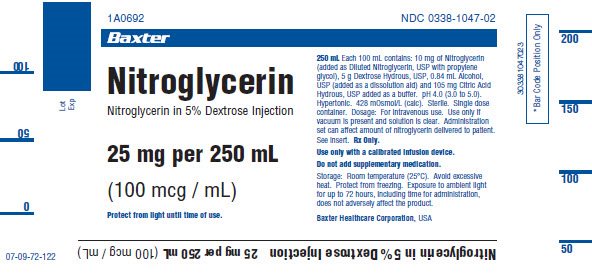
PRINCIPAL DISPLAY PANEL Container Label Lot Exp 07-09-72-122 1A0692 NDC 0338-1047-02 Baxter Logo Nitroglycerin Nitroglycerin in 5% Dextrose Injection 25 mg per 250 mL (100 mcg / mL) Protect frm light until time of use. 250 mL Each 100 mL contains: 10 mg of Nitroglycerin (added as Diluted Nitroglycerin, USP with propylene glycol), 5 g Dextrose Hydrous, USP, 0.84 mL Alcohol, USP (added as a dissolution aid) and 105 mg Citric Acid Hydrous, USP added as a buffer. pH 4.0 (3.0 to 5.0). Hypertonic.
428 mOsmol/L (calc). Sterile. Single dose container.
Dosage: For intravenous use. Use only if vacuum is present and solution is clear. Administration set can affect amount of nitroglycerin delivered to patient.
See insert. Rx Only. Use only with a calibrated infusion device.
Do not add supplementary medication. Storage: Room temperature (25ºC). Avoid excessive heat.
Protect from freezing. Exposure to ambient light for up to 72 hours, including time for administration, does not adversely affect the product. Baxter Healthcare Corporation, USA 3 0 3 3 8 1 0 4 7 0 2 3 *Bar Code Position Only Nitroglycerin in 5% Dextrose Injection 25 mg per 250 mL (100 mcg / mL) Container Label Lot Exp 07-09-72-120 1A0694 NDC 0338-1049-02 Baxter Logo Nitroglycerin Nitroglycerin in 5% Dextrose Injection 50 mg per 250 mL (200 mcg / mL) Protect from light until time of use.
250 mL Each 100 mL contains: 20 mg of Nitroglycerin (added as Diluted Nitroglycerin, USP with propylene glycol), 5 g Dextrose Hydrous, USP, 0.84 mL Alcohol, USP (added as a dissolution aid) and 105 mg Citric Acid Hydrous, USP added as a buffer. pH 4.0 (3.0 to 5.0). Hypertonic. 440 mOsmol/L (calc).
Sterile. Single dose container. Dosage: For intravenous use.
Use only if vacuum is present and solution is clear. Administration set can affect amount of nitroglycerin delivered to patient. See insert.
Rx Only. Use only with a calibrated infusion device. Do not add supplementary medication.
Storage: Room temperature (25ºC). Avoid excessive heat. Protect from freezing.
Exposure to ambient light for up to 72 hours, including time for administration, does not adversely affect the product. Baxter Healthcare Corporation , USA 303381049027 *Bar Code Position Only Nitroglycerin in 5% Dextose Injecton 50 mg per 250 mL (200 mcg / mL) Container Label Lot Exp 07-09-72-121 1A0696 NDC 0338-1051-02 Baxter Logo Nitroglycerin Nitroglycerin in 5% Dextrose Injection 100 mg per 250 mL (400 mcg / mL) Protect from light until time of use. 250 mL Each 100 mL contains: 40 mg of Nitroglycerin (added as Diluted Nitroglycerin, USP with propylene glycol), 5 g Dextrose Hydrous, USP, 0.84 mL Alcohol, USP (added as a dissolution aid) and 105 mg Citric Acid Hydrous, USP added as a buffer. pH 4.0 (3.0 to 5.0).
Hypertonic. 465 mOsmol/L (calc). Sterile.
Single dose container. Dosage: For intravenous use. Use only if vacuum is present and solution is clear.
Administration set can affect amount of nitroglycerin delivered to patient. See insert. Rx Only.
Use only with calibrated infusion device. Do not add supplementary medication. Storage: Room temperature (25ºC).
Avoid excessive heat. Protect from freezing. Exposure to ambient light for up to 72 hours, including time for administration, does not adversely affect the product.
Baxter Healthcare Corporation 303381051020 *Bar Code Position Only Nitrogycerin in 5% Dextrose Injection 100 mg per 250 mL (400 mcg / mL) Representative container 25 mg Nitroglycerin, 0338-1047-02 Representative Container_50 mg Nitroglycerin, NDC 0338-1049-02 Representative Container Label_100 mg Nitroglycerin, 0338-1051-02
Medicaid utilization & spend
Medicare Part D spend CMS · PART D · 2026 (Q1)
About this NDC listing & data coverage
What data is (and isn’t) available for this NDC — tap to expand
| NDC identity (package / product / labeler codes) | ✓ Available |
| Labeler | ✓ Available |
| Product & package description | ✓ Available |
| Marketing category & status | ✓ Available |
| Active ingredient / dosage form / route | ✓ Available |
| FDA label (SPL via DailyMed) | ✓ Available |
| Package photos | ✓ Available |
| Inactive ingredients (structured) | ✓ Available |
| NADAC pharmacy acquisition price (CMS) | — Not published for this NDC CMS publishes NADAC only for NDCs reported in its retail-pharmacy survey. |
| Orange Book / therapeutic-equivalence data | — Not published for this NDC Applies only to products approved under an NDA/ANDA; many listings are out of scope. |
| HCPCS J-code billing crosswalk | ✓ Available |
| Medicaid utilization (CMS SDUD) | ✓ Available |