
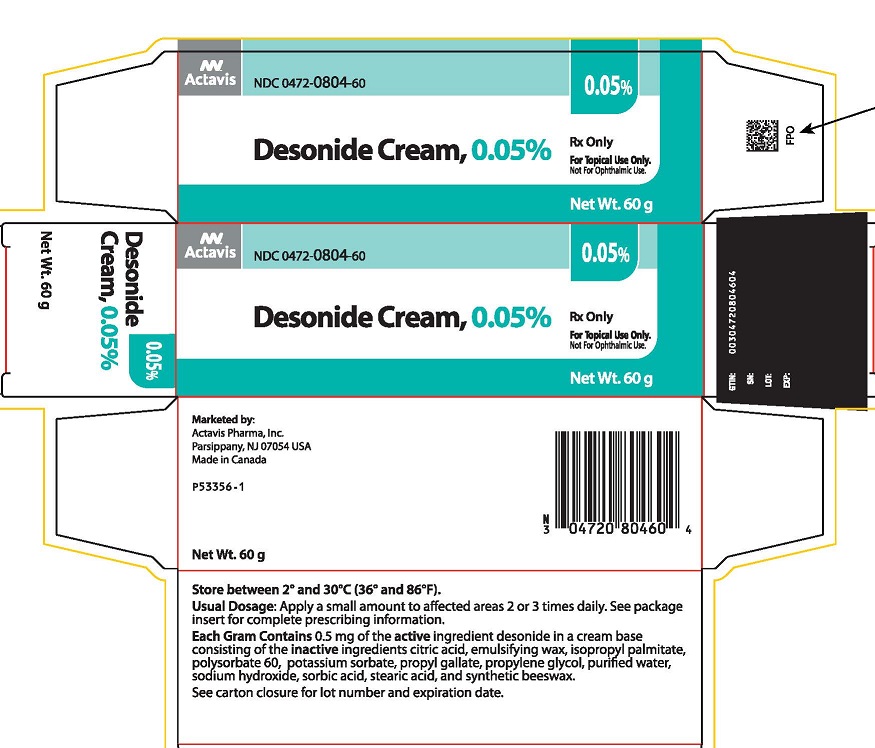
NDC 00472-0804-15: Desonide .5 mg/g Cream
This is a package of Desonide .5 mg/g Cream from Actavis Pharma, Inc., no longer marketed (first marketed Aug 2013), no longer in the FDA NDC Directory, this package's marketing ended Jul 2026; retail pharmacies pay about $0.2661 per g (NADAC).
NDC Database Record
One package, one record: these facts belong to NDC 0472-0804-15 alone.
- Record
- FDA NDC Directory package listing · Human prescription drug
- Code segments
- 0472 labeler · 0804 product · 15 package
- Package marketed since
- Aug 1, 2013
- Package marketing ended
- Jul 31, 2026
- Sample package
- No — commercial package
- Barcode (UPC)
- 0304720804604, 0304720803041
- FDA record last changed
- Jul 24, 2026
Identity & Classification
Regulatory identifiers FDA, NLM and CMS codes for this package
Drug-database identifiers Medi-Span GPI and First Databank GCN / HICL / AHFS classification
- GSN (GCN sequence number): 007620
- GCN: 31425
- GPI-14 (Medi-Span): 90550035003705
- HICL (First Databank): 003322
- AHFS class code: 84:06.08.00
- RxCUI (RxNorm): 197572
Where does this data come from?
- FDA openFDA NDC Directory · synced Nov 26, 2026
- FDA label on DailyMed · label index refreshed Nov 26, 2026
- RxNorm (NLM RxNav) · catalog refreshed Nov 26, 2026
- Medi-Span GPI (licensed)
- First Databank (licensed) · refreshed Nov 26, 2026
RxNorm Drug Class
This medicine belongs to the Corticosteroid class.
Where does this data come from?
- RxClass (NLM) · catalog refreshed Nov 26, 2026
Clinical
Desonide is used to treat the redness, swelling, itching, and discomfort of various skin conditions, including psoriasis (a skin disease in which red, scaly patches form on some areas of the body and eczema (a skin disease that causes the skin to be dry and itchy and to sometimes develop red, scaly rashes). Desonide is in a class of medications called topical corticosteroids. It works by activating natural substances in the skin to reduce swelling, redness, and itching.
Read the full MedlinePlus article ↗- Desonide is a mild steroid for the skin. The cream and ointment relieve inflammation and itching from steroid-responsive skin conditions. The gel is used for mild to moderate atopi...
- Put a thin layer on the affected skin and rub it in gently. The gel is used twice daily. Keep it out of your eyes and don't cover the area with airtight dressings. It is for the sk...
- Stop when your skin is under control. The gel should not be used beyond 4 consecutive weeks, and the cream and ointment not longer than two weeks unless your doctor says so. If the...
- Some people notice burning, itching, rash or headache. Call your doctor if your skin gets irritated, worsens, looks infected, or becomes thin or marked with stretch marks.
Patient education
Drug interactions
Supplement & herbal interactions
Some supplements/herbs that may interact with Desonide — tap one for details:
Where does this data come from?
- MedlinePlus (NLM) · refreshed Nov 26, 2026
- FDA label on DailyMed · label index refreshed Nov 26, 2026
Ask a licensed pharmacist directly — free, answered by our team.
Pricing
A drug doesn't have one price. Each row is a different public payment system, and none is what you'd pay at the counter — that depends on your insurance. The ⓘ on each row explains what it measures.
| Price system | Per g | Per package |
|---|---|---|
| Retail pharmacies pay NADAC · weekly | $0.266 | $3.99 / 15 g |
| Medicaid paysCMS SDUD · 12 mo | No recent Medicaid claims on file for this NDC — rare and low-volume NDCs are suppressed in the public data. | |
| Medicare drug plans payPart D · Q2 2026 | $0.6421 | $9.63 / 15 g |
See this NDC in the NADAC Price Lookup: every NDC at its price and what a fill costs the pharmacy →
Where does this data come from?
- CMS NADAC weekly file · file of Jul 29, 2026
- CMS ASP pricing files · refreshed Nov 20, 2026
- CMS Medicaid State Drug Utilization Data · refreshed Nov 29, 2026
- CMS Part D plan pricing files · refreshed Nov 24, 2026
- VA National Acquisition Center price file
Packaging — All Sizes for This Product
| Package NDC | Description | Per unit | Per pack | Marketing start | Marketing end | Status |
|---|---|---|---|---|---|---|
| 00472-0804-15 You're viewing this | 1 TUBE in 1 CARTON / 15 g in 1 TUBE | $0.2661 / g | $3.99 | 2013-08-01 | Jul 31, 2026 | Discontinued by firm |
| 00472-0804-60 0472-0804-60 Main listing | 1 TUBE in 1 CARTON / 60 g in 1 TUBE | $0.1926 / g | $11.55 | 2013-08-01 | Jul 31, 2026 | Discontinued by firm |
Per g, this pack runs about 38% above the cheapest pack (NDC 00472-0804-60, $0.1926 vs $0.2661 NADAC).
This pack shows little to no recent Medicaid volume — a different pack size carries most fills. See all packs ↓
Pack size FAQ
What quantity is in this package?
What NDC number is used to bill for this package of Desonide .5 mg/g Cream?
Prices are the latest CMS NADAC pharmacy acquisition cost per NDC; per-pack figures are per-unit × pack quantity, shown only when the pack is denominated in the same measure NADAC prices.
Therapeutic Equivalents
| Product | Labeler | Pack | NADAC/unit | TE | Status | Price vs. this |
|---|---|---|---|---|---|---|
| Desonide .5 mg/g 00713-0661-15 | Cosette | 1 tube | $0.264 | AB | Availability likely | save 1% |
| Desonide .5 mg/g 16714-0729-01 | NORTHSTAR | 1 tube | $0.264 | AB | Availability likely | save 1% |
| Desonide .5 mg/g 51672-1280-01 | Sun | 1 tube | $0.264 | AB | Availability likely | save 1% |
| Desonide .5 mg/g 62332-0632-15 | Alembic | 1 tube | $0.264 | AB | Availability likely | save 1% |
| Desonide .5 mg/g 72578-0086-01 | Viona | 1 tube | $0.264 | AB | Availability likely | save 1% |
| Desonide .5 mg/g 45802-0423-35 | Padagis | 1 tube | $0.364 | AB | Availability likely | +37% |
| Desonide .5 mg/g 72603-0164-01 | NORTHSTAR | 1 tube | $0.364 | AB | Availability likely | +37% |
| Desonide .5 mg/g 51672-1281-01 | Sun | 1 tube | $0.364 | AB | Availability likely | +37% |
| Desonide .5 mg/g 62332-0485-15 | Alembic | 1 tube | $0.364 | AB | Availability likely | +37% |
| Desonide .5 mg/g 46708-0632-15 | Alembic | 1 tube | — | AB | FDA listed | — |
| Desonide .5 mg/g 63187-0747-15 | Proficient | 1 tube | — | AB | FDA listed | — |
| Desonide .5 mg/g 63629-2506-01 | Bryant | 1 tube | — | AB | FDA listed | — |
| Desonide .5 mg/g 63629-2507-01 | Bryant | 1 tube | — | AB | FDA listed | — |
| Tridesilon Cream .03 g/60g 69482-0600-60 | Encore | 1 tube | — | — | FDA listed | — |
| Desonide .5 mg/g 70771-1381-01 | Zydus | 1 tube | — | AB | FDA listed | — |
| Desonide .5 mg/g 72162-2005-02 | Bryant | 1 tube | — | AB | FDA listed | — |
| Desonide .5 mg/g 80425-0371-01 | Advanced | 1 tube | — | AB | FDA listed | — |
| Desonide .5 mg/g 80425-0418-01 | Advanced | 1 tube | — | AB | FDA listed | — |
| Desonide .5 mg/g 24470-0920-60 | Cintex | 1 tube | — | — | FDA listed | — |
| Desonide .5 mg/g 46708-0485-15 | Alembic | 1 tube | — | AB | FDA listed | — |
| Desonide .5 mg/gthis 00472-0804-15 | Actavis | 1 tube | $0.266 | AB | Discontinued | — |
Where does this data come from?
- FDA openFDA NDC Directory · synced Nov 26, 2026
- FDA Orange Book · refreshed Nov 6, 2026
- CMS NADAC weekly file · file of Jul 29, 2026
Availability & Generic Status
This product is an authorized generic: the brand-name medicine sold under its generic name. Other versions of the same drug are listed under Therapeutic equivalents, least expensive first.
Where does this data come from?
- FDA Orange Book · refreshed Nov 6, 2026
Inactive Ingredients / Excipients
Inactive ingredients, also called excipients, are components of the drug product other than the active ingredient. They may include fillers, dyes, coatings, preservatives, flavors, or other formulation ingredients.
Avoiding an ingredient? See Desonide Topical inactive ingredients by manufacturer: every current product's list side by side, so you can ask your pharmacy for the version that does not list it.
Tap an ingredient (hover on desktop) to see what it is and why it’s used.
-
UNII XF417D3PSL
Anhydrous citric acid is a sour, crystalline powder derived from citric acid with water removed. In medicines, it acts as a buffer to control pH, adds tartness to improve taste, and helps tablets disintegrate.
-
UNII 8CRQ2TH63M
Isopropyl palmitate is an oily liquid derived from palm oil. It acts as an emollient and lubricant in medicines, helping soften the skin or improve how the product spreads and flows.
-
UNII CAL22UVI4M
A synthetic emulsifier derived from sorbitol and fatty acids. It helps mix oil and water-based ingredients together and improves the texture and stability of the medicine.
-
UNII 1VPU26JZZ4
Potassium sorbate is a salt derived from sorbic acid, a naturally occurring preservative. It prevents growth of mold, yeast, and some bacteria, extending the medicine's shelf life.
-
UNII 8D4SNN7V92
Propyl gallate is a synthetic antioxidant derived from gallic acid. It prevents oils and fats in the medicine from oxidizing and spoiling, helping the product stay stable and effective during storage.
-
UNII 6DC9Q167V3
Propylene glycol is a clear liquid derived from petroleum or vegetable sources. It acts as a solvent, humectant, and preservative in medicines, helping dissolve active ingredients and maintain product stability.
-
UNII 55X04QC32I
A strong alkaline chemical used to adjust and maintain the pH balance of liquid medicines. It helps keep the medicine stable and ensures it stays effective during storage.
-
UNII X045WJ989B
Sorbic acid is a preservative derived from berries that prevents mold, yeast, and bacterial growth in medicines. It keeps the product stable and safe during storage.
-
UNII 4ELV7Z65AP
Stearic acid is a fatty acid derived from plant or animal sources. It acts as a binder and lubricant in tablets and capsules, helping them hold together and flow smoothly during manufacturing.
-
UNII 059QF0KO0R
Water is a liquid solvent that dissolves and mixes ingredients together in liquid medicines, syrups, and injections. It helps distribute the active drug evenly throughout the product.
10 inactive ingredients listed in the exact product block matched to this NDC.
Where does this data come from?
ingredient classCode="IACT" elements from the exact product block matched by this NDC. Label-section narrative from DailyMed / the openFDA label index is shown separately when available.- FDA label on DailyMed · label index refreshed Nov 26, 2026
- FDA openFDA NDC Directory · synced Nov 26, 2026
Inactive ingredient FAQ
Are inactive ingredients the same for every manufacturer?
Why might an inactive ingredient be missing?
Can inactive ingredients matter?
Manufacturer & Labeler
More NDCs from Actavis Pharma, Inc. labeler code 00472
- Betamethasone Dipropionate .5 mg/g Ointment NDC 0472-0381-15
- Betamethasone Dipropionate .5 mg/g Ointment, Augmented NDC 0472-0382-15
- Clobetasol Propionate .05 g/100mL Lotion NDC 0472-0404-92
- Desoximetasone 2.5 mg/g Cream NDC 0472-0478-15
- Desoximetasone 2.5 mg/g Ointment NDC 0472-0479-15
- Desonide .5 mg/mL Lotion NDC 0472-0803-02
- Hydromet hydrocodone bitartrate and homatropine methylbromide 5 mg/5mL; 1.5 mg/5mL Solution NDC 0472-1030-16
- Miconazole Nitrate 200 mg Suppository NDC 0472-1738-03
- Diclofenac Sodium 30 mg/g Gel NDC 0472-1783-10
- Clindamycin Phosphate and Tretinoin 12 mg/g; .25 mg/g Gel NDC 0472-1790-30
- Mesalamine 1000 mg Suppository NDC 0472-1915-30
- Ibuprofen 100 mg/5mL Suspension NDC 0472-2002-16
Where does this data come from?
- FDA openFDA NDC Directory · synced Nov 26, 2026
- Drugs@FDA
Full Prescribing Information FDA SPL
Indications and Usage
INDICATIONS AND USAGE: Desonide Cream and Lotion are low to medium potency corticosteroids indicated for the relief of the inflammatory and pruritic manifestations of corticosteroid responsive dermatoses.
Dosage and Administration
DOSAGE AND ADMINISTRATION: Desonide Cream or Lotion should be applied to the affected areas as a thin film two or three times daily depending on the severity of the condition. SHAKE LOTION WELL BEFORE USING. As with other corticosteroids, therapy should be discontinued when control is achieved. If no improvement is seen within 2 weeks, reassessment of diagnosis may be necessary. Desonide Cream and Lotion should not be used with occlusive dressings.
Contraindications
CONTRAINDICATIONS: Desonide Cream and Lotion are contraindicated in those patients with a history of hypersensitivity to any of the components of the preparations.
Adverse Reactions
ADVERSE REACTIONS: In controlled clinical trials, the total incidence of adverse reactions associated with the use of desonide was approximately 8%. These were: stinging and burning approximately 3%, irritation, contact dermatitis, condition worsened, peeling of skin, itching, intense transient erythema, and dryness/scaliness, each less than 2%. The following additional local adverse reactions have been reported infrequently with other topical corticosteroids, and they may occur more frequently with the use of occlusive dressings, especially with higher potency corticosteroids.
These reactions are listed in an approximate decreasing order of occurrence: folliculitis, acneiform eruptions, hypopigmentation, perioral dermatitis, secondary infection, skin atrophy, striae, and miliaria.
Pregnancy
Pregnancy: Teratogenic Effects: Pregnancy category C: Corticosteroids have been shown to be teratogenic in laboratory animals when administered systemically at relatively low dosage levels. Some corticosteroids have been shown to be teratogenic after dermal application in laboratory animals. Animal reproduction studies have not been conducted with Desonide Cream or Lotion.
It is also not known whether Desonide Cream or Lotion can cause fetal harm when administered to a pregnant woman or can affect reproduction capacity. Desonide Cream and Lotion should be given to a pregnant woman only if clearly needed.
Pediatric Use
Pediatric use: Safety and effectiveness in pediatric patients have not been established. Because of a higher ratio of skin surface area to body mass, pediatric patients are at a greater risk than adults of HPA axis suppression when they are treated with topical corticosteroids. They are therefore also at greater risk of glucocorticosteroid insufficiency after withdrawal of treatment and of Cushing’s syndrome while on treatment.
Adverse effects including striae have been reported with inappropriate use of topical corticosteroids in infants and children. HPA axis suppression, Cushing’s syndrome, linear growth retardation, delayed weight gain and intracranial hypertension have been reported in children receiving topical corticosteroids. Manifestations of adrenal suppression in children include low plasma cortisol levels, and absence of response to ACTH stimulation.
Manifestations of intracranial hypertension include bulging fontanelles, headaches, and bilateral papilledema.
Overdosage
OVERDOSAGE: Topically applied Desonide Cream and Lotion can be absorbed in sufficient amounts to produce systemic effects (See PRECAUTIONS ).
Clinical Pharmacology
CLINICAL PHARMACOLOGY: Like other topical corticosteroids, desonide has anti-inflammatory, antipruritic and vasoconstrictive properties. The mechanism of the anti-inflammatory activity of the topical steroids, in general, is unclear. However, corticosteroids are thought to act by the induction of phospholipase A 2 inhibitory proteins, collectively called lipocortins.
It is postulated that these proteins control the biosynthesis of potent mediators of inflammation such as prostaglandins and leukotrienes by inhibiting the release of their common precursor arachidonic acid. Arachidonic acid is released from membrane phospholipids by phospholipase A 2 . Pharmacokinetics: The extent of percutaneous absorption of topical corticosteroids is determined by many factors including the vehicle and the integrity of the epidermal barrier.
Occlusive dressings with hydrocortisone for up to 24 hours have not been demonstrated to increase penetration; however, occlusion of hydrocortisone for 96 hours markedly enhances penetration. Topical corticosteroids can be absorbed from normal intact skin. Inflammation and/or other disease processes in the skin may increase percutaneous absorption.
Studies performed with Desonide Cream and Lotion indicate that they are in the low to medium range of potency as compared with other topical corticosteroids.
How Supplied / Storage and Handling
HOW SUPPLIED: Desonide Cream 0.05% is supplied in a tube containing: 15 g NDC 0472- 0804 -15 60 g NDC 0472- 0804 -60 Desonide Lotion 0.05% is supplied in bottles containing: 2 fl oz NDC 0472- 0803 -02 4 fl oz NDC 0472- 0803 -04 Storage Conditions: Store between 2° and 30°C (36° and 86°F). Marketed by: Actavis Pharma, Inc. Parsippany, NJ 07054 USA Made in Canada P53355-1 Rev. March 2018
Description
DESCRIPTION: Desonide Cream 0.05% and Lotion 0.05% contain desonide (Pregna-1,4-diene-3,20-dione,11,21-dihydroxy-16,17 [(1-methylethylidene)bis(oxy)]-,(11β,16α)- a synthetic nonfluorinated corticosteroid for topical dermatologic use. The corticosteroids constitute a class of primarily synthetic steroids used topically as anti-inflammatory and anti-pruritic agents. Chemically, desonide is C 24 H 32 O 6 .
It has the following structural formula: Desonide has the molecular weight of 416.51. It is a white to off white odorless powder which is soluble in methanol and practically insoluble in water. Each gram of Desonide Cream contains 0.5 mg of desonide in a base of citric acid, emulsifying wax, isopropyl palmitate, polysorbate 60, potassium sorbate, propyl gallate, propylene glycol, purified water, sodium hydroxide, sorbic acid, stearic acid, and synthetic beeswax.
Each gram of Desonide Lotion contains 0.5 mg of desonide in a base of cetyl alcohol, edetate sodium, glyceryl stearate SE, light mineral oil, methylparaben, propylene glycol, propylparaben, purified water, sodium lauryl sulfate, sorbitan monostearate, and stearyl alcohol. May contain citric acid and/or sodium hydroxide for pH adjustment. desowen-structure-01
Information for Patients
Information for patients: Patients using topical corticosteroids should receive the following information and instructions: This medication is to be used as directed by the physician. It is for external use only. Avoid contact with the eyes.
This medication should not be used for any disorder other than that for which it was prescribed. The treated skin area should not be bandaged or otherwise covered or wrapped so as to be occlusive unless directed by the physician. Patients should report to their physician any signs of local adverse reactions.
Precautions
PRECAUTIONS: General: Systemic absorption of topical corticosteroids can produce reversible hypothalamic-pituitary-adrenal (HPA) axis suppression with the potential for glucocorticosteroid insufficiency after withdrawal of treatment. Manifestations of Cushing’s syndrome, hyperglycemia, and glucosuria can also be produced in some patients by systemic absorption of topical corticosteroids while on treatment. Patients applying a topical steroid to a large surface area or to areas under occlusion should be evaluated periodically for evidence of HPA axis suppression.
This may be done by using the ACTH stimulation, A.M. plasma cortisol, and urinary free cortisol tests. Patients receiving superpotent corticosteroids should not be treated for more than 2 weeks at a time and only small areas should be treated at any one time due to the increased risk of HPA axis suppression. If HPA axis suppression is noted, an attempt should be made to withdraw the drug, to reduce the frequency of application, or to substitute a less potent corticosteroid.
Recovery of HPA axis function is generally prompt and complete upon discontinuation of topical corticosteroids. Infrequently, signs and symptoms of glucocorticosteroid insufficiency may occur requiring supplemental systemic corticosteroids. For information on systemic supplementation, see prescribing information for those products.
Pediatric patients may be more susceptible to systemic toxicity from equivalent doses due to their larger skin surface to body mass ratios. (See PRECAUTIONS - Pediatric use ). If irritation develops, Desonide Cream or Lotion should be discontinued and appropriate therapy instituted.
Allergic contact dermatitis with corticosteroids is usually diagnosed by observing failure to heal rather than noting a clinical exacerbation as with most topical products not containing corticosteroids. Such an observation should be corroborated with appropriate diagnostic patch testing. If concomitant skin infections are present or develop, an appropriate antifungal or antibacterial agent should be used.
If a favorable response does not occur promptly, use of Desonide Cream or Lotion should be discontinued until the infection has been adequately controlled. Information for patients: Patients using topical corticosteroids should receive the following information and instructions: This medication is to be used as directed by the physician. It is for external use only.
Avoid contact with the eyes. This medication should not be used for any disorder other than that for which it was prescribed. The treated skin area should not be bandaged or otherwise covered or wrapped so as to be occlusive unless directed by the physician.
Patients should report to their physician any signs of local adverse reactions. Laboratory tests: The following tests may be helpful in evaluating patients for HPA axis suppression: ACTH stimulation test A.M. plasma cortisol test Urinary free cortisol test Carcinogenesis, mutagenesis, impairment of fertility: Long-term animal studies have not been performed to evaluate the carcinogenic potential or the effect on reproduction with the use of Desonide Cream and Lotion. Pregnancy: Teratogenic Effects: Pregnancy category C: Corticosteroids have been shown to be teratogenic in laboratory animals when administered systemically at relatively low dosage levels.
Some corticosteroids have been shown to be teratogenic after dermal application in laboratory animals. Animal reproduction studies have not been conducted with Desonide Cream or Lotion. It is also not known whether Desonide Cream or Lotion can cause fetal harm when administered to a pregnant woman or can affect reproduction capacity.
Desonide Cream and Lotion should be given to a pregnant woman only if clearly needed. Nursing mothers: Systemically administered corticosteroids appear in human milk and could suppress growth, interfere with endogenous corticosteroid production, or cause other untoward effects. It is not known whe… [Excerpted — this section continues on DailyMed.]
Nursing Mothers
Nursing mothers: Systemically administered corticosteroids appear in human milk and could suppress growth, interfere with endogenous corticosteroid production, or cause other untoward effects. It is not known whether topical administration of corticosteroids could result in sufficient systemic absorption to produce detectable quantities in human milk. Because many drugs are excreted in human milk, caution should be exercised when Desonide Cream or Lotion is administered to a nursing woman.
Pharmacokinetics
Pharmacokinetics: The extent of percutaneous absorption of topical corticosteroids is determined by many factors including the vehicle and the integrity of the epidermal barrier. Occlusive dressings with hydrocortisone for up to 24 hours have not been demonstrated to increase penetration; however, occlusion of hydrocortisone for 96 hours markedly enhances penetration. Topical corticosteroids can be absorbed from normal intact skin.
Inflammation and/or other disease processes in the skin may increase percutaneous absorption. Studies performed with Desonide Cream and Lotion indicate that they are in the low to medium range of potency as compared with other topical corticosteroids.
Carcinogenesis, Mutagenesis, Impairment of Fertility
Carcinogenesis, mutagenesis, impairment of fertility: Long-term animal studies have not been performed to evaluate the carcinogenic potential or the effect on reproduction with the use of Desonide Cream and Lotion.
Package Label / Principal Display Panel
PACKAGE LABEL - Desonide Cream Actavis NDC 0472-0804-60 Rx Only For Topical Use Only. Not for Ophthalmic Use. Desonide Cream 0.05% NET WT.
60 g Marketed by: Actavis Pharma, Inc. Parsippany, NJ 07054 USA Made in Canada P53356-1 Store between 2° and 30°C (36° and 86°F). Usual dosage: Apply a small amount to affected areas 2 or 3 times daily.
See package insert for complete prescribing information. Each gram contains 0.5 mg of the active ingredient desonide in a cream base consisting of the inactive ingredients citric acid, emulsifying wax, isopropyl palmitate, polysorbate 60, potassium sorbate, propyl gallate, propylene glycol, purified water, sodium hydroxide, sorbic acid, stearic acid and synthetic beeswax. See carton closure for lot number and expiration date.
PACKAGE LABEL - Desonide Lotion Rx Only NDC 0472-0803-04 Desonide Lotion 0.05% For Topical Use Only. Not for Ophthalmic Use. 4 FL OZ (118 mL) SHAKE WELL BEFORE USING.
Usual dosage: Apply a small amount to affected areas 2 or 3 times daily. See package insert for complete prescribing information. Contains: Active: desonide 0.05% w/w (0.5 mg/g).
Inactive: cetyl alcohol, edetate sodium, glyceryl stearate SE, light mineral oil, methylparaben, propylene glycol, propylparaben, purified water, sodium lauryl sulfate, sorbitan monostearate, and stearyl alcohol. May contain citric acid and/or sodium hydroxide for pH adjustment. Lot number and expiration date on bottom of carton.
Store between 2° AND 30°C (36° AND 86°F). Marketed by: Actavis Pharma, Inc. Parsippany, NJ 07054 USA Made in Canada P53346-0
Medicaid Utilization by Pack Size
Medicare Part D Spend CMS · Part D · 2026 (Q1-Q2)
Reported Adverse Events (FAERS)
Top reported reactions
Age at onset
Reporter sex
Serious outcomes
Where does this data come from?
About This NDC Listing & Data Coverage
What data is (and isn’t) available for this NDC — tap to expand
| NDC identity (package / product / labeler codes) | Available |
| Labeler | Available |
| Product & package description | Available |
| Marketing category & status | Available |
| Active ingredient / dosage form / route | Available |
| FDA label (SPL via DailyMed) | Available |
| Package photos | Available |
| Inactive ingredients (structured) | Available |
| NADAC pharmacy acquisition price (CMS) | Available |
| Orange Book / therapeutic-equivalence data | Available |
| HCPCS J-code billing crosswalk | — Not published for this NDC Most self-administered / retail products have no J-code — that is normal. |
| Medicaid utilization (CMS SDUD) | — Not published for this NDC CMS reports utilization only for NDCs with Medicaid claims above its privacy threshold. |