
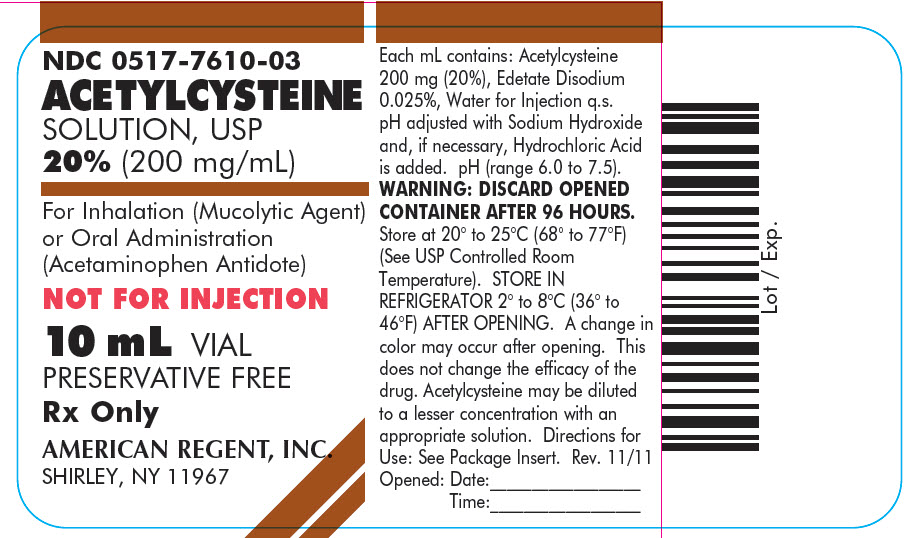
Acetylcysteine 200 mg/mL Inhalant — NDC 0517-7610-03 (Billing 00517-7610-03)
This is a package of Acetylcysteine 200 mg/mL Inhalant from American Regent, Inc., marketed since Oct 1995 and currently FDA-listed. It is this product's only package size.
NDC database record
One package, one record: these facts belong to NDC 0517-7610-03 alone.
- Record
- FDA NDC Directory package listing · Human prescription drug
- Code segments
- 0517 labeler · 7610 product · 03 package
- Package marketed since
- Oct 1, 1995
- Sample package
- No — commercial package
- Listing certified through
- Dec 31, 2026
- Barcode (UPC)
- 0305177510032, 0305177604250, 0305177504253, 0305177610039
- FDA record last changed
- Jul 24, 2026
Identity & classification
Regulatory identifiers FDA, NLM and CMS codes for this package
Drug-database identifiers Medi-Span GPI and First Databank GCN / HICL / AHFS classification
- GSN (GCN sequence number): 000592
- GCN: 02401
- GPI-14 (Medi-Span): 43300010002005
- HICL (First Databank): 000189
- AHFS class code: 48:24.00.00
- RxCUI (RxNorm): 307718
Where does this data come from?
- FDA openFDA NDC Directory · synced Oct 8, 2026
- FDA label on DailyMed · label index refreshed Oct 6, 2026
- RxNorm (NLM RxNav) · catalog refreshed Oct 1, 2026
- Medi-Span GPI (licensed)
- First Databank (licensed) · refreshed Oct 8, 2026
RxNorm drug class
This medicine belongs to the Antidote class.
Where does this data come from?
- RxClass (NLM) · catalog refreshed Oct 1, 2026
Clinical
- It has two main uses. It is an antidote that helps protect the liver after an acetaminophen overdose. In inhaled form, it also helps loosen thick, sticky mucus in many lung conditi...
- The injection is given into a vein by healthcare staff, usually starting with a loading dose. The inhaled solution is breathed in as a mist, often a few times a day. Your prescribe...
- The most common ones are rash, hives, facial flushing and itching. Some people have nausea, vomiting or a fast heartbeat. Mild flushing often fades even while the infusion continue...
- Get help for wheezing, shortness of breath, throat tightness, swelling or feeling faint. These can be signs of a serious allergic reaction. If you have asthma, tell your care team...
Patient education
Supplement & herbal interactions
Some supplements/herbs that may interact with Acetylcysteine (prescription drug) — tap one for details:
Where does this data come from?
- MedlinePlus (NLM) · refreshed Oct 1, 2026
- FDA label on DailyMed · label index refreshed Oct 6, 2026
Ask a licensed pharmacist directly — free, answered by our team.
Pricing
A drug doesn't have one price. Each row is a different public payment system, and none is what you'd pay at the counter — that depends on your insurance. The ⓘ on each row explains what it measures.
| Price system | Per each | Per package |
|---|---|---|
| Retail pharmacies payNADAC · weekly | Not in the retail survey — common for institutional, discontinued, or low-volume packs. | |
| Medicaid paysCMS SDUD · 12 mo | No recent Medicaid claims on file for this NDC — rare and low-volume NDCs are suppressed in the public data. | |
| Medicare drug plans payPart D · Q2 2026 | $1.53 | $4.60 / 3 vials |
Where does this data come from?
- CMS NADAC weekly file
- CMS ASP pricing files · refreshed Sep 20, 2026
- CMS Medicaid State Drug Utilization Data · refreshed Oct 8, 2026
- CMS Part D plan pricing files · refreshed Sep 24, 2026
- VA National Acquisition Center price file
Packaging — all sizes for this product
| Package NDC | Description | Marketing start | Marketing end | Status |
|---|---|---|---|---|
| 00517-7610-03 You're viewing this Main listing | 3 VIAL, GLASS in 1 BOX / 10 mL in 1 VIAL, GLASS | 1995-10-01 | — | Active |
Therapeutic equivalents
| Product | Labeler | Pack | NADAC/unit | TE | Status | Price vs. this |
|---|---|---|---|---|---|---|
| Acetylcysteine 200 mg/mL 00409-3308-03 | Hospira, | 3 vials | $0.737 | AN | Availability likely | — |
| Acetylcysteine 200 mg/mL 63323-0690-30 | Fresenius | 3 vials | $0.737 | AN | Availability likely | — |
| Acetylcysteine 200 mg/mL 70069-0020-03 | Somerset | 3 vials | $0.737 | AN | Availability likely | — |
| Acetylcysteine 200 mg/mL 63323-0692-10 | Fresenius | 3 vials | $1.318 | AN | Availability likely | — |
| Acetylcysteine 200 mg/mL 00517-7604-25 | American | 25 vials | $2.245 | AN | Availability likely | — |
| Acetylcysteine 200 mg/mL 42494-0436-25 | Cameron | 25 vials | $2.245 | AN | Availability likely | — |
| Acetylcysteine 200 mg/mL 63323-0694-04 | Fresenius | 25 vials | $2.245 | AN | Availability likely | — |
| Acetylcysteine 200 mg/mL 70069-0019-25 | Somerset | 25 vials | $2.245 | AN | Availability likely | — |
| Acetylcysteine 200 mg/mLthis 00517-7610-03 | American | 3 vials | — | AN | FDA listed | — |
| Acetylcysteine 200 mg/mL 55154-5731-05 | Cardinal | 5 vials | — | AN | FDA listed | — |
Where does this data come from?
- FDA openFDA NDC Directory · synced Oct 8, 2026
- FDA Orange Book · refreshed Oct 3, 2026
- CMS NADAC weekly file
Availability & generic status
This product is an FDA-approved generic. Other versions of the same drug are listed under Therapeutic equivalents, least expensive first.
Where does this data come from?
- FDA Orange Book · refreshed Oct 3, 2026
Inactive Ingredients / Excipients
Inactive ingredients, also called excipients, are components of the drug product other than the active ingredient. They may include fillers, dyes, coatings, preservatives, flavors, or other formulation ingredients.
🧪 Avoiding an ingredient? See Acetylcysteine inactive ingredients by manufacturer: every current product's list side by side, so you can ask your pharmacy for the version that does not list it.
💡 Tap an ingredient (hover on desktop) to see what it is and why it’s used.
-
UNII 7FLD91C86K
Edetate disodium is a chemical compound that binds and removes certain metal ions. In medicines, it acts as a preservative and stabilizer by preventing metals like calcium from interfering with the product's shelf life and consistency.
-
UNII 059QF0KO0R
Water is a liquid solvent that dissolves and mixes ingredients together in liquid medicines, syrups, and injections. It helps distribute the active drug evenly throughout the product.
2 inactive ingredients listed in the exact product block matched to this NDC.
Where does this data come from?
ingredient classCode="IACT" elements from the exact product block matched by this NDC. Label-section narrative from DailyMed / the openFDA label index is shown separately when available.- FDA label on DailyMed · label index refreshed Oct 6, 2026
- FDA openFDA NDC Directory · synced Oct 8, 2026
Inactive ingredient FAQ
Are inactive ingredients the same for every manufacturer?
Why might an inactive ingredient be missing?
Can inactive ingredients matter?
Manufacturer & labeler
More NDCs from American Regent, Inc. labeler code 00517
- Sodium Phosphates sodium phosphate, monobasic, monohydrate and sodium phosphate, dibasic anhydrous 276 mg/mL; 142 mg/mL Injection, Solution NDC 0517-7305-25
- Sodium Phosphates sodium phosphate, monobasic, monohydrate and sodium phosphate, dibasic anhydrous 276 mg/mL; 142 mg/mL Injection, Solution NDC 0517-7315-25
- Sodium Phosphates sodium phosphate, monobasic, monohydrate and sodium phosphate, dibasic anhydrous 276 mg/mL; 142 mg/mL Injection, Solution NDC 0517-7350-25
- Acetylcysteine 100 mg/mL Inhalant NDC 0517-7504-25
- Acetylcysteine 100 mg/mL Inhalant NDC 0517-7510-03
- Acetylcysteine 200 mg/mL Inhalant NDC 0517-7604-25
- Zinc Sulfate 5 mg/mL Injection, Solution NDC 0517-8005-25
- Multitrace-5 Trace Elements 5 4.39 mg/mL; 1.57 mg/mL; .308 mg/mL; 20.5 ug/mL; 32.7 ug/mL Injection, Solution NDC 0517-8510-25
- Aminocaproic Acid 250 mg/mL Injection, Solution NDC 0517-9120-25
- Aminocaproic Acid 250 mg/mL Injection, Solution NDC 0517-9191-25
- Multitrace -4 Pediatric Trace Elements 4 4.39 mg/mL; .4 mg/mL; 77 ug/mL; 5.12 ug/mL Injection, Solution, Concentrate NDC 0517-9203-25
- Multrys Trace Elements Injection 4 2470 ug/mL; 150 ug/mL; 8.22 ug/mL; 9.8 ug/mL Injection, Solution NDC 0517-9302-25
Where does this data come from?
- FDA openFDA NDC Directory · synced Oct 8, 2026
- Drugs@FDA
Full prescribing information FDA SPL
🎯 Indications and Usage ▾
INDICATIONS AND USAGE Acetylcysteine is indicated as adjuvant therapy for patients with abnormal, viscid, or inspissated mucous secretions in such conditions as: Chronic bronchopulmonary disease (chronic emphysema, emphysema with bronchitis, chronic asthmatic bronchitis, tuberculosis, bronchiectasis and primary amyloidosis of the lung) Acute bronchopulmonary disease (pneumonia, bronchitis, tracheobronchitis) Pulmonary complications of cystic fibrosis Tracheostomy care Pulmonary complications associated with surgery Use during anesthesia Post-traumatic chest conditions Atelectasis due to mucous obstruction Diagnostic bronchial studies (bronchograms, bronchospirometry, and bronchial wedge catheterization)
INDICATIONS AND USAGE Acetylcysteine, administered orally, is indicated as an antidote to prevent or lessen hepatic injury which may occur following the ingestion of a potentially hepatotoxic quantity of acetaminophen. It is essential to initiate treatment as soon as possible after the overdose and, in any case, within 24 hours of ingestion.
⏱️ Dosage and Administration ▾
DOSAGE AND ADMINISTRATION General Acetylcysteine is available in rubber stoppered glass vials containing 4, 10, or 30 mL. The 20% solution may be diluted to a lesser concentration with either Sodium Chloride Injection, Sodium Chloride Inhalation Solution, Sterile Water for Injection, or Sterile Water for Inhalation. The 10% solution may be used undiluted.
Acetylcysteine does not contain an antimicrobial agent, and care must be taken to minimize contamination of the sterile solution. If only a portion of the solution in a vial is used for inhalation, store the remainder in a refrigerator and use within 96 hours. Nebulization-face mask, mouth piece, tracheostomy When nebulized into a face mask, mouth piece, or tracheostomy, 1 to 10 mL of the 20% solution or 2 to 20 mL of the 10% solution may be given every 2 to 6 hours; the recommended dose for most patients is 3 to 5 mL of the 20% solution or 6 to 10 mL of the 10% solution 3 to 4 times a day.
Nebulization tent, Croupette In special circumstances it may be necessary to nebulize into a tent or Croupette, and this method of use must be individualized to take into account the available equipment and the patient's particular needs. This form of administration requires very large volumes of the solution, occasionally as much as 300 mL during a single treatment period. If a tent or Croupette must be used, the recommended dose is the volume of acetylcysteine (using 10% or 20%) that will maintain a very heavy mist in the tent or Croupette for the desired period.
Administration for intermittent or continuous prolonged periods, including overnight, may be desirable. Direct Instillation When used by direct instillation, 1 to 2 mL of a 10% to 20% solution may be given as often as every hour. When used for the routine nursing care of patients with tracheostomy, 1 to 2 mL of a 10% to 20% solution may be given every 1 to 4 hours by instillation into the tracheostomy.
Acetylcysteine may be introduced directly into a particular segment of the bronchopulmonary tree by inserting (under local anesthesia and direct vision) a small plastic catheter into the trachea. Two to 5 mL of the 20% solution may then be instilled by means of a syringe connected to the catheter. Acetylcysteine may also be given through a percutaneous intratracheal catheter.
One to 2 mL of the 20% or 2 to 4 mL of the 10% solution every 1 to 4 hours may then be given by a syringe attached to the catheter. Diagnostic Bronchograms For diagnostic bronchial studies, two or three administrations of 1 to 2 mL of the 20% solution or 2 to 4 mL of the 10% solution should be given by nebulization or by instillation intratracheally, prior to the procedure. Administration of Aerosol Materials Acetylcysteine may be administered using conventional nebulizers made of plastic or glass.
Certain materials used in nebulization equipment react with acetylcysteine. The most reactive of these are certain metals (notably iron and copper) and rubber. Where materials may come into contact with acetylcysteine solution, parts made of the following acceptable materials should be used: glass, plastic, aluminum, anodized aluminum, chromed metal, tantalum, sterling silver, or stainless steel.
Silver may become tarnished after exposure, but this is not harmful to the drug action or to the patient. Nebulizing Gases Compressed tank gas (air) or an air compressor should be used to provide pressure for nebulizing the solution. Oxygen may also be used but should be used with the usual precautions in patients with severe respiratory disease and CO 2 retention.
Apparatus Acetylcysteine is usually administered as fine nebulae and the nebulizer used should be capable of providing optimal quantities of a suitable range of particle sizes. Commercially available nebulizers will produce nebulae of acetylcysteine satisfactory for retention in the respiratory tract. Most of the nebulizers tested will supply a high proportion of the drug solution as particles of less than 10 mi… [Excerpted — this section continues on DailyMed.]
⛔ Contraindications ▾
CONTRAINDICATIONS Acetylcysteine is contraindicated in those patients who are sensitive to it.
CONTRAINDICATIONS There are no contraindications to oral administration of acetylcysteine in the treatment of acetaminophen overdose.
⚠️ Warnings ▾
WARNINGS After proper administration of acetylcysteine, an increased volume of liquified bronchial secretions may occur. When cough is inadequate, the open airway must be maintained open by mechanical suction if necessary. When there is a mechanical block due to foreign body or local accumulation, the airway should be cleared by endotracheal aspiration, with or without bronchoscopy.
Asthmatics under treatment with acetylcysteine should be watched carefully. Most patients with bronchospasm are quickly relieved by the use of a bronchodilator given by nebulization. If bronchospasm progresses, the medication should be discontinued immediately.
WARNINGS Generalized urticaria has been observed rarely in patients receiving oral acetylcysteine for acetaminophen overdose. If this occurs or other allergic symptoms appear, treatment with acetylcysteine should be discontinued unless it is deemed essential and the allergic symptoms can be otherwise controlled. If encephalopathy due to hepatic failure becomes evident, acetylcysteine treatment should be discontinued to avoid further administration of nitrogenous substances.
There are no data indicating that acetylcysteine influences hepatic failure, but this remains a theoretical possibility.
🤒 Adverse Reactions ▾
ADVERSE REACTIONS Adverse effects have included stomatitis, nausea, vomiting, fever, rhinorrhea, drowsiness, clamminess, chest tightness, and bronchoconstriction. Clinically overt acetylcysteine induced bronchospasm occurs infrequently and unpredictably even in patients with asthmatic bronchitis or bronchitis complicating bronchial asthma. Acquired sensitization to acetylcysteine has been reported rarely.
Reports of sensitization in patients have not been confirmed by patch testing. Sensitization has been confirmed in several inhalation therapists who reported a history of dermal eruptions after frequent and extended exposure to acetylcysteine. Reports of irritation to the tracheal and bronchial tracts have been received and although hemoptysis has occurred in patients receiving acetylcysteine such findings are not uncommon in patients with bronchopulmonary disease and a causal relationship has not been established.
ADVERSE REACTIONS Oral administration of acetylcysteine, especially in the large doses needed to treat acetaminophen overdose, may result in nausea, vomiting and other gastrointestinal symptoms. Rash with or without mild fever has been observed rarely.
🔄 Drug Interactions ▾
Drug Interactions Drug stability and safety of acetylcysteine when mixed with other drugs in a nebulizer have not been established.
🧬 Clinical Pharmacology ▾
CLINICAL PHARMACOLOGY The viscosity of pulmonary mucous secretions depends on the concentrations of mucoprotein and, to a lesser extent, deoxyribonucleic acid (DNA). The latter increases with increasing purulence owing to the presence of cellular debris. The mucolytic action of acetylcysteine is related to the sulfhydryl group in the molecule.
This group probably ``opens′′ disulfide linkages in mucus thereby lowering the viscosity. The mucolytic activity of acetylcysteine is unaltered by the presence of DNA, and increases with increasing pH. Significant mucolysis occurs between pH 7 and 9.
Acetylcysteine undergoes rapid deacetylation in vivo to yield cysteine or oxidation to yield diacetylcystine. Occasionally, patients exposed to the inhalation of an acetylcysteine aerosol respond with the development of increased airways obstruction of varying and unpredictable severity. Those patients who are reactors cannot be identified a priori from a random patient population.
Even when patients are known to have reacted previously to the inhalation of an acetylcysteine aerosol, they may not react during a subsequent treatment. The converse is also true; patients who have had inhalation treatments of acetylcysteine without incident may still react to subsequent inhalation with increased airways obstruction. Most patients with bronchospasm are quickly relieved by the use of a bronchodilator given by nebulization.
If bronchospasm progresses, the medication should be discontinued immediately.
CLINICAL PHARMACOLOGY (Antidotal) Acetaminophen is rapidly absorbed from the upper gastrointestinal tract with peak plasma levels occurring between 30 and 60 minutes after therapeutic doses and usually within 4 hours following an overdose. The parent compound, which is nontoxic, is extensively metabolized in the liver to form principally the sulfate and glucuronide conjugates which are also nontoxic and are rapidly excreted in the urine. A small fraction of an ingested dose is metabolized in the liver by the cytochrome P-450 mixed function oxidase enzyme system to form a reactive, potentially toxic, intermediate metabolite which preferentially conjugates with hepatic glutathione to form the nontoxic cysteine and mercapturic acid derivatives which are then excreted by the kidney.
Therapeutic doses of acetaminophen do not saturate the glucuronide and sulfate conjugation pathways and do not result in the formation of sufficient reactive metabolite to deplete glutathione stores. However, following ingestion of a large overdose (150 mg/kg or greater) the glucuronide and sulfate conjugation pathways are saturated resulting in a larger fraction of the drug being metabolized via the P-450 pathway. The increased formation of reactive metabolite may deplete the hepatic stores of glutathione with subsequent binding of the metabolite to protein molecules within the hepatocyte resulting in cellular necrosis.
Acetylcysteine has been shown to reduce the extent of liver injury following acetaminophen overdose. Its effectiveness depends on early oral administration, with benefit seen principally in patients treated within 16 hours of the overdose. Acetylcysteine probably protects the liver by maintaining or restoring the glutathione levels, or by acting as an alternate substrate for conjugation with, and thus detoxification of, the reactive metabolite.
📦 How Supplied / Storage and Handling ▾
HOW SUPPLIED Acetylcysteine is available in rubber stoppered glass vials containing 4, 10, or 30 mL. The 20% solution may be diluted to a lesser concentration with either Sodium Chloride for Injection, Sodium Chloride for Inhalation, Sterile Water for Injection, or Sterile Water for Inhalation. The 10% solution may be used undiluted.
Acetylcysteine solution is sterile and can be used for inhalation (mucolytic agent) or oral administration (acetaminophen antidote). Acetylcysteine solution is not for parenteral injection. It is available as: Acetylcysteine 20% solution (200 mg acetylcysteine per mL).
Sterile, not for injection. NDC 0517-7604-25 Cartons of twenty-five 4 mL vials NDC 0517-7610-03 Cartons of three 10 mL vials, plastic dropper NDC 0517-7630-03 Cartons of three 30 mL vials Acetylcysteine 10% solution (100 mg acetylcysteine per mL). Sterile, not for injection.
NDC 0517-7504-25 Cartons of twenty-five 4 mL vials NDC 0517-7510-03 Cartons of three 10 mL vials, plastic dropper
📦 Storage and Handling ▾
STORAGE Store unopened vials at 20°-25°C (68°-77°F); excursions permitted to 15°-30°C (59°-86°F) (see USP Controlled Room Temperature). Acetylcysteine solution does not contain an antimicrobial agent, and care must be taken to minimize contamination of the sterile solution. Dilutions of acetylcysteine should be used freshly prepared and utilized within one hour.
If only a portion of the solution in a vial is used, store the remaining undiluted portion in a refrigerator and use within 96 hours. A change in color may occur after opening. This does not change the efficacy of the drug.
📋 Description ▾
DESCRIPTION Acetylcysteine is for inhalation (mucolytic agent) or oral administration (acetaminophen antidote), available as a sterile, unpreserved solution (NOT FOR INJECTION). The solutions contain 20% (200 mg/mL) or 10% (100 mg/mL) acetylcysteine, with disodium edetate in water for injection. Sodium hydroxide and/or hydrochloric acid is added to adjust pH (range 6.0 - 7.5).
Acetylcysteine is the N-acetyl derivative of the naturally-occurring amino acid, L-cysteine. The compound is a white crystalline powder with the molecular formula C 5 H 9 NO 3 S, a molecular weight of 163.2, and chemical name of N-acetyl-L-cysteine. Acetylcysteine has the following structural formula: This product contains the following inactive ingredients: disodium edetate, sodium hydroxide and water for injection.
Structural Formula
⚠️ Precautions ▾
PRECAUTIONS General With the administration of acetylcysteine, the patient may initially observe a slight disagreeable odor that is soon not noticeable. With a face mask there may be stickiness on the face after nebulization. This is easily removed by washing with water.
Under certain conditions, a color change may occur in the opened bottle of acetylcysteine. The light purple color is the result of a chemical reaction which does not significantly affect the safety or mucolytic effectiveness of acetylcysteine. Continued nebulization of acetylcysteine solution with a dry gas will result in an increased concentration of the drug in the nebulizer because of evaporation of the solvent.
Extreme concentration may impede nebulization and efficient delivery of the drug. Dilution of the nebulizing solution with appropriate amounts of Sterile Water for Injection, USP, as concentration occurs, will obviate this problem. Drug Interactions Drug stability and safety of acetylcysteine when mixed with other drugs in a nebulizer have not been established.
Carcinogenesis, Mutagenesis, Impairment of Fertility: Carcinogenesis Carcinogenicity studies in laboratory animals have not been performed with acetylcysteine alone, nor with acetylcysteine in combination with isoproterenol. Long-term oral studies of acetylcysteine alone in rats (12 months of treatment followed by 6 months of observation) at doses up to 1,000 mg/kg/day (5.2 times the human mucolytic dose) provided no evidence of oncogenic activity. Mutagenesis Published data 1 indicate that acetylcysteine is not mutagenic in the Ames test, both with and without metabolic activation.
Impairment of Fertility A reproductive toxicity test to assess potential impairment of fertility was performed with acetylcysteine (10%) combined with isoproterenol (0.05%) and administered as an aerosol into a chamber of 12.43 cubic meters. The combination was administered for 25, 30, or 35 minutes twice a day for 68 days before mating, to 200 male and 150 female rats; no adverse effects were noted in dams or pups. Females after mating were continued on treatment for the next 42 days.
Reproductive toxicity studies of acetylcysteine in the rat given oral doses of acetylcysteine up to 1,000 mg/kg (5.2 times the human mucolytic dose) have also been reported in the literature. 1 The only adverse effect observed was a slight non-dose-related reduction in fertility at dose levels of 500 or 1,000 mg/kg/day (2.6 or 5.2 times the human mucolytic dose) in the Segment I study. Pregnancy: Teratogenic Effects: Pregnancy Category B In a teratology study of acetylcysteine in the rabbit, oral doses of 500 mg/kg/day (2.6 times the human mucolytic dose) were administered to pregnant does by intubation on days 6 through 16 of gestation.
Acetylcysteine was found to be nonteratogenic under the conditions of the study. In the rabbit, two groups (one of 14 and one of 16 pregnant females) were exposed to an aerosol of 10% acetylcysteine and 0.05% isoproterenol hydrochloride for 30 and 35 minutes twice a day from the 6th through the 18th day of pregnancy. No teratogenic effects were observed among the offspring.
Teratology and a perinatal or postnatal toxicity study in rats were performed with a combination of acetylcysteine and isoproterenol administered by the inhalation route. In the rat, two groups of 25 pregnant females each were exposed to the aerosol for 30 and 35 minutes, respectively, twice a day from the 6th through the 15th day of gestation. No teratogenic effects were observed among the offspring.
In the pregnant rat (30 rats per group), twice-daily exposure to an aerosol of acetylcysteine and isoproterenol for 30 or 35 minutes from the 15th day of gestation through the 21st day postpartum was without adverse effect on dams or newborns. Reproduction studies of acetylcysteine with isoproterenol have been performed in rats and of acetylcysteine alone in rabbits at doses up to 2.6 times the human dose. These have revealed no evi… [Excerpted — this section continues on DailyMed.]
🍼 Nursing Mothers ▾
Nursing Mothers It is not known whether this drug is excreted in human milk. Because many drugs are excreted in human milk, caution should be exercised when acetylcysteine is administered to a nursing woman.
📄 Carcinogenesis, Mutagenesis, Impairment of Fertility ▾
Carcinogenesis, Mutagenesis, Impairment of Fertility: Carcinogenesis Carcinogenicity studies in laboratory animals have not been performed with acetylcysteine alone, nor with acetylcysteine in combination with isoproterenol. Long-term oral studies of acetylcysteine alone in rats (12 months of treatment followed by 6 months of observation) at doses up to 1,000 mg/kg/day (5.2 times the human mucolytic dose) provided no evidence of oncogenic activity. Mutagenesis Published data 1 indicate that acetylcysteine is not mutagenic in the Ames test, both with and without metabolic activation.
Impairment of Fertility A reproductive toxicity test to assess potential impairment of fertility was performed with acetylcysteine (10%) combined with isoproterenol (0.05%) and administered as an aerosol into a chamber of 12.43 cubic meters. The combination was administered for 25, 30, or 35 minutes twice a day for 68 days before mating, to 200 male and 150 female rats; no adverse effects were noted in dams or pups. Females after mating were continued on treatment for the next 42 days.
Reproductive toxicity studies of acetylcysteine in the rat given oral doses of acetylcysteine up to 1,000 mg/kg (5.2 times the human mucolytic dose) have also been reported in the literature. 1 The only adverse effect observed was a slight non-dose-related reduction in fertility at dose levels of 500 or 1,000 mg/kg/day (2.6 or 5.2 times the human mucolytic dose) in the Segment I study.
📚 References ▾
REFERENCES Bonanomi L, Gazzaniga A. Toxicological, pharmacokinetic and metabolic studies on acetylcysteine. Eur J Respir Dis , 1981; 61 (Suppl III): 45-51. Am Rev Respir Dis, 1960; 82:627-639. Rx Only IN7504 Rev. 5/14 MG #11105 AMERICAN REGENT, INC. SHIRLEY, NY 11967
📄 Package Label / Principal Display Panel ▾
PRINCIPAL DISPLAY PANEL - 4 mL (10%) Container & Carton NDC 0517-7504-01 ACETYLCYSTEINE SOLUTION, USP 10% (100 mg/mL) 4 mL VIAL Rx Only For Inhalation (Mucolytic Agent) or Oral Administration (Acetaminophen Antidote) NOT FOR INJECTION PRESERVATIVE FREE AMERICAN REGENT, INC. SHIRLEY, NY 11967 ACETYLCYSTEINE SOLUTION, USP 10% (100 mg/mL) NDC 0517-7504-25 25 x 4 mL VIALS Rx Only For Inhalation (Mucolytic Agent) or Oral Administration (Acetaminophen Antidote) NOT FOR INJECTION PRESERVATIVE FREE. Each mL contains: Acetylcysteine 100 mg (10%), Edetate Disodium 0.025%, Water for Injection q.s. pH adjusted with Sodium Hydroxide and, if necessary, Hydrochloric Acid is added. pH (range 6.0 to 7.5).
WARNING: DISCARD OPENED CONTAINER AFTER 96 HOURS. Store at 20° to 25°C (68° to 77°F) (See USP Controlled Room Temperature). STORE IN REFRIGERATOR 2° to 8°C (36° to 46°F) AFTER OPENING.
A change in color may occur after opening. This does not change the efficacy of the drug. Acetylcysteine may be diluted to a lesser concentration with an appropriate solution.
Directions for Use: See Package Insert. AMERICAN REGENT, INC. SHIRLEY, NY 11967 Rev.
11/11 Container Label (4 mL) 10% 4 mL (10%) Carton
PRINCIPAL DISPLAY PANEL - 4 mL (20%) Container & Carton NDC 0517-7604-01 ACETYLCYSTEINE SOLUTION, USP 20% (200 mg/mL) 4 mL VIAL Rx Only For Inhalation (Mucolytic Agent) or Oral Administration (Acetaminophen Antidote) NOT FOR INJECTION PRESERVATIVE FREE AMERICAN REGENT, INC. SHIRLEY, NY 11967 ACETYLCYSTEINE SOLUTION, USP 20% (200 mg/mL) NDC 0517-7604-25 25 x 4 mL VIALS For Inhalation (Mucolytic Agent) or Oral Administration (Acetaminophen Antidote) NOT FOR INJECTION PRESERVATIVE FREE Rx Only Each mL contains: Acetylcysteine 200 mg (20%), Edetate Disodium 0.025%, Water for Injection q.s. pH adjusted with Sodium Hydroxide and, if necessary, Hydrochloric Acid is added. pH (range 6.0 to 7.5).
WARNING: DISCARD OPENED CONTAINER AFTER 96 HOURS. Store at 20° to 25°C (68° to 77°F) (See USP Controlled Room Temperature). STORE IN REFRIGERATOR 2° to 8°C (36° to 46°F) AFTER OPENING.
A change in color may occur after opening. This does not change the efficacy of the drug. Acetylcysteine may be diluted to a lesser concentration with an appropriate solution.
Directions for Use: See Package Insert. AMERICAN REGENT, INC. SHIRLEY, NY 11967 Rev.
11/11 Container Label (4 mL) 20% 4 mL (20%) Carton
PRINCIPAL DISPLAY PANEL - 10 mL (10%) Container & Carton NDC 0517-7510-03 ACETYLCYSTEINE SOLUTION, USP 10% (100 mg/mL) For Inhalation (Mucolytic Agent) or Oral Administration (Acetaminophen Antidote) NOT FOR INJECTION 10 mL VIAL PRESERVATIVE FREE Rx Only AMERICAN REGENT, INC. SHIRLEY, NY 11967 ACETYLCYSTEINE SOLUTION, USP 10% (100 mg/mL) NDC 0517-7510-03 3 x 10 mL VIALS Rx Only For Inhalation (Mucolytic Agent) or Oral Administration (Acetaminophen Antidote) NOT FOR INJECTION PRESERVATIVE FREE Each mL contains: Acetylcysteine 100 mg (10%), Edetate Disodium 0.025%, Water for Injection q.s. pH adjusted with Sodium Hydroxide and, if necessary, Hydrochloric Acid is added. pH (range 6.0 to 7.5).
CONTAINS ONE PLASTIC DROPPER FOR DISPENSING. WARNING: DISCARD OPENED CONTAINER AFTER 96 HOURS. Store at 20°-25°C (68°-77°F), excursions permitted to 15°-30° (59°-86°F) (See USP Controlled Room Temperature).
STORE IN REFRIGERATOR 2° to 8°C (36° to 46°F) AFTER OPENING. A change in color may occur after opening, this does not change the efficacy of the drug. Acetylcysteine may be diluted to a lesser concentration with an appropriate solution.
Directions for Use: See Package Insert. AMERICAN REGENT, INC. SHIRLEY, NY 11967 Rev.
11/11 10 mL (10%) Container 10 mL (10%) Carton
PRINICPAL DISPLAY PANEL - 10 mL (20%) Container & Carton NDC 0517-7610-03 ACETYLCYSTEINE SOLUTION, USP 20% (200 mg/mL) For Inhalation (Mucolytic Agent) or Oral Administration (Acetaminophen Antidote) NOT FOR INJECTION 10 mL VIAL PRESERVATIVE FREE Rx Only AMERICAN REGENT, INC. SHIRLEY, NY 11967 ACETYLCYSTEINE SOLUTION, USP 20% (200… [Excerpted — this section continues on DailyMed.]
Medicare Part D spend CMS · PART D · 2026 (Q1)
About this NDC listing & data coverage
What data is (and isn’t) available for this NDC — tap to expand
| NDC identity (package / product / labeler codes) | ✓ Available |
| Labeler | ✓ Available |
| Product & package description | ✓ Available |
| Marketing category & status | ✓ Available |
| Active ingredient / dosage form / route | ✓ Available |
| FDA label (SPL via DailyMed) | ✓ Available |
| Package photos | ✓ Available |
| Inactive ingredients (structured) | ✓ Available |
| NADAC pharmacy acquisition price (CMS) | — Not published for this NDC CMS publishes NADAC only for NDCs reported in its retail-pharmacy survey. |
| Orange Book / therapeutic-equivalence data | ✓ Available |
| HCPCS J-code billing crosswalk | — Not published for this NDC Most self-administered / retail products have no J-code — that is normal. |
| Medicaid utilization (CMS SDUD) | — Not published for this NDC CMS reports utilization only for NDCs with Medicaid claims above its privacy threshold. |