
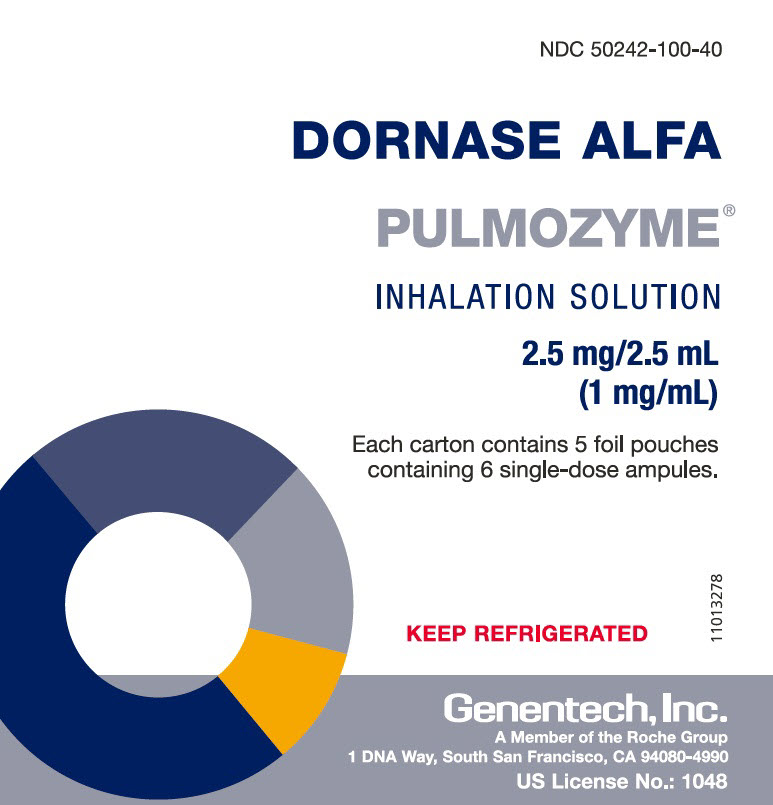
Pulmozyme dornase alfa 1 mg/mL Solution — NDC 50242-100-40 (Billing 50242-0100-40)
This is a package of Pulmozyme dornase alfa 1 mg/mL Solution from Genentech, Inc., marketed since Dec 1993 and currently FDA-listed; retail pharmacies pay about $53.16 per mL (NADAC). It is this product's only package size.
NDC database record
One package, one record: these facts belong to NDC 50242-100-40 alone.
- Record
- FDA NDC Directory package listing · Human prescription drug
- Code segments
- 50242 labeler · 100 product · 40 package
- Package marketed since
- Dec 30, 1993
- Sample package
- No — commercial package
- Listing certified through
- Dec 31, 2026
- Barcode (UPC-A, from the NDC)
- 3 5024210040 3
- Medicaid fills, this package
- 40,917 prescriptions in the last four reported quarters
- FDA record last changed
- Jul 24, 2026
Identity & classification
Regulatory identifiers FDA, NLM and CMS codes for this package
Drug-database identifiers Medi-Span GPI and First Databank GCN / HICL / AHFS classification
- GSN (GCN sequence number): 021416
- GCN: 27200
- GPI-14 (Medi-Span): 45304020002010
- HICL (First Databank): 008832
- AHFS class code: 44:00.00.00
- RxCUI (RxNorm): 205532
Where does this data come from?
- FDA openFDA NDC Directory · synced Oct 8, 2026
- FDA label on DailyMed · label index refreshed Oct 8, 2026
- RxNorm (NLM RxNav) · catalog refreshed Oct 1, 2026
- Medi-Span GPI (licensed)
- First Databank (licensed) · refreshed Oct 8, 2026
RxNorm drug class
This medicine belongs to the Recombinant Human Deoxyribonuclease 1 class.
Where does this data come from?
- RxClass (NLM) · catalog refreshed Oct 1, 2026
Clinical
- It is used along with your other standard treatments to manage cystic fibrosis. It helps improve lung function. In people with an FVC of 40% of predicted or higher, daily use has a...
- What is Pulmozyme (dornase alfa) used for?
- You inhale it as a mist through a recommended nebulizer, usually once a day. Some people may do better with twice daily use, so follow your prescriber's directions. Squeeze each am...
- No. Do not dilute it or mix it with other drugs in the nebulizer. Mixing could change how Pulmozyme or the other medicine works. The label says there are no clinically important dr...
Patient education
Supplement & herbal interactions
Where does this data come from?
- MedlinePlus (NLM) · refreshed Oct 8, 2026
- FDA label on DailyMed · label index refreshed Oct 8, 2026
Ask a licensed pharmacist directly — free, answered by our team.
Pricing
A drug doesn't have one price. Each row is a different public payment system, and none is what you'd pay at the counter — that depends on your insurance. The ⓘ on each row explains what it measures.
| Price system | Per mL | Per package |
|---|---|---|
| Retail pharmacies payNADAC · weekly | $53.157 | $3,986.77 / 75 ml |
| Medicaid paysCMS SDUD · 12 mo | $51.98 | $3,898.78 / 75 ml |
| Medicare drug plans payPart D · Q2 2026 | $55.04 | $4,128.16 / 75 ml |
| Medicare Part B allowsASP · J7639 | $56.780 / J7639 unit | — |
Where does this data come from?
- CMS NADAC weekly file · file of Oct 7, 2026
- CMS ASP pricing files · refreshed Sep 20, 2026
- CMS Medicaid State Drug Utilization Data · through Q1 2026
- CMS Part D plan pricing files · refreshed Sep 24, 2026
- VA National Acquisition Center price file
Billing & reimbursement
Where does this data come from?
- CMS ASP NDC-HCPCS crosswalk · refreshed Sep 22, 2026
- DMEPDAC NDC-HCPCS crosswalk
- openFDA NSDE billing units · refreshed Oct 7, 2026
Packaging — all sizes for this product
| Package NDC | Description | Marketing start | Marketing end | Status |
|---|---|---|---|---|
| 50242-0100-40 You're viewing this Main listing | 5 POUCH in 1 CARTON / 6 AMPULE in 1 POUCH / 2.5 mL in 1 AMPULE | 1993-12-30 | — | Active |
Therapeutic equivalents
| Product | Labeler | Pack | NADAC/unit | TE | Status | Price vs. this |
|---|---|---|---|---|---|---|
| Pulmozyme 1 mg/mLthis 50242-0100-40 | Genentech, | 5 pouches | $53.157 | — | Availability likely | — |
Where does this data come from?
- FDA openFDA NDC Directory · synced Oct 8, 2026
- FDA Purple Book · refreshed Oct 5, 2026
- CMS NADAC weekly file · file of Oct 7, 2026
Availability & biosimilar status
Biologics have no small-molecule generics; biosimilar competition is tracked in the FDA Purple Book.
Where does this data come from?
- FDA Purple Book · refreshed Oct 5, 2026
Inactive Ingredients / Excipients
Inactive ingredients, also called excipients, are components of the drug product other than the active ingredient. They may include fillers, dyes, coatings, preservatives, flavors, or other formulation ingredients.
🧪 Avoiding an ingredient? See Dornase Alfa inactive ingredients by manufacturer: every current product's list side by side, so you can ask your pharmacy for the version that does not list it.
💡 Tap an ingredient (hover on desktop) to see what it is and why it’s used.
-
0.15 mg / 1 mL
UNII M4I0D6VV5M
Calcium chloride is a salt compound that acts as a firming agent and source of calcium ions in medications. It's used in formulations to help maintain tablet structure, improve texture, or serve as a buffering agent.
-
8.77 mg / 1 mL
UNII 451W47IQ8X
Sodium chloride is common table salt. It's used in medicines as a buffer to maintain proper pH, as a filler to add bulk, or to adjust the osmotic balance in liquid formulations.
2 inactive ingredients listed in the exact product block matched to this NDC.
Where does this data come from?
ingredient classCode="IACT" elements from the exact product block matched by this NDC. Label-section narrative from DailyMed / the openFDA label index is shown separately when available.- FDA label on DailyMed · label index refreshed Oct 8, 2026
- FDA openFDA NDC Directory · synced Oct 8, 2026
Inactive ingredient FAQ
Are inactive ingredients the same for every manufacturer?
Why might an inactive ingredient be missing?
Can inactive ingredients matter?
Manufacturer & labeler
More NDCs from Genentech, Inc. labeler code 50242
- KADCYLA ADO-TRASTUZUMAB EMTANSINE 20 mg/mL Injection, Powder, Lyophilized, For Solution NDC 50242-088-01
- ZELBORAF Vemurafenib 240 mg Tablet, Film Coated NDC 50242-090-02
- Rozlytrek ENTRECTINIB 100 mg Capsule NDC 50242-091-30
- Rozlytrek ENTRECTINIB 200 mg Capsule NDC 50242-094-47
- VABYSMO Faricimab 6 mg/.05mL Injection, Solution NDC 50242-096-01
- dornase alfa 14 g/L Liquid NDC 50242-099-01
- POLIVY polatuzumab vedotin 30 mg/1.88mL Injection, Powder, Lyophilized, For Solution NDC 50242-103-01
- POLIVY polatuzumab vedotin 140 mg/7.52mL Injection, Powder, Lyophilized, For Solution NDC 50242-105-01
- Rituxan Hycela rituximab and hyaluronidase 120 mg/mL; 2000 U/mL Injection, Solution NDC 50242-108-01
- Rituxan Hycela rituximab and hyaluronidase 120 mg/mL; 2000 U/mL Injection, Solution NDC 50242-109-01
- Piasky Crovalimab 340 mg/2mL Injection, Solution NDC 50242-115-01
- TNKase tenecteplase Kit NDC 50242-120-47
Where does this data come from?
- FDA openFDA NDC Directory · synced Oct 8, 2026
- Drugs@FDA
Full prescribing information FDA SPL
🎯 Indications and Usage ▾
1 INDICATIONS AND USAGE PULMOZYME ® is indicated, in conjunction with standard therapies, for the management of pediatric and adult patients with cystic fibrosis (CF) to improve pulmonary function. In CF patients with an FVC ≥ 40% of predicted, daily administration of PULMOZYME has also been shown to reduce the risk of respiratory tract infections requiring parenteral antibiotics. PULMOZYME is a recombinant DNase enzyme indicated in conjunction with standard therapies for the management of cystic fibrosis (CF) patients to improve pulmonary function.
( 1 )
⏱️ Dosage and Administration ▾
2 DOSAGE AND ADMINISTRATION The recommended dosage is 2.5 mg (one single-dose ampule) inhaled once daily using a recommended nebulizer. ( 2.1 ) Some patients may benefit from twice daily administration. ( 2.1 ) See full prescribing information for the recommended nebulizers for use with PULMOZYME. ( 2.2 )
2.1Recommended Dosage The recommended dosage, in most cystic fibrosis patients, is 2.5 mg (one single-dose ampule) inhaled once daily using a recommended jet nebulizer connected to an air compressor system or via a vibrating mesh nebulizer [see Dosage and Administration (2.2) ] . Some patients may benefit from twice daily administration [see Clinical Studies (14) ] .
2.2Administration Instructions Nebulizer Information Administer PULMOZYME via a jet nebulizer connected to an air compressor with an adequate air flow and equipped with a mouthpiece or suitable face mask, or via a vibrating mesh nebulizer. Refer to Table 1 for the recommended Jet Nebulizers or Vibrating Mesh Nebulizers for use with PULMOZYME. No data are currently available to support the administration of PULMOZYME with other nebulizer systems.
The eRapid Nebulizer System should only be used by adults and pediatric patients who can use a mouthpiece, and not by younger patients who need a mask to inhale PULMOZYME. Use the selected nebulizer in accordance with the manufacturer's instruction manual. Refer to the manufacturer's instruction manual on the use, maintenance, and replacement of the equipment, including cleaning and disinfection procedures for the selected nebulizer.
For additional information, refer to the selected nebulizer manufacturer's instruction manual. Table 1. Recommended Jet Nebulizers or Vibrating Mesh Nebulizers for Use with PULMOZYME Jet Nebulizer Follow the selected nebulizer manufacturer's instruction manual.
Compressor Hudson T Up-draft II ® Pulmo-Aide ® or legally marketed compressor of identical pressure and flow rate (maximum 30 psi, 12 LPM). Marquest Acorn II ® PARI LC ® Plus PARI PRONEB ® or legally marketed compressor of identical pressure and flow rate (maximum 24 psi, 9 LPM). PARI BABY™ Patients who are unable to inhale or exhale orally throughout the entire nebulization period may use the PARI BABY™ nebulizer.
Durable Sidestream ® MOBILAIRE™, Porta-NEB ® or legally marketed compressor of identical pressure and flow rate (maximum 45 psi, 7 LPM). Vibrating Mesh Nebulizers eRapid ® Nebulizer System Consisting of the eRapid ® Nebulizer Handset with eBase™ Controller. Avoid use in patients who need a mask to inhale PULMOZYME.
Innospire Go Pulmogine Vibrating Mesh Nebulizer AireHealth Nebulizer™ Intelligent Mesh Nebulizer PULMOZYME Information Each PULMOZYME ampule should be squeezed prior to use in order to check for leaks. Discard ampules if the solution is cloudy or discolored. Once opened, the entire contents of the ampule must be used or discarded.
Do not dilute or mix PULMOZYME with other drugs in the nebulizer. Mixing of PULMOZYME with other drugs could lead to adverse physicochemical and/or functional changes in PULMOZYME or the admixed compound.
💊 Dosage Forms and Strengths ▾
3 DOSAGE FORMS AND STRENGTHS Inhalation solution: 2.5 mg/2.5 mL (1 mg/mL) clear, colorless solution in single-dose ampules. Inhalation solution: 2.5 mg/2.5 mL (1 mg/mL) clear, colorless solution in single-dose ampules ( 3 )
⛔ Contraindications ▾
4 CONTRAINDICATIONS PULMOZYME is contraindicated in patients with known hypersensitivity to dornase alfa, Chinese Hamster Ovary cell products, or any component of the product. PULMOZYME is contraindicated in patients with known hypersensitivity to dornase alfa, Chinese Hamster Ovary cell products, or any component of the product. ( 4 )
⚠️ Warnings and Cautions ▾
5 WARNINGS AND PRECAUTIONS None. None. ( 5 )
🤒 Adverse Reactions ▾
6 ADVERSE REACTIONS The most common adverse reactions (occurring in ≥3% of patients treated with PULMOZYME over placebo) seen in clinical trials in CF patients were: voice alteration, pharyngitis, rash, laryngitis, chest pain, conjunctivitis, rhinitis, decrease in FVC of ≥10%, fever, and dyspnea. ( 6.1 ) To report SUSPECTED ADVERSE REACTIONS, contact Genentech at 1-888-835-2555 or FDA at 1-800-FDA-1088 or www.fda.gov/medwatch.
6.1Clinical Trials Experience Because clinical trials are conducted under widely varying conditions, adverse reaction rates observed in the clinical trials of a drug cannot be directly compared to rates in the clinical trials of another drug and may not reflect the rates observed in practice. The data described below reflect exposure to PULMOZYME in 902 patients, with exposures ranging from 2 weeks of daily administration up to once or twice daily administration for six months. PULMOZYME was studied in both placebo-controlled (n=804) and uncontrolled trials (n=98).
The population of patients in placebo-controlled trials was with FVC ≥ 40% of predicted (n=643) or with more advanced pulmonary disease, FVC < 40% of predicted (n=161). The population in the uncontrolled trial included 98 pediatric patients with CF ranging from 3 months to 10 years of age. More than half of the patients received PULMOZYME 2.5 mg by inhalation once a day (n=581), while the rest of patients (n=321) received PULMOZYME 2.5 mg by inhalation twice a day.
Placebo-Controlled Trials Trial 1 : Trial 1 was a randomized, placebo-controlled clinical trial in patients with FVC ≥ 40% of predicted. In this trial, over 600 patients received PULMOZYME once or twice daily for six months. The most common adverse reaction (risk difference ≥5%) was voice alteration.
The proportion of most adverse events was similar for patients on PULMOZYME and on placebo, probably reflecting the sequelae of the underlying lung disease. In most cases reactions that were increased were mild, transient in nature, and did not require alterations in dosing. Few patients experienced adverse reactions resulting in permanent discontinuation from PULMOZYME, and the proportion of discontinuations were similar for placebo (2%) and PULMOZYME (3%).
Adverse reactions occurring in a higher proportion (greater than 3%) of PULMOZYME treated patients than in placebo-treated patients are listed in Table 2 . Trial 2 : Trial 2 was a randomized, placebo-controlled trial in patients with more advanced pulmonary disease (FVC < 40% of predicted) who were treated for 12 weeks. In this trial, the safety profile of PULMOZYME was similar to that reported in patients with less advanced pulmonary disease (FVC ≥ 40% of predicted).
Adverse reactions that were reported in this trial with a higher proportion (greater than 3%) in the PULMOZYME treated patients are listed in Table 2 . Table 2. Adverse Reactions Increased 3% or More in PULMOZYME Treated Patients Over Placebo in CF Clinical Trials Adverse Reactions (of any severity or seriousness) Trial 1 CF Patients with FVC ≥ 40% of predicted treated for 24 weeks Trial 2 CF Patients with FVC <40% of predicted treated for 12 weeks Placebo n=325 Pulmozyme QD n=322 Pulmozyme BID n=321 Placebo n=159 Pulmozyme QD n=161 Voice alteration 7% 12% 16% 6% 18% Pharyngitis 33% 36% 40% 28% 32% Rash 7% 10% 12% 1% 3% Laryngitis 1% 3% 4% 1% 3% Chest Pain 16% 18% 21% 23% 25% Conjunctivitis 2% 4% 5% 0% 1% Rhinitis Differences were less than 3% 24% 30% FVC decrease of ≥ 10% of predicted Single measurement only, does not reflect overall FVC changes.
17% 22% Fever 28% 32% Dyspepsia 0% 3% Dyspnea (when reported as serious) Differences were less than 3% 12% Total reports of dyspnea (regardless of severity or seriousness) had a difference of less than 3% in Trial 2. 17% Mortality rates observed in controlled trials were similar for the placebo and PULMOZYME treated patients. Causes of death were consistent with progression of cystic fibrosis and included apnea, cardiac arre… [Excerpted — this section continues on DailyMed.]
🔄 Drug Interactions ▾
7 DRUG INTERACTIONS Available data indicate there are no clinically important drug-drug interactions with PULMOZYME.
👥 Use in Specific Populations ▾
8 USE IN SPECIFIC POPULATIONS
8.1Pregnancy Risk Summary There are no adequate and well-controlled studies with PULMOZYME in pregnant women. However, animal reproduction studies have been conducted with dornase alfa. In these studies, no evidence of fetal harm was observed in rats and rabbits at doses of dornase alfa up to approximately 600 times the maximum recommended human dose (MRHD).
The background risk of major birth defects and miscarriage for the cystic fibrosis population is unknown. However, the background risk in the U.S. general population of major birth defects is 2-4% and of miscarriage is 15-20% of clinically recognized pregnancies. Data Animal Data Reproductive studies have been performed in rats and rabbits at intravenous doses of dornase alfa up to 10 mg/kg/day (approximately 600 times the MRHD in adults).
In a combined embryo-fetal development and pre- and post-natal development study, no evidence of maternal toxicity, embryotoxicity, or teratogenicity was observed when dornase alfa was administered to dams throughout organogenesis (Gestation days 6 to 17). Dornase alfa did not elicit adverse effects on fetal or neonatal growth when administered to dams throughout most of gestation and delivery (Gestation days 6 to 25) and nursing (Post-partum days 6 to 21). A pharmacokinetic study in Cynomolgus monkeys found no detectable levels of dornase alfa in fetal blood or amniotic fluid on gestation day 150 (end of gestation) from mothers that were administered an intravenous bolus dose (0.1 mg/kg) followed by an intravenous infusion dose (0.080 mg/kg) over a 6-hour period during pregnancy.
8.2Lactation Risk Summary It is not known whether PULMOZYME is present in human milk. In a pharmacokinetic study in Cynomolgus monkeys, levels of dornase alfa detected in milk were less than 0.1% of the maternal serum concentration at 24 hours after dosing [intravenous bolus dose (0.1 mg/kg) of dornase alfa followed by an intravenous infusion (0.080 mg/kg/hr) over a 6-hour period] on post-partum day 14. The developmental and health benefits of breastfeeding should be considered along with the mother's clinical need for PULMOZYME and any potential adverse effects on the breastfed child from PULMOZYME or from the underlying maternal condition.
8.4Pediatric Use The safety and effectiveness of PULMOZYME in conjunction with standard therapies for cystic fibrosis have been established in pediatric patients. Use of PULMOZYME in pediatric patients is supported by evidence in the following age groups: Patients 5 to 17 years of age: Use of PULMOZYME in patients 5 to 17 years of age is supported by evidence from a randomized, placebo-controlled trial of 303 of clinically stable cystic fibrosis patients 5 to 17 years of age who received PULMOZYME [see Clinical Studies (14) ].
Patients less than 5 years : Use of PULMOZYME in patients less than 5 years of age is supported by extrapolation of efficacy data in patients 5 years of age and older with additional safety data in 65 pediatric patients aged 3 months to less than 5 years who received PULMOZYME 2.5 mg daily by inhalation for 2 weeks [see Adverse Reactions (6.1) and Clinical Studies (14) ] .
8.5Geriatric Use Cystic fibrosis is primarily a disease of children and young adults. Clinical studies of PULMOZYME did not include sufficient numbers of subjects aged 65 or older to determine whether they respond differently from younger subjects.
🤰 Pregnancy ▾
8.1Pregnancy Risk Summary There are no adequate and well-controlled studies with PULMOZYME in pregnant women. However, animal reproduction studies have been conducted with dornase alfa. In these studies, no evidence of fetal harm was observed in rats and rabbits at doses of dornase alfa up to approximately 600 times the maximum recommended human dose (MRHD).
The background risk of major birth defects and miscarriage for the cystic fibrosis population is unknown. However, the background risk in the U.S. general population of major birth defects is 2-4% and of miscarriage is 15-20% of clinically recognized pregnancies. Data Animal Data Reproductive studies have been performed in rats and rabbits at intravenous doses of dornase alfa up to 10 mg/kg/day (approximately 600 times the MRHD in adults).
In a combined embryo-fetal development and pre- and post-natal development study, no evidence of maternal toxicity, embryotoxicity, or teratogenicity was observed when dornase alfa was administered to dams throughout organogenesis (Gestation days 6 to 17). Dornase alfa did not elicit adverse effects on fetal or neonatal growth when administered to dams throughout most of gestation and delivery (Gestation days 6 to 25) and nursing (Post-partum days 6 to 21). A pharmacokinetic study in Cynomolgus monkeys found no detectable levels of dornase alfa in fetal blood or amniotic fluid on gestation day 150 (end of gestation) from mothers that were administered an intravenous bolus dose (0.1 mg/kg) followed by an intravenous infusion dose (0.080 mg/kg) over a 6-hour period during pregnancy.
🧒 Pediatric Use ▾
8.4Pediatric Use The safety and effectiveness of PULMOZYME in conjunction with standard therapies for cystic fibrosis have been established in pediatric patients. Use of PULMOZYME in pediatric patients is supported by evidence in the following age groups: Patients 5 to 17 years of age: Use of PULMOZYME in patients 5 to 17 years of age is supported by evidence from a randomized, placebo-controlled trial of 303 of clinically stable cystic fibrosis patients 5 to 17 years of age who received PULMOZYME [see Clinical Studies (14) ].
Patients less than 5 years : Use of PULMOZYME in patients less than 5 years of age is supported by extrapolation of efficacy data in patients 5 years of age and older with additional safety data in 65 pediatric patients aged 3 months to less than 5 years who received PULMOZYME 2.5 mg daily by inhalation for 2 weeks [see Adverse Reactions (6.1) and Clinical Studies (14) ] .
🧓 Geriatric Use ▾
8.5Geriatric Use Cystic fibrosis is primarily a disease of children and young adults. Clinical studies of PULMOZYME did not include sufficient numbers of subjects aged 65 or older to determine whether they respond differently from younger subjects.
🧬 Clinical Pharmacology ▾
12 CLINICAL PHARMACOLOGY
12.1Mechanism of Action PULMOZYME is recombinant human deoxyribonuclease I (rhDNase), an enzyme which selectively cleaves DNA. In preclinical in vitro studies, PULMOZYME hydrolyzes the DNA in sputum of CF patients and reduces sputum viscoelasticity. In CF patients, retention of viscous purulent secretions in the airways contributes both to reduced pulmonary function and to exacerbations of infection.
Purulent pulmonary secretions contain very high concentrations of extracellular DNA released by degenerating leukocytes that accumulate in response to infection.
12.3Pharmacokinetics When 2.5 mg PULMOZYME was administered by inhalation to eighteen CF patients, mean sputum concentrations of 3 µg/mL DNase were measurable within 15 minutes. Mean sputum concentrations declined to an average of 0.6 µg/mL two hours following inhalation. Inhalation of up to 10 mg TID of PULMOZYME by 4 CF patients for six consecutive days, did not result in a significant elevation of serum concentrations of DNase above normal endogenous levels.
After administration of up to 2.5 mg of PULMOZYME twice daily for six months to 321 CF patients, no accumulation of serum DNase was noted. Dornase alfa is expected to be metabolized by proteases present in biological fluids. A human intravenous dose study suggested an elimination half-life of 3-4 hours for dornase alfa.
PULMOZYME, 2.5 mg by inhalation, was administered daily to 98 patients aged 3 months to ≤ 10 years, and bronchoalveolar lavage (BAL) fluid was obtained within 90 minutes of the first dose. BAL DNase concentrations were detectable in all patients but showed a broad range, from 0.007 to 1.8 µg/mL. Over an average of 14 days of exposure, serum DNase concentrations (mean ± s.d.) increased by 1.1 ± 1.6 ng/mL for the 3 months to < 5 year age group and by 0.8 ± 1.2 ng/mL for the 5 to ≤ 10 year age group.
The relationship between BAL or serum DNase concentration and adverse experiences and clinical outcomes is unknown.
🧬 Mechanism of Action ▾
12.1Mechanism of Action PULMOZYME is recombinant human deoxyribonuclease I (rhDNase), an enzyme which selectively cleaves DNA. In preclinical in vitro studies, PULMOZYME hydrolyzes the DNA in sputum of CF patients and reduces sputum viscoelasticity. In CF patients, retention of viscous purulent secretions in the airways contributes both to reduced pulmonary function and to exacerbations of infection.
Purulent pulmonary secretions contain very high concentrations of extracellular DNA released by degenerating leukocytes that accumulate in response to infection.
📦 How Supplied / Storage and Handling ▾
16 HOW SUPPLIED/STORAGE AND HANDLING PULMOZYME (dornase alfa) inhalation solution is a sterile, clear, colorless solution supplied in: 30 unit cartons containing 5 foil pouches of 6 single-dose ampules. Each 2.5 mL ampule contains 2.5 mg of dornase alfa (1 mg/mL): NDC 50242-100-40. Storage and Handling Store PULMOZYME ampules at a refrigerated temperature between 2°C to 8°C (36°F to 46°F) in their protective foil to protect from light and heat.
Once the protective foil pouch is opened, the unused ampules must be kept refrigerated in the protective foil pouch to protect from light and heat. Do not use beyond the expiration date stamped on the ampule. During transport, keep the ampules refrigerated in their protective foil pouch to protect from light and heat.
Do not use if the ampules are exposed to room temperature (22°C to 28°C [72°F to 82°F]) for more than a total of 60 hours. Avoid excessive heat and light.
📦 Storage and Handling ▾
Storage and Handling Store PULMOZYME ampules at a refrigerated temperature between 2°C to 8°C (36°F to 46°F) in their protective foil to protect from light and heat. Once the protective foil pouch is opened, the unused ampules must be kept refrigerated in the protective foil pouch to protect from light and heat. Do not use beyond the expiration date stamped on the ampule.
During transport, keep the ampules refrigerated in their protective foil pouch to protect from light and heat. Do not use if the ampules are exposed to room temperature (22°C to 28°C [72°F to 82°F]) for more than a total of 60 hours. Avoid excessive heat and light.
📋 Description ▾
11 DESCRIPTION Dornase alfa is a recombinant human deoxyribonuclease I (rhDNase) an enzyme which selectively cleaves DNA. The protein is produced by genetically engineered Chinese Hamster Ovary (CHO) cells containing DNA encoding for the native human protein, deoxyribonuclease I (DNase). The product is purified by column chromatography and tangential flow filtration.
The purified glycoprotein contains 260 amino acids with an approximate molecular weight of 37,000 daltons. The primary amino acid sequence is identical to that of the native human enzyme. PULMOZYME (dornase alfa) inhalation solution is administered by inhalation of an aerosol mist produced by a compressed air driven nebulizer or a recommended nebulizer system [see Clinical Studies (14) and Dosage and Administration (2.2) ] .
PULMOZYME is a sterile, clear, colorless, highly purified solution in single-dose ampules. Each ampule delivers 2.5 mL of the solution to the nebulizer bowl. Each mL of aqueous solution contains 1 mg dornase alfa, calcium chloride dihydrate (0.15 mg) and sodium chloride (8.77 mg).
The solution contains no preservative. The nominal pH of the solution is 6.3.
💬 Information for Patients ▾
17 PATIENT COUNSELING INFORMATION Advise patients to read the FDA-approved patient labeling ( Instructions for Use ). Preparation Advise patients to squeeze each ampule prior to use in order to check for leaks. The solution should be discarded if it is cloudy or discolored.
Once opened, the entire contents of the ampule must be used or discarded [see Dosage and Administration (2.2) ] . Drug Incompatibilities Instruct patients not to dilute or mix PULMOZYME with other drugs in the nebulizer. Mixing of PULMOZYME with other drugs could lead to adverse physicochemical and/or functional changes in PULMOZYME or the admixed compound [see Dosage and Administration (2.2) ] .
Storage Instruct patients on the proper techniques to store and handle PULMOZYME [see How Supplied/Storage and Handling (16) ]. Manufacturer's Instruction Manual Instruct patients to read and follow the manufacturer's instruction manual for the proper use and maintenance of the jet nebulizer/compressor system, or the vibrating mesh nebulizer used in PULMOZYME delivery.
🧬 Pharmacokinetics ▾
12.3Pharmacokinetics When 2.5 mg PULMOZYME was administered by inhalation to eighteen CF patients, mean sputum concentrations of 3 µg/mL DNase were measurable within 15 minutes. Mean sputum concentrations declined to an average of 0.6 µg/mL two hours following inhalation. Inhalation of up to 10 mg TID of PULMOZYME by 4 CF patients for six consecutive days, did not result in a significant elevation of serum concentrations of DNase above normal endogenous levels.
After administration of up to 2.5 mg of PULMOZYME twice daily for six months to 321 CF patients, no accumulation of serum DNase was noted. Dornase alfa is expected to be metabolized by proteases present in biological fluids. A human intravenous dose study suggested an elimination half-life of 3-4 hours for dornase alfa.
PULMOZYME, 2.5 mg by inhalation, was administered daily to 98 patients aged 3 months to ≤ 10 years, and bronchoalveolar lavage (BAL) fluid was obtained within 90 minutes of the first dose. BAL DNase concentrations were detectable in all patients but showed a broad range, from 0.007 to 1.8 µg/mL. Over an average of 14 days of exposure, serum DNase concentrations (mean ± s.d.) increased by 1.1 ± 1.6 ng/mL for the 3 months to < 5 year age group and by 0.8 ± 1.2 ng/mL for the 5 to ≤ 10 year age group.
The relationship between BAL or serum DNase concentration and adverse experiences and clinical outcomes is unknown.
🔬 Clinical Studies ▾
14 CLINICAL STUDIES Trial in CF Patients with FVC ≥40% of Predicted PULMOZYME has been evaluated in a randomized, placebo-controlled trial of clinically stable cystic fibrosis patients, 5 years of age and older, with baseline forced vital capacity (FVC) greater than or equal to 40% of predicted and receiving standard therapies for cystic fibrosis. Patients were treated with placebo (325 patients), 2.5 mg of PULMOZYME once a day (322 patients), or 2.5 mg of PULMOZYME twice a day (321 patients) for six months administered via a Hudson T Up-draft II ® nebulizer with a Pulmo-Aide ® compressor.
Both doses of PULMOZYME resulted in significant reductions in the number of patients experiencing respiratory tract infections requiring use of parenteral antibiotics compared with the placebo group. Administration of PULMOZYME reduced the relative risk of developing a respiratory tract infection by 27% and 29% for the 2.5 mg daily dose and the 2.5 mg twice daily dose, respectively (see Table 3 ). The data suggest that the effects of PULMOZYME on respiratory tract infections in older patients ( > 21 years) may be smaller than in younger patients, and that twice daily dosing may be required in the older patients.
Patients with baseline FVC > 85% may also benefit from twice a day dosing (see Table 3 ). The reduced risk of respiratory infection observed in PULMOZYME treated patients did not directly correlate with improvement in FEV 1 during the initial two weeks of therapy. Within 8 days of the start of treatment with PULMOZYME, mean FEV 1 increased 7.9% in those treated once a day and 9.0% in those treated twice a day compared to the baseline values.
The overall mean FEV 1 during long-term therapy increased 5.8% from baseline at the 2.5 mg daily dose level and 5.6% from baseline at the 2.5 mg twice daily dose level. Placebo recipients did not show significant mean changes in pulmonary function testing (see Figure 1 ). For patients 5 years of age or older, with baseline FVC greater than or equal to 40%, administration of PULMOZYME decreased the incidence of occurrence of first respiratory tract infection requiring parenteral antibiotics, and improved mean FEV 1 , regardless of age or baseline FVC.
Table 3. Incidence of First Respiratory Tract Infection Requiring Parenteral Antibiotics in Patients with FVC ≥40% of Predicted Placebo N=325 2.5 mg QD N=322 2.5 mg BID N=321 Percent of Patients Infected 43% 34% 33% Relative Risk (vs placebo) 0.73 0.71 p-value (vs placebo) 0.015 0.007 Subgroup by Age and Baseline FVC Placebo % (N) 2.5 mg QD % (N) 2.5 mg BID % (N) Age 5-20 years 42% (201) 25% (199) 28% (184) 21 years and older 44% (124) 48% (123) 39% (137) Baseline FVC 40-85% Predicted 54% (194) 41% (201) 44% (203) > 85% Predicted 27% (131) 21% (121) 14% (118) Figure 1.
Mean Percent Change from Baseline FEV 1 in Patients with FVC ≥40% of Predicted Figure 1 Trial in CF Patients with FVC <40% of Predicted PULMOZYME has also been evaluated in a second randomized, placebo-controlled trial in clinically stable patients with baseline FVC < 40% of predicted. Patients were enrolled and treated with placebo (162 patients) or PULMOZYME 2.5 mg QD (158 patients) for twelve weeks. In patients who received PULMOZYME, there was an increase in mean change (as percent of baseline) compared to placebo in FEV 1 (9.4% vs.
2.1%, p < 0.001) and in FVC (12.4% vs. 7.3%, p < 0.01). PULMOZYME did not significantly reduce the risk of developing a respiratory tract infection requiring parenteral antibiotics (54% of PULMOZYME patients vs.
55% of placebo patients had experienced a respiratory tract infection by 12 weeks, relative risk = .93, p = 0.62). The effect of PULMOZYME on exercise tolerance has not been established in adult and pediatric patients. Other Studies Clinical trials have indicated that PULMOZYME therapy can be continued or initiated during an acute respiratory exacerbation.
Short-term dose ranging studies demonstrated that doses in excess of 2.5 mg BID did not pr… [Excerpted — this section continues on DailyMed.]
🧪 Nonclinical Toxicology ▾
13 NONCLINICAL TOXICOLOGY
13.1Carcinogenesis, Mutagenesis, Impairment of Fertility PULMOZYME produced no treatment-related increases in the incidence of tumors in a lifetime study in Sprague Dawley rats that were administered inhaled doses up to 0.246 mg/kg/day (approximately 30 times the MRHD in adults). There was no increase in the development of benign or malignant neoplasms and no occurrence of unusual tumor types in rats after lifetime exposure. PULMOZYME tested negative in the following genotoxicity assays: the in vitro Ames assay, in vitro mouse lymphoma assay, and in vivo mouse bone marrow micronucleus assay.
No evidence of impairment of fertility was observed in male and female rats that received intravenous doses up to 10 mg/kg/day (approximately 600 times the MRHD in adults).
📄 Carcinogenesis, Mutagenesis, Impairment of Fertility ▾
13.1Carcinogenesis, Mutagenesis, Impairment of Fertility PULMOZYME produced no treatment-related increases in the incidence of tumors in a lifetime study in Sprague Dawley rats that were administered inhaled doses up to 0.246 mg/kg/day (approximately 30 times the MRHD in adults). There was no increase in the development of benign or malignant neoplasms and no occurrence of unusual tumor types in rats after lifetime exposure. PULMOZYME tested negative in the following genotoxicity assays: the in vitro Ames assay, in vitro mouse lymphoma assay, and in vivo mouse bone marrow micronucleus assay.
No evidence of impairment of fertility was observed in male and female rats that received intravenous doses up to 10 mg/kg/day (approximately 600 times the MRHD in adults).
📄 Patient Package Insert ▾
INSTRUCTIONS FOR USE PULMOZYME ® (PULL-muh-zyme) (dornase alfa) Inhalation Solution This Instructions for Use contains information on how to use PULMOZYME with Jet Nebulizers and Compressors See the other side of this Instructions for Use for information on use of Pulmozyme with the recommended vibrating mesh nebulizers Read and understand this Instructions for Use and the nebulizer manufacturer's instruction manual before you start taking Pulmozyme and each time you get a refill. There may be new information. This information does not take the place of talking to your doctor about your medical condition or your treatment.
A nebulizer and a compressor are used together to give a dose of Pulmozyme. A nebulizer changes the Pulmozyme liquid medicine into a fine mist you inhale by breathing through a mouthpiece. A compressor gives the nebulizer power and makes the nebulizer work.
Pulmozyme should only be used with the approved nebulizers and appropriate compressors as recommended below, or with the recommended vibrating mesh nebulizers (see other side of this Instructions for Use). Read and follow the manufacturer's instruction manual. Do not use any other inhaled medicines in the nebulizer at the same time.
Keep all other inhaled medicine systems completely separate from Pulmozyme. Use the mouthpiece or face mask provided with the nebulizer kit. If your child cannot breathe in or breathe out by mouth, you may use the PARI BABY reusable nebulizer, but you should discuss it with your doctor first.
The PARI BABY nebulizer is the same as the PARI LC Plus Jet system, except the mouthpiece is replaced by a tight-fitting face mask connected to an elbow piece. Follow the steps on this side of the Instructions for Use to give Pulmozyme using the following jet nebulizer systems Jet Nebulizer Compressor Hudson T Up-draft II A compressor with the following specifications is recommended: Approximate air flow of
3.5L/min to 12 L/min at approximately 20 psi to 45 psi pressure Marquest Acorn II PARI LC Plus PARI BABY Durable Sidestream For additional information on an appropriate compressor to use with Pulmozyme, read the manufacturer's instruction manual for the recommended nebulizer. Important Information You Need to Know Before Using PULMOZYME Read and follow the nebulizer manufacturer's instruction manual for correct use and maintenance: to clean the nebulizer before first use and after each use as recommended. to disinfect the nebulizer parts by using the disinfecting method recommended. to replace nebulizer parts as recommended.
Supplies you will need to give a dose of Pulmozyme (See Figure A ): 1 Pulmozyme ampule Compressor Nebulizer cup and cap (screw-on or snap-on) Plastic T (not needed for Sidestream nebulizer or PARI BABY) Flexible aerosol tube (not needed for Sidestream nebulizer or PARI BABY) Mouthpiece (clean) or PARI BABY facemask Long connecting tube Nose clip (optional, not needed for PARI BABY) Preparing the jet nebulizer and compressor: Step 1. Clean a flat table surface and wash your hands. Clean a flat table surface.
Wash your hands well with soap and water before using the Pulmozyme ampule and nebulizer. This helps prevent infection (See Figure B ) . Step 2.
Gather the nebulizer and test the compressor. Place the nebulizer parts on a clean, flat table surface within reach. Test the compressor by turning it on and putting your finger in front of the "air out" or "air" port to feel air flowing.
Turn off the compressor (See Figure C ) . Step 3. Gather the Pulmozyme ampule and check the expiration date.
Remove 1 foil pouch of Pulmozyme from the refrigerator. Open the foil pouch and remove 1 ampule of Pulmozyme. Put the remaining ampules back in the foil pouch and return them to the refrigerator.
Check the expiration (exp.) date printed on the ampule (See Figure D ) . Do not use the Pulmozyme ampule if the expiration date has passed. Step 4.
Check the Pulmozyme ampule. Check the ampule for leaks by turning it upside down and ge… [Excerpted — this section continues on DailyMed.]
📖 Instructions for Use ▾
INSTRUCTIONS FOR USE PULMOZYME ® (PULL-muh-zyme) (dornase alfa) Inhalation Solution This Instructions for Use contains information on how to use PULMOZYME with the following recommended vibrating mesh nebulizers: Recommended Vibrating Mesh Nebulizers eRapid ® Nebulizer System Innospire Go Pulmogine Vibrating Mesh Nebulizer AireHealth Nebulizer™ Intelligent Mesh Nebulizer See the other side of this Instructions for Use for information on use with Jet Nebulizers and Compressors Read and understand this Instructions for Use and the nebulizer manufacturer's instruction manual before you start taking Pulmozyme and each time you get a refill.
There may be new information. This information does not take the place of talking to your healthcare provider about your medical condition or your treatment. This information does not take the place of the manufacturer's instruction manual for the vibrating mesh nebulizer.
The vibrating mesh nebulizer changes the Pulmozyme liquid medicine into a fine mist you inhale by breathing through a mouthpiece. Do not use any other inhaled medicines in the nebulizer at the same time. Keep all other inhaled medication systems completely separate from Pulmozyme.
The eRapid Nebulizer System should only be used by adults and children who can use a mouthpiece, and not by younger children who need a mask to take Pulmozyme. Follow the instructions on this side of the Instructions for Use to give Pulmozyme using a vibrating mesh nebulizer. Important Information You Need to Know Before Using PULMOZYME Read and follow the nebulizer manufacturer's instruction manual for correct use and maintenance: to clean the nebulizer before first use and after each use as recommended to disinfect the nebulizer parts by using the disinfecting method recommended to replace nebulizer parts as recommended Supplies you will need to give a dose of PULMOZYME: 1 Pulmozyme ampule (See Figure A ) Vibrating mesh nebulizer and its parts Manufacturer's instruction manual for the vibrating mesh nebulizer Nose clip (optional) (See Figure B ) Pulmozyme ampule Figure A Figure B Prepare the vibrating mesh nebulizer: Step 1.
Clean a flat table surface and wash your hands. Clean a flat table surface. Wash your hands well with soap and water before using the Pulmozyme ampule and nebulizer.
This helps prevent infection (See Figure C ) . Figure C Step 2. Gather the nebulizer.
Make sure you have all parts and make sure they are clean and not damaged. Prepare and test it as recommended in the manufacturer's instruction manual. Place the vibrating mesh nebulizer on a clean, flat table surface within reach.
Make sure you have followed the manufacturer's instruction manual to make sure that the nebulizer is charged and ready for use. Step 3. Gather the Pulmozyme ampule and check the expiration date.
Remove 1 foil pouch of Pulmozyme from the refrigerator. Open the foil pouch and remove 1 ampule of Pulmozyme. Put the remaining ampules back in the foil pouch and return them to the refrigerator.
Check the expiration (exp.) date printed on the ampule (See Figure D ) . Do not use the Pulmozyme ampule if the expiration date has passed. Figure D Step 4.
Check the Pulmozyme ampule. Check the ampule for leaks by turning it upside down and gently squeezing (See Figure E ) . Do not use the ampule if it is leaking.
Throw it away and get a new one. Check the Pulmozyme liquid in the ampule and make sure it is clear and free of particles. Do not use Pulmozyme if the liquid is cloudy or discolored.
Take the Pulmozyme back to the pharmacy, hospital, or clinic that gave you the medicine. Figure E Step 5. Put the vibrating mesh nebulizer together.
Put the nebulizer together according to the step-by-step manufacturer's instruction manual. Step 6. Prepare to take the Pulmozyme treatment.
Follow the manufacturer's instruction manual on how to add the Pulmozyme medicine to the nebulizer. Open the Pulmozyme ampule. Hold the tab at the bottom of the Pulmozyme ampule firmly.
Twist o… [Excerpted — this section continues on DailyMed.]
📄 Recent Major Changes ▾
Dosage and Administration. ( 2.1 , 2.2 ) 02/2024
📄 Package Label / Principal Display Panel ▾
PRINCIPAL DISPLAY PANEL - 2.5 mg/2.5 mL Ampule Pouch Carton NDC 50242-100-40 DORNASE ALFA PULMOZYME ® INHALATION SOLUTION 2.5 mg/2.5 mL (1 mg/mL) Each carton contains 5 foil pouches containing 6 single-dose ampules. KEEP REFRIGERATED 11013278 Genentech, Inc. A Member of the Roche Group 1 DNA Way, South San Francisco, CA 94080-4990 US License No.: 1048 PRINCIPAL DISPLAY PANEL - 2.5 mg/2.5 mL Ampule Pouch Carton