
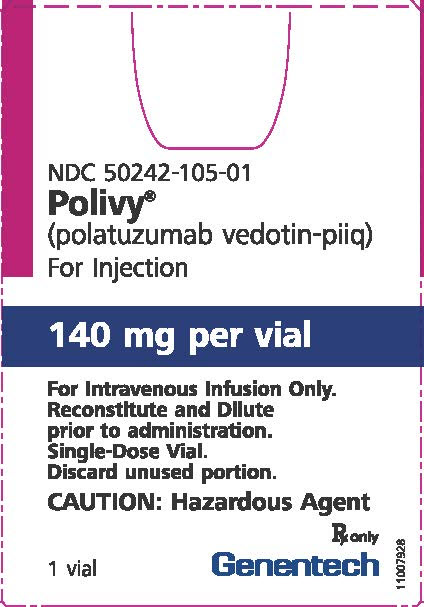
POLIVY polatuzumab vedotin 140 mg/7.52mL Injection, Powder, Lyophilized, For Solution — NDC 50242-105-01 (Billing 50242-0105-01)
This is a package of POLIVY polatuzumab vedotin 140 mg/7.52mL Injection, Powder, Lyophilized, For Solution from Genentech, Inc., marketed since Jun 2019 and currently FDA-listed. It is this product's only package size.
NDC database record
One package, one record: these facts belong to NDC 50242-105-01 alone.
- Record
- FDA NDC Directory package listing · Human prescription drug
- Code segments
- 50242 labeler · 105 product · 01 package
- Package marketed since
- Jun 10, 2019
- Sample package
- No — commercial package
- Listing certified through
- Dec 31, 2027
- Barcode (UPC-A, from the NDC)
- 3 5024210501 9
- Medicaid fills, this package
- 270 prescriptions in the last four reported quarters
- FDA record last changed
- Sep 10, 2026
Identity & classification
Regulatory identifiers FDA, NLM and CMS codes for this package
Drug-database identifiers Medi-Span GPI and First Databank GCN / HICL / AHFS classification
- GSN (GCN sequence number): 079834
- GCN: 46419
- HICL (First Databank): 045781
- AHFS class code: 10:00.00.00
- RxCUI (RxNorm): 2174095
Where does this data come from?
- FDA openFDA NDC Directory · synced Oct 8, 2026
- FDA label on DailyMed · label index refreshed Oct 8, 2026
- RxNorm (NLM RxNav) · catalog refreshed Oct 8, 2026
- Medi-Span GPI (licensed)
- First Databank (licensed) · refreshed Oct 8, 2026
RxNorm drug class
This medicine belongs to the Other monoclonal antibodies and antibody drug conjugates class.
Where does this data come from?
- RxClass (NLM) · catalog refreshed Oct 8, 2026
Clinical
Patient education
Supplement & herbal interactions
Where does this data come from?
- MedlinePlus (NLM) · refreshed Oct 8, 2026
- FDA label on DailyMed · label index refreshed Oct 8, 2026
Ask a licensed pharmacist directly — free, answered by our team.
Pricing
A drug doesn't have one price. Each row is a different public payment system, and none is what you'd pay at the counter — that depends on your insurance. The ⓘ on each row explains what it measures.
| Price system | Per mL | Per package |
|---|---|---|
| Retail pharmacies payNADAC · weekly | Not in the retail survey — common for institutional, discontinued, or low-volume packs. | |
| Medicaid paysCMS SDUD · 12 mo | $17,819.66 | $356,393.17 / 20 ml |
| Medicare drug plans payPart D · quarterly | No Part D plan price is available for this NDC in our data. | |
| Medicare Part B allowsASP · J9309 | $143.611 / J9309 unit | — |
Where does this data come from?
- CMS NADAC weekly file
- CMS ASP pricing files · refreshed Sep 20, 2026
- CMS Medicaid State Drug Utilization Data · through Q1 2026
- CMS Part D plan pricing files · refreshed Sep 24, 2026
- VA National Acquisition Center price file
Billing & reimbursement
Where does this data come from?
- CMS ASP NDC-HCPCS crosswalk · refreshed Sep 22, 2026
- DMEPDAC NDC-HCPCS crosswalk
- openFDA NSDE billing units · refreshed Oct 7, 2026
Packaging — all sizes for this product
| Package NDC | Description | Marketing start | Marketing end | Status |
|---|---|---|---|---|
| 50242-0105-01 You're viewing this Main listing | 1 VIAL, SINGLE-DOSE in 1 CARTON / 20 mL in 1 VIAL, SINGLE-DOSE | 2019-06-10 | — | Active |
Therapeutic equivalents
| Product | Labeler | Pack | NADAC/unit | TE | Status | Price vs. this |
|---|---|---|---|---|---|---|
| Polivy 140 mg/7.52mLthis 50242-0105-01 | Genentech, | 1 vial | — | — | FDA listed | — |
Where does this data come from?
- FDA openFDA NDC Directory · synced Oct 8, 2026
- FDA Purple Book · refreshed Oct 5, 2026
- CMS NADAC weekly file
Availability & biosimilar status
Biologics have no small-molecule generics; biosimilar competition is tracked in the FDA Purple Book.
Why the date isn’t exact: Biosimilar timing can change because patents may be challenged, settled, licensed, added or removed, and litigation can move the real date earlier or later.
🛈 What do these terms mean?
- Biologic patent
- A patent the reference product’s maker has publicly listed. A biosimilar generally can’t launch until these expire — unless they’re invalidated or resolved in a settlement.
- Reference-product exclusivity
- A flat 12 years of FDA market protection from the biologic’s first licensure (the BPCIA). No biosimilar can be licensed before it ends, regardless of patents.
- Interchangeable exclusivity
- The first interchangeable biosimilar can earn a period as the only interchangeable version (pharmacists can substitute it without the prescriber).
- Earliest biosimilar (LOE)
- The latest of all the dates above — the soonest a biosimilar can realistically reach the market. Litigation and settlements can move it earlier.
Biologics have no small-molecule “generics” — competition comes from FDA-licensed biosimilars, tracked in the FDA Purple Book.
| Code | What it grants | Expires |
|---|---|---|
| RefProduct | Reference-product exclusivity (12-year, BPCIA) — no biosimilar can be licensed before this date | Jun 10, 2031 |
Is there a biosimilar for POLIVY 140 MG VIAL?
Why do different websites show different biosimilar dates?
Can a biosimilar launch before the last patent expires?
What does “current Purple Book estimate” mean?
What does “FDA listed” mean?
What does a patent or protection date mean here?
Where does this data come from?
- FDA Purple Book · refreshed Oct 5, 2026
Inactive Ingredients / Excipients
Inactive ingredients, also called excipients, are components of the drug product other than the active ingredient. They may include fillers, dyes, coatings, preservatives, flavors, or other formulation ingredients.
💡 Tap an ingredient (hover on desktop) to see what it is and why it’s used.
-
8.4 mg / 7.52 mL
UNII 7T1F30V5YH
A synthetic emulsifier derived from sorbitol and oleic acid. It helps mix oil and water-based ingredients together and keeps them from separating in liquid formulations.
-
3.8 mg / 7.52 mL
UNII 55X04QC32I
A strong alkaline chemical used to adjust and maintain the pH balance of liquid medicines. It helps keep the medicine stable and ensures it stays effective during storage.
-
8.27 mg / 7.52 mL
UNII AB6MNQ6J6L
Succinic acid is an organic acid derived from natural sources or chemical synthesis. In medications, it functions as a buffer to help maintain the proper pH level and may also serve as a preservative or flavor enhancer in formulations.
-
288 mg / 7.52 mL
UNII C151H8M554
A natural sugar derived from sugar cane or sugar beets. It's used as a sweetener, filler, and binder to improve taste, add bulk, and help hold tablet or capsule ingredients together.
4 inactive ingredients listed in the exact product block matched to this NDC.
Where does this data come from?
ingredient classCode="IACT" elements from the exact product block matched by this NDC. Label-section narrative from DailyMed / the openFDA label index is shown separately when available.- FDA label on DailyMed · label index refreshed Oct 8, 2026
- FDA openFDA NDC Directory · synced Oct 8, 2026
Inactive ingredient FAQ
Are inactive ingredients the same for every manufacturer?
Why might an inactive ingredient be missing?
Can inactive ingredients matter?
Manufacturer & labeler
More NDCs from Genentech, Inc. labeler code 50242
- Rozlytrek ENTRECTINIB 100 mg Capsule NDC 50242-091-30
- Rozlytrek ENTRECTINIB 200 mg Capsule NDC 50242-094-47
- VABYSMO Faricimab 6 mg/.05mL Injection, Solution NDC 50242-096-01
- dornase alfa 14 g/L Liquid NDC 50242-099-01
- Pulmozyme dornase alfa 1 mg/mL Solution NDC 50242-100-40
- POLIVY polatuzumab vedotin 30 mg/1.88mL Injection, Powder, Lyophilized, For Solution NDC 50242-103-01
- Rituxan Hycela rituximab and hyaluronidase 120 mg/mL; 2000 U/mL Injection, Solution NDC 50242-108-01
- Rituxan Hycela rituximab and hyaluronidase 120 mg/mL; 2000 U/mL Injection, Solution NDC 50242-109-01
- Piasky Crovalimab 340 mg/2mL Injection, Solution NDC 50242-115-01
- TNKase tenecteplase Kit NDC 50242-120-47
- Esbriet Pirfenidone 267 mg Tablet, Coated NDC 50242-122-06
- Esbriet Pirfenidone 801 mg Tablet, Coated NDC 50242-123-01
Where does this data come from?
- FDA openFDA NDC Directory · synced Oct 8, 2026
- Drugs@FDA
Full prescribing information FDA SPL
🎯 Indications and Usage ▾
1 INDICATIONS AND USAGE POLIVY is a CD79b-directed antibody and microtubule inhibitor conjugate indicated: in combination with a rituximab product, cyclophosphamide, doxorubicin, and prednisone (R-CHP) for the treatment of adult patients who have previously untreated diffuse large B-cell lymphoma (DLBCL), not otherwise specified (NOS) or high-grade B-cell lymphoma (HGBL) and who have an International Prognostic Index score of 2 or greater. ( 1.1 ) in combination with bendamustine and a rituximab product for the treatment of adult patients with relapsed or refractory DLBCL, NOS, after at least two prior therapies.
( 1.2 )
1.1Previously Untreated DLBCL, NOS or HGBL POLIVY in combination with a rituximab product, cyclophosphamide, doxorubicin, and prednisone (R-CHP) is indicated for the treatment of adult patients who have previously untreated diffuse large B-cell lymphoma (DLBCL), not otherwise specified (NOS) or high-grade B-cell lymphoma (HGBL) and who have an International Prognostic Index score of 2 or greater.
1.2Relapsed or Refractory DLBCL, NOS POLIVY in combination with bendamustine and a rituximab product is indicated for the treatment of adult patients with relapsed or refractory DLBCL, NOS, after at least two prior therapies.
⏱️ Dosage and Administration ▾
2 DOSAGE AND ADMINISTRATION The recommended dose of POLIVY is 1.8 mg/kg as an intravenous infusion every 21 days for 6 cycles. ( 2 ) Administer the initial POLIVY dose over 90 minutes. Subsequent infusions may be administered over 30 minutes if the previous infusion is tolerated. ( 2 ) Premedicate with an antihistamine and antipyretic before POLIVY. ( 2 ) See Full Prescribing Information for instructions on preparation and administration. ( 2.4 )
2.1Recommended Dosage Patients with Previously Untreated DLBCL, NOS or HGBL The recommended dosage of POLIVY is 1.8 mg/kg administered as an intravenous infusion every 21 days for 6 cycles in combination with a rituximab product, cyclophosphamide, doxorubicin, and prednisone [see Clinical Studies (14.1) ] . Administer POLIVY, cyclophosphamide, doxorubicin, and a rituximab product in any order on Day 1 after the administration of prednisone. Prednisone is administered on Days 1–5 of each cycle.
Patients with Relapsed or Refractory DLBCL, NOS The recommended dosage of POLIVY is 1.8 mg/kg administered as an intravenous infusion every 21 days for 6 cycles in combination with bendamustine and a rituximab product. Administer POLIVY, bendamustine, and a rituximab product in any order on Day 1 of each cycle. The recommended dose of bendamustine is 90 mg/m 2 /day on Days 1 and 2 when administered with POLIVY and a rituximab product.
The recommended dose of rituximab product is 375 mg/m 2 intravenously on Day 1 of each cycle. For All Indicated Patients If not already premedicated, administer an antihistamine and antipyretic at least 30 minutes prior to POLIVY. If a planned dose of POLIVY is missed, administer as soon as possible.
Adjust the schedule of administration to maintain a 21-day interval between doses.
2.2Management of Adverse Reactions Previously Untreated DLBCL, NOS or HGBL Table 1 provides management guidelines for peripheral neuropathy in patients receiving POLIVY plus R-CHP [see Warnings and Precautions (5.1) ] . Table 1 Management of Peripheral Neuropathy in Patients Receiving POLIVY Plus R-CHP Adverse reaction Grade Dose modification Starting dose for POLIVY is 1.8 mg/kg. First dose reduction level is 1.4 mg/kg.
Second dose reduction level is 1 mg/kg. No further dose reduction is recommended beyond 1 mg/kg. If further reduction needed discontinue POLIVY.
R-CHP should be continued if POLIVY is withheld. If there is concurrent sensory and motor neuropathy, follow the guidance for the most severe neuropathy. If the grade of sensory and motor neuropathy are the same, follow the guidance for motor neuropathy.
Peripheral sensory neuropathy Grade 1 None Grade 2 If resolves to Grade 1 or lower before the next scheduled dose, resume at the same dose level. If Grade 2 persists at the next scheduled dose, reduce one dose level. Grade 3 Withhold until Grade 2 or lower and reduce one dose level.
Grade 4 Permanently discontinue. Peripheral motor neuropathy Grade 1 None Grade 2 or 3 Withhold until Grade 1 or lower and reduce one dose level. Grade 4 Permanently discontinue.
Table 2 provides management guidelines for infusion-related reaction and myelosuppression [see Warnings and Precautions (5.2 and 5.3) ] . Table 2 Management of Infusion-Related Reaction and Myelosuppression in Patients Receiving POLIVY Plus R-CHP Adverse Reaction Dosage Modification Starting dose for POLIVY is 1.8 mg/kg. First dose reduction level is 1.4 mg/kg.
Second dose reduction level is 1 mg/kg. No further dose reduction is recommended beyond 1 mg/kg. If further reduction needed discontinue POLIVY.
Toxicity graded per National Cancer Institute (NCI) Common Terminology for Adverse Events (CTCAE) version 4.0. Infusion-Related Reaction Grade 1–3 Interrupt POLIVY infusion and give supportive treatment. For the first instance of Grade 3 wheezing, bronchospasm, or generalized urticaria, permanently discontinue POLIVY.
For recurrent Grade 2 wheezing or urticaria, or for recurrence of any Grade 3 symptoms, permanently discont… [Excerpted — this section continues on DailyMed.]
💊 Dosage Forms and Strengths ▾
3 DOSAGE FORMS AND STRENGTHS For injection: 30 mg/vial or 140 mg/vial of polatuzumab vedotin-piiq as a white to grayish-white lyophilized powder in a single-dose vial for reconstitution and further dilution. For injection: 30 mg or 140 mg of polatuzumab vedotin-piiq as a lyophilized powder in a single-dose vial. ( 3 )
⛔ Contraindications ▾
4 CONTRAINDICATIONS None. None. ( 4 )
⚠️ Warnings and Cautions ▾
5 WARNINGS AND PRECAUTIONS Peripheral Neuropathy: Monitor patients for peripheral neuropathy and modify or discontinue dose accordingly. ( 5.1 ) Infusion-Related Reactions: Premedicate with an antihistamine and antipyretic. Monitor patients closely during infusions.
Interrupt or discontinue infusion for reactions. ( 5.2 ) Myelosuppression: Monitor complete blood counts. Manage using dose delays or reductions and growth factor support.
Monitor for signs of infection. ( 5.3 ) Serious and Opportunistic Infections: Closely monitor patients for signs of bacterial, fungal, or viral infections. ( 5.4 ) Progressive Multifocal Leukoencephalopathy (PML): Monitor patients for new or worsening neurological, cognitive, or behavioral changes suggestive of PML.
( 5.5 ) Tumor Lysis Syndrome: Closely monitor patients with high tumor burden or rapidly proliferative tumors. ( 5.6 ) Hepatotoxicity: Monitor liver enzymes and bilirubin. ( 5.7 ) Infusion Site Extravasation Injury: Ensure patent venous access prior to initiating the infusion and closely monitor the infusion site throughout administration for any signs of extravasation.
Stop the infusion immediately if extravasation occurs. ( 5.8 ) Embryo-Fetal Toxicity: Can cause fetal harm. Advise females of reproductive potential of the potential risk to a fetus and to use effective contraception during treatment and for 3 months after the last dose.
( 5.9 )
5.1Peripheral Neuropathy POLIVY can cause peripheral neuropathy, including severe cases. Peripheral neuropathy occurs as early as the first cycle of treatment and is a cumulative effect [see Adverse Reactions (6.1) ] . POLIVY may exacerbate pre-existing peripheral neuropathy.
In POLARIX, of 435 patients treated with POLIVY plus R-CHP, 53% reported new or worsening peripheral neuropathy, with a median time to onset of 2.3 months. Peripheral neuropathy was Grade 1 in 39% of patients, Grade 2 in 12%, and Grade 3 in 1.6%. Peripheral neuropathy resulted in dose reduction in 4% of treated patients and treatment discontinuation in 0.7%.
Among patients with peripheral neuropathy after POLIVY, 58% reported resolution after a median of 4 months. In Study GO29365, of 173 patients treated with POLIVY, 40% reported new or worsening peripheral neuropathy, with a median time to onset of 2.1 months. Peripheral neuropathy was Grade 1 in 26% of patients, Grade 2 in 12%, and Grade 3 in 2.3%.
Peripheral neuropathy resulted in POLIVY dose reduction in 2.9% of treated patients, dose delay in 1.2%, and permanent discontinuation in 2.9%. Sixty-five percent of patients reported improvement or resolution of peripheral neuropathy after a median of 1 month, and 48% reported complete resolution. The peripheral neuropathy is predominantly sensory; however, motor and sensorimotor peripheral neuropathy also occur.
Monitor for symptoms of peripheral neuropathy such as hypoesthesia, hyperesthesia, paresthesia, dysesthesia, neuropathic pain, burning sensation, weakness, or gait disturbance. Patients experiencing new or worsening peripheral neuropathy may require a delay, dose reduction, or discontinuation of POLIVY [see Dosage and Administration (2.2) ] .
5.2Infusion-Related Reactions POLIVY can cause infusion-related reactions, including severe cases. Delayed infusion-related reactions as late as 24 hours after receiving POLIVY have occurred. With premedication, 13% of patients (58/435) in POLARIX reported infusion-related reactions after the administration of POLIVY plus R-CHP.
The reactions were Grade 1 in 4.4% of patients, Grade 2 in 8%, and Grade 3 in 1.1%. With premedication, 7% of patients (12/173) in Study GO29365 reported infusion-related reactions after the administration of POLIVY. The reactions were Grade 1 in 4.6% of patients, Grade 2 in 1.7%, and Grade 3 in 0.6%.
Symptoms occurring in ≥1% of patients included chills, dyspnea, pyrexia, pruritus, rash, and chest discomfort. Administer an antihistamine and antipyretic prior to the administration of POLIVY, and monit… [Excerpted — this section continues on DailyMed.]
🤒 Adverse Reactions ▾
6 ADVERSE REACTIONS The following clinically significant adverse reactions are discussed in greater detail in other sections of the label: Peripheral Neuropathy [see Warnings and Precautions (5.1) ] Infusion-Related Reactions [see Warnings and Precautions (5.2) ] Myelosuppression [see Warnings and Precautions (5.3) ] Serious and Opportunistic Infections [see Warnings and Precautions (5.4) ] Progressive Multifocal Leukoencephalopathy [see Warnings and Precautions (5.5) ] Tumor Lysis Syndrome [see Warnings and Precautions (5.6) ] Hepatotoxicity [see Warnings and Precautions (5.7) ] Infusion Site Extravasation Injury [see Warnings and Precautions (5.8) ] The most common adverse reactions (≥20%) in patients with large B-cell lymphoma treated with POLIVY in combination with R-CHP, excluding laboratory abnormalities, are peripheral neuropathy, nausea, fatigue, diarrhea, constipation, alopecia, and mucositis.
Grade 3 to 4 laboratory abnormalities (≥10%) are lymphopenia, neutropenia, hyperuricemia, and anemia. ( 6.1 ) The most common adverse reaction (≥20%) in patients with relapsed or refractory DLBCL treated with POLIVY in combination with BR are neutropenia, thrombocytopenia, anemia, peripheral neuropathy, fatigue, diarrhea, pyrexia, decreased appetite, and pneumonia. ( 6.1 ) To report SUSPECTED ADVERSE REACTIONS, contact Genentech at 1-888-835-2555 or FDA at 1-800-FDA-1088 or www.fda.gov/medwatch.
6.1Clinical Trials Experience Because clinical trials are conducted under widely varying conditions, adverse reaction rates observed in the clinical trials of a drug cannot be directly compared with rates in the clinical trials of another drug and may not reflect the rates observed in practice. The safety data described below reflect exposure to POLIVY 1.8 mg/kg in 480 patients with large B-cell lymphoma (LBCL), including those with previously untreated LBCL (POLARIX) and relapsed or refractory DLBCL (GO29365). Previously Untreated DLBCL, NOS or HGBL GO39942 (POLARIX) The safety of POLIVY in combination with R-CHP chemoimmunotherapy was evaluated in POLARIX, a randomized double-blind, placebo-controlled, multicenter study of 873 patients with previously untreated large B-cell lymphoma, 435 of whom received POLIVY plus R-CHP [see Clinical Studies (14.1) ] .
Patients were randomized 1:1 to receive POLIVY plus R-CHP or to receive R-CHOP for six 21-day cycles followed by two additional cycles of rituximab alone in both arms. Granulocyte colony-stimulating factor (G-CSF) primary prophylaxis was required and administered to 90% of patients in the POLIVY plus R-CHP arm and 93% of patients in the R-CHOP arm. Following premedication with an antihistamine and antipyretic, POLIVY was administered intravenously at 1.8 mg/kg on Day 1 of Cycles 1–6.
R-CHP was administered starting on Day 1 of Cycles 1–6. Rituximab monotherapy was administered on Day 1 of Cycles 7–8 [see Clinical Studies (14.1) ] . The trial required an absolute neutrophil count ≥1,000/µL, platelet count ≥75,000/µL, creatinine clearance (CLcr) ≥40 mL/min, hepatic transaminases ≤2.5 times the upper limit of normal (ULN), and bilirubin <1.5 times ULN, unless abnormalities were from the underlying disease.
The trial excluded patients having age >80, ECOG performance status above 2, known central nervous system (CNS) lymphoma, and Grade 2 or higher peripheral neuropathy. The median age was 65 years overall (range: 19 to 80 years); 54% of patients were male; 53% were White, 19% were Asian, 2%, Black or African American, and 5% were Hispanic or Latino. In the POLIVY plus R-CHP group, 92% of patients received 6 cycles of POLIVY, and 94% completed 6 cycles of combination therapy.
Serious adverse reactions occurred in 34% of patients who received POLIVY plus R-CHP, including febrile neutropenia and pneumonia in ≥5% of recipients. Fatal adverse reactions occurred in 3% of recipients of POLIVY plus R-CHP within 90 days of last treatment, primarily from infection including pneumonia (0.9%) and se… [Excerpted — this section continues on DailyMed.]
🔄 Drug Interactions ▾
7 DRUG INTERACTIONS Concomitant use of strong CYP3A inhibitors or inducers has the potential to affect the exposure to unconjugated monomethyl auristatin E (MMAE). ( 7.1 )
7.1Effects of Other Drugs on POLIVY Strong CYP3A Inhibitors Concomitant use with a strong CYP3A4 inhibitor may increase unconjugated MMAE AUC [see Clinical Pharmacology (12.3) ] , which may increase POLIVY toxicities. Monitor patients for signs of toxicity. Strong CYP3A Inducers Concomitant use with a strong CYP3A4 inducer may decrease unconjugated MMAE AUC [see Clinical Pharmacology (12.3) ] .
👥 Use in Specific Populations ▾
8 USE IN SPECIFIC POPULATIONS Hepatic impairment has the potential to increase exposure to MMAE. Monitor patients for adverse reactions. ( 8.6 ) Lactation: Advise not to breastfeed. ( 8.2 )
8.1Pregnancy Risk Summary Based on findings from animal studies and its mechanism of action [see Clinical Pharmacology (12.1) ] , POLIVY can cause fetal harm. There are no available data in pregnant women to inform the drug-associated risk. In animal reproduction studies, administration of the small molecule component of POLIVY, MMAE, to pregnant rats during organogenesis at exposures below the clinical exposure at the recommended dose of 1.8 mg/kg POLIVY every 21 days resulted in embryo-fetal mortality and structural abnormalities (see Data ) .
Advise a pregnant woman of the potential risks to a fetus. The estimated background risk of major birth defects and miscarriage for the indicated population is unknown. All pregnancies have a background risk of birth defect, loss, or other adverse outcomes.
In the U.S. general population, the estimated background risk of major birth defects and miscarriage in clinically recognized pregnancies is 2–4% and 15–20%, respectively. Data Animal Data No embryo-fetal development studies in animals have been performed with polatuzumab vedotin-piiq. In an embryo-fetal developmental study in pregnant rats, administration of two intravenous doses of MMAE, the small molecule component of POLIVY, on gestational days 6 and 13 caused embryo-fetal mortality and structural abnormalities, including protruding tongue, malrotated limbs, gastroschisis, and agnathia compared to controls at a dose of 0.2 mg/kg (approximately 0.5-fold the human area under the curve [AUC] at the recommended dose).
8.2Lactation Risk Summary There is no information regarding the presence of polatuzumab vedotin-piiq in human milk, the effects on the breastfed child, or milk production. Because of the potential for serious adverse reactions in breastfed children, advise women not to breastfeed during treatment with POLIVY and for 2 months after the last dose.
8.3Females and Males of Reproductive Potential POLIVY can cause embryo-fetal harm when administered to pregnant women [see Use in Specific Populations (8.1) ] . Pregnancy Testing Verify pregnancy status in females of reproductive potential prior to initiating POLIVY [see Use in Specific Populations (8.1) ] . Contraception Females Advise females of reproductive potential to use effective contraception during treatment with POLIVY and for 3 months after the last dose [see Nonclinical Toxicology (13.1) ] .
Males Based on genotoxicity findings, advise males with female partners of reproductive potential to use effective contraception during treatment with POLIVY and for 5 months after the final dose [see Nonclinical Toxicity (13.1) ] . Infertility Females Based on findings in animal studies with MMAE-containing antibody-drug conjugates (ADCs), POLIVY may impair female fertility. The effect on fertility is reversible [see Nonclinical Toxicology (13.1) ] .
Males Based on findings from animal studies, POLIVY may impair male fertility. The reversibility of this effect is unknown [see Nonclinical Toxicology (13.1) ] .
8.4Pediatric Use Safety and effectiveness of POLIVY have not been established in pediatric patients.
8.5Geriatric Use Among 435 patients treated with POLIVY plus R-CHP in POLARIX, 227 (52%) were ≥65 years of age. No overall differences in safety or efficacy were observed between patients aged ≥65 years and younger patients. Among 173 patients treated with POLIVY plus BR in Study GO29365, 95 (55%) were ≥65 years of age.
Patients aged ≥65 had a numerically higher incidence of serious adverse reactions (64%) than patients aged <65 (53%). This study did not include sufficient numbers of patients to determine whether efficacy differed in patients aged ≥65 and younger patients.
8.6Hepatic Impairment Avoid the administration of POLIVY in patients with moderate or severe hepatic impairmen… [Excerpted — this section continues on DailyMed.]
🤰 Pregnancy ▾
8.1Pregnancy Risk Summary Based on findings from animal studies and its mechanism of action [see Clinical Pharmacology (12.1) ] , POLIVY can cause fetal harm. There are no available data in pregnant women to inform the drug-associated risk. In animal reproduction studies, administration of the small molecule component of POLIVY, MMAE, to pregnant rats during organogenesis at exposures below the clinical exposure at the recommended dose of 1.8 mg/kg POLIVY every 21 days resulted in embryo-fetal mortality and structural abnormalities (see Data ) .
Advise a pregnant woman of the potential risks to a fetus. The estimated background risk of major birth defects and miscarriage for the indicated population is unknown. All pregnancies have a background risk of birth defect, loss, or other adverse outcomes.
In the U.S. general population, the estimated background risk of major birth defects and miscarriage in clinically recognized pregnancies is 2–4% and 15–20%, respectively. Data Animal Data No embryo-fetal development studies in animals have been performed with polatuzumab vedotin-piiq. In an embryo-fetal developmental study in pregnant rats, administration of two intravenous doses of MMAE, the small molecule component of POLIVY, on gestational days 6 and 13 caused embryo-fetal mortality and structural abnormalities, including protruding tongue, malrotated limbs, gastroschisis, and agnathia compared to controls at a dose of 0.2 mg/kg (approximately 0.5-fold the human area under the curve [AUC] at the recommended dose).
🧒 Pediatric Use ▾
8.4Pediatric Use Safety and effectiveness of POLIVY have not been established in pediatric patients.
🧓 Geriatric Use ▾
8.5Geriatric Use Among 435 patients treated with POLIVY plus R-CHP in POLARIX, 227 (52%) were ≥65 years of age. No overall differences in safety or efficacy were observed between patients aged ≥65 years and younger patients. Among 173 patients treated with POLIVY plus BR in Study GO29365, 95 (55%) were ≥65 years of age.
Patients aged ≥65 had a numerically higher incidence of serious adverse reactions (64%) than patients aged <65 (53%). This study did not include sufficient numbers of patients to determine whether efficacy differed in patients aged ≥65 and younger patients.
🧬 Clinical Pharmacology ▾
12 CLINICAL PHARMACOLOGY
12.1Mechanism of Action Polatuzumab vedotin-piiq is a CD79b-directed antibody-drug conjugate with activity against dividing B cells. The small molecule, MMAE, is an anti-mitotic agent covalently attached to the antibody via a cleavable linker. The monoclonal antibody binds to CD79b, a B-cell specific surface protein, which is a component of the B-cell receptor.
Upon binding CD79b, polatuzumab vedotin-piiq is internalized, and the linker is cleaved by lysosomal proteases to enable intracellular delivery of MMAE. MMAE binds to microtubules and kills dividing cells by inhibiting cell division and inducing apoptosis.
12.2Pharmacodynamics Over polatuzumab vedotin-piiq dosages of 0.1 to 2.4 mg/kg (0.06 to 1.33 times the approved recommended dosage), higher exposures (AUC and C max ) of antibody-conjugated MMAE (acMMAE) and unconjugated MMAE were associated with higher incidence of some adverse reactions (including ≥Grade 3 thrombocytopenia and ≥Grade 3 anemia). Higher exposure (AUC and C max ) of unconjugated MMAE was associated with higher incidence of ≥Grade 2 peripheral neuropathy. Lower acMMAE exposure (AUC) was associated with lower efficacy in patients with relapsed or refractory DLBCL.
Cardiac Electrophysiology Polatuzumab vedotin-piiq did not prolong the mean QTc interval to any clinically relevant extent based on ECG data from two open-label studies in patients with previously treated B-cell malignancies at the recommended dosage.
12.3Pharmacokinetics The exposure parameters of acMMAE and unconjugated MMAE (the cytotoxic component of polatuzumab vedotin-piiq) are summarized in Table 11 . The plasma exposure of acMMAE and unconjugated MMAE increased proportionally over a polatuzumab vedotin-piiq dose range from 0.1 to 2.4 mg/kg (0.06 to 1.33 times the approved recommended dosage). Cycle 3 acMMAE AUC were predicted to increase by approximately 30% over Cycle 1 AUC, and achieved more than 90% of the Cycle 6 AUC.
Unconjugated MMAE plasma exposures were <3% of acMMAE exposures, and the AUC and C max were predicted to decrease after repeated every-3-week dosing. Table 11 Cycle 1 Exposure of acMMAE and Unconjugated MMAE After the first polatuzumab vedotin-piiq dose of 1.8 mg/kg. , Cycle 1 exposures are reported as Geometric Mean (Geometric Coefficient of Variation %). R/R DLBCL, NOS Previously Untreated DLBCL, NOS or HGBL acMMAE Unconjugated MMAE acMMAE Unconjugated MMAE C max =maximum concentration; AUC=area under the concentration-time curve from time zero to day 21.
C max (ng/mL) 688 (15%) 3.19 (57%) 587 (15%) 2.45 (46%) AUC (day*ng/mL) 2040 (35%) 31.0 (56%) 1690 (22%) 20.8 (50%) Distribution The acMMAE central volume of distribution is
3.15L. For humans, MMAE plasma protein binding is 71% to 77% and the blood-to-plasma ratio is 0.79 to 0.98, in vitro. Elimination At the end of Cycle 6, the median (min, max) acMMAE terminal half-life was 12.2 days (4.5 to 36.7 days) and the clearance was
0.9L/day in patients with B-cell malignancies. The median (min, max) unconjugated MMAE terminal half-life was 3.74 days (1.58 to 10.1 days) days after the first polatuzumab vedotin-piiq dose. Metabolism Polatuzumab vedotin-piiq catabolism has not been studied in humans; however, it is expected to undergo catabolism to small peptides, amino acids, unconjugated MMAE, and unconjugated MMAE-related catabolites.
MMAE is a substrate for CYP3A4. Specific Populations No clinically significant differences in the pharmacokinetics of acMMAE or unconjugated MMAE were observed based on age (19 to 89 years), sex (males versus females), race (White 69%, Asian 11%), or mild to moderate renal impairment (CLcr 30 to 89 mL/min). The effect of severe renal impairment (CLcr 15 to 29 mL/min) or end-stage renal disease with or without dialysis on the pharmacokinetics of acMMAE or unconjugated MMAE is unknown.
Patients with Hepatic Impairment Compared to patients with normal hepatic function, geometric mean MMAE exposure was 11% higher in… [Excerpted — this section continues on DailyMed.]
🧬 Mechanism of Action ▾
12.1Mechanism of Action Polatuzumab vedotin-piiq is a CD79b-directed antibody-drug conjugate with activity against dividing B cells. The small molecule, MMAE, is an anti-mitotic agent covalently attached to the antibody via a cleavable linker. The monoclonal antibody binds to CD79b, a B-cell specific surface protein, which is a component of the B-cell receptor.
Upon binding CD79b, polatuzumab vedotin-piiq is internalized, and the linker is cleaved by lysosomal proteases to enable intracellular delivery of MMAE. MMAE binds to microtubules and kills dividing cells by inhibiting cell division and inducing apoptosis.
📦 How Supplied / Storage and Handling ▾
16 HOW SUPPLIED/STORAGE AND HANDLING How Supplied POLIVY (polatuzumab vedotin-piiq) for injection is a preservative-free, white to grayish-white lyophilized powder, which has a cake-like appearance. POLIVY is supplied as: Carton Contents NDC One 30 mg single-dose vial NDC 50242-103-01 One 140 mg single-dose vial NDC 50242-105-01 Storage and Handling Store refrigerated at 2°C to 8°C (36°F to 46°F) in original carton to protect from light. Do not use beyond the expiration date shown on the carton.
Do not freeze. Do not shake. POLIVY is a hazardous drug.
Follow applicable special handling and disposal procedures. 1
📦 Storage and Handling ▾
Storage and Handling Store refrigerated at 2°C to 8°C (36°F to 46°F) in original carton to protect from light. Do not use beyond the expiration date shown on the carton. Do not freeze. Do not shake. POLIVY is a hazardous drug. Follow applicable special handling and disposal procedures. 1
📋 Description ▾
11 DESCRIPTION Polatuzumab vedotin-piiq is a CD79b-directed antibody and microtubule inhibitor conjugate. It consists of three components: 1) the humanized immunoglobulin G1 (IgG1) monoclonal antibody specific for human CD79b; 2) the small molecule anti-mitotic agent MMAE; and 3) a protease-cleavable linker maleimidocaproyl-valine-citrulline-p-aminobenzyloxycarbonyl (mc-vc-PAB) that covalently attaches MMAE to the polatuzumab antibody. Polatuzumab vedotin-piiq has an approximate molecular weight of 150 kDa.
An average of 3.5 molecules of MMAE are attached to each antibody molecule. Polatuzumab vedotin-piiq is produced by chemical conjugation of the antibody and small molecule components. The antibody is produced by mammalian (Chinese hamster ovary) cells, and the small molecule components are produced by chemical synthesis.
POLIVY (polatuzumab vedotin-piiq) for injection is supplied as a sterile, white to grayish-white, preservative-free, lyophilized powder, which has a cake-like appearance, for intravenous infusion after reconstitution and dilution. Each single-dose 30 mg POLIVY vial delivers 30 mg of polatuzumab vedotin-piiq, polysorbate-20 (1.8 mg), sodium hydroxide (0.82 mg), succinic acid (1.77 mg), and sucrose (62 mg). After reconstitution with 1.8 mL of any of the diluents listed in Table 5 , the final concentration is 20 mg/mL with a pH of approximately 5.3.
Each single-dose 140 mg POLIVY vial delivers 140 mg of polatuzumab vedotin-piiq, polysorbate-20 (8.4 mg), sodium hydroxide (3.8 mg), succinic acid (8.27 mg), and sucrose (288 mg). After reconstitution with 7.2 mL of any of the diluents listed in Table 5 , the final concentration is 20 mg/mL with a pH of approximately 5.3. The POLIVY vial stoppers are not made with natural rubber latex.
Chemical Structure
💬 Information for Patients ▾
17 PATIENT COUNSELING INFORMATION Peripheral Neuropathy Advise patients that POLIVY can cause peripheral neuropathy. Advise patients to report to their healthcare provider any numbness or tingling of the hands or feet or any muscle weakness [see Warnings and Precautions (5.1) ] . Infusion-Related Reactions Advise patients to contact their healthcare provider if they experience signs and symptoms of infusion reactions, including fever, chills, rash, or breathing problems, within 24 hours of infusion [see Warnings and Precautions (5.2) ] .
Myelosuppression Advise patients to report signs or symptoms of bleeding or infection immediately. Advise patients of the need for periodic monitoring of blood counts [see Warnings and Precautions (5.3) ] . Infections Advise patients to contact their healthcare provider if a fever of 38°C (100.4°F) or greater or other evidence of potential infection such as chills, cough, or pain on urination develops.
Advise patients of the need for periodic monitoring of blood counts [see Warnings and Precautions (5.4) ] . Progressive Multifocal Leukoencephalopathy Advise patients to seek immediate medical attention for new or changes in neurological symptoms such as confusion, dizziness, or loss of balance; difficulty talking or walking; or changes in vision [see Warnings and Precautions (5.5) ] . Tumor Lysis Syndrome Advise patients to seek immediate medical attention for symptoms of tumor lysis syndrome such as nausea, vomiting, diarrhea, and lethargy [see Warnings and Precautions (5.6) ] .
Hepatotoxicity Advise patients to report symptoms that may indicate liver injury, including fatigue, anorexia, right upper abdominal discomfort, dark urine, or jaundice [see Warnings and Precautions (5.7) ] . Infusion Site Extravasation Injury Advise patients to contact their healthcare provider if they experience any signs or symptoms of infusion site extravasation such as burning sensation, tingling, pain, discomfort, swelling or redness at or around the infusion site during or after the treatment with POLIVY [see Warnings and Precautions (5.8) ] .
Embryo-Fetal Toxicity Advise females of reproductive potential of the potential risk to a fetus. Advise females to contact their healthcare provider if they become pregnant, or if pregnancy is suspected, during treatment with POLIVY [see Warnings and Precautions (5.9) and Use in Specific Populations (8.1) ] . Females and Males of Reproductive Potential Advise females of reproductive potential, and males with female partners of reproductive potential, to use effective contraception during treatment with POLIVY and for 3 months and 5 months after the last dose, respectively [see Use in Specific Populations (8.3) ] .
Lactation Advise women not to breastfeed while receiving POLIVY and for 2 months after the last dose [see Use in Specific Populations (8.2) ] . Infertility Advise females and males of reproductive toxicity that POLIVY may impair fertility [See Use in Specific Populations (8.3) ].
🧬 Pharmacokinetics ▾
12.3Pharmacokinetics The exposure parameters of acMMAE and unconjugated MMAE (the cytotoxic component of polatuzumab vedotin-piiq) are summarized in Table 11 . The plasma exposure of acMMAE and unconjugated MMAE increased proportionally over a polatuzumab vedotin-piiq dose range from 0.1 to 2.4 mg/kg (0.06 to 1.33 times the approved recommended dosage). Cycle 3 acMMAE AUC were predicted to increase by approximately 30% over Cycle 1 AUC, and achieved more than 90% of the Cycle 6 AUC.
Unconjugated MMAE plasma exposures were <3% of acMMAE exposures, and the AUC and C max were predicted to decrease after repeated every-3-week dosing. Table 11 Cycle 1 Exposure of acMMAE and Unconjugated MMAE After the first polatuzumab vedotin-piiq dose of 1.8 mg/kg. , Cycle 1 exposures are reported as Geometric Mean (Geometric Coefficient of Variation %). R/R DLBCL, NOS Previously Untreated DLBCL, NOS or HGBL acMMAE Unconjugated MMAE acMMAE Unconjugated MMAE C max =maximum concentration; AUC=area under the concentration-time curve from time zero to day 21.
C max (ng/mL) 688 (15%) 3.19 (57%) 587 (15%) 2.45 (46%) AUC (day*ng/mL) 2040 (35%) 31.0 (56%) 1690 (22%) 20.8 (50%) Distribution The acMMAE central volume of distribution is
3.15L. For humans, MMAE plasma protein binding is 71% to 77% and the blood-to-plasma ratio is 0.79 to 0.98, in vitro. Elimination At the end of Cycle 6, the median (min, max) acMMAE terminal half-life was 12.2 days (4.5 to 36.7 days) and the clearance was
0.9L/day in patients with B-cell malignancies. The median (min, max) unconjugated MMAE terminal half-life was 3.74 days (1.58 to 10.1 days) days after the first polatuzumab vedotin-piiq dose. Metabolism Polatuzumab vedotin-piiq catabolism has not been studied in humans; however, it is expected to undergo catabolism to small peptides, amino acids, unconjugated MMAE, and unconjugated MMAE-related catabolites.
MMAE is a substrate for CYP3A4. Specific Populations No clinically significant differences in the pharmacokinetics of acMMAE or unconjugated MMAE were observed based on age (19 to 89 years), sex (males versus females), race (White 69%, Asian 11%), or mild to moderate renal impairment (CLcr 30 to 89 mL/min). The effect of severe renal impairment (CLcr 15 to 29 mL/min) or end-stage renal disease with or without dialysis on the pharmacokinetics of acMMAE or unconjugated MMAE is unknown.
Patients with Hepatic Impairment Compared to patients with normal hepatic function, geometric mean MMAE exposure was 11% higher in patients with previously untreated DLBCL and mild hepatic impairment (total bilirubin 1 to 1.5 × ULN or any AST greater than ULN) and 40% higher in patients with relapsed or refractory DLBCL and mild hepatic impairment. The effect of mild hepatic impairment on MMAE exposure is not expected to have a clinically significant impact. Mild hepatic impairment was not associated with a significant difference in acMMAE exposure.
The effect of moderate to severe hepatic impairment (total bilirubin greater than 1.5 × ULN and any AST) or liver transplantation on the pharmacokinetics of acMMAE or unconjugated MMAE is unknown. Drug Interaction Studies No dedicated clinical drug-drug interaction studies with POLIVY in humans have been conducted. Physiologically-Based Pharmacokinetic (PBPK) Modeling Predictions: Strong CYP3A Inhibitor: Concomitant use of polatuzumab vedotin-piiq with ketoconazole (strong CYP3A inhibitor) is predicted to increase unconjugated MMAE AUC by 45%.
Strong CYP3A Inducer: Concomitant use of polatuzumab vedotin-piiq with rifampin (strong CYP3A inducer) is predicted to decrease unconjugated MMAE AUC by 63%. Sensitive CYP3A Substrate: Concomitant use of polatuzumab vedotin-piiq is predicted not to affect exposure to midazolam (sensitive CYP3A substrate). Population Pharmacokinetic (popPK) Modeling Predictions: Bendamustine or Rituximab: No clinically significant differences in the pharmacokinetics of acMMAE or unconjugated MMAE are predicted when polatu… [Excerpted — this section continues on DailyMed.]
🧬 Pharmacodynamics ▾
12.2Pharmacodynamics Over polatuzumab vedotin-piiq dosages of 0.1 to 2.4 mg/kg (0.06 to 1.33 times the approved recommended dosage), higher exposures (AUC and C max ) of antibody-conjugated MMAE (acMMAE) and unconjugated MMAE were associated with higher incidence of some adverse reactions (including ≥Grade 3 thrombocytopenia and ≥Grade 3 anemia). Higher exposure (AUC and C max ) of unconjugated MMAE was associated with higher incidence of ≥Grade 2 peripheral neuropathy. Lower acMMAE exposure (AUC) was associated with lower efficacy in patients with relapsed or refractory DLBCL.
Cardiac Electrophysiology Polatuzumab vedotin-piiq did not prolong the mean QTc interval to any clinically relevant extent based on ECG data from two open-label studies in patients with previously treated B-cell malignancies at the recommended dosage.
🔬 Clinical Studies ▾
14 CLINICAL STUDIES
14.1Previously Untreated DLBCL, NOS or HGBL GO39942 (POLARIX) The efficacy of POLIVY was evaluated in POLARIX (NCT03274492), a randomized double-blind, placebo-controlled, multicenter trial in patients with previously untreated large B-cell lymphoma. Eligible patients were aged 18–80 and had an International Prognostic Index (IPI) score of 2–5 and ECOG performance status of 0–2. The study excluded patients with transformed lymphoma, primary mediastinal large B-cell lymphoma, known CNS lymphoma, or Grade 2 or higher peripheral neuropathy.
Patients were randomized in a 1:1 ratio to receive POLIVY plus R-CHP or to receive R-CHOP for six 21-day cycles followed by two additional cycles of rituximab alone in both arms. Randomization was stratified by IPI score (2 vs 3–5), presence or absence of bulky disease (lesion ≥7.5 cm), and geographical region. Dosing in each treatment arm was as follows: POLIVY + R-CHP arm: POLIVY 1.8 mg/kg intravenously, rituximab 375 mg/m 2 intravenously, cyclophosphamide 750 mg/m 2 intravenously, and doxorubicin 50 mg/m 2 intravenously on Day 1 and prednisone 100 mg orally once daily on Days 1–5 for 6 cycles.
Rituximab 375 mg/m 2 was administered intravenously on Day 1 of cycles 7 and 8. R-CHOP arm: rituximab 375 mg/m 2 intravenously, cyclophosphamide 750 mg/m 2 intravenously, doxorubicin 50 mg/m 2 intravenously, and vincristine 1.4 mg/m 2 intravenously on Day 1 and prednisone 100 mg orally once daily on Days 1–5 for 6 cycles. Rituximab 375 mg/m 2 was administered intravenously on Day 1 of cycles 7 and 8.
Prophylaxis with granulocyte-colony stimulating factor (G-CSF) was mandated for both arms. Dosing in both treatment arms was preceded by premedication. Of the 879 patients randomized (440 to POLIVY plus R-CHP, 439 to R-CHOP), the median age was 65 years (range 19 to 80 years), 54% were male, 54% were White, 19% were Asian, 1.8% were Black or African American, and 6% were Hispanic or Latino.
In total, 38% had an IPI score of 2, 62% had an IPI score of 3–5, 89% had Stage 3 or 4 disease, and 44% had bulky disease. The majority of patients had DLBCL, NOS (84%; n = 740), 11% (n = 93) had HGBL with MYC and BCL2 and/or BCL6 rearrangements or HGBL, NOS, and 5% had other large B-cell lymphomas. Efficacy was based on investigator-assessed progression-free survival (PFS).
Other efficacy measures included modified event-free survival. Efficacy results are summarized in Table 12 and in Figure 1 . Table 12 Summary of Efficacy in POLARIX by Intention-to-Treat Analysis Outcomes POLIVY + R-CHP n = 440 R-CHOP n = 439 CI=confidence interval; CR=complete response; EFS=event-free survival; HR=hazard ratio; PFS=progression-free survival.
Progression-Free Survival per Investigator Estimated median follow-up for PFS was 24.7 months in both arms combined. Number (%) of patients with event 107 (24) 134 (31) Progression 88 114 Death 19 20 HR (95% CI) 0.73 (0.57, 0.95) p-value Stratified log-rank test, with a two-sided significance boundary of 0.05. The hierarchical testing order was PFS, modified EFS, then CR rate and overall survival.
0.0177 Modified Event-Free Survival per Investigator Modified EFS was defined as time from randomization to the earliest occurrence of disease progression or relapse, death, an efficacy finding that led to non-protocol specified lymphoma treatment, or biopsy positive for residual disease. Number (%) of patients with event 112 (26) 138 (31) HR (95% CI) 0.75 (0.58, 0.96) p-value 0.0244 Objective Response at End of Treatment By blinded independent central review, per 2014 Lugano response criteria. Objective response rate, % (95% CI) 86 (82, 89) 84 (80, 87) CR rate, % 78 (74, 82) 74 (70, 78) Difference in CR rate, % (95% CI) 3.9 (–1.9, 9.7) p-value Cochran-Mantel-Haenszel chi-squared test, with a two-sided significance boundary of 0.01.
0.1557 Figure 1 Kaplan-Meier Curve of Investigator-Assessed Progression-Free Survival in POLARIX by Intention-to-Treat Analysis In a prespecified des… [Excerpted — this section continues on DailyMed.]
🧪 Nonclinical Toxicology ▾
13 NONCLINICAL TOXICOLOGY
13.1Carcinogenesis, Mutagenesis, Impairment of Fertility Carcinogenicity studies in animals have not been performed with polatuzumab vedotin-piiq or MMAE. MMAE was positive for genotoxicity in the in vivo rat bone marrow micronucleus study through an aneugenic mechanism. MMAE was not mutagenic in the bacterial reverse mutation (Ames) assay or the L5178Y mouse lymphoma forward mutation assay.
Fertility studies in animals have not been performed with polatuzumab vedotin-piiq or MMAE. However, results of repeat-dose toxicity indicate the potential for polatuzumab vedotin-piiq to impair female and male fertility. In the 4-week repeat-dose toxicity study in rats with weekly dosing of 2, 6, and 10 mg/kg, dose-dependent testicular seminiferous tubule degeneration with abnormal lumen contents in the epididymis was observed.
Findings in the testes and epididymis did not reverse and correlated with decreased testes weight and gross findings of small and/or soft testes at recovery necropsy in males given doses ≥2 mg/kg (below the exposure at the recommended dose based on unconjugated MMAE AUC). MMAE-containing ADCs have been associated with adverse ovarian effects when administered to sexually immature animals. Adverse effects included decrease in, or absence of, secondary and tertiary ovarian follicles after weekly administration to cynomolgus monkeys in studies of 4-week duration.
These effects showed a trend towards recovery 6 weeks after the end of dosing; no changes were observed in primordial follicles.
📄 Carcinogenesis, Mutagenesis, Impairment of Fertility ▾
13.1Carcinogenesis, Mutagenesis, Impairment of Fertility Carcinogenicity studies in animals have not been performed with polatuzumab vedotin-piiq or MMAE. MMAE was positive for genotoxicity in the in vivo rat bone marrow micronucleus study through an aneugenic mechanism. MMAE was not mutagenic in the bacterial reverse mutation (Ames) assay or the L5178Y mouse lymphoma forward mutation assay.
Fertility studies in animals have not been performed with polatuzumab vedotin-piiq or MMAE. However, results of repeat-dose toxicity indicate the potential for polatuzumab vedotin-piiq to impair female and male fertility. In the 4-week repeat-dose toxicity study in rats with weekly dosing of 2, 6, and 10 mg/kg, dose-dependent testicular seminiferous tubule degeneration with abnormal lumen contents in the epididymis was observed.
Findings in the testes and epididymis did not reverse and correlated with decreased testes weight and gross findings of small and/or soft testes at recovery necropsy in males given doses ≥2 mg/kg (below the exposure at the recommended dose based on unconjugated MMAE AUC). MMAE-containing ADCs have been associated with adverse ovarian effects when administered to sexually immature animals. Adverse effects included decrease in, or absence of, secondary and tertiary ovarian follicles after weekly administration to cynomolgus monkeys in studies of 4-week duration.
These effects showed a trend towards recovery 6 weeks after the end of dosing; no changes were observed in primordial follicles.
📚 References ▾
15 REFERENCES "OSHA Hazardous Drugs." OSHA . http://www.osha.gov/SLTC/hazardousdrugs/index.html
📄 Recent Major Changes ▾
Dosage and Administration ( 2.4 ) 8/2026 Warnings and Precautions ( 5.8 ) 3/2026
📄 Package Label / Principal Display Panel ▾
PRINCIPAL DISPLAY PANEL - 140 mg Vial Carton NDC 50242-105-01 Polivy ® (polatuzumab vedotin-piiq) For Injection 140 mg per vial For Intravenous Infusion Only. Reconstitute and Dilute prior to administration. Single-Dose Vial. Discard unused portion. CAUTION: Hazardous Agent Rx only 1 vial Genentech 11047255 PRINCIPAL DISPLAY PANEL - 140 mg Vial Carton
PRINCIPAL DISPLAY PANEL - 30 mg Vial Carton NDC 50242-103-01 Polivy ® (polatuzumab vedotin-piiq) For Injection 30 mg per vial For Intravenous Infusion Only. Reconstitute and Dilute prior to administration. Single-Dose Vial. Discard unused portion. CAUTION: Hazardous Agent Rx only 1 vial Genentech 11047254 PRINCIPAL DISPLAY PANEL - 30 mg Vial Carton
Medicaid utilization & spend
Medicare Part D spend CMS · PART D · 2026 (Q1)
Reported adverse events (FAERS)
Top reported reactions
Reporter sex
Serious outcomes
Where does this data come from?
About this NDC listing & data coverage
What data is (and isn’t) available for this NDC — tap to expand
| NDC identity (package / product / labeler codes) | ✓ Available |
| Labeler | ✓ Available |
| Product & package description | ✓ Available |
| Marketing category & status | ✓ Available |
| Active ingredient / dosage form / route | ✓ Available |
| FDA label (SPL via DailyMed) | ✓ Available |
| Package photos | ✓ Available |
| Inactive ingredients (structured) | ✓ Available |
| NADAC pharmacy acquisition price (CMS) | — Not published for this NDC CMS publishes NADAC only for NDCs reported in its retail-pharmacy survey. |
| Orange Book / therapeutic-equivalence data | ✓ Available |
| HCPCS J-code billing crosswalk | ✓ Available |
| Medicaid utilization (CMS SDUD) | ✓ Available |