
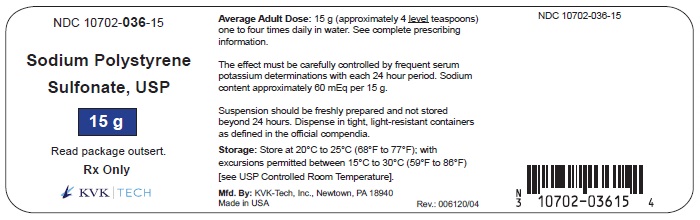
Sodium Polystyrene Sulfonate 1 g/g Powder, 15 g — NDC 10702-036-15 (Billing 10702-0036-15)
This is a package of 15 g of Sodium Polystyrene Sulfonate 1 g/g Powder from KVK-Tech, Inc., marketed since Jul 2012 and currently FDA-listed; retail pharmacies pay about $0.4741 per g (NADAC).
NDC database record
One package, one record: these facts belong to NDC 10702-036-15 alone.
- Record
- FDA NDC Directory package listing · Human prescription drug
- Code segments
- 10702 labeler · 036 product · 15 package
- Package marketed since
- Apr 3, 2015
- Sample package
- No — commercial package
- Listing certified through
- Dec 31, 2026
- Billing quantity
- 15 g per package
- Barcode (UPC)
- 0310702036451
- Medicaid fills, this package
- 122 prescriptions in the last four reported quarters
- FDA record last changed
- Jul 24, 2026
Identity & classification
Regulatory identifiers FDA, NLM and CMS codes for this package
Drug-database identifiers Medi-Span GPI and First Databank GCN / HICL / AHFS classification
- GSN (GCN sequence number): 001194
- GCN: 02890
- GPI-14 (Medi-Span): 99450010002900
- HICL (First Databank): 013209
- AHFS class code: 40:18.18.00
- RxCUI (RxNorm): 2101899
Where does this data come from?
- FDA openFDA NDC Directory · synced Oct 1, 2026
- FDA label on DailyMed · label index refreshed Oct 5, 2026
- RxNorm (NLM RxNav) · catalog refreshed Oct 1, 2026
- Medi-Span GPI (licensed)
- First Databank (licensed) · refreshed Oct 1, 2026
Clinical
- Think of it like a sponge that travels through your gut. It swaps out sodium for potassium along the way, grabbing extra potassium and carrying it out of your body in your stool. Y...
- What exactly is this medicine doing to my body?
- That's one of the most important things to understand about this medicine — it's slow. It can take anywhere from several hours to a couple of days to meaningfully lower your potass...
- No — and this is really important. This resin can grab on to other medications in your stomach and prevent them from being absorbed properly. You need to take all your other oral m...
Patient education
Supplement & herbal interactions
Where does this data come from?
- MedlinePlus (NLM) · refreshed Oct 1, 2026
- FDA label on DailyMed · label index refreshed Oct 5, 2026
Ask a licensed pharmacist directly — free, answered by our team.
Pricing
A drug doesn't have one price. Each row is a different public payment system, and none is what you'd pay at the counter — that depends on your insurance. The ⓘ on each row explains what it measures.
| Price system | Per g | Per package |
|---|---|---|
| Retail pharmacies payNADAC · weekly | $0.474 | $7.11 / 15 g |
| Medicaid paysCMS SDUD · 12 mo | $0.2126 | $3.19 / 15 g |
| Medicare drug plans payPart D · Q2 2026 | $0.1789 | $2.68 / 15 g |
Where does this data come from?
- CMS NADAC weekly file · file of Sep 30, 2026
- CMS ASP pricing files · refreshed Sep 20, 2026
- CMS Medicaid State Drug Utilization Data · through Q1 2026
- CMS Part D plan pricing files · refreshed Sep 24, 2026
- VA National Acquisition Center price file
Packaging — all sizes for this product
| Package NDC | Description | Per unit | Per pack | Marketing start | Marketing end | Status |
|---|---|---|---|---|---|---|
| 10702-0036-15 You're viewing this | 15 g in 1 BOTTLE | $0.4741 / g | $7.11 | 2015-04-03 | — | Active |
| 10702-0036-45 10702-036-45 Main listing | 454 g in 1 JAR | $0.0924 / g | $41.95 | 2012-07-25 | — | Active |
You're viewing the smallest of 2 pack sizes for this product.
Per g, this pack runs about 413% above the cheapest pack (454 g, $0.0924 vs $0.4741 NADAC).
This pack accounts for about 14% of this product's recent Medicaid fills; most go to the 454 g pack. See all packs ↓
Pack size FAQ
What quantity is in this package?
How does this package differ from NDC 10702-0036-45?
What NDC number is used to bill for this package of Sodium Polystyrene Sulfonate 1 g/g Powder?
Prices are the latest CMS NADAC pharmacy acquisition cost per NDC; per-pack figures are per-unit × pack quantity, shown only when the pack is denominated in the same measure NADAC prices.
Therapeutic equivalents
| Product | Labeler | Pack | NADAC/unit | TE | Status | Price vs. this |
|---|---|---|---|---|---|---|
| Sodium Polystyrene Sulfonate 1 g/g 46287-0012-16 | CMP | 454 g | $0.092 | AA | Availability likely | save 81% |
| Sodium Polystyrene Sulfonate 4.1 meq/g 24658-0760-16 | PuraCap | 453.6 g | $0.155 | AA | Availability likely | save 67% |
| Sodium Polystyrene Sulfonate 1 g/gthis 10702-0036-15 | KVK-Tech, | 15 g | $0.474 | AA | Availability likely | — |
| Sodium Polystyrene Sulfonate 4.1 meq/g 42806-0013-94 | Epic | 15 g | $0.474 | AA | Availability likely | — |
| Sodium Polystyrene Sulfonate 4.1 meq/g 11534-0166-15 | SUNRISE | 15 g | $0.529 | — | FDA listed | +12% |
| Sodium Polystyrene Sulfonate 4.1 meq/g 17856-0024-01 | ATLANTIC | 50 cups | — | AA | FDA listed | — |
| Sodium Polystyrene Sulfonate 4.1 meq/g 62135-0340-11 | Chartwell | 10 bottles | — | AA | FDA listed | — |
| Sodium Polystyrene Sulfonate 4.1 meq/g 63629-2390-01 | Bryant | 454 g | — | — | FDA listed | — |
| Sodium Polystyrene Sulfonate 4.1 meq/g 63629-8849-01 | Bryant | 15 g | — | — | FDA listed | — |
| Sodium Polystyrene Sulfonate 4.1 meq/g 63629-8850-01 | Bryant | 15 g | — | — | FDA listed | — |
| Sodium Polystyrene Sulfonate 4.1 meq/g 71335-2855-01 | Bryant | 15 g | — | — | FDA listed | — |
| Sodium Polystyrene Sulfonate 4.1 meq/g 72162-1230-02 | Bryant | 454 g | — | — | FDA listed | — |
Where does this data come from?
- FDA openFDA NDC Directory · synced Oct 1, 2026
- FDA Orange Book · refreshed Oct 3, 2026
- CMS NADAC weekly file · file of Sep 30, 2026
Availability & generic status
This product is an FDA-approved generic. Other versions of the same drug are listed under Therapeutic equivalents, least expensive first.
Where does this data come from?
- FDA Orange Book · refreshed Oct 3, 2026
What it looks like
Where does this data come from?
- FDA label on DailyMed · label index refreshed Oct 5, 2026
Inactive Ingredients / Excipients
Inactive ingredients, also called excipients, are components of the drug product other than the active ingredient. They may include fillers, dyes, coatings, preservatives, flavors, or other formulation ingredients.
Where does this data come from?
IACT rows and label-wide narrative are kept separate; availability and product-level specificity depend on the submitted label.- FDA label on DailyMed · label index refreshed Oct 5, 2026
- FDA openFDA NDC Directory · synced Oct 1, 2026
Inactive ingredient FAQ
Are inactive ingredients the same for every manufacturer?
Why might an inactive ingredient be missing?
Can inactive ingredients matter?
Manufacturer & labeler
More NDCs from KVK-Tech, Inc. labeler code 10702
- Oxycodone Hydrochloride 5 mg Capsule NDC 10702-023-01
- Phentermine Hydrochloride 37.5 mg Tablet NDC 10702-025-01
- Phentermine Hydrochloride 15 mg Capsule NDC 10702-026-01
- Phentermine Hydrochloride 30 mg Capsule NDC 10702-027-01
- Phentermine Hydrochloride 30 mg Capsule NDC 10702-028-01
- Phentermine Hydrochloride 37.5 mg Capsule NDC 10702-029-01
- Benzphetamine Hydrochloride 50 mg Tablet NDC 10702-040-01
- Diethylpropion Hydrochloride 25 mg Tablet NDC 10702-044-01
- Phendimetrazine Tartrate 35 mg Tablet NDC 10702-045-01
- Hydrocodone Bitartrate and Homatropine Methylbromide 5 mg; 1.5 mg Tablet NDC 10702-055-01
- Oxycodone Hydrochloride 10 mg Tablet NDC 10702-056-01
- Oxycodone Hydrochloride 20 mg Tablet NDC 10702-057-01
Where does this data come from?
- FDA openFDA NDC Directory · synced Oct 1, 2026
- Drugs@FDA
Full prescribing information FDA SPL
🎯 Indications and Usage ▾
1 INDICATIONS AND USAGE Sodium polystyrene sulfonate is indicated for the treatment of hyperkalemia. Limitation of Use : Sodium polystyrene sulfonate should not be used as an emergency treatment for life-threatening hyperkalemia because of its delayed onset of action [see Clinical Pharmacology (12.2)]. Sodium polystyrene sulfonate is a potassium binder indicated for the treatment of hyperkalemia.
Limitation of Use : Sodium polystyrene sulfonate should not be used as an emergency treatment for life-threatening hyperkalemia because of its delayed onset of action.
⏱️ Dosage and Administration ▾
2 DOSAGE AND ADMINISTRATION Oral : The average total daily adult dose of sodium polystyrene sulfonate is 15 g to 60 g, administered as a 15-g dose (four level teaspoons), one to four times daily. Rectal : The average adult dose is 30 g to 50 g every six hours.
2.1General Information Administer sodium polystyrene sulfonate at least 3 hours before or 3 hours after other oral medications. Patients with gastroparesis may require a 6 hour separation [see Warnings and Precautions (5.5) and Drug Interaction (7)] .
2.2Recommended Dosage The intensity and duration of therapy depend upon the severity and resistance of hyperkalemia. Oral The average total daily adult dose of sodium polystyrene sulfonate is 15 g to 60 g, administered as a 15-g dose (four level teaspoons), one to four times daily. Rectal The average adult dose is 30 g to 50 g every six hours.
2.3Preparation and Administration Prepare suspension fresh and use within 24 hours. Do not heat sodium polystyrene sulfonate as it could alter the exchange properties of the resin. One level teaspoon contains approximately 3.5 g of sodium polystyrene sulfonate and 15 mEq of sodium.
Oral Suspension Suspend each dose in a small quantity of water or syrup, approximately 3 to 4 mL of liquid per gram of resin. Administer with patient in an upright position [see Warnings and Precautions (5.4)] . Enema After an initial cleansing enema, insert a soft, large size (French 28) rubber tube into the rectum for a distance of about 20 cm, with the tip well into the sigmoid colon, and tape in place.
Administer as a warm (body temperature) emulsion in 100 mL of aqueous vehicle and flush with 50 to 100 mL of fluid. A somewhat thicker suspension may be used, but do not form a paste. Agitate the emulsion gently during administration.
The resin should be retained for as long as possible and follow by a cleansing enema with a nonsodium containing solution. Ensure an adequate volume of cleansing solution (up to 2 liters) is utilized.
💊 Dosage Forms and Strengths ▾
3 DOSAGE FORMS AND STRENGTHS Sodium polystyrene sulfonate, USP is a cream to light brown, finely ground powder and is available in 454 g jars and 15 g bottles. Sodium polystyrene sulfonate is available as a cream to light brown, finely ground powder.
⛔ Contraindications ▾
4 CONTRAINDICATIONS Sodium polystyrene sulfonate is contraindicated in patients with the following conditions: • Hypersensitivity to polystyrene sulfonate resins • Obstructive bowel disease • Neonates with reduced gut motility • Hypersensitivity to polystyrene sulfonate resins • Obstructive bowel disease • Neonates with reduced gut motility
⚠️ Warnings and Cautions ▾
5 WARNINGS AND PRECAUTIONS • Intestinal Necrosis : cases of intestinal necrosis and other serious gastrointestinal events have been reported. • Electrolyte Disturbances : Severe hypokalemia can occur. • Fluid overload in patients sensitive to high sodium intake : Monitor patients who are sensitive to sodium intake for signs of fluid overload. • Risk of aspiration : Acute bronchitis or bronchopneumonia caused by inhalation of sodium polystyrene sulfonate particles has been reported.
5.1Intestinal Necrosis Cases of intestinal necrosis, some fatal, and other serious gastrointestinal adverse events (bleeding, ischemic colitis, perforation) have been reported in association with sodium polystyrene sulfonate use. The majority of these cases reported the concomitant use of sorbitol. Risk factors for gastrointestinal adverse events were present in many of the cases including prematurity, history of intestinal disease or surgery, hypovolemia, and renal insufficiency and failure.
Concomitant administration of sorbitol is not recommended. • Use only in patients who have normal bowel function. Avoid use in patients who have not had a bowel movement post-surgery. • Avoid use in patients who are at risk for developing constipation or impaction (including those with history of impaction, chronic constipation, inflammatory bowel disease, ischemic colitis, vascular intestinal atherosclerosis, previous bowel resection, or bowel obstruction). Discontinue use in patients who develop constipation.
5.2Electrolyte Disturbances Monitor serum potassium during therapy because severe hypokalemia may occur. Sodium polystyrene sulfonate is not totally selective for potassium, and small amounts of other cations such as magnesium and calcium can also be lost during treatment. Monitor calcium and magnesium in patients receiving sodium polystyrene sulfonate.
5.3Fluid Overload in Patients Sensitive to High Sodium Intake Each 15 g dose of sodium polystyrene sulfonate contains 1500 mg (60 mEq) of sodium. Monitor patients who are sensitive to sodium intake (heart failure, hypertension, edema) for signs of fluid overload. Adjustment of other sources of sodium may be required.
5.4Risk of Aspiration Cases of acute bronchitis or bronchopneumonia caused by inhalation of sodium polystyrene sulfonate particles have been reported. Patients with impaired gag reflex, altered level of consciousness, or patients prone to regurgitation may be at increased risk. Administer sodium polystyrene sulfonate with the patient in an upright position.
5.5Binding to Other Orally Administered Medications Sodium polystyrene sulfonate may bind orally administered medications, which could decrease their gastrointestinal absorption and lead to reduced efficacy. Administer other oral medications at least 3 hours before or 3 hours after sodium polystyrene sulfonate. Patients with gastroparesis may require a 6 hour separation [see Dosage and Administration (2.1) and Drug Interactions (7)] .
🤒 Adverse Reactions ▾
6 ADVERSE REACTIONS The following adverse reactions are discussed elsewhere in the labeling: • Intestinal Necrosis [see Warnings and Precautions (5.1)] • Electrolyte Disturbances [see Warnings and Precautions (5.2, 5.3)] • Aspiration [see Warnings and Precautions (5.4)] The following adverse reactions have been identified during post-approval use of sodium polystyrene sulfonate. Because these reactions are reported voluntarily from a population of uncertain size, it is not always possible to estimate their frequency reliably or establish a causal relationship to drug exposure.
Gastrointestinal: anorexia, constipation, diarrhea, fecal impaction, gastrointestinal concretions (bezoars), ischemic colitis, nausea, ulcerations, vomiting, gastric irritation, intestinal obstruction (due to concentration of aluminium hydroxide) Metabolic: systemic alkalosis Adverse reactions reported include: anorexia, constipation, diarrhea, fecal impaction, gastrointestinal concretions (bezoars), ischemic colitis, nausea, vomiting. To report SUSPECTED ADVERSE REACTIONS, contact KVK-Tech, Inc. at 1-215-579-1842 or FDA at 1-800-FDA-1088 or www.fda.gov/medwatch .
🔄 Drug Interactions ▾
7 DRUG INTERACTIONS • Take other orally administered drugs at least 3 hours before or 3 hours after sodium polystyrene sulfonate. • Cation-Donating Antacids: may reduce the resin’s potassium exchange capability and increase risk of systemic alkalosis. • Sorbitol: Concomitant use may contribute to the risk of intestinal necrosis and is not recommended.
7.1General Interactions No formal drug interaction studies have been conducted in humans. Sodium polystyrene sulfonate has the potential to bind other drugs. In in vitro binding studies, sodium polystyrene sulfonate was shown to significantly bind the oral medications (n=6) that were tested.
Decreased absorption of lithium and thyroxine have also been reported with co-administration of sodium polystyrene sulfonate. Binding of sodium polystyrene sulfonate to other oral medications could cause decreased gastrointestinal absorption and loss of efficacy when taken close to the time sodium polystyrene sulfonate is administered. Administer sodium polystyrene sulfonate at least 3 hours before or 3 hours after other oral medications.
Patients with gastroparesis may require a 6 hour separation. Monitor for clinical response and/or blood levels where possible.
7.2Cation-Donating Antacids The simultaneous oral administration of sodium polystyrene sulfonate with nonabsorbable cation-donating antacids and laxatives may reduce the resin's potassium exchange capability and increase the risk of systemic alkalosis.
7.3Sorbitol Sorbitol may contribute to the risk of intestinal necrosis [see Warnings and Precautions (5.1)] and concomitant use is not recommended.
👥 Use in Specific Populations ▾
8 USE IN SPECIFIC POPULATIONS
8.1Pregnancy Risk Summary Sodium polystyrene sulfonate is not absorbed systemically following oral or rectal administration and maternal use is not expected to result in fetal risk.
8.2Lactation Risk Summary Sodium polystyrene sulfonate is not absorbed systemically by the mother, so breastfeeding is not expected to result in risk to the infant.
8.4Pediatric Use Studies of safety and efficacy have not been conducted in pediatric patients. In pediatric patients, as in adults, sodium polystyrene sulfonate is expected to bind potassium at the practical exchange ratio of 1 mEq potassium per 1 gram of resin. In neonates, sodium polystyrene sulfonate should not be given by the oral route.
In both children and neonates, excessive dosage or inadequate dilution could result in impaction of the resin. Premature infants or low birth weight infants may have an increased risk for gastrointestinal adverse effects with sodium polystyrene sulfonate use [see Warnings and Precautions (5.4)] .
🆘 Overdosage ▾
10 OVERDOSAGE Overdosage may result in electrolyte disturbances including hypokalemia, hypocalcemia, and hypomagnesemia. Appropriate measures should be taken to correct serum electrolytes (potassium, calcium, magnesium), and the resin should be removed from the alimentary tract by appropriate use of laxatives or enemas.
🧬 Clinical Pharmacology ▾
12 CLINICAL PHARMACOLOGY
12.1Mechanism of Action Sodium polystyrene sulfonate is a non-absorbed, cation exchange polymer that contains a sodium counterion. Sodium polystyrene sulfonate increases fecal potassium excretion through binding of potassium in the lumen of the gastrointestinal tract. Binding of potassium reduces the concentration of free potassium in the gastrointestinal lumen, resulting in a reduction of serum potassium levels.
The practical exchange ratio is 1 mEq K per 1 gram of resin. As the resin passes along the intestine or is retained in the colon after administration by enema, the sodium ions are partially released and are replaced by potassium ions. This action occurs primarily in the large intestine, which excretes potassium ions to a greater degree than does the small intestine.
The efficiency of this process is limited and unpredictably variable.
12.2Pharmacodynamics The effective lowering of serum potassium with sodium polystyrene sulfonate may take hours to days.
12.3Pharmacokinetics The in vivo efficiency of sodium-potassium exchange resins is approximately 33 percent; hence, about one third of the resin's actual sodium content is delivered to the body. Sodium polystyrene sulfonate is not absorbed systemically. Drug Interactions In vitro binding studies showed that sodium polystyrene sulfonate bound significantly to the following tested drugs – warfarin, metoprolol, phenytoin, furosemide, amlodipine and amoxicillin.
📦 How Supplied / Storage and Handling ▾
16 HOW SUPPLIED/STORAGE AND HANDLING Sodium polystyrene sulfonate, USP is available as a cream to light brown, finely ground powder in Jars of 1 pound (454 g) NDC 10702-036-45 Bottles of 15 g NDC 10702-036-15 Store at 20° to 25°C (68° to 77°F) with excursions permitted between 15° to 30°C (59° to 86°F) [See USP Controlled Room Temperature].
📋 Description ▾
11 DESCRIPTION Sodium polystyrene sulfonate, USP is a benzene, diethenyl-polymer, with ethenylbenzene, sulfonated, sodium salt and has the following structural formula: The drug is a cream to light brown finely ground, powdered form of sodium polystyrene sulfonate, a cation-exchange resin prepared in the sodium phase with an in vitro exchange capacity of approximately 3.1 mEq ( in vivo approximately 1 mEq) of potassium per gram. The sodium content is approximately 100 mg (4.1 mEq) per gram of the drug. It can be administered orally or rectally as an enema.
One gram of sodium polystyrene sulfonate, USP contains 4.1 mEq of sodium. Chemical Structure
💬 Information for Patients ▾
17 PATIENT COUNSELING INFORMATION Drug Interactions Advise patients who are taking other oral medication to separate the dosing of sodium polystyrene sulfonate by at least 3 hours (before or after) [see Dosage and Administration (2.1), Warnings and Precautions (5.5), and Drug Interactions (7.1)] Rx Only Manufactured by: KVK-Tech, Inc. 110 Terry Drive Newtown, PA 18940 Manufacturer’s code: 10702 Item ID#: 006119/06 Rev.: 11/2018 company logo
🧪 Nonclinical Toxicology ▾
13 NONCLINICAL TOXICOLOGY
13.1Carcinogenesis, Mutagenesis, Impairment of Fertility Studies have not been performed.
📄 Package Label / Principal Display Panel ▾
Principal Display Panel NDC 10702- 036 -45 Sodium Polystyrene Sulfonate, USP Powder 454 g (1 lb) Read package outsert. Rx Only KVK-TECH 454 g jar label
Principal Display Panel NDC 10702-0036-15 Sodium Polystyrene Sulfonate, USP 15 g Read package outsert. Rx only KVK-TECH, INC. 15 g bottle label