
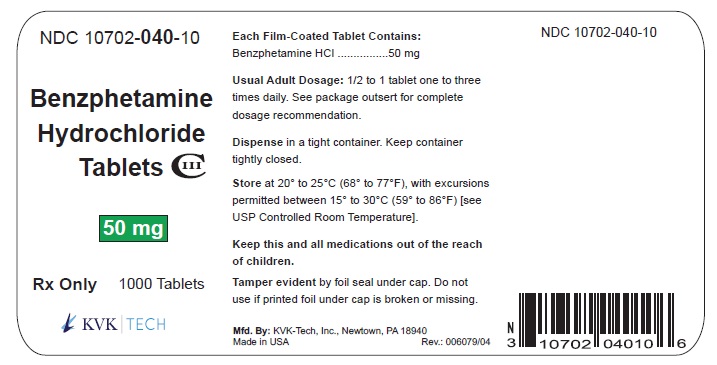
Benzphetamine Hydrochloride 50 mg Tablet, 1,000-count — NDC 10702-040-10 (Billing 10702-0040-10)
This is a package of 1,000 tablets of Benzphetamine Hydrochloride 50 mg Tablet from KVK-TECH, INC, marketed since Jul 2010 and currently FDA-listed.
NDC database record
One package, one record: these facts belong to NDC 10702-040-10 alone.
- Record
- FDA NDC Directory package listing · Human prescription drug
- Code segments
- 10702 labeler · 040 product · 10 package
- Package marketed since
- Jul 21, 2010
- Sample package
- No — commercial package
- Listing certified through
- Dec 31, 2027
- Barcode (UPC)
- 0310702040014, 0310702040106, 0310702040038, 0310702040502
- FDA record last changed
- Aug 13, 2026
Identity & classification
Regulatory identifiers FDA, NLM and CMS codes for this package
Drug-database identifiers Medi-Span GPI and First Databank GCN / HICL / AHFS classification
- GSN (GCN sequence number): 005021
- GCN: 19981
- HICL (First Databank): 002070
- AHFS class code: 28:20.04.00
- RxCUI (RxNorm): 904368
Where does this data come from?
- FDA openFDA NDC Directory · synced Oct 8, 2026
- FDA label on DailyMed · label index refreshed Oct 6, 2026
- RxNorm (NLM RxNav) · catalog refreshed Oct 1, 2026
- Medi-Span GPI (licensed)
- First Databank (licensed) · refreshed Oct 8, 2026
RxNorm drug class
This medicine belongs to the Sympathomimetic Amine Anorectic class.
Where does this data come from?
- RxClass (NLM) · catalog refreshed Oct 1, 2026
Clinical
Patient education
Supplement & herbal interactions
Where does this data come from?
- MedlinePlus (NLM) · refreshed Oct 1, 2026
- FDA label on DailyMed · label index refreshed Oct 6, 2026
Ask a licensed pharmacist directly — free, answered by our team.
Pricing
A drug doesn't have one price. Each row is a different public payment system, and none is what you'd pay at the counter — that depends on your insurance. The ⓘ on each row explains what it measures.
| Price system | Per each | Per package |
|---|---|---|
| Retail pharmacies payNADAC · weekly | Not in the retail survey — common for institutional, discontinued, or low-volume packs. | |
| Medicaid paysCMS SDUD · 12 mo | No recent Medicaid claims on file for this NDC — rare and low-volume NDCs are suppressed in the public data. | |
| Medicare drug plans payPart D · quarterly | No Part D plan price is available for this NDC in our data. | |
Where does this data come from?
- CMS NADAC weekly file
- CMS ASP pricing files · refreshed Sep 20, 2026
- CMS Medicaid State Drug Utilization Data · refreshed Oct 8, 2026
- CMS Part D plan pricing files · refreshed Sep 24, 2026
- VA National Acquisition Center price file
Packaging — all sizes for this product
| Package NDC | Description | Marketing start | Marketing end | Status |
|---|---|---|---|---|
| 10702-0040-01 10702-040-01 Main listing | 100 TABLET in 1 BOTTLE | 2010-07-21 | — | Active |
| 10702-0040-03 10702-040-03 | 30 TABLET in 1 BOTTLE | 2010-07-21 | — | Active |
| 10702-0040-10 You're viewing this | 1000 TABLET in 1 BOTTLE | 2010-07-21 | — | Active |
| 10702-0040-50 10702-040-50 | 500 TABLET in 1 BOTTLE | 2010-07-21 | — | Active |
You're viewing the largest of 4 pack sizes for this product.
Pack size FAQ
What quantity is in this package?
How does this package differ from NDC 10702-0040-03?
What NDC number is used to bill for this package of Benzphetamine Hydrochloride 50 mg Tablet?
Therapeutic equivalents
| Product | Labeler | Pack | NADAC/unit | TE | Status | Price vs. this |
|---|---|---|---|---|---|---|
| Benzphetamine Hydrochloride 50 mgthis 10702-0040-10 | KVK-TECH, | 1000 tablets | — | AA | FDA listed | — |
| benzphetamine hydrochloride 50 mg 17224-0672-30 | Calvin | 30 tablets | — | AA | FDA listed | — |
| Benzphetamine Hydrochloride 50 mg 23155-0952-01 | Heritage | 100 tablets | — | AA | FDA listed | — |
| Benzphetamine Hydrochloride 50 mg 42806-0081-01 | Epic | 100 tablets | — | AA | FDA listed | — |
| Benzphetamine Hydrochloride 50 mg 43063-0541-14 | PD-Rx | 14 tablets | — | AA | FDA listed | — |
| Benzphetamine Hydrochloride 50 mg 71335-0451-01 | Bryant | 30 tablets | — | AA | FDA listed | — |
Where does this data come from?
- FDA openFDA NDC Directory · synced Oct 8, 2026
- FDA Orange Book · refreshed Oct 3, 2026
- CMS NADAC weekly file
Availability & generic status
This product is an FDA-approved generic. Other versions of the same drug are listed under Therapeutic equivalents, least expensive first.
Where does this data come from?
- FDA Orange Book · refreshed Oct 3, 2026
What it looks like
Where does this data come from?
- FDA label on DailyMed · label index refreshed Oct 6, 2026
Inactive Ingredients / Excipients
Inactive ingredients, also called excipients, are components of the drug product other than the active ingredient. They may include fillers, dyes, coatings, preservatives, flavors, or other formulation ingredients.
💡 Tap an ingredient (hover on desktop) to see what it is and why it’s used.
-
UNII R12CBM0EIZ
A natural wax derived from a Brazilian palm tree, used as a coating and polish on tablets and capsules. It creates a smooth, shiny finish that protects the medicine and improves appearance.
-
UNII WZB9127XOA
A synthetic red dye used to color medications and make them easier to identify. It serves as a colorant in tablets, capsules, and liquid formulations.
-
UNII H77VEI93A8
A synthetic yellow dye used to color medications. It helps identify the drug and make it visually distinctive, with no effect on how the medicine works.
-
UNII EWQ57Q8I5X
Lactose monohydrate is a natural sugar derived from milk. It serves as a filler and binder in tablets and capsules, helping create the proper size, texture, and consistency of the medicine.
-
UNII 70097M6I30
Magnesium stearate is a salt made from magnesium and stearic acid, a fatty substance. It's used in tablets and capsules as a lubricant and glidant to help ingredients flow smoothly during manufacturing and prevent sticking.
-
UNII OP1R32D61U
Microcrystalline cellulose is a purified form of cellulose, a natural fiber from plant sources. It acts as a binder and filler in tablets and capsules, helping hold ingredients together and give the medicine its shape and size.
-
UNII G2M7P15E5P
Polyethylene glycol 3350 is a synthetic polymer used as a solvent, humectant, and thickening agent in medicines. It helps dissolve other ingredients, retain moisture in the product, and achieve the desired consistency.
-
UNII 532B59J990
Polyvinyl alcohol is a synthetic polymer made from plant-derived materials. It's used as a binder to hold ingredients together, a film-former in coatings, and a thickener in liquid formulations.
-
UNII ETJ7Z6XBU4
Silicon dioxide is a naturally occurring mineral used as a glidant and anti-caking agent. It helps powder ingredients flow smoothly and prevents clumping during manufacturing and storage.
-
UNII 5856J3G2A2
A starch-based powder made from potatoes and processed with sodium. It acts as a disintegrant, helping the tablet or capsule break apart quickly in the stomach so the medicine can be absorbed.
-
UNII 7SEV7J4R1U
A powder made from a naturally occurring mineral. In medicines, talc works as a glidant and anti-caking agent, helping tablets and capsules flow smoothly during manufacturing and preventing clumping.
-
UNII 15FIX9V2JP
Titanium dioxide is a bright white mineral powder commonly used as a colorant and opacifying agent. It makes pills and tablets white or lighter in color and helps make coatings non-transparent.
12 inactive ingredients listed in the exact product block matched to this NDC.
Where does this data come from?
ingredient classCode="IACT" elements from the exact product block matched by this NDC. Label-section narrative from DailyMed / the openFDA label index is shown separately when available.- FDA label on DailyMed · label index refreshed Oct 6, 2026
- FDA openFDA NDC Directory · synced Oct 8, 2026
Inactive ingredient FAQ
Are inactive ingredients the same for every manufacturer?
Why might an inactive ingredient be missing?
Can inactive ingredients matter?
Manufacturer & labeler
More NDCs from KVK-TECH, INC labeler code 10702
- Phentermine Hydrochloride 37.5 mg Tablet NDC 10702-025-01
- Phentermine Hydrochloride 15 mg Capsule NDC 10702-026-01
- Phentermine Hydrochloride 30 mg Capsule NDC 10702-027-01
- Phentermine Hydrochloride 30 mg Capsule NDC 10702-028-01
- Phentermine Hydrochloride 37.5 mg Capsule NDC 10702-029-01
- Sodium Polystyrene Sulfonate 1 g/g Powder NDC 10702-036-15
- Diethylpropion Hydrochloride 25 mg Tablet NDC 10702-044-01
- Phendimetrazine Tartrate 35 mg Tablet NDC 10702-045-01
- Hydrocodone Bitartrate and Homatropine Methylbromide 5 mg; 1.5 mg Tablet NDC 10702-055-01
- Oxycodone Hydrochloride 10 mg Tablet NDC 10702-056-01
- Oxycodone Hydrochloride 20 mg Tablet NDC 10702-057-01
- Dextroamphetamine Sulfate 5 mg Tablet NDC 10702-065-01
Where does this data come from?
- FDA openFDA NDC Directory · synced Oct 8, 2026
- Drugs@FDA
Full prescribing information FDA SPL
🎯 Indications and Usage ▾
INDICATIONS AND USAGE Benzphetamine hydrochloride tablets are indicated in the management of exogenous obesity as a short term (a few weeks) adjunct in a regimen of weight reduction based on caloric restriction in patients with an initial body mass index (BMI) of 30 kg/m2 or higher who have not responded to appropriate weight reducing regimen (diet and/or exercise) alone. Below is a chart of Body Mass Index (BMI) based on various heights and weights. BMI is calculated by taking the patient's weight, in kilograms (kg), divided by the patient's height, in meters (m), squared.
Metric conversions are as follows: pounds ÷2.2 = kg; inches × 0.0254 = meters. The limited usefulness of agents of this class (See CLINICAL PHARMACOLOGY ) should be weighed against possible risks inherent in their use such as those described below. Benzphetamine hydrochloride tablets are indicated for use as monotherapy only.
BMI Table
⏱️ Dosage and Administration ▾
DOSAGE AND ADMINISTRATION Dosage should be individualized according to the response of the patient. The suggested dosage ranges from 25 to 50 mg one to three times daily. Treatment should begin with 25 to 50 mg once daily with subsequent increase in individual dose or frequency according to response.
A single daily dose is preferably given in mid-morning or mid-afternoon, according to the patient’s eating habits. In an occasional patient it may be desirable to avoid late afternoon administration. Use of benzphetamine hydrochloride is not recommended in individuals under 17 years of age.
⛔ Contraindications ▾
CONTRAINDICATIONS Benzphetamine hydrochloride tablets are contraindicated in patients with advanced arteriosclerosis, symptomatic cardiovascular disease, moderate to severe hypertension, hyperthyroidism, known hypersensitivity or idiosyncrasy to sympathomimetic amines, and glaucoma. Benzphetamine should not be given to patients who are in an agitated state or who have a history of drug abuse. Hypertensive crises have resulted when sympathomimetic amines have been used concomitantly or within 14 days following use of monoamine oxidase inhibitors.
Benzphetamine hydrochloride tablets should not be used concomitantly with other CNS stimulants. Benzphetamine hydrochloride tablets may cause fetal harm when administered to a pregnant woman. Amphetamines have been shown to be teratogenic and embryotoxic in mammals at high multiples of the human dose.
Benzphetamine hydrochloride tablets are contraindicated in women who are or may become pregnant. If this drug is used during pregnancy, or if the patient becomes pregnant while taking this drug, the patient should be apprised of the potential hazard to the fetus.
⚠️ Warnings ▾
WARNINGS Benzphetamine hydrochloride tablets should not be used in combination with other anorectic agents, including prescribed drugs, over-the-counter preparations and herbal products. In a case-control epidemiological study, the use of anorectic agents was associated with an increased risk of developing pulmonary hypertension, a rare, but often fatal disorder. The use of anorectic agents for longer than three months was associated with a 23-fold increase in the risk of developing pulmonary hypertension.
Increased risk of pulmonary hypertension with repeated courses of therapy cannot be excluded. It should be noted that benzphetamine was not specifically studied in this case-control study. The onset or aggravation of exertional dyspnea, or unexplained symptoms of angina pectoris, syncope, or lower extremity edema suggest the possibility of occurrence of pulmonary hypertension.
Under these circumstances, Benzphetamine hydrochloride tablets should be immediately discontinued, and the patient should be evaluated for the possible presence of pulmonary hypertension. Valvular heart disease associated with the use of some anorectic agents such as fenfluramine and dexfenfluramine has been reported. Possible contributing factors include use for extended periods of time, higher than recommended dose, and/or use in combination with other anorectic drugs.
However, no cases of this valvulopathy have been reported when benzphetamine has been used alone. The potential risk of possible serious adverse effects such as valvular heart disease and pulmonary hypertension should be assessed carefully against the potential benefit of weight loss. Baseline cardiac evaluation should be considered to detect pre-existing valvular heart diseases or pulmonary hypertension prior to initiation of benzphetamine treatment.
Benzphetamine hydrochloride tablets are not recommended in patients with known heart murmur or valvular heart disease. Echocardiogram during and after treatment could be useful for detecting any valvular disorders which may occur. To limit unwarranted exposure and risks, treatment with benzphetamine hydrochloride tablets should be continued only if the patient has satisfactory weight loss within the first 4 weeks of treatment (i.e., weight loss of at least 4 pounds, or as determined by the physician and patient).
When tolerance to the anorectic effect develops, the recommended dose should not be exceeded in an attempt to increase the effect; rather, the drug should be discontinued. Benzphetamine hydrochloride tablets are not recommended for severely hypertensive patients or for patients with symptomatic cardiovascular disease including arrhythmias. Benzphetamine hydrochloride tablets are not recommended for patients who used any anorectic agents within the prior year.
🤒 Adverse Reactions ▾
ADVERSE REACTIONS The following have been associated with the use of benzphetamine hydrochloride: Cardiovascular Palpitation, tachycardia, elevation of blood pressure. There have been isolated reports of cardiomyopathy and ischemic cardiac events associated with chronic amphetamine use. Valvular heart disease associated with the use of some anorectic agents such as fenfluramine and dexfenfluramine, both independently and especially when used in combination with other anorectic drugs, have been reported.
However, no cases of this valvulopathy have been reported when benzphetamine hydrochloride tablets have been used alone. CNS Overstimulation, restlessness, dizziness, insomnia, tremor, sweating, headache; rarely, psychotic episodes at recommended doses; depression following withdrawal of the drug. Gastrointestinal Dryness of the mouth, unpleasant taste, nausea, diarrhea, other gastrointestinal disturbances.
Allergic Urticaria and other allergic reactions involving the skin. Endocrine Changes in libido.
🔄 Drug Interactions ▾
Drug Interactions Efficacy of benzphetamine hydrochloride tablets in combination with other anorectic agents has not been studied and the combined use may have the potential for serious cardiac problems. Hypertensive crises have resulted when sympathomimetic amines have been used concomitantly or within 14 days following use of monoamine oxidase inhibitors. Benzphetamine hydrochloride tablets should not be used concomitantly with other CNS stimulants.
Amphetamines may decrease the hypotensive effect of antihypertensives. Amphetamines may enhance the effects of tricyclic antidepressants. Urinary alkalinizing agents increase blood levels and decrease excretion of amphetamines.
Urinary acidifying agents decrease blood levels and increase excretion of amphetamines.
🤰 Pregnancy ▾
Pregnancy Benzphetamine hydrochloride tablets are contraindicated in pregnancy.
🧒 Pediatric Use ▾
Pediatric Use Safety and effectiveness in pediatric patients have not been established. The use of benzphetamine hydrochloride is not recommended in patients less than 17 years of age.
🧓 Geriatric Use ▾
Geriatric Use Clinical studies of benzphetamine hydrochloride tablets did not include sufficient numbers of subjects aged 65 and over to establish safety and efficacy in this population. In general, dose selection for an elderly patient should be cautious, usually starting at the low end of the dosing range, reflecting the greater frequency of decreased hepatic, renal, or cardiac function, and of concomitant disease or other drug therapy.
🆘 Overdosage ▾
OVERDOSAGE Manifestations of Overdosage Acute overdosage with amphetamines may result in restlessness, tremor, tachypnea, confusion, assaultiveness and panic states. Fatigue and depression usually follow the central stimulation. Cardiovascular effects include arrhythmias, hypertension or hypotension, and circulatory collapse.
Gastrointestinal symptoms include nausea, vomiting, diarrhea, and abdominal cramps. Hyperpyrexia and rhabdomyolysis have been reported and can lead to a number of associated complications. Fatal poisoning is usually preceded by convulsions and coma.
Treatment of Overdosage (See WARNINGS) - Information concerning the effects of overdosage with benzphetamine hydrochloride tablets is extremely limited. The following is based on experience with other anorexiants. Management of acute amphetamine intoxication is largely symptomatic and includes sedation with a barbiturate.
If hypertension is marked, the use of a nitrite or rapidly acting alpha receptor blocking agent should be considered. Experience with hemodialysis or peritoneal dialysis is inadequate to permit recommendations in this regard. Acidification of the urine increases amphetamine excretion.
The oral LD 50 is 174 mg/kg in mice and 104 mg/kg in rats. The intraperitoneal LD 50 in mice is 153 mg/kg.
Treatment of Overdosage (See WARNINGS) - Information concerning the effects of overdosage with benzphetamine hydrochloride tablets is extremely limited. The following is based on experience with other anorexiants. Management of acute amphetamine intoxication is largely symptomatic and includes sedation with a barbiturate.
If hypertension is marked, the use of a nitrite or rapidly acting alpha receptor blocking agent should be considered. Experience with hemodialysis or peritoneal dialysis is inadequate to permit recommendations in this regard. Acidification of the urine increases amphetamine excretion.
The oral LD 50 is 174 mg/kg in mice and 104 mg/kg in rats. The intraperitoneal LD 50 in mice is 153 mg/kg.
🧬 Clinical Pharmacology ▾
CLINICAL PHARMACOLOGY Benzphetamine hydrochloride is a sympathomimetic amine with pharmacologic activity similar to the prototype drugs of this class used in obesity, the amphetamines. Actions include central nervous system stimulation and elevation of blood pressure. Tachyphylaxis and tolerance have been demonstrated with all drugs of this class in which these phenomena have been looked for.
Drugs of this class used in obesity are commonly known as "anorectics" or "anorexigenics". It has not been established, however, that the action of such drugs in treating obesity is primarily one of appetite suppression. Other central nervous system actions, or metabolic effects, may be involved.
Adult obese subjects instructed in dietary management and treated with "anorectic" drugs, lose more weight on the average than those treated with placebo and diet, as determined in relatively short-term clinical trials. The magnitude of increased weight loss of drug-treated patients over placebo-treated patients is only a fraction of a pound a week. The rate of weight loss is the greatest in the first weeks of therapy for both drug and placebo subjects and tends to decrease in succeeding weeks.
The possible origins of the increased weight loss due to the various drug effects are not established. The amount of weight loss associated with the use of an "anorectic" drug varies from trial to trial, and the increased weight loss appears to be related in part to variables other than the drug prescribed, such as the physician-investigator, the population treated, and the diet prescribed. Studies do not permit conclusions as to the relative importance of the drug and non-drug factors on weight loss.
The natural history of obesity is measured in years, whereas the studies cited are restricted to a few weeks duration; thus, the total impact of drug-induced weight loss over that of diet alone must be considered to be clinically limited. Pharmacokinetic data in humans are not available.
📦 How Supplied / Storage and Handling ▾
HOW SUPPLIED Benzphetamine hydrochloride tablets, USP are available as follows: Benzphetamine hydrochloride tablets, USP 50 mg are supplied as peach, round, biconvex, film coated tablets debossed with “K” on left of the score and the number “40” debossed right of the score and plain on other side. Bottles of 30 NDC 10702-040-03 Bottles of 100 NDC 10702-040-01 Bottles of 500 NDC 10702-040-50 Bottles of 1000 NDC 10702-040-10 Dispense in a tight container as defined in the USP, with a child-resistant closure (as required).
Store at 20° to 25°C with excursions permitted between 15° to 30°C (59° to 86°F) [see USP Controlled Room Temperature]. Rx only Manufactured by: KVK-Tech, INC. 110 Terry Dr.
Suite 200 Newtown, PA 18940-1850 Item ID #: 6077/07 Rev.: 06/2026 Manufacturer’s Code: 10702 company logo
📋 Description ▾
DESCRIPTION Benzphetamine hydrochloride tablets, USP contain the anorectic agent benzphetamine hydrochloride. Benzphetamine hydrochloride is a white crystalline powder readily soluble in water and 95% ethanol. The chemical name for benzphetamine hydrochloride, USP is d -N,α-Dimethyl-N -(phenylmethyl)-benzeneethanamine hydrochloride and its molecular weight is 275.82.
The structural formula (dextro form) is represented below: Each benzphetamine hydrochloride tablet, USP for oral administration, contains 50 mg of benzphetamine hydrochloride. Inactive Ingredients: carnauba wax powder, colloidal silicon dioxide, FD&C red # 40 aluminum lake, FD&C yellow # 6 aluminum lake, lactose monohydrate, macrogol/polyethylene glycol 3350, magnesium stearate, microcrystalline cellulose 101, polyvinyl alcohol – partially hydrolyzed, sodium starch glycolate, talc and titanium dioxide. chemical structure
💬 Information for Patients ▾
Information for Patients Amphetamines may impair the ability of the patient to engage in potentially hazardous activities such as operating machinery or driving a motor vehicle; the patient should therefore be cautioned accordingly.
⚠️ Precautions ▾
PRECAUTIONS General Insulin requirements in diabetes mellitus may be altered in association with use of anorexigenic drugs and the concomitant dietary restrictions. Psychological disturbances have been reported in patients who receive an anorectic agent together with a restrictive dietary regime. Caution is to be exercised in prescribing amphetamines for patients with even mild hypertension.
The least amount feasible should be prescribed or dispensed at one time in order to minimize the possibility of overdosage. Information for Patients Amphetamines may impair the ability of the patient to engage in potentially hazardous activities such as operating machinery or driving a motor vehicle; the patient should therefore be cautioned accordingly. Drug Interactions Efficacy of benzphetamine hydrochloride tablets in combination with other anorectic agents has not been studied and the combined use may have the potential for serious cardiac problems.
Hypertensive crises have resulted when sympathomimetic amines have been used concomitantly or within 14 days following use of monoamine oxidase inhibitors. Benzphetamine hydrochloride tablets should not be used concomitantly with other CNS stimulants. Amphetamines may decrease the hypotensive effect of antihypertensives.
Amphetamines may enhance the effects of tricyclic antidepressants. Urinary alkalinizing agents increase blood levels and decrease excretion of amphetamines. Urinary acidifying agents decrease blood levels and increase excretion of amphetamines.
Carcinogenesis, Mutagenesis, Impairment of Fertility Animal studies to evaluate the potential for carcinogenesis, mutagenesis or impairment of fertility have not been performed by Pharmacia & Upjohn Company. Pregnancy Benzphetamine hydrochloride tablets are contraindicated in pregnancy. Nursing Mothers Amphetamines are excreted in human milk.
Mothers taking amphetamines should be advised to refrain from nursing. Pediatric Use Safety and effectiveness in pediatric patients have not been established. The use of benzphetamine hydrochloride is not recommended in patients less than 17 years of age.
Geriatric Use Clinical studies of benzphetamine hydrochloride tablets did not include sufficient numbers of subjects aged 65 and over to establish safety and efficacy in this population. In general, dose selection for an elderly patient should be cautious, usually starting at the low end of the dosing range, reflecting the greater frequency of decreased hepatic, renal, or cardiac function, and of concomitant disease or other drug therapy.
🍼 Nursing Mothers ▾
Nursing Mothers Amphetamines are excreted in human milk. Mothers taking amphetamines should be advised to refrain from nursing.
🔒 Drug Abuse and Dependence ▾
DRUG ABUSE AND DEPENDENCE Benzphetamine is a controlled substance under the Controlled Substance Act by the Drug Enforcement Administration and has been assigned to Schedule III. Benzphetamine hydrochloride is related chemically and pharmacologically to the amphetamines. Amphetamines and related stimulant drugs have been extensively abused, and the possibility of abuse of benzphetamine hydrochloride tablets should be kept in mind when evaluating the desirability of including a drug as part of a weight reduction program.
Abuse of amphetamines and related drugs may be associated with intense psychological dependence and severe social dysfunction. There are reports of patients who have increased the dosage to many times that recommended. Abrupt cessation following prolonged high dosage administration results in extreme fatigue and mental depression; changes are also noted on the sleep EEG.
Manifestations of chronic intoxication with anorectic drugs include severe dermatoses, marked insomnia, irritability, hyperactivity, and personality changes. The most severe manifestation of chronic intoxication is psychosis, often clinically indistinguishable from schizophrenia.
📄 Carcinogenesis, Mutagenesis, Impairment of Fertility ▾
Carcinogenesis, Mutagenesis, Impairment of Fertility Animal studies to evaluate the potential for carcinogenesis, mutagenesis or impairment of fertility have not been performed by Pharmacia & Upjohn Company.
📄 Package Label / Principal Display Panel ▾
PRINCIPAL DISPLAY PANEL - 30s Container Label NDC 10702- 040 -03 Benzphetamine Hydrochloride Tablets 50 mg CIII Rx Only 30 Tablets KVK-TECH figure-03-30s-label
PRINCIPAL DISPLAY PANEL - 100s Container Label NDC 10702- 040 -01 Benzphetamine Hydrochloride Tablets 50 mg CIII Rx Only 100 Tablets KVK-TECH figure-04-100s-label
PRINCIPAL DISPLAY PANEL - 500s Container Label NDC 10702- 040 -50 Benzphetamine Hydrochloride Tablets 50 mg CIII Rx Only 500 Tablets KVK-TECH figure-05-500s-label
PRINCIPAL DISPLAY PANEL - 1000s Container Label NDC 10702- 040 -10 Benzphetamine Hydrochloride Tablets 50 mg CIII Rx Only 1000 Tablets KVK-TECH figure-06-1000s-label
About this NDC listing & data coverage
What data is (and isn’t) available for this NDC — tap to expand
| NDC identity (package / product / labeler codes) | ✓ Available |
| Labeler | ✓ Available |
| Product & package description | ✓ Available |
| Marketing category & status | ✓ Available |
| Active ingredient / dosage form / route | ✓ Available |
| FDA label (SPL via DailyMed) | ✓ Available |
| Package photos | ✓ Available |
| Inactive ingredients (structured) | ✓ Available |
| NADAC pharmacy acquisition price (CMS) | — Not published for this NDC CMS publishes NADAC only for NDCs reported in its retail-pharmacy survey. |
| Orange Book / therapeutic-equivalence data | ✓ Available |
| HCPCS J-code billing crosswalk | — Not published for this NDC Most self-administered / retail products have no J-code — that is normal. |
| Medicaid utilization (CMS SDUD) | — Not published for this NDC CMS reports utilization only for NDCs with Medicaid claims above its privacy threshold. |