
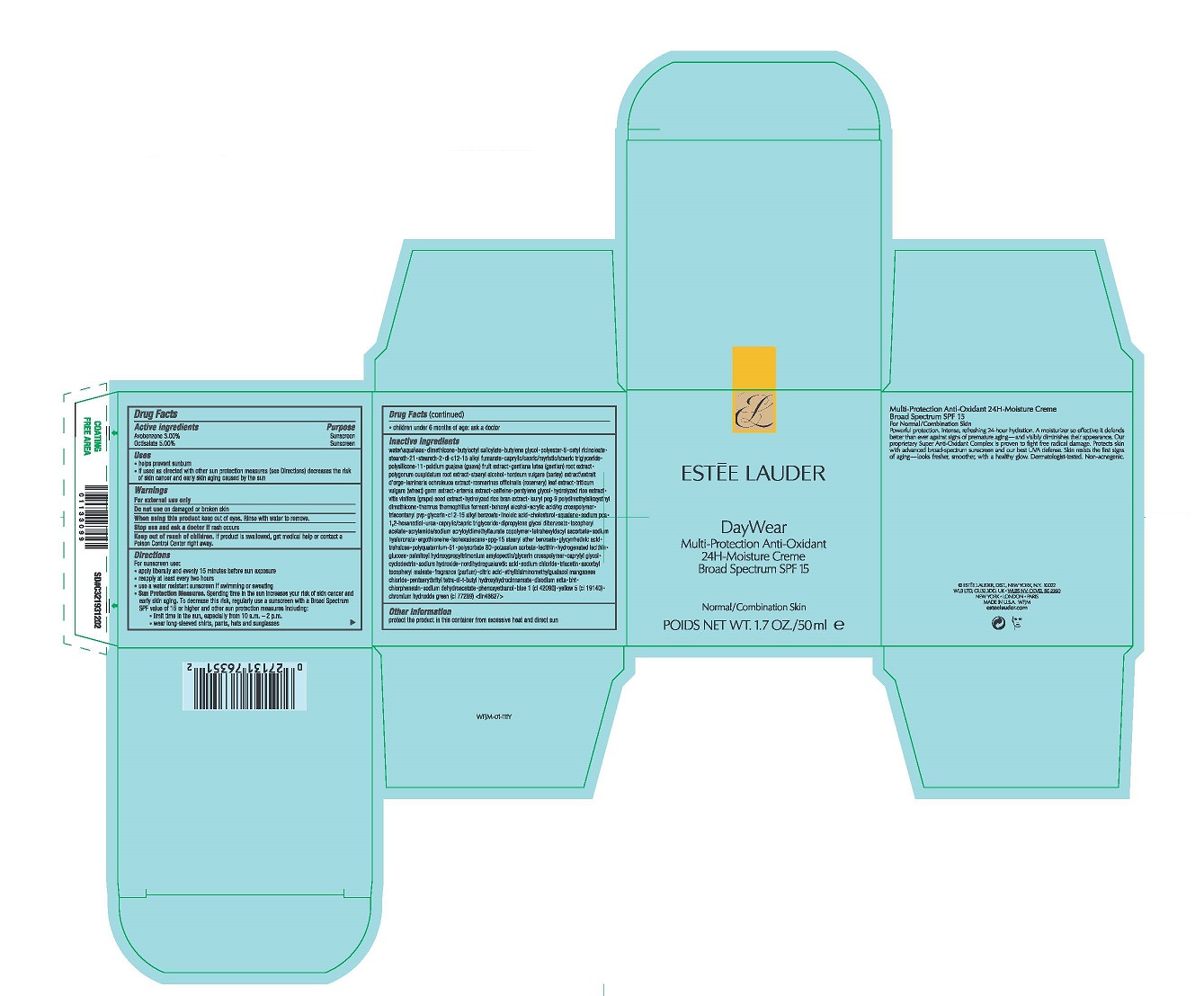
DAYWEAR MULTI-PROTECTION ANTII-OXIDANT 24H-MOISTURE CREME BROAD SPECTRUM SPF 15 NORMAL/COMBINATION SKIN AVOBENZONE and OCTISALATE 30 mg/mL; 50 mg/mL Cream — NDC 11559-049-01 (Billing 11559-0049-01)
This is a package of DAYWEAR MULTI-PROTECTION ANTII-OXIDANT 24H-MOISTURE CREME BROAD SPECTRUM SPF 15 NORMAL/COMBINATION SKIN AVOBENZONE and OCTISALATE 30 mg/mL; 50 mg/mL Cream from ESTEE LAUDER INC, no longer marketed (first marketed Dec 2017), no longer in the FDA NDC Directory. It is the main listing for this product, which comes in 4 package sizes.
NDC database record
One package, one record: these facts belong to NDC 11559-049-01 alone.
- Record
- FDA NDC Directory package listing · Human OTC drug
- Code segments
- 11559 labeler · 049 product · 01 package
- Package marketed since
- Dec 1, 2017
- Sample package
- No — commercial package
- Listing certified through
- Dec 31, 2026
- Barcode (UPC-A, from the NDC)
- 3 1155904901 4
- FDA record last changed
- Jul 24, 2026
Identity & classification
Regulatory identifiers FDA, NLM and CMS codes for this package
Where does this data come from?
- FDA openFDA NDC Directory · synced Oct 1, 2026
- FDA label on DailyMed · label index refreshed Oct 6, 2026
- RxNorm (NLM RxNav) · catalog refreshed Oct 1, 2026
- Medi-Span GPI (licensed)
- First Databank (licensed) · refreshed Oct 1, 2026
Clinical
This is an over-the-counter monograph sunscreen cream for topical application to the face, formulated for normal to combination skin. It contains two UV filter ingredients, avobenzone and octisalate, which are commonly used together in sunscreens to help protect skin from ultraviolet rays and are labeled with a broad spectrum SPF 15 rating. The product is also marketed as a moisturizer with antioxidant ingredients intended for daytime facial care. As an OTC monograph product, it is manufactured according to FDA category rules rather than as an individually approved application.
Patient education
Supplement & herbal interactions
Where does this data come from?
- MedlinePlus (NLM) · refreshed Oct 1, 2026
- FDA label on DailyMed · label index refreshed Oct 6, 2026
Ask a licensed pharmacist directly — free, answered by our team.
Pricing
A drug doesn't have one price. Each row is a different public payment system, and none is what you'd pay at the counter — that depends on your insurance. The ⓘ on each row explains what it measures.
| Price system | Per g | Per package |
|---|---|---|
| Retail pharmacies payNADAC · weekly | Not in the retail survey — common for institutional, discontinued, or low-volume packs. | |
| Medicaid paysCMS SDUD · 12 mo | No recent Medicaid claims on file for this NDC — rare and low-volume NDCs are suppressed in the public data. | |
| Medicare drug plans payPart D · quarterly | No Part D plan price is available for this NDC in our data. | |
Where does this data come from?
- CMS NADAC weekly file
- CMS ASP pricing files · refreshed Sep 20, 2026
- CMS Medicaid State Drug Utilization Data · refreshed Oct 6, 2026
- CMS Part D plan pricing files · refreshed Sep 24, 2026
- VA National Acquisition Center price file
Packaging — all sizes for this product
| Package NDC | Description | Marketing start | Marketing end | Status |
|---|---|---|---|---|
| 11559-0049-01 You're viewing this Main listing | 1 JAR in 1 CARTON / 50 mL in 1 JAR | 2017-12-01 | — | Inactivated by FDA |
| 11559-0049-02 11559-049-02 | 1 JAR in 1 CARTON / 15 mL in 1 JAR | 2022-12-01 | — | Inactivated by FDA |
| 11559-0049-03 11559-049-03 | 30 mL in 1 JAR | 2022-12-01 | — | Inactivated by FDA |
| 11559-0049-04 11559-049-04 | 7 mL in 1 JAR | 2022-12-01 | — | Inactivated by FDA |
Pack size FAQ
What quantity is in this package?
What NDC number is used to bill for this package of DAYWEAR MULTI-PROTECTION ANTII-OXIDANT 24H-MOISTURE CREME BROAD SPECTRUM SPF 15 NORMAL/COMBINATION SKIN AVOBENZONE and OCTISALATE 30 mg/mL; 50 mg/mL Cream?
Therapeutic equivalents
| Product | Labeler | Pack | NADAC/unit | TE | Status | Price vs. this |
|---|---|---|---|---|---|---|
| Clinique Smart Custom Repair Moisturizer Broad Spectrum Spf 15 - Very Dry/Dry 30 mg/mL; 50 mg/mL 49527-0048-01 | CLINIQUE | 1 jar | — | — | FDA listed | — |
| Clinique Smart Custom Repair Moisturizer Broad Spectrum Spf 15 - Combination/Oily To Oily 30 mg/mL; 50 mg/mL 49527-0050-01 | CLINIQUE | 1 jar | — | — | FDA listed | — |
| CLINIQUE FOR MEN SUPER ENGERGIZER ANTI -FATIGUE HYDRATING Concentrate BROAD SPECTRUM SPF 25 30 mg/mL; 50 mg/mL 49527-0063-01 | CLINIQUE | 1 bottle | — | — | FDA listed | — |
| Clinique Smart Broad Spectrum Spf 15 Custom-Repair Moisturizer Dry Combination 30 mg/mL; 50 mg/mL 49527-0051-01 | CLINIQUE | 1 jar | — | — | Discontinued | — |
| Daywear Multi-Protection Antii-Oxidant 24H-Moisture Creme Broad Spectrum Spf 15 Normal/Combination Skin 30 mg/mL; 50 mg/mLthis 11559-0049-01 | ESTEE | 1 jar | — | — | Discontinued | — |
Where does this data come from?
- FDA openFDA NDC Directory · synced Oct 1, 2026
- FDA Orange Book · refreshed Oct 3, 2026
- CMS NADAC weekly file
Availability & generic status
We did not find an FDA-approved generic match for this exact strength, form and route.
Where does this data come from?
- FDA Orange Book · refreshed Oct 3, 2026
Inactive Ingredients / Excipients
Inactive ingredients, also called excipients, are components of the drug product other than the active ingredient. They may include fillers, dyes, coatings, preservatives, flavors, or other formulation ingredients.
💡 Tap an ingredient (hover on desktop) to see what it is and why it’s used.
-
UNII 9E8X80D2L0
A synthetic form of vitamin E used as an antioxidant and preservative in medications. It helps prevent the active ingredients from degrading when exposed to oxygen or light.
-
UNII H1HJ8WR7WG
A modified sugar molecule that acts as a solubilizer and stabilizer. It helps dissolve poorly water-soluble drugs and protects active ingredients from degradation in the formulation.
-
UNII TR046Y3K1G
A liquid alcohol derived from petroleum or plant sources. It acts as a solvent and humectant in medicines, helping dissolve active ingredients and retain moisture in the formulation.
-
UNII 20R035KLCI
A synthetic polymer used as a thickener and gelling agent. In medicines, it helps create the proper texture and consistency of gels, creams, or solutions, and may help control how quickly the active ingredient is released.
-
UNII J94PBK7X8S
A synthetic polymer derived from acrylic acid monomers. In medicines, it's used as a binder to hold tablet ingredients together and sometimes as a coating agent to control where and how the drug releases in the body.
-
UNII A9EJ3J61HQ
A synthetic liquid derived from benzoic acid and long-chain alcohols. It functions as a solvent and penetration enhancer in topical formulations, helping active ingredients dissolve and absorb into the skin.
-
UNII D2G6259XR5
A synthetic antioxidant compound made from vitamin E and vitamin C derivatives. It prevents oils and fats in the medication from breaking down and becoming rancid, helping preserve the product's stability and shelf life.
-
UNII 5PWM7YLI7R
Barley is a grain plant. It may be used in some medicines as a filler or binder to add bulk and help hold the tablet or capsule together.
-
UNII 1P9D0Z171K
BHT is a synthetic antioxidant that prevents fats and oils in medicines from breaking down and becoming rancid. It helps keep the product stable and effective during storage.
-
UNII 3XUS85K0RA
Butylene glycol is a clear liquid derived from petroleum or plants that acts as a humectant, solvent, and preservative booster in medicines. It helps keep formulations stable, dissolve active ingredients, and maintain moisture in topical products.
-
UNII 2EH13UN8D3
A synthetic compound used as a solvent and penetration enhancer in topical formulations. It helps dissolve active ingredients and allows them to penetrate the skin more effectively.
-
UNII 3G6A5W338E
Caffeine is a natural stimulant compound commonly extracted from coffee beans and tea leaves. In medicines, it serves as an active booster in pain relievers and cold products to enhance alertness and improve the effectiveness of other ingredients.
-
UNII ZF29F7IK5I
A blend of plant-derived fats that helps dissolve and deliver active ingredients. It acts as a solvent and carrier in liquid or soft capsule formulations, improving how the body absorbs certain drugs.
-
UNII 00YIU5438U
Caprylyl glycol is a clear liquid derived from coconut oil. In medicines, it acts as a humectant to retain moisture, a preservative booster to prevent microbial growth, and a solvent to help dissolve or mix other ingredients.
-
UNII 1P677500YD
Cetyl ricinoleate is a waxy substance derived from castor oil. It works as an emollient and thickener in medications, helping to soften the product and improve its texture and stability.
-
UNII I670DAL4SZ
A preservative that fights bacteria and fungi. It keeps medicines and topical products stable and safe from microbial contamination during storage and use.
-
UNII 97C5T2UQ7J
Cholesterol is a fatty substance found naturally in animal tissues. In medications, it's used as an ingredient in liposomal formulations and lipid-based drug delivery systems to help encapsulate and stabilize active drugs for better absorption.
-
UNII RV8FT8XF5R
Chromium hydroxide green is a synthetic mineral colorant that gives medicines their green color. It's used in tablets, capsules, and coatings to help identify the drug and make it visually distinct.
-
UNII 2968PHW8QP
A weak organic acid derived from citrus fruits or made through fermentation. It works as a buffer to control pH, a preservative to extend shelf life, and a flavoring agent in medications.
-
UNII A1CB3Z898P
A synthetic oily compound made from plant-derived fatty acids and fumaric acid. It acts as a solubilizer and emulsifier to help dissolve and stabilize active ingredients in the medicine.
-
UNII 92RU3N3Y1O
Dimethicone is a silicone-based oil that acts as an anti-foaming agent and lubricant in medicines. It reduces gas bubbles in liquid formulations and helps coat and protect the stomach lining when ingested.
-
UNII 6OA5ZDY41O
A synthetic oily liquid made by combining propylene glycol with benzoic acid. It works as a plasticizer and solvent in medicines, helping to soften coatings, improve texture, and keep ingredients blended together in liquid or semi-solid formulations.
-
UNII 9G1OE216XY
Docosanol is a waxy, fatty alcohol derived from plant sources. It acts as an emollient and thickener in topical medicines, helping to soften the skin and improve product texture and stability.
-
UNII 8NLQ36F6MM
Edetate disodium anhydrous is a chemical compound that binds to metal ions in a medicine. It's used as a stabilizer to prevent unwanted chemical reactions and help keep the drug product effective during storage.
-
UNII P540XA09DR
Enoxolone is a naturally derived compound from licorice root that acts as a skin-soothing and anti-inflammatory agent. In medicines, it helps reduce irritation and supports the healing of mucous membranes or damaged skin.
-
UNII BDZ3DQM98W
Ergothioneine is a naturally occurring compound found in mushrooms and some bacteria. It's used in medicines as an antioxidant to help protect the product from degradation during storage.
-
UNII SM5YJ88LTU
A manganese-based compound that acts as an antioxidant in medications. It helps prevent ingredient breakdown and degradation during storage, keeping the medicine stable and effective over time.
-
UNII H3R47K3TBD
FD&C Blue No. 1 is a synthetic blue dye approved for use in foods and medicines. It serves as a colorant to give the medication its distinctive appearance and help with product identification.
-
UNII I753WB2F1M
FD&C Yellow No. 5 is a synthetic yellow colorant approved by the FDA. It is added to medicines to make pills, tablets, or liquids visually distinct and easier to identify.
-
UNII VH659J61ZL
A plant extract from fumaria officinalis (also called fumewort), used as a natural flavoring or coloring agent in some medicines to improve taste or appearance.
-
UNII S72O3284MS
A plant extract from the gentian root used as a flavoring agent and bitter taste component in some medicines. It helps mask unpleasant tastes and may support digestive formulations.
-
UNII DRX17R6AM2
A sugar compound derived from glucose that acts as a buffer and pH regulator in medications. It helps stabilize the medicine's acidity level and maintain consistent formulation conditions during storage and use.
-
UNII PDC6A3C0OX
Glycerin is a clear, thick liquid derived from plant oils or fats. It acts as a humectant to retain moisture, a sweetener, and a solvent in medications.
-
UNII 74O70D6VG0
Guava is a tropical fruit used as a flavoring agent and natural coloring source in medications. It adds fruity taste and may provide a mild sweetening effect to make medicines more palatable.
-
UNII YSE9PPT4TH
Hyaluronate sodium is a natural carbohydrate that holds moisture. It's used in medicines as a lubricant, thickener, and moisture-retaining agent to improve texture and delivery of the active ingredient.
-
UNII H1109Z9J4N
A natural emulsifier derived from soybean oil. It helps mix oil and water-based ingredients together, ensuring even distribution of active ingredients throughout the medicine.
-
UNII 918X1OUF1E
Isohexadecane is a synthetic hydrocarbon oil used as an emollient and solvent in topical medicines. It helps dissolve active ingredients and improves spreadability and absorption through the skin.
-
UNII 4R2124HE76
A brown seaweed extract used as a thickener and stabilizer in liquid formulations. It helps maintain consistent texture and prevents separation of ingredients in medicines.
-
UNII 25G622K2RA
A silicone-based surfactant that helps blend oil and water in cosmetic or topical formulations. It reduces surface tension to improve product spreadability and texture.
-
UNII 1DI56QDM62
A natural fatty substance from soybeans that helps mix oil and water-based ingredients together. It acts as an emulsifier and lubricant in medicines to improve texture and help the product break down properly in your body.
-
UNII 9KJL21T0QJ
Linoleic acid is an omega-6 fatty acid derived from plant oils. It serves as an emulsifier and skin conditioning agent in topical formulations, helping ingredients mix smoothly and improving product texture.
-
UNII C9H2L21V7U
A fat derived from coconut or palm oil containing shorter fatty acid chains. It serves as a solvent and carrier to help dissolve or suspend active ingredients, improving absorption and stability in liquid formulations.
-
UNII 7PZ73W4ZNR
A plant-derived antioxidant compound used to prevent fats and oils in medicines from breaking down and becoming rancid. It helps extend the shelf life and stability of drug products.
-
UNII 255PIF62MS
A synthetic antioxidant compound used to prevent oils and fats in medications from breaking down or becoming rancid during storage. It helps maintain the medicine's stability and shelf life.
-
UNII 50C1307PZG
Pentylene glycol is a humectant and preservative helper derived from petroleum or plant sources. It draws moisture into the product and helps prevent bacterial growth, keeping medicines stable during storage.
-
UNII HIE492ZZ3T
Phenoxyethanol is a synthetic preservative and antimicrobial agent used to prevent bacterial and fungal growth in medicines and cosmetic products, extending shelf life and maintaining product safety.
-
UNII T9296U138P
A synthetic polymer derived from polyester chemistry, modified with a cyanodiphenylpropenoyl cap. It serves as a film-former and binder in pharmaceutical formulations, helping create protective coatings on tablets or improving product consistency.
-
UNII EL9825H96J
Polyquaternium-51 is a synthetic polymer used in topical medicines and cosmetics. It acts as a film-former and conditioning agent, helping the product coat and adhere to skin or mucous membranes.
-
UNII 6OZP39ZG8H
Polysorbate 80 is a synthetic emulsifier derived from sorbitol and oleic acid. It helps mix oil and water-based ingredients together in medications and improves how the product disperses in the body.
-
UNII 1VPU26JZZ4
Potassium sorbate is a salt derived from sorbic acid, a naturally occurring preservative. It prevents growth of mold, yeast, and some bacteria, extending the medicine's shelf life.
-
UNII 80D2J6361M
A synthetic oily compound made from propylene glycol, stearyl alcohol, and benzoic acid. It acts as an emulsifier and solvent in formulations, helping mix oil and water-based ingredients and improve product texture.
-
UNII 7TRV45YZF7
A plant extract from Japanese knotweed root used as a natural ingredient. It functions as an antioxidant and preservative to help maintain product stability and shelf life.
-
UNII R60QEP13IC
Rice bran is a natural powder made from the outer layer of rice grains. It's used in medicines as a filler and flow agent to add bulk and help the product mix and flow smoothly during manufacturing.
-
UNII 7N2B70SFEZ
Rice germ is the nutrient-rich inner layer of the rice grain. It's used in medicines as a filler and bulking agent to add volume and help bind ingredients together in tablets and capsules.
-
UNII IJ67X351P9
A natural plant extract from rosemary leaves used as a preservative to help prevent oils and fats in the medicine from spoiling or becoming rancid during storage.
-
UNII 451W47IQ8X
Sodium chloride is common table salt. It's used in medicines as a buffer to maintain proper pH, as a filler to add bulk, or to adjust the osmotic balance in liquid formulations.
-
UNII 8W46YN971G
Sodium dehydroacetate is a salt derived from dehydroacetic acid, a compound used as a preservative. It helps prevent mold, bacteria, and yeast growth in medicines, extending shelf life and maintaining product safety.
-
UNII 55X04QC32I
A strong alkaline chemical used to adjust and maintain the pH balance of liquid medicines. It helps keep the medicine stable and ensures it stays effective during storage.
-
UNII 469OTG57A2
Sodium pyrrolidone carboxylate is a synthetic polymer derived from pyrrolidone chemistry. It functions as a solubilizer and binder in medications, helping dissolve poorly water-soluble drugs and hold tablet ingredients together.
-
UNII GW89575KF9
Squalane is a lightweight oil derived from plant sources or synthesized. It acts as an emollient and lubricant in formulations, helping ingredients blend smoothly and improving product texture and spreadability.
-
UNII V56DFE46J5
Steareth-2 is a synthetic emulsifier made from stearic acid and ethylene oxide. It helps mix oil and water-based ingredients together in the formulation and may improve how the medicine spreads or dissolves.
-
UNII 53J3F32P58
A synthetic detergent derived from stearic acid, a fatty substance. It helps dissolve or distribute oil-based ingredients evenly throughout the medicine, acting as an emulsifier and solubilizer in tablets and capsules.
-
UNII 2KR89I4H1Y
Stearyl alcohol is a waxy, fatty substance derived from natural oils or made synthetically. It acts as an emulsifier and thickener in medicines, helping mix ingredients together and give the product the right texture.
-
UNII 9LBV3F07AZ
A synthetic, oil-soluble form of vitamin C used as an antioxidant to prevent degradation of the medicine and maintain its stability during storage.
-
UNII 775R692494
A liquid extract from heat-loving bacteria that helps support the immune system's natural defenses. It acts as an active ingredient enhancer in topical formulations, helping the product work more effectively on skin.
-
UNII B8WCK70T7I
Trehalose is a natural sugar made from two glucose molecules linked together. It's used in medicines as a filler to add bulk, a sweetener for taste, and a stabilizer to help keep active ingredients effective during storage.
-
UNII XHX3C3X673
Triacetin is a clear, oily liquid made from glycerin and acetic acid. It works as a plasticizer and solvent in medicines, helping soften coatings and improve how liquids mix together in formulations.
-
UNII N0SS3Q238D
A synthetic polymer made by combining povidone with long-chain fatty compounds. It acts as a binder and film-former to help hold tablet ingredients together and create smooth coatings on medicine surfaces.
-
UNII 587WKM3S9Q
A synthetic polymer made from trimethylpentanediol, adipic acid, and glycerin. It acts as a thickener and stabilizer in formulations, helping maintain consistent texture and prevent ingredient separation.
-
UNII 8W8T17847W
A nitrogen-containing chemical compound used in pharmaceuticals as a humectant to retain moisture, and sometimes as a keratolytic agent in topical formulations to help soften and remove dead skin cells.
-
UNII C34U15ICXA
A plant extract from grape seeds that acts as an antioxidant and preservative in medications. It helps protect the active ingredients from degrading and extends the product's shelf life.
-
UNII 059QF0KO0R
Water is a liquid solvent that dissolves and mixes ingredients together in liquid medicines, syrups, and injections. It helps distribute the active drug evenly throughout the product.
-
UNII YR3G369F5A
Wheat germ is the nutrient-rich central part of the wheat kernel. It's used in medications as a natural filler and source of vitamins and oils that can help bind and preserve the product.
73 inactive ingredients listed in the exact product block matched to this NDC.
Label-section wording can be broader than the structured product block and may mention additional formulation ingredients.
Where does this data come from?
ingredient classCode="IACT" elements from the exact product block matched by this NDC. Label-section narrative from DailyMed / the openFDA label index is shown separately when available.- FDA label on DailyMed · label index refreshed Oct 6, 2026
- FDA openFDA NDC Directory · synced Oct 1, 2026
Inactive ingredient FAQ
Are inactive ingredients the same for every manufacturer?
Why might an inactive ingredient be missing?
Can inactive ingredients matter?
Manufacturer & labeler
More NDCs from ESTEE LAUDER INC labeler code 11559
- YOUTH DEW ROLL-ON ANTIPERSPIRANT DEODORANT ALUMINUM CHLOROHYDRATE 200 mg/mL Liquid NDC 11559-001-01
- DOUBLE WEAR MAXIMUM COVER CAMOUFLAGE MAKEUP FOR FACE AND BODY BROAD SPECTRUM SPF 15 titanium dioxide 14 mg/mL Cream NDC 11559-030-01
- PERFECTIONIST PRO MULTI-DEFENSE UV FLUID BROAD SPRECTRUM SPF 45 TITANIUM DIOXIDE and ZINC OXIDE 63 mg/mL; 40 mg/mL Lotion NDC 11559-050-01
- RESILIENCE MULTI-EFFECT TRI-PEPTIDE FACE AND NECK CREME BROAD SPECTRUM SPF 15 AVOBENZONE, OCTISALATE, and OCTOCRYLENE 30 mg/mL; 45 mg/mL; 27 mg/mL Cream NDC 11559-052-01
- RESILIENCE MULTI-EFFECT TRI-PEPTIDE FACE AND NECK CREME BROAD SPECTRUM SPF 15 dry skin AVOBENZONE, OCTISALATE, and OCTOCRYLENE .03 g/mL; .045 g/mL; .027 g/mL Cream NDC 11559-053-01
- DAYWEAR ANTI OXIDANT 72H-HYDRATION SORBET CREME BROAD SPECTRUM SPF 15 AVOBENZONE, HOMOSALATE, OCTISALATE, and OCTOCRYLENE 20 mg/mL; 40 mg/mL; 45 mg/mL; 20 mg/mL Cream NDC 11559-055-01
- REVITALIZING SUPREME PLUS GLOBAL ANTI-AGING CELL POWER CREME BROAD SPECTRUM SPF 15 AVOBENZONE, OCTISALATE, and OCTOCRYLENE 30 mg/mL; 45 mg/mL; 50 mg/mL Cream NDC 11559-056-01
- RE-NUTRIV ULTRA RADIANCE MAKEUP BROAD SPECTRUM SPF 20 OCTINOXATE and TITANIUM DIOXIDE 22 mg/mL; 14 mg/mL Liquid NDC 11559-057-01
Where does this data come from?
- FDA openFDA NDC Directory · synced Oct 1, 2026
- Drugs@FDA
FDA label — Drug Facts FDA SPL
🎯 Indications and Usage ▾
Uses helps prevent sunburn if used as directed with other sun protection measures (see Directions ) decreases the risk of skin cancer and early skin aging caused by the sun
⏱️ Dosage and Administration ▾
Directions For sunscreen use: apply liberally and evenly 15 minutes before sun exposure reapply at least every two hours use a water resistant sunscreen if swimming or sweating Sun Protection Measures. Spending time in the sun increases your risk of skin cancer and early skin aging. To decrease this risk, regularly use a sunscreen with a Broad Spectrum SPF value of 15 or higher and other sun protection measures including: limit time in the sun, especially from 10 a.m. – 2 p.m. wear long-sleeved shirts, pants, hats and sunglasses children under 6 months of age: ask a doctor
⚠️ Warnings ▾
Warnings For external use only Do not use on damaged or broken skin When using this product keep out of eyes. Rinse with water to remove. Stop use and ask a doctor if rash occurs Keep out of reach of children. If product is swallowed, get medical help or contact a Poison Control Center right away.
📦 Storage and Handling ▾
Other information protect the product in this container from excessive heat and direct sun
🧪 Active Ingredient ▾
Active ingredients Purpose Avobenzone 3.00% Sunscreen Octisalate 5.00% Sunscreen
🧪 Inactive Ingredients ▾
Inactive ingredients water\aqua\eau • dimethicone • butyloctyl salicylate • butylene glycol • polyester-8 • cetyl ricinoleate • steareth-21 • steareth-2 • di-c12-15 alkyl fumarate • caprylic/capric/myristic/stearic triglyceride • polysilicone-11 • psidium guajava (guava) fruit extract • gentiana lutea (gentian) root extract • polygonum cuspidatum root extract • stearyl alcohol • hordeum vulgare (barley) extract\extrait d'orge • laminaria ochroleuca extract • rosmarinus officinalis (rosemary) leaf extract • triticum vulgare (wheat) germ extract • artemia extract • caffeine • pentylene glycol • hydrolyzed rice extract • vitis vinifera (grape) seed extract • hydrolyzed rice bran extract • lauryl peg-9 polydimethylsiloxyethyl dimethicone • thermus thermophillus ferment • behenyl alcohol • acrylic acid/vp crosspolymer • triacontanyl pvp • glycerin • c12-15 alkyl benzoate • linoleic acid • cholesterol • squalane • sodium pca • 1,2-hexanediol • urea • caprylic/capric triglyceride • dipropylene glycol dibenzoate • tocopheryl acetate • acrylamide/sodium acryloyldimethyltaurate copolymer • tetrahexyldecyl ascorbate • sodium hyaluronate • ergothioneine • isohexadecane • ppg-15 stearyl ether benzoate • glycyrrhetinic acid • trehalose • polyquaternium-51 • polysorbate 80 • potassium sorbate • lecithin • hydrogenated lecithin • glucose • palmitoyl hydroxypropyltrimonium amylopectin/glycerin crosspolymer • caprylyl glycol • cyclodextrin • sodium hydroxide • nordihydroguaiaretic acid • sodium chloride • triacetin • ascorbyl tocopheryl maleate • fragrance (parfum) • citric acid • ethylbisiminomethylguaiacol manganese chloride • pentaerythrityl tetra-di-t-butyl hydroxyhydrocinnamate • disodium edta • bht • chlorphenesin • sodium dehydroacetate • phenoxyethanol • blue 1 (ci 42090) • yellow 5 (ci 19140) • chromium hydroxide green (ci 77289) <iln48627>
🎯 Purpose ▾
Active ingredients Purpose Avobenzone 3.00% Sunscreen Octisalate 5.00% Sunscreen
📄 Do Not Use ▾
Do not use on damaged or broken skin
📄 When Using This Product ▾
When using this product keep out of eyes. Rinse with water to remove.
📄 Stop Use and Ask a Doctor If ▾
Stop use and ask a doctor if rash occurs
📄 Keep Out of Reach of Children ▾
Keep out of reach of children. If product is swallowed, get medical help or contact a Poison Control Center right away.
📄 Package Label / Principal Display Panel ▾
PRINCIPAL DISPLAY PANEL - 50 ml Jar Carton ESTĒE LAUDER DayWear Multi-Protection Anti-Oxidant 24H-Moisture Creme Broad Spectrum SPF 15 NORMAL/COMBINATION SKIN POIDS NET WT.
1.7OZ. / 50 ml e Principal Display Panel
About this NDC listing & data coverage
What data is (and isn’t) available for this NDC — tap to expand
| NDC identity (package / product / labeler codes) | ✓ Available |
| Labeler | ✓ Available |
| Product & package description | ✓ Available |
| Marketing category & status | ✓ Available |
| Active ingredient / dosage form / route | ✓ Available |
| FDA label (SPL via DailyMed) | ✓ Available |
| Package photos | ✓ Available |
| Inactive ingredients (structured) | ✓ Available |
| NADAC pharmacy acquisition price (CMS) | — Not published for this NDC CMS publishes NADAC only for NDCs reported in its retail-pharmacy survey. |
| Orange Book / therapeutic-equivalence data | — Not published for this NDC Applies only to products approved under an NDA/ANDA; many listings are out of scope. |
| HCPCS J-code billing crosswalk | — Not published for this NDC Most self-administered / retail products have no J-code — that is normal. |
| Medicaid utilization (CMS SDUD) | — Not published for this NDC CMS reports utilization only for NDCs with Medicaid claims above its privacy threshold. |