
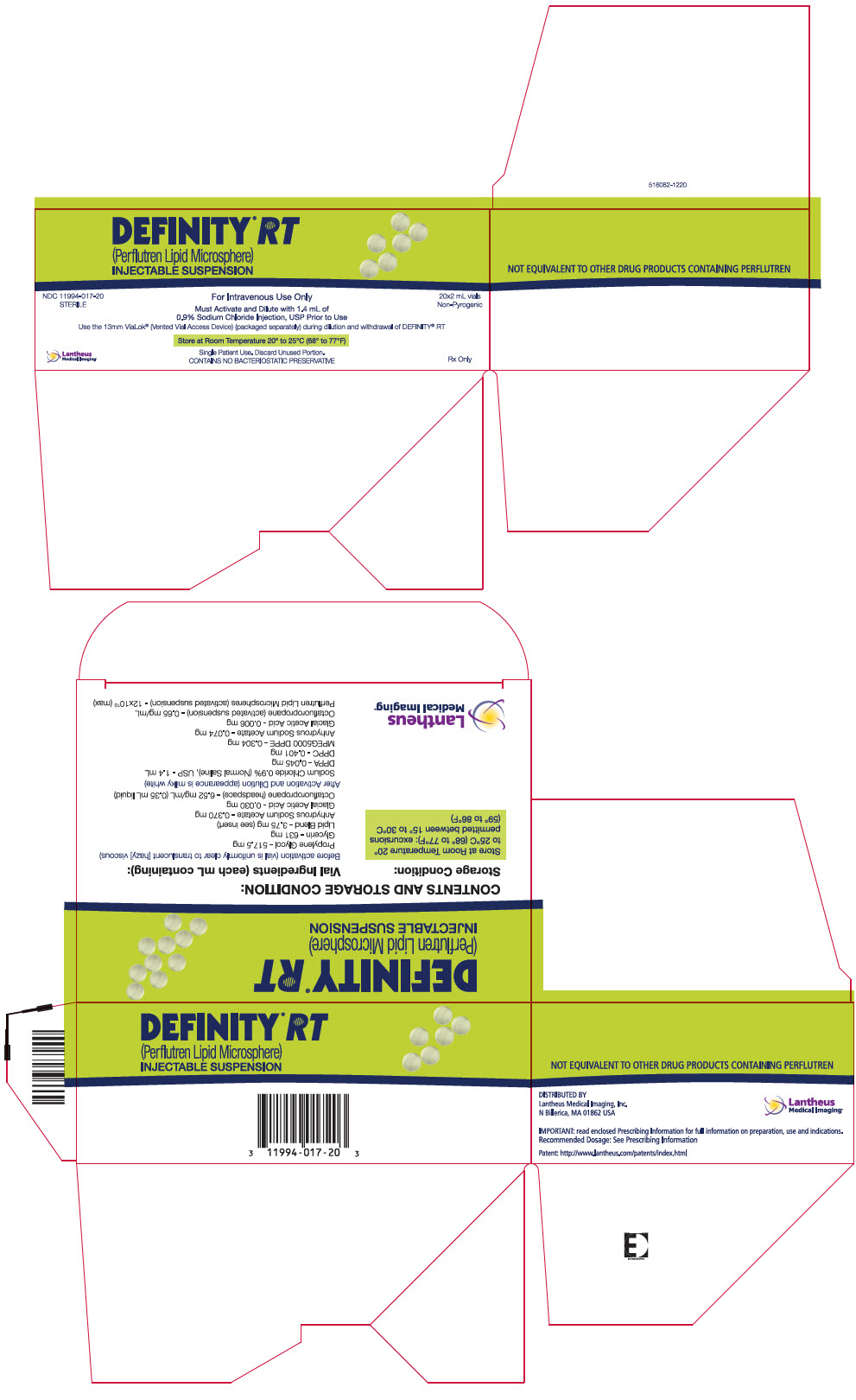
DEFINITY RT perflutren 6.52 mg/mL Injection, Suspension, 20 vials — NDC 11994-017-20 (Billing 11994-0017-20)
This is a package of 20 vials of DEFINITY RT perflutren 6.52 mg/mL Injection, Suspension from Lantheus Medical Imaging, Inc., marketed since Oct 2020 and currently FDA-listed. It is the main listing for this product, which comes in 2 package sizes.
NDC database record
One package, one record: these facts belong to NDC 11994-017-20 alone.
- Record
- FDA NDC Directory package listing · Human prescription drug
- Code segments
- 11994 labeler · 017 product · 20 package
- Package marketed since
- Oct 1, 2020
- Sample package
- No — commercial package
- Listing certified through
- Dec 31, 2026
- Barcode (UPC-A, from the NDC)
- 3 1199401720 3
- Medicaid fills, this package
- 20 prescriptions in the last four reported quarters
- FDA record last changed
- Jul 24, 2026
Identity & classification
Regulatory identifiers FDA, NLM and CMS codes for this package
Drug-database identifiers Medi-Span GPI and First Databank GCN / HICL / AHFS classification
- GSN (GCN sequence number): 082274
- GCN: 49633
- GPI-14 (Medi-Span): 94500075301820
- HICL (First Databank): 022868
- AHFS class code: 36:00.00.00
Where does this data come from?
- FDA openFDA NDC Directory · synced Oct 1, 2026
- FDA label on DailyMed · label index refreshed Oct 1, 2026
- RxNorm (NLM RxNav) · catalog refreshed Oct 1, 2026
- Medi-Span GPI (licensed)
- First Databank (licensed) · refreshed Oct 1, 2026
Clinical
Patient education
Supplement & herbal interactions
Where does this data come from?
- MedlinePlus (NLM) · refreshed Oct 1, 2026
- FDA label on DailyMed · label index refreshed Oct 1, 2026
Ask a licensed pharmacist directly — free, answered by our team.
Pricing
A drug doesn't have one price. Each row is a different public payment system, and none is what you'd pay at the counter — that depends on your insurance. The ⓘ on each row explains what it measures.
| Price system | Per mL | Per package |
|---|---|---|
| Retail pharmacies payNADAC · weekly | Not in the retail survey — common for institutional, discontinued, or low-volume packs. | |
| Medicaid paysCMS SDUD · 12 mo | No recent Medicaid claims on file for this NDC — rare and low-volume NDCs are suppressed in the public data. | |
| Medicare drug plans payPart D · quarterly | No Part D plan price is available for this NDC in our data. | |
| Medicare Part B allowsASP · Q9957 | $40.854 / Q9957 unit | — |
Where does this data come from?
- CMS NADAC weekly file
- CMS ASP pricing files · refreshed Sep 20, 2026
- CMS Medicaid State Drug Utilization Data · through Q1 2026
- CMS Part D plan pricing files · refreshed Sep 24, 2026
- VA National Acquisition Center price file
Billing & reimbursement
Where does this data come from?
- CMS ASP NDC-HCPCS crosswalk · refreshed Sep 22, 2026
- DMEPDAC NDC-HCPCS crosswalk
- openFDA NSDE billing units · refreshed Sep 7, 2026
Packaging — all sizes for this product
| Package NDC | Description | Marketing start | Marketing end | Status |
|---|---|---|---|---|
| 11994-0017-01 11994-017-01 | 1 VIAL, GLASS in 1 CARTON / .35 mL in 1 VIAL, GLASS | 2020-10-01 | — | Active |
| 11994-0017-20 You're viewing this Main listing | 20 VIAL, GLASS in 1 CARTON / .35 mL in 1 VIAL, GLASS | 2020-10-01 | — | Active |
Pack size FAQ
What quantity is in this package?
How does this package differ from NDC 11994-0017-01?
What NDC number is used to bill for this package of DEFINITY RT perflutren 6.52 mg/mL Injection, Suspension?
Therapeutic equivalents
| Product | Labeler | Pack | NADAC/unit | TE | Status | Price vs. this |
|---|---|---|---|---|---|---|
| Definity Rt 6.52 mg/mLthis 11994-0017-20 | Lantheus | 20 vials | — | — | FDA listed | — |
| Definity 6.52 mg/mL 11994-0011-01 | Lantheus | 1 vial | — | — | FDA listed | — |
Where does this data come from?
- FDA openFDA NDC Directory · synced Oct 1, 2026
- FDA Orange Book · refreshed Oct 3, 2026
- CMS NADAC weekly file
Availability & generic status
We did not find an FDA-approved generic match for this exact strength, form and route. Patent/protection dates below may affect future generic timing.
Why the date isn’t exact: Generic timing can change because patents may be challenged, settled, licensed, added, removed, or worked around with a narrower label — and FDA approval does not always mean a pharmacy can get the generic today.
🛈 What do these terms mean?
- Patent
- Legal protection listed in the Orange Book that may delay generic approval or launch. Issued by the U.S. Patent & Trademark Office.
- Substance patent
- Covers the active drug molecule itself — the hardest to design around. A generic generally can’t launch until it expires.
- Formulation (product) patent
- Covers a specific formulation or dosage form. A generic can sometimes work around it with a different formulation.
- Method-of-use patent
- A patent covering one specific approved use of the drug — not necessarily the whole molecule. A generic can sometimes launch with a “skinny label” that carves out the protected use and keeps the others.
- Skinny label
- A generic label that omits a still-patented use when the FDA allows it — letting a generic reach the market for the unprotected uses.
- Exclusivity
- FDA-granted marketing protection, separate from patents — e.g. 5-yr new chemical entity, 7-yr orphan drug, or a +6-month pediatric extension.
- Paragraph IV
- A generic applicant’s formal challenge to a listed patent. It can potentially lead to earlier generic entry, but often involves litigation or a settlement.
- RLD / RS
- Reference Listed Drug — the brand product the FDA uses as the reference for generic applications. Reference Standard — the product the FDA expects generics to compare against in bioequivalence testing.
- TE / AB rating
- FDA therapeutic-equivalence rating. An AB rating generally means the FDA considers a generic therapeutically equivalent to — and substitutable for — the brand.
- LOE (loss of exclusivity)
- The latest patent or exclusivity currently listed — the loss-of-exclusivity / latest-listed-protection date shown on this page. Paragraph-IV challenges and settlements can move the real date earlier; FDA approval and a manufacturer’s decision to market can move it later.
Built from the FDA Orange Book. The bars above are scaled to each protection’s expiry; the red LOE marker is the last one to lapse.
| Patent | Type | Use code | Expires |
|---|---|---|---|
| US 9789210 ↗ | Method of use | U-665 | Mar 16, 2037 |
| US 10588988 ↗ | Method of use | U-665 | May 4, 2037 |
| US 10583208 ↗ | Method of use | U-665 | Mar 16, 2037 |
| US 10588988 ↗ | Method of use | U-665 | May 4, 2037 |
| US 9789210 ↗ | Method of use | U-665 | Mar 16, 2037 |
| US 10583207 ↗ | Method of use | U-665 | Dec 28, 2035 |
| US 10583207 ↗ | Method of use | U-665 | Dec 28, 2035 |
| US 10583208 ↗ | Method of use | U-665 | Mar 16, 2037 |
| US 11925695 ↗ | Method of use | U-665 | Mar 16, 2037 |
| US 11925695 ↗ | Method of use | U-665 | Mar 16, 2037 |
| US 11529431 ↗ | Method of use | U-665 | Mar 16, 2037 |
| US 11529431 ↗ | Method of use | U-665 | Mar 16, 2037 |
| US 11395856 ↗ | Drug substance | U-665 | Dec 28, 2035 |
| US 11857646 ↗ | Method of use | U-665 | Mar 16, 2037 |
| US 11857646 ↗ | Method of use | U-665 | Mar 16, 2037 |
| US 11266750 ↗ | Method of use | U-665 | Mar 16, 2037 |
| US 11266750 ↗ | Method of use | U-665 | Mar 16, 2037 |
| US 12161730 ↗ | Method of use | U-665 | Mar 16, 2037 |
| US 12161730 ↗ | Method of use | U-665 | Mar 16, 2037 |
| US 10022460 ↗ | Drug substance | — | Dec 28, 2035 |
Is there a generic version of DEFINITY RT 0.65 MG/ML VIAL?
The FDA approved a generic — why can’t I get it at my pharmacy yet?
Why do different websites show different generic release dates?
What does “FDA listed” mean?
What does a patent or protection date mean here?
What does “current Orange Book estimate” mean?
Can a generic come out before the last patent expires?
Can a generic come out after the listed dates?
What is the difference between patents and exclusivity?
Why are there multiple patent dates?
Where does this data come from?
- FDA Orange Book · refreshed Oct 3, 2026
Inactive Ingredients / Excipients
Inactive ingredients, also called excipients, are components of the drug product other than the active ingredient. They may include fillers, dyes, coatings, preservatives, flavors, or other formulation ingredients.
💡 Tap an ingredient (hover on desktop) to see what it is and why it’s used.
-
0.03 mg / 1 mL
UNII Q40Q9N063P
Acetic acid is a weak organic acid commonly used in medicines as a buffer and pH adjuster. It helps maintain the proper acidity level to ensure the drug remains stable and effective in its formulation.
-
631 mg / 1 mL
UNII PDC6A3C0OX
Glycerin is a clear, thick liquid derived from plant oils or fats. It acts as a humectant to retain moisture, a sweetener, and a solvent in medications.
-
517.5 mg / 1 mL
UNII 6DC9Q167V3
Propylene glycol is a clear liquid derived from petroleum or vegetable sources. It acts as a solvent, humectant, and preservative in medicines, helping dissolve active ingredients and maintain product stability.
-
0.37 mg / 1 mL
UNII NVG71ZZ7P0
A salt derived from acetic acid, sodium acetate anhydrous is used in medicines as a buffer to help maintain stable pH levels and sometimes as a preservative or bulking agent in solid formulations.
4 inactive ingredients listed in the exact product block matched to this NDC.
Where does this data come from?
ingredient classCode="IACT" elements from the exact product block matched by this NDC. Label-section narrative from DailyMed / the openFDA label index is shown separately when available.- FDA label on DailyMed · label index refreshed Oct 1, 2026
- FDA openFDA NDC Directory · synced Oct 1, 2026
Inactive ingredient FAQ
Are inactive ingredients the same for every manufacturer?
Why might an inactive ingredient be missing?
Can inactive ingredients matter?
Manufacturer & labeler
More NDCs from Lantheus Medical Imaging, Inc. labeler code 11994
- Cardiolite TETRAKIS(2-METHOXYISOBUTYLISOCYANIDE)COPPER(I) TETRAFLUOROBORATE 1 mg/mL Injection, Powder, Lyophilized, For Solution NDC 11994-001-20
- Kit for the Preparation of Technetium Tc99m Sestamibi TETRAKIS(2-METHOXYISOBUTYLISOCYANIDE)COPPER(I) TETRAFLUOROBORATE 1 mg/mL Injection, Powder, Lyophilized, For Solution NDC 11994-003-20
- NEUROLITE Bicisate dihydrochloride Kit NDC 11994-006-02
- Definity perflutren 6.52 mg/mL Injection, Suspension NDC 11994-011-01
- TechneLite Technetium Tc99m Generator 250 mCi/mL Injection, Solution NDC 11994-090-01
- TechneLite Technetium Tc99m Generator 250 mCi/mL Injection, Solution NDC 11994-091-01
- Xenon 10 mCi Gas NDC 11994-127-11
- Xenon 20 mCi Gas NDC 11994-128-21
Where does this data come from?
- FDA openFDA NDC Directory · synced Oct 1, 2026
- Drugs@FDA
Full prescribing information FDA SPL
🚨 Boxed Warning ▾
WARNING: SERIOUS CARDIOPULMONARY REACTIONS Serious cardiopulmonary reactions, including fatalities, have occurred uncommonly during or following perflutren-containing microsphere administration. Most serious reactions occur within 30 minutes of administration. Assess all patients for the presence of any condition that precludes DEFINITY RT administration [see Contraindications (4) ] .
Always have resuscitation equipment and trained personnel readily available [see Warnings and Precautions (5.1) ] . WARNING: SERIOUS CARDIOPULMONARY REACTIONS Serious cardiopulmonary reactions, including fatalities, have occurred uncommonly during or following perflutren-containing microsphere administration. Most serious reactions occur within 30 minutes of administration.
Assess all patients for the presence of any condition that precludes DEFINITY RT administration ( 4 ). Always have resuscitation equipment and trained personnel readily available ( 5.1 ).
🎯 Indications and Usage ▾
1 INDICATIONS AND USAGE DEFINITY RT is indicated, after activation, for use in adult and pediatric patients with suboptimal echocardiograms to opacify the left ventricular chamber and to improve the delineation of the left ventricular endocardial border. DEFINITY RT is an ultrasound contrast agent indicated, after activation, for use in adult and pediatric patients with suboptimal echocardiograms to opacify the left ventricular chamber and to improve the delineation of the left ventricular endocardial border. ( 1 )
⏱️ Dosage and Administration ▾
2 DOSAGE AND ADMINISTRATION Adult Patients Bolus: 10 microL/kg intravenously over 30 seconds to 60 seconds followed by a 10 mL flush of 0.9% Sodium Chloride Injection. Infusion: 1.3 mL added to 50 mL of 0.9% Sodium Chloride Injection intravenously starting at 4 mL/minute, titrating as necessary, not to exceed 10 mL/minutes. The maximum dose is two bolus doses 30 minute apart or one single infusion.
( 2.2 ) Pediatric Patients Bolus: 3 microL/kg over 30 seconds to 60 seconds by intravenous bolus injection followed by a 5 mL flush of 0.9% Sodium Chloride Injection. The maximum dose is two bolus doses 30 minute apart. ( 2.3 ) See Full Prescribing Information for imaging instructions and preparation ( 2.4 , 2.5 ).
2.1Important Preparation and Administration Instructions There are two formulations, DEFINITY and DEFINITY RT, that have differences in preparation and storage. Ensure of the correct product when following the directions for preparation and storage. DEFINITY RT must be activated using the VIALMIX RFID device and diluted before administration according to the instructions outlined below [see Dosage and Administration (2.5) ] .
DEFINITY RT is for intravenous use only and must not be administered by intra-arterial injection [see Warnings and Precautions (5.3) ] . For adult patients, DEFINITY RT can be administered by either an intravenous bolus or infusion. The maximum dose is either two bolus doses or one single infusion.
Do not administer the bolus and infusion dosing in combination or in sequence [see Dosage and Administration (2.2) ] . For pediatric patients, DEFINITY RT is administered by an intravenous bolus injection only. The maximum dose is two bolus doses [see Dosage and Administration (2.3) ].
2.2Recommended Dosage in Adult Patients Bolus Dosing The recommended bolus dose in adult patients is 10 microL/kg of activated DEFINITY RT administered intravenously over 30 seconds to 60 seconds followed by a 10 mL flush of 0.9% Sodium Chloride Injection, USP. If necessary, administer a second 10 microL/kg dose followed by a second 10 mL flush of 0.9% Sodium Chloride Injection, USP 30 minutes after the first injection to prolong contrast enhancement. Infusion Dosing The recommended infusion dose in adult patients is 1.3 mL of activated DEFINITY RT added to 50 mL of preservative-free 0.9% Sodium Chloride Injection, USP administered intravenously.
Initiate infusion at 4 mL/minute, titrating the infusion rate as necessary to achieve optimal image enhancement, not to exceed 10 mL/minute.
2.3Recommended Dosage in Pediatric Patients Bolus Dosing The recommended bolus dose in pediatric patients is 3 microL/kg of activated DEFINITY RT administered intravenously over 30 seconds to 60 seconds followed by a 5 mL flush of 0.9% Sodium Chloride Injection, USP. If necessary, administer a second bolus at a dose of 3 microL/kg to 5 microL/kg, followed by a second 5 mL flush of 0.9% Sodium Chloride Injection, USP 30 minutes after the first injection to prolong contrast enhancement.
2.4Imaging Instructions Adult Patients After baseline non-contrast echocardiography is completed, set the mechanical index for the ultrasound device at 0.8 or below [see Warnings and Precautions (5.4) ] . Then inject activated DEFINITY RT (as described above) and begin ultrasound imaging immediately [see Clinical Pharmacology(12.2) . Evaluate the DEFINITY RT echocardiogram images in combination with the non-contrast echocardiogram images.
Pediatric Patients After baseline non-contrast echocardiography is completed, set the mechanical index for the ultrasound transducer at 0.3 or below [see Warnings and Precautions (5.4) ] . Then inject activated DEFINITY RT (as described above) and begin ultrasound imaging immediately [see Clinical Pharmacology(12.2) . Evaluate the DEFINITY RT echocardiogram images in combination with the non-contrast echocardiogram images.
2.5Instructions for Activation, Preparation, and Handling of Definity RT Adhere to strict aseptic proce… [Excerpted — this section continues on DailyMed.]
💊 Dosage Forms and Strengths ▾
3 DOSAGE FORMS AND STRENGTHS DEFINITY RT is supplied in a single-patient use vial containing 6.52 mg/mL perflutren in the headspace and 3.75 mg/mL of a lipid blend as a clear colorless to translucent viscous solution with 0.35 mL volume. After activation and dilution each mL contains a maximum of 1.2 × 10 10 perflutren lipid microspheres as a homogeneous milky white injectable suspension, and about 80 microL/mL (0.65 mg/mL) perflutren. DEFINITY RT: 6.52 mg/mL perflutren in the head space and 3.75 mg/mL of a lipid blend as viscous solution with 0.35 mL volume in a single-patient use vial; after activation and dilution, each mL contains a maximum of 1.2 × 10 10 perflutren lipid microspheres as injectable suspension.
( 3 )
⛔ Contraindications ▾
4 CONTRAINDICATIONS DEFINTY RT is contraindicated in patients with known or suspected hypersensitivity to Perflutren lipid microsphere or its components, such as polyethylene glycol (PEG) [see Warnings and Precautions (5.2) and Description (11) ]. Known or suspected hypersensitivity to perflutren lipid microsphere or its Components, such as polyethylene glycol (PEG) ( 4 )
⚠️ Warnings and Cautions ▾
5 WARNINGS AND PRECAUTIONS Hypersensitivity Reactions: Serious acute hypersensitivity reactions have occurred. Always have cardiopulmonary resuscitation personnel and equipment readily available prior to DEFINITY RT administration and monitor all patients for acute reactions. ( 5.2 ) Pain Episodes in Patients with Sickle Cell Disease: Discontinue DEFINITY RT for new or worsening pain. ( 5.5 )
5.1Serious Cardiopulmonary Reactions Serious cardiopulmonary reactions including fatalities have occurred uncommonly during or shortly following perflutren-containing microsphere administration, typically within 30 minutes of administration. The risk for these reactions may be increased among patients with unstable cardiopulmonary conditions (acute myocardial infarction, acute coronary artery syndromes, worsening or unstable congestive heart failure, or serious ventricular arrhythmias). Always have cardiopulmonary resuscitation personnel and equipment readily available prior to DEFINITY RT administration and monitor all patients for acute reactions.
The reported reactions include: fatal cardiac or respiratory arrest, shock, syncope, symptomatic arrhythmias (atrial fibrillation, tachycardia, bradycardia, supraventricular tachycardia, ventricular fibrillation, ventricular tachycardia), hypertension, hypotension, dyspnea, hypoxia, chest pain, respiratory distress, stridor, wheezing, loss of consciousness, and convulsions [see Adverse Reactions (6.2) ] .
5.2Hypersensitivity Reactions In postmarketing use, serious hypersensitivity reactions were observed during or shortly following perflutren-containing microsphere administration including: Anaphylaxis, with manifestations that may include death, shock, bronchospasm, throat tightness, angioedema, edema (pharyngeal, palatal, mouth, peripheral, localized), swelling (face, eye, lip, tongue, upper airway), facial hypoesthesia, rash, urticaria, pruritus, flushing, and erythema. These reactions have occurred in patients with no prior exposure to perflutren-containing microsphere products.
DEFINITY RT contains PEG. There may be increased risk of serious reactions including death in patients with prior hypersensitivity reaction(s) to PEG [see Adverse Reactions (6.2) and Description (11) ] . Clinically assess patients for prior hypersensitivity reactions to products containing PEG, such as certain colonoscopy bowel preparations and laxatives.
DEFINITY RT is contraindicated in patients with known or suspected hypersensitivity to perflutren lipid microsphere or its components such as PEG [see Contraindications (4) ]. Always have cardiopulmonary resuscitation personnel and equipment readily available prior to DEFINITY RT administration and monitor all patients for hypersensitivity reactions.
5.3Systemic Embolization When administering DEFINITY RT to patients with a cardiac shunt, the microspheres can bypass filtering by the lung and enter the arterial circulation. Assess patients with shunts for embolic phenomena following DEFINITY RT administration. DEFINITY RT is only for intravenous administration and must not be administered by intra-arterial injection [see Dosage and Administration (2.1 , 2.2 , 2.3) ] .
5.4Ventricular Arrhythmia Related to High Mechanical Index High ultrasound mechanical index values may cause microsphere cavitation or rupture and lead to ventricular arrhythmias. Additionally, end-systolic triggering with high mechanical indices has been reported to cause ventricular arrhythmias. The maximum recommended mechanical index for use with DEFINITY RT is 0.8 in adult patients and 0.3 in pediatric patients [see Dosage and Administration (2.4) ] .
5.5Pain Episodes in Patients with Sickle Cell Disease In postmarketing reports, acute pain episodes shortly following DEFINITY RT administration have been reported in patients with sickle cell disease (SCD). The pain episodes included moderate to severe back pain and vaso-occlusive crisis [see Adverse Reactions (6.2) ]. If a patient with sickle… [Excerpted — this section continues on DailyMed.]
🤒 Adverse Reactions ▾
6 ADVERSE REACTIONS The following serious adverse reactions are described elsewhere in the labeling: Serious Cardiopulmonary Reactions [see Warnings and Precautions (5.1) ] Hypersensitivity Reactions [see Warnings and Precautions (5.2) ] Pain Episodes in Patients with Sickle Cell Disease [see Warnings and Precautions (5.5) ] The most common adverse reactions (≥0.5%) are headache, back/renal pain, flushing, nausea, chest pain, injection site reactions, and dizziness. ( 6 ) To report SUSPECTED ADVERSE REACTIONS, contact Lantheus Medical Imaging, Inc. at 1-800-362-2668 or FDA at 1-800-FDA-1088 or www.fda.gov/medwatch.
6.1Clinical Trials Experience Because clinical trials are conducted under widely varying conditions, adverse reaction rates observed in the clinical trials of a drug cannot be directly compared to rates in the clinical trials of another drug and may not reflect the rates observed in practice. Adverse Reactions in Adults Safety of DEFINITY RT was evaluated in a total of 1,716 adult subjects who received DEFINITY, another formulation of perflutren lipid microspheres, in pre-market clinical trials. In this group, 1,063 (62%) were male and 653 (38%) were female, 1,328 (77%) were White, 258 (15%) were Black or African American, 74 (4%) were Hispanic, and 56 (3%) were classified as other racial or ethnic groups.
The mean age was 56 years (range 18 to 93). Among the 1,716 subjects, 19 (1.1%) suffered serious cardiopulmonary adverse reactions. Adverse reactions that led to discontinuation in a total of 15 (0.9%) subjects receiving DEFINITY in the clinical trials included urticaria, pruritus, dizziness, chest pain, dyspnea, and back pain.
Table 1 summarizes the most common adverse reactions occurring at ≥0.5%. Table 1 Adverse Reactions Occurring in ≥0.5% of All DEFINITY-Treated Subjects DEFINITY (N=1716) Total Number of Adverse Reactions 269 Total Number of Subjects with an Adverse Reaction 144 (8.4%) Body system Preferred term n (%) N=Sample size 1716 subjects who received activated DEFINITY n=Number of subjects reporting at least one Adverse Reaction Application Site Disorders 11 (0.6) Injection Site Reactions 11 (0.6) Body as a Whole 41 (2.4) Back/renal pain 20 (1.2) Chest pain 13 (0.8) Central and peripheral nervous system disorder 54 (3.1) Headache 40 (2.3) Dizziness 11 (0.6) Gastrointestinal system 31 (1.8) Nausea 17 (1.0) Vascular (extracardiac) disorders 19 (1.1) Flushing 19 (1.1) Other adverse reactions that occurred in <0.5% of the activated DEFINITY-dosed subjects were: Body as a Whole: Fatigue, fever, hot flushes, pain, rigors, and syncope Cardiovascular: Abnormal ECGs, bradycardia, tachycardia, palpitation, hypertension and hypotension Digestive: Dyspepsia, dry mouth, tongue disorder, toothache, abdominal pain, diarrhea and vomiting Hematology: Granulocytosis, leukocytosis, leukopenia, and eosinophilia Musculoskeletal: Arthralgia Nervous System: Leg cramps, hypertonia, vertigo and paresthesia Platelet, Bleeding, and Clotting: Hematoma Respiratory: Coughing, hypoxia, pharyngitis, rhinitis and dyspnea Special Senses: Decreased hearing, conjunctivitis, abnormal vision and taste perversion Skin: Pruritus, rash, erythematous rash, urticaria, increased sweating, and dry skin Urinary: Albuminuria Adverse Reactions in Pediatric Patients In a study of DEFINITY in 40 pediatric patients 1 month of age and older, no new safety signals were observed [see Use in Specific Populations (8.4) and Clinical Pharmacology (12.2) ] .
In published studies of DEFINITY in 149 patients 5 years to 24 years of age (mean age 16.8 years; 56% male) clinically indicated for echocardiography, no additional safety signals were observed.
6.2Postmarketing Experience Adverse Reactions from Observational Studies In a prospective, multicenter, open-label registry of 1,053 patients receiving DEFINITY in routine clinical practice, heart rate, respiratory rate, and pulse oximetry were monitored for 30 minutes after DEFINITY administration. No deaths or… [Excerpted — this section continues on DailyMed.]
👥 Use in Specific Populations ▾
8 USE IN SPECIFIC POPULATIONS
8.1Pregnancy Risk Summary Available data from case reports with DEFINITY RT use in pregnant women have not identified a drug-associated risk of major birth defects, miscarriage, or adverse maternal or fetal outcomes. DEFINITY RT has a very short half-life; therefore, administration of DEFINITY RT to a pregnant woman is not expected to result in clinically relevant fetal exposure. No adverse developmental outcomes were observed in animal reproduction studies with administration of activated DEFINITY, another formulation of perflutren lipid microspheres, in pregnant rats and rabbits during organogenesis at doses up to 8 and 16 times, respectively, the maximum human dose based on body surface area (see Data ) .
All pregnancies have a background risk of birth defects, loss, or other adverse outcomes. In the U.S. general population, the estimated background risk of major birth defects and miscarriage in clinically recognized pregnancies is 2% to 4% and 15% to 20%, respectively. Data Animal Data DEFINITY was administered intravenously to rats at doses of 0.1mL/kg, 0.3 mL/kg, and 1 mL/kg (approximately 0.8, 2.4, and 8 times the recommended maximum human dose based on body surface area); DEFINITY doses were administered daily from day 6 to day 17 of gestation.
DEFINITY was administered intravenously to rabbits at doses of 0.1mL/kg, 0.3 mL/kg, and 1 mL/kg (approximately, 1.6, 4.8, and 16 times the recommended maximum human dose based on body surface area); DEFINITY doses were administered daily from day 7 to day 19 of gestation. No significant findings on the fetus were observed.
8.2Lactation Risk Summary There are no data on the presence of perflutren lipid microspheres in human milk, the effects on the breastfed infant, or the effects on milk production. The developmental and health benefits of breastfeeding should be considered along with the mother's clinical need for DEFINITY RT and any potential adverse effects on the breastfed infant from DEFINITY RT or from the underlying maternal condition.
8.4Pediatric Use The safety and effectiveness of DEFINITY RT have been established for use in pediatric patients with suboptimal echocardiograms to opacify the left ventricular chamber and to improve delineation of the left endocardial border. Use of DEFINITY RT for this indication is supported by evidence from adequate and well-controlled studies in adults [see Clinical Studies (14) ] , a pharmacodynamic and safety study in 40 pediatric patients 1 month of age and older [see Adverse Reactions (6.1) and Clinical Pharmacology (12.2) ] , and published studies in 149 patients 5 years to 24 years of age [see Adverse Reactions (6.1) ] .
8.5Geriatric Use Of the total number of subjects in clinical trials of DEFINITY, 144 (33%) were 65 and over. No overall differences in safety or effectiveness were observed between these subjects and younger subjects, and other reported clinical experience has not identified differences between the elderly and younger patients.
🤰 Pregnancy ▾
8.1Pregnancy Risk Summary Available data from case reports with DEFINITY RT use in pregnant women have not identified a drug-associated risk of major birth defects, miscarriage, or adverse maternal or fetal outcomes. DEFINITY RT has a very short half-life; therefore, administration of DEFINITY RT to a pregnant woman is not expected to result in clinically relevant fetal exposure. No adverse developmental outcomes were observed in animal reproduction studies with administration of activated DEFINITY, another formulation of perflutren lipid microspheres, in pregnant rats and rabbits during organogenesis at doses up to 8 and 16 times, respectively, the maximum human dose based on body surface area (see Data ) .
All pregnancies have a background risk of birth defects, loss, or other adverse outcomes. In the U.S. general population, the estimated background risk of major birth defects and miscarriage in clinically recognized pregnancies is 2% to 4% and 15% to 20%, respectively. Data Animal Data DEFINITY was administered intravenously to rats at doses of 0.1mL/kg, 0.3 mL/kg, and 1 mL/kg (approximately 0.8, 2.4, and 8 times the recommended maximum human dose based on body surface area); DEFINITY doses were administered daily from day 6 to day 17 of gestation.
DEFINITY was administered intravenously to rabbits at doses of 0.1mL/kg, 0.3 mL/kg, and 1 mL/kg (approximately, 1.6, 4.8, and 16 times the recommended maximum human dose based on body surface area); DEFINITY doses were administered daily from day 7 to day 19 of gestation. No significant findings on the fetus were observed.
🧒 Pediatric Use ▾
8.4Pediatric Use The safety and effectiveness of DEFINITY RT have been established for use in pediatric patients with suboptimal echocardiograms to opacify the left ventricular chamber and to improve delineation of the left endocardial border. Use of DEFINITY RT for this indication is supported by evidence from adequate and well-controlled studies in adults [see Clinical Studies (14) ] , a pharmacodynamic and safety study in 40 pediatric patients 1 month of age and older [see Adverse Reactions (6.1) and Clinical Pharmacology (12.2) ] , and published studies in 149 patients 5 years to 24 years of age [see Adverse Reactions (6.1) ] .
🧓 Geriatric Use ▾
8.5Geriatric Use Of the total number of subjects in clinical trials of DEFINITY, 144 (33%) were 65 and over. No overall differences in safety or effectiveness were observed between these subjects and younger subjects, and other reported clinical experience has not identified differences between the elderly and younger patients.
🧬 Clinical Pharmacology ▾
12 CLINICAL PHARMACOLOGY
12.1Mechanism of Action Perflutren lipid microspheres exhibit lower acoustic impedance than blood and enhance the intrinsic backscatter of blood. These physical acoustic properties of activated DEFINITY RT provide contrast enhancement of the left ventricular chamber and aid delineation of the left ventricular endocardial border during echocardiography. In animal models the acoustic properties of activated DEFINITY were established at or below a mechanical index of 0.7 (1.8 MHz frequency).
In clinical trials, the majority of the patients were imaged at or below a mechanical index of 0.8.
12.2Pharmacodynamics Contrast Enhancement Duration in Adults In a crossover trial of 64 adult subjects randomized to both bolus and infusion, the duration of clinically useful contrast enhancement for fundamental imaging was approximately 3.4 minutes after a 10 microL/kg bolus and was approximately 7.1 minutes during the continuous infusion of 1.3 mL activated DEFINITY in 50 mL saline at a rate of 4 mL/min. Dose-Ranging and Contrast Enhancement Duration in Pediatric Patients In a pharmacodynamic and safety study, DEFINITY was administered to 40 pediatric patients 1 month of age and older clinically indicated for echocardiography (60% male; 10 patients were 1 month to younger than 1 year of age; 9 patients were 1 to 5 years of age; 10 patients were 6 to 10 years of age; 10 patients were 11 to 16 years of age; and 1 patient was 17 years of age).
Patients underwent echocardiography with a mechanical index of ≤ 0.3 and received DEFINITY as a series of sequential bolus injections (3 microL/kg and 5 microL/kg) with each injection separated by approximately 7 minutes. Patients had acceptable cardiac imaging at baseline. Left ventricular opacification with DEFINITY was graded as adequate or full in 80% to 95% of patients (depending on view) at the 3 microL/kg dose and 85% to 88% of patients at the 5 microL/kg dose [see Dosage and Administration (2.3) ] .
The mean duration of clinically useful contrast enhancement was approximately 2.7 minutes after a bolus dose of 3 microL/kg and 3.9 minutes after a bolus dose of 5 microL/kg. Pulmonary Hemodynamic Effects The impact of DEFINITY on pulmonary hemodynamics was explored in a prospective, open-label study of patients with normal (≤ 35 mmHg, 16 patients) and elevated (> 35 mmHg, ≤ 75 mmHg, 16 patients) pulmonary artery systolic pressure undergoing right heart catheterization. Patients with pulmonary artery systolic pressure greater than 75 mmHg were excluded from this study.
Systemic hemodynamic parameters and ECGs were also evaluated. No clinically important pulmonary hemodynamic, systemic hemodynamic, or ECG changes were observed.
12.3Pharmacokinetics Human pharmacokinetics information is not available for the intact or degassed lipid microspheres. The pharmacokinetics of perflutren gas was evaluated in healthy subjects (n=8) after the intravenous administration of activated DEFINITY at 50 microL/kg (5 times the recommended dose). Distribution Perflutren gas binding to plasma proteins or partitioning into blood cells has not been studied.
However, perflutren protein binding is expected to be minimal due to its low partition coefficient into whole blood. Elimination Metabolism Perflutren is a stable gas that is not metabolized. The phospholipid components of the microspheres are thought to be metabolized to free fatty acids.
Excretion Perflutren was not detectable after 10 minutes in most subjects either in the blood or in expired air. Perflutren concentrations in blood were shown to decline in a mono-exponential fashion with a mean half-life of 1.3 minutes in healthy subjects. Specific Populations Patients with Obstructive Pulmonary Disease The pharmacokinetics of perflutren gas was evaluated in subjects (n=11) with chronic obstructive pulmonary disease (COPD).
The mean half-life of perflutren in blood was 1.9 minutes. The total lung clearance of perflutren was similar to that i… [Excerpted — this section continues on DailyMed.]
🧬 Mechanism of Action ▾
12.1Mechanism of Action Perflutren lipid microspheres exhibit lower acoustic impedance than blood and enhance the intrinsic backscatter of blood. These physical acoustic properties of activated DEFINITY RT provide contrast enhancement of the left ventricular chamber and aid delineation of the left ventricular endocardial border during echocardiography. In animal models the acoustic properties of activated DEFINITY were established at or below a mechanical index of 0.7 (1.8 MHz frequency).
In clinical trials, the majority of the patients were imaged at or below a mechanical index of 0.8.
📦 How Supplied / Storage and Handling ▾
16 HOW SUPPLIED/STORAGE AND HANDLING How Supplied DEFINITY RT (perflutren lipid microsphere) injectable suspension is supplied in a single-patient use clear glass Radio Frequency Identification (RFID)-tagged vial containing 6.52 mg/mL perflutren in the headspace of the vial and 3.75 mg/mL of a lipid blend in a colorless, uniformly clear to translucent (hazy) viscous solution phase with 0.35 mL volume. DEFINITY RT is available in the following packages: One (1) RFID-tagged vial per carton - NDC (11994-017-01) Twenty (20) RFID-tagged vials per carton - NDC (11994-017-20) Order VIALMIX RFID from Lantheus Medical Imaging Storage and Handling Store at 20° to 25°C (68° to 77°F); excursions permitted between 15° to 30°C (59° to 86°F) [see USP Controlled Room Temperature].
Regarding interference with medical devices, the RFID tag and VIALMIX RFID unit meets the IEC 60601-1-2 requirements for emission and immunity standards for medical devices.
📦 Storage and Handling ▾
Storage and Handling Store at 20° to 25°C (68° to 77°F); excursions permitted between 15° to 30°C (59° to 86°F) [see USP Controlled Room Temperature]. Regarding interference with medical devices, the RFID tag and VIALMIX RFID unit meets the IEC 60601-1-2 requirements for emission and immunity standards for medical devices.
📋 Description ▾
11 DESCRIPTION DEFINITY RT (perflutren lipid microsphere) injectable suspension is, after activation, an ultrasound contrast agent for intravenous use. The perflutren lipid microspheres are composed of perflutren encapsulated in an outer lipid shell consisting of (R) – hexadecanoic acid, 1-[(phosphonoxy)methyl]-1,2-ethanediyl ester, monosodium salt (abbreviated DPPA); (R) - 4-hydroxy-N,N,N-trimethyl-10-oxo-7-[(1-oxohexadecyl)oxy]-3,4,9-trioxa-4-phosphapentacosan-1-aminium, 4-oxide, inner salt (abbreviated DPPC); and (R)- ∝-[6-hydroxy-6-oxido-9-[(1-oxohexadecyl)oxy]-5,7,11-trioxa-2-aza-6-phosphahexacos-1-yl]- ω-methoxypoly(ox-1,2-ethanediyl), monosodium salt; commonly called N-( m ethoxy p oly e thylene g lycol 5000 carbamoyl)-1,2- d i p almitoyl-sn-glycero-3- p hosphatidyl e thanolamine, monosodium salt (abbreviated MPEG5000 DPPE).
Perflutren is chemically characterized as 1,1,1,2,2,3,3,3-octafluoropropane. It has a molecular weight of 188, empirical formula of C 3 F 8 and has the following structural formula: DPPA has a molecular weight of 670, empirical formula of C 35 H 68 O 8 PNa, and following structural formula: DPPC has a molecular weight of 734, empirical formula of C 40 H 80 NO 8 P, and following structural formula: MPEG5000 DPPE has an approximate molecular weight of 5750 represented by empirical formula C 265 H 527 NO 123 PNa, contains <100ppm Ca 2+ and Mg 2+ and the following structural formula: Prior to activation, perflutren is in the headspace of the vial with a concentration of 6.52 mg/mL which is confirmed by positive IR spectroscopic testing in every vial.
The lipid blend is in the clear, colorless to translucent (hazy), viscous sterile solution. Each mL of the solution contains 3.75 mg lipid blend (consisting of 0.225 mg DPPA, 2.005 mg DPPC, and 1.520 mg MPEG5000 DPPE) and the following inactive ingredients: 517.5 mg propylene glycol, 631 mg glycerin, 0.370 mg anhydrous sodium acetate, and 0.030 mg glacial acetic acid. The pH is 5.2 to 6.4.
DEFINITY RT does not contain bacterial preservative. After activation with the aid of VIALMIX RFID and dilution with 1.4 mL of preservative-free 0.9% Sodium Chloride, Injection, USP, each mL of the activated DEFINITY RT as homogeneous milky white suspension contains 0.045 mg DPPA, 0.401 mg DPPC, 0.304 mg MPEG5000 DPPE, 0.074 mg anhydrous sodium acetate, 0.006 mg glacial acetic acid, a maximum of 1.2 × 10 10 perflutren lipid microspheres, and about 80 microL/mL (0.65 mg/mL) perflutren. The microsphere particle size parameters are listed in Table 2 below: Table 2 Microsphere Size Distribution Microsphere particle size parameters Mean diameter range 1.1 µm – 3.3 µm Percent less than 10 µm 98% Maximum diameter 20 µm Chemical Structure Chemical Structure Chemical Structure Chemical Structure
💬 Information for Patients ▾
17 PATIENT COUNSELING INFORMATION Hypersensitivity Reactions Advise patients to inform their healthcare provider if they develop any symptoms of hypersensitivity after DEFINITY RT administration, including rash, wheezing, or shortness of breath [see Warnings and Precautions (5.2) ] .
🧬 Pharmacokinetics ▾
12.3Pharmacokinetics Human pharmacokinetics information is not available for the intact or degassed lipid microspheres. The pharmacokinetics of perflutren gas was evaluated in healthy subjects (n=8) after the intravenous administration of activated DEFINITY at 50 microL/kg (5 times the recommended dose). Distribution Perflutren gas binding to plasma proteins or partitioning into blood cells has not been studied.
However, perflutren protein binding is expected to be minimal due to its low partition coefficient into whole blood. Elimination Metabolism Perflutren is a stable gas that is not metabolized. The phospholipid components of the microspheres are thought to be metabolized to free fatty acids.
Excretion Perflutren was not detectable after 10 minutes in most subjects either in the blood or in expired air. Perflutren concentrations in blood were shown to decline in a mono-exponential fashion with a mean half-life of 1.3 minutes in healthy subjects. Specific Populations Patients with Obstructive Pulmonary Disease The pharmacokinetics of perflutren gas was evaluated in subjects (n=11) with chronic obstructive pulmonary disease (COPD).
The mean half-life of perflutren in blood was 1.9 minutes. The total lung clearance of perflutren was similar to that in healthy subjects.
🧬 Pharmacodynamics ▾
12.2Pharmacodynamics Contrast Enhancement Duration in Adults In a crossover trial of 64 adult subjects randomized to both bolus and infusion, the duration of clinically useful contrast enhancement for fundamental imaging was approximately 3.4 minutes after a 10 microL/kg bolus and was approximately 7.1 minutes during the continuous infusion of 1.3 mL activated DEFINITY in 50 mL saline at a rate of 4 mL/min. Dose-Ranging and Contrast Enhancement Duration in Pediatric Patients In a pharmacodynamic and safety study, DEFINITY was administered to 40 pediatric patients 1 month of age and older clinically indicated for echocardiography (60% male; 10 patients were 1 month to younger than 1 year of age; 9 patients were 1 to 5 years of age; 10 patients were 6 to 10 years of age; 10 patients were 11 to 16 years of age; and 1 patient was 17 years of age).
Patients underwent echocardiography with a mechanical index of ≤ 0.3 and received DEFINITY as a series of sequential bolus injections (3 microL/kg and 5 microL/kg) with each injection separated by approximately 7 minutes. Patients had acceptable cardiac imaging at baseline. Left ventricular opacification with DEFINITY was graded as adequate or full in 80% to 95% of patients (depending on view) at the 3 microL/kg dose and 85% to 88% of patients at the 5 microL/kg dose [see Dosage and Administration (2.3) ] .
The mean duration of clinically useful contrast enhancement was approximately 2.7 minutes after a bolus dose of 3 microL/kg and 3.9 minutes after a bolus dose of 5 microL/kg. Pulmonary Hemodynamic Effects The impact of DEFINITY on pulmonary hemodynamics was explored in a prospective, open-label study of patients with normal (≤ 35 mmHg, 16 patients) and elevated (> 35 mmHg, ≤ 75 mmHg, 16 patients) pulmonary artery systolic pressure undergoing right heart catheterization. Patients with pulmonary artery systolic pressure greater than 75 mmHg were excluded from this study.
Systemic hemodynamic parameters and ECGs were also evaluated. No clinically important pulmonary hemodynamic, systemic hemodynamic, or ECG changes were observed.
🔬 Clinical Studies ▾
14 CLINICAL STUDIES Effectiveness and safety of DEFINITY RT were evaluated in four controlled clinical trials of DEFINITY, another formulation of perflutren lipid microsphere, (two open-label baseline controlled, unpaired blinded image evaluation studies and two identical placebo-controlled, unpaired blinded image evaluation studies) in 249 subjects who had two or more (of six) non-evaluable segments in either the apical 2- or 4-chamber view in non-contrast fundamental echocardiography. In this group, 154 (62%) were male and 95 (38%) were female; 183 (74%) were White, 38 (15%) were Black or African American, 21 (8%) were Hispanic, and 7 (3%) were classified as other racial or ethnic groups.
The mean age was 54 years (range 18 to 87). In the two open-label baseline controlled studies, a total of 126 (67 in study A and 59 in study B) subjects received a bolus dose of 10 microL/kg activated DEFINITY. The outcome measures in these studies included the blinded assessment of ejection fraction (EF), endocardial border length (EBL) obtained by direct measurement, and qualitative assessment of wall motion.
In the two placebo-controlled studies a total of 123 subjects were randomized in 1:2 ratio to receive two intravenous bolus doses of either 0.9% Sodium Chloride Injection (placebo) or activated DEFINITY 10 microL/kg (17 placebo vs. 33 DEFINITY subjects and 24 placebo vs. 49 DEFINITY subjects, respectively).
The outcome measure for assessing the effectiveness of DEFINITY was the blinded assessment of improvement in ventricular chamber enhancement (measured by videodensitometry at end-diastole and end-systole). Endocardial Border Length As shown in Table 3, compared to baseline, a single bolus dose of 10 microL/kg of activated DEFINITY increased the length of endocardial border that could be measured at both end-systole and end-diastole. The mean change in border length from baseline at end-diastole was statistically significant for all readers in the apical 4-chamber view and for 3 out of 4 readers for the apical 2-chamber view.
The mean change in border length from baseline at end-systole was statistically significant for 3 out of 4 readers for the apical 4-chamber view and for 2 out of 4 readers for the apical 2-chamber view. Ventricular Chamber Enhancement Left ventricular chamber enhancement after an activated DEFINITY dose of 10 microL/kg was significantly increased from baseline compared to placebo in both views at the mid-ventricular and apical levels at end-diastole. Similar results were noted at end-systole, with the exception of the 4-chamber view.
Wall Motion In a retrospective analysis, in a subset of subjects (n=12 to 47, depending on reader) having at least 2 adjacent segments non-evaluable on non-contrast imaging, DEFINITY converted a baseline non-evaluable image to an evaluable image in 58 to 91% of the subjects, depending on the reader. In the converted images, the accuracy of wall motion (i.e., normal versus abnormal) improved in 42 to 71% of the subjects, depending on the reader, however, improvement in the specific diagnostic accuracy (e.g., hypokinetic, akinetic etc.) was not established.
Also, in 13 to 37% of the subjects, depending on the reader, DEFINITY was found to obscure the wall motion rendering the image non-evaluable. Ejection Fraction In the 2 baseline controlled studies, ejection fraction results were evaluated in comparison to MRI. The results were evaluated by 3 blinded, independent radiologists.
In these studies, although there was a statistically significant increase in ventricular chamber enhancement, DEFINITY did not significantly improve the assessment of ejection fraction compared to the baseline images. Table 3 MEAN (SD) ENDOCARDIAL BORDER LENGTH (CM) BY BOTH APICAL 2- AND 4-CHAMBER VIEWS AT END-SYSTOLE AND END-DIASTOLE BY STUDY, EVALUABLE SUBJECTS Study/View Endocardial Border Length – Blinded Read Mean(SD) at End-Diastole Mean(SD) at End-Systole Reader 1 Reader 2 Reader 1 Reader 2 Activated… [Excerpted — this section continues on DailyMed.]
🧪 Nonclinical Toxicology ▾
13 NONCLINICAL TOXICOLOGY
13.1Carcinogenesis, Mutagenesis, and Impairment of Fertility Studies with activated DEFINITY RT have not been performed to evaluate carcinogenic potential. Evidence of genotoxicity was not found in the following studies with activated DEFINITY: 1) bacterial mutagenesis assay (Ames assay), 2) in vitro mammalian mutagenesis assay, 3) in vitro human lymphocyte chromosome aberration assay, and 4) in vivo rat micronucleus assay. Impairment of male or female fertility was not observed in rats and rabbits treated with activated DEFINITY at doses up to 24 and 15 times the human dose based on body surface area (in rats and rabbits respectively).
📄 Carcinogenesis, Mutagenesis, Impairment of Fertility ▾
13.1Carcinogenesis, Mutagenesis, and Impairment of Fertility Studies with activated DEFINITY RT have not been performed to evaluate carcinogenic potential. Evidence of genotoxicity was not found in the following studies with activated DEFINITY: 1) bacterial mutagenesis assay (Ames assay), 2) in vitro mammalian mutagenesis assay, 3) in vitro human lymphocyte chromosome aberration assay, and 4) in vivo rat micronucleus assay. Impairment of male or female fertility was not observed in rats and rabbits treated with activated DEFINITY at doses up to 24 and 15 times the human dose based on body surface area (in rats and rabbits respectively).
📄 Recent Major Changes ▾
Indications and Usage ( 1 ) 3/2024 Dosage and Administration ( 2.1 , 2.3 , 2.4 ) 3/2024 Warnings and Precautions, Pain Episodes in Patients with Sickle Cell Disease ( 5.5 ) 6/2023
📄 Package Label / Principal Display Panel ▾
PRINCIPAL DISPLAY PANEL - 2 mL Vial Carton DEFINITY ® RT (Perflutren Lipid Microsphere) INJECTABLE SUSPENSION NDC 11994-017-20 STERILE 20x2 mL vials Non-Pyrogenic For Intravenous Use Only Must Activate and Dilute with 1.4 mL of 0.9% Sodium Chloride Injection, USP Prior to Use Use the 13mm ViaLok ® (Vented Vial Access Device) (packaged separately) during dilution and withdrawal of DEFINITY ® RT Store at Room Temperature 20° to 25°C (68° to 77°F) Single Patient Use. Discard Unused Portion. CONTAINS NO BACTERIOSTATIC PRESERVATIVE Lantheus Medical Imaging ® Rx Only PRINCIPAL DISPLAY PANEL - 2 mL Vial Carton
Medicaid utilization & spend
Medicaid utilization by pack size
Reported adverse events (FAERS)
Top reported reactions
Age at onset
Reporter sex
Serious outcomes
Where does this data come from?
About this NDC listing & data coverage
What data is (and isn’t) available for this NDC — tap to expand
| NDC identity (package / product / labeler codes) | ✓ Available |
| Labeler | ✓ Available |
| Product & package description | ✓ Available |
| Marketing category & status | ✓ Available |
| Active ingredient / dosage form / route | ✓ Available |
| FDA label (SPL via DailyMed) | ✓ Available |
| Package photos | ✓ Available |
| Inactive ingredients (structured) | ✓ Available |
| NADAC pharmacy acquisition price (CMS) | — Not published for this NDC CMS publishes NADAC only for NDCs reported in its retail-pharmacy survey. |
| Orange Book / therapeutic-equivalence data | ✓ Available |
| HCPCS J-code billing crosswalk | ✓ Available |
| Medicaid utilization (CMS SDUD) | ✓ Available |