
Xenon 10 mCi Gas, 5 vials — NDC 11994-127-15 (Billing 11994-0127-15)
This is a package of 5 vials of Xenon 10 mCi Gas from Lantheus Medical Imaging, Inc., marketed since Oct 1974 and currently FDA-listed. It is the main listing for this product, which comes in 2 package sizes.
NDC database record
One package, one record: these facts belong to NDC 11994-127-15 alone.
- Record
- FDA NDC Directory package listing · Human prescription drug
- Code segments
- 11994 labeler · 127 product · 15 package
- Package marketed since
- Oct 10, 1974
- Sample package
- No — commercial package
- Listing certified through
- Dec 31, 2026
- Billing quantity
- 5 EA per package
- Barcode (UPC-A, from the NDC)
- 3 1199412715 5
- Medicaid fills, this package
- 58 prescriptions in the last four reported quarters
- FDA record last changed
- Jul 24, 2026
Identity & classification
Regulatory identifiers FDA, NLM and CMS codes for this package
Drug-database identifiers Medi-Span GPI and First Databank GCN / HICL / AHFS classification
- GSN (GCN sequence number): 080504
- GCN: 47368
- GPI-14 (Medi-Span): 94359575002620
- HICL (First Databank): 046223
- AHFS class code: 36:68.00.00
Where does this data come from?
- FDA openFDA NDC Directory · synced Oct 8, 2026
- FDA label on DailyMed · label index refreshed Oct 8, 2026
- RxNorm (NLM RxNav) · catalog refreshed Oct 8, 2026
- Medi-Span GPI (licensed)
- First Databank (licensed) · refreshed Oct 8, 2026
Clinical
Patient education
Supplement & herbal interactions
Where does this data come from?
- MedlinePlus (NLM) · refreshed Oct 8, 2026
- FDA label on DailyMed · label index refreshed Oct 8, 2026
Ask a licensed pharmacist directly — free, answered by our team.
Pricing
A drug doesn't have one price. Each row is a different public payment system, and none is what you'd pay at the counter — that depends on your insurance. The ⓘ on each row explains what it measures.
| Price system | Per each | Per package |
|---|---|---|
| Retail pharmacies payNADAC · weekly | Not in the retail survey — common for institutional, discontinued, or low-volume packs. | |
| Medicaid paysCMS SDUD · 12 mo | $112.13 | $560.63 / 5 gas |
| Medicare drug plans payPart D · quarterly | No Part D plan price is available for this NDC in our data. | |
Where does this data come from?
- CMS NADAC weekly file
- CMS ASP pricing files · refreshed Sep 20, 2026
- CMS Medicaid State Drug Utilization Data · through Q1 2026
- CMS Part D plan pricing files · refreshed Sep 24, 2026
- VA National Acquisition Center price file
Packaging — all sizes for this product
| Package NDC | Description | Marketing start | Marketing end | Status |
|---|---|---|---|---|
| 11994-0127-11 11994-127-11 | 1 VIAL in 1 CAN / 1 GAS in 1 VIAL | 1974-10-10 | — | Active |
| 11994-0127-15 You're viewing this Main listing | 5 VIAL in 1 CAN / 1 GAS in 1 VIAL | 1974-10-10 | — | Active |
Pack size FAQ
What quantity is in this package?
How does this package differ from NDC 11994-0127-11?
What NDC number is used to bill for this package of Xenon 10 mCi Gas?
Therapeutic equivalents
| Product | Labeler | Pack | NADAC/unit | TE | Status | Price vs. this |
|---|---|---|---|---|---|---|
| Xenon 10 mCithis 11994-0127-15 | Lantheus | 5 vials | — | — | FDA listed | — |
| Xenon 10 mCi 87333-0127-11 | Shine | 1 vial | — | — | FDA listed | — |
Where does this data come from?
- FDA openFDA NDC Directory · synced Oct 8, 2026
- FDA Orange Book · refreshed Oct 3, 2026
- CMS NADAC weekly file
Availability & generic status
We did not find an FDA-approved generic match for this exact strength, form and route.
Where does this data come from?
- FDA Orange Book · refreshed Oct 3, 2026
Inactive Ingredients / Excipients
Inactive ingredients, also called excipients, are components of the drug product other than the active ingredient. They may include fillers, dyes, coatings, preservatives, flavors, or other formulation ingredients.
💡 Tap an ingredient (hover on desktop) to see what it is and why it’s used.
-
UNII 142M471B3J
Carbon dioxide is a colorless gas used in medicines as a propellant in pressurized inhalers and aerosol sprays to help deliver the active medication to where it's needed.
1 inactive ingredient listed in the exact product block matched to this NDC.
Where does this data come from?
ingredient classCode="IACT" elements from the exact product block matched by this NDC. Label-section narrative from DailyMed / the openFDA label index is shown separately when available.- FDA label on DailyMed · label index refreshed Oct 8, 2026
- FDA openFDA NDC Directory · synced Oct 8, 2026
Inactive ingredient FAQ
Are inactive ingredients the same for every manufacturer?
Why might an inactive ingredient be missing?
Can inactive ingredients matter?
Manufacturer & labeler
More NDCs from Lantheus Medical Imaging, Inc. labeler code 11994
- Kit for the Preparation of Technetium Tc99m Sestamibi TETRAKIS(2-METHOXYISOBUTYLISOCYANIDE)COPPER(I) TETRAFLUOROBORATE 1 mg/mL Injection, Powder, Lyophilized, For Solution NDC 11994-003-20
- NEUROLITE Bicisate dihydrochloride Kit NDC 11994-006-02
- Definity perflutren 6.52 mg/mL Injection, Suspension NDC 11994-011-01
- DEFINITY RT perflutren 6.52 mg/mL Injection, Suspension NDC 11994-017-01
- TechneLite Technetium Tc99m Generator 250 mCi/mL Injection, Solution NDC 11994-090-01
- TechneLite Technetium Tc99m Generator 250 mCi/mL Injection, Solution NDC 11994-091-01
- Xenon 20 mCi Gas NDC 11994-128-21
Where does this data come from?
- FDA openFDA NDC Directory · synced Oct 8, 2026
- Drugs@FDA
Full prescribing information FDA SPL
🎯 Indications and Usage ▾
INDICATIONS AND USAGE: Inhalation of Xenon Xe 133 Gas has proved valuable for the evaluation of pulmonary function and for imaging the lungs. It may also be applied to assessment of cerebral flow.
⏱️ Dosage and Administration ▾
DOSAGE AND ADMINISTRATION: Xenon Xe 133 Gas is administered by inhalation from closed respirator systems or spirometers. The suggested activity range employed for inhalation by the average adult patient (70 kg) is: Pulmonary function including imaging: 74-1110MBq (2-30mCi) in 3 liters of air. Cerebral blood flow: 370-1110MBq (10-30mCi) in 3 liters of air.
The patient dose should be measured by a suitable radioactivity calibration system immediately prior to administration. RADIATION DOSIMETRY The estimated absorbed radiation doses Method of Calculation: A Schema for Absorbed-Dose Calculation for Biologically Distributed Radionuclides, Supplement No. 1, MIRD pamphlet No.
1, J. Nucl. Med., p.7 (1968). to an average patient (70 kg) for pulmonary perfusion and cerebral blood flow studies from a maximum dose of 1110 MBq (30mCi) of Xenon Xe 133 in 3 liters of air are shown in Table 4.
Table 4. Radiation Doses Effective Whole Half-Time Lungs 99% of activity is in lungs. Brain Body mGy/1110MBq (rads/30mCi) Pulmonary Perfusion 2 min.
2.5(0.25) 0.014(0.0014) 0.027(0.0027) Cerebral Blood Flow 5 min. 6.3(0.63) 0.035(0.0035) 0.068(0.0068)
⛔ Contraindications ▾
CONTRAINDICATIONS: None known.
⚠️ Warnings ▾
WARNINGS: Xenon Xe 133 Gas delivery systems, i.e., respirators or spirometers, and associated tubing assemblies must be leakproof to avoid loss of radioactivity into the environs not specifically protected by exhaust systems. Xenon Xe 133 adheres to some plastics and rubber and should not be allowed to stand in tubing or respirator containers. The unrecognized loss of radioactivity from the dose for administration may render the study non-diagnostic.
The vial stopper contains dry natural rubber latex and may cause allergic reactions in providers or patients who are sensitive to latex.
🤒 Adverse Reactions ▾
ADVERSE REACTIONS: Adverse reactions related to the use of this agent have not been reported to date.
🤰 Pregnancy ▾
Pregnancy Animal reproductive studies have not been conducted with Xenon Xe 133 Gas. It is also not known whether Xenon Xe 133 Gas can cause fetal harm when administered to a pregnant woman or can affect reproduction capacity. Xenon Xe 133 Gas should be given to a pregnant woman only if clearly needed.
Ideally, examination using radiopharmaceuticals, especially those elective in nature in a woman of childbearing capability, should be performed during the first few (approximately 10) days following the onset of menses.
🧒 Pediatric Use ▾
Pediatric Use Safety and effectiveness in the pediatric population has not been established.
🧓 Geriatric Use ▾
Geriatric Use Clinical studies of Xenon Xe 133 Gas did not include sufficient numbers of subjects aged 65 and over to determine whether they respond differently from younger subjects. Other reported clinical experience has not identified differences in responses between the elderly and younger patients. In general, dose selection for an elderly patient should be cautious, usually starting at the low end of the dosage range, reflecting the greater frequency of decreased hepatic, renal, or cardiac function, and of concomitant disease or other drug therapy.
🧬 Clinical Pharmacology ▾
CLINICAL PHARMACOLOGY: Xenon Xe 133 is a readily diffusible gas which is neither utilized nor produced by the body. It passes through cell membranes and freely exchanges between blood and tissue. It tends to concentrate more in body fat than in blood, plasma, water or protein solutions.
In the concentrations used for diagnostic purposes it is physiologically inactive. Inhaled Xenon Xe 133 Gas will enter the alveolar wall and enter the pulmonary venous circulation via the capillaries. Most of the Xenon Xe 133 that enters the circulation from a single breath is returned to the lungs and exhaled after a single pass through the peripheral circulation.
📦 How Supplied / Storage and Handling ▾
HOW SUPPLIED: The Xenon Xe 133 Gas is supplied as part of the Calidose™ system, consisting of 3ml unit dose vials and the Calidose™ dispenser for shielded dispensing. Normally vials containing either 370 or 740MBq (10 or 20mCi)/vial, packed 1 vial or 5 vials per shield tube, are supplied. The NDC number for: 10mCi vial is 11994-127; 20mCi vial is 11994-128.
Store at room temperature. This radiopharmaceutical is approved for distribution to persons licensed pursuant to the Code of Massachusetts Regulations 105 CMR 120.100 for the uses listed in 105 CMR 120. 547 or 120.552 or under equivalent regulations of the U.S.
Nuclear Regulatory Commission, an Agreement State, or a Licensing State. The contents of the vial are radioactive. Adequate shielding and handling precautions must be maintained.
Lantheus Medical Imaging, Inc. 331 Treble Cove Rd., N. Billerica, MA 01862 USA For Ordering Tel.
Toll Free 800-299-3431 (For Massachusetts & International, Call 978-667-9531) All Other Business 800-362-2668 Patent: http://www.lantheus.com/patents/index.html Printed in U.S.A. 515083-0719 July 2019
📋 Description ▾
DESCRIPTION: Xenon Xe 133 Gas is supplied in a mixture of xenon gas (5%) in carbon dioxide (95%). It is contained within septum sealed glass vials and is suitable for inhalation in the diagnostic evaluation of pulmonary function and imaging, as well as assessment of cerebral blood flow. Xenon Xe 133 Gas is reactor-produced as a by-product of Uranium U235 fission.
Each vial contains the labeled amount of Xenon Xe 133 radioactivity at the time of calibration. The contents of the vial are in gaseous form, contain no preservatives, and are ready for use. Xenon Xe 133 is chemically and physiologically related to elemental Xenon, a non-radioactive monoatomic gas which is physiologically inert except for anesthetic properties at high doses.
PHYSICAL CHARACTERISTICS Xenon Xe 133 decays by beta and gamma emissions with a half-life of 5.245 days. Kocher, David C., "Radioactive Decay Data Tables," DOE/TIC-11026, p. 138,1981.
Significant radiations which are emitted by the nuclide are listed in Table 1. Table 1. Principal Radiation Emission Data from Xenon-133 Mean Mean % per Radiation Energy (KeV) Disintegration Beta-2 100.6
99.3Ce-K-2 45.0
53.3Ce-L-2 75.3
8.1Ce-M-2 79.8
1.7Gamma-2 81.0
36.5K α2 X-ray 30.6
13.6K α1 X-ray 31.0
25.3K β X-ray 35.0
9.1EXTERNAL RADIATION The specific gamma ray constant for Xenon Xe 133 is 3.6 microcoulombs/Kg-MBq-hr (0.51R/hr-mCi) at 1 cm. The first half value thickness of lead is 0.0035 cm. A range of values for the relative attenuation of the radiation emitted by this radionuclide that results from the interposition of various thicknesses of Pb is shown in Table 2.
For example, the use of 0.20 cm of Pb will decrease the external radiation exposure by a factor of 1,000. Table 2. Radiation Attenuation by Lead Shielding cm of Pb Radiation Attenuation Factor 0.0035 0.5 0.037 10 -1 0.12 10 -2 0.20 10 -3 0.29 10 -4 To correct for physical decay of this radionuclide, the fractions that remain at selected time intervals after the time of calibration are shown in Table 3.
Table 3. Xenon Xe 133 Physical Decay Chart (Half Life 5.245 days) Fraction Fraction Day Remaining Day Remaining 0 Calibration Day 1.000 8 .349 1 .877 9 .302 2 .768 10 .268 3 .674 11 .235 4 .591 12 .206 5 .518 13 .181 6 .452 14 .157 7 .398
🍼 Nursing Mothers ▾
Nursing Mothers It is not known whether Xenon Xe 133 is excreted in human milk. Many drugs are excreted in human milk, therefore formula feedings should be substituted for breast feeding, because of the potential for adverse reactions in nursing infants.
📄 Carcinogenesis, Mutagenesis, Impairment of Fertility ▾
Carcinogenesis, Mutagenesis, Impairment of Fertility No long term animal studies have been performed to evaluate carcinogenic potential or whether Xenon Xe 133 affects fertility in males or females.
📄 Package Label / Principal Display Panel ▾
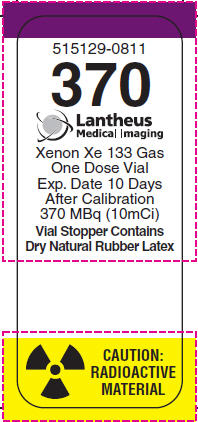
PRINCIPAL DISPLAY PANEL - 10mCi Vial Label 515129-0811 370 Lantheus Medical Imaging Xenon Xe 133 Gas One Dose Vial Exp. Date 10 Days After Calibration 370 MBq (10mCi) Vial Stopper Contains Dry Natural Rubber Latex CAUTION: RADIOACTIVE MATERIAL PRINCIPAL DISPLAY PANEL - 10mCi Vial Label
PRINCIPAL DISPLAY PANEL - 20mCi Vial Label 515130-0811 740 Lantheus Medical Imaging Xenon Xe 133 Gas One Dose Vial Exp. Date 10 Days After Calibration 740 MBq (20mCi) Vial Stopper Contains Dry Natural Rubber Latex CAUTION: RADIOACTIVE MATERIAL PRINCIPAL DISPLAY PANEL - 20mCi Vial Label
Medicaid utilization & spend
Medicaid utilization by pack size
About this NDC listing & data coverage
What data is (and isn’t) available for this NDC — tap to expand
| NDC identity (package / product / labeler codes) | ✓ Available |
| Labeler | ✓ Available |
| Product & package description | ✓ Available |
| Marketing category & status | ✓ Available |
| Active ingredient / dosage form / route | ✓ Available |
| FDA label (SPL via DailyMed) | ✓ Available |
| Package photos | ✓ Available |
| Inactive ingredients (structured) | ✓ Available |
| NADAC pharmacy acquisition price (CMS) | — Not published for this NDC CMS publishes NADAC only for NDCs reported in its retail-pharmacy survey. |
| Orange Book / therapeutic-equivalence data | — Not published for this NDC Applies only to products approved under an NDA/ANDA; many listings are out of scope. |
| HCPCS J-code billing crosswalk | — Not published for this NDC Most self-administered / retail products have no J-code — that is normal. |
| Medicaid utilization (CMS SDUD) | ✓ Available |