
Phenobarbital 30 mg Tablet, 100-count — NDC 16571-672-01 (Billing 16571-0672-01)
This is a package of 100 tablets of Phenobarbital 30 mg Tablet from Rising Pharma Holdings, Inc., marketed since Nov 2020 and currently FDA-listed; retail pharmacies pay about $0.1416 per tablet (NADAC).
Identity & classification
Regulatory identifiers FDA, NLM and CMS codes for this package
Drug-database identifiers Medi-Span GPI and First Databank GCN / HICL / AHFS classification
- GSN (GCN sequence number): 003590
- GCN: 12973
- GPI-14 (Medi-Span): 60100060000315
- HICL (First Databank): 001561
- AHFS class code: 28:12.04.00
- RxCUI (RxNorm): 198083
Where does this data come from?
- FDA openFDA NDC Directory · synced Oct 1, 2026
- FDA label on DailyMed · label index refreshed Oct 1, 2026
- RxNorm (NLM RxNav) · catalog refreshed Oct 1, 2026
- Medi-Span GPI (licensed)
- First Databank (licensed) · refreshed Oct 1, 2026
RxNorm drug class
This medicine belongs to the Barbiturates and derivatives class.
Where does this data come from?
- RxClass (NLM) · catalog refreshed Oct 1, 2026
Clinical
Phenobarbital is used to control seizures. Phenobarbital is also used to relieve anxiety. It is also used to prevent withdrawal symptoms in people who are dependent ('addicted'; feel a need to continue taking the medication) on another barbiturate medication and are going to stop taking the medication. Phenobarbital is in a class of medications called barbiturates. It works by slowing activity in the brain.
Read the full MedlinePlus article ↗- It is used as a sedative and to control seizures. The tablets and oral solutions cover both. The injections have additional uses, such as short-term insomnia, sedation before surge...
- Please don't stop on your own. Phenobarbital can cause physical dependence, and stopping suddenly can lead to withdrawal problems like delirium and seizures. If you need to stop, y...
- No, this is a big one. Alcohol and other sedating drugs add to the drowsiness. Opioid pain medicines combined with phenobarbital can cause dangerously slow breathing, coma and deat...
- Is it safe to drink alcohol or take pain medicine with it?
Patient education
Supplement & herbal interactions
Some supplements/herbs that may interact with Phenobarbital — tap one for details:
Phenobarbital may be associated with lower levels of 11 nutrients — worth a chat with your pharmacist, not a cause for alarm.
Where does this data come from?
- MedlinePlus (NLM) · refreshed Oct 1, 2026
- FDA label on DailyMed · label index refreshed Oct 1, 2026
Ask a licensed pharmacist directly — free, answered by our team.
Pricing
A drug doesn't have one price. Each row is a different public payment system, and none is what you'd pay at the counter — that depends on your insurance. The ⓘ on each row explains what it measures.
| Price system | Per ea | Per package |
|---|---|---|
| Retail pharmacies payNADAC · weekly | $0.142 | $14.16 / 100 tablets |
| Medicaid paysCMS SDUD · 12 mo | $0.2392 | $23.92 / 100 tablets |
| Medicare drug plans payPart D · Q2 2026 | $0.2071 | $20.71 / 100 tablets |
Where does this data come from?
- CMS NADAC weekly file · file of Sep 30, 2026
- CMS ASP pricing files · refreshed Sep 20, 2026
- CMS Medicaid State Drug Utilization Data · through Q1 2026
- CMS Part D plan pricing files · refreshed Sep 24, 2026
- VA National Acquisition Center price file
Packaging — all sizes for this product
| Package NDC | Description | Per unit | Per pack | Marketing start | Marketing end | Status |
|---|---|---|---|---|---|---|
| 16571-0672-01 You're viewing this | 100 TABLET in 1 BOTTLE | $0.1416 / ea | $14.16 | 2020-11-01 | — | Active |
| 16571-0672-10 16571-672-10 | 1000 TABLET in 1 BOTTLE | — | — | 2020-11-01 | — | Active |
| 16571-0672-50 16571-672-50 Main listing | 500 TABLET in 1 BOTTLE | $0.1416 / ea | $70.82 | 2020-11-01 | — | Active |
You're viewing the smallest of 3 pack sizes for this product.
This pack has the lowest per-ea cost of the 2 priced pack sizes ($0.1416 NADAC).
This pack accounts for about 35% of this product's recent Medicaid fills; most go to the 500 tablets pack. See all packs ↓
Pack size FAQ
What quantity is in this package?
How does this package differ from NDC 16571-0672-50?
What NDC number is used to bill for this package of Phenobarbital 30 mg Tablet?
Prices are the latest CMS NADAC pharmacy acquisition cost per NDC; per-pack figures are per-unit × pack quantity, shown only when the pack is denominated in the same measure NADAC prices.
Therapeutic equivalents
| Product | Labeler | Pack | NADAC/unit | TE | Status | Price vs. this |
|---|---|---|---|---|---|---|
| Phenobarbital 30 mg 00143-1500-01 | Hikma | 100 tablets | $0.142 | — | Availability likely | — |
| Phenobarbital 30 mg 13517-0692-01 | e5 | 100 tablets | $0.142 | — | Availability likely | — |
| Phenobarbital 30 mg 13811-0301-10 | Trigen | 100 tablets | $0.142 | — | Availability likely | — |
| Phenobarbital 30 mgthis 16571-0672-01 | Rising | 100 tablets | $0.142 | — | Availability likely | — |
| Phenobarbital 30 mg 69367-0440-01 | Westminster | 100 tablets | $0.142 | — | Availability likely | — |
| Phenobarbital 30 mg 69367-0692-01 | Westminster | 100 tablets | $0.142 | — | Availability likely | — |
| Phenobarbital 30 mg 75826-0138-10 | WINDER | 100 tablets | $0.142 | — | Availability likely | — |
| Phenobarbital 30 mg 51672-5332-01 | Sun | 100 tablets | — | — | FDA listed | — |
| Phenobarbital 30 mg 58118-0573-08 | Clinical | 30 tablets | — | — | FDA listed | — |
| Phenobarbital 30 mg 62135-0410-05 | Chartwell | 500 tablets | — | — | FDA listed | — |
| Phenobarbital 30 mg 64950-0573-01 | Genus | 100 tablets | — | — | FDA listed | — |
| Phenobarbital 30 mg 70752-0166-10 | QUAGEN | 100 tablets | — | — | FDA listed | — |
| Phenobarbital 30 mg 71205-0890-00 | Proficient | 100 tablets | — | — | FDA listed | — |
| Phenobarbital 30 mg 72162-1582-01 | Bryant | 100 tablets | — | — | Discontinued | — |
| Phenobarbital 30 mg 82804-0997-00 | Proficient | 100 tablets | — | — | FDA listed | — |
| Phenobarbital 30 mg 62135-0514-90 | Chartwell | 90 tablets | — | — | FDA listed | — |
Where does this data come from?
- FDA openFDA NDC Directory · synced Oct 1, 2026
- FDA Orange Book · refreshed Sep 3, 2026
- CMS NADAC weekly file · file of Sep 30, 2026
Availability & generic status
We did not find an FDA-approved generic match for this exact strength, form and route.
Where does this data come from?
- FDA Orange Book · refreshed Sep 3, 2026
What it looks like
Where does this data come from?
- FDA label on DailyMed · label index refreshed Oct 1, 2026
Inactive Ingredients / Excipients
Inactive ingredients, also called excipients, are components of the drug product other than the active ingredient. They may include fillers, dyes, coatings, preservatives, flavors, or other formulation ingredients.
💡 Tap an ingredient (hover on desktop) to see what it is and why it’s used.
-
UNII EWQ57Q8I5X
Lactose monohydrate is a natural sugar derived from milk. It serves as a filler and binder in tablets and capsules, helping create the proper size, texture, and consistency of the medicine.
-
UNII 70097M6I30
Magnesium stearate is a salt made from magnesium and stearic acid, a fatty substance. It's used in tablets and capsules as a lubricant and glidant to help ingredients flow smoothly during manufacturing and prevent sticking.
-
UNII OP1R32D61U
Microcrystalline cellulose is a purified form of cellulose, a natural fiber from plant sources. It acts as a binder and filler in tablets and capsules, helping hold ingredients together and give the medicine its shape and size.
-
UNII ETJ7Z6XBU4
Silicon dioxide is a naturally occurring mineral used as a glidant and anti-caking agent. It helps powder ingredients flow smoothly and prevents clumping during manufacturing and storage.
-
UNII H8AV0SQX4D
A modified starch derived from potato or corn starch. It absorbs water quickly and helps tablets or capsules break apart and dissolve in the stomach, acting as a disintegrant to ensure the medicine releases its active ingredients properly.
5 inactive ingredients listed in the exact product block matched to this NDC.
Where does this data come from?
ingredient classCode="IACT" elements from the exact product block matched by this NDC. Label-section narrative from DailyMed / the openFDA label index is shown separately when available.- FDA label on DailyMed · label index refreshed Oct 1, 2026
- FDA openFDA NDC Directory · synced Oct 1, 2026
Inactive ingredient FAQ
Are inactive ingredients the same for every manufacturer?
Why might an inactive ingredient be missing?
Can inactive ingredients matter?
Manufacturer & labeler
Where does this data come from?
- FDA openFDA NDC Directory · synced Oct 1, 2026
- Drugs@FDA
Full prescribing information FDA SPL
🎯 Indications and Usage ▾
INDICATIONS AND USAGE Phenobarbital Tablets, USP are indicated for use as a sedative or anticonvulsant.
⏱️ Dosage and Administration ▾
DOSAGE AND ADMINISTRATION Oral Sedative Dose, Adults - 30 to 120 mg daily in 2 or 3 divided doses. Children - 6 mg/kg of body weight daily in 3 divided doses. Oral Hypnotic Dose, Adults - 100 to 320 mg. Oral Anticonvulsant Dose, Adults - 50 to 100 mg 2 or 3 times daily. Children - 15 to 50 mg 2 or 3 times daily.
⛔ Contraindications ▾
CONTRAINDICATIONS Phenobarbital is contraindicated in patients who are hypersensitive to barbiturates. In such patients, severe hepatic damage can occur from ordinary doses and is usually associated with dermatitis and involvement of parenchymatous organs. A personal or familial history of acute intermittent porphyria represents one of the few absolute contraindications to the use of barbiturates.
Phenobarbital is also contraindicated in patients with marked impairment of liver function, or respiratory disease in which dyspnea or obstruction is evident. It should not be administered to persons with known previous addiction to the sedative/hypnotic group, since ordinary doses may be ineffectual and may contribute to further addiction.
⚠️ Warnings ▾
WARNINGS In small doses, the barbiturates may increase the reaction to painful stimuli. Taken by themselves, the barbiturates cannot be relied upon to relieve pain or even to produce sedation or sleep in the presence of severe pain.
🤒 Adverse Reactions ▾
ADVERSE REACTIONS The following adverse reactions have been reported: CNS Depression: Residual sedation or “hangover”, drowsiness, lethargy, and vertigo. Emotional disturbances and phobias may be accentuated. In some persons, barbiturates such as phenobarbital repeatedly produce excitement rather than depression, and the patient may appear to be inebriated.
Like other non-analgesic hypnotic drugs, barbiturates, such as phenobarbital, when given in the presence of pain, may cause restlessness, excitement, and even delirium. Rarely, the use of barbiturates results in localized or diffused myalgic, neuralgic, or arthritic pain, especially in psychoneurotic patients with insomnia. The pain may appear in paroxysms, is most intense in the early morning hours, and is most frequently located in the region of the neck, shoulder girdle, and upper limbs.
Symptoms may last for days after the drug is discontinued. Respiratory/Circulatory: Respiratory depression, apnea, circulatory collapse. Allergic: Acquired hypersensitivity to barbiturates consists chiefly in allergic reactions that occur especially in persons who tend to have asthma, urticaria, angioedema, and similar conditions.
Hypersensitivity reactions in this category include localized swelling, particularly of the eyelids, cheeks, or lips, and erythematous dermatitis. Rarely, exfoliative dermatitis (e.g., Stevens-Johnson syndrome and toxic epidermal necrolysis) may be caused by phenobarbital and can prove fatal. The skin eruption may be associated with fever, delirium, and marked degenerative changes in the liver and other parenchymatous organs.
In a few cases, megaloblastic anemia has been associated with the chronic use of phenobarbital. Other: Nausea and vomiting; headache. To report SUSPECTED ADVERSE REACTIONS, contact Rising Pharma Holdings, Inc. at 1-844-874-7464, or FDA at 1-800-FDA-1088 or www.fda.gov/medwatch .
🔄 Drug Interactions ▾
Drug Interactions: Phenobarbital in combination with alcohol, tranquilizers, and other central nervous system depressants has additive depressant effects, and the patient should be so advised. Patients taking this drug should be warned not to exceed the dosage recommended by their physician. Toxic effects and fatalities have occurred following overdoses of phenobarbital alone and in combination with other central nervous system depressants.
Caution should be exercised in prescribing unnecessarily large amounts of phenobarbital for patients who have a history of emotional disturbances or suicidal ideation or who have misused alcohol and other CNS drugs (see OVERDOSAGE ).
🤰 Pregnancy ▾
Usage in Pregnancy: Pregnancy Category B - Reproduction studies have been performed in animals and have revealed no evidence of impaired fertility or harm to the fetus due to phenobarbital. There are, however, no adequate and well-controlled studies in pregnant women. Because animal reproduction studies are not always predictive of human response, this drug should be used during pregnancy only if clearly needed.
🆘 Overdosage ▾
OVERDOSAGE The signs and symptoms of barbiturate poisoning are referable especially to the central nervous system and the cardiovascular system. Moderate intoxication resembles alcoholic inebriation. In severe intoxication, the patient is comatose, the level of reflex activity conforming in a general way to the intensity of the central depression.
The deep reflexes may persist for some time despite coexistent coma. The Babinski sign is often positive. The EEG may be of the “burst-suppression” type, with brief periods of electrical silence.
The pupils may be constricted and react to light, but late in the course of barbiturate poisoning they may show hypoxic paralytic dilatation. Respiration is affected early. Breathing may be either slow or rapid and shallow; Cheyne-Stokes rhythm may be present.
Respiratory minute volume is diminished, and hypoxia and respiratory acidosis may develop. The blood pressure falls, owing partly to depression of medullary vasomotor centers; partly to a direct action of the drug on the myocardium, sympathetic ganglia, and vascular smooth muscle; partly to hypoxia. The patient thus develops a typical shock syndrome, with a weak and rapid pulse, cold and clammy skin, and a rise in the hematocrit.
Respiratory complications (atelectasis, pulmonary edema, and bronchopneumonia) and renal failure are much dreaded and not infrequent concomitant of severe barbiturate poisoning. There is usually hypothermia, sometimes with temperatures as low as 32°C. Treatment: General management should consist of symptomatic and supportive therapy, including gastric lavage, administration of intravenous fluids, and maintenance of blood pressure, body temperature and adequate respiratory exchange.
Dialysis will increase the rate of removal of barbiturates from the body fluids. Antibiotics may be required to control pulmonary complications.
🧬 Clinical Pharmacology ▾
CLINICAL PHARMACOLOGY Phenobarbital, a long-acting barbiturate, is a central nervous system depressant. In ordinary doses, the drug acts as a sedative and anticonvulsant. Its onset of action occurs within 30 minutes, and the duration of action ranges from 5 to 6 hours. It is detoxified in the liver.
📦 How Supplied / Storage and Handling ▾
HOW SUPPLIED Phenobarbital Tablets, USP 15 mg: White to off-white round, biconvex tablets debossed “T35” on one side and plain on the other side. Available in bottles of 100 tablets, NDC 16571-670-01; 500 tablets, NDC 16571-670-50; and 1000 tablets, NDC 16571-670-10. Phenobarbital Tablets, USP 30 mg: White to off-white round, biconvex tablets debossed “T” above and “36” below the bisect on one side and plain on the other side.
Available in bottles of 100 tablets, NDC 16571-672-01; 500 tablets, NDC 16571-672-50; and 1000 tablets, NDC 16571-672-10. Phenobarbital Tablets, USP 60 mg: White to off-white round, biconvex tablets debossed “T” above and “37” below the bisect on one side and plain on the other side. Available in bottles of 100 tablets, NDC 16571-674-01; 500 tablets, NDC 16571-674-50; and 1000 tablets, NDC 16571-674-10.
Phenobarbital Tablets, USP 100 mg: White to off-white round, biconvex tablets debossed “T” above and “38” below the bisect on one side and plain on the other side. Available in bottles of 100 tablets, NDC 16571-669-01; 500 tablets, NDC 16571-669-50; and 1000 tablets, NDC 16571-669-10. Store at 20° to 25°C (68° to 77°F) [See USP Controlled Room Temperature].
Protect from light and moisture. Dispense in a tight, light-resistant container as defined in the USP using a child-resistant closure. Distributed by: Rising Pharma Holdings, Inc.
East Brunswick, NJ 08816 Manufactured by: Quagen Pharmaceuticals LLC West Caldwell, NJ 07006 52024 Rev. 07/20
📋 Description ▾
DESCRIPTION Phenobarbital is a barbituric acid derivative for oral administration and occurs as a white, odorless, slightly bitter powder that is soluble in chloroform, freely soluble in alcohol or ether, and slightly soluble in water. Its saturated solution has a pH of about 5.6. Chemically, it is 5-ethyl-5- phenylbarbituric acid with the molecular formula C 12 H 12 N 2 O 3 (232.24).
The structural formula is as follows: Each Phenobarbital Tablet, USP contains 15 mg, 30 mg, 60 mg or 100 mg of phenobarbital, USP. Inactive ingredients include: colloidal silicon dioxide, lactose monohydrate, microcrystalline cellulose, sodium starch glycolate and magnesium stearate. Structure
💬 Information for Patients ▾
Information for Patients: Phenobarbital may impair the mental and/or physical abilities required for the performance of potentially hazardous tasks, such as driving a car or operating machinery. The patient should be cautioned accordingly.
⚠️ Precautions ▾
PRECAUTIONS General Precautions: Barbiturates induce liver microsomal enzyme activity. This accelerates the biotransformation of various drugs and is probably part of the mechanism of the tolerance encountered with barbiturates. Phenobarbital, therefore, should be used with caution in patients with decreased liver function.
This drug should also be administered cautiously to patients with a history of drug dependence or abuse (see DRUG ABUSE AND DEPENDENCE ). Phenobarbital may decrease the potency of coumarin anticoagulants; therefore, patients receiving such concomitant therapy should have more frequent prothrombin determinations. As with other sedatives and hypnotics, elderly or debilitated patients may react to barbiturates with marked excitement, depression, or confusion.
The systemic effects of exogenous hydrocortisone and endogenous hydrocortisone (cortisol) may be diminished by phenobarbital. Thus, this product should be administered with caution to patients with borderline hypoadrenal function, regardless of whether it is of pituitary or of primary adrenal origin. Information for Patients: Phenobarbital may impair the mental and/or physical abilities required for the performance of potentially hazardous tasks, such as driving a car or operating machinery.
The patient should be cautioned accordingly. Drug Interactions: Phenobarbital in combination with alcohol, tranquilizers, and other central nervous system depressants has additive depressant effects, and the patient should be so advised. Patients taking this drug should be warned not to exceed the dosage recommended by their physician.
Toxic effects and fatalities have occurred following overdoses of phenobarbital alone and in combination with other central nervous system depressants. Caution should be exercised in prescribing unnecessarily large amounts of phenobarbital for patients who have a history of emotional disturbances or suicidal ideation or who have misused alcohol and other CNS drugs (see OVERDOSAGE ). Usage in Pregnancy: Pregnancy Category B - Reproduction studies have been performed in animals and have revealed no evidence of impaired fertility or harm to the fetus due to phenobarbital.
There are, however, no adequate and well-controlled studies in pregnant women. Because animal reproduction studies are not always predictive of human response, this drug should be used during pregnancy only if clearly needed. Nursing Mothers: Caution should be exercised when phenobarbital is administered to a nursing woman.
🍼 Nursing Mothers ▾
Nursing Mothers: Caution should be exercised when phenobarbital is administered to a nursing woman.
🔒 Drug Abuse and Dependence ▾
DRUG ABUSE AND DEPENDENCE Controlled Substance - Phenobarbital is a Schedule IV drug. Dependence: Prolonged, uninterrupted use of barbiturates (particularly the short-acting drugs), even in therapeutic doses, may result in psychic and physical dependence. Withdrawal symptoms due to physical dependence following chronic use of large doses of barbiturates may include delirium, convulsions, and death.
📄 Package Label / Principal Display Panel ▾
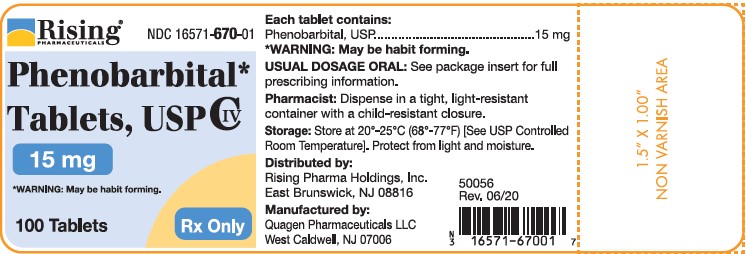
PACKAGE LABEL.PRINCIPAL DISPLAY PANEL Rising ® NDC 16571-670-01 Phenobarbital* Tablets, USP CIV 15 mg *WARNING: May be habit forming. 100 Tablets Rx Only Rising ® NDC 16571-670-50 Phenobarbital* Tablets, USP CIV 15 mg *WARNING: May be habit forming. 500 Tablets Rx Only Rising ® NDC 16571-670-10 Phenobarbital* Tablets, USP CIV 15 mg *WARNING: May be habit forming.
1000 Tablets Rx Only Rising ® NDC 16571-672-01 Phenobarbital* Tablets, USP CIV 30 mg *WARNING: May be habit forming. 100 Tablets Rx Only Rising ® NDC 16571-672-50 Phenobarbital* Tablets, USP CIV 30 mg *WARNING: May be habit forming. 500 Tablets Rx Only Rising ® NDC 16571-672-10 Phenobarbital* Tablets, USP CIV 30 mg *WARNING: May be habit forming.
1000 Tablets Rx Only Rising ® NDC 16571-674-01 Phenobarbital* Tablets, USP CIV 60 mg *WARNING: May be habit forming. 100 Tablets Rx Only Rising ® NDC 16571-674-50 Phenobarbital* Tablets, USP CIV 60 mg *WARNING: May be habit forming. 500 Tablets Rx Only Rising ® NDC 16571-674-10 Phenobarbital* Tablets, USP CIV 60 mg *WARNING: May be habit forming.
1000 Tablets Rx Only Rising ® NDC 16571-669-01 Phenobarbital* Tablets, USP CIV 100 mg *WARNING: May be habit forming. 100 Tablets Rx Only Rising ® NDC 16571-669-50 Phenobarbital* Tablets, USP CIV 100 mg *WARNING: May be habit forming. 500 Tablets Rx Only Rising ® NDC 16571-669-10 Phenobarbital* Tablets, USP CIV 100 mg *WARNING: May be habit forming.
1000 Tablets Rx Only 15100 15500 151000 30mg100 30mg500 30mg1000 60mg100 60mg500 60mg1000 100mg100 100mg500 100mg1000
Medicaid utilization & spend
Medicaid utilization by pack size
Medicare Part D spend CMS · PART D · 2026 (Q1)
About this NDC listing & data coverage
Listed without an FDA application
This product's marketing category indicates it is marketed without an approved FDA application (no NDA, ANDA, or BLA on file). Having an NDC does not by itself establish FDA approval — the NDC Directory is a listing system, not an approval decision. Approval-linked data such as Orange Book therapeutic-equivalence ratings therefore does not apply.
What data is (and isn’t) available for this NDC — tap to expand
| NDC identity (package / product / labeler codes) | ✓ Available |
| Labeler | ✓ Available |
| Product & package description | ✓ Available |
| Marketing category & status | ✓ Available |
| Active ingredient / dosage form / route | ✓ Available |
| FDA label (SPL via DailyMed) | ✓ Available |
| Package photos | ✓ Available |
| Inactive ingredients (structured) | ✓ Available |
| NADAC pharmacy acquisition price (CMS) | ✓ Available |
| Orange Book / therapeutic-equivalence data | — Not published for this NDC Applies only to products approved under an NDA/ANDA; many listings are out of scope. |
| HCPCS J-code billing crosswalk | — Not published for this NDC Most self-administered / retail products have no J-code — that is normal. |
| Medicaid utilization (CMS SDUD) | ✓ Available |