
HomeNDC LookupIngredientsSodium Bicarbonate › 24286-1537-08
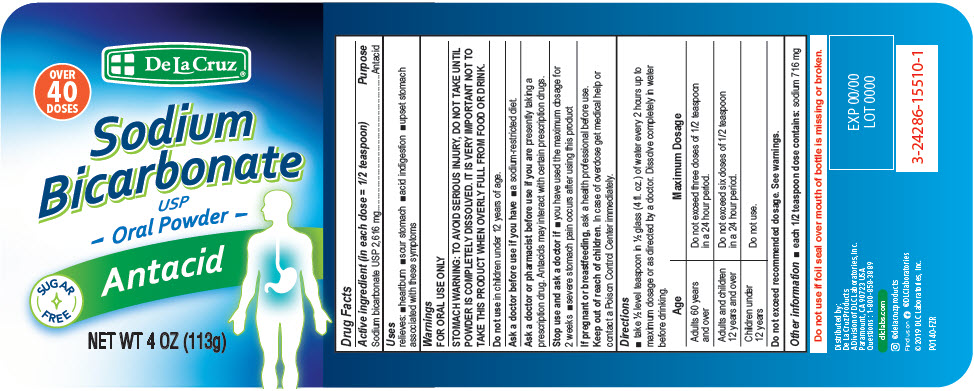
DE LA CRUZ SODIUM BICARBONATE ANTACID 2.6 g/2.6g Powder, 226 g — NDC 24286-1537-08 package photo

DE LA CRUZ SODIUM BICARBONATE ANTACID 2.6 g/2.6g Powder, 226 g

by DLC Laboratories, Inc. · 226 g in 1 BOTTLE, PLASTIC (24286-1537-8)
NDC 24286-1537-08
🏷️ FDA NDC (as labeled) 24286-1537-8 billing pads the package segment with a zero
This package
Contains226 g Pack sizes2 compare ↓
Also comes in: 113 g 24286-1537-07
OTC On market Non-controlled
🗂️ Data synced Jul 24, 2026 · sources: openFDA · FDA label (DailyMed) · FDA Orange & Purple Book · First Databank · CMS NADAC, ASP, Medicare & Medicaid · RxNorm
📋 All sources & update times →
⚠️
Other active recalls for Sodium Bicarbonate (different manufacturers) — 5 · tap to view
These affect other manufacturers’ products for the same ingredient — not necessarily the exact NDC on this page.
Class II · Aug 4, 2025 — Lack of Assurance of Sterility. (PFIZER INC) · FDA recall D-0591-2025
Class II · Jul 30, 2025 — Failed Impurities/Degradation Specifications: out of specification results for arsenic in the impurities tested. (Exela Pharma Sciences LLC) · FDA recall D-0620-2025
Class II · Mar 7, 2025 — Lack of Assurance of Sterility (Exela Pharma Sciences LLC) · FDA recall D-0303-2025
Class I · Dec 21, 2023 — Presence of Particulate Matter; identified as glass (Pfizer Inc.) · FDA recall D-0234-2024
Class I · Oct 18, 2023 — Presence of Particulate Matter: Silicone (Exela Pharma Sciences LLC) · FDA recall D-0116-2024
Each entry is an official FDA enforcement report — look up any recall number in the FDA recall database ↗

🆔 Identity & classification

FDA NDC (as labeled) 24286-1537-8
Product NDC 24286-1537
11-digit billing NDC 24286153708
RxCUI 1488624
UNII 8MDF5V39QO
Application # M001
SPL Set ID fc469943-9749-45ee-93f7-90fdbcdc7215
Mechanism of action Alkalinizing Activity
DEA schedule Non-controlled
Marketing category OTC MONOGRAPH DRUG
Marketing status On market
FDA listing status Listed (active directory)
Marketing start 2013-09-25
Route ORAL
Dosage form POWDER
Substance SODIUM BICARBONATE
Why two NDCs? The FDA registers this code as 24286-1537-8 — a 5-4-1 layout, and that's what's printed on the package and shown on DailyMed. For insurance claims, every NDC is standardized to a uniform 11-digit 5-4-2 format by adding a zero to the package segment → 24286-1537-08. Same drug, same package — only the format differs.
Where does this data come from?
Identifiers from the FDA openFDA NDC Directory and Structured Product Labeling; RxCUI from RxNorm (NLM); GPI from Medi-Span; GCN / HIC / AHFS / legend from First Databank.

🏷️ RxNorm drug class

This medicine belongs to the Salt solutions class.

Drug family (ATC) Salt solutions, Electrolyte solutions
Where does this data come from?
Therapeutic classes from RxNorm RxClass (U.S. National Library of Medicine) — Established Pharmacologic Class (FDA), ATC drug family (WHO) and mechanism of action, matched by this product’s RxCUI.

🏭 Manufacturer & labeler

LabelerDLC Laboratories, Inc.
FDA applicationM001 (OTC MONOGRAPH DRUG)
Labeler code24286
First marketedSep 2013
Product typeHuman Otc Drug
Portfolio29 products on file
The labeler markets the product; the application holder owns the FDA approval. They’re often the same company but can differ (e.g. a repackager or an authorized generic). A mailing address / phone appears here when the manufacturer includes it in the product’s FDA label (not all do).
Where does this data come from?
Labeler, application holder and registered establishment from the FDA openFDA NDC Directory and Drugs@FDA; address/contact from the product’s FDA label.

🩺 Clinical

📗 Our plain-language guide HelloPharmacist
  • Sodium bicarbonate antacids work fast for occasional heartburn, but they're not meant for daily long-term use on your own. Most labels say not to use the maximum dose for more than...
  • Can I use this for my heartburn every day?
  • The active ingredient is the same — sodium bicarbonate. Products like Arm and Hammer Baking Soda are actually FDA-labeled for both antacid use and skin soaks or compresses for irri...
  • Is baking soda from the kitchen the same as these antacid products?
📖 Read our full Sodium Bicarbonate guide →
4
Nutrient depletion considerations

Sodium Bicarbonate (OTC Drug) may be associated with lower levels of 4 nutrients — worth a chat with your pharmacist, not a cause for alarm.

An association is not a deficiency. Educational only — don't start or stop anything without professional guidance.
Where does this data come from?
Plain-language summary from MedlinePlus (U.S. National Library of Medicine); supplement & herbal interactions and nutrient depletion data from the Natural Medicines database; our full guide is HelloPharmacist editorial content.

💊 What it looks like

Color white
One label can cover several strengths, so colors may be combined — always confirm a loose pill against the dispensed prescription label or a pharmacist.
Where does this data come from?
Physical description (imprint, shape, color, scoring, coating) from this product’s FDA Structured Product Labeling (SPL), mirrored from DailyMed / openFDA.

🧪 Inactive Ingredients / Excipients

Inactive ingredients, also called excipients, are components of the drug product other than the active ingredient. They may include fillers, dyes, coatings, preservatives, flavors, or other formulation ingredients.

From the label’s inactive-ingredient sectionnone

This is label-wide narrative text, not a normalized exact-product ingredient list. A label can cover multiple strengths or packages.

Where does this data come from?
Source: official FDA Structured Product Labeling (SPL) via DailyMed and the openFDA label index. Structured IACT rows and label-wide narrative are kept separate; availability and product-level specificity depend on the submitted label.

Inactive ingredient FAQ

Are inactive ingredients the same for every manufacturer?
No. Inactive ingredients can differ by manufacturer, dosage form, strength, and package / product version.
Why might an inactive ingredient be missing?
Some SPLs do not provide a complete structured inactive-ingredient list, and older or unusual labels may only include the information in narrative text.
Can inactive ingredients matter?
Yes. They can matter for allergies, intolerances, dyes, gluten / lactose concerns, preservatives, and formulation differences — but confirm with a pharmacist or the manufacturer when it’s clinically important.

💲 Pricing

A drug doesn't have one price. Each row is a different public payment system, and none is what you'd pay at the counter — that depends on your insurance. The ⓘ on each row explains what it measures.

Price systemPer gPer package
Retail pharmacies payNADAC · weekly Not in the retail survey — common for institutional, discontinued, or low-volume packs.
Medicaid paysCMS SDUD · 12 mo No recent Medicaid claims on file for this NDC — rare and low-volume NDCs are suppressed in the public data.
Medicare drug plans payPart D · quarterly No Part D plan price is available for this NDC in our data.
ℹ️
No price is published for this exact package yet. CMS surveys NADAC per package size, so a different pack of the same drug often has one.
Try another pack size: 113 g
Where does this data come from?
NADAC (National Average Drug Acquisition Cost) is the CMS weekly pharmacy-acquisition-cost survey — what pharmacies pay. ASP (Average Sales Price) is the CMS Medicare Part B drug-payment file, published quarterly. Medicaid pays is computed by us from CMS State Drug Utilization Data (total reimbursed ÷ units, trailing 12 months) — gross of rebates and inclusive of dispensing fees, so it reflects what Medicaid paid, not an acquisition cost. Medicare drug plans pay is the median negotiated point-of-sale unit cost across plans listing this NDC in the CMS quarterly Prescription Drug Plan pricing files, before rebates. The VA pays is the federal contract price (FSS, and the statutory Big 4 ceiling where listed) from the VA National Acquisition Center pharmaceutical price file. All are free public government data; each measures a different payer, so the figures are not directly comparable.

🔁 Therapeutic equivalents

ProductLabelerPackNADAC/unitTEStatusPrice vs. this
Sodium Bicarbonate 2.6 g/2.6g 10095-0100-01 World 113 g FDA listed
De La Cruz Sodium Bicarbonate Antacid 2.6 g/2.6gthis 24286-1537-08 DLC 226 g FDA listed
Rapidol Sodium Bicarbonate 2.6 g/2.6g 55758-0319-04 Pharmadel 113 g FDA listed
Sodium Bicarbonate 2.6 g/2.6g 69469-0100-04 Vitamex 113 g FDA listed
About this product: other versions of the same ingredient, strength and form are listed above, least expensive first, with FDA equivalence ratings where available.
Where does this data come from?
Equivalents are other NDCs of the same ingredient, form and route from the openFDA NDC Directory, ranked least-expensive-first by NADAC. Therapeutic-equivalence (AB) ratings come from the FDA Orange Book; biologics use the FDA Purple Book for biosimilar & interchangeable status.

Availability & generic status

🏛️
2013
On the market since
Sep 2013
📍
2026
Currently FDA-listed
13 years listed
🔒
·
No generic listed yet
brand only
ℹ️No FDA-approved generic found

We did not find an FDA-approved generic match for this exact strength, form and route.

Where does this data come from?
Patents and exclusivity from the FDA Orange Book (small-molecule drugs), refreshed from public FDA data. Generic launch timing is an estimate, not a guarantee.

📊 Medicare Part D spend CMS · PART D · 2026 (Q1)

Medicare Part D (outpatient prescription) spending for Sodium Bicarbonate (matched by generic name) — the program that covers self-administered drugs. 9 manufacturers.
⚠️ Drug-level data: CMS publishes Part D spending by drug, not by NDC — these figures combine every manufacturer, strength and package size sold under the name Sodium Bicarbonate. That’s a different level of aggregation than the Medicaid card above, which is specific to this exact 11-digit NDC (pack size included), so the two aren’t directly comparable.
Period
Total Part D spend
$136.8K
Claims incl. refills
2.2K
Beneficiaries
722
Spend / beneficiary
$189.50
Spend / claim
$61.05
Trend by period
💵 About the dollar figures: spending is what Part D plans paid before confidential manufacturer rebates, so the program’s real net cost is lower. A blank patient count means fewer than 11 people — CMS hides counts that small to protect privacy. Source: CMS Medicare Quarterly Part D Spending by Drug (data.cms.gov), updated quarterly.

📦 Packaging — all sizes for this product

Package NDCDescription Marketing startStatus
24286-1537-07 113 g in 1 BOTTLE, PLASTIC (24286-1537-7) 2013-09-25 Active
24286-1537-08 You're viewing this 226 g in 1 BOTTLE, PLASTIC (24286-1537-8) 2019-07-22 Active

You're viewing the largest of 2 pack sizes for this product.

Pack size FAQ

What quantity is in NDC 24286-1537-08?
NDC 24286-1537-08 contains 226 g — 226 g in 1 bottle, plastic.
What is the difference between NDC 24286-1537-08 and NDC 24286-1537-07?
Both are DE LA CRUZ SODIUM BICARBONATE ANTACID 2.6 g/2.6g Powder — the drug itself is identical. NDC 24286-1537-08 is the 226 g package, while NDC 24286-1537-07 is the 113 g package.
What NDC number is used to bill for this package of DE LA CRUZ SODIUM BICARBONATE ANTACID 2.6 g/2.6g Powder?
Bill NDC 24286-1537-08 — the 11-digit billing format is 24286153708. Pharmacy and medical claims use the 11-digit form; the FDA label may print a shorter form of the same code.

🧭 About this NDC listing & data coverage

Over-the-counter (OTC) product
What data is (and isn’t) available for this NDC — tap to expand
NDC identity (package / product / labeler codes) ✓ Available
Labeler ✓ Available
Product & package description ✓ Available
Marketing category & status ✓ Available
Active ingredient / dosage form / route ✓ Available
FDA label (SPL via DailyMed) ✓ Available
Package photos ✓ Available
Inactive ingredients (structured) ✓ Available
NADAC pharmacy acquisition price (CMS) — Not published for this NDC CMS publishes NADAC only for NDCs reported in its retail-pharmacy survey.
Orange Book / therapeutic-equivalence data — Not published for this NDC Applies only to products approved under an NDA/ANDA; many listings are out of scope.
HCPCS J-code billing crosswalk — Not published for this NDC Most self-administered / retail products have no J-code — that is normal.
Medicaid utilization (CMS SDUD) — Not published for this NDC CMS reports utilization only for NDCs with Medicaid claims above its privacy threshold.
“Not published” reflects what the public FDA / CMS / NLM sources provide for this exact package code — it is a property of the data feeds, not a judgment about the product.

Questions about this listing

Is this NDC FDA-approved?
An NDC listing does not by itself establish FDA approval — the NDC Directory records that a product is listed with FDA, not that it was reviewed and approved. This listing's marketing category is "Otc Monograph Drug". Products approved under an application carry an NDA, ANDA, or BLA number.
Why is there no price listed?
The pricing shown on our NDC pages comes from CMS NADAC, a voluntary survey of retail community pharmacy invoices. CMS does not publish a NADAC for every NDC — packages outside the retail survey (institutional and hospital products, bulk packages, discontinued items, and many OTC items) may never receive one. A missing price reflects the survey's scope, not this product's actual cost, and does not mean the product is free or unavailable.
Is the NDC printed on the package the same as the 11-digit billing NDC?
Yes, they identify this exact package in different formats. The FDA registers it as 24286-1537-8, which is what is printed on the packaging and shown on DailyMed. Insurance claims use a fixed 11-digit 5-4-2 format, so the short segment is padded with a leading zero: 24286-1537-08, written without dashes as 24286153708. The Identity section at the top of this page lists every form of this code.
What do the three segments of this NDC mean?
In 24286-1537-08, the first segment (24286) is the labeler code FDA assigned to DLC Laboratories, Inc.; the middle segment (1537) identifies this specific product — its ingredient, strength, and dosage form; and the last segment (08) identifies this exact package size and type. Together they name one specific package of one specific product.
Is this package still being marketed?
Yes, per the latest FDA NDC Directory data on this page: this package is listed as actively marketed, with no marketing end date reported by DLC Laboratories, Inc.. Listing status can change — the directory data on this page refreshes weekly.
Does this product come in other package sizes?
Yes — the FDA directory lists 1 other package presentation of this same product, including 113 g (24286-1537-07). Each has its own NDC and its own page — see the package list near the top of this page.
Who lists this product with the FDA?
DLC Laboratories, Inc. is the labeler of record for this NDC — the company under whose FDA-assigned code the package is listed. The labeler may be the manufacturer itself or a distributor marketing the product under its own code.
Do I need a prescription for this product?
This NDC is listed with FDA as an over-the-counter product, so it does not require a prescription. Follow the package directions, and ask your pharmacist if you are unsure whether it is right for you.
This page identifies an FDA-listed package (the NDC) and reports public regulatory and pricing data about the listing. It is reference information, not a medical recommendation — talk to your pharmacist or prescriber about your own medication.
Where does this data come from?
Listing facts (marketing category, packager status, marketing dates) from the FDA openFDA NDC Directory; label availability from DailyMed; pricing coverage from CMS NADAC; equivalence scope from the FDA Orange Book.

📄 FDA label — Drug Facts FDA SPL

The complete FDA label for this product — the official Drug Facts labeling, verbatim, section by section. Jump with a chip, search within the label, or expand everything.
🎯 Indications and Usage 13 words

Uses relieves: heartburn sour stomach acid indigestion upset stomach associated with these symptoms

⏱️ Dosage and Administration 88 words

Directions take ½ level teaspoon in ½ glass (4 fl. oz.) of water every 2 hours up to maximum dosage or as directed by a doctor. Dissolve completely in water before drinking. Age Maximum Dosage Adults 60 years and over Do not exceed three doses of 1/2 teaspoon in a 24 hour period.

Adults and children 12 years and over Do not exceed six doses of 1/2 teaspoon in a 24 hour period. Children under 12 years Do not use. Do not exceed recommended dosage.

See warnings .

⚠️ Warnings 133 words

Warnings FOR ORAL USE ONLY STOMACH WARNING TO AVOID SERIOUS INJURY, DO NOT TAKE UNTIL POWDER IS COMPLETELY DISSOLVED. IT IS VERY IMPORTANT NOT TO TAKE THIS PRODUCT WHEN OVERLY FULL FROM FOOD OR DRINK. Do not use in children under 12 years of age.

Ask a doctor before use if you have a sodium-restricted diet. Ask a doctor or pharmacist before use if you are presently taking a prescription drug. Antacids may interact with certain prescription drugs.

Stop use and ask a doctor if you have used the maximum dosage for 2 weeks severe stomach pain occurs after using this product If pregnant or breastfeeding, ask a health professional before use. Keep out of reach of children . In case of overdose get medical help or contact a Poison Control Center immediately.

📦 Storage and Handling 10 words

Other information each 1/2 teaspoon dose contains: sodium 716 mg

🧪 Active Ingredient 13 words

Active ingredient (in each dose = 1/2 teaspoon) Sodium bicarbonate USP 2,616 mg

🧪 Inactive Ingredients 3 words

Inactive Ingredient none

🎯 Purpose 2 words

Purpose Antacid

Source: FDA Structured Product Labeling, mirrored from DailyMed / openFDA. Prefer the government’s original formatting? View this label on DailyMed ↗
For educational and professional reference only — not medical advice. Pricing reflects published NADAC and CMS ASP (free public data) and may differ from your acquisition cost; always verify before billing or dispensing.