
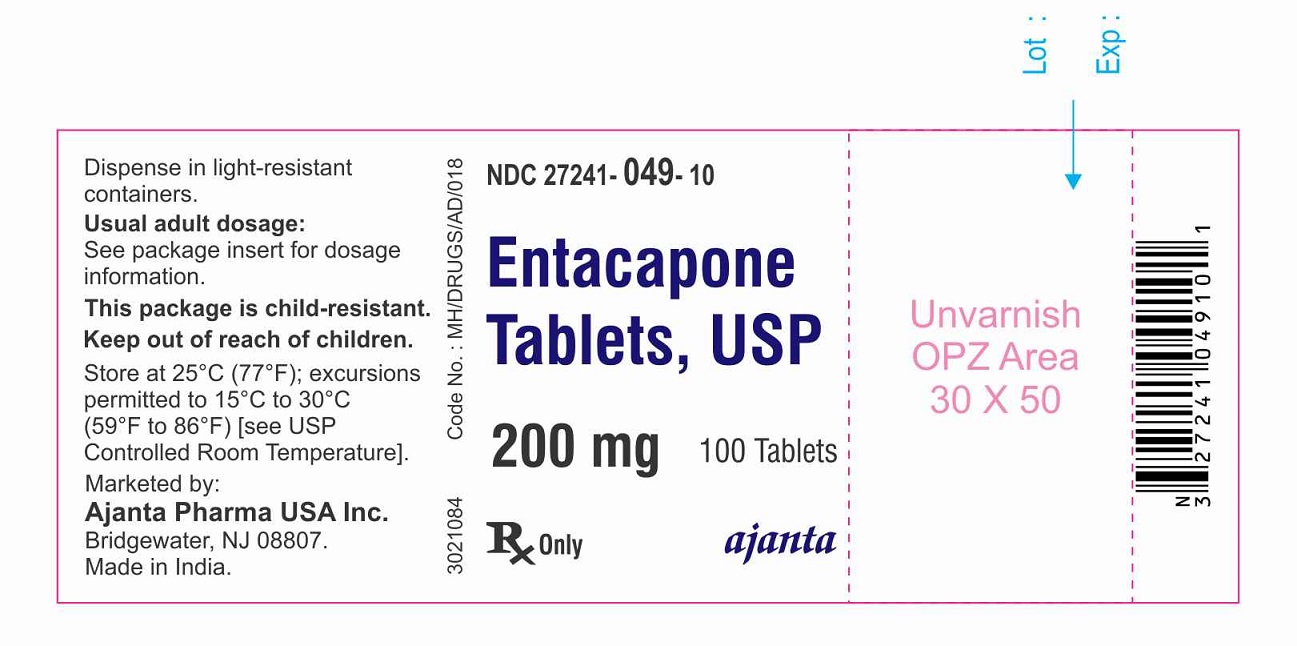
Entacapone 200 mg Tablet, 100-count — NDC 27241-049-10 (Billing 27241-0049-10)
This is a package of 100 tablets of Entacapone 200 mg Tablet from Ajanta Pharma USA Inc., marketed since Aug 2017 and currently FDA-listed; retail pharmacies pay about $0.3246 per tablet (NADAC). It is this product's only package size.
NDC database record
One package, one record: these facts belong to NDC 27241-049-10 alone.
- Record
- FDA NDC Directory package listing · Human prescription drug
- Code segments
- 27241 labeler · 049 product · 10 package
- Package marketed since
- Aug 31, 2017
- Sample package
- No — commercial package
- Listing certified through
- Dec 31, 2026
- Billing quantity
- 100 EA per package
- Barcode (UPC)
- 0327241049101
- Medicaid fills, this package
- 934 prescriptions in the last four reported quarters
- FDA record last changed
- Jul 24, 2026
Identity & classification
Regulatory identifiers FDA, NLM and CMS codes for this package
Drug-database identifiers Medi-Span GPI and First Databank GCN / HICL / AHFS classification
- GSN (GCN sequence number): 041199
- GCN: 95079
- GPI-14 (Medi-Span): 73153030000320
- HICL (First Databank): 018950
- AHFS class code: 28:36.12.00
- RxCUI (RxNorm): 317094
Where does this data come from?
- FDA openFDA NDC Directory · synced Oct 8, 2026
- FDA label on DailyMed · label index refreshed Oct 8, 2026
- RxNorm (NLM RxNav) · catalog refreshed Oct 1, 2026
- Medi-Span GPI (licensed)
- First Databank (licensed) · refreshed Oct 8, 2026
RxNorm drug class
This medicine belongs to the Catechol-O-Methyltransferase Inhibitor class.
Where does this data come from?
- RxClass (NLM) · catalog refreshed Oct 1, 2026
Clinical
Entacapone is an inhibitor of catechol-O-methyltransferase (COMT). It is used in combination with levodopa and carbidopa (Sinemet) to treat the end-of-dose 'wearing-off' symptoms of Parkinson's disease. Entacapone helps the levodopa and carbidopa work better by allowing more of it to reach the brain, where it has its effects. This medication is sometimes prescribed for other uses; ask your doctor or pharmacist for more information.
Read the full MedlinePlus article ↗- It’s an add-on to levodopa and carbidopa for Parkinson’s disease. It helps when your symptoms return before your next dose, known as wearing-off. It doesn’t work on its own.
- Take one tablet with each levodopa and carbidopa dose, as your prescriber directs. You can take it with or without food. Don’t stop it suddenly without talking to your doctor.
- Common ones include extra or uncontrolled movements, nausea, diarrhea, stomach pain and dry mouth. Your urine may turn a darker color, which is expected. Let your doctor know if si...
- Use caution. Some people on entacapone or levodopa have fallen asleep suddenly without warning, even while driving. If you’ve felt very sleepy or had a sudden sleep episode, avoid...
Patient education
Supplement & herbal interactions
Some supplements/herbs that may interact with Entacapone — tap one for details:
Where does this data come from?
- MedlinePlus (NLM) · refreshed Oct 8, 2026
- FDA label on DailyMed · label index refreshed Oct 8, 2026
Ask a licensed pharmacist directly — free, answered by our team.
Pricing
A drug doesn't have one price. Each row is a different public payment system, and none is what you'd pay at the counter — that depends on your insurance. The ⓘ on each row explains what it measures.
| Price system | Per ea | Per package |
|---|---|---|
| Retail pharmacies payNADAC · weekly | $0.325 | $32.46 / 100 tablets |
| Medicaid paysCMS SDUD · 12 mo | $0.4083 | $40.83 / 100 tablets |
| Medicare drug plans payPart D · Q2 2026 | $0.5524 | $55.24 / 100 tablets |
Where does this data come from?
- CMS NADAC weekly file · file of Oct 7, 2026
- CMS ASP pricing files · refreshed Sep 20, 2026
- CMS Medicaid State Drug Utilization Data · through Q4 2025
- CMS Part D plan pricing files · refreshed Sep 24, 2026
- VA National Acquisition Center price file
Packaging — all sizes for this product
| Package NDC | Description | Marketing start | Marketing end | Status |
|---|---|---|---|---|
| 27241-0049-10 You're viewing this Main listing | 100 TABLET in 1 BOTTLE | 2017-08-31 | — | Active |
Therapeutic equivalents
| Product | Labeler | Pack | NADAC/unit | TE | Status | Price vs. this |
|---|---|---|---|---|---|---|
| Entacapone 200 mg 00527-1830-37 | Lannett | 100 tablets | $0.325 | AB | Availability likely | — |
| Entacapone 200 mg 00781-5578-01 | Sandoz | 100 tablets | $0.325 | AB | Availability likely | — |
| Entacapone 200 mg 00904-6822-07 | Major | 1 tablet | $0.325 | AB | Availability likely | — |
| Entacapone 200 mgthis 27241-0049-10 | Ajanta | 100 tablets | $0.325 | AB | Availability likely | — |
| Entacapone 200 mg 33342-0260-11 | Macleods | 100 tablets | $0.325 | AB | Availability likely | — |
| Entacapone 200 mg 50268-0295-15 | AvPAK | 1 tablet | $0.325 | AB | Availability likely | — |
| Entacapone 200 mg 60687-0188-21 | American | 1 tablet | $0.325 | AB | Availability likely | — |
| Entacapone 200 mg 62332-0478-31 | Alembic | 100 tablets | $0.325 | AB | Availability likely | — |
| Entacapone 200 mg 65862-0654-01 | Aurobindo | 100 tablets | $0.325 | AB | Availability likely | — |
| Entacapone 200 mg 47335-0007-88 | Sun | 100 tablets | $0.411 | AB | FDA listed | +27% |
| Entacapone 200 mg 00615-8298-39 | NCS | 30 tablets | — | AB | FDA listed | — |
| Entacapone 200 mg 46708-0478-31 | Alembic | 100 tablets | — | AB | FDA listed | — |
| Entacapone 200 mg 64980-0722-01 | Rising | 100 tablets | — | AB | FDA listed | — |
| Entacapone 200 mg 71610-0247-83 | Aphena | 3600 tablets | — | AB | FDA listed | — |
Where does this data come from?
- FDA openFDA NDC Directory · synced Oct 8, 2026
- FDA Orange Book · refreshed Oct 3, 2026
- CMS NADAC weekly file · file of Oct 7, 2026
Availability & generic status
This product is an FDA-approved generic. Other versions of the same drug are listed under Therapeutic equivalents, least expensive first.
Where does this data come from?
- FDA Orange Book · refreshed Oct 3, 2026
What it looks like
Where does this data come from?
- FDA label on DailyMed · label index refreshed Oct 8, 2026
Inactive Ingredients / Excipients
Inactive ingredients, also called excipients, are components of the drug product other than the active ingredient. They may include fillers, dyes, coatings, preservatives, flavors, or other formulation ingredients.
🧪 Avoiding an ingredient? See Entacapone inactive ingredients by manufacturer: every current product's list side by side, so you can ask your pharmacy for the version that does not list it.
💡 Tap an ingredient (hover on desktop) to see what it is and why it’s used.
-
UNII 1K09F3G675
Ferric oxide red is an inorganic iron compound used as a colorant in medicines. It gives tablets, capsules, or other dosage forms a red or reddish tint for identification and appearance.
-
UNII EX438O2MRT
Ferric oxide yellow is a naturally occurring iron compound used as a colorant in medications. It gives tablets, capsules, and other forms a yellow or golden hue for identification and appearance.
-
UNII 3NXW29V3WO
Hypromellose is a plant-based thickener made from cellulose. It's used in medicines as a binder to hold ingredients together, a coating for tablets, and a thickener for liquids.
-
UNII 70097M6I30
Magnesium stearate is a salt made from magnesium and stearic acid, a fatty substance. It's used in tablets and capsules as a lubricant and glidant to help ingredients flow smoothly during manufacturing and prevent sticking.
-
UNII OP1R32D61U
Microcrystalline cellulose is a purified form of cellulose, a natural fiber from plant sources. It acts as a binder and filler in tablets and capsules, helping hold ingredients together and give the medicine its shape and size.
-
UNII 3WJQ0SDW1A
Polyethylene glycol is a synthetic liquid or solid polymer used in medicines as a solvent, lubricant, and humectant. It helps dissolve active ingredients, reduces friction during manufacturing, and retains moisture in the final product.
-
UNII 7YC686GQ8F
A synthetic oily substance made from castor oil. It works as a solubilizer and emulsifier to help mix oily and water-based ingredients together in the medicine.
-
UNII 532B59J990
Polyvinyl alcohol is a synthetic polymer made from plant-derived materials. It's used as a binder to hold ingredients together, a film-former in coatings, and a thickener in liquid formulations.
-
UNII 5856J3G2A2
A starch-based powder made from potatoes and processed with sodium. It acts as a disintegrant, helping the tablet or capsule break apart quickly in the stomach so the medicine can be absorbed.
-
UNII 7SEV7J4R1U
A powder made from a naturally occurring mineral. In medicines, talc works as a glidant and anti-caking agent, helping tablets and capsules flow smoothly during manufacturing and preventing clumping.
-
UNII 15FIX9V2JP
Titanium dioxide is a bright white mineral powder commonly used as a colorant and opacifying agent. It makes pills and tablets white or lighter in color and helps make coatings non-transparent.
-
UNII 059QF0KO0R
Water is a liquid solvent that dissolves and mixes ingredients together in liquid medicines, syrups, and injections. It helps distribute the active drug evenly throughout the product.
12 inactive ingredients listed in the exact product block matched to this NDC.
Where does this data come from?
ingredient classCode="IACT" elements from the exact product block matched by this NDC. Label-section narrative from DailyMed / the openFDA label index is shown separately when available.- FDA label on DailyMed · label index refreshed Oct 8, 2026
- FDA openFDA NDC Directory · synced Oct 8, 2026
Inactive ingredient FAQ
Are inactive ingredients the same for every manufacturer?
Why might an inactive ingredient be missing?
Can inactive ingredients matter?
Manufacturer & labeler
More NDCs from Ajanta Pharma USA Inc. labeler code 27241
- Omeprazole and Sodium Bicarbonate 20 mg; 1100 mg Capsule NDC 27241-031-03
- Omeprazole and Sodium Bicarbonate 40 mg; 1100 mg Capsule NDC 27241-032-03
- solifenacin succinate 5 mg Tablet, Film Coated NDC 27241-037-03
- solifenacin succinate 10 mg Tablet, Film Coated NDC 27241-038-03
- almotriptan 6.25 mg Tablet, Film Coated NDC 27241-041-11
- almotriptan 12.5 mg Tablet, Film Coated NDC 27241-042-21
- Aripiprazole 2 mg Tablet NDC 27241-051-03
- Aripiprazole 5 mg Tablet NDC 27241-052-03
- Aripiprazole 10 mg Tablet NDC 27241-053-03
- Aripiprazole 15 mg Tablet NDC 27241-054-03
- Aripiprazole 20 mg Tablet NDC 27241-055-03
- Aripiprazole 30 mg Tablet NDC 27241-056-03
Where does this data come from?
- FDA openFDA NDC Directory · synced Oct 8, 2026
- Drugs@FDA
Full prescribing information FDA SPL
🎯 Indications and Usage ▾
INDICATIONS AND USAGE Entacapone tablets are indicated as an adjunct to levodopa and carbidopa to treat end-of-dose “wearing-off” in patients with Parkinson’s disease (see CLINICAL PHARMACOLOGY , Clinical Studies ). Entacapone tablet’s effectiveness has not been systematically evaluated in patients with Parkinson’s disease who do not experience end-of-dose “wearing-off”.
⏱️ Dosage and Administration ▾
DOSAGE AND ADMINISTRATION The recommended dose of entacapone tablets is one 200 mg tablet administered concomitantly with each levodopa and carbidopa dose to a maximum of 8 times daily (200 mg x 8 = 1,600 mg per day). Clinical experience with daily doses above 1,600 mg is limited. Entacapone tablets should always be administered in association with levodopa and carbidopa.
Entacapone has no antiparkinsonian effect of its own. In clinical studies, the majority of patients required a decrease in daily levodopa dose if their daily dose of levodopa had been greater than or equal to 800 mg or if patients had moderate or severe dyskinesia before beginning treatment. To optimize an individual patient’s response, reductions in daily levodopa dose or extending the interval between doses may be necessary.
In clinical studies, the average reduction in daily levodopa dose was about 25% in those patients requiring a levodopa dose reduction. (More than 58% of patients with levodopa doses above 800 mg daily required such a reduction.) Entacapone tablets can be combined with both the immediate and sustained-release formulations of levodopa and carbidopa. Entacapone tablets may be taken with or without food (see CLINICAL PHARMACOLOGY ).
Patients With Impaired Hepatic Function : Patients with hepatic impairment should be treated with caution. The AUC and C max of entacapone approximately doubled in patients with documented liver disease, compared to controls. However, these studies were conducted with single-dose entacapone without levodopa and dopa decarboxylase inhibitor coadministration, and therefore the effects of liver disease on the kinetics of chronically administered entacapone have not been evaluated (see CLINICAL PHARMACOLOGY , Pharmacokinetics of Entacapone ).
Withdrawing Patients from Entacapone tablets : Rapid withdrawal or abrupt reduction in the entacapone tablets dose could lead to emergence of signs and symptoms of Parkinson’s disease (see CLINICAL PHARMACOLOGY , Clinical Studies ), and may lead to hyperpyrexia and confusion, a symptom complex resembling NMS (see PRECAUTIONS , Other Events Reported With Dopaminergic Therapy ). This syndrome should be considered in the differential diagnosis for any patient who develops a high fever or severe rigidity. If a decision is made to discontinue treatment with entacapone tablets, patients should be monitored closely and other dopaminergic treatments should be adjusted as needed.
Although tapering entacapone tablets has not been systematically evaluated, it seems prudent to withdraw patients slowly if the decision to discontinue treatment is made.
⛔ Contraindications ▾
CONTRAINDICATIONS Entacapone tablets are contraindicated in patients who have demonstrated hypersensitivity to the drug or its ingredients.
⚠️ Warnings ▾
WARNINGS Monoamine oxidase (MAO) and COMT are the two major enzyme systems involved in the metabolism of catecholamines. It is theoretically possible, therefore, that the combination of entacapone tablets and a non-selective MAO inhibitor (e.g., phenelzine and tranylcypromine) would result in inhibition of the majority of the pathways responsible for normal catecholamine metabolism. For this reason, patients should ordinarily not be treated concomitantly with entacapone tablets and a non-selective MAO inhibitor.
Entacapone can be taken concomitantly with a selective MAO-B inhibitor (e.g., selegiline). Drugs Metabolized By Catechol-O-Methyltransferase (COMT) When a single 400 mg dose of entacapone was given with intravenous isoprenaline (isoproterenol) and epinephrine without coadministered levodopa and dopa decarboxylase inhibitor, the overall mean maximal changes in heart rate during infusion were about 50% and 80% higher than with placebo, for isoprenaline and epinephrine, respectively. Therefore, drugs known to be metabolized by COMT, such as isoproterenol, epinephrine, norepinephrine, dopamine, dobutamine, alpha-methyldopa, apomorphine, isoetharine, and bitolterol should be administered with caution in patients receiving entacapone regardless of the route of administration (including inhalation), as their interaction may result in increased heart rates, possibly arrhythmias, and excessive changes in blood pressure.
Ventricular tachycardia was noted in one 32-year-old healthy male volunteer in an interaction study after epinephrine infusion and oral entacapone administration. Treatment with propranolol was required. A causal relationship to entacapone administration appears probable but cannot be attributed with certainty.
Falling Asleep During Activities of Daily Living and Somnolence Patients with Parkinson’s disease treated with entacapone tablets, which increases plasma levodopa levels, or with levodopa have reported suddenly falling asleep without prior warning of sleepiness while engaged in activities of daily living (including the operation of motor vehicles). Some of these episodes resulted in accidents. Although many of these patients reported somnolence while on entacapone tablets, some did not perceive warning signs, such as excessive drowsiness, and believed that they were alert immediately prior to the event.
Some of these events have been reported as late as one year after initiation of treatment. The risk of somnolence was increased (entacapone tablets 2% and placebo 0%) in controlled studies. It has been reported that falling asleep while engaged in activities of daily living always occurs in a setting of preexisting somnolence, although patients may not give such a history.
For this reason, prescribers should reassess patients for drowsiness or sleepiness especially since some of the events occur well after the start of treatment. Prescribers should also be aware that patients may not acknowledge drowsiness or sleepiness until directly questioned about drowsiness or sleepiness during specific activities. Patients should be advised to exercise caution while driving, operating machines, or working at heights during treatment with entacapone tablets.
Patients who have already experienced somnolence and/or an episode of sudden sleep onset should not participate in these activities during treatment with entacapone tablets. Before initiating treatment with entacapone tablets, advise patients of the potential to develop drowsiness and specifically ask about factors that may increase this risk such as concomitant use of sedating medications and the presence of sleep disorders. If a patient develops daytime sleepiness or episodes of falling asleep during activities that require active participation (e.g., conversations, eating, etc.), entacapone tablets should ordinarily be discontinued (see DOSAGE AND ADMINISTRATION for guidance on discontinuing entacapone tablets).
If the decision is made to continue entacapone ta… [Excerpted — this section continues on DailyMed.]
🤒 Adverse Reactions ▾
ADVERSE REACTIONS Because clinical studies are conducted under widely varying conditions, the incidence of adverse reactions (number of unique patients experiencing an adverse reaction associated with treatment per total number of patients treated) observed in the clinical studies of a drug cannot be directly compared to the incidence of adverse reactions in the clinical studies of another drug and may not reflect the incidence of adverse reactions observed in practice. A total of 1,450 patients with Parkinson’s disease were treated with entacapone tablets in premarketing clinical studies.
Included were patients with fluctuating symptoms, as well as those with stable responses to levodopa therapy. All patients received concomitant treatment with levodopa preparations, however, and were similar in other clinical aspects. The most commonly observed adverse reactions (incidence at least 3% greater than placebo) in double-blind, placebo-controlled studies (N=1,003) associated with the use of entacapone tablets were: dyskinesia, urine discoloration, diarrhea, nausea, hyperkinesia, abdominal pain, vomiting, and dry mouth.
Approximately 14% of the 603 patients given entacapone in the double-blind, placebo-controlled studies discontinued treatment due to adverse reactions, compared to 9% of the 400 patients who received placebo. The most frequent causes of discontinuation in decreasing order were: psychiatric disorders (2% vs. 1%), diarrhea (2% vs.
0%), dyskinesia and hyperkinesia (2% vs. 1%), nausea (2% vs. 1%), and abdominal pain (1% vs.
0%). Adverse Event Incidence in Controlled Clinical Studies Table 4 lists treatment-emergent adverse events that occurred in at least 1% of patients treated with entacapone participating in the double-blind, placebo-controlled studies and that were numerically more common in the entacapone group, compared to placebo. In these studies, either entacapone or placebo was added to levodopa and carbidopa (or levodopa and benserazide).
Table 4: Summary of Patients with Adverse Events after Start of Trial Drug Administration At least 1% in Entacapone Tablets Group and Greater Than Placebo SYSTEM ORGAN CLASS Preferred term Entacapone tablets (n = 603) % of patients Placebo (n = 400) % of patients SKIN AND APPENDAGES DISORDERS Sweating increased 2 1 MUSCULOSKELETAL SYSTEM DISORDERS Back pain 2 1 CENTRAL AND PERIPHERAL NERVOUS SYSTEM DISORDERS Dyskinesia 25 15 Hyperkinesia 10 5 Hypokinesia 9 8 Dizziness 8 6 SPECIAL SENSES, OTHER DISORDERS Taste perversion 1 0 PSYCHIATRIC DISORDERS Anxiety 2 1 Somnolence 2 0 Agitation 1 0 GASTROINTESTINAL SYSTEM DISORDERS Nausea 14 8 Diarrhea 10 4 Abdominal pain 8 4 Constipation 6 4 Vomiting 4 1 Mouth dry 3 0 Dyspepsia 2 1 Flatulence 2 0 Gastritis 1 0 Gastrointestinal disorders 1 0 RESPIRATORY SYSTEM DISORDERS Dyspnea 3 1 PLATELET,BLEEDING AND CLOTTING DISORDERS Purpura 2 1 URINARY SYSTEM DISORDERS Urine discoloration 10 0 BODY AS A WHOLE - GENERAL DISORDERS Back pain 4 2 Fatigue 6 4 Asthenia 2 1 RESISTANCE MECHANISM DISORDERS Infection bacterial 1 0 Effects of Gender and Age on Adverse Reactions No differences were noted in the rate of adverse events attributable to entacapone by age or gender.
Postmarketing Reports The following spontaneous reports of adverse events temporally associated with entacapone tablets have been identified since market introduction and are not listed in Table 4. Because these reactions are reported voluntarily from a population of unknown size, it is not always possible to reliably estimate their frequency or establish causal relationship to entacapone tablets exposure. Hepatitis with mainly cholestatic features has been reported.
🆘 Overdosage ▾
OVERDOSAGE The postmarketing data include several cases of overdose. The highest reported dose of entacapone was at least 40,000 mg. The acute symptoms and signs commonly seen in these cases included somnolence and decreased activity, states related to depressed level of consciousness (e.g., coma, confusion and disorientation) and discolorations of skin, tongue, and urine, as well as restlessness, agitation, and aggression.
COMT inhibition by entacapone treatment is dose-dependent. A massive overdose of entacapone tablets may theoretically produce a 100% inhibition of the COMT enzyme in humans, thereby preventing the metabolism of endogenous and exogenous catechols. The highest daily dose given to humans was 2,400 mg, administered in one study as 400 mg six times daily with levodopa and carbidopa for 14 days in 15 Parkinson’s disease patients, and in another study as 800 mg three times daily for 7 days in 8 healthy volunteers.
At this daily dose, the peak plasma concentrations of entacapone averaged 2.0 mcg per mL (at 45 minutes, compared to 1.0 mcg per mL and 1.2 mcg per mL with 200 mg entacapone at 45 minutes). Abdominal pain and loose stools were the most commonly observed adverse events during this study. Daily doses as high as 2,000 mg entacapone tablets have been administered as 200 mg 10 times daily with levodopa and carbidopa or levodopa and benserazide for at least 1 year in 10 patients, for at least 2 years in 8 patients and for at least 3 years in 7 patients.
Overall, however, clinical experience with daily doses above 1,600 mg is limited. The range of lethal plasma concentrations of entacapone based on animal data was 80 mcg per mL to 130 mcg per mL in mice. Respiratory difficulties, ataxia, hypoactivity, and convulsions were observed in mice after high oral (gavage) doses.
Management of Overdose Management of entacapone tablets overdose is symptomatic; there is no known antidote to entacapone tablets. Hospitalization is advised, and general supportive care is indicated. There is no experience with hemodialysis or hemoperfusion, but these procedures are unlikely to be of benefit, because entacapone is highly bound to plasma proteins.
An immediate gastric lavage and repeated doses of charcoal over time may hasten the elimination of entacapone tablets by decreasing its absorption and reabsorption from the gastrointestinal (GI) tract. The adequacy of the respiratory and circulatory systems should be carefully monitored and appropriate supportive measures employed. The possibility of drug interactions, especially with catechol-structured drugs, should be borne in mind.
🧬 Clinical Pharmacology ▾
CLINICAL PHARMACOLOGY Mechanism of Action Entacapone is a selective and reversible inhibitor of COMT. In mammals, COMT is distributed throughout various organs with the highest activities in the liver and kidney. COMT also occurs in the heart, lung, smooth and skeletal muscles, intestinal tract, reproductive organs, various glands, adipose tissue, skin, blood cells, and neuronal tissues, especially in glial cells.
COMT catalyzes the transfer of the methyl group of S-adenosyl-L-methionine to the phenolic group of substrates that contain a catechol structure. Physiological substrates of COMT include dopa, catecholamines (dopamine, norepinephrine, and epinephrine) and their hydroxylated metabolites. The function of COMT is the elimination of biologically active catechols and some other hydroxylated metabolites.
In the presence of a decarboxylase inhibitor, COMT becomes the major metabolizing enzyme for levodopa, catalyzing the metabolism to 3-methoxy-4-hydroxy-L-phenylalanine (3-OMD) in the brain and periphery. The mechanism of action of entacapone is believed to be through its ability to inhibit COMT and alter the plasma pharmacokinetics of levodopa. When entacapone is given in conjunction with levodopa and an aromatic amino acid decarboxylase inhibitor, such as carbidopa, plasma levels of levodopa are greater and more sustained than after administration of levodopa and an aromatic amino acid decarboxylase inhibitor alone.
It is believed that at a given frequency of levodopa administration, these more sustained plasma levels of levodopa result in more constant dopaminergic stimulation in the brain, leading to greater effects on the signs and symptoms of Parkinson’s disease. The higher levodopa levels also lead to increased levodopa adverse effects, sometimes requiring a decrease in the dose of levodopa. In animals, while entacapone enters the central nervous system (CNS) to a minimal extent, it has been shown to inhibit central COMT activity.
In humans, entacapone inhibits the COMT enzyme in peripheral tissues. The effects of entacapone on central COMT activity in humans have not been studied. Pharmacodynamics COMT Activity in Erythrocytes: Studies in healthy volunteers have shown that entacapone reversibly inhibits human erythrocyte COMT activity after oral administration.
There was a linear correlation between entacapone dose and erythrocyte COMT inhibition, the maximum inhibition being 82% following an 800 mg single dose. With a 200 mg single dose of entacapone, maximum inhibition of erythrocyte COMT activity is on average 65% with a return to baseline level within 8 hours. Effect on the Pharmacokinetics of Levodopa and its Metabolites When 200 mg entacapone is administered together with levodopa and carbidopa, it increases the area under the curve (AUC) of levodopa by approximately 35% and the elimination half-life of levodopa is prolonged from 1.3 hours to 2.4 hours.
In general, the average peak levodopa plasma concentration and the time of its occurrence (T max of 1 hour) are unaffected. The onset of effect occurs after the first administration and is maintained during long-term treatment. Studies in Parkinson’s disease patients suggest that the maximal effect occurs with 200 mg entacapone.
Plasma levels of 3-OMD are markedly and dose-dependently decreased by entacapone when given with levodopa and carbidopa. Pharmacokinetics of Entacapone Entacapone pharmacokinetics are linear over the dose range of 5 mg to 800 mg, and are independent of levodopa and carbidopa coadministration. The elimination of entacapone is biphasic, with an elimination half-life of 0.4 hour to 0.7 hour based on the β-phase and 2.4 hours based on the γ-phase.
The γ-phase accounts for approximately 10% of the total AUC. The total body clearance after intravenous administration is 850 mL per min. After a single 200 mg dose of entacapone tablets , the C max is approximately 1.2 mcg per mL.
Absorption : Entacapone is rapidly absorbed, with a T max of appro… [Excerpted — this section continues on DailyMed.]
📦 How Supplied / Storage and Handling ▾
HOW SUPPLIED Entacapone tablets are supplied as 200 mg film-coated tablets for oral administration. The oval-shaped tablets are light brown colored, biconvex film-coated tablets with ‘EN1’ engraved on one side and plain on other side. Tablets are provided in HDPE containers as follows: Bottles of 100 with child-resistant closure………………………………………NDC 27241-049-10 Store at 25°C (77°F); excursions permitted to 15°C to 30°C (59°F to 86°F). [See USP Controlled Room Temperature.] Entacapone tablets are Product of India Manufactured by: Ajanta Pharma Limited, India Marketed by: Ajanta Pharma USA Inc.
Bridgewater, NJ 08807. Revised: 10/2025
📋 Description ▾
DESCRIPTION Entacapone is available as tablets containing 200 mg entacapone. Entacapone is an inhibitor of catechol- O -methyltransferase (COMT), used in the treatment of Parkinson’s disease as an adjunct to levodopa and carbidopa therapy. It is a nitrocatechol-structured compound with a relative molecular mass of 305.29.
The chemical name of entacapone USP is (E)-2-cyano-3-(3,4-dihydroxy-5-nitrophenyl)-N,N-diethyl-2-propenamide. Its molecular formula is C 14 H 15 N 3 O 5 and its structural formula is: The inactive ingredients of the entacapone tablet are microcrystalline cellulose, sodium starch glycolate, hypromelloses, polyoxyl 40 hydrogenated castor oil, purified water, magnesium stearate, polyethylene glycols, ferric oxide red, ferric oxide yellow, titanium dioxide, polyvinyl alcohol and talc. structure
⚠️ Precautions ▾
PRECAUTIONS Hypotension, Orthostatic Hypotension, and Syncope Dopaminergic therapy in Parkinson’s disease patients has been associated with orthostatic hypotension. Entacapone enhances levodopa bioavailability and, therefore, might be expected to increase the occurrence of orthostatic hypotension. In controlled studies, approximately 1.2% and 0.8% of 200 mg entacapone and placebo patients, respectively, reported at least one episode of syncope.
Reports of syncope were generally more frequent in patients in both treatment groups who had an episode of documented hypotension. Hallucinations and Psychotic-Like Behavior Dopaminergic therapy in patients with Parkinson’s disease has been associated with hallucinations. In clinical studies, hallucinations led to drug discontinuation and premature withdrawal in 0.8% and 0% of patients treated with 200 mg entacapone tablets and placebo, respectively.
Hallucinations led to hospitalization in 1.0% and 0.3% of patients in the 200 mg entacapone tablets and placebo groups, respectively. Agitation occurred in 1% of patients treated with entacapone tablets and 0% treated with placebo. Postmarketing reports indicate that patients may experience new or worsening mental status and behavioral changes, which may be severe, including psychotic-like behavior during entacapone tablets treatment or after starting or increasing the dose of entacapone tablets.
Other drugs prescribed to improve the symptoms of Parkinson’s disease can have similar effects on thinking and behavior. Abnormal thinking and behavior can cause paranoid ideation, delusions, hallucinations, confusion, disorientation, aggressive behavior, agitation, and delirium. Psychotic-like behaviors were also observed during the clinical development of entacapone tablets.
Patients with a major psychotic disorder should ordinarily not be treated with entacapone tablets because of the risk of exacerbating psychosis. In addition, certain medications used to treat psychosis may exacerbate the symptoms of Parkinson's disease and may decrease the effectiveness of entacapone tablets (see PRECAUTIONS ). Impulse Control and Compulsive Behaviors Postmarketing reports suggest that patients treated with anti-Parkinson medications can experience intense urges to gamble, increased sexual urges, intense urges to spend money uncontrollably, and other intense urges.
Patients may be unable to control these urges while taking one or more of the medications that are used for the treatment of Parkinson’s disease and that increase central dopaminergic tone, including entacapone tablets taken with levodopa and carbidopa. In some cases, although not all, these urges were reported to have stopped when the dose of anti-Parkinson medications was reduced or discontinued. Because patients may not recognize these behaviors as abnormal it is important for prescribers to specifically ask patients or their caregivers about the development of new or increased gambling urges, sexual urges, uncontrolled spending or other urges while being treated with entacapone.
Physicians should consider dose reduction or stopping entacapone tablets if a patient develops such urges while taking entacapone tablets. Diarrhea and Colitis In clinical studies, diarrhea developed in 60 of 603 (10%) and 16 of 400 (4%) of patients treated with 200 mg entacapone tablets and placebo, respectively. In patients treated with entacapone tablets, diarrhea was generally mild to moderate in severity (8.6%) but was regarded as severe in 1.3%.
Diarrhea resulted in withdrawal in 10 of 603 (1.7%) patients, 7 (1.2%) with mild and moderate diarrhea and 3 (0.5%) with severe diarrhea. Diarrhea generally resolved after discontinuation of entacapone tablets. Two patients with diarrhea were hospitalized.
Typically, diarrhea presents within 4 weeks to 12 weeks after entacapone is started, but it may appear as early as the first week and as late as many months after the initiation of treatment. Diarrhea may be associated w… [Excerpted — this section continues on DailyMed.]
🔒 Drug Abuse and Dependence ▾
DRUG ABUSE AND DEPENDENCE Entacapone tablets are not a controlled substance. Animal studies to evaluate the drug abuse and potential dependence have not been conducted. Although clinical studies have not revealed any evidence of the potential for abuse, tolerance or physical dependence, systematic studies in humans designed to evaluate these effects have not been performed.
📄 Package Label / Principal Display Panel ▾
PACKAGE LABEL.PRINCIPAL DISPLAY PANEL 200 mg Bottle Label NDC 27241-049-10 Entacapone Tablets, USP 200 mg 100 Tablets Rx only 200mg