
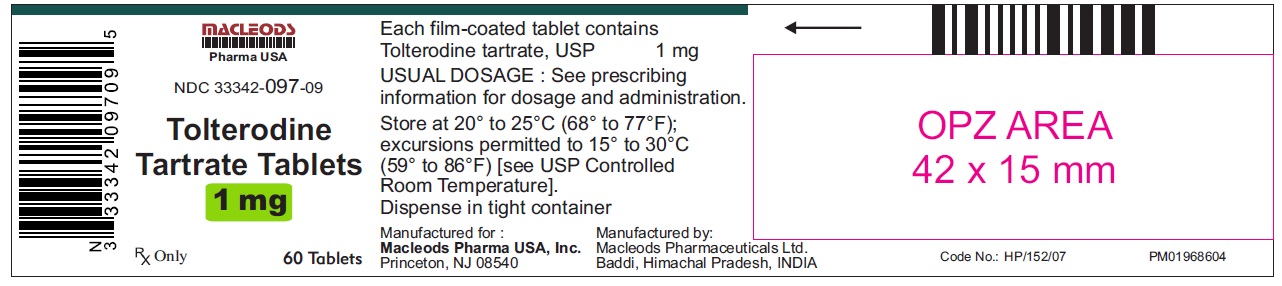
Tolterodine tartrate 1 mg Tablet, Film Coated, 60-count — NDC 33342-097-09 (Billing 33342-0097-09)
This is a package of 60 tablets of Tolterodine tartrate 1 mg Tablet, Film Coated from Macleods Pharmaceuticals Limited, marketed since Oct 2020 and currently FDA-listed; retail pharmacies pay about $0.2039 per tablet (NADAC). It is the main listing for this product, which comes in 3 package sizes.
NDC database record
One package, one record: these facts belong to NDC 33342-097-09 alone.
- Record
- FDA NDC Directory package listing · Human prescription drug
- Code segments
- 33342 labeler · 097 product · 09 package
- Package marketed since
- Oct 8, 2020
- Sample package
- No — commercial package
- Listing certified through
- Dec 31, 2026
- Billing quantity
- 60 EA per package
- Barcode (UPC)
- 0333342097095
- Medicaid fills, this package
- 533 prescriptions in the last four reported quarters
- FDA record last changed
- Jul 24, 2026
Identity & classification
Regulatory identifiers FDA, NLM and CMS codes for this package
Drug-database identifiers Medi-Span GPI and First Databank GCN / HICL / AHFS classification
- GSN (GCN sequence number): 039138
- GCN: 37061
- GPI-14 (Medi-Span): 54100060200320
- HICL (First Databank): 018047
- AHFS class code: 86:12.04.00
- RxCUI (RxNorm): 855178
Where does this data come from?
- FDA openFDA NDC Directory · synced Oct 1, 2026
- FDA label on DailyMed · label index refreshed Oct 5, 2026
- RxNorm (NLM RxNav) · catalog refreshed Oct 1, 2026
- Medi-Span GPI (licensed)
- First Databank (licensed) · refreshed Oct 1, 2026
RxNorm drug class
This medicine belongs to the Cholinergic Muscarinic Antagonist class.
Where does this data come from?
- RxClass (NLM) · catalog refreshed Oct 1, 2026
Clinical
- It treats overactive bladder, meaning sudden urges to urinate, leaking with those urges, and going very often. It helps calm the bladder muscle.
- It is taken by mouth. If you have the extended-release capsule, such as Detrol LA, take it once daily with water and swallow it whole. Follow your label and prescriber for your exa...
- Dry mouth is the most common. Headache, constipation, dizziness, stomach pain and dry or blurry eyes can also happen. Tell me if any of them bother you.
- Get emergency help for swelling of the face, lips or throat, or trouble breathing. Call your doctor if you cannot pass urine, or if you notice confusion, hallucinations, or a fast...
Patient education
Supplement & herbal interactions
Where does this data come from?
- MedlinePlus (NLM) · refreshed Oct 1, 2026
- FDA label on DailyMed · label index refreshed Oct 5, 2026
Ask a licensed pharmacist directly — free, answered by our team.
Pricing
A drug doesn't have one price. Each row is a different public payment system, and none is what you'd pay at the counter — that depends on your insurance. The ⓘ on each row explains what it measures.
| Price system | Per ea | Per package |
|---|---|---|
| Retail pharmacies payNADAC · weekly | $0.204 | $12.23 / 60 tablets |
| Medicaid paysCMS SDUD · 12 mo | $0.3962 | $23.77 / 60 tablets |
| Medicare drug plans payPart D · Q2 2026 | $0.5958 | $35.75 / 60 tablets |
Where does this data come from?
- CMS NADAC weekly file · file of Sep 30, 2026
- CMS ASP pricing files · refreshed Sep 20, 2026
- CMS Medicaid State Drug Utilization Data · through Q1 2026
- CMS Part D plan pricing files · refreshed Sep 24, 2026
- VA National Acquisition Center price file
Packaging — all sizes for this product
| Package NDC | Description | Per unit | Per pack | Marketing start | Marketing end | Status |
|---|---|---|---|---|---|---|
| 33342-0097-09 You're viewing this Main listing | 60 TABLET, FILM COATED in 1 BOTTLE | $0.2039 / ea | $12.23 | 2020-10-08 | — | Active |
| 33342-0097-12 33342-097-12 | 10 BLISTER PACK in 1 CARTON / 10 TABLET, FILM COATED in 1 BLISTER PACK | — | — | 2020-10-08 | — | Active |
| 33342-0097-15 33342-097-15 | 500 TABLET, FILM COATED in 1 BOTTLE | $0.2039 / ea | $101.95 | 2020-10-08 | — | Active |
This pack has the lowest per-ea cost of the 2 priced pack sizes ($0.2039 NADAC).
In Medicaid, this is the most-dispensed pack of this product — about 100% of fills over the last four reported quarters. See all packs ↓
Pack size FAQ
What quantity is in this package?
How does this package differ from NDC 33342-0097-15?
What NDC number is used to bill for this package of Tolterodine tartrate 1 mg Tablet, Film Coated?
Prices are the latest CMS NADAC pharmacy acquisition cost per NDC; per-pack figures are per-unit × pack quantity, shown only when the pack is denominated in the same measure NADAC prices.
Therapeutic equivalents
| Product | Labeler | Pack | NADAC/unit | TE | Status | Price vs. this |
|---|---|---|---|---|---|---|
| Tolterodine Tartrate 1 mg 59762-0170-01 | Mylan | 500 tablets | $0.204 | AB | Discontinued | +0% |
| Tolterodine Tartrate 1 mg 00093-0010-06 | Teva | 60 tablets | $0.204 | AB | Availability likely | — |
| Tolterodine tartrate 1 mgthis 33342-0097-09 | Macleods | 60 tablets | $0.204 | AB | Availability likely | — |
| Tolterodine Tartrate 1 mg 16571-0126-01 | Rising | 100 tablets | — | AB | FDA listed | — |
| Tolterodine Tartrate 1 mg 29300-0239-05 | Unichem | 500 tablets | — | AB | FDA listed | — |
| Tolterodine Tartrate 1 mg 31722-0805-01 | Camber | 10 tablets | — | AB | FDA listed | — |
| Detrol 1 mg 58151-0098-91 | Viatris | 60 tablets | — | AB | Discontinued | — |
| Tolterodine Tartrate 1 mg 71205-0319-30 | Proficient | 30 tablets | — | AB | FDA listed | — |
Where does this data come from?
- FDA openFDA NDC Directory · synced Oct 1, 2026
- FDA Orange Book · refreshed Oct 3, 2026
- CMS NADAC weekly file · file of Sep 30, 2026
Availability & generic status
This product is an FDA-approved generic. Other versions of the same drug are listed under Therapeutic equivalents, least expensive first.
Where does this data come from?
- FDA Orange Book · refreshed Oct 3, 2026
What it looks like
Where does this data come from?
- FDA label on DailyMed · label index refreshed Oct 5, 2026
Inactive Ingredients / Excipients
Inactive ingredients, also called excipients, are components of the drug product other than the active ingredient. They may include fillers, dyes, coatings, preservatives, flavors, or other formulation ingredients.
🧪 Avoiding an ingredient? See Tolterodine inactive ingredients by manufacturer: every current product's list side by side, so you can ask your pharmacy for the version that does not list it.
Where does this data come from?
IACT rows and label-wide narrative are kept separate; availability and product-level specificity depend on the submitted label.- FDA label on DailyMed · label index refreshed Oct 5, 2026
- FDA openFDA NDC Directory · synced Oct 1, 2026
Inactive ingredient FAQ
Are inactive ingredients the same for every manufacturer?
Why might an inactive ingredient be missing?
Can inactive ingredients matter?
Manufacturer & labeler
More NDCs from Macleods Pharmaceuticals Limited labeler code 33342
- Rivastigmine Tartrate 3 mg Capsule NDC 33342-090-06
- Rivastigmine Tartrate 4.5 mg Capsule NDC 33342-091-06
- Rivastigmine Tartrate 6 mg Capsule NDC 33342-092-06
- rizatriptan benzoate 5 mg Tablet, Orally Disintegrating NDC 33342-093-04
- rizatriptan benzoate 10 mg Tablet, Orally Disintegrating NDC 33342-094-04
- tenofovir disoproxil fumarate 300 mg Tablet, Film Coated NDC 33342-096-07
- Tolterodine tartrate 2 mg Tablet, Film Coated NDC 33342-098-09
- Quetiapine fumarate 25 mg Tablet, Film Coated NDC 33342-099-11
- Quetiapine fumarate 50 mg Tablet, Film Coated NDC 33342-100-11
- Quetiapine fumarate 100 mg Tablet, Film Coated NDC 33342-101-11
- Montelukast 10 mg Tablet NDC 33342-102-07
- Quetiapine fumarate 200 mg Tablet, Film Coated NDC 33342-103-11
Where does this data come from?
- FDA openFDA NDC Directory · synced Oct 1, 2026
- Drugs@FDA
Full prescribing information FDA SPL
🎯 Indications and Usage ▾
INDICATIONS & USAGE Tolterodine tartrate tablets are indicated for the treatment of overactive bladder with symptoms of urge urinary incontinence, urgency, and frequency.
⏱️ Dosage and Administration ▾
DOSAGE & ADMINISTRATION The initial recommended dose of tolterodine tartrate tablets is 2 mg twice daily. The dose may be lowered to 1 mg twice daily based on individual response and tolerability. For patients with significantly reduced hepatic or renal function or who are currently taking drugs that are potent inhibitors of CYP3A4, the recommended dose of tolterodine tartrate is 1 mg twice daily (see PRECAUTIONS , General , PRECAUTIONS, Reduced Hepatic and Renal Function , and PRECAUTIONS, Drug Interactions ).
⛔ Contraindications ▾
CONTRAINDICATIONS Tolterodine tartrate tablets are contraindicated in patients with urinary retention, gastric retention, or uncontrolled narrow-angle glaucoma. Tolterodine tartrate is also contraindicated in patients who have demonstrated hypersensitivity to the drug or its ingredients, or to fesoterodine fumarate extended-release tablets which, like tolterodine tartrate, are metabolized to 5-hydroxymethyl tolterodine.
⚠️ Warnings ▾
WARNINGS Anaphylaxis and angioedema requiring hospitalization and emergency medical treatment have occurred with the first or subsequent doses of tolterodine tartrate. In the event of difficulty in breathing, upper airway obstruction, or fall in blood pressure, tolterodine tartrate should be discontinued and appropriate therapy promptly provided.
🤒 Adverse Reactions ▾
ADVERSE REACTIONS The Phase 2 and 3 clinical trial program for tolterodine tartrate tablets included 3071 patients who were treated with tolterodine tartrate (N=2133) or placebo (N=938). The patients were treated with 1, 2, 4, or 8 mg/day for up to 12 months. No differences in the safety profile of tolterodine were identified based on age, gender, race, or metabolism.
The data described below reflect exposure to tolterodine tartrate 2 mg bid in 986 patients and to placebo in 683 patients exposed for 12 weeks in five Phase 3, controlled clinical studies. Because clinical trials are conducted under widely varying conditions, adverse reaction rates observed in the clinical trials of a drug cannot be directly compared to rates in the clinical trials of another drug and may not reflect the rates observed in practice. The adverse reaction information from clinical trials does, however, provide a basis for identifying the adverse events that appear to be related to drug use and approximating rates.
Sixty-six percent of patients receiving tolterodine tartrate 2 mg bid reported adverse events versus 56% of placebo patients. The most common adverse events reported by patients receiving tolterodine tartrate were dry mouth, headache, constipation, vertigo/dizziness, and abdominal pain. Dry mouth, constipation, abnormal vision (accommodation abnormalities), urinary retention, and xerophthalmia are expected side effects of antimuscarinic agents.
Dry mouth was the most frequently reported adverse event for patients treated with tolterodine tartrate 2 mg bid in the Phase 3 clinical studies, occurring in 34.8% of patients treated with tolterodine tartrate and 9.8% of placebo-treated patients. One percent of patients treated with tolterodine tartrate discontinued treatment due to dry mouth. The frequency of discontinuation due to adverse events was highest during the first 4 weeks of treatment.
Seven percent of patients treated with tolterodine tartrate 2 mg bid discontinued treatment due to adverse events versus 6% of placebo patients. The most common adverse events leading to discontinuation of tolterodine tartrate were dizziness and headache. Three percent of patients treated with tolterodine tartrate 2 mg bid reported a serious adverse event versus 4% of placebo patients.
Significant ECG changes in QT and QTc have not been demonstrated in clinical-study patients treated with tolterodine tartrate 2 mg bid. Table 5 lists the adverse events reported in 1% or more of the patients treated with tolterodine tartrate 2 mg bid in the 12-week studies. The adverse events are reported regardless of causality.
Table 5. Incidence* (%) of Adverse Events Exceeding Placebo Rate and Reported in >1% of Patients Treated with tolterodine tartrate tablets (2 mg bid) in 12 week, Phase 3 Clinical Studies Body System Adverse Event % Tolterodine tartrate N=986 % PlaceboN=683 Autonomic Nervous accommodation abnormal dry mouth 235 110 General chest pain fatigue headache influenza-like symptoms 2473 1352 Central/Peripheral Nervous vertigo/dizziness 5 3 Gastrointestinal abdominal pain constipation diarrhea dyspepsia 5744 3431 Urinary dysuria 2 1 Skin/Appendages dry skin 1 0 Musculoskeletal arthralgia 2 1 Vision xerophthalmia 3 2 Psychiatric somnolence 3 2 Metabolic/Nutritional weight gain 1 0 Resistance Mechanism infection 1 0 *in nearest integer.
Post-marketing Surveillance The following events have been reported in association with tolterodine use in worldwide post-marketing experience: General: anaphylaxis and angioedema; Cardiovascular: tachycardia, palpitations, peripheral edema; Central/Peripheral Nervous: confusion, disorientation, memory impairment, hallucinations. Reports of aggravation of symptoms of dementia (e.g., confusion, disorientation, delusion) have been reported after tolterodine therapy was initiated in patients taking cholinesterase inhibitors for the treatment of dementia.
Because these spontaneously reported events are from the worldwide post-mark… [Excerpted — this section continues on DailyMed.]
🔄 Drug Interactions ▾
Drug Interactions CYP3A4 Inhibitors: Ketoconazole, an inhibitor of the drug metabolizing enzyme CYP3A4, significantly increased plasma concentrations of tolterodine when coadministered to subjects who were poor metabolizers (see CLINICAL PHARMACOLOGY , Variability in Metabolism and Drug-Drug Interactions ). For patients receiving ketoconazole or other potent CYP3A4 inhibitors such as other azole antifungals (e.g., itraconazole, miconazole) or macrolide antibiotics (e.g., erythromycin, clarithromycin) or cyclosporine or vinblastine, the recommended dose of tolterodine tartrate is 1 mg twice daily (see DOSAGE AND ADMINISTRATION ).
🔄 Drug / Laboratory Test Interactions ▾
Drug- Laboratory Test Interactions Interactions between tolterodine and laboratory tests have not been studied.
🤰 Pregnancy ▾
Pregnancy Pregnancy Category C. At oral doses of 20 mg/kg/day (approximately 14 times the human exposure), no anomalies or malformations were observed in mice. When given at doses of 30 to 40 mg/kg/day, tolterodine has been shown to be embryolethal, reduce fetal weight, and increase the incidence of fetal abnormalities (cleft palate, digital abnormalities, intra-abdominal hemorrhage, and various skeletal abnormalities, primarily reduced ossification) in mice.
At these doses, the AUC values were about 20- to 25-fold higher than in humans. Rabbits treated subcutaneously at a dose of 0.8 mg/kg/day achieved an AUC of 100 µg•h/L, which is about 3-fold higher than that resulting from the human dose. This dose did not result in any embryotoxicity or teratogenicity.
There are no studies of tolterodine in pregnant women. Therefore, tolterodine tartrate should be used during pregnancy only if the potential benefit for the mother justifies the potential risk to the fetus.
🧒 Pediatric Use ▾
Pediatric Use Efficacy in the pediatric population has not been demonstrated. Two pediatric phase 3 randomized, placebo-controlled, double-blind, 12-week studies were conducted using tolterodine extended release (DETROL LA) capsules. A total of 710 pediatric patients (486 on DETROL LA and 224 on placebo) aged 5–10 years with urinary frequency and urge urinary incontinence were studied.
The percentage of patients with urinary tract infections was higher in patients treated with DETROL LA (6.6%) compared to patients who received placebo (4.5%). Aggressive, abnormal, and hyperactive behavior and attention disorders occurred in 2.9% of children treated with DETROL LA compared to 0.9% of children treated with placebo.
🧓 Geriatric Use ▾
Geriatric Use Of the 1120 patients who were treated in the four Phase 3, 12-week clinical studies of tolterodine tartrate, 474 (42%) were 65 to 91 years of age. No overall differences in safety were observed between the older and younger patients (see CLINICAL PHARMACOLOGY , Pharmacokinetics in Special Populations ).
🆘 Overdosage ▾
OVERDOSAGE A 27-month-old child who ingested 5 to 7 tolterodine tartrate tablets 2 mg was treated with a suspension of activated charcoal and was hospitalized overnight with symptoms of dry mouth. The child fully recovered. Management of Overdosage Overdosage with tolterodine tartrate can potentially result in severe central anticholinergic effects and should be treated accordingly.
ECG monitoring is recommended in the event of overdosage. In dogs, changes in the QT interval (slight prolongation of 10% to 20%) were observed at a suprapharmacologic dose of 4.5 mg/kg, which is about 68 times higher than the recommended human dose. In clinical trials of normal volunteers and patients, QT interval prolongation was observed with tolterodine immediate release at doses up to 8 mg (4 mg bid) and higher doses were not evaluated (see PRECAUTIONS, Patients with Congenital or Acquired QT Prolongation ).
🧬 Clinical Pharmacology ▾
CLINICAL PHARMACOLOGY Tolterodine is a competitive muscarinic receptor antagonist. Both urinary bladder contraction and salivation are mediated via cholinergic muscarinic receptors. After oral administration, tolterodine is metabolized in the liver, resulting in the formation of the 5-hydroxymethyl derivative, a major pharmacologically active metabolite.
The 5-hydroxymethyl metabolite, which exhibits an antimuscarinic activity similar to that of tolterodine, contributes significantly to the therapeutic effect. Both tolterodine and the 5-hydroxymethyl metabolite exhibit a high specificity for muscarinic receptors, since both show negligible activity or affinity for other neurotransmitter receptors and other potential cellular targets, such as calcium channels. Tolterodine has a pronounced effect on bladder function.
Effects on urodynamic parameters before and 1 and 5 hours after a single 6.4 mg dose of tolterodine immediate release were determined in healthy volunteers. The main effects of tolterodine at 1 and 5 hours were an increase in residual urine, reflecting an incomplete emptying of the bladder, and a decrease in detrusor pressure. These findings are consistent with an antimuscarinic action on the lower urinary tract.
Pharmacokinetics Absorption: In a study with 14 C-tolterodine solution in healthy volunteers who received a 5 mg oral dose, at least 77% of the radiolabeled dose was absorbed. Tolterodine immediate release is rapidly absorbed, and maximum serum concentrations (C max ) typically occur within 1 to 2 hours after dose administration. C max and area under the concentration-time curve (AUC) determined after dosage of tolterodine immediate release are dose-proportional over the range of 1 to 4 mg.
Effect of Food: Food intake increases the bioavailability of tolterodine (average increase 53%), but does not affect the levels of the 5-hydroxymethyl metabolite in extensive metabolizers. This change is not expected to be a safety concern and adjustment of dose is not needed. Distribution: Tolterodine is highly bound to plasma proteins, primarily α1-acid glycoprotein.
Unbound concentrations of tolterodine average 3.7% ± 0.13% over the concentration range achieved in clinical studies. The 5-hydroxymethyl metabolite is not extensively protein bound, with unbound fraction concentrations averaging 36% ± 4.0%. The blood to serum ratio of tolterodine and the 5-hydroxymethyl metabolite averages 0.6 and 0.8, respectively, indicating that these compounds do not distribute extensively into erythrocytes.
The volume of distribution of tolterodine following administration of a 1.28 mg intravenous dose is 113 ±
26.7L. Metabolism: Tolterodine is extensively metabolized by the liver following oral dosing. The primary metabolic route involves the oxidation of the 5-methyl group and is mediated by the cytochrome P450 2D6 (CYP2D6) and leads to the formation of a pharmacologically active 5-hydroxymethyl metabolite.
Further metabolism leads to formation of the 5-carboxylic acid and N-dealkylated 5-carboxylic acid metabolites, which account for 51% ± 14% and 29% ± 6.3% of the metabolites recovered in the urine, respectively. Variability in Metabolism: A subset (about 7%) of the population is devoid of CYP2D6, the enzyme responsible for the formation of the 5-hydroxymethyl metabolite of tolterodine. The identified pathway of metabolism for these individuals ("poor metabolizers") is dealkylation via cytochrome P450 3A4 (CYP3A4) to N-dealkylated tolterodine.
The remainder of the population is referred to as "extensive metabolizers." Pharmacokinetic studies revealed that tolterodine is metabolized at a slower rate in poor metabolizers than in extensive metabolizers; this results in significantly higher serum concentrations of tolterodine and in negligible concentrations of the 5-hydroxymethyl metabolite. Excretion: Following administration of a 5 mg oral dose of 14 C-tolterodine solution to healthy volunteers, 77% of radioactivity was recovered… [Excerpted — this section continues on DailyMed.]
📦 How Supplied / Storage and Handling ▾
HOW SUPPLIED Tolterodine tartrate tablets 1 mg (white to off white, round, biconvex, film-coated tablets debossed with 'CL60' on one side and plain on other side) and tolterodine tartrate tablets 2 mg (white to off white, round, biconvex, film-coated tablets debossed with 'CL61' on one side and plain on other side) are supplied as follows: Bottles of 60 1mg NDC 33342-097-09 2mg NDC 33342-098-09 Bottles of 500 1mg NDC 33342-097-15 2mg NDC 33342-098-15 Unit Dose Pack of 100 1mg NDC 33342-097-12 2 mg NDC 33342-098-12 Store at 20º to 25ºC (68º to 77ºF); excursions permitted to 15º to 30ºC (59º to 86ºF) [see USP Controlled Room Temperature].
All other trademarks are properties of their respective owners. Manufactured for : Macleods Pharma USA, Inc. Princeton, NJ 08540 Manufactured by : Macleods Pharmaceuticals Ltd.
Baddi, Himachal Pradesh, INDIA Revised: November 2022
📋 Description ▾
DESCRIPTION Tolterodine tartrate tablets contain tolterodine tartrate, USP. The active moiety, tolterodine, is a muscarinic receptor antagonist. The chemical name of tolterodine tartrate is (R)-2-[3-[bis(1-methylethyl)-amino]1-phenylpropyl]-4-methylphenol[R-(R*,R*)]-2,3dihydroxybutanedioate (1:1) (salt).
The molecular formula of tolterodine tartrate is C 26 H 37 NO 7 , and its molecular weight is 475.6. The structural formula of tolterodine tartrate is represented below: Tolterodine tartrate, USP is a white, crystalline powder. The pKa value is 9.87 and the solubility in water is 12 mg/mL.
It is soluble in methanol, slightly soluble in ethanol, and practically insoluble in toluene. The partition coefficient (Log D) between n-octanol and water is 1.83 at pH 7.3. Tolterodine tartrate tablets for oral administration contain 1 or 2 mg of tolterodine tartrate.
The inactive ingredients are colloidal silicon dioxide, dibasic calcium phosphate anhydrous, cellulose microcrystalline, hypromellose, magnesium stearate, sodium starch glycolate (pH 3.0 to 5.0), stearic acid, and titanium dioxide. structure
💬 Information for Patients ▾
Information for Patients Patients should be informed that antimuscarinic agents such as tolterodine tartrate tablets may produce the following effects: blurred vision, dizziness, or drowsiness. Patients should be advised to exercise caution in decisions to engage in potentially dangerous activities until the drug's effects have been determined.
⚠️ Precautions ▾
PRECAUTIONS General Risk of Urinary Retention and Gastric Retention: Tolterodine tartrate tablets should be administered with caution to patients with clinically significant bladder outflow obstruction because of the risk of urinary retention and to patients with gastrointestinal obstructive disorders, such as pyloric stenosis, because of the risk of gastric retention (see CONTRAINDICATIONS ). Decreased Gastrointestinal Motility: Tolterodine tartrate, like other antimuscarinic drugs, should be used with caution in patients with decreased gastrointestinal motility.
Controlled Narrow-Angle Glaucoma: Tolterodine tartrate should be used with caution in patients being treated for narrow-angle glaucoma. Central Nervous System (CNS) Effects: Tolterodine tartrate is associated with anticholinergic central nervous system (CNS) effects including dizziness and somnolence (see Adverse Reactions). Patients should be monitored for signs of anticholinergic CNS effects, particularly after beginning treatment or increasing the dose.
Advise patients not to drive or operate heavy machinery until the drug’s effects have been determined. If a patient experiences anticholinergic CNS effects, dose reduction or drug discontinuation should be considered. Reduced Hepatic and Renal Function: For patients with significantly reduced hepatic function or renal function, the recommended dose of tolterodine tartrate is 1 mg twice daily (see CLINICAL PHARMACOLOGY, Pharmacokinetics in Special Populations ).
Myasthenia Gravis: Tolterodine tartrate should be used with caution in patients with myasthenia gravis, a disease characterized by decreased cholinergic activity at the neuromuscular junction. Patients with Congenital or Acquired QT Prolongation In a study of the effect of tolterodine immediate release tablets on the QT interval (see CLINICAL PHARMACOLOGY, Cardiac Electrophysiology ), the effect on the QT interval appeared greater for 8 mg/day (two times the therapeutic dose) compared to 4 mg/day and was more pronounced in CYP2D6 poor metabolizers (PM) than extensive metabolizers (EMs).
The effect of tolterodine 8 mg/day was not as large as that observed after four days of therapeutic dosing with the active control moxifloxacin. However, the confidence intervals overlapped. These observations should be considered in clinical decisions to prescribe tolterodine tartrate for patients with a known history of QT prolongation or patients who are taking Class IA (e.g., quinidine, procainamide) or Class III (e.g., amiodarone, sotalol) antiarrhythmic medications (see PRECAUTIONS, Drug Interactions ).
There has been no association of Torsade de Pointes in the international post-marketing experience with tolterodine tartrate tablets or tolterodine tartrate extended-release capsules. Information for Patients Patients should be informed that antimuscarinic agents such as tolterodine tartrate tablets may produce the following effects: blurred vision, dizziness, or drowsiness. Patients should be advised to exercise caution in decisions to engage in potentially dangerous activities until the drug's effects have been determined.
Drug Interactions CYP3A4 Inhibitors: Ketoconazole, an inhibitor of the drug metabolizing enzyme CYP3A4, significantly increased plasma concentrations of tolterodine when coadministered to subjects who were poor metabolizers (see CLINICAL PHARMACOLOGY , Variability in Metabolism and Drug-Drug Interactions ). For patients receiving ketoconazole or other potent CYP3A4 inhibitors such as other azole antifungals (e.g., itraconazole, miconazole) or macrolide antibiotics (e.g., erythromycin, clarithromycin) or cyclosporine or vinblastine, the recommended dose of tolterodine tartrate is 1 mg twice daily (see DOSAGE AND ADMINISTRATION ).
Drug- Laboratory Test Interactions Interactions between tolterodine and laboratory tests have not been studied. Carcinogenesis, Mutagenesis, Impairment of Fertility Carcinogenicity studies with tolterodine were conducted in m… [Excerpted — this section continues on DailyMed.]
🍼 Nursing Mothers ▾
Nursing Mothers Tolterodine is excreted into the milk in mice. Offspring of female mice treated with tolterodine 20 mg/kg/day during the lactation period had slightly reduced body weight gain. The offspring regained the weight during the maturation phase.
It is not known whether tolterodine is excreted in human milk; therefore, tolterodine tartrate should not be administered during nursing. A decision should be made whether to discontinue nursing or to discontinue tolterodine tartrate in nursing mothers.
🔬 Clinical Studies ▾
CLINICAL STUDIES Tolterodine tartrate tablets were evaluated for the treatment of overactive bladder with symptoms of urge urinary incontinence, urgency, and frequency in four randomized, double-blind, placebo-controlled, 12-week studies. A total of 853 patients received tolterodine tartrate 2 mg twice daily and 685 patients received placebo. The majority of patients were Caucasian (95%) and female (78%), with a mean age of 60 years (range, 19 to 93 years).
At study entry, nearly all patients perceived they had urgency and most patients had increased frequency of micturitions and urge incontinence. These characteristics were well balanced across treatment groups for the studies. The efficacy endpoints for study 007 (see Table 3) included the change from baseline for: • Number of incontinence episodes per week • Number of micturitions per 24 hours (averaged over 7 days) • Volume of urine voided per micturition (averaged over 2 days) The efficacy endpoints for studies 008, 009, and 010 (see Table 4) were identical to the above endpoints with the exception that the number of incontinence episodes was per 24 hours (averaged over 7 days).
Table 3. 95% Confidence Intervals (CI) for the Difference between tolterodine tartrate (2 mg bid) and Placebo for the Mean Change at Week 12 from Baseline in Study 007 Tolterodine tartrate (SD) N=514 Placebo (SD) N=508 Difference (95% CI) Number of Incontinence Episodes per Week Mean baseline Mean change from baseline 23.2 -10.6 (17) 23.3 -6.9 (15) -3.7 (-5.7, -1.6) Number of Micturitions per 24 Hours Mean baseline Mean change from baseline 11.1 -1.7 (3.3) 11.3 -1.2 (2.9) -0.5* (-0.9, -0.1) Volume Voided per Micturition (mL) Mean baseline Mean change from baseline 137 29 (47) 136 14 (41) 15* (9, 21) SD = Standard Deviation. *The difference between tolterodine tartrate and placebo was statistically significant.
Table 4. 95% Confidence Intervals (CI) for the Difference between tolterodine tartrate (2 mg bid) and Placebo for the Mean Change at Week 12 from Baseline in Studies 008, 009, 010 Study Tolterodine tartrate(SD) Placebo(SD) Difference(95% CI) Number of Incontinence Episodes per 24 Hours 008 Number of patients Mean baseline Mean change from baseline 93 2.9 -1.3 (3.2) 40 3.3 -0.9 (1.5) 0.5 (-1.3, 0.3) 009 Number of patients Mean baseline Mean change from baseline 116 3.6 -1.7 (2.5) 55 3.5 -1.3 (2.5) -0.4 (-1.0, 0.2) 010 Number of patients Mean baseline Mean change from baseline 90 3.7 -1.6 (2.4) 50 3.5 -1.1 (2.1) -0.5 (-1.1, 0.1) Number of Micturitions per 24 Hours 008 Number of patients Mean baseline Mean change from baseline 118 11.5 -2.7 (3.8) 56 11.7 -1.6 (3.6) -1.2* (-2.0,-0.4) 009 Number of patients Mean baseline Mean change from baseline 128 11.2 -2.3 (2.1) 64 11.3 -1.4 (2.8) -0.9* (-1.5,-0.3) 010 Number of patients Mean baseline Mean change from baseline 108 11.6 -1.7 (2.3) 56 11.6 -1.4 (2.8) -0.38 (-1.1,0.3) Volume Voided per Micturition (mL) 008 Number of patients Mean baseline Mean change from baseline 118 166 38 (54) 56 157 6 (42) 32* (18,46) 009 Number of patients Mean baseline Mean change from baseline 129 155 36 (50) 64 158 10 (47) 26* (14,38) 010 Number of patients Mean baseline Mean change from baseline 108 155 31 (45) 56 160 13 (52) 18* (4,32) SD = Standard Deviation. *The difference between tolterodine tartrate and placebo was statistically significant.
📄 Carcinogenesis, Mutagenesis, Impairment of Fertility ▾
Carcinogenesis, Mutagenesis, Impairment of Fertility Carcinogenicity studies with tolterodine were conducted in mice and rats. At the maximum tolerated dose in mice (30 mg/kg/day), female rats (20 mg/kg/day), and male rats (30 mg/kg/day), AUC values obtained for tolterodine were 355, 291, and 462 µg•h/L, respectively. In comparison, the human AUC value for a 2 mg dose administered twice daily is estimated at 34 µg•h/L.
Thus, tolterodine exposure in the carcinogenicity studies was 9- to 14-fold higher than expected in humans. No increase in tumors was found in either mice or rats. No mutagenic effects of tolterodine were detected in a battery of in vitro tests, including bacterial mutation assays (Ames test) in 4 strains of Salmonella typhimurium and in 2 strains of Escherichia coli , a gene mutation assay in L5178Y mouse lymphoma cells, and chromosomal aberration tests in human lymphocytes.
Tolterodine was also negative in vivo in the bone marrow micronucleus test in the mouse. In female mice treated for 2 weeks before mating and during gestation with 20 mg/kg/day (corresponding to AUC value of about 500 µg•h/L), neither effects on reproductive performance or fertility were seen. Based on AUC values, the systemic exposure was about 15-fold higher in animals than in humans.
In male mice, a dose of 30 mg/kg/day did not induce any adverse effects on fertility.
📄 Patient Package Insert ▾
SPL PATIENT PACKAGE INSERT TOLTERODINE TARTRATE TABLETS (tol-TER-oh-deen TAR-trate) Read the Patient Information that comes with tolterodine tartrate before you start using it and each time you get a refill. There may be new information. This leaflet does not take the place of talking with your doctor about your condition or your treatment.
Only your doctor can determine if treatment with tolterodine tartrate is right for you. What are tolterodine tartrate tablets? Tolterodine tartrate tablets are a prescription medicine for adults used to treat the following symptoms due to a condition called overactive bladder : • Urge urinary incontinence: a strong need to urinate with leaking or wetting accidents. • Urgency: a strong need to urinate right away. • Frequency: urinating often DETROL LA (tolterodine tartrate extended release capsules) did not help the symptoms of overactive bladder when studied in children.
What is overactive bladder? Overactive bladder happens when you cannot control your bladder muscle. When the muscle contracts too often or cannot be controlled, you get symptoms of overactive bladder, which are leakage of urine (urge urinary incontinence), needing to urinate right away (urgency), and needing to urinate often (frequency).
Who should not take tolterodine tartrate tablets? Do not take tolterodine tartrate tablets if you: • Are not able to empty your bladder (urinary retention) • Have delayed or slow emptying of your stomach (gastric retention) • Have an eye problem called “uncontrolled narrow-angle glaucoma” • Are allergic to tolterodine tartrate tablets or to any of its ingredients. See the end of this leaflet for a complete list of ingredients • Are allergic to TOVIAZ which contains fesoterodine.
What should I tell my doctor before starting tolterodine tartrate tablets? Before starting tolterodine tartrate tablets, tell your doctor about all of your medical and other conditions that may affect the use of tolterodine tartrate tablets, including: • Stomach or intestinal problems or problems with constipation • Problems emptying your bladder or if you have a weak urine stream • Treatment for an eye problem called narrow-angle glaucoma • Liver problems • Kidney problems • A condition called myasthenia gravis • If you or any family members have a rare heart condition called QT prolongation (long QT syndrome) • If you are pregnant or trying to become pregnant.
It is not known if tolterodine tartrate tablets could harm your unborn baby. • If you are breastfeeding. It is not known if tolterodine tartrate passes into your breast milk or if it can harm your baby. Talk to your doctor about the best way to feed your baby if you take tolterodine tartrate tablets.
Tell your doctor about all the medicines you take, including prescription and non-prescription medicines, vitamins, and herbal supplements. Other medicines can affect how your body handles tolterodine tartrate tablets. Your doctor may use a lower dose of tolterodine tartrate tablets if you are taking: • Certain medicines for fungus or yeast infections • Certain medicines for bacterial infections • Sandimmune ® .
(cyclosporine) or Velban ® . (vinblastine) Ask your doctor or pharmacist for a list of these medicines, if you are not sure. Know the medicines you take.
Keep a list of them with you to show your doctor or pharmacist each time you get a new medicine. How should I take tolterodine tartrate tablets ? • Take tolterodine tartrate tablets exactly as your doctor tells you to take it. • Your doctor will tell you how many tolterodine tartrate tablets to take and when to take them. • Do not change your dose unless told to do so by your doctor. • You can take tolterodine tartrate tablets with or without food. • Take tolterodine tartrate tablets at the same times each day. • If you miss a dose of tolterodine tartrate tablets, just take your next regular dose at your next regular time.
Do not try to make up for your missed dose. • If you take too much tolterodine ta… [Excerpted — this section continues on DailyMed.]
📄 Package Label / Principal Display Panel ▾
PACKAGE LABEL.PRINCIPAL DISPLAY PANEL Rx Only NDC 33342-097-09 Tolterodine Tartrate Tablets 1 mg Bottle of 60 tablets Rx Only NDC 33342-098-09 Tolterodine Tartrate Tablets 2 mg Bottle of 60 tablets 505 505