
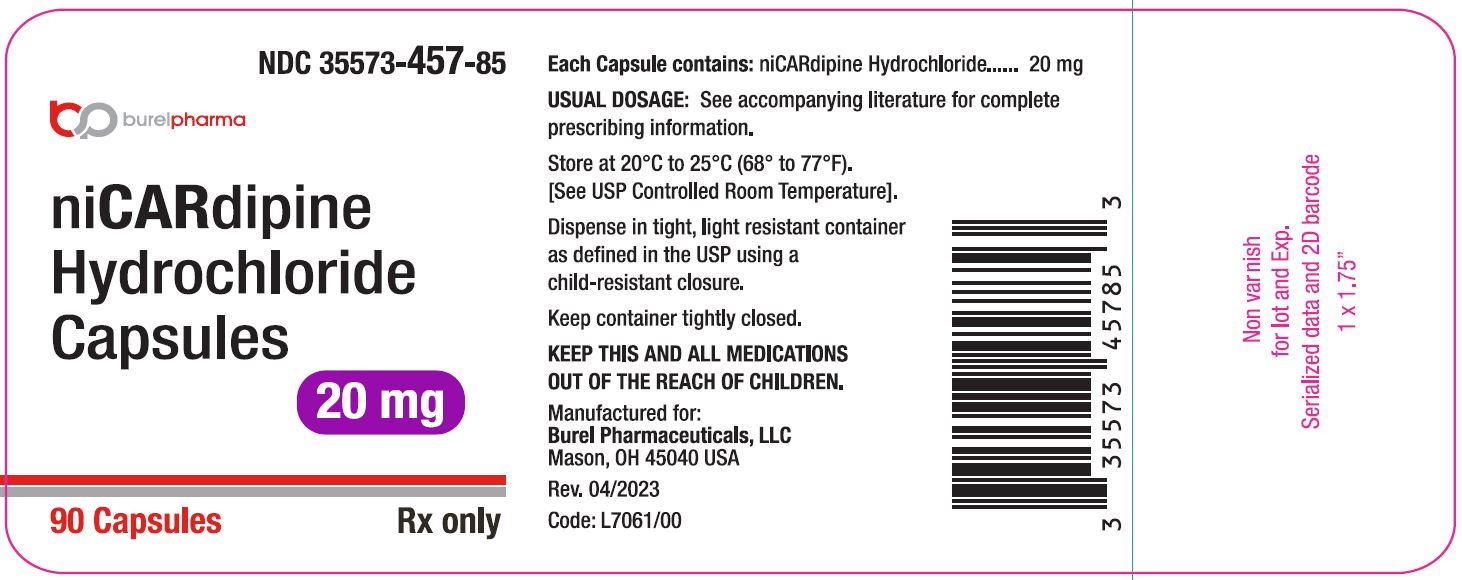
Nicardipine Hydrochloride 20 mg Capsule, 90-count — NDC 35573-457-85 (Billing 35573-0457-85)
This is a package of 90 capsules of Nicardipine Hydrochloride 20 mg Capsule from Burel Pharmaceuticals, LLC, marketed since Jan 2023 and currently FDA-listed; retail pharmacies pay about $1.12 per capsule (NADAC). It is this product's only package size.
NDC database record
One package, one record: these facts belong to NDC 35573-457-85 alone.
- Record
- FDA NDC Directory package listing · Human prescription drug
- Code segments
- 35573 labeler · 457 product · 85 package
- Package marketed since
- Jan 8, 2023
- Sample package
- No — commercial package
- Listing certified through
- Dec 31, 2026
- Billing quantity
- 90 EA per package
- Barcode (UPC)
- 0335573457853, 0335573458850
- Medicaid fills, this package
- 11 prescriptions in the last four reported quarters
- FDA record last changed
- Oct 8, 2026
Other active recalls for Nicardipine Hydrochloride (different manufacturers) — 6 · tap to view
Identity & classification
Regulatory identifiers FDA, NLM and CMS codes for this package
Drug-database identifiers Medi-Span GPI and First Databank GCN / HICL / AHFS classification
- GSN (GCN sequence number): 000577
- GCN: 02390
- GPI-14 (Medi-Span): 34000018100120
- HICL (First Databank): 000183
- AHFS class code: 24:28.08.00
- RxCUI (RxNorm): 858613
Where does this data come from?
- FDA openFDA NDC Directory · synced Oct 8, 2026
- FDA label on DailyMed · label index refreshed Oct 8, 2026
- RxNorm (NLM RxNav) · catalog refreshed Oct 8, 2026
- Medi-Span GPI (licensed)
- First Databank (licensed) · refreshed Oct 8, 2026
RxNorm drug class
This medicine belongs to the Dihydropyridine Calcium Channel Blocker class.
Where does this data come from?
- RxClass (NLM) · catalog refreshed Oct 8, 2026
Clinical
- Nicardipine treats high blood pressure. The capsules are also used for chronic stable angina, which is chest pain brought on by effort. The IV form is used short term in a medical...
- You take them by mouth, usually three times a day, and your prescriber adjusts the dose to your blood pressure. Doses shouldn't be raised more often than every 3 days. Food can low...
- Common ones include ankle swelling, dizziness, headache, flushing, weakness and a pounding heartbeat. These come from the blood vessels widening. Call your doctor if your chest pai...
- Tell me about everything you take. Nicardipine raises levels of cyclosporine and tacrolimus, and cimetidine raises nicardipine levels. Your doctor may check digoxin levels after yo...
Patient education
Supplement & herbal interactions
Nicardipine may be associated with lower levels of 2 nutrients — worth a chat with your pharmacist, not a cause for alarm.
Where does this data come from?
- MedlinePlus (NLM) · refreshed Oct 8, 2026
- FDA label on DailyMed · label index refreshed Oct 8, 2026
Ask a licensed pharmacist directly — free, answered by our team.
Pricing
A drug doesn't have one price. Each row is a different public payment system, and none is what you'd pay at the counter — that depends on your insurance. The ⓘ on each row explains what it measures.
| Price system | Per ea | Per package |
|---|---|---|
| Retail pharmacies payNADAC · weekly | $1.122 | $100.97 / 90 capsules |
| Medicaid paysCMS SDUD · 12 mo | $3.10 | $279.34 / 90 capsules |
| Medicare drug plans payPart D · Q2 2026 | $2.32 | $208.39 / 90 capsules |
Where does this data come from?
- CMS NADAC weekly file · file of Aug 19, 2026
- CMS ASP pricing files · refreshed Sep 20, 2026
- CMS Medicaid State Drug Utilization Data · through Q3 2025
- CMS Part D plan pricing files · refreshed Sep 24, 2026
- VA National Acquisition Center price file
Packaging — all sizes for this product
| Package NDC | Description | Marketing start | Marketing end | Status |
|---|---|---|---|---|
| 35573-0457-85 You're viewing this Main listing | 90 CAPSULE in 1 BOTTLE | 2023-01-08 | — | Active |
Therapeutic equivalents
| Product | Labeler | Pack | NADAC/unit | TE | Status | Price vs. this |
|---|---|---|---|---|---|---|
| Nicardipine Hydrochloride 20 mg 62559-0205-90 | ANI | 90 capsules | $1.120 | AB | Availability likely | +0% |
| Nicardipine hydrochloride 20 mg 69238-2691-01 | Amneal | 90 capsules | $1.120 | AB | Availability likely | +0% |
| Nicardipine Hydrochloride 20 mg 69292-0620-90 | Amici | 90 capsules | $1.120 | AB | Availability likely | +0% |
| Nicardipine Hydrochloride 20 mg 69452-0436-19 | Bionpharma | 90 capsules | $1.120 | AB | Availability likely | +0% |
| Nicardipine Hydrochloride 20 mgthis 35573-0457-85 | Burel | 90 capsules | $1.122 | AB | Availability likely | — |
| Nicardipine Hydrochloride 20 mg 24658-0750-90 | PuraCap | 90 capsules | — | AB | FDA listed | — |
| Nicardipine Hydrochloride 20 mg 42806-0501-01 | Epic | 100 capsules | — | AB | FDA listed | — |
| Nicardipine Hydrochloride 20 mg 68462-0120-05 | Glenmark | 500 capsules | — | AB | FDA listed | — |
| Nicardipine Hydrochloride 20 mg 70710-2010-09 | Zydus | 90 capsules | — | — | Discontinued | — |
| Nicardipine Hydrochloride 20 mg 87564-0027-90 | Amerisyn | 90 capsules | — | AB | FDA listed | — |
Where does this data come from?
- FDA openFDA NDC Directory · synced Oct 8, 2026
- FDA Orange Book · refreshed Oct 9, 2026
- CMS NADAC weekly file · file of Aug 19, 2026
Availability & generic status
This product is an FDA-approved generic. Other versions of the same drug are listed under Therapeutic equivalents, least expensive first.
Where does this data come from?
- FDA Orange Book · refreshed Oct 9, 2026
Inactive Ingredients / Excipients
Inactive ingredients, also called excipients, are components of the drug product other than the active ingredient. They may include fillers, dyes, coatings, preservatives, flavors, or other formulation ingredients.
🧪 Avoiding an ingredient? See Nicardipine inactive ingredients by manufacturer: every current product's list side by side, so you can ask your pharmacy for the version that does not list it.
💡 Tap an ingredient (hover on desktop) to see what it is and why it’s used.
-
UNII 5138Q19F1X
Ammonia is a colorless gas made from nitrogen and hydrogen. It's used in medicines as a pH buffer to maintain the correct acidity level and help keep the product stable.
-
UNII H3R47K3TBD
FD&C Blue No. 1 is a synthetic blue dye approved for use in foods and medicines. It serves as a colorant to give the medication its distinctive appearance and help with product identification.
-
UNII XM0M87F357
A dark iron oxide compound that gives medicines their black or dark color. It's used as a colorant in tablets and capsules to help identify the product and make it visually distinctive.
-
UNII 2G86QN327L
Gelatin is a protein derived from animal collagen, commonly used in medicines as a gelling agent and capsule material. It helps create soft or hard capsule shells that hold and release medication, and can also thicken liquid formulations.
-
UNII 70097M6I30
Magnesium stearate is a salt made from magnesium and stearic acid, a fatty substance. It's used in tablets and capsules as a lubricant and glidant to help ingredients flow smoothly during manufacturing and prevent sticking.
-
UNII WZH3C48M4T
Potassium hydroxide is a strong alkaline chemical used in medicines to adjust and maintain the pH level of liquid formulations, helping keep the product stable and the active ingredients effective.
-
UNII 6DC9Q167V3
Propylene glycol is a clear liquid derived from petroleum or vegetable sources. It acts as a solvent, humectant, and preservative in medicines, helping dissolve active ingredients and maintain product stability.
-
UNII 46N107B71O
Shellac is a natural resin secreted by the lac beetle. It's used as a coating on tablets and capsules to control how quickly the medicine dissolves and to improve appearance and stability.
-
UNII ETJ7Z6XBU4
Silicon dioxide is a naturally occurring mineral used as a glidant and anti-caking agent. It helps powder ingredients flow smoothly and prevents clumping during manufacturing and storage.
-
UNII O8232NY3SJ
A plant-based carbohydrate derived from corn kernels. It acts as a filler to add bulk, a binder to hold ingredients together, and a disintegrant to help the tablet break apart in your stomach for absorption.
-
UNII 15FIX9V2JP
Titanium dioxide is a bright white mineral powder commonly used as a colorant and opacifying agent. It makes pills and tablets white or lighter in color and helps make coatings non-transparent.
11 inactive ingredients listed in the exact product block matched to this NDC.
Where does this data come from?
ingredient classCode="IACT" elements from the exact product block matched by this NDC. Label-section narrative from DailyMed / the openFDA label index is shown separately when available.- FDA label on DailyMed · label index refreshed Oct 8, 2026
- FDA openFDA NDC Directory · synced Oct 8, 2026
Inactive ingredient FAQ
Are inactive ingredients the same for every manufacturer?
Why might an inactive ingredient be missing?
Can inactive ingredients matter?
Manufacturer & labeler
More NDCs from Burel Pharmaceuticals, LLC labeler code 35573
- Leflunomide 10 mg Tablet, Film Coated NDC 35573-447-30
- Leflunomide 20 mg Tablet, Film Coated NDC 35573-448-30
- Benzoyl Peroxide 50 mg/mL Liquid NDC 35573-453-08
- Benzoyl Peroxide 100 mg/mL Liquid NDC 35573-454-08
- Butalbital and Acetaminophen 50 mg; 300 mg Tablet NDC 35573-455-02
- Butalbital and Acetaminophen 50 mg; 325 mg Tablet NDC 35573-456-02
- Nicardipine Hydrochloride 30 mg Capsule NDC 35573-458-85
- Carglumic acid 200 mg Tablet, For Suspension NDC 35573-459-60
- tadalafil 2.5 mg Tablet, Film Coated NDC 35573-460-56
- tadalafil 5 mg Tablet, Film Coated NDC 35573-461-30
- tadalafil 10 mg Tablet, Film Coated NDC 35573-462-30
- tadalafil 20 mg Tablet, Film Coated NDC 35573-463-30
Where does this data come from?
- FDA openFDA NDC Directory · synced Oct 8, 2026
- Drugs@FDA
Full prescribing information FDA SPL
🎯 Indications and Usage ▾
INDICATIONS AND USAGE I. Stable Angina Nicardipine hydrochloride capsules are indicated for the management of patients with chronic stable angina (effort-associated angina). Nicardipine hydrochloride capsules may be used alone or in combination with beta-blockers.
II. Hypertension Nicardipine hydrochloride capsules are indicated for the treatment of hypertension. Nicardipine hydrochloride capsules may be used alone or in combination with other antihypertensive drugs.
In administering nicardipine hydrochloride it is important to be aware of the relatively large peak to trough differences in blood pressure effect (See DOSAGE AND ADMINISTRATION ).
⏱️ Dosage and Administration ▾
DOSAGE AND ADMINISTRATION Angina The dose should be individually titrated for each patient beginning with 20 mg three times daily. Doses in the range of 20 to 40 mg three times a day have been shown to be effective. At least 3 days should be allowed before increasing the nicardipine hydrochloride capsules dose to ensure achievement of steady-state plasma drug concentrations.
Concomitant Use With Other Antianginal Agents Sublingual NTG may be taken as required to abort acute anginal attacks during nicardipine hydrochloride capsules therapy. Prophylactic Nitrate Therapy: nicardipine hydrochloride capsules may be safely co-administered with short- and long-acting nitrates. Beta-blockers: Nicardipine hydrochloride capsules may be safely co-administered with beta- blockers (see Drug Interactions ) .
Hypertension The dose of nicardipine hydrochloride capsules should be individually adjusted according to the blood pressure response beginning with 20 mg three times daily. The effective doses in clinical trials have ranged from 20 mg to 40 mg three times daily. The maximum blood pressure lowering effect occurs approximately 1 to 2 hours after dosing.
To assess the adequacy of blood pressure response, the blood pressure should be measured at trough (8 hours after dosing). Because of the prominent peak effects of nicardipine, blood pressure should be measured 1 to 2 hours after dosing, particularly during initiation of therapy (see PRECAUTIONS: Blood Pressure , INDICATIONS AND USAGE , CLINICAL PHARMACOLOGY, Effects in Hypertension ). At least 3 days should be allowed before increasing the nicardipine hydrochloride capsules dose to ensure achievement of steady-state plasma drug concentrations.
Concomitant Use With Other Antihypertensive Agents Diuretics: nicardipine hydrochloride capsules may be safety co-administered with thiazide diuretics. Beta-blockers: nicardipine hydrochloride capsules may be safely co-administered with beta-blocker (see PRECAUTIONS , Drug Interactions ) Special Patient Population Renal Insufficiency Although there is no evidence that nicardipine hydrochloride capsules impair renal function, careful dose titration beginning with 20 mg tid is advised (see PRECAUTIONS ). Hepatic Insufficiency Nicardipine hydrochloride capsules should be administered cautiously in patients with severely impaired hepatic function.
A suggested starting dose of 20 mg twice a day is advised with individual titration based on clinical findings maintaining the twice a day schedule (see PRECAUTIONS ). Congestive Heart Failure Caution is advised when titrating nicardipine hydrochloride capsules dosage in patients with congestive heart failure (see WARNINGS ).
⛔ Contraindications ▾
CONTRAINDICATIONS Nicardipine hydrochloride capsules are contraindicated in patients with hypersensitivity to the drug. Because part of the effect of nicardipine hydrochloride capsules are secondary to reduced afterload, the drug is also contraindicated in patients with advanced aortic stenosis. Reduction of diastolic pressure in these patients may worsen rather than improve myocardial oxygen balance.
⚠️ Warnings ▾
WARNINGS Increased Angina About 7% of patients in short-term, placebo-controlled angina trials have developed increased frequency, duration or severity of angina on starting nicardipine hydrochloride capsules or at the time of dosage increases, compared with 4% of patients on placebo. Comparisons with beta-blockers also show a greater frequency of increased angina, 4% vs 1%. The mechanism of this effect has not been established (see ADVERSE REACTIONS ).
Use in Patients With Congestive Heart Failure Although preliminary hemodynamic studies in patients with congestive heart failure have shown that nicardipine hydrochloride capsules reduced afterload without impairing myocardial contractility, it has a negative inotropic effect in vitro and in some patients. Caution should be exercised when using the drug in congestive heart failure patients, particularly in combination with a beta-blocker. Beta-Blocker Withdrawal Nicardipine hydrochloride capsules are not a beta-blocker and therefore gives no protection against the dangers of abrupt beta-blocker withdrawal; any such withdrawal should be by gradual reduction of the dose of beta-blocker, preferably over 8 to 10 days.
🤒 Adverse Reactions ▾
ADVERSE REACTIONS In multiple-dose U.S. and foreign controlled short-term (up to 3 months) studies 1910 patients received nicardipine hydrochloride capsules alone or in combination with other drugs. In these studies adverse events were reported spontaneously; adverse experiences were generally not serious but occasionally required dosage adjustment and about 10% of patients left the studies prematurely because of them. Peak responses were not observed to be associated with adverse effects during clinical trials, but physicians should be aware that adverse effects associated with decreases in blood pressure (tachycardia, hypotension, etc.) could occur around the time of the peak effect.
Most adverse effects were expected consequences of the vasodilator effects of nicardipine hydrochloride capsules. Angina The incidence rates of adverse effects in anginal patients were derived from multicenter, controlled clinical trials. Following are the rates of adverse effects for nicardipine hydrochloride capsules (n=520) and placebo (n=310), respectively, that occurred in 0.4% of patients or more.
These represent events considered probably drug-related by the investigator (except for certain cardiovascular events that were recorded in a different category). Where the frequency of adverse effects for nicardipine hydrochloride capsules and placebo is similar, causal relationship is uncertain. The only dose-related effects were pedal edema and increased angina.
Table 2 Percent of Patients With Adverse Effects in Controlled Studies (Incidence of Discontinuations Shown in Parentheses) ADVERSE EXPERIENCE NICARDIPINE HYDROCHLORIDE CAPSULES (n= 520) PLACEBO (n= 310) Pedal Edema 7.1 (0) 0.3 (0) Dizziness 6.9 (1.2) 0.6 (0) Headache 6.4 (0.6) 2.6 (0) Asthenia 5.8 (0.4) 2.6 (0) Flushing 5.6 (0.4) 1.0 (0) Increased Angina 5.6 (3.5) 4.2 (1.9) Palpitations 3.3 (0.4) 0.0 (0) Nausea 1.9 (0) 0.3 (0) Dyspepsia 1.5 (0.6) 0.6 (0.3) Dry Mouth 1.4 (0) 0.3 (0) Somnolence 1.4 (0) 1.0 (0) Rash 1.2 (0.2) 0.3 (0) Tachycardia 1.2 (0.2) 0.6 (0) Myalgia 1.0 (0) 0.0 (0) Other Edema 1.0 (0) 0.0 (0) Paresthesia 1.0 (0.2) 0.3 (0) Sustained Tachycardia 0.8 (0.6) 0.0 (0) Syncope 0.8 (0.2) 0.0 (0) Constipation 0.6 (0.2) 0.6 (0) Dyspnea 0.6 (0) 0.0 (0) Abnormal ECG 0.6 (0.6) 0.0 (0) Malaise 0.6 (0) 0.0 (0) Nervousness 0.6 (0) 0.3 (0) Tremor 0.6 (0) 0.0 (0) In addition, adverse events were observed that are not readily distinguishable from the natural history of the atherosclerotic vascular disease in these patients.
Adverse events in this category each occurred in <0.4% of patients receiving nicardipine hydrochloride capsules and included myocardial infarction, atrial fibrillation, exertional hypotension, pericarditis, heart block, cerebral ischemia, and ventricular tachycardia. It is possible that some of these events were drug-related. Hypertension The incidence rates of adverse effects in hypertensive patients were derived from multicenter, controlled clinical trials.
Following are the rates of adverse effects for nicardipine hydrochloride capsules (n= 1390) and placebo (n= 211), respectively, that occurred in 0.4% of patients or more. These represent events considered probably drug-related by the investigator. Where the frequency of adverse effects for nicardipine hydrochloride capsules and placebo is similar, causal relationship is uncertain.
The only dose-related effect was pedal edema. Table 3 Percent of Patients with Adverse Effects in Controlled Studies (Incidence of discontinuations shown in parentheses) ADVERSE EXPERIENCE NICARDIPINE HYDROCHLORIDE CAPSULES (n = 1390) PLACEBO (n = 211) Flushing 9.7 (2.1) 2.8 (0) Headache 8.2 (2.6) 4.7 (0) Pedal Edema 8.0 (1.8) 0.9 (0) Asthenia 4.2 (1.7) 0.5 (0) Palpitations 4.1 (1.0) 0.0 (0) Dizziness 4.0 (1.8) 0.0 (0) Tachycardia 3.4 (1.2) 0.5 (0) Nausea 2.2 (0.9) 0.9 (0) Somnolence 1.1 (0.1) 0.0 (0) Dyspepsia 0.8 (0.3) 0.5 (0) Insomnia 0.6 (0.1) 0.0 (0) Malaise 0.6 (0.1) 0.0 (0) Other Edema 0.6 (0.3) 1.4 (0) Abnormal Dreams 0.4 (0)… [Excerpted — this section continues on DailyMed.]
🔄 Drug Interactions ▾
Drug Interactions Beta Blockers In controlled clinical studies, adrenergic beta-receptor blockers have been frequently administered concomitantly with nicardipine hydrochloride capsules. The combination is well tolerated. Cimetidine Cimetidine increases nicardipine hydrochloride capsules plasma levels.
Patients receiving the two drugs concomitantly should be carefully monitored. Digoxin Some calcium blockers may increase the concentration of digitalis preparations in the blood. Nicardipine hydrochloride capsules usually do not alter the plasma levels of digoxin; however, serum digoxin levels should be evaluated after concomitant therapy with nicardipine hydrochloride capsules are initiated.
Maalox® Coadministration of Maalox TC had no effect on nicardipine hydrochloride capsules absorption. Fentanyl Anesthesia Severe hypotension has been reported during fentanyl anesthesia with concomitant use of a beta-blocker and a calcium channel blocker. Even though such interactions were not seen during clinical studies with nicardipine hydrochloride capsules, an increased volume of circulating fluids might be required if such an interaction were to occur.
Cyclosporine Concomitant administration of oral or intravenous nicardipine and cyclosporine results in elevated plasma cyclosporine levels through nicardipine inhibition of hepatic microsomal enzymes, including CYP3A4. Plasma concentrations of cyclosporine should therefore be closely monitored, and its dosage reduced accordingly, in patients treated with nicardipine. Tacrolimus: Concomitant administration of oral or intravenous nicardipine and tacrolimus may result in elevated plasma tacrolimus levels through nicardipine inhibition of hepatic microsomal enzymes, including CYP3A4.
Closely monitor plasma concentrations of tacrolimus during nicardipine administration, and adjust the dose of tacrolimus accordingly. When therapeutic concentrations of furosemide, propranolol, dipyridamole, warfarin, quinidine or naproxen were added to human plasma (in vitro), the plasma protein binding of nicardipine hydrochloride capsules were not altered. Carcinogenesis, Mutagenesis, Impairment of Fertility Rats treated with nicardipine in the diet (at concentrations calculated to provide daily dosage levels of 5, 15 or 45 mg/kg/day) for 2 years showed a dose-dependent increase in thyroid hyperplasia and neoplasia (follicular adenoma/carcinoma).
One- and 3 month studies in the rat have suggested that these results are linked to a nicardipine-induced reduction in plasma thyroxine (T4) levels with a consequent increase in plasma levels of thyroid stimulating hormone (TSH). Chronic elevation of TSH is known to cause hyperstimulation of the thyroid. In rats on an iodine deficient diet, nicardipine administration for 1 month was associated with thyroid hyperplasia that was prevented by T4 supplementation.
Mice treated with nicardipine in the diet (at concentrations calculated to provide daily dosage levels of up to 100 mg/kg/day) for up to 18 months showed no evidence of neoplasia of any tissue and no evidence of thyroid changes. There was no evidence of thyroid pathology in dogs treated with up to 25 mg nicardipine/kg/day for 1 year and no evidence of effects of nicardipine on thyroid function (plasma T4 and TSH) in man. There was no evidence of a mutagenic potential of nicardipine in a battery of genotoxicity tests conducted on microbial indicator organisms, in micronucleus tests in mice and hamsters, or in a sister chromatid exchange study in hamsters.
No impairment of fertility was seen in male or female rats administered nicardipine at oral doses as high as 100 mg/kg/day (50 times the 40 mg tid maximum recommended antianginal or antihypertensive dose in man, assuming a patient weight of 60 kg). Pregnancy Nicardipine was embryocidal when administered orally to pregnant Japanese White rabbits, during organogenesis, at 150 mg/kg/day (a dose associated with marked body weight gain suppression in the treated doe… [Excerpted — this section continues on DailyMed.]
🆘 Overdosage ▾
OVERDOSAGE Overdosage with a 600-mg single dose (15 to 30 times normal clinical dose) has been reported. Marked hypotension (blood pressure unobtainable) and bradycardia (heart rate 20 bpm in normal sinus rhythm) occurred, along with drowsiness, confusion and slurred speech. Supportive treatment with a vasopressor resulted in gradual improvement with normal vital signs approximately 9 hours posttreatment.
Based on results obtained in laboratory animals, overdosage may cause systemic hypotension, bradycardia (following initial tachycardia) and progressive atrioventricular conduction block. Reversible hepatic function abnormalities and sporadic focal hepatic necrosis were noted in some animal species receiving very large doses of nicardipine. For treatment of overdose standard measures (for example, evacuation of gastric contents, elevation of extremities, attention to circulating fluid volume, and urine output) including monitoring of cardiac and respiratory functions should be implemented.
The patient should be positioned so as to avoid cerebral anoxia. Frequent blood pressure determinations are essential. Vasopressors are clinically indicated for patients exhibiting profound hypotension.
Intravenous calcium gluconate may help reverse the effects of calcium entry blockade.
🧬 Clinical Pharmacology ▾
CLINICAL PHARMACOLOGY Mechanism of Action Nicardipine hydrochloride capsules are a calcium entry blocker (slow channel blocker or calcium ion antagonist) that inhibits the transmembrane influx of calcium ions into cardiac muscle and smooth muscle without changing serum calcium concentrations. The contractile processes of cardiac muscle and vascular smooth muscle are dependent upon the movement of extracellular calcium ions into these cells through specific ion channels. The effects of nicardipine hydrochloride capsules are more selective to vascular smooth muscle than cardiac muscle.
In animal models, Nicardipine hydrochloride capsules produce relaxation of coronary vascular smooth muscle at drug levels that cause little or no negative inotropic effect. Pharmacokinetics and Metabolism Nicardipine hydrochloride capsules are completely absorbed following oral doses administered as capsules. Plasma levels are detectable as early as 20 minutes following an oral dose and maximal plasma levels are observed within 30 minutes to 2 hours (mean T max = 1 hour).
While nicardipine hydrochloride capsules are completely absorbed, it is subject to saturable first pass metabolism and the systemic bioavailability is about 35% following a 30-mg oral dose at steady-state. When nicardipine hydrochloride capsules were administered 1 or 3 hours after a high-fat meal, the mean C max and mean AUC were lower (20% to 30%) than when nicardipine hydrochloride capsules were given to fasting subjects. These decreases in plasma levels observed following a meal may be significant, but the clinical trials establishing the efficacy and safety of nicardipine hydrochloride capsules were done in patients without regard to the timing of meals.
Thus, the results of these trials reflect the effects of meal-induced variability. The pharmacokinetics of nicardipine hydrochloride capsules are nonlinear due to saturable hepatic first pass metabolism. Following oral administration, increasing doses result in a disproportionate increase in plasma levels.
Steady-state C max values following 20-, 30-, and 40-mg doses every 8 hours averaged 36, 88, and 133 ng/mL, respectively. Hence, increasing the dose from 20 to 30 mg every 8 hours more than doubled C max and increasing the dose from 20 to 40 mg every 8 hours increased C max more than threefold. A similar disproportionate increase in AUC with dose was observed.
Considerable inter-subject variability in plasma levels was also observed. Post-absorption kinetics of nicardipine hydrochloride capsules are also non-linear, although there is a reproducible terminal plasma half-life that averaged 8.6 hours following 30- and 40-mg doses at steady-state (tid). The terminal half-life represents the elimination of less than 5% of the absorbed drug (measured by plasma concentrations).
Elimination over the first 8 hours after dosing is much faster with a half-life of 2 to 4 hours. Steady-state plasma levels are achieved after 2 to 3 days of tid dosing (every 8 hours) and are twofold higher than after a single dose. Nicardipine hydrochloride capsules are highly protein bound (>95%) in human plasma over a wide concentration range.
Nicardipine hydrochloride capsules are metabolized extensively by the hepatic cytochrome P450 enzymes, CYP2C8, 2D6, and 3A4; less than 1% of intact drug is detected in the urine. Following a radioactive oral dose in solution, 60% of the radioactivity was recovered in the urine and 35% in feces. Most of the dose (over 90%) was recovered within 48 hours of dosing.
Nicardipine hydrochloride capsules do not induce its own metabolism, however, nicardipine causes inhibition of certain cytochrome P450 enzymes (including CYP3A4, CYP2D6, CYP2C8, and CYP2C19). Inhibition of these enzymes may result in increased plasma levels of certain drugs, including cyclosporine and tacrolimus (see Drug Interactions ). The altered pharmacokinetics may necessitate dosage adjustment of the affected drug or discontinuation of treatment.
Ni… [Excerpted — this section continues on DailyMed.]
🧬 Mechanism of Action ▾
Mechanism of Action Nicardipine hydrochloride capsules are a calcium entry blocker (slow channel blocker or calcium ion antagonist) that inhibits the transmembrane influx of calcium ions into cardiac muscle and smooth muscle without changing serum calcium concentrations. The contractile processes of cardiac muscle and vascular smooth muscle are dependent upon the movement of extracellular calcium ions into these cells through specific ion channels. The effects of nicardipine hydrochloride capsules are more selective to vascular smooth muscle than cardiac muscle.
In animal models, Nicardipine hydrochloride capsules produce relaxation of coronary vascular smooth muscle at drug levels that cause little or no negative inotropic effect.
📦 How Supplied / Storage and Handling ▾
HOW SUPPLIED Nicardipine hydrochloride 20 mg capsules are available in yellow powder filled in a hard gelatin capsule with a light blue opaque cap and white opaque body, imprinted with "A41" on cap and body in black ink. They are available as: Bottles of 90 with child-resistant closure: NDC 35573-457-85 Nicardipine hydrochloride 30 mg capsules are available in yellow powder filled in a hard gelatin capsule with a blue opaque cap and light blue opaque body, imprinted with "A42" on cap and body in black ink. They are available as: Bottles of 90 with child-resistant closure: NDC 35573-458-85 Store at 20° to 25°C (68° to 77°F) [see USP Controlled Room Temperature].
Dispense contents in a tight, light-resistant container with a child-resistant closure. The brands listed are trademarks of their respective owners and are not trademarks of Aavis Pharmaceuticals, Inc. Manufactured for: Burel Pharmaceuticals, LLC Mason, OH 45040 USA Code.
L7064/00 Rev. 04/2023
📋 Description ▾
DESCRIPTION Nicardipine hydrochloride capsules for oral administration each contain 20 mg or 30 mg of nicardipine hydrochloride. Nicardipine hydrochloride capsules are a calcium ion influx inhibitor (slow channel blocker or calcium channel blocker). Nicardipine hydrochloride is a dihydropyridine structure with the IUPAC (International Union of Pure and Applied Chemistry) chemical name 2-(benzyl-methyl amino)ethyl methyl 1,4-dihydro-2,6-dimethyl- 4-(m-nitrophenyl)-3,5-pyridinedicarboxylate monohydrochloride, and it has the following structure: Molecular formula: C 26 H 29 N 3 O 6 ● HCl Nicardipine hydrochloride is a pale greenish-yellow, crystalline powder that melts at about 169°C.
It is soluble in methanol, sparingly soluble in ethanol, slightly soluble in acetone, chloroform and water. It has a molecular weight of 515.99. Each capsule, for oral administration, contains 20 mg or 30 mg of nicardipine hydrochloride.
In addition, each capsule contains the following inactive ingredients: colloidal silicon dioxide, magnesium stearate and pregelatinized starch with capsule shell composed of gelatin, titanium dioxide and FD&C blue #1. Imprinting ink composed of black iron oxide, potassium hydroxide, propylene glycol, shellac and strong ammonia solution. Image
⚠️ Precautions ▾
PRECAUTIONS General Blood Pressure Because nicardipine hydrochloride capsules decrease peripheral resistance, careful monitoring of blood pressure during the initial administration and titration of nicardipine hydrochloride capsules are suggested. Nicardipine hydrochloride capsules like other calcium channel blockers, may occasionally produce symptomatic hypotension. Caution is advised to avoid systemic hypotension when administering the drug to patients who have sustained an acute cerebral infarction or hemorrhage.
Because of prominent effects at the time of peak blood levels, initial titration should be performed with measurements of blood pressure at peak effect (1 to 2 hours after dosing) and just before the next dose. Use in Patients With Impaired Hepatic Function: Since the liver is the major site of biotransformation and since nicardipine hydrochloride capsules are subject to first pass metabolism, the drug should be used with caution in patients having impaired liver function or reduced hepatic blood flow. Patients with severe liver disease developed elevated blood levels (fourfold increase in AUC) and prolonged half- life (19 hours) of nicardipine (see DOSAGE AND ADMINISTRATION ).
Use in Patients With Impaired Renal Function: When nicardipine hydrochloride capsules 20 mg or 30 mg tid was given to hypertensive patients with mild renal impairment, mean plasma concentrations, AUC and C max were approximately twofold higher in renally impaired patients than in healthy controls. Doses in these patients must be adjusted (see CLINICAL PHARMACOLOGY and DOSAGE AND ADMINISTRATION ).
📄 Package Label / Principal Display Panel ▾
PRINCIPAL DISPLAY PANEL NDC: 35573- 457 -85 burelpharma niCARdipine Hydrochloride Capsules 20 mg 90 Capsules Rx Only 20mg NDC: 35573- 458 -85 burelpharma niCARdipine Hydrochloride Capsules 30 mg 90 Capsules Rx Only 20 mg Image