
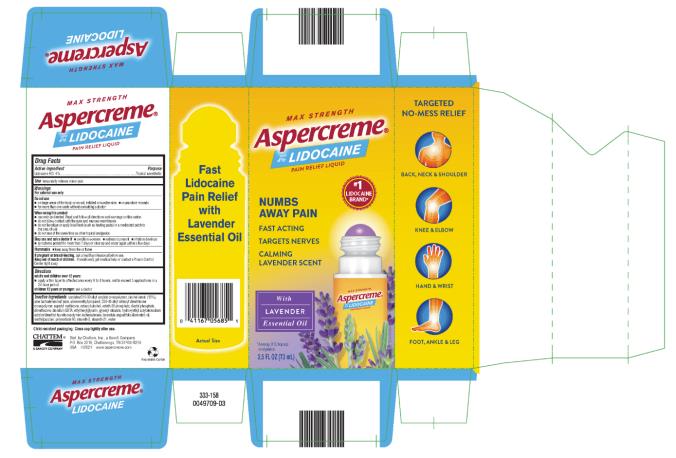
Aspercreme Lidocaine No-Mess plus Lavender Lidocaine HCl 4 g/100mL Liquid
🆔 Identity & classification
Where does this data come from?
🏷️ RxNorm drug class
This medicine belongs to the Antiarrhythmic class.
Where does this data come from?
🏭 Manufacturer & labeler
Where does this data come from?
🩺 Clinical
- It's best to avoid using two lidocaine products at the same time unless your doctor says it's okay. When you use multiple products containing a local anesthetic, the total amount a...
- Can I use a lidocaine patch and a lidocaine cream at the same time?
- No — please don't do this. Heat significantly increases how much lidocaine is absorbed through your skin, which can push drug levels in your blood higher than they should be. Stick...
- Can I put a heating pad on the area where I applied a lidocaine patch?
Patient education
Supplement & herbal interactions
Where does this data come from?
Ask a licensed pharmacist directly — free, answered by our team.
🧪 Inactive Ingredients / Excipients
Inactive ingredients, also called excipients, are components of the drug product other than the active ingredient. They may include fillers, dyes, coatings, preservatives, flavors, or other formulation ingredients.
💡 Tap an ingredient (hover on desktop) to see what it is and why it’s used.
-
UNII 3K9958V90M
A liquid solvent derived from fermentation or chemical synthesis. In medicines, alcohol dissolves active ingredients, helps preserve the product, and improves how the body absorbs certain drugs.
-
UNII ZY81Z83H0X
Aloe vera leaf is a plant extract derived from the aloe plant. It is used in medicines as a natural moisturizer and skin-soothing agent in topical formulations.
-
UNII LU49E6626Q
A synthetic organic compound used as a pH buffer and neutralizing agent in medicines. It helps maintain the proper acidity level in liquid formulations to improve stability and comfort.
-
UNII Q95M2P1KJL
A silicone-based ingredient that acts as a lubricant and glidant. It helps the tablet or capsule move smoothly through manufacturing equipment and improves powder flow during production.
-
UNII 59TL3WG5CO
A synthetic polymer made by crosslinking acrylic acid with allyl sucrose. It thickens liquids, forms gels, and helps control how fast the medicine is released in your body.
-
UNII 921FTA1500
A synthetic compound derived from cetyl alcohol and ethylene oxide. It acts as an emulsifier and solubilizer to help blend oil and water components together in liquid formulations.
-
UNII 2DMT128M1S
A waxy solid derived from plant or animal sources. It acts as an emulsifier to blend oil and water components, and also thickens the medicine to give it the right texture and consistency.
-
UNII 2V6E5WN99N
A lipid compound made from fatty acids, used as an emulsifier and stabilizer in medicines to help mix oil and water-based ingredients and keep them from separating.
-
UNII 92RU3N3Y1O
Dimethicone is a silicone-based oil that acts as an anti-foaming agent and lubricant in medicines. It reduces gas bubbles in liquid formulations and helps coat and protect the stomach lining when ingested.
-
UNII 8NLQ36F6MM
Edetate disodium anhydrous is a chemical compound that binds to metal ions in a medicine. It's used as a stabilizer to prevent unwanted chemical reactions and help keep the drug product effective during storage.
-
UNII 147D247K3P
Ethylhexylglycerin is a synthetic preservative used to prevent bacteria and mold from growing in medicines and personal care products. It helps keep the product safe and stable throughout its shelf life.
-
UNII 230OU9XXE4
A waxy substance made from glycerin and stearic acid that acts as an emulsifier to blend oily and watery ingredients together. It also helps thicken and stabilize the medicine's texture.
-
UNII 86FQE96TZ4
A synthetic polymer, this ingredient acts as a thickener and suspending agent in liquid formulations. It helps maintain uniform consistency and keeps particles evenly distributed throughout the medicine.
-
UNII 918X1OUF1E
Isohexadecane is a synthetic hydrocarbon oil used as an emollient and solvent in topical medicines. It helps dissolve active ingredients and improves spreadability and absorption through the skin.
-
UNII ZBP1YXW0H8
A fragrant oil extracted from lavender plants, used as a flavoring and scent agent in medicines to improve taste and aroma.
-
UNII A2I8C7HI9T
Methylparaben is a preservative derived from benzoic acid that prevents growth of bacteria, fungi, and mold in medicines. It extends the product's shelf life and maintains safety during storage.
-
UNII CAL22UVI4M
A synthetic emulsifier derived from sorbitol and fatty acids. It helps mix oil and water-based ingredients together and improves the texture and stability of the medicine.
-
UNII V56DFE46J5
Steareth-2 is a synthetic emulsifier made from stearic acid and ethylene oxide. It helps mix oil and water-based ingredients together in the formulation and may improve how the medicine spreads or dissolves.
-
UNII 53J3F32P58
A synthetic detergent derived from stearic acid, a fatty substance. It helps dissolve or distribute oil-based ingredients evenly throughout the medicine, acting as an emulsifier and solubilizer in tablets and capsules.
-
UNII 059QF0KO0R
Water is a liquid solvent that dissolves and mixes ingredients together in liquid medicines, syrups, and injections. It helps distribute the active drug evenly throughout the product.
20 inactive ingredients listed in the exact product block matched to this NDC.
Label-section wording can be broader than the structured product block and may mention additional formulation ingredients.
Where does this data come from?
ingredient classCode="IACT" elements from the exact product block matched by this NDC. Label-section narrative from DailyMed / the openFDA label index is shown separately when available.Inactive ingredient FAQ
Are inactive ingredients the same for every manufacturer?
Why might an inactive ingredient be missing?
Can inactive ingredients matter?
💲 Pricing
A drug doesn't have one price. Each row is a different public payment system, and none is what you'd pay at the counter — that depends on your insurance. The ⓘ on each row explains what it measures.
| Price system | Per mL | Per package |
|---|---|---|
| Retail pharmacies payNADAC · weekly | Not in the retail survey — common for institutional, discontinued, or low-volume packs. | |
| Medicaid paysCMS SDUD · 12 mo | No recent Medicaid claims on file for this NDC — rare and low-volume NDCs are suppressed in the public data. | |
| Medicare drug plans payPart D · quarterly | No Part D plan price is available for this NDC in our data. | |
Where does this data come from?
🔁 Therapeutic equivalents
| Product | Labeler | Pack | NADAC/unit | TE | Status | Price vs. this |
|---|---|---|---|---|---|---|
| Aspercreme Lidocaine No-Mess plus Lavender 4 g/100mLthis 41167-0568-05 | Chattem, | 1 bottle | — | — | FDA listed | — |
| Amino Rip Muscle Pain Relief 4 mg/100mL 54859-0415-02 | LLORENS | 60 ml | — | — | FDA listed | — |
| IceQuake Lidocaine Analgesic 4 g/100mL 65852-0026-03 | Dextrum | 74 ml | — | — | FDA listed | — |
| Meijer Pain Relief 4 g/100g 79481-0989-02 | Meijer | 71 g | — | — | FDA listed | — |
| equate Maximum Strength Pain Relieving 4% Lidocaine with Lavender Essential Oil Topical analgesic 40 mg/mL 79903-0229-01 | Wal-Mart | 1 bottle | — | — | FDA listed | — |
| Dologesic Roll-On 4 g/100mL 54859-0513-02 | Llorens | 60 ml | — | — | FDA listed | — |
| Leader Lidocaine 4 g/100mL 70000-0099-01 | CARDINAL | 1 bottle | — | — | FDA listed | — |
Where does this data come from?
⏳ Availability & generic status
The FDA lists approved generic versions of this medicine, but that does not always mean a pharmacy can get one today. Patent rules, launch agreements, supply and pricing can affect when generics actually arrive.
Where does this data come from?
📊 Medicare Part D spend CMS · PART D · 2026 (Q1)
🔬 Reported adverse events (FAERS)
Top reported reactions
Age at onset
Reporter sex
Serious outcomes
Where does this data come from?
📦 Packaging — all sizes for this product
| Package NDC | Description | Marketing start | Status |
|---|---|---|---|
| 41167-0568-05 You're viewing this | 1 BOTTLE, WITH APPLICATOR in 1 CARTON (41167-0568-5) / 73 mL in 1 BOTTLE, WITH APPLICATOR | 2020-01-20 | Active |
| 41167-0568-06 | 1 BOTTLE, WITH APPLICATOR in 1 CARTON (41167-0568-6) / 44 mL in 1 BOTTLE, WITH APPLICATOR | 2022-06-01 | Active |
Pack size FAQ
What quantity is in NDC 41167-0568-05?
What NDC number is used to bill for this package of Aspercreme Lidocaine No-Mess plus Lavender Lidocaine HCl 4 g/100mL Liquid?
🧭 About this NDC listing & data coverage
What data is (and isn’t) available for this NDC — tap to expand
| NDC identity (package / product / labeler codes) | ✓ Available |
| Labeler | ✓ Available |
| Product & package description | ✓ Available |
| Marketing category & status | ✓ Available |
| Active ingredient / dosage form / route | ✓ Available |
| FDA label (SPL via DailyMed) | ✓ Available |
| Package photos | ✓ Available |
| Inactive ingredients (structured) | ✓ Available |
| NADAC pharmacy acquisition price (CMS) | — Not published for this NDC CMS publishes NADAC only for NDCs reported in its retail-pharmacy survey. |
| Orange Book / therapeutic-equivalence data | — Not published for this NDC Applies only to products approved under an NDA/ANDA; many listings are out of scope. |
| HCPCS J-code billing crosswalk | — Not published for this NDC Most self-administered / retail products have no J-code — that is normal. |
| Medicaid utilization (CMS SDUD) | — Not published for this NDC CMS reports utilization only for NDCs with Medicaid claims above its privacy threshold. |
Questions about this listing
Is this NDC FDA-approved?
Why is there no price listed?
Is the NDC printed on the package the same as the 11-digit billing NDC?
What do the three segments of this NDC mean?
Is this package still being marketed?
Does this product come in other package sizes?
Who lists this product with the FDA?
Do I need a prescription for this product?
Where does this data come from?
📄 FDA label — Drug Facts FDA SPL
🎯 Indications and Usage ▾
Use for the temporary relief of pain
⏱️ Dosage and Administration ▾
Directions ■ adults and children 12 years of age and older: ■ apply a thin layer to affected area using roller ball every 6 to 8 hours, not more than 3 to 4 times daily ■ massage as needed ■ if product unintentionally gets on hands, wash hands thoroughly with soap and water after each use ■ children under 12 years of age: ask a doctor
⚠️ Warnings ▾
Warnings For external use only Flammable ■ keep away from heat and open flame Do not use ■ in large quantities ■ on wounds or on irritated or damaged skin ■ with a heating pad When using this product ■ use only as directed ■ do not bandage tightly ■ avoid contact with eyes and mucous membranes ■ do not expose the area to local heat or to direct sunlight Stop use and ask a doctor if ■ condition worsens or symptoms persist for more than 7 days ■ symptoms clear up and occur again within a few days ■ redness is present or excessive skin irritation occurs ■ you experience severe burning pain, swelling, or blistering where the product was applied If pregnant or breast-feeding, ask a health professional before use.
Keep out of reach of children. If swallowed, get medical help or contact a Poison Control Center right away.
🧪 Active Ingredient ▾
Active i ngredient Lidocaine HCl 4%
🧪 Inactive Ingredients ▾
Inactive ingredients acrylates/C10-30 alkyl acrylate crosspolymer, alcohol denat. (15%), aloe barbadensis leaf juice, aminomethyl propanol, C30-45 alkyl cetearyl dimethicone crosspolymer, caprylyl methicone, cetearyl alcohol, ceteth-20 phosphate, dicetyl phosphate, dimethicone, disodium EDTA, ethylhexylglycerin, glyceryl stearate, hydroxyethyl acrylate/sodium acryloyldimethyl taurate copolymer, isohexadecane, lavandula angustifolia (lavender) oil, methylparaben, polysorbate 60, steareth-2, steareth-21, water Child-resistant packaging.
Replace cap after each use.
🎯 Purpose ▾
Purpose Topical anesthetic