
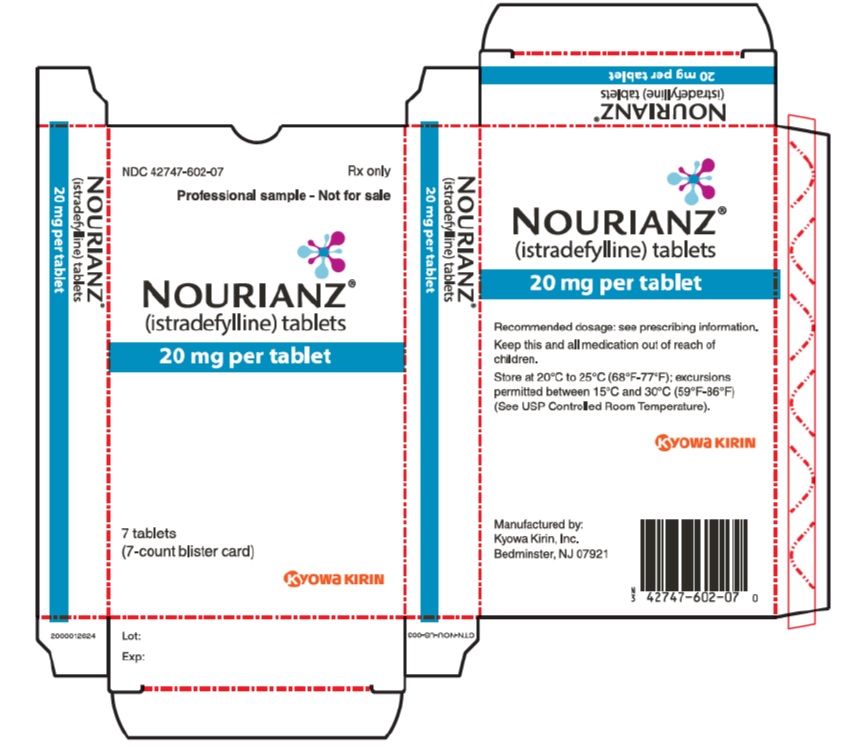
Nourianz istradefylline 20 mg Tablet, Film Coated, 7-count — NDC 42747-602-07 (Billing 42747-0602-07)
This is a package of 7 tablets of Nourianz istradefylline 20 mg Tablet, Film Coated from Kyowa Kirin, Inc., marketed since Aug 2019 and currently FDA-listed.
NDC database record
One package, one record: these facts belong to NDC 42747-602-07 alone.
- Record
- FDA NDC Directory package listing · Human prescription drug
- Code segments
- 42747 labeler · 602 product · 07 package
- Package marketed since
- Aug 27, 2019
- Sample package
- Yes — professional sample, not for sale
- Listing certified through
- Dec 31, 2026
- Barcode (UPC)
- 0342747604906, 0342747602902
- FDA record last changed
- Jul 24, 2026
Identity & classification
Regulatory identifiers FDA, NLM and CMS codes for this package
Drug-database identifiers Medi-Span GPI and First Databank GCN / HICL / AHFS classification
- GSN (GCN sequence number): 080177
- GCN: 46883
- GPI-14 (Medi-Span): 73401025000320
- HICL (First Databank): 045994
- AHFS class code: 28:36.24.00
- RxCUI (RxNorm): 2199020
Where does this data come from?
- FDA openFDA NDC Directory · synced Oct 8, 2026
- FDA label on DailyMed · label index refreshed Oct 6, 2026
- RxNorm (NLM RxNav) · catalog refreshed Oct 1, 2026
- Medi-Span GPI (licensed)
- First Databank (licensed) · refreshed Oct 8, 2026
RxNorm drug class
This medicine belongs to the Other antiparkinson drugs class.
Where does this data come from?
- RxClass (NLM) · catalog refreshed Oct 1, 2026
Clinical
- Istradefylline (Nourianz) is an add-on to levodopa/carbidopa for adults with Parkinson’s disease. It is for people who still have “off” episodes, when symptoms come back between le...
- You take one tablet by mouth once a day. It’s fine with or without food. Follow your prescriber’s directions, since the amount can depend on your liver health, tobacco use, and oth...
- The most common ones are uncontrolled movements (dyskinesia), dizziness, constipation, nausea, hallucinations, and trouble sleeping. Let your doctor know if any are bothersome or g...
- Call if you see or hear things that aren’t there, become paranoid, confused or agitated, or have new strong urges to gamble, spend, binge eat, or increased sexual urges. Lowering t...
Patient education
Supplement & herbal interactions
Some supplements/herbs that may interact with Istradefylline — tap one for details:
Where does this data come from?
- MedlinePlus (NLM) · refreshed Oct 1, 2026
- FDA label on DailyMed · label index refreshed Oct 6, 2026
Ask a licensed pharmacist directly — free, answered by our team.
Pricing
A drug doesn't have one price. Each row is a different public payment system, and none is what you'd pay at the counter — that depends on your insurance. The ⓘ on each row explains what it measures.
| Price system | Per each | Per package |
|---|---|---|
| Retail pharmacies payNADAC · weekly | Not in the retail survey — common for institutional, discontinued, or low-volume packs. | |
| Medicaid paysCMS SDUD · 12 mo | No recent Medicaid claims on file for this NDC — rare and low-volume NDCs are suppressed in the public data. | |
| Medicare drug plans payPart D · Q2 2026 | $69.06 | $483.39 / 7 tablets |
Where does this data come from?
- CMS NADAC weekly file
- CMS ASP pricing files · refreshed Sep 20, 2026
- CMS Medicaid State Drug Utilization Data · refreshed Oct 8, 2026
- CMS Part D plan pricing files · refreshed Sep 24, 2026
- VA National Acquisition Center price file
Packaging — all sizes for this product
| Package NDC | Description | Marketing start | Marketing end | Status |
|---|---|---|---|---|
| 42747-0602-07 You're viewing this | 1 BLISTER PACK in 1 BOX / 7 TABLET, FILM COATED in 1 BLISTER PACK Sample | 2019-08-27 | — | Active |
| 42747-0602-90 42747-602-90 Main listing | 90 TABLET, FILM COATED in 1 BOTTLE | 2019-08-27 | — | Active |
This pack shows little to no recent Medicaid volume — the 90 tablets pack carries most fills. See all packs ↓
Pack size FAQ
What quantity is in this package?
How does this package differ from NDC 42747-0602-90?
What NDC number is used to bill for this package of Nourianz istradefylline 20 mg Tablet, Film Coated?
Therapeutic equivalents
| Product | Labeler | Pack | NADAC/unit | TE | Status | Price vs. this |
|---|---|---|---|---|---|---|
| Nourianz 20 mgthis 42747-0602-07 | Kyowa | 7 tablets | — | — | FDA listed | — |
Where does this data come from?
- FDA openFDA NDC Directory · synced Oct 8, 2026
- FDA Orange Book · refreshed Oct 3, 2026
- CMS NADAC weekly file
Availability & generic status
We did not find an FDA-approved generic match for this exact strength, form and route. Patent/protection dates below may affect future generic timing.
Why the date isn’t exact: Generic timing can change because patents may be challenged, settled, licensed, added, removed, or worked around with a narrower label — and FDA approval does not always mean a pharmacy can get the generic today.
🛈 What do these terms mean?
- Patent
- Legal protection listed in the Orange Book that may delay generic approval or launch. Issued by the U.S. Patent & Trademark Office.
- Substance patent
- Covers the active drug molecule itself — the hardest to design around. A generic generally can’t launch until it expires.
- Formulation (product) patent
- Covers a specific formulation or dosage form. A generic can sometimes work around it with a different formulation.
- Method-of-use patent
- A patent covering one specific approved use of the drug — not necessarily the whole molecule. A generic can sometimes launch with a “skinny label” that carves out the protected use and keeps the others.
- Skinny label
- A generic label that omits a still-patented use when the FDA allows it — letting a generic reach the market for the unprotected uses.
- Exclusivity
- FDA-granted marketing protection, separate from patents — e.g. 5-yr new chemical entity, 7-yr orphan drug, or a +6-month pediatric extension.
- Paragraph IV
- A generic applicant’s formal challenge to a listed patent. It can potentially lead to earlier generic entry, but often involves litigation or a settlement.
- RLD / RS
- Reference Listed Drug — the brand product the FDA uses as the reference for generic applications. Reference Standard — the product the FDA expects generics to compare against in bioequivalence testing.
- TE / AB rating
- FDA therapeutic-equivalence rating. An AB rating generally means the FDA considers a generic therapeutically equivalent to — and substitutable for — the brand.
- LOE (loss of exclusivity)
- The latest patent or exclusivity currently listed — the loss-of-exclusivity / latest-listed-protection date shown on this page. Paragraph-IV challenges and settlements can move the real date earlier; FDA approval and a manufacturer’s decision to market can move it later.
Built from the FDA Orange Book. The bars above are scaled to each protection’s expiry; the red LOE marker is the last one to lapse.
| Patent | Type | Use code | Expires |
|---|---|---|---|
| US 7727993 ↗ | Method of use | U-2623 | Jan 28, 2028 |
| US 7727993 ↗ | Method of use | U-2623 | Jan 28, 2028 |
| US 8318201 ↗ | Drug product | — | Sep 5, 2027 |
| US 8318201 ↗ | Drug product | — | Sep 5, 2027 |
Is there a generic version of NOURIANZ 20 MG TABLET?
The FDA approved a generic — why can’t I get it at my pharmacy yet?
Why do different websites show different generic release dates?
What does “FDA listed” mean?
What does a patent or protection date mean here?
What does “current Orange Book estimate” mean?
Can a generic come out before the last patent expires?
Can a generic come out after the listed dates?
What is the difference between patents and exclusivity?
Why are there multiple patent dates?
Where does this data come from?
- FDA Orange Book · refreshed Oct 3, 2026
Inactive Ingredients / Excipients
Inactive ingredients, also called excipients, are components of the drug product other than the active ingredient. They may include fillers, dyes, coatings, preservatives, flavors, or other formulation ingredients.
🧪 Avoiding an ingredient? See Istradefylline inactive ingredients by manufacturer: every current product's list side by side, so you can ask your pharmacy for the version that does not list it.
💡 Tap an ingredient (hover on desktop) to see what it is and why it’s used.
-
UNII R12CBM0EIZ
A natural wax derived from a Brazilian palm tree, used as a coating and polish on tablets and capsules. It creates a smooth, shiny finish that protects the medicine and improves appearance.
-
UNII 2S7830E561
Crospovidone is a synthetic polymer derived from povidone. It acts as a disintegrant, helping the tablet or capsule break apart quickly in the stomach so the active ingredient can be absorbed.
-
UNII EWQ57Q8I5X
Lactose monohydrate is a natural sugar derived from milk. It serves as a filler and binder in tablets and capsules, helping create the proper size, texture, and consistency of the medicine.
-
UNII 70097M6I30
Magnesium stearate is a salt made from magnesium and stearic acid, a fatty substance. It's used in tablets and capsules as a lubricant and glidant to help ingredients flow smoothly during manufacturing and prevent sticking.
-
UNII OP1R32D61U
Microcrystalline cellulose is a purified form of cellulose, a natural fiber from plant sources. It acts as a binder and filler in tablets and capsules, helping hold ingredients together and give the medicine its shape and size.
-
UNII 532B59J990
Polyvinyl alcohol is a synthetic polymer made from plant-derived materials. It's used as a binder to hold ingredients together, a film-former in coatings, and a thickener in liquid formulations.
6 inactive ingredients listed in the exact product block matched to this NDC.
Where does this data come from?
ingredient classCode="IACT" elements from the exact product block matched by this NDC. Label-section narrative from DailyMed / the openFDA label index is shown separately when available.- FDA label on DailyMed · label index refreshed Oct 6, 2026
- FDA openFDA NDC Directory · synced Oct 8, 2026
Inactive ingredient FAQ
Are inactive ingredients the same for every manufacturer?
Why might an inactive ingredient be missing?
Can inactive ingredients matter?
Manufacturer & labeler
More NDCs from Kyowa Kirin, Inc. labeler code 42747
- CRYSVITA Burosumab 10 mg/mL Injection NDC 42747-102-01
- CRYSVITA Burosumab 20 mg/mL Injection NDC 42747-203-01
- CRYSVITA Burosumab 30 mg/mL Injection NDC 42747-304-01
- Fareston toremifene citrate 60 mg Tablet NDC 42747-327-30
- Nourianz istradefylline 40 mg Tablet, Film Coated NDC 42747-604-07
- POTELIGEO mogamulizumab-kpkc 4 mg/mL Injection NDC 42747-761-01
Where does this data come from?
- FDA openFDA NDC Directory · synced Oct 8, 2026
- Drugs@FDA
Full prescribing information FDA SPL
🎯 Indications and Usage ▾
1 INDICATIONS AND USAGE NOURIANZ is indicated as adjunctive treatment to levodopa/carbidopa in adult patients with Parkinson's disease (PD) experiencing "off" episodes. NOURIANZ is an adenosine receptor antagonist indicated as adjunctive treatment to levodopa/carbidopa in adult patients with Parkinson's disease (PD) experiencing "off" episodes ( 1 ).
⏱️ Dosage and Administration ▾
2 DOSAGE AND ADMINISTRATION The recommended dosage is 20 mg orally once daily. The dosage may be increased to a maximum of 40 mg once daily ( 2.1 ). May be taken with or without food ( 2.1 ).
Patients with hepatic impairment: Maximum recommended dosage with moderate hepatic impairment is 20 mg once daily; use of NOURIANZ in patients with severe hepatic impairment should be avoided ( 2.4 , 8.7 ). Patients who smoke 20 or more cigarettes per day (or the equivalent of another tobacco product): Recommended dosage is 40 mg once daily ( 2.5 , 8.8 ).
2.1Dosing Information The recommended dosage of NOURIANZ is 20 mg administered orally once daily. The dosage may be increased to a maximum of 40 mg once daily, based on individual need and tolerability. Initial dose titration is not required. NOURIANZ can be taken with or without food [see Clinical Pharmacology (12.3) ] .
2.2Dosage Adjustment with Strong CYP3A4 Inhibitors The maximum recommended dosage of NOURIANZ with concomitant use of strong CYP3A4 inhibitors is 20 mg once daily [see Drug Interactions (7.1) ] .
2.3Dosing with Strong CYP3A4 Inducers Avoid use of NOURIANZ with strong CYP3A4 inducers [see Drug Interactions (7.1) ] .
2.4Dosage Adjustment in Patients with Hepatic Impairment The maximum recommended dosage of NOURIANZ in patients with moderate hepatic impairment (Child-Pugh Class B) is 20 mg once daily. Closely monitor patients with moderate hepatic impairment for adverse reactions when on NOURIANZ treatment [see Adverse Reactions (6.1) ] . Avoid use of NOURIANZ in patients with severe hepatic impairment (Child-Pugh Class C) [see Use in Specific Populations (8.7) ] .
2.5Dosage Adjustment for Tobacco Smokers The recommended dosage of NOURIANZ in patients who use tobacco in amounts of 20 or more cigarettes per day (or the equivalent of another tobacco product) is 40 mg once daily [see Use in Specific Populations (8.8) and Clinical Pharmacology (12.3) ] .
💊 Dosage Forms and Strengths ▾
3 DOSAGE FORMS AND STRENGTHS 20 mg tablets: Peach-colored, pillow-shaped, film-coated tablets with "20" debossed on one side. 40 mg tablets: Peach-colored, almond-shaped, film-coated tablets with "40" debossed on one side. Tablets: 20 mg and 40 mg ( 3 ).
⛔ Contraindications ▾
4 CONTRAINDICATIONS None. None ( 4 ).
⚠️ Warnings and Cautions ▾
5 WARNINGS AND PRECAUTIONS Dyskinesia: Monitor patients for dyskinesia or exacerbation of existing dyskinesia ( 5.1 ). Hallucinations / Psychotic Behavior: Consider dosage reduction or stopping NOURIANZ if occurs ( 5.2 ). Impulse Control / Compulsive Behaviors: Consider dosage reduction or stopping NOURIANZ if occurs ( 5.3 ).
5.1Dyskinesia NOURIANZ in combination with levodopa may cause dyskinesia or exacerbate pre-existing dyskinesia. In controlled clinical trials (Studies 1, 2, 3, and 4) [see Clinical Studies (14) ] , the incidence of dyskinesia was 15% for NOURIANZ 20 mg, 17% for NOURIANZ 40 mg, and 8% for placebo, in combination with levodopa. One percent of patients treated with either NOURIANZ 20 mg or 40 mg discontinued treatment because of dyskinesia, compared to 0% for placebo.
5.2Hallucinations / Psychotic Behavior Because of the potential risk of exacerbating psychosis, patients with a major psychotic disorder should not be treated with NOURIANZ. Consider dosage reduction or discontinuation if a patient develops hallucinations or psychotic behaviors while taking NOURIANZ. In controlled clinical trials (Studies 1, 2, 3, and 4) [see Clinical Studies (14) ] , the incidence of hallucinations was 2% for NOURIANZ 20 mg, 6% for NOURIANZ 40 mg, and 3% for placebo.
In patients treated with NOURIANZ 40 mg, 1% discontinued because of hallucinations, compared to 0% for placebo and 0% for patients treated with NOURIANZ 20 mg. The incidence of "abnormal thinking and behavior" (paranoid ideation, delusions, confusion, mania, disorientation, aggressive behavior, agitation, or delirium) reported as an adverse reaction was 1% for NOURIANZ 20 mg, 2% for NOURIANZ 40 mg, and 1% for placebo.
5.3Impulse Control / Compulsive Behaviors Patients treated with NOURIANZ and one or more medication(s) for the treatment of Parkinson's disease (including levodopa) may experience intense urges to gamble, increased sexual urges, intense urges to spend money, binge or compulsive eating, and/or other intense urges, and the inability to control these urges. In controlled clinical trials (Studies 1, 2, 3 and 4) [see Clinical Studies (14) ] , one patient treated with NOURIANZ 40 mg was reported to have impulse control disorder, compared to no patient on placebo or NOURIANZ 20 mg.
In some postmarketing cases, these urges were reported to have stopped when the dose was reduced, or the medication was discontinued. Because patients may not recognize these behaviors as abnormal, it is important for prescribers to specifically ask patients or their caregivers about the development of new or increased gambling urges, sexual urges, uncontrolled spending, binge or compulsive eating, or other urges while being treated with NOURIANZ. Consider dose reduction or discontinuation if a patient develops such urges while taking NOURIANZ [see Adverse Reactions (6.2) ] .
🤒 Adverse Reactions ▾
6 ADVERSE REACTIONS The following clinically significant adverse reactions are discussed in greater detail in other sections of the labeling: Dyskinesia [see Warnings and Precautions (5.1) ] Hallucinations / Psychotic Behavior [see Warnings and Precautions (5.2) ] Impulse Control / Compulsive Behaviors [see Warnings and Precautions (5.3) ] The most common adverse reactions (at least 5% and more frequent than placebo) were dyskinesia, dizziness, constipation, nausea, hallucination, and insomnia ( 6.1 ). To report SUSPECTED ADVERSE REACTIONS, contact Kyowa Kirin Inc. at 1-844-768-3544 or FDA at 1-800-FDA-1088 or www.fda.gov/medwatch.
6.1Clinical Trials Experience Because clinical trials are conducted under widely varying conditions, adverse reaction rates observed in the clinical trials of a drug cannot be directly compared to rates in the clinical trials of another drug and may not reflect the rates observed in practice. The safety of NOURIANZ was evaluated in 734 patients with Parkinson's disease (PD) taking a stable dose of levodopa and a DOPA decarboxylase inhibitor, with or without other PD medications, in four randomized, multicenter, double-blind, placebo-controlled trials 12 weeks in duration (Studies 1, 2, 3 and 4) [see Clinical Studies (14) ] .
Of the patient population exposed to NOURIANZ, 50% were male, 32% White, 67% Asian, and the mean age was 65 years (range: 33 to 84 years). Of these patients, 356 received NOURIANZ 20 mg and 378 received NOURIANZ 40 mg. Adverse Reactions Leading to Discontinuation of Treatment The incidence of patients discontinuing for any adverse reaction was 5% for NOURIANZ 20 mg, 6% for NOURIANZ 40 mg, and 5% for placebo.
The most frequently reported adverse reaction causing study discontinuation was dyskinesia [see Warnings and Precautions (5.1) ] . Common Adverse Reactions in Pooled Placebo-Controlled Trials Table 1 shows adverse reactions with a frequency of at least 2% in patients treated with NOURIANZ 20 mg or 40 mg once daily. The most common adverse reactions in which the frequency for NOURIANZ was at least 5%, and greater than the incidence on placebo, were dyskinesia, dizziness, constipation, nausea, hallucination, and insomnia.
Table 1: Adverse Reactions with an Incidence of at Least 2% in Patients Treated with NOURIANZ, and Greater than on Placebo, in Pooled Studies 1, 2, 3, and 4 Adverse Reactions NOURIANZ 20 mg/day (N=356) % NOURIANZ 40 mg/day (N=378) % Placebo N=426 (%) Nervous system disorders Dyskinesia 15 17 8 Dizziness 3 6 4 Gastrointestinal disorders Constipation 5 6 3 Nausea 4 6 5 Diarrhea 1 2 1 Psychiatric disorders Hallucination Includes hallucinations, hallucinations visual, hallucinations olfactory, hallucinations somatic, hallucinations auditory.
2 6 3 Insomnia 1 6 4 Metabolism and nutrition disorders Decreased appetite 1 3 1 Investigations Blood alkaline phosphatase increased 1 2 1 Blood glucose increased 1 2 0 Blood urea increased 1 2 0 Respiratory, thoracic and mediastinal disorders Upper Respiratory Tract Inflammation 1 2 0 Skin and subcutaneous tissue disorders Rash 1 2 1
6.2Postmarketing Experience The following adverse reaction has been identified during post approval use of istradefylline outside of the United States. Because these reactions are reported voluntarily from a population of uncertain size, it is not always possible to reliably estimate their frequency or establish a causal relationship to drug exposure: increased libido.
🔄 Drug Interactions ▾
7 DRUG INTERACTIONS Strong CYP3A4 inhibitors: Recommended maximum dosage with concomitant use is 20 mg once daily ( 2.2 , 7.1 ). Strong CYP3A4 inducers: Avoid use ( 2.3 , 7.1 ).
7.1Effect of Other Drugs on NOURIANZ Strong CYP3A4 Inhibitors Coadministration of NOURIANZ with a strong CYP3A4 inhibitor (ketoconazole) increased istradefylline AUC inf by 2.5-fold [see Clinical Pharmacology (12.3) ] . Therefore, the recommended maximum dosage of NOURIANZ in patients concomitantly using strong CYP3A4 inhibitors (e.g., itraconazole, ketoconazole, clarithromycin) is 20 mg once daily [see Dosage and Administration (2.2) ]. Strong CYP3A4 Inducers Coadministration of NOURIANZ with a strong CYP3A4 inducer (rifampin) decreased istradefylline C max and AUC inf by 45% and 81%, respectively [see Clinical Pharmacology (12.3) ] .
Therefore, it is recommended to avoid use of NOURIANZ with strong CYP3A4 inducers (e.g., carbamazepine, rifampin, phenytoin, St. John's wort) [see Dosage and Administration (2.3) ].
7.2Effect of NOURIANZ on Other Drugs CYP3A4 Substrates Coadministration of NOURIANZ 20 mg with a CYP3A4 substrate (midazolam) did not affect the CYP3A4 substrate exposure, while concomitant administration of NOURIANZ 40 mg increased the CYP3A4 substrate (atorvastatin) C max and AUC inf by 1.5-fold [see Clinical Pharmacology (12.3) ] . Monitor for an increase in adverse reactions of concomitant drugs that are CYP3A4 substrates when coadministering with NOURIANZ 40 mg. P-glycoprotein (P-gp) Substrates Coadministration of NOURIANZ with a P-gp substrate (digoxin) increased the P-gp substrate C max and AUC inf by 33% and 21%, respectively [see Clinical Pharmacology (12.3) ] .
Monitor for an increase in adverse reactions of concomitant drugs that are P-gp substrates when coadministering with NOURIANZ.
👥 Use in Specific Populations ▾
8 USE IN SPECIFIC POPULATIONS Pregnancy: Based on animal data, may cause fetal harm ( 8.1 ).
8.1Pregnancy Risk Summary There are no adequate data on the developmental risk associated with the use of NOURIANZ in pregnant women. In animal studies ( see Data ), oral administration of istradefylline during pregnancy resulted in teratogenicity (increased incidences of fetal structural abnormalities, embryofetal and offspring mortality and growth deficits) at clinically relevant exposures and in the absence of maternal toxicity. The teratogenic effects of istradefylline in pregnant rabbits were substantially greater when administered in combination with levodopa/carbidopa than when administered alone.
The estimated background risk of major birth defects and miscarriage for the indicated population is unknown. In the U.S. general population, the estimated background risks of major birth defects and miscarriage in clinically recognized pregnancies are 2-4% and 15-20%, respectively. Data Animal Data Oral administration of istradefylline (0, 40, 200, or 1000 mg/kg/day) to pregnant rats throughout organogenesis resulted in decreased fetal body weight and increased fetal skeletal and visceral variations at the highest dose tested.
Plasma exposure (AUC) at the no-effect dose for adverse effects on embryofetal development in rats (200 mg/kg/day) is approximately 4 times that in humans at the maximum recommended human dose (MRHD) of 40 mg. Oral administration of istradefylline (0, 50, 200, or 800 mg/kg/day) to pregnant rabbits throughout organogenesis resulted in increased embryofetal mortality at the mid and high doses, increased fetal malformations (external, visceral, skeletal) at all doses, and reduced fetal body weight at the highest dose tested.
A no-effect dose for adverse effects on embryofetal development in rabbits was not identified. Plasma exposure (AUC) at the lowest dose tested (50 mg/kg/day) is less than that in humans at the MRHD. In pregnant rabbits, oral administration of istradefylline (0, 50, 200, or 400 mg/kg/day) alone or in combination with oral levodopa/carbidopa (80/20 mg/kg/day) throughout the period of organogenesis resulted in an increase in embryofetal mortality and an increase (marked at the high dose) in malformations (including limb reduction, craniofacial, and cardiovascular) in fetuses from rats administered istradefylline at all doses in combination with levodopa/carbidopa.
Istradefylline alone resulted in an increase in embryofetal mortality and visceral malformations; no increase in fetal malformations was observed with levodopa/carbidopa alone. Fetal body weight was reduced by istradefylline alone (400 mg/kg/day) and in combination (200 and 400 mg/kg/day) with levodopa/carbidopa. A no-effect dose for adverse effects on embryofetal development in rabbits when istradefylline was administered in combination with levodopa/carbidopa was not identified.
Plasma exposure (AUC) at the lowest dose of istradefylline tested (50 mg/kg/day) in combination with levodopa/carbidopa is less than that in humans at the MRHD. Oral administration of istradefylline (0, 6, 25, 100, or 400 mg/kg/day) to female rats throughout gestation and lactation resulted in decreased pup survival and reduced pup body weight (which persisted into adulthood) at all but the lowest dose tested. Exposure to drug in the milk may have contributed to these effects, as demonstrated in pups of untreated (control) dams reared by dams receiving istradefylline (400 mg/kg/day).
No adverse effects were observed on physical or neurobehavioral development, or reproductive function. Plasma exposure at the no-effect dose for adverse effects on pre- and postnatal development in rats (6 mg/kg/day) is less than that in humans at the MRHD.
8.2Lactation Risk Summary There are no data on the presence of istradefylline in human milk, the effects of istradefylline on the breastfed infant, or the effects of istradefylline on milk production. Istradefylline was presen… [Excerpted — this section continues on DailyMed.]
🤰 Pregnancy ▾
8.1Pregnancy Risk Summary There are no adequate data on the developmental risk associated with the use of NOURIANZ in pregnant women. In animal studies ( see Data ), oral administration of istradefylline during pregnancy resulted in teratogenicity (increased incidences of fetal structural abnormalities, embryofetal and offspring mortality and growth deficits) at clinically relevant exposures and in the absence of maternal toxicity. The teratogenic effects of istradefylline in pregnant rabbits were substantially greater when administered in combination with levodopa/carbidopa than when administered alone.
The estimated background risk of major birth defects and miscarriage for the indicated population is unknown. In the U.S. general population, the estimated background risks of major birth defects and miscarriage in clinically recognized pregnancies are 2-4% and 15-20%, respectively. Data Animal Data Oral administration of istradefylline (0, 40, 200, or 1000 mg/kg/day) to pregnant rats throughout organogenesis resulted in decreased fetal body weight and increased fetal skeletal and visceral variations at the highest dose tested.
Plasma exposure (AUC) at the no-effect dose for adverse effects on embryofetal development in rats (200 mg/kg/day) is approximately 4 times that in humans at the maximum recommended human dose (MRHD) of 40 mg. Oral administration of istradefylline (0, 50, 200, or 800 mg/kg/day) to pregnant rabbits throughout organogenesis resulted in increased embryofetal mortality at the mid and high doses, increased fetal malformations (external, visceral, skeletal) at all doses, and reduced fetal body weight at the highest dose tested.
A no-effect dose for adverse effects on embryofetal development in rabbits was not identified. Plasma exposure (AUC) at the lowest dose tested (50 mg/kg/day) is less than that in humans at the MRHD. In pregnant rabbits, oral administration of istradefylline (0, 50, 200, or 400 mg/kg/day) alone or in combination with oral levodopa/carbidopa (80/20 mg/kg/day) throughout the period of organogenesis resulted in an increase in embryofetal mortality and an increase (marked at the high dose) in malformations (including limb reduction, craniofacial, and cardiovascular) in fetuses from rats administered istradefylline at all doses in combination with levodopa/carbidopa.
Istradefylline alone resulted in an increase in embryofetal mortality and visceral malformations; no increase in fetal malformations was observed with levodopa/carbidopa alone. Fetal body weight was reduced by istradefylline alone (400 mg/kg/day) and in combination (200 and 400 mg/kg/day) with levodopa/carbidopa. A no-effect dose for adverse effects on embryofetal development in rabbits when istradefylline was administered in combination with levodopa/carbidopa was not identified.
Plasma exposure (AUC) at the lowest dose of istradefylline tested (50 mg/kg/day) in combination with levodopa/carbidopa is less than that in humans at the MRHD. Oral administration of istradefylline (0, 6, 25, 100, or 400 mg/kg/day) to female rats throughout gestation and lactation resulted in decreased pup survival and reduced pup body weight (which persisted into adulthood) at all but the lowest dose tested. Exposure to drug in the milk may have contributed to these effects, as demonstrated in pups of untreated (control) dams reared by dams receiving istradefylline (400 mg/kg/day).
No adverse effects were observed on physical or neurobehavioral development, or reproductive function. Plasma exposure at the no-effect dose for adverse effects on pre- and postnatal development in rats (6 mg/kg/day) is less than that in humans at the MRHD.
🧒 Pediatric Use ▾
8.4Pediatric Use Safety and effectiveness in pediatric patients have not been established.
🧓 Geriatric Use ▾
8.5Geriatric Use No adjustment of NOURIANZ dosage is recommended on the basis of age. Of the total number of PD patients who received NOURIANZ in clinical trials, 53% were ≥65 years and 13% were ≥75 years of age. No overall differences in effectiveness were observed between these patients and younger patients.
🆘 Overdosage ▾
10 OVERDOSAGE
10.1Human Experience There is limited clinical experience regarding human overdosage with NOURIANZ. In clinical trials, one patient took 6 tablets (120 mg, 3 times the maximum recommended dosage) of istradefylline with alcoholic beverages and developed hallucinations, agitation, and worsening dyskinesia.
10.2Management of Overdose There are no known specific antidotes for NOURIANZ nor any specific treatment for istradefylline overdose. If an overdose occurs, NOURIANZ treatment should be discontinued and supportive treatment should be administered as clinically indicated. Consider the long terminal half-life of istradefylline (about 83 hours) and the possibility of multiple drug involvement.
Consult a Certified Poison Control Center for up-to-date guidance and advice.
🧬 Clinical Pharmacology ▾
12 CLINICAL PHARMACOLOGY
12.1Mechanism of Action The precise mechanism by which istradefylline exerts its therapeutic effect in Parkinson’s disease is unknown. In in vitro studies and in in vivo animal studies, istradefylline was demonstrated to be an adenosine A 2A receptor antagonist.
12.2Pharmacodynamics Cardiac Electrophysiology The effect of NOURIANZ (40 mg or 160 mg [4 times the maximum recommended dosage] once daily for 14 days) on the QTc interval was evaluated in a randomized, placebo and moxifloxacin-controlled, multiple-dose, blinded, parallel group study. There was no clinically significant prolongation of QTc interval or relationship between changes in QTc and concentrations of istradefylline.
12.3Pharmacokinetics Istradefylline exhibits dose-proportional pharmacokinetics after multiple oral doses from 20 mg to 80 mg (2 times the maximum recommended dosage). Steady-state was reached within 2 weeks of once-daily dosing. The pharmacokinetics of istradefylline were similar in PD patients and healthy subjects.
Absorption The median time to reach the maximum concentration (T max ) for istradefylline was about 4 hours under fasted dosing conditions. Effect of Food Istradefylline exposure, represented by the area under the curve over time to infinity (AUC inf ), increased 1.25-fold when NOURIANZ was coadministered with a standard high-fat meal, compared with administration in a fasted state. Istradefylline maximum plasma concentrations (C max ) increased by 1.64-fold and T max was shortened by 1 hour when NOURIANZ was administered with a high-fat meal.
These differences in pharmacokinetic parameters are not expected to be clinically significant [see Dosage and Administration (2.1) ]. Distribution The plasma protein binding of istradefylline was approximately 98%. The apparent volume of distribution (V d /F) of istradefylline is approximately 557 liters.
Elimination The total clearance of istradefylline is approximately
4.6L/hour. The mean terminal half-life (t 1/2 ) for istradefylline at steady-state is approximately 83 hours. Metabolism In humans, istradefylline is exclusively eliminated via metabolism.
In vitro studies indicate that istradefylline is primarily metabolized via CYP1A1 and CYP3A4, with minor contribution from CYP1A2, 2B6, 2C8, CYP2C9, CYP2C18, and 2D6. Six metabolites have been identified in human plasma. These metabolites each account for less than 10% of the exposure of the parent drug.
Excretion Approximately 48% of a 40-mg oral dose of 14 C-istradefylline was eliminated in feces, and 39% in urine. Unchanged istradefylline was not detected in urine. Specific Populations In patients with moderate hepatic impairment (Child-Pugh Class B), the steady-state exposure (AUC 0-24 ) of istradefylline is predicted to be 3.3-fold higher relative to healthy subjects, based on the estimated mean terminal half-life [see Use in Specific Populations (8.7) ].
Based on population pharmacokinetic analyses, no clinically relevant changes in the pharmacokinetics of istradefylline were observed based on age, sex, weight, or race. No clinically relevant changes in istradefylline exposure were observed in patients with severe renal impairment (CrCL 15-29 mL/min) or mild hepatic impairment. NOURIANZ has not been studied in patients with ESRD (CrCL < 15 mL/min), ESRD patients requiring hemodialysis, or severe hepatic impairment (Child-Pugh Class C) [see Use in Specific Populations (8.6 , 8.7) ] .
Steady-state systemic exposure to istradefylline (40 mg) is 38% to 54% lower in tobacco smokers (who smoke 20 or more cigarettes per day) when compared with non-smokers matched for age, gender, and body weight [see Specific Populations (8.8) ] . Drug Interaction Studies In Vitro Assessment of Drug Interactions Drug-Metabolizing Enzyme Inhibition Istradefylline is a weak inhibitor of CYP3A4, but not an inhibitor of CYP1A2, 2B6, 2C9, 2C19, or 2D6 in vitro . Drug-Metabolizing Enzyme Induction Istradefylline was a weak inducer of CYP3A4… [Excerpted — this section continues on DailyMed.]
🧬 Mechanism of Action ▾
12.1Mechanism of Action The precise mechanism by which istradefylline exerts its therapeutic effect in Parkinson’s disease is unknown. In in vitro studies and in in vivo animal studies, istradefylline was demonstrated to be an adenosine A 2A receptor antagonist.
📦 How Supplied / Storage and Handling ▾
16 HOW SUPPLIED/STORAGE AND HANDLING
16.1How Supplied NOURIANZ (istradefylline) tablets are available as: 20 mg Tablets: Peach-colored, pillow-shaped, film-coated tablets with "20" debossed on one side. Bottle of 90: NDC 42747-602-90 40 mg Tablets: Peach-colored, almond-shaped, film-coated tablets with "40" debossed on one side. Bottle of 90: NDC 42747-604-90
16.2Storage and Handling Store at 20°C to 25°C (68°F to 77°F); excursions permitted between 15°C and 30°C (59°F to 86°F) [see USP Controlled Room Temperature].
📦 Storage and Handling ▾
16.2Storage and Handling Store at 20°C to 25°C (68°F to 77°F); excursions permitted between 15°C and 30°C (59°F to 86°F) [see USP Controlled Room Temperature].
📋 Description ▾
11 DESCRIPTION NOURIANZ contains istradefylline, an adenosine receptor antagonist, which has a xanthine derivative structure. The chemical name is ( E )-8-(3,4-dimethoxystyryl)-1,3-diethyl-7-methyl-3,7-dihydro-1 H -purine-2,6-dione. Its molecular formula is C 20 H 24 N 4 O 4 .
The molecular weight is 384.43. Istradefylline has the following structural formula: Istradefylline is a light yellow-green crystalline powder. Istradefylline has a dissociation constant (p K a ) of 0.78.
The aqueous solubility of istradefylline is ~0.5 µg/mL across the physiological pH range and 0.6 µg/mL in water. NOURIANZ tablets are intended for oral administration only. Each tablet contains 20 mg or 40 mg of istradefylline and the following inactive ingredients: crospovidone, lactose monohydrate, magnesium stearate, microcrystalline cellulose, and polyvinyl alcohol.
The film coating contains hypromellose, lactose monohydrate, polyethylene glycol 3350, titanium dioxide, triacetin, and the following dyes: iron oxide red and iron oxide yellow. Carnauba wax is used for polishing. Chemical Structure
💬 Information for Patients ▾
17 PATIENT COUNSELING INFORMATION Advise the patient to read the FDA-approved patient labeling (Patient Information). Dyskinesia Advise patients that NOURIANZ may cause dyskinesia or exacerbate pre-existing dyskinesia [see Warnings and Precautions (5.1) ] . Hallucinations / Psychotic Behavior Advise patients that NOURIANZ may cause hallucinations or psychotic behavior and they should report any of these adverse reactions to their healthcare provider [see Warnings and Precautions (5.2) ].
Impulse Control / Compulsive Behaviors Inform patients that they may experience intense urges to gamble, increased sexual urges, and other intense urges and the inability to control these urges while taking NOURIANZ and one or more medication(s) for the treatment of Parkinson's disease (including levodopa). Advise patients that they should report any of these adverse reactions to their healthcare provider [see Warnings and Precautions (5.3) ]. Concomitant Medications Certain medications can cause an interaction with NOURIANZ.
Advise patients to inform their healthcare provider about their smoking status and about all of the medicines they are taking or plan to take, including over-the-counter medicines, dietary supplements, and herbal products [see Drug Interactions (7.1 , 7.2) and Use in Specific Populations (8.8) ] .
🧬 Pharmacokinetics ▾
12.3Pharmacokinetics Istradefylline exhibits dose-proportional pharmacokinetics after multiple oral doses from 20 mg to 80 mg (2 times the maximum recommended dosage). Steady-state was reached within 2 weeks of once-daily dosing. The pharmacokinetics of istradefylline were similar in PD patients and healthy subjects.
Absorption The median time to reach the maximum concentration (T max ) for istradefylline was about 4 hours under fasted dosing conditions. Effect of Food Istradefylline exposure, represented by the area under the curve over time to infinity (AUC inf ), increased 1.25-fold when NOURIANZ was coadministered with a standard high-fat meal, compared with administration in a fasted state. Istradefylline maximum plasma concentrations (C max ) increased by 1.64-fold and T max was shortened by 1 hour when NOURIANZ was administered with a high-fat meal.
These differences in pharmacokinetic parameters are not expected to be clinically significant [see Dosage and Administration (2.1) ]. Distribution The plasma protein binding of istradefylline was approximately 98%. The apparent volume of distribution (V d /F) of istradefylline is approximately 557 liters.
Elimination The total clearance of istradefylline is approximately
4.6L/hour. The mean terminal half-life (t 1/2 ) for istradefylline at steady-state is approximately 83 hours. Metabolism In humans, istradefylline is exclusively eliminated via metabolism.
In vitro studies indicate that istradefylline is primarily metabolized via CYP1A1 and CYP3A4, with minor contribution from CYP1A2, 2B6, 2C8, CYP2C9, CYP2C18, and 2D6. Six metabolites have been identified in human plasma. These metabolites each account for less than 10% of the exposure of the parent drug.
Excretion Approximately 48% of a 40-mg oral dose of 14 C-istradefylline was eliminated in feces, and 39% in urine. Unchanged istradefylline was not detected in urine. Specific Populations In patients with moderate hepatic impairment (Child-Pugh Class B), the steady-state exposure (AUC 0-24 ) of istradefylline is predicted to be 3.3-fold higher relative to healthy subjects, based on the estimated mean terminal half-life [see Use in Specific Populations (8.7) ].
Based on population pharmacokinetic analyses, no clinically relevant changes in the pharmacokinetics of istradefylline were observed based on age, sex, weight, or race. No clinically relevant changes in istradefylline exposure were observed in patients with severe renal impairment (CrCL 15-29 mL/min) or mild hepatic impairment. NOURIANZ has not been studied in patients with ESRD (CrCL < 15 mL/min), ESRD patients requiring hemodialysis, or severe hepatic impairment (Child-Pugh Class C) [see Use in Specific Populations (8.6 , 8.7) ] .
Steady-state systemic exposure to istradefylline (40 mg) is 38% to 54% lower in tobacco smokers (who smoke 20 or more cigarettes per day) when compared with non-smokers matched for age, gender, and body weight [see Specific Populations (8.8) ] . Drug Interaction Studies In Vitro Assessment of Drug Interactions Drug-Metabolizing Enzyme Inhibition Istradefylline is a weak inhibitor of CYP3A4, but not an inhibitor of CYP1A2, 2B6, 2C9, 2C19, or 2D6 in vitro . Drug-Metabolizing Enzyme Induction Istradefylline was a weak inducer of CYP3A4 but not an inducer of CYP1A2 and 2B6 when tested in vitro .
However, clinical drug-drug interaction studies with a CYP3A4 substrate (i.e., midazolam) showed no induction of CYP3A4. Transporters Istradefylline was not a substrate for drug transporters P-gp, BCRP, OATP1B1, or OATP1B3 when tested in vitro . Istradefylline was a weak inhibitor for P-gp, BCRP, OATP1B1, OATP1B3, OAT1, OCT2, MATE1, and MATE2-K, but not an inhibitor of OAT3 when tested in vitro .
In Vivo Assessment of Drug Interactions Effect of Other Drugs on Istradefylline Strong CYP3A4 Inhibitors Coadministration of ketoconazole (200 mg twice daily for 4 days) with a single dose of istradefylline (40 mg) increased the AUC inf of istradefylline by… [Excerpted — this section continues on DailyMed.]
🧬 Pharmacodynamics ▾
12.2Pharmacodynamics Cardiac Electrophysiology The effect of NOURIANZ (40 mg or 160 mg [4 times the maximum recommended dosage] once daily for 14 days) on the QTc interval was evaluated in a randomized, placebo and moxifloxacin-controlled, multiple-dose, blinded, parallel group study. There was no clinically significant prolongation of QTc interval or relationship between changes in QTc and concentrations of istradefylline.
🔬 Clinical Studies ▾
14 CLINICAL STUDIES The efficacy of NOURIANZ for the adjunctive treatment to levodopa/carbidopa in patients with Parkinson's disease experiencing "off" episodes was shown in four randomized, multicenter, double-blind, 12-week, placebo-controlled studies (Study 1, NCT00456586; Study 2, NCT00199407; Study 3, NCT00455507; and Study 4, NCT00955526). The studies enrolled patients with a mean duration of Parkinson's disease of 9 years (range: 1 month to 37 years) that were Hoehn and Yahr Stage II to IV, experiencing at least 2 hours (mean approximately 6 hours) of "off" time per day, and were treated with levodopa for at least one year, with stable dosage for at least 4 weeks before screening (mean total daily dosage range: 416 to 785 mg).
Patients continued levodopa treatment with or without concomitant PD medications, including dopamine agonists (85%), COMT inhibitors (38%), MAO-B inhibitors (40%), anticholinergics (13%), and/or amantadine (33%), provided the medications were stable for at least 4 weeks before screening and throughout the study period. The studies excluded patients who had received a neurosurgical treatment for PD (e.g., pallidotomy, thalamotomy, deep brain stimulation). The primary efficacy endpoint was the change from baseline in the daily awake percentage of "off" time, or the change from baseline in total daily "off" time, based on 24-hour diaries completed by patients.
A change from baseline in "on" time without troublesome dyskinesia (i.e., "on" time without dyskinesia plus "on" time with non-troublesome dyskinesia) was a secondary efficacy endpoint. Study 1 was conducted in the U.S. and Canada, and Study 2 was conducted in the U.S. In these studies, patients were randomized to once-daily treatment with NOURIANZ 20 mg, 40 mg, or placebo.
Patients treated with NOURIANZ 20 mg or NOURIANZ 40 mg once daily experienced a statistically significant decrease from baseline in percentage of daily awake "off" time, compared with patients on placebo, as summarized in Table 2. Table 2: Studies 1 and 2: Change From Baseline in Daily Awake OFF Time Baseline Change from Baseline to Endpoint N (mean ± SD) % of awake "off" hours N (LSMD LSMD: Least squares mean difference; a negative value indicates a greater reduction from baseline in Percentage Daily Awake "off" time for NOURIANZ, relative to placebo. vs. placebo), % awake "off" hours, (p-value) SD: Standard Deviation Study 1 Placebo 66 37.2 ± 13.8 65 -- NOURIANZ 40 mg 129 38.4 ± 16.2 126 - 6.78 ( p =0.007) Study 2 Placebo 113 38.7 ± 11.6 113 -- NOURIANZ 20 mg 112 39.8 ± 14.0 112 - 4.57 ( p =0.025) Compared with patients on placebo, patients treated with NOURIANZ experienced an additional increase from baseline in "on" time without troublesome dyskinesia of 0.96 hours (nominal p =0.026) in Study 1, and of 0.55 hours (nominal p =0.135) in Study 2.
Study 3 and Study 4 were conducted in Japan. In these studies, patients were randomized equally to treatment with NOURIANZ 20 mg, 40 mg, or placebo. Patients treated with NOURIANZ 20 mg or NOURIANZ 40 mg once daily experienced a statistically significant decrease from baseline in "off" time compared with patients on placebo, as summarized in Table 3.
Table 3: Studies 3 and 4: Change From Baseline in Daily OFF Time Baseline Change from Baseline to Endpoint N (mean ± SD) hours N (LSMD LSMD: Least squares mean difference; a negative value indicates a greater reduction from baseline in "off" time for NOURIANZ, relative to placebo. vs. placebo) hours ( p-value) SD: Standard Deviation Study 3 Placebo 118 6.4 ± 2.7 118 -- NOURIANZ 20 mg 115 6.8 ± 2.9 115 -0.65 ( p =0.028) NOURIANZ 40 mg 124 6.6 ± 2.5 124 -0.92 ( p =0.002) Study 4 Placebo 123 6.3 ± 2.5 123 -- NOURIANZ 20 mg 120 6.6 ± 2.7 120 -0.76 ( p =0.006) NOURIANZ 40 mg 123 6.0 ± 2.5 123 -0.74 ( p =0.008) In Study 3, compared with placebo, an additional increase from baseline in "on" time without troublesome dyskinesia of 0.57 hours (nominal p =0.085) and of 0.65 hours (nominal p =0.04… [Excerpted — this section continues on DailyMed.]
🧪 Nonclinical Toxicology ▾
13 NONCLINICAL TOXICOLOGY
13.1Carcinogenesis, Mutagenesis, and Impairment of Fertility Carcinogenesis In lifetime oral carcinogenicity studies, there was no evidence of carcinogenicity in mouse (0, 25, 125, or 250 mg/kg) or rat (0, 30, 100, or 320 mg/kg). Plasma exposures (AUC) at the highest doses tested were approximately 20 (mouse) and 10 (rat) times that in humans at the maximum recommended human dose (MRHD) of 40 mg/day. Mutagenesis Istradefylline was negative in in vitro (bacterial reverse mutation assay, chromosomal aberration in mammalian cells) and in vivo (mouse bone marrow micronucleus) assays.
Impairment of Fertility Oral administration of istradefylline (0, 160, 360, or 800 mg/kg/day) to male and female rats prior to and during mating and continuing in females to gestation day 7 resulted in a decrease in fertility at the highest dose tested and an increase in preimplantation loss at the mid and high doses. Sperm motility was reduced at the highest dose tested. Plasma exposure (AUC) at the no-effect dose (160 mg/kg) for adverse effects on reproductive function is approximately 3 times that in humans at the MRHD.
13.2Animal Toxicology and/or Pharmacology Oral administration of istradefylline (0, 30, 100, or 320 mg/kg/day) to rats for two years resulted in an increase in the incidence and severity of vascular mineralization in the brain (including in the caudate/putamen, globus pallidus, thalamus, and nucleus accumbens) at all doses tested. The vascular mineralization was composed of calcium and phosphorus and, at higher doses, were reported to partially or completely occlude the blood vessels. There was no evidence of neuronal degeneration, inflammation, or glial response associated with the foci of mineralization.
Brain mineralization was not detected in mice administered istradefylline (0, 25, 125, or 250 mg/kg/day) orally for two years or in dogs administered istradefylline (0, 10, 30, or 100 mg/kg/day) orally for 52 weeks.
📄 Carcinogenesis, Mutagenesis, Impairment of Fertility ▾
13.1Carcinogenesis, Mutagenesis, and Impairment of Fertility Carcinogenesis In lifetime oral carcinogenicity studies, there was no evidence of carcinogenicity in mouse (0, 25, 125, or 250 mg/kg) or rat (0, 30, 100, or 320 mg/kg). Plasma exposures (AUC) at the highest doses tested were approximately 20 (mouse) and 10 (rat) times that in humans at the maximum recommended human dose (MRHD) of 40 mg/day. Mutagenesis Istradefylline was negative in in vitro (bacterial reverse mutation assay, chromosomal aberration in mammalian cells) and in vivo (mouse bone marrow micronucleus) assays.
Impairment of Fertility Oral administration of istradefylline (0, 160, 360, or 800 mg/kg/day) to male and female rats prior to and during mating and continuing in females to gestation day 7 resulted in a decrease in fertility at the highest dose tested and an increase in preimplantation loss at the mid and high doses. Sperm motility was reduced at the highest dose tested. Plasma exposure (AUC) at the no-effect dose (160 mg/kg) for adverse effects on reproductive function is approximately 3 times that in humans at the MRHD.
📄 Patient Package Insert ▾
This Patient Information has been approved by the U.S. Food and Drug Administration Issued: 3/2023 Patient Information NOURIANZ ® ( nue'–ree–anz ) (istradefylline) tablets, for oral use What is NOURIANZ? NOURIANZ is a prescription medicine used with levodopa and carbidopa to treat adults with Parkinson's disease (PD) who are having "off" episodes.
It is not known if NOURIANZ is safe and effective in children. Before you take NOURIANZ, tell your healthcare provider about all your medical conditions, including if you: have a history of abnormal movement (dyskinesia). have reduced liver function. smoke cigarettes. are pregnant or plan to become pregnant. NOURIANZ may harm your unborn baby. are breastfeeding or plan to breastfeed.
It is not known if NOURIANZ passes into breast milk. You and your healthcare provider should decide if you will take NOURIANZ or breastfeed. Tell your healthcare provider about all the medicines you take, including prescription and over-the-counter medicines, vitamins, and herbal supplements.
NOURIANZ and other medicines may affect each other causing side effects. NOURIANZ may affect the way other medicines work, and other medicines may affect how NOURIANZ works. Know the medicines you take.
Keep a list of them to show your healthcare provider and pharmacist when you get a new medicine. How should I take NOURIANZ? Take NOURIANZ exactly as your healthcare provider tells you to.
Take NOURIANZ one time each day. You can take NOURIANZ with or without food. If you take too much NOURIANZ, call your health care provider or go to the nearest hospital emergency room right away.
What are the possible side effects of NOURIANZ? NOURIANZ may cause serious side effects, including: uncontrolled sudden movements (dyskinesia). Uncontrolled sudden movements is one of the most common side effects.
NOURIANZ may cause uncontrolled sudden movements or make such movements you already have worse or more frequent. Tell your healthcare provider if this happens. hallucinations and other symptoms of psychosis. NOURIANZ can cause abnormal thinking and behavior including: being overly suspicious or feeling people want to harm you (paranoid ideation) believing things that are not real (delusions) seeing or hearing things that are not real (hallucinations) confusion increase activity or talking (mania) disorientation aggressive behavior agitation delirium (decreased awareness of things around you) If you have hallucinations or any other abnormal thinking or behavior, talk with your healthcare provider. unusual urges (impulse control or compulsive behaviors).
Some people taking NOURIANZ get urges to behave in a way unusual for them. Examples of this are unusual urges to gamble, increased sexual urges, strong urges to spend money, binge eating, and the inability to control these urges. If you notice or your family notices that you are developing any unusual behaviors, talk to your healthcare provider.
The most common side effects of NOURIANZ include uncontrolled movements (dyskinesia), dizziness, constipation, nausea, hallucinations, and problems sleeping (insomnia). These are not all the possible side effects of NOURIANZ. Call your doctor for medical advice about side effects.
You may report side effects to FDA at 1-800-FDA-1088. How should I store NOURIANZ? Store NOURIANZ at room temperature between 68°F to 77°F (20°C to 25°C).
Keep NOURIANZ and all medicines out of the reach of children. General information about the safe and effective use of NOURIANZ. Medicines are sometimes prescribed for purposes other than those listed in a Patient Information leaflet.
Do not use NOURIANZ for a condition for which it was not prescribed. Do not give NOURIANZ to other people, even if they have the same symptoms that you have. It may harm them.
You can ask your healthcare provider or pharmacist for information about NOURIANZ that is written for health professionals. What are the ingredients in NOURIANZ? Active ingredient: istradefylline Inactive ingr… [Excerpted — this section continues on DailyMed.]
📄 Package Label / Principal Display Panel ▾
PRINCIPAL DISPLAY PANEL - 20 mg Tablet Label NDC 42747-602-90 NOURIANZ ® (istradefylline) tablets 20 mg 90 tablets Rx Only KYOWA KIRIN PRINCIPAL DISPLAY PANEL - 20 mg Label
PRINCIPAL DISPLAY PANEL - 20 mg Tablet Carton Label NDC 42747-602-07 Rx Only NOURIANZ ® (istradefylline) tablets 20 mg per tablet 7 tablets (7-count blister card) KYOWA KIRIN PRINCIPAL DISPLAY PANEL - 20 mg Carton Label
PRINCIPAL DISPLAY PANEL - 40 mg Tablet Label NDC 42747-604-90 NOURIANZ ® (istradefylline) tablets 40 mg 90 tablets Rx Only KYOWA KIRIN PRINCIPAL DISPLAY PANEL - 40 mg Carton Label
PRINCIPAL DISPLAY PANEL - 40 mg Tablet Carton Label NDC 42747-604-07 Rx Only NOURIANZ ® (istradefylline) tablets 40 mg per tablet 7 tablets (7-count blister card) KYOWA KIRIN PRINCIPAL DISPLAY PANEL - 40 mg Carton Label
Medicaid utilization by pack size
Medicare Part D spend CMS · PART D · 2026 (Q1)
About this NDC listing & data coverage
What data is (and isn’t) available for this NDC — tap to expand
| NDC identity (package / product / labeler codes) | ✓ Available |
| Labeler | ✓ Available |
| Product & package description | ✓ Available |
| Marketing category & status | ✓ Available |
| Active ingredient / dosage form / route | ✓ Available |
| FDA label (SPL via DailyMed) | ✓ Available |
| Package photos | ✓ Available |
| Inactive ingredients (structured) | ✓ Available |
| NADAC pharmacy acquisition price (CMS) | — Not published for this NDC CMS publishes NADAC only for NDCs reported in its retail-pharmacy survey. |
| Orange Book / therapeutic-equivalence data | ✓ Available |
| HCPCS J-code billing crosswalk | — Not published for this NDC Most self-administered / retail products have no J-code — that is normal. |
| Medicaid utilization (CMS SDUD) | — Not published for this NDC CMS reports utilization only for NDCs with Medicaid claims above its privacy threshold. |