
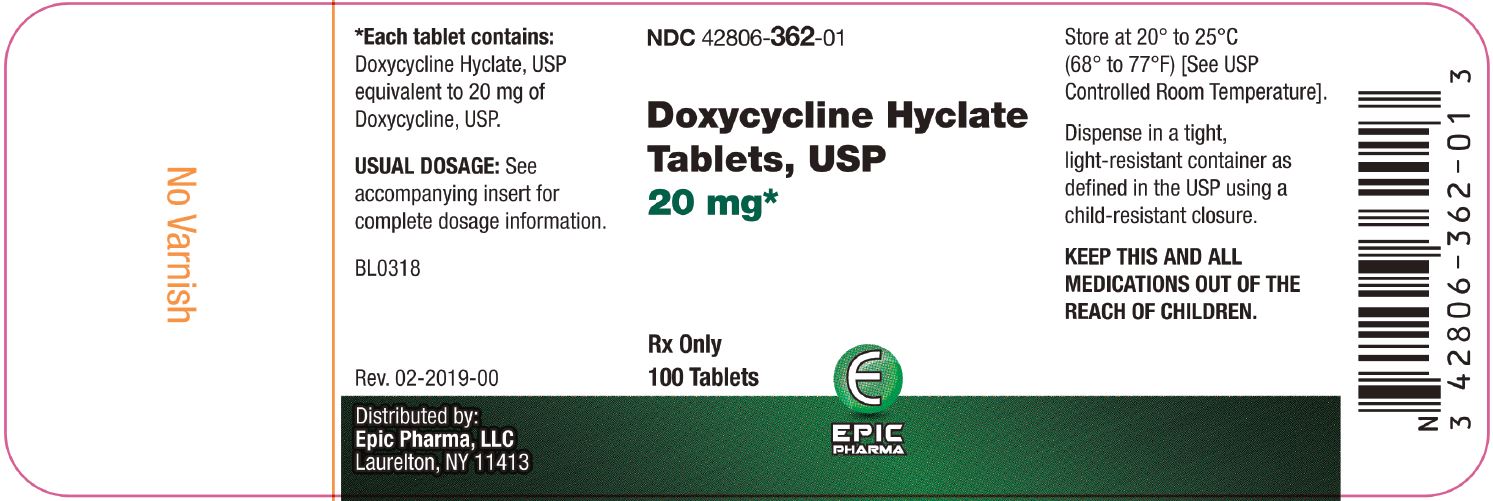
Doxycycline Hyclate 20 mg Tablet, 100-count — NDC 42806-362-01 (Billing 42806-0362-01)
This is a package of 100 tablets of Doxycycline Hyclate 20 mg Tablet from EPIC PHARMA, LLC, marketed since Aug 2019 and currently FDA-listed; retail pharmacies pay about $0.0984 per tablet (NADAC). It is the main listing for this product, which comes in 2 package sizes.
NDC database record
One package, one record: these facts belong to NDC 42806-362-01 alone.
- Record
- FDA NDC Directory package listing · Human prescription drug
- Code segments
- 42806 labeler · 362 product · 01 package
- Package marketed since
- Aug 30, 2019
- Sample package
- No — commercial package
- Listing certified through
- Dec 31, 2026
- Billing quantity
- 100 EA per package
- Barcode (UPC-A, from the NDC)
- 3 4280636201 3
- Medicaid fills, this package
- 14,216 prescriptions in the last four reported quarters
- FDA record last changed
- Jul 24, 2026
Other active recalls for Doxycycline Hyclate (different manufacturers) — 1 · tap to view
Identity & classification
Regulatory identifiers FDA, NLM and CMS codes for this package
Drug-database identifiers Medi-Span GPI and First Databank GCN / HICL / AHFS classification
- GSN (GCN sequence number): 048077
- GCN: 13521
- GPI-14 (Medi-Span): 04000020100302
- HICL (First Databank): 004013
- AHFS class code: 52:04.04.00
- RxCUI (RxNorm): 283535
Where does this data come from?
- FDA openFDA NDC Directory · synced Oct 8, 2026
- FDA label on DailyMed · label index refreshed Oct 8, 2026
- RxNorm (NLM RxNav) · catalog refreshed Oct 1, 2026
- Medi-Span GPI (licensed)
- First Databank (licensed) · refreshed Oct 8, 2026
RxNorm drug class
This medicine belongs to the Tetracycline-class Drug class.
Where does this data come from?
- RxClass (NLM) · catalog refreshed Oct 1, 2026
Clinical
Doxycycline is used to treat infections caused by bacteria and certain other infections spread by ticks, lice, mites, and infected animals. Doxycyline is also used to prevent malaria and to treat acne and rosacea (a skin disease that causes redness, flushing, and pimples on the face) Doxycycline is in a class of medications called tetracycline antibiotics. It works to treat infections by stopping bacteria from growing and spreading. It works to treat acne by killing the bacteria that infects pores and by lowering the amount of oil on your skin that can cause acne. It works to treat rosacea b...
Read the full MedlinePlus article ↗- It is an antibiotic for bacterial infections such as rickettsial infections, sexually transmitted infections, respiratory tract infections and eye infections. Some products are als...
- Take it exactly as your prescriber and label say. Swallow capsules with a full glass of water and avoid taking them right before lying down. For one capsule product, take it at lea...
- Diarrhea, nausea, vomiting, stomach upset and loss of appetite are the most common. You may also sunburn much more easily, so cover up and avoid tanning beds. Call me or your docto...
- Call right away for severe or watery diarrhea, a blistering or peeling rash, headache with vision changes, trouble swallowing, or signs of an allergic reaction. Diarrhea can show u...
Patient education
Supplement & herbal interactions
Some supplements/herbs that may interact with Doxycycline Hyclate — tap one for details:
Doxycycline Hyclate may be associated with lower levels of 7 nutrients — worth a chat with your pharmacist, not a cause for alarm.
Where does this data come from?
- MedlinePlus (NLM) · refreshed Oct 8, 2026
- FDA label on DailyMed · label index refreshed Oct 8, 2026
Ask a licensed pharmacist directly — free, answered by our team.
Pricing
A drug doesn't have one price. Each row is a different public payment system, and none is what you'd pay at the counter — that depends on your insurance. The ⓘ on each row explains what it measures.
| Price system | Per ea | Per package |
|---|---|---|
| Retail pharmacies payNADAC · weekly | $0.098 | $9.84 / 100 tablets |
| Medicaid paysCMS SDUD · 12 mo | $0.2514 | $25.14 / 100 tablets |
| Medicare drug plans payPart D · Q2 2026 | $0.2300 | $23.00 / 100 tablets |
Where does this data come from?
- CMS NADAC weekly file · file of Oct 7, 2026
- CMS ASP pricing files · refreshed Sep 20, 2026
- CMS Medicaid State Drug Utilization Data · through Q1 2026
- CMS Part D plan pricing files · refreshed Sep 24, 2026
- VA National Acquisition Center price file
Packaging — all sizes for this product
| Package NDC | Description | Per unit | Per pack | Marketing start | Marketing end | Status |
|---|---|---|---|---|---|---|
| 42806-0362-01 You're viewing this Main listing | 100 TABLET in 1 BOTTLE | $0.0984 / ea | $9.84 | 2019-08-30 | — | Active |
| 42806-0362-10 42806-362-10 | 1000 TABLET in 1 BOTTLE | — | — | 2019-08-30 | — | Active |
You're viewing the smallest of 2 pack sizes for this product.
In Medicaid, this is the most-dispensed pack of this product — about 100% of fills over the last four reported quarters. See all packs ↓
Pack size FAQ
What quantity is in this package?
How does this package differ from NDC 42806-0362-10?
What NDC number is used to bill for this package of Doxycycline Hyclate 20 mg Tablet?
Prices are the latest CMS NADAC pharmacy acquisition cost per NDC; per-pack figures are per-unit × pack quantity, shown only when the pack is denominated in the same measure NADAC prices.
Therapeutic equivalents
| Product | Labeler | Pack | NADAC/unit | TE | Status | Price vs. this |
|---|---|---|---|---|---|---|
| Doxycycline Hyclate 20 mg 68047-0714-01 | Larken | 100 tablets | $0.098 | AB | Availability likely | +0% |
| Doxycycline Hyclate 20 mgthis 42806-0362-01 | EPIC | 100 tablets | $0.098 | AB | Availability likely | — |
| Doxycycline Hyclate 20 mg 53489-0647-01 | Sun | 100 tablets | $0.098 | AB | Availability likely | — |
| Doxycycline Hyclate 20 mg 62135-0623-90 | Chartwell | 90 tablets | $0.098 | AB | Availability likely | — |
| Doxycycline Hyclate 20 mg 62332-0352-31 | Alembic | 100 tablets | $0.098 | AB | Availability likely | — |
| Doxycycline Hyclate 20 mg 46708-0352-31 | Alembic | 100 tablets | — | AB | FDA listed | — |
| Doxycycline Hyclate 20 mg 71335-2526-01 | Bryant | 20 tablets | — | AB | FDA listed | — |
| Doxycycline Hyclate 20 mg 72162-2256-01 | Bryant | 100 tablets | — | AB | FDA listed | — |
| Doxycycline Hyclate 20 mg 72789-0309-01 | PD-Rx | 100 tablets | — | AB | FDA listed | — |
Where does this data come from?
- FDA openFDA NDC Directory · synced Oct 8, 2026
- FDA Orange Book · refreshed Oct 3, 2026
- CMS NADAC weekly file · file of Oct 7, 2026
Availability & generic status
This product is an FDA-approved generic. Other versions of the same drug are listed under Therapeutic equivalents, least expensive first.
Where does this data come from?
- FDA Orange Book · refreshed Oct 3, 2026
Inactive Ingredients / Excipients
Inactive ingredients, also called excipients, are components of the drug product other than the active ingredient. They may include fillers, dyes, coatings, preservatives, flavors, or other formulation ingredients.
🧪 Avoiding an ingredient? See Doxycycline inactive ingredients by manufacturer: every current product's list side by side, so you can ask your pharmacy for the version that does not list it.
💡 Tap an ingredient (hover on desktop) to see what it is and why it’s used.
-
UNII 3SY5LH9PMK
Anhydrous lactose is a milk sugar with no water content. It acts as a filler and binder in tablets and capsules, adding bulk and helping ingredients stick together.
-
UNII 3NXW29V3WO
Hypromellose is a plant-based thickener made from cellulose. It's used in medicines as a binder to hold ingredients together, a coating for tablets, and a thickener for liquids.
-
UNII 70097M6I30
Magnesium stearate is a salt made from magnesium and stearic acid, a fatty substance. It's used in tablets and capsules as a lubricant and glidant to help ingredients flow smoothly during manufacturing and prevent sticking.
-
UNII OP1R32D61U
Microcrystalline cellulose is a purified form of cellulose, a natural fiber from plant sources. It acts as a binder and filler in tablets and capsules, helping hold ingredients together and give the medicine its shape and size.
-
UNII 3WJQ0SDW1A
Polyethylene glycol is a synthetic liquid or solid polymer used in medicines as a solvent, lubricant, and humectant. It helps dissolve active ingredients, reduces friction during manufacturing, and retains moisture in the final product.
-
UNII 6OZP39ZG8H
Polysorbate 80 is a synthetic emulsifier derived from sorbitol and oleic acid. It helps mix oil and water-based ingredients together in medications and improves how the product disperses in the body.
-
UNII 15FIX9V2JP
Titanium dioxide is a bright white mineral powder commonly used as a colorant and opacifying agent. It makes pills and tablets white or lighter in color and helps make coatings non-transparent.
7 inactive ingredients listed in the exact product block matched to this NDC.
Where does this data come from?
ingredient classCode="IACT" elements from the exact product block matched by this NDC. Label-section narrative from DailyMed / the openFDA label index is shown separately when available.- FDA label on DailyMed · label index refreshed Oct 8, 2026
- FDA openFDA NDC Directory · synced Oct 8, 2026
Inactive ingredient FAQ
Are inactive ingredients the same for every manufacturer?
Why might an inactive ingredient be missing?
Can inactive ingredients matter?
Manufacturer & labeler
More NDCs from EPIC PHARMA, LLC labeler code 42806
- Dextroamphetamine Saccharate, Amphetamine Aspartate, Dextroamphetamine Sulfate and 5 mg; 5 mg; 5 mg; 5 mg Tablet NDC 42806-344-01
- Dextroamphetamine Saccharate, Amphetamine Aspartate, Dextroamphetamine Sulfate and 7.5 mg; 7.5 mg; 7.5 mg; 7.5 mg Tablet NDC 42806-345-01
- Bupropion Hydrochloride XL 150 mg Tablet, Extended Release NDC 42806-348-05
- Bupropion Hydrochloride XL 300 mg Tablet, Extended Release NDC 42806-349-05
- Leucovorin Calcium 5 mg Tablet NDC 42806-358-01
- Leucovorin Calcium 25 mg Tablet NDC 42806-359-25
- Oseltamivir Phosphate for Oral Suspension 6 mg/mL Powder, For Suspension NDC 42806-363-13
- Deferasirox Oral Granules 90 mg Granule NDC 42806-371-30
- Deferasirox Oral Granules 180 mg Granule NDC 42806-372-30
- Deferasirox Oral Granules 360 mg Granule NDC 42806-373-30
- Methylprednisolone 4 mg Tablet NDC 42806-400-01
- metformin hydrochloride 500 mg Tablet, Film Coated, Extended Release NDC 42806-405-60
Where does this data come from?
- FDA openFDA NDC Directory · synced Oct 8, 2026
- Drugs@FDA
Full prescribing information FDA SPL
🎯 Indications and Usage ▾
INDICATIONS AND USAGE Doxycycline hyclate tablets, USP are indicated for use as an adjunct to scaling and root planing to promote attachment level gain and to reduce pocket depth in patients with adult periodontitis. To reduce the development of drug-resistant bacteria and maintain the effectiveness of doxycycline hyclate tablets and other antibacterial drugs, doxycycline hyclate tablets should be used only to treat or prevent infections that are proven or strongly suspected to be caused by susceptible bacteria. When culture susceptibility information is available, they should be considered in selecting or modifying antibacterial therapy.
In the absence of such data, local epidemiology and susceptibility patterns may contribute to the empiric selection of therapy.
⏱️ Dosage and Administration ▾
DOSAGE AND ADMINISTRATION THE DOSAGE OF DOXYCYCLINE HYCLATE TABLETS DIFFERS FROM THAT OF DOXYCYCLINE USED TO TREAT INFECTIONS. EXCEEDING THE RECOMMENDED DOSAGE MAY RESULT IN AN INCREASED INCIDENCE OF SIDE EFFECTS INCLUDING THE DEVELOPMENT OF RESISTANT MICROORGANISMS. Doxycycline hyclate tablets 20 mg twice daily as an adjunct following scaling and root planing may be administered for up to 9 months.
Doxycycline hyclate tablets should be taken twice daily at 12 hour intervals, usually in the morning and evening. It is recommended that if doxycycline hyclate tablets is taken close to meal times, allow at least one hour prior to or two hours after meals. Safety beyond 12 months and efficacy beyond 9 months have not been established.
Administration of adequate amounts of fluid along with the tablets is recommended to wash down the drug and reduce the risk of esophageal irritation and ulceration. (See ADVERSE REACTIONS Section).
⛔ Contraindications ▾
CONTRAINDICATIONS This drug is contraindicated in persons who have shown hypersensitivity to doxycycline or any of the other tetracyclines.
⚠️ Warnings ▾
WARNINGS THE USE OF DRUGS OF THE TETRACYCLINE CLASS DURING TOOTH DEVELOPMENT (LAST HALF OF PREGNANCY, INFANCY AND CHILDHOOD TO THE AGE OF 8 YEARS) MAY CAUSE PERMANENT DISCOLORATION OF THE TEETH (YELLOW-GRAY-BROWN). This adverse reaction is more common during long-term use of the drugs but has been observed following repeated short-term courses. Enamel hypoplasia has also been reported.
TETRACYCLINE DRUGS, THEREFORE, SHOULD NOT BE USED IN THIS AGE GROUP AND IN PREGNANT OR NURSING MOTHERS UNLESS THE POTENTIAL BENEFITS MAY BE ACCEPTABLE DESPITE THE POTENTIAL RISKS. All tetracyclines form a stable calcium complex in any bone forming tissue. A decrease in fibula growth rate has been observed in premature infants given oral tetracyclines in doses of 25 mg/kg every 6 hours.
This reaction was shown to be reversible when the drug was discontinued. Doxycycline can cause fetal harm when administered to a pregnant woman. Results of animal studies indicate that tetracyclines cross the placenta, are found in fetal tissues, and can have toxic effects on the developing fetus (often related to retardation of skeletal development).
Evidence of embryotoxicity has also been noted in animals treated early in pregnancy. If any tetracyclines are used during pregnancy, or if the patient becomes pregnant while taking this drug, the patient should be apprised of the potential hazard to the fetus. The catabolic action of the tetracyclines may cause and increase in BUN.
Previous studies have not observed an increase in BUN with the use of doxycycline in patients with impaired renal function. Photosensitivity manifested by an exaggerated sunburn reaction has been observed in some individuals taking tetracyclines. Patients apt to be exposed to direct sunlight or ultraviolet light should be advised that this reaction can occur with tetracycline drugs, and treatment should be discontinued at the first evidence of skin erythema.
Fixed drug eruptions have occurred with doxycycline and have been associated with worsening severity upon subsequent administrations, including generalized bullous fixed drug eruption ( see ADVERSE REACTIONS ). If severe skin reactions occur, discontinue doxycycline hyclate tablets immediately and institute appropriate therapy.
🤒 Adverse Reactions ▾
ADVERSE REACTIONS Adverse Reactions in Clinical Trials of a bioequivalent form of doxycycline hyclate capsules : In clinical trials of adult patients with periodontal disease 213 patients received 20 mg BID over a 9 to 12 month period. The most frequent adverse reactions occurring in studies involving treatment with a bioequivalent form of doxycycline hyclate capsules or placebo are listed below: Incidence (%) of Adverse Reactions in Clinical Trials of Doxycycline Hyclate Capsules, 20 mg (Bioequivalent to Doxycycline Hyclate Tablets, 20 mg) vs.
Placebo Adverse Reactions Doxycycline Hyclate Capsules 20 mg BID (n=213) Placebo (n=215) Headache 55 (26%) 56 (26%) Common Cold 47 (22%) 46 (21%) Flu Symptoms 24 (11%) 40 (19%) Tooth Ache 14 (7%) 28 (13%) Periodontal Abscess 8 (4%) 21 (10%) Tooth Disorder 13 (6%) 19 (9%) Nausea 17 (8%) 12 (6%) Sinusitis 7 (3%) 18 (8%) Injury 11 (5%) 18 (8%) Dyspepsia 13 (6%) 5 (2%) Sore Throat 11 (5%) 13 (6%) Joint Pain 12 (6%) 8 (4%) Diarrhea 12 (6%) 8 (4%) Sinus Congestion 11 (5%) 11 (5%) Coughing 9 (4%) 11 (5%) Sinus Headache 8 (4%) 8 (4%) Rash 8 (4%) 6 (3%) Back Pain 7 (3%) 8 (4%) Back Ache 4 (2%) 9 (4%) Menstrual Cramp 9 (4%) 5 (2%) Acid Indigestion 8 (4%) 7 (3%) Pain 8 (4%) 5 (2%) Infection 4 (2%) 6 (3%) Gum Pain 1 (<1%) 6 (3%) Bronchitis 7 (3%) 5 (2%) Muscle Pain 2 (1%) 6 (3%) Note: Percentages are based on total number of study participants in each treatment group.
Adverse Reactions for Tetracyclines: The following adverse reactions have been observed in patients receiving tetracyclines: Gastrointestinal: anorexia, nausea, vomiting, diarrhea, glossitis, dysphagia, enterocolitis, and inflammatory lesions (with vaginal candidiasis) in the anogenital region. Hepatotoxicity has been reported rarely. Rare instances of esophagitis and esophageal ulcerations have been reported in patients receiving the capsule forms of the drugs in the tetracycline class.
Most of these patients took medications immediately before going to bed. (See DOSAGE AND ADMINISTRATION Section). Skin: maculopapular and erythematous rashes, Stevens-Johnson syndrome, toxic epidermal necrolysis, erythema multiforme, and fixed drug eruption have been reported.
Exfoliative dermatitis has been reported but is uncommon. Photosensitivity is discussed above. (See WARNINGS Section).
Renal toxicity: Rise in BUN has been reported and is apparently dose related. (See WARNINGS Section). Hypersensitivity reactions: urticaria, angioneurotic edema, anaphylaxis, anaphylactoid purpura, serum sickness, pericarditis, and exacerbation of systemic lupus erythematosus.
Blood: Hemolytic anemia, thrombocytopenia, neutropenia, and eosinophilia have been reported. Psychiatric: Depression, anxiety, suicidal ideation, insomnia, abnormal dreams, hallucination.
🔄 Drug Interactions ▾
Drug Interactions Because tetracyclines have been shown to depress plasma prothrombin activity, patients who are on anticoagulant therapy may require downward adjustment of their anticoagulant dosage. Since bacterial antibiotics, such as the tetracycline class of antibiotics, may interfere with the bactericidal action of members of the β-lactam (e.g. penicillin) class of antibiotics, it is not advisable to administer these antibiotics concomitantly. Absorption of tetracyclines is impaired by antacids containing aluminum, calcium, or magnesium, and iron-containing preparations, and by bismuth subsalicylate.
Barbiturates, carbamazepine, and phenytoin decrease the half-life of doxycycline. The concurrent use of tetracycline and methoxyflurane has been reported to result in fatal renal toxicity. Concurrent use of tetracyclines may render oral contraceptives less effective.
🔄 Drug / Laboratory Test Interactions ▾
Drug/Laboratory Test Interactions False elevations of urinary catecholamine levels may occur due to interference with the fluorescence test.
🤰 Pregnancy ▾
Pregnancy Teratogenic Effects: Pregnancy Category D. (See WARNINGS Section). Results from animal studies indicate that doxycycline crosses the placenta and is found in fetal tissues. Nonteratogenic effects: (See WARNINGS Section).
🧒 Pediatric Use ▾
Pediatric Use The use of doxycycline hyclate tablets in infancy and childhood is contraindicated. (See WARNINGS section.)
🆘 Overdosage ▾
OVERDOSAGE In case of overdosage, discontinue medication, treat symptomatically and institute supportive measures. Dialysis does not alter serum half-life and thus would not be of benefit in treating cases of overdose.
🧬 Clinical Pharmacology ▾
CLINICAL PHARMACOLOGY After oral administration, doxycycline hyclate is rapidly and nearly completely absorbed from the gastrointestinal tract. Doxycycline is eliminated with a half-life of approximately 18 hours by renal and fecal excretion of unchanged drug.
📦 How Supplied / Storage and Handling ▾
HOW SUPPLIED Doxycycline hyclate tablets USP, 20 mg are round, white unscored tablet, debossed “Є” above “362” on one side and plain on the other side. They are supplied as follows: NDC 42806-362-01 Bottles of 100 tablets NDC 42806-362-10 Bottles of 1000 tablets Store at 20° to 25°C (68° to 77°F) [See USP Controlled Room Temperature]. Dispense in tight, light-resistant containers as defined in the USP. KEEP THIS AND ALL DRUGS OUT OF THE REACH OF CHILDREN.
📋 Description ▾
DESCRIPTION Doxycycline hyclate tablets, USP are available as a 20 mg formulation of doxycycline for oral administration. The structural formula of doxycycline hyclate is: with a structural formula of (C 22 H 24 N 2 O 8 •HCl) 2 •C 2 H 6 O•H 2 O and a molecular weight of 1025.89. The chemical designation for doxycycline is 4-(dimethylamino)-1,4,4a,5,5a,6,11,12a-octahydro-3,5,10,12,12a-pentahydroxy-6-methyl-1,11-dioxo-2-naphthacenecarboxamide monohydrochloride, compound with ethyl alcohol (2:1), monohydrate.
Doxycycline hyclate is a yellow to light-yellow crystalline powder which is soluble in water. Each tablet contains the following inactive ingredients: hypromellose, lactose anhydrous, magnesium stearate, microcrystalline cellulose, polyethylene glycol, polysorbate 80 and titanium dioxide. Meet USP Dissolution Test 5. structure.JPG
💬 Information for Patients ▾
Information for Patients Patients should be counseled that antibacterial drugs including doxycycline hyclate tablets should only be used to treat bacterial infections. They do not treat viral infections (e.g. the common cold). When doxycycline hyclate tablets are prescribed to treat a bacterial infection, patients should be told that although it is common to feel better early in the course of therapy, the medication should be taken exactly as directed.
Skipping doses or not completing the full course of therapy may (1) decrease the effectiveness of the immediate treatment and (2) increase the likelihood that bacteria will develop resistance and will not be treatable by doxycycline hyclate tablets or other antibacterial drugs in the future.
⚠️ Precautions ▾
PRECAUTIONS General Prescribing doxycycline hyclate tablets in the absence of a proven or strongly suspected bacterial infection or a prophylactic indication is unlikely to provide benefit to the patient and increase the risk of the development of drug-resistant bacteria. While no overgrowth by opportunistic microorganisms such as yeast were noted during clinical studies, as with other antimicrobials, doxycycline hyclate tablets therapy may result in overgrowth of nonsusceptible microorganisms including fungi. The use of tetracyclines may increase the incidence of vaginal candidiasis.
Doxycycline hyclate tablets should be used with caution in patients with a history or predisposition to oral candidiasis. The safety and effectiveness of doxycycline hyclate tablets have not been established for the treatment of periodontitis in patients with coexistent oral candidiasis. If superinfection is suspected, appropriate measures should be taken.
Information for Patients Patients should be counseled that antibacterial drugs including doxycycline hyclate tablets should only be used to treat bacterial infections. They do not treat viral infections (e.g. the common cold). When doxycycline hyclate tablets are prescribed to treat a bacterial infection, patients should be told that although it is common to feel better early in the course of therapy, the medication should be taken exactly as directed.
Skipping doses or not completing the full course of therapy may (1) decrease the effectiveness of the immediate treatment and (2) increase the likelihood that bacteria will develop resistance and will not be treatable by doxycycline hyclate tablets or other antibacterial drugs in the future. Laboratory Tests In long term therapy, periodic laboratory evaluations of organ systems, including hematopoietic, renal, and hepatic studies should be performed. Drug Interactions Because tetracyclines have been shown to depress plasma prothrombin activity, patients who are on anticoagulant therapy may require downward adjustment of their anticoagulant dosage.
Since bacterial antibiotics, such as the tetracycline class of antibiotics, may interfere with the bactericidal action of members of the β-lactam (e.g. penicillin) class of antibiotics, it is not advisable to administer these antibiotics concomitantly. Absorption of tetracyclines is impaired by antacids containing aluminum, calcium, or magnesium, and iron-containing preparations, and by bismuth subsalicylate. Barbiturates, carbamazepine, and phenytoin decrease the half-life of doxycycline.
The concurrent use of tetracycline and methoxyflurane has been reported to result in fatal renal toxicity. Concurrent use of tetracyclines may render oral contraceptives less effective. Drug/Laboratory Test Interactions False elevations of urinary catecholamine levels may occur due to interference with the fluorescence test.
Carcinogenesis, Mutagenesis, Impairment of Fertility Doxycycline hyclate was assessed for potential to induce carcinogenesis in a study in which the compound was administered to Sprague-Dawley rats by gavage at dosages of 20, 75, and 200 mg/kg/day for two years. An increased incidence of uterine polyps was observed in female rats that received 200 mg/kg/day, a dosage that resulted in a systemic exposure to doxycycline approximately nine times that observed in female humans that used doxycycline hyclate tablets (exposure comparison based upon AUC values).
No impact upon tumor incidence was observed in male rats at 200 mg/kg/day, or in either gender at the other dosages studied. Evidence of oncogenic activity was obtained in studies with related compounds, i.e., oxytetracycline (adrenal and pituitary tumors), and minocycline (thyroid tumors). Doxycycline hyclate demonstrated no potential to cause genetic toxicity in an in vitro point mutation study with mammalian cells (CHO/HGPRT forward mutation assay) or in an in vivo micronucleus assay conducted in CD-1 mice.
However, data from an in vitro assay… [Excerpted — this section continues on DailyMed.]
🍼 Nursing Mothers ▾
Nursing Mothers Tetracyclines are excreted in human milk. Because of the potential for serious adverse reactions in nursing infants from doxycycline, the use of doxycycline hyclate tablets in nursing mothers is contraindicated. (See WARNINGS Section).
📄 Carcinogenesis, Mutagenesis, Impairment of Fertility ▾
Carcinogenesis, Mutagenesis, Impairment of Fertility Doxycycline hyclate was assessed for potential to induce carcinogenesis in a study in which the compound was administered to Sprague-Dawley rats by gavage at dosages of 20, 75, and 200 mg/kg/day for two years. An increased incidence of uterine polyps was observed in female rats that received 200 mg/kg/day, a dosage that resulted in a systemic exposure to doxycycline approximately nine times that observed in female humans that used doxycycline hyclate tablets (exposure comparison based upon AUC values).
No impact upon tumor incidence was observed in male rats at 200 mg/kg/day, or in either gender at the other dosages studied. Evidence of oncogenic activity was obtained in studies with related compounds, i.e., oxytetracycline (adrenal and pituitary tumors), and minocycline (thyroid tumors). Doxycycline hyclate demonstrated no potential to cause genetic toxicity in an in vitro point mutation study with mammalian cells (CHO/HGPRT forward mutation assay) or in an in vivo micronucleus assay conducted in CD-1 mice.
However, data from an in vitro assay with CHO cells for potential to cause chromosomal aberrations suggest that doxycycline hyclate is a weak clastogen. Oral administration of doxycycline hyclate to male and female Sprague-Dawley rats adversely affected fertility and reproductive performance, as evidenced by increased time for mating to occur, reduced sperm motility, velocity, and concentration, abnormal sperm morphology, and increased pre-and post-implantation losses. Doxycycline hyclate induced reproductive toxicity at all dosages that were examined in this study, as even the lowest dosage tested (50 mg/kg/day) induced a statistically significant reduction in sperm velocity.
Note that 50 mg/kg/day is approximately 10 times the amount of doxycycline hyclate contained in the recommended daily dose of doxycycline hyclate tablets for a 60 kg human when compared on the basis of body surface area estimates (mg/m 2 ). Although doxycycline impairs the fertility of rats when administered at sufficient dosage, the effect of doxycycline hyclate tablets on human fertility is unknown.
📚 References ▾
References 1. Golub L.M., Sorsa T., Lee H-M, Ciancio S., Sorbi D., Ramamurthy N.S., Gruber B., Salo T., Konttinen Y.T.: Doxycycline Inhibits Neutrophil (PMN)-type Matrix Metalloproteinases in Human Adult Periodontitis Gingiva. J.
Clin. Periodontol: 1995; 22: 100-109. 2.
Golub L.M., Ciancio S., Ramamurthy N.S., Leung M., McNamara T.F.: Low-dose Doxycycline Therapy: Effect on Gingival and Crevicular Fluid Collagenase Activity in Humans. J. Periodont Res 1990; 25: 321-330.
3. Golub L.M., Lee H.M., Greenwald R.A., Ryan M.E., Salo T., Giannobile W.V.: A Matrix Metalloproteinase Inhibitor Reduces Bone-type Collagen Degradation Fragments and Specific Collegenases in Gingival Crevicular Fluid During Adult Periodontitis. Inflammation Research 1997; 46: 310-319.
4. Saivain S., Houin G.: Clinical Pharmacokinetics of Doxycycline and Minocycline. Clin.
Pharmacokinetics 1988; 15: 355-366. 5. Schach von Wittenau M., Twomey T.: The Disposition of Doxycycline by Man and Dog.
Chemotherapy 1971; 16: 217-228. 6. Campistron G., Coulais Y., Caillard C., Mosser J., Pontagnier H., Houin G.: Pharmacokinetics and Bioavailability of Doxycycline in Humans.
Arzneimittel Forschung 1986; 36: 1705-1707. Distributed by: Epic Pharma, LLC Laurelton, NY 11413 USA Rev.03-2025-00 MF0362REV03/25E LN0017
📄 Package Label / Principal Display Panel ▾
PACKAGE/LABEL PRINCIPAL DISPLAY PANEL – 20 mg 100ct doxy-20mg-100ct