
Doxycycline 50 mg Capsule, 100-count — NDC 43386-790-01 (Billing 43386-0790-01)
This is a package of 100 capsules of Doxycycline 50 mg Capsule from Lupin Pharmaceuticals,Inc., marketed since Jul 2015 and currently FDA-listed. It is the main listing for this product, which comes in 3 package sizes.
NDC database record
One package, one record: these facts belong to NDC 43386-790-01 alone.
- Record
- FDA NDC Directory package listing · Human prescription drug
- Code segments
- 43386 labeler · 790 product · 01 package
- Package marketed since
- Jul 8, 2015
- Sample package
- No — commercial package
- Listing certified through
- Dec 31, 2026
- Billing quantity
- 100 EA per package
- Barcode (UPC)
- 0343386792115, 0343386791019
- FDA record last changed
- Jul 24, 2026
Identity & classification
Regulatory identifiers FDA, NLM and CMS codes for this package
Drug-database identifiers Medi-Span GPI and First Databank GCN / HICL / AHFS classification
- GSN (GCN sequence number): 016815
- GCN: 40652
- GPI-14 (Medi-Span): 04000020000105
- HICL (First Databank): 004014
- AHFS class code: 08:12.24.00
- RxCUI (RxNorm): 700408
Where does this data come from?
- FDA openFDA NDC Directory · synced Oct 8, 2026
- FDA label on DailyMed · label index refreshed Oct 6, 2026
- RxNorm (NLM RxNav) · catalog refreshed Oct 1, 2026
- Medi-Span GPI (licensed)
- First Databank (licensed) · refreshed Oct 8, 2026
RxNorm drug class
This medicine belongs to the Tetracycline-class Drug class.
Where does this data come from?
- RxClass (NLM) · catalog refreshed Oct 1, 2026
Clinical
Doxycycline is used to treat infections caused by bacteria and certain other infections spread by ticks, lice, mites, and infected animals. Doxycyline is also used to prevent malaria and to treat acne and rosacea (a skin disease that causes redness, flushing, and pimples on the face) Doxycycline is in a class of medications called tetracycline antibiotics. It works to treat infections by stopping bacteria from growing and spreading. It works to treat acne by killing the bacteria that infects pores and by lowering the amount of oil on your skin that can cause acne. It works to treat rosacea b...
Read the full MedlinePlus article ↗- It is an antibiotic for bacterial infections such as rickettsial infections, sexually transmitted infections, respiratory tract infections and eye infections. Some products are als...
- Take it exactly as your prescriber and label say. Swallow capsules with a full glass of water and avoid taking them right before lying down. For one capsule product, take it at lea...
- Diarrhea, nausea, vomiting, stomach upset and loss of appetite are the most common. You may also sunburn much more easily, so cover up and avoid tanning beds. Call me or your docto...
- Call right away for severe or watery diarrhea, a blistering or peeling rash, headache with vision changes, trouble swallowing, or signs of an allergic reaction. Diarrhea can show u...
Patient education
Supplement & herbal interactions
Some supplements/herbs that may interact with Doxycycline — tap one for details:
Doxycycline may be associated with lower levels of 7 nutrients — worth a chat with your pharmacist, not a cause for alarm.
Where does this data come from?
- MedlinePlus (NLM) · refreshed Oct 1, 2026
- FDA label on DailyMed · label index refreshed Oct 6, 2026
Ask a licensed pharmacist directly — free, answered by our team.
Pricing
A drug doesn't have one price. Each row is a different public payment system, and none is what you'd pay at the counter — that depends on your insurance. The ⓘ on each row explains what it measures.
| Price system | Per each | Per package |
|---|---|---|
| Retail pharmacies payNADAC · weekly | Not in the retail survey — common for institutional, discontinued, or low-volume packs. | |
| Medicaid paysCMS SDUD · 12 mo | No recent Medicaid claims on file for this NDC — rare and low-volume NDCs are suppressed in the public data. | |
| Medicare drug plans payPart D · Q2 2026 | $0.2701 | $27.01 / 100 capsules |
Where does this data come from?
- CMS NADAC weekly file
- CMS ASP pricing files · refreshed Sep 20, 2026
- CMS Medicaid State Drug Utilization Data · refreshed Oct 8, 2026
- CMS Part D plan pricing files · refreshed Sep 24, 2026
- VA National Acquisition Center price file
Packaging — all sizes for this product
| Package NDC | Description | Marketing start | Marketing end | Status |
|---|---|---|---|---|
| 43386-0790-01 You're viewing this Main listing | 100 CAPSULE in 1 BOTTLE | 2015-07-08 | — | Active |
| 43386-0790-10 43386-790-10 | 1000 CAPSULE in 1 BOTTLE | 2015-07-08 | — | Active |
| 43386-0790-11 43386-790-11 | 50 CAPSULE in 1 BOTTLE | 2015-07-08 | — | Active |
You're viewing one of 3 pack sizes for this product.
Pack size FAQ
What quantity is in this package?
How does this package differ from NDC 43386-0790-11?
What NDC number is used to bill for this package of Doxycycline 50 mg Capsule?
Therapeutic equivalents
| Product | Labeler | Pack | NADAC/unit | TE | Status | Price vs. this |
|---|---|---|---|---|---|---|
| doxycycline 50 mg 50268-0280-15 | AvPAK | 50 capsules | $0.152 | AB | Availability likely | — |
| Doxycycline Monohydrate 50 mg 62135-0260-01 | Chartwell | 100 capsules | $0.152 | AB | Availability likely | — |
| Doxycycline 50 mg 64380-0179-01 | Strides | 100 capsules | $0.152 | AB | Availability likely | — |
| Doxycycline 50 mg 64380-0920-01 | Strides | 100 capsules | $0.152 | AB | Availability likely | — |
| Doxycycline 50 mg 68180-0650-01 | Lupin | 100 capsules | $0.152 | AB | Availability likely | — |
| doxycycline 50 mg 68382-0782-01 | Zydus | 100 capsules | $0.152 | AB | Availability likely | — |
| Doxycycline 50 mgthis 43386-0790-01 | Lupin | 100 capsules | — | — | FDA listed | — |
| Doxycycline 50 mg 51407-0678-01 | Golden | 100 capsules | — | AB | FDA listed | — |
| Doxycycline 50 mg 63304-0614-01 | Sun | 100 capsules | — | AB | FDA listed | — |
| doxycycline 50 mg 65841-0821-01 | Zydus | 100 capsules | — | AB | FDA listed | — |
| doxycycline 50 mg 71335-1479-01 | Bryant | 30 capsules | — | AB | Discontinued | — |
| doxycycline 50 mg 48433-0158-03 | Safecor | 30 capsules | — | AB | FDA listed | — |
Where does this data come from?
- FDA openFDA NDC Directory · synced Oct 8, 2026
- FDA Orange Book · refreshed Oct 3, 2026
- CMS NADAC weekly file
Availability & generic status
This product is an FDA-approved generic. Other versions of the same drug are listed under Therapeutic equivalents, least expensive first.
Where does this data come from?
- FDA Orange Book · refreshed Oct 3, 2026
What it looks like
Where does this data come from?
- FDA label on DailyMed · label index refreshed Oct 6, 2026
Inactive Ingredients / Excipients
Inactive ingredients, also called excipients, are components of the drug product other than the active ingredient. They may include fillers, dyes, coatings, preservatives, flavors, or other formulation ingredients.
🧪 Avoiding an ingredient? See Doxycycline inactive ingredients by manufacturer: every current product's list side by side, so you can ask your pharmacy for the version that does not list it.
💡 Tap an ingredient (hover on desktop) to see what it is and why it’s used.
-
UNII OP1R32D61U
Microcrystalline cellulose is a purified form of cellulose, a natural fiber from plant sources. It acts as a binder and filler in tablets and capsules, helping hold ingredients together and give the medicine its shape and size.
-
UNII 35SW5USQ3G
A synthetic yellow dye used to color medicines. It helps make tablets, capsules, and liquids visually distinct so patients can easily identify their medication.
-
UNII PN2ZH5LOQY
A synthetic red dye approved by the FDA for use in foods, medicines, and cosmetics. It serves as a colorant to make tablets, capsules, and liquids visually distinctive for product identification.
-
UNII 1K09F3G675
Ferric oxide red is an inorganic iron compound used as a colorant in medicines. It gives tablets, capsules, or other dosage forms a red or reddish tint for identification and appearance.
-
UNII XM0M87F357
A dark iron oxide compound that gives medicines their black or dark color. It's used as a colorant in tablets and capsules to help identify the product and make it visually distinctive.
-
UNII 2G86QN327L
Gelatin is a protein derived from animal collagen, commonly used in medicines as a gelling agent and capsule material. It helps create soft or hard capsule shells that hold and release medication, and can also thicken liquid formulations.
-
UNII 70097M6I30
Magnesium stearate is a salt made from magnesium and stearic acid, a fatty substance. It's used in tablets and capsules as a lubricant and glidant to help ingredients flow smoothly during manufacturing and prevent sticking.
-
UNII WZH3C48M4T
Potassium hydroxide is a strong alkaline chemical used in medicines to adjust and maintain the pH level of liquid formulations, helping keep the product stable and the active ingredients effective.
-
UNII 46N107B71O
Shellac is a natural resin secreted by the lac beetle. It's used as a coating on tablets and capsules to control how quickly the medicine dissolves and to improve appearance and stability.
-
UNII ETJ7Z6XBU4
Silicon dioxide is a naturally occurring mineral used as a glidant and anti-caking agent. It helps powder ingredients flow smoothly and prevents clumping during manufacturing and storage.
-
UNII 368GB5141J
A detergent and foaming agent derived from coconut or palm oil. In medications, it helps break down and mix oil and water-based ingredients, aids in tablet disintegration, and improves how the drug dissolves and spreads in the mouth or digestive system.
-
UNII 5856J3G2A2
A starch-based powder made from potatoes and processed with sodium. It acts as a disintegrant, helping the tablet or capsule break apart quickly in the stomach so the medicine can be absorbed.
-
UNII 15FIX9V2JP
Titanium dioxide is a bright white mineral powder commonly used as a colorant and opacifying agent. It makes pills and tablets white or lighter in color and helps make coatings non-transparent.
13 inactive ingredients listed in the exact product block matched to this NDC.
Where does this data come from?
ingredient classCode="IACT" elements from the exact product block matched by this NDC. Label-section narrative from DailyMed / the openFDA label index is shown separately when available.- FDA label on DailyMed · label index refreshed Oct 6, 2026
- FDA openFDA NDC Directory · synced Oct 8, 2026
Inactive ingredient FAQ
Are inactive ingredients the same for every manufacturer?
Why might an inactive ingredient be missing?
Can inactive ingredients matter?
Manufacturer & labeler
More NDCs from Lupin Pharmaceuticals,Inc. labeler code 43386
- Quinapril HCL and Hydrochlorothiazide 20 mg; 12.5 mg Tablet NDC 43386-711-03
- Quinapril HCL and Hydrochlorothiazide 20 mg; 25 mg Tablet NDC 43386-712-03
- Zolpidem Tartrate 3.5 mg Tablet NDC 43386-761-30
- Zolpidem Tartrate 1.75 mg Tablet NDC 43386-762-30
- Flucytosine 500 mg Capsule NDC 43386-770-01
- Flucytosine 250 mg Capsule NDC 43386-771-01
- Doxycycline 75 mg Capsule NDC 43386-791-01
- Doxycycline 100 mg Capsule NDC 43386-792-02
- Doxycycline Hyclate 100 mg Tablet NDC 43386-794-01
- Dexmethylphenidate Hydrochloride 5 mg Tablet NDC 43386-860-01
- Dexmethylphenidate Hydrochloride 10 mg Tablet NDC 43386-861-01
- Dexmethylphenidate Hydrochloride 2.5 mg Tablet NDC 43386-862-01
Where does this data come from?
- FDA openFDA NDC Directory · synced Oct 8, 2026
- Drugs@FDA
Full prescribing information FDA SPL
🎯 Indications and Usage ▾
INDICATIONS AND USAGE To reduce the development of drug-resistant bacteria and maintain effectiveness of doxycycline capsules, USP and other antibacterial drugs, doxycycline capsules, USP should be used only to treat or prevent infections that are proven or strongly suspected to be caused by susceptible bacteria. When culture and susceptibility information are available, they should be considered in selecting or modifying antibacterial therapy. In the absence of such data, local epidemiology and susceptibility patterns may contribute to the empiric selection of therapy.
Doxycycline is indicated for the treatment of the following infections: Rocky mountain spotted fever, typhus fever and the typhus group, Q fever, rickettsialpox, and tick fevers caused by Rickettsiae. Respiratory tract infections caused by Mycoplasma pneumoniae Lymphogranuloma venereum caused by Chlamydia trachomatis Psittacosis (ornithosis) caused by Chlamydophila psittaci Trachoma caused by Chlamydia trachomatis , although the infectious agent is not always eliminated as judged by immunofluorescence Inclusion conjunctivitis caused by Chlamydia trachomatis Uncomplicated urethral, endocervical or rectal infections in adults caused by Chlamydia trachomatis Nongonococcal urethritis caused by Ureaplasma urealyticum Relapsing fever due to Borrelia recurrentis .
Doxycycline is also indicated for the treatment of infections caused by the following gram-negative microorganisms: Chancroid caused by Haemophilus ducreyi Plague due to Yersinia pestis . Tularemia due to Francisella tularensis Cholera caused by Vibrio cholerae Campylobacter fetus infections caused by Campylobacter fetus Brucellosis due to Brucella species (in conjunction with streptomycin) Bartonellosis due to Bartonella bacilliformis Granuloma inguinale caused by Calymmatobacterium granulomatis . Because many strains of the following groups of microorganisms have been shown to be resistant to doxycycline, culture and susceptibility testing are recommended.
Doxycycline is indicated for treatment of infections caused by the following gram-negative microorganisms, when bacteriologic testing indicates appropriate susceptibility to the drug: Escherichia coli Enterobacter aerogenes Shigella species Acinetobacter species Respiratory tract infections caused by Haemophilus influenzae Respiratory tract and urinary tract infections caused by Klebsiella species . Doxycycline is indicated for treatment of infections caused by the following gram-positive microorganisms when bacteriologic testing indicates appropriate susceptibility to the drug: Upper respiratory infections caused by Streptococcus pneumoniae Anthrax due to Bacillus anthracis , including inhalational anthrax (post-exposure): to reduce the incidence or progression of disease following exposure to aerosolized Bacillus anthracis .
When penicillin is contraindicated, doxycycline is an alternative in the treatment of the following infections: Uncomplicated gonorrhea caused by Neisseria gonorrhoeae Syphilis caused by Treponema pallidum Yaws caused by Treponema pertenue Listeriosis due to Listeria monocytogenes Vincent's infection caused by Fusobacterium fusiforme Actinomycosis caused by Actinomyces israelii Infections caused by Clostridium species. In acute intestinal amebiasis, doxycycline may be a useful adjunct to amebicides. In severe acne, doxycycline may be useful adjunctive therapy.
⏱️ Dosage and Administration ▾
DOSAGE AND ADMINISTRATION THE USUAL DOSAGE AND FREQUENCY OF ADMINISTRATION OF DOXYCYCLINE DIFFERS FROM THAT OF THE OTHER TETRACYCLINES. EXCEEDING THE RECOMMENDED DOSAGE MAY RESULT IN AN INCREASED INCIDENCE OF SIDE EFFECTS. Adults: The usual dose of oral doxycycline is 200 mg on the first day of treatment (administered 100 mg every 12 hours or 50 mg every 6 hours) followed by a maintenance dose of 100 mg/day.
The maintenance dose may be administered as a single dose or as 50 mg every 12 hours. In the management of more severe infections (particularly chronic infections of the urinary tract), 100 mg every 12 hours is recommended. For pediatric patients above eight years of age: The recommended dosage schedule for pediatric patients weighing 100 pounds or less is 2 mg/lb of body weight divided into two doses on the first day of treatment, followed by 1 mg/lb of body weight given as a single daily dose or divided into two doses, on subsequent days.
For more severe infections up to 2 mg/lb of body weight may be used. For pediatric patients over 100 pounds the usual adult dose should be used. Uncomplicated gonococcal infections in adults (except anorectal infections in men): 100 mg, by mouth, twice a day for 7 days.
As an alternate single visit dose, administer 300 mg stat followed in one hour by a second 300 mg dose. Acute epididymo-orchitis caused by N. gonorrhoeae: 100 mg, by mouth, twice a day for at least 10 days. Primary and secondary syphilis: 300 mg a day in divided doses for at least 10 days.
Uncomplicated urethral, endocervical, or rectal infection in adults caused by Chlamydia trachomatis: 100 mg, by mouth, twice a day for at least 7 days. Nongonococcal urethritis caused by C. trachomatis and U. urealyticum: 100 mg, by mouth, twice a day for at least 7 days. Acute epididymo-orchitis caused by C. trachomatis: 100 mg, by mouth, twice a day for at least 10 days.
Inhalational anthrax (post-exposure): ADULTS: 100 mg of doxycycline, by mouth, twice a day for 60 days. CHILDREN: weighing less than 100 pounds (45 kg); 1 mg/lb (2.2 mg/kg) of body weight, by mouth, twice a day for 60 days. Children weighing 100 pounds or more should receive the adult dose.
When used in streptococcal infections, therapy should be continued for 10 days. Administration of adequate amounts of fluid along with capsule and tablet forms of drugs in the tetracycline class is recommended to wash down the drugs and reduce the risk of esophageal irritation and ulceration. (See ADVERSE REACTIONS .) If gastric irritation occurs, doxycycline may be given with food.
Ingestion of a high fat meal has been shown to delay the time to peak plasma concentrations by an average of one hour and 20 minutes. However, in the same study, food enhanced the average peak concentration by 7.5% and the area under the curve by 5.7%.
⛔ Contraindications ▾
CONTRAINDICATIONS This drug is contraindicated in persons who have shown hypersensitivity to any of the tetracyclines.
⚠️ Warnings ▾
WARNINGS THE USE OF DRUGS OF THE TETRACYCLINE CLASS DURING TOOTH DEVELOPMENT (LAST HALF OF PREGNANCY, INFANCY, AND CHILDHOOD TO THE AGE OF 8 YEARS) MAY CAUSE PERMANENT DISCOLORATION OF THE TEETH (YELLOW-GRAY-BROWN). This adverse reaction is more common during long-term use of the drugs but has been observed following repeated short-term courses. Enamel hypoplasia has also been reported.
TETRACYCLINE DRUGS, THEREFORE, SHOULD NOT BE USED IN THIS AGE GROUP, EXCEPT FOR ANTHRAX, INCLUDING INHALATIONAL ANTHRAX (POST- EXPOSURE), UNLESS OTHER DRUGS ARE NOT LIKELY TO BE EFFECTIVE OR ARE CONTRAINDICATED. Clostridium difficile associated diarrhea (CDAD) has been reported with use of nearly all antibacterial agents, including doxycycline capsules, and may range in severity from mild diarrhea to fatal colitis. Treatment with antibacterial agents alters the normal flora of the colon leading to overgrowth of C. difficile .
C. difficile produces toxins A and B which contribute to the development of CDAD. Hypertoxin producing strains of C. difficile cause increased morbidity and mortality, as these infections can be refractory to antimicrobial therapy and may require colectomy. CDAD must be considered in all patients who present with diarrhea following antibiotic use.
Careful medical history is necessary since CDAD has been reported to occur over two months after the administration of antibacterial agents. If CDAD is suspected or confirmed, ongoing antibiotic use not directed against C. difficile may need to be discontinued. Appropriate fluid and electrolyte management, protein supplementation, antibiotic treatment of C. difficile , and surgical evaluation should be instituted as clinically indicated.
All tetracyclines form a stable calcium complex in any bone-forming tissue. A decrease in the fibula growth rate has been observed in prematures given oral tetracycline in doses of 25 mg/kg every six hours. This reaction was shown to be reversible when the drug was discontinued.
Results of animal studies indicate that tetracyclines cross the placenta, are found in fetal tissues, and can have toxic effects on the developing fetus (often related to retardation of skeletal development). Evidence of embryo toxicity has been noted in animals treated early in pregnancy. If any tetracycline is used during pregnancy or if the patient becomes pregnant while taking these drugs, the patient should be apprised of the potential hazard to the fetus.
The antianabolic action of the tetracyclines may cause an increase in BUN. Studies to date indicate that this does not occur with the use of doxycycline in patients with impaired renal function. Photosensitivity manifested by an exaggerated sunburn reaction has been observed in some individuals taking tetracyclines.
Patients apt to be exposed to direct sunlight or ultraviolet light should be advised that this reaction can occur with tetracycline drugs, and treatment should be discontinued at the first evidence of skin erythema.
🤒 Adverse Reactions ▾
ADVERSE REACTIONS Due to oral doxycycline's virtually complete absorption, side effects to the lower bowel, particularly diarrhea, have been infrequent. The following adverse reactions have been observed in patients receiving tetracyclines. Gastrointestinal: Anorexia, nausea, vomiting, diarrhea, glossitis, dysphagia, enterocolitis, and inflammatory lesions (with monilial overgrowth) in the anogenital region.
Hepatotoxicity has been reported. These reactions have been caused by both the oral and parenteral administration of tetracyclines. Rare instances of esophagitis and esophageal ulcerations have been reported in patients receiving capsule and tablet forms of drugs in the tetracycline class.
Most of these patients took medications immediately before going to bed. (See DOSAGE AND ADMINISTRATION .) Skin: Maculopapular and erythematous rashes, Stevens-Johnson syndrome, toxic epidermal necrolysis, and erythema multiforme have been reported. Exfoliative dermatitis has been reported but is uncommon.
Photosensitivity is discussed above. (See WARNINGS .) Renal Toxicity: Rise in BUN has been reported and is apparently dose related. (See WARNINGS.) Hypersensitivity Reactions: Urticaria, angioneurotic edema, anaphylaxis, anaphylactoid purpura, serum sickness, pericarditis, and exacerbation of systemic lupus erythematosus.
Blood: Hemolytic anemia, thrombocytopenia, neutropenia, and eosinophilia have been reported with tetracyclines. Other: Intracranial hypertension (IH, pseudotumor cerebri) has been associated with the use of tetracyclines . (See PRECAUTIONS-General .) When given over prolonged periods, tetracyclines have been reported to produce brown-black microscopic discoloration of the thyroid gland.
No abnormalities of thyroid function are known to occur.
🆘 Overdosage ▾
OVERDOSAGE In case of overdosage, discontinue medication, treat symptomatically and institute supportive measures. Dialysis does not alter serum half-life, and it would not be of benefit in treating cases of overdosage.
🧬 Clinical Pharmacology ▾
CLINICAL PHARMACOLOGY Tetracyclines are readily absorbed and are bound to plasma proteins in varying degrees. They are concentrated by the liver in the bile and excreted in the urine and feces at high concentrations in a biologically active form. Doxycycline is virtually completely absorbed after oral administration.
Following a 200 mg dose of doxycycline monohydrate, 24 normal adult volunteers averaged the following serum concentration values: Time (hr): 0.5 1.0 1.5 2.0 3.0 4.0 8.0 12.0 24.0 48.0
72.0Conc. 1.02 2.26 2.67 3.01 3.16 3.03 2.03 1.62 0.95 0.37 0.15 (mcg/mL) Average Observed Values Maximum Concentration 3.61 mcg/mL (± 0.9 sd) Time of Maximum Concentration 2.60 hr (± 1.10 sd) Elimination Rate Constant 0.049 per hr (± 0.030 sd) Half-Life 16.33 hr (± 4.53 sd) Excretion of doxycycline by the kidney is about 40%/72 hours in individuals with normal function (creatinine clearance about 75 mL/min). This percentage excretion may fall as low as 1-5%/72 hours in individuals with severe renal insufficiency (creatinine clearance below 10 mL/min).
Studies have shown no significant difference in serum half-life of doxycycline (range 18 to 22 hours) in individuals with normal and severely impaired renal function. Hemodialysis does not alter serum half-life. Microbiology: Mechanism of Action Doxycycline inhibits bacterial protein synthesis by binding to the 30S ribosomal subunit.
Doxycycline has bacteriostatic activity against a broad range of Gram-positive and Gram-negative bacteria. Cross resistance with other tetracyclines is common. Doxycycline has been shown to be active against most isolates of the following microorganisms, both in vitro and in clinical infections as described in the INDICATIONS AND USAGE section of the package insert.
Gram-Negative Bacteria Acinetobacter species Bartonella bacilliformis Brucella species Enterobacter aerogenes Escherichia coli Francisella tularensis Haemophilus ducreyi Haemophilus influenzae Klebsiella granulomatis Klebsiella species Neisseria gonorrhoeae Shigella species Vibrio cholerae Vibrio fetus Yersinia pestis Gram-Positive Bacteria Bacillus anthracis Streptococcus pneumoniae Anaerobes Clostridium species Fusobacterium fusiforme Propionibacterium acnes Other Bacteria Norcardiae and other aerobic Actinomyces species Borrelia recurrentis Chlamydophila psittaci Chlamydia trachomatis Mycoplasma pneumoniae Rickettsiae Treponema pallidum Treponema pallidum subspecies pertenue Ureaplasma urealyticum Parasites Balantidium coli Entamoeba species Plasmodium falciparum* *Doxycycline has been found to be active against the asexual erythrocytic forms of Plasmodium falciparum , but not against the gametocytes of P. falciparum .
The precise mechanism of action of the drug is not known. Susceptibility Testing Methods When available, the clinical microbiology laboratory should provide the results of in vitro susceptibility test results for antimicrobial drugs used in resident hospitals to the physician as periodic reports that describe the susceptibility profile of nosocomial and community-acquired pathogens. These reports should aid the physician in selecting the most effective antimicrobial.
Dilution Techniques Quantitative methods are used to determine antimicrobial minimum inhibitory concentrations (MICs). These MICs provide estimates of the susceptibility of bacteria to antimicrobial compounds. The MICs should be determined using a standardized test method (broth and /or agar).
1,2,4,6,7 The MIC values should be interpreted according to criteria provided in Table 1. Diffusion Techniques Quantitative methods that require measurement of zone diameters can also provide reproducible estimates of the susceptibility of bacteria to antimicrobial compounds. The zone size provides an estimate of the susceptibility of bacteria to antimicrobial compounds.
The zone size should be determined using a standardized test method. 1,3,4 This procedure uses paper disks impregnated with 30 mcg doxycycline to test the… [Excerpted — this section continues on DailyMed.]
📦 How Supplied / Storage and Handling ▾
HOW SUPPLIED Doxycycline Capsules, USP 50 mg have a yellow opaque cap and a white opaque body. The capsules are imprinted "NL 790" with white ink on the cap and "50 mg" with brown ink on the body, filled with yellow to beige powder. Each capsule contains doxycycline monohydrate equivalent to 50 mg doxycycline.
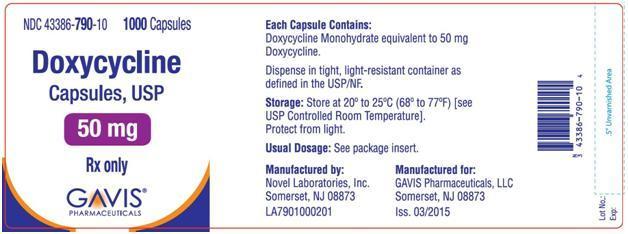
Doxycycline Capsules, USP 50 mg is available in: Bottles of 50 capsules ............................NDC 43386-790-11 Bottles of 100 capsules ...........................NDC 43386-790-01 Bottles of 1000 capsules ..........................NDC 43386-790-10 Doxycycline Capsules, USP 75 mg have a brown opaque cap and a white opaque body. The capsules are imprinted "NL 791" with white ink on the cap and "75 mg" with brown ink on the body, filled with yellow to beige powder. Each capsule contains doxycycline monohydrate equivalent to 75 mg doxycycline.
Doxycycline Capsules, USP 75 mg is available in: Bottles of 50 capsules ..............................NDC 43386-791-11 Bottles of 100 capsules .............................NDC 43386-791-01 Bottles of 1000 capsules ...........................NDC 43386-791-10 Doxycycline Capsules, USP 100 mg have a brown opaque cap and a yellow opaque body. The capsules are imprinted "NL 792" with white ink on the cap and "100 mg" with brown ink on the body, filled with yellow to beige powder. Each capsule contains doxycycline monohydrate equivalent to 100 mg doxycycline.
Doxycycline Capsules, USP 100 mg is available in: Bottles of 50 capsules .............................NDC 43386-792-11 Bottles of 250 capsules..............................NDC 43386-792-02 Bottles of 1000 capsules ............................NDC 43386-792-10 STORE AT 20° to 25°C (68° to 77°F). [SEE USP CONTROLLED ROOM TEMPERATURE.] DISPENSE IN A TIGHT, LIGHT-RESISTANT CONTAINER AS DEFINED IN THE USP/NF. PROTECT FROM LIGHT.
📋 Description ▾
DESCRIPTION Doxycycline is a broad-spectrum antibacterial synthetically derived from oxytetracycline. Doxycycline capsules USP, 50 mg, 75 mg, and 100 mg contain doxycycline monohydrate equivalent to 50 mg, 75 mg, and 100 mg of doxycycline for oral administration. The chemical designation of the light yellow to pale yellow powder is 2-Naphthacenecarboxamide,4-(dimethylamino)-1,4,4a,5,5a,6,11,12a-octahydro-3,5,10,12,12a-pentahydroxy-6-methyl-1,11-dioxo-,[4 S -(4α,4aα,5α,5aα,6α,12aα)]-,monohydrate.
Structural formula: C 22 H 24 N 2 O 8 • H 2 O M.W. = 462.45 Doxycycline has a high degree of lipid solubility and a low affinity for calcium binding. It is highly stable in normal human serum. Doxycycline will not degrade into an epianhydro form.
Inert ingredients: colloidal silicon dioxide; magnesium stearate; microcrystalline cellulose; sodium starch glycolate; and a hard gelatin capsule which contains titanium dioxide, FD&C Red # 3, D&C Yellow # 10, gelatin, sodium lauryl sulfate, for the 50 mg strength; iron oxide black, iron oxide red, iron oxide yellow, titanium dioxide, gelatin, sodium lauryl sulfate for the 75 mg strength and iron oxide black, Iron Oxide Red, Iron Oxide Yellow, Titanium Dioxide, FD & C Red# 3, D&C Yellow # 10, gelatin, sodium lauryl sulfate for the 100 mg strength.
The capsules are printed with edible ink containing shellac, titanium dioxide, black iron oxide, red iron oxide and potassium hydroxide for 50 mg, 75 mg and 100 mg strengths. Doxycycline structural formula.
⚠️ Precautions ▾
PRECAUTIONS General: As with other antibacterial preparations, use of this drug may result in overgrowth of non-susceptible organisms, including fungi. If superinfection occurs, the antibiotic should be discontinued and appropriate therapy instituted. Intracranial hypertension (IH, pseudotumor cerebri) has been associated with the use of tetracyclines including doxycycline.
Clinical manifestations of IH include headache, blurred vision, diplopia, and vision loss; papilledema can be found on fundoscopy. Women of childbearing age who are overweight or have a history of IH are at greater risk for developing tetracycline associated IH. Concomitant use of isotretinoin and doxycyline should be avoided because isotretinoin is also known to cause pseudotumor cerebri.
Although IH typically resolves after discontinuation of treatment, the possibility for permanent visual loss exists. If visual disturbance occurs during treatment, prompt ophthalmologic evaluation is warranted. Since intracranial pressure can remain elevated for weeks after drug cessation patients should be monitored until they stabilize.
Incision and drainage or other surgical procedures should be performed in conjunction with antibacterial therapy when indicated. Prescribing doxycycline capsules in the absence of proven or strongly suspected bacterial infection or a prophylactic indication is unlikely to provide benefit to the patient and increases the risk of the development of drug-resistant bacteria. Information for Patients: All patients taking doxycycline should be advised: –to avoid excessive sunlight or artificial ultraviolet light while receiving doxycycline and to discontinue therapy if phototoxicity (e.g., skin eruptions, etc.) occurs.
Sunscreen or sunblock should be considered. (See WARNINGS .) –to drink fluids liberally along with doxycycline to reduce the risk of esophageal irritation and ulceration. (See ADVERSE REACTIONS .) –that the absorption of tetracyclines is reduced when taken with foods, especially those which contain calcium.
However, the absorption of doxycycline is not markedly influenced by simultaneous ingestion of food or milk. (See Drug Interactions .) –that the absorption of tetracyclines is reduced when taking bismuth subsalicylate. (See Drug Interactions .) –not to use outdated or poorly stored doxycycline. –that the use of doxycycline might increase the incidence of vaginal candidiasis.
Diarrhea is a common problem caused by antibiotics which usually ends when the antibiotic is discontinued. Sometimes after starting treatment with antibiotics, patients can develop watery and bloody stools (with or without stomach cramps and fever) even as late as two or more months after having taken the last dose of the antibiotic. If this occurs, patients should contact their physician as soon as possible.
Patients should be counseled that antibacterial drugs including doxycycline capsules should only be used to treat bacterial infections. They do not treat viral infections (e.g., the common cold). When doxycycline capsules are prescribed to treat a bacterial infection, patients should be told that although it is common to feel better early in the course of therapy, the medication should be taken exactly as directed.
Skipping doses or not completing the full course of therapy may (1) decrease the effectiveness of the immediate treatment and (2) increase the likelihood that bacteria will develop resistance and will not be treatable by doxycycline capsules or other antibacterial drugs in the future. Laboratory Tests: In venereal disease when coexistent syphilis is suspected, a dark-field examination should be done before treatment is started and the blood serology repeated monthly for at least four months. In long-term therapy, periodic laboratory evaluations of organ systems, including hematopoietic, renal, and hepatic studies should be performed.
Drug Interactions: Because tetracyclines have been shown to depress plasma prothrombin activity, patients w… [Excerpted — this section continues on DailyMed.]
📚 References ▾
REFERENCES Clinical and Laboratory Standards Institute (CLSI). Performance Standards for Antimicrobial Susceptibility Testing; Twentyfifth Informational Supplement , CLSI document M100-S25. Clinical and Laboratory Standards Institute, 950 West Valley Road, Suite 2500, Wayne, Pennsylvania 19087, USA, 2015.
Clinical and Laboratory Standards Institute. Methods for Dilution Antimicrobial Susceptibility Tests for Bacteria that Grow Aerobically; Approved Standard - 10th ed. CLSI document M07- A10.
Clinical and Laboratory Standards Institute, 950 West Valley Road, Suite 2500, Wayne, Pennsylvania 19087, USA, 2015. Clinical and Laboratory Standards Institute. Performance Standards for Antimicrobial Disk Susceptibility Tests; Approved Standard - 11th ed.
CLSI document M02-A12. Clinical and Laboratory Standards Institute, 950 West Valley Road, Suite 2500, Wayne, Pennsylvania 19087, USA, 2015. Clinical and Laboratory Standards Institute.
Methods for Antimicrobial Dilution and Disk Susceptibility Testing of Infrequently Isolated or Fastidious Bacteria; Approved Guideline—Second Edition. CLSI document M45-A2. Clinical and Laboratory Standards Institute, 950 West Valley Road, Suite 2500, Wayne, Pennsylvania 19087, USA, 2010.
Clinical and Laboratory Standards Institute (CLSI). Methods for Antimicrobial Susceptibility Testing of Anaerobic Bacteria; Approved Standard - Eighth Edition . CLSI document M11-A8.
Clinical and Laboratory Standards Institute, 950 West Valley Road, Suite 2500, Wayne, PA 19087 USA, 2012. Clinical and Laboratory Standards Institute. Susceptibility Testing of Mycobacteria, Nocardiae, and Other Aerobic Actinomycetes; Approved Standard—Second Edition.
CLSI document M24-A2. Clinical and Laboratory Standards Institute, 950 West Valley Road, Suite 2500, Wayne, Pennsylvania 19087, USA. 2011.
Clinical and Laboratory Standards Institute. Methods for Antimicrobial Susceptibility Testing for Human Mycoplasmas; Approved Guideline. CLSI document M43-A.
Clinical and Laboratory Standards Institute, 950 West Valley Road, Suite 2500, Wayne, Pennsylvania 19087, USA. 2011. Rx only Novel Laboratories, Inc.
400 Campus Drive Somerset, NJ 08873 Manufactured for: GAVIS Pharmaceuticals, LLC Somerset, NJ 08873 PI7920000202 Revised: 10/2015
📄 Package Label / Principal Display Panel ▾
PACKAGE LABEL.PRINCIPAL DISPLAY PANEL Doxycycline Capsules, USP 50 mg 1000 count Doxycycline Capsules, USP 75 mg 100 count Doxycycline Capsules, USP 100 mg 50 count C:\Users\kvyas\Desktop\Doxycycline\50-1000.jpg C:\Users\kvyas\Desktop\Doxycycline\75-100.jpg C:\Users\kvyas\Desktop\Doxycycline\100-50.jpg
About this NDC listing & data coverage
What data is (and isn’t) available for this NDC — tap to expand
| NDC identity (package / product / labeler codes) | ✓ Available |
| Labeler | ✓ Available |
| Product & package description | ✓ Available |
| Marketing category & status | ✓ Available |
| Active ingredient / dosage form / route | ✓ Available |
| FDA label (SPL via DailyMed) | ✓ Available |
| Package photos | ✓ Available |
| Inactive ingredients (structured) | ✓ Available |
| NADAC pharmacy acquisition price (CMS) | — Not published for this NDC CMS publishes NADAC only for NDCs reported in its retail-pharmacy survey. |
| Orange Book / therapeutic-equivalence data | — Not published for this NDC Applies only to products approved under an NDA/ANDA; many listings are out of scope. |
| HCPCS J-code billing crosswalk | — Not published for this NDC Most self-administered / retail products have no J-code — that is normal. |
| Medicaid utilization (CMS SDUD) | — Not published for this NDC CMS reports utilization only for NDCs with Medicaid claims above its privacy threshold. |