
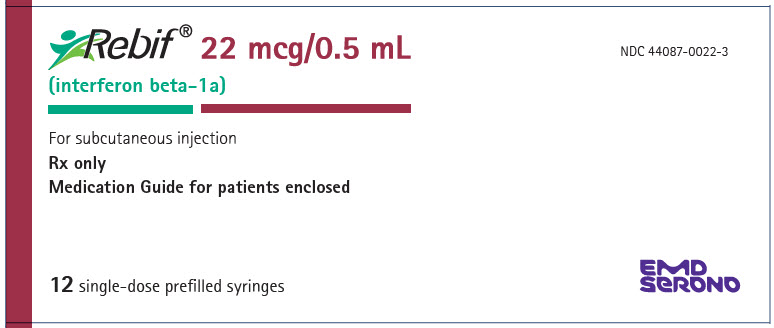
REBIF INTERFERON BETA-1A 22 ug/.5mL Injection, Solution, 12 syringes — NDC 44087-0022-3 (Billing 44087-0022-03)
This is a package of 12 syringes of REBIF INTERFERON BETA-1A 22 ug/.5mL Injection, Solution from EMD Serono, Inc., marketed since Mar 2002 and currently FDA-listed; retail pharmacies pay about $1,400.93 per mL (NADAC). It is this product's only package size.
NDC database record
One package, one record: these facts belong to NDC 44087-0022-3 alone.
- Record
- FDA NDC Directory package listing · Human prescription drug
- Code segments
- 44087 labeler · 0022 product · 3 package
- Package marketed since
- Mar 7, 2002
- Sample package
- No — commercial package
- Listing certified through
- Dec 31, 2026
- Barcode (UPC-A, from the NDC)
- 3 4408700223 7
- FDA record last changed
- Jul 24, 2026
Identity & classification
Regulatory identifiers FDA, NLM and CMS codes for this package
Drug-database identifiers Medi-Span GPI and First Databank GCN / HICL / AHFS classification
- GSN (GCN sequence number): 050035
- GCN: 15914
- GPI-14 (Medi-Span): 6240306045E520
- HICL (First Databank): 023353
- AHFS class code: 90:04.12.00
- RxCUI (RxNorm): 758025
Where does this data come from?
- FDA openFDA NDC Directory · synced Oct 1, 2026
- FDA label on DailyMed · label index refreshed Oct 6, 2026
- RxNorm (NLM RxNav) · catalog refreshed Oct 1, 2026
- Medi-Span GPI (licensed)
- First Databank (licensed) · refreshed Oct 1, 2026
RxNorm drug class
This medicine belongs to the Interferon beta class.
Where does this data come from?
- RxClass (NLM) · catalog refreshed Oct 1, 2026
Clinical
Patient education
Supplement & herbal interactions
Some supplements/herbs that may interact with Interferon Beta-1a — tap one for details:
Where does this data come from?
- MedlinePlus (NLM) · refreshed Oct 1, 2026
- FDA label on DailyMed · label index refreshed Oct 6, 2026
Ask a licensed pharmacist directly — free, answered by our team.
Pricing
A drug doesn't have one price. Each row is a different public payment system, and none is what you'd pay at the counter — that depends on your insurance. The ⓘ on each row explains what it measures.
| Price system | Per mL | Per package |
|---|---|---|
| Retail pharmacies payNADAC · weekly | $1,400.930 | $8,405.58 / 6 ml |
| Medicaid paysCMS SDUD · 12 mo | No recent Medicaid claims on file for this NDC — rare and low-volume NDCs are suppressed in the public data. | |
| Medicare drug plans payPart D · Q2 2026 | $1,922.72 | $11,536.33 / 6 ml |
Where does this data come from?
- CMS NADAC weekly file · file of Jan 12, 2022
- CMS ASP pricing files · refreshed Sep 20, 2026
- CMS Medicaid State Drug Utilization Data · refreshed Oct 6, 2026
- CMS Part D plan pricing files · refreshed Sep 24, 2026
- VA National Acquisition Center price file
Packaging — all sizes for this product
| Package NDC | Description | Marketing start | Marketing end | Status |
|---|---|---|---|---|
| 44087-0022-03 You're viewing this Main listing | 12 SYRINGE, GLASS in 1 CARTON / .5 mL in 1 SYRINGE, GLASS | 2002-03-07 | — | Active |
Therapeutic equivalents
| Product | Labeler | Pack | NADAC/unit | TE | Status | Price vs. this |
|---|---|---|---|---|---|---|
| Rebif 22 ug/.5mLthis 44087-0022-03 | EMD | 12 syringes | $1,400.930 | — | FDA listed | — |
| Rebif Rebidose 22 ug/.5mL 44087-3322-01 | EMD | 5 ml | — | — | FDA listed | — |
Where does this data come from?
- FDA openFDA NDC Directory · synced Oct 1, 2026
- FDA Purple Book · refreshed Oct 5, 2026
- CMS NADAC weekly file · file of Jan 12, 2022
Availability & biosimilar status
Biologics have no small-molecule generics; biosimilar competition is tracked in the FDA Purple Book.
Where does this data come from?
- FDA Purple Book · refreshed Oct 5, 2026
Inactive Ingredients / Excipients
Inactive ingredients, also called excipients, are components of the drug product other than the active ingredient. They may include fillers, dyes, coatings, preservatives, flavors, or other formulation ingredients.
Where does this data come from?
IACT rows and label-wide narrative are kept separate; availability and product-level specificity depend on the submitted label.- FDA label on DailyMed · label index refreshed Oct 6, 2026
- FDA openFDA NDC Directory · synced Oct 1, 2026
Inactive ingredient FAQ
Are inactive ingredients the same for every manufacturer?
Why might an inactive ingredient be missing?
Can inactive ingredients matter?
Manufacturer & labeler
More NDCs from EMD Serono, Inc. labeler code 44087
- Serostim somatropin Kit NDC 44087-0004-7
- Serostim somatropin Kit NDC 44087-0005-7
- Serostim somatropin Kit NDC 44087-0006-7
- REBIF interferon beta-1a 44 ug/.5mL Injection, Solution NDC 44087-0044-3
- Rebif Rebidose Interferon BETA-1A Kit NDC 44087-0188-1
- Gonal-f RFF Redi-ject FOLLITROPIN 300 [iU]/.5mL Injection, Solution NDC 44087-1115-1
- Gonal-f RFF Redi-ject FOLLITROPIN 450 [iU]/.75mL Injection, Solution NDC 44087-1116-1
- Gonal-f RFF Redi-ject FOLLITROPIN 900 [iU]/1.5mL Injection, Solution NDC 44087-1117-1
- Ovidrel choriogonadotropin alfa 250 ug/.5mL Injection, Solution NDC 44087-1150-1
Where does this data come from?
- FDA openFDA NDC Directory · synced Oct 1, 2026
- Drugs@FDA
Full prescribing information FDA SPL
🎯 Indications and Usage ▾
1 INDICATIONS AND USAGE REBIF is indicated for the treatment of relapsing forms of multiple sclerosis (MS), to include clinically isolated syndrome, relapsing-remitting disease, and active secondary progressive disease, in adults. Rebif is an interferon beta indicated for the treatment of relapsing forms of multiple sclerosis (MS), to include clinically isolated syndrome, relapsing-remitting disease, and active secondary progressive disease, in adults. ( 1 )
⏱️ Dosage and Administration ▾
2 DOSAGE AND ADMINISTRATION For subcutaneous injection only ( 2.1 ) The recommended dose is either 22 mcg or 44 mcg injected subcutaneously three times per week ( 2.1 ) Titration: Generally, the starting dose should be 20% of the prescribed dose three times per week, and increased over a 4 week period to the targeted recommended dose of either 22 mcg or 44 mcg injected subcutaneously three times per week ( 2.1 ) Analgesics and/or antipyretics on treatment days may help ameliorate flu-like symptoms ( 2.3 )
2.1Dosing Information The recommended dose of REBIF is either 22 mcg or 44 mcg injected subcutaneously three times per week. REBIF should be administered, if possible, at the same time (preferably in the late afternoon or evening) on the same three days (e.g., Monday, Wednesday, and Friday) at least 48 hours apart each week. Generally, patients should be started at 20% of the prescribed dose three times per week and increased over a 4-week period to the targeted dose, either 22 mcg three times per week (see Table 1 ) or 44 mcg three times per week (see Table 2 ).
Patients prescribed a targeted dose of 22 mcg three times per week should use the prefilled syringes for titration. A Titration Pack containing 6 doses of 8.8 mcg (0.2 mL) and 6 doses of 22 mcg (0.5 mL) is available for use during the titration period in both REBIF prefilled syringes and REBIF Rebidose autoinjectors. Table 1: Titration Schedule for a 22 mcg Prescribed Dose Use only prefilled syringes, not autoinjectors, to titrate to the 22 mcg Prescribed Dose Week of Use Dose Syringe to Use Amount of syringe Week 1 Titration 4.4 mcg 8.8 mcg syringe Use half of syringe Week 2 Titration 4.4 mcg 8.8 mcg syringe Use half of syringe Week 3 Titration 11 mcg 22 mcg syringe Use half of syringe Week 4 Titration 11 mcg 22 mcg syringe Use half of syringe Week 5 and after 22 mcg 22 mcg syringe or autoinjector Use full syringe or autoinjector Table 2: Titration Schedule for a 44 mcg Prescribed Dose Prefilled syringes or autoinjectors can be used to titrate to the 44 mcg Prescribed Dose Week of Use Dose Syringe or Autoinjector to Use Amount of syringe or autoinjector Week 1 Titration 8.8 mcg 8.8 mcg syringe or autoinjector Use full syringe or autoinjector Week 2 Titration 8.8 mcg 8.8 mcg syringe or autoinjector Use full syringe or autoinjector Week 3 Titration 22 mcg 22 mcg syringe or autoinjector Use full syringe or autoinjector Week 4 Titration 22 mcg 22 mcg syringe or autoinjector Use full syringe or autoinjector Week 5 and after 44 mcg 44 mcg syringe or autoinjector Use full syringe or autoinjector Decreased peripheral blood counts or elevated liver function tests may necessitate dose reduction or discontinuation of REBIF administration until toxicity is resolved [see Warnings and Precautions (5.2 , 5.5) and Adverse Reactions (6) ].
2.2Important Administration Instructions REBIF is intended for use under the guidance and supervision of a physician. It is recommended that physicians or qualified medical personnel train patients in the proper technique for self-administering subcutaneous injections using the prefilled syringe or injection device approved for use with REBIF. Injection depth of the REBIF Rebidose autoinjector is fixed at 8 mm; the healthcare provider should determine the injection technique.
The initial injection should be performed under the supervision of an appropriately qualified healthcare provider. Appropriate instruction for self-injection or injection by another person should be provided to the patient or their caregiver, including careful review of the REBIF Medication Guide and the REBIF Rebidose autoinjector Instructions for Use that accompanies the product. Users should demonstrate competency in all aspects of the injection prior to independent use.
If a patient is to self-administer REBIF, the physical and cognitive ability of that patient to self-administer and properly dispose of prefilled syringes or the REBIF Rebidose autoinjectors should be as… [Excerpted — this section continues on DailyMed.]
💊 Dosage Forms and Strengths ▾
3 DOSAGE FORMS AND STRENGTHS Injection: 8.8 mcg per 0.2 mL in a graduated, single-dose REBIF prefilled syringe Injection: 22 mcg per 0.5 mL in a graduated, single-dose REBIF prefilled syringe Injection: 44 mcg per 0.5 mL in a graduated, single-dose REBIF prefilled syringe Injection: 8.8 mcg per 0.2 mL in a single-dose prefilled REBIF Rebidose autoinjector Injection: 22 mcg per 0.5 mL in a single-dose prefilled REBIF Rebidose autoinjector Injection: 44 mcg per 0.5 mL in a single-dose prefilled REBIF Rebidose autoinjector Injection: 8.8 mcg in 0.2 mL, and 22 mcg or 44 mcg in 0.5 mL in single-dose prefilled syringe ( 3 ) Injection: 8.8 mcg in 0.2 mL, and 22 mcg or 44 mcg in 0.5 mL in single-dose autoinjector ( 3 )
⛔ Contraindications ▾
4 CONTRAINDICATIONS REBIF is contraindicated in patients with a history of hypersensitivity to natural or recombinant interferon beta, human albumin, or any other component of the formulation. History of hypersensitivity to natural or recombinant interferon beta, human albumin, or any other component of the formulation ( 4 )
⚠️ Warnings and Cautions ▾
5 WARNINGS AND PRECAUTIONS Depression and Suicide: Advise patients to immediately report any symptoms of depression and/or suicidal ideation; consider discontinuation of REBIF if depression occurs ( 5.1 ) Hepatic Injury: Monitor liver function tests; monitor patients for signs and symptoms of hepatic injury; consider discontinuing REBIF if hepatic injury occurs ( 5.2 ) Anaphylaxis and Other Allergic Reactions: Discontinue REBIF if anaphylaxis occurs ( 5.3 ) Injection Site Reactions Including Necrosis: Do not administer REBIF into affected area until fully healed; if multiple lesions occur, change injections sites or discontinue REBIF until healing of skin lesions ( 5.4 ) Decreased Peripheral Blood Counts: Monitor complete blood counts ( 5.5 ) Thrombotic Microangiopathy: Cases of thrombotic microangiopathy have been reported.
Discontinue REBIF if clinical symptoms and laboratory findings consistent with TMA occur ( 5.6 ). Pulmonary Arterial Hypertension: Cases of pulmonary arterial hypertension (PAH) have been reported in patients treated with interferon beta products, including REBIF. Discontinue REBIF if PAH is diagnosed ( 5.7 ) Seizures: Monitor for seizures when administering REBIF to patients, particularly those with pre-existing seizure disorders ( 5.8 )
5.1Depression and Suicide REBIF (interferon beta-1a) should be used with caution in patients with depression, a condition that is common in people with multiple sclerosis. Depression, suicidal ideation, and suicide attempts have been reported to occur with increased frequency in patients receiving interferon compounds, including REBIF. In addition, there have been postmarketing reports of suicide in patients treated with REBIF.
Patients should be advised to report immediately any symptoms of depression and/or suicidal ideation to the prescribing physician. If a patient develops depression, cessation of treatment with REBIF should be considered.
5.2Hepatic Injury Severe liver injury, including some cases of hepatic failure requiring liver transplantation, has been reported rarely in patients taking REBIF. Symptoms of liver dysfunction began from one to six months following the initiation of REBIF. If jaundice or other symptoms of liver dysfunction appear, treatment with REBIF should be discontinued immediately due to the potential for rapid progression to liver failure.
Asymptomatic elevation of hepatic transaminases (particularly SGPT) is common with interferon therapy [see Adverse Reactions (6.1) ] . REBIF should be initiated with caution in patients with active liver disease, alcohol abuse, increased serum SGPT (> 2.5 times ULN), or a history of significant liver disease. Also, the potential risk of REBIF used in combination with known hepatotoxic products should be considered prior to REBIF administration, or when adding new agents to the regimen of patients already on REBIF.
Reduction of REBIF dose should be considered if SGPT rises above 5 times the upper limit of normal. The dose may be gradually re-escalated when enzyme levels have normalized [see Warnings and Precautions (5.9) and Dosage and Administration (2.1) ].
5.3Anaphylaxis and Other Allergic Reactions Anaphylaxis has been reported as a rare complication of REBIF use. Other allergic reactions have included skin rash and urticaria, and have ranged from mild to severe without a clear relationship to dose or duration of exposure. Several allergic reactions, some severe, have occurred after prolonged use. Discontinue REBIF if anaphylaxis occurs.
5.4Injection Site Reactions Including Necrosis Injection site reactions, including injection site necrosis, can occur with the use of interferon beta products, including REBIF. In controlled clinical trials, injection site reactions occurred more frequently in REBIF-treated patients (92% in the 44 mcg group and 89% in the 22 mcg group) than in placebo-treated patients (39%) and at a higher frequency in REBIF treated patients (83%) than in AVONEX-treated patients (28%… [Excerpted — this section continues on DailyMed.]
🤒 Adverse Reactions ▾
6 ADVERSE REACTIONS The following adverse reactions are discussed in more detail in the Warnings and Precautions section of the label: Depression and Suicide [see Warnings and Precautions (5.1) ] Hepatic Injury [see Warnings and Precautions (5.2) ] Anaphylaxis and Other Allergic Reactions [see Warnings and Precautions (5.3) ] Injection Site Reactions including Necrosis [see Warnings and Precautions (5.4) ] Decreased Peripheral Blood Counts [see Warnings and Precautions (5.5) ] Thrombotic Microangiopathy [see Warnings and Precautions (5.6) ] Pulmonary Arterial Hypertension [ see Warnings and Precautions (5.7) ] Seizures [see Warnings and Precautions (5.8) ] Laboratory Tests [see Warnings and Precautions (5.9) ] The most common adverse reactions in controlled clinical trials were injection site disorders, influenza-like symptoms, abdominal pain, depression, elevation of liver enzymes and hematologic abnormalities ( 6.1 ) To report SUSPECTED ADVERSE REACTIONS, contact EMD Serono at 1-800-283-8088 ext.
5563 or FDA at 1-800-FDA-1088 or www.fda.gov/medwatch
6.1Clinical Trial Experience Because clinical trials are conducted under widely varying conditions, adverse reaction rates observed in the clinical trials of REBIF cannot be directly compared to rates in the clinical trials of other drugs and may not reflect the rates observed in practice. A total of 712 patients with relapsing-remitting multiple sclerosis (RRMS) in two controlled clinical trials took REBIF (22 mcg or 44 mcg given three times per week) [ see Clinical Studies (14) ]. Ages ranged from 18 to 55 years.
Nearly three-fourths of the patients were female, and more than 90% were Caucasian, largely reflecting the general demographics of the population of patients with multiple sclerosis. The most commonly reported adverse reactions were injection site disorders, influenza-like symptoms (headache, fatigue, fever, rigors, chest pain, back pain, myalgia), abdominal pain, depression, elevation of liver enzymes and hematologic abnormalities. The most frequently reported adverse reactions resulting in clinical intervention (e.g., discontinuation of REBIF, adjustment in dosage, or the need for concomitant medication to treat an adverse reaction were injection site disorders, influenza-like symptoms, depression, and elevation of liver enzymes [see Warnings and Precautions (5) ] .
Study 1 was a 2-year placebo-controlled study in RRMS patients treated with REBIF 22 mcg (n=189), 44 mcg (n=184), or placebo (n=187). Table 3 enumerates adverse reactions and laboratory abnormalities that occurred at an incidence that was at least 2% more in either REBIF-treated group than was observed in the placebo group. Table 3.
Adverse Reactions and Laboratory Abnormalities in Study 1 Body System Placebo tiw (n=187) REBIF 22 mcg tiw (n=189) REBIF 44 mcg tiw (n=184) Preferred Term % % % BODY AS A WHOLE Influenza-like symptoms 51 56 59 Headache 63 65 70 Fatigue 36 33 41 Fever 16 25 28 Rigors 5 6 13 Chest pain 5 6 8 Malaise 1 4 5 INJECTION SITE DISORDERS Injection Site Reaction 39 89 92 Injection Site Necrosis 0 1 3 NERVOUS SYSTEM DISORDERS Hypertonia 5 7 6 Coordination Abnormal 2 5 4 Convulsions 2 5 4 Somnolence 1 4 5 ENDOCRINE DISORDERS Thyroid Disorder 3 4 6 GASTROINTESTINAL SYSTEM DISORDERS Abdominal Pain 17 22 20 Dry Mouth 1 1 5 LIVER AND BILIARY SYSTEM DISORDERS SGPT Increased 4 20 27 SGOT Increased 4 10 17 Bilirubinemia 1 3 2 MUSCULO-SKELETAL SYSTEM DISORDERS Myalgia 20 25 25 Back Pain 20 23 25 Skeletal Pain 10 15 10 HEMATOLOGIC DISORDERS Leukopenia 14 28 36 Lymphadenopathy 8 11 12 Thrombocytopenia 2 2 8 Anemia 3 3 5 SKIN DISORDERS Rash Erythematous 3 7 5 Rash Maculo-Papular 2 5 4 Hyperhidrosis 2 4 4 URINARY SYSTEM DISORDERS Micturition Frequency 4 2 7 Urinary Incontinence 2 4 2 VISION DISORDERS Vision Abnormal 7 7 13 Xerophthalmia 0 3 1 Adverse reactions in Study 2, a 1-year active-controlled (vs. interferon beta-1a, 30 mcg once weekly intramuscular injection, n=338) study including 339 patient… [Excerpted — this section continues on DailyMed.]
👥 Use in Specific Populations ▾
8 USE IN SPECIFIC POPULATIONS Pregnancy: Epidemiological data do not suggest a clear relationship between interferon beta use and major congenital malformations, but interferon beta may cause fetal harm based on animal data ( 8.1 ).
8.1Pregnancy Risk Summary Data from a large population-based cohort study, as well as other published studies over several decades, have not identified a drug-associated risk of major birth defects with the use of interferon beta during early pregnancy. Findings regarding a potential risk for low birth weight or miscarriage with the use of interferon beta in pregnancy have been inconsistent (see Data ) . It is unclear whether, as a class of products, administration of interferon beta therapies to pregnant animals at doses greater than those used clinically results in an increased rate of abortion.
The potential for REBIF to have adverse effects on embryofetal development has not been fully assessed in animals [ see Data ]. In the U.S. general population, the estimated background risk of major birth defects and miscarriage in clinically recognized pregnancies is 2% to 4% and 15% to 20%, respectively. The background risk of major birth defects and miscarriage for the indicated population is unknown.
Data Human data The majority of observational studies reporting on pregnancies exposed to interferon beta products did not identify an association between the use of interferon beta products during early pregnancy and an increased risk of major birth defects. In a population-based cohort study conducted in Finland and Sweden, data were collected from 1996—2014 in Finland and from 2005—2014 in Sweden on 2,831 pregnancy outcomes from women with MS. 797 pregnancies were in women exposed to interferon beta only.
No evidence was found of an increased risk of major birth defects among women with MS exposed to interferon beta products compared to women with MS that were unexposed to any non-steroid therapy for MS (n=1,647) within the study. No increased risks were observed for miscarriages and ectopic pregnancies, though there were limitations in obtaining complete data capture for these outcomes, making the interpretation of the findings more difficult. Two small cohort studies that examined pregnancies exposed to interferon beta products (without differentiating between subtypes of interferon beta products) suggested that a decrease in mean birth weight may be associated with interferon beta exposure during pregnancy, but this finding was not confirmed in larger observational studies.
Two small studies observed an increased prevalence of miscarriage, although the finding was only statistically significant in one study. Most studies enrolled patients later in pregnancy, which made it difficult to ascertain the true percentage of miscarriages. In one small cohort study, a significantly increased risk of preterm birth following interferon beta exposure during pregnancy was observed.
Animal data In a study in pregnant cynomolgus monkeys, interferon beta was administered daily (intramuscular doses approximately 1, 2, and 7 times the maximum recommended cumulative weekly human dose, based on body surface area) either throughout the period of organogenesis or later in pregnancy (gestation day 90 to term). No adverse effects on embryofetal development were observed; however, the possibility of adverse effects cannot be ruled out because of the small number of animals tested (six per dose group at each developmental period).
8.2Lactation Risk Summary Limited published literature has described the presence of interferon beta-1a products in human milk at low levels. There are no data on the effects of interferon beta-1a on milk production. Therefore, the developmental and health benefits of breastfeeding should be considered along with the mother's clinical need for REBIF and any potential adverse effects on the breastfed child from REBIF or from the underlying maternal condition.
8.4Pediatric Use Safety and effective… [Excerpted — this section continues on DailyMed.]
🤰 Pregnancy ▾
8.1Pregnancy Risk Summary Data from a large population-based cohort study, as well as other published studies over several decades, have not identified a drug-associated risk of major birth defects with the use of interferon beta during early pregnancy. Findings regarding a potential risk for low birth weight or miscarriage with the use of interferon beta in pregnancy have been inconsistent (see Data ) . It is unclear whether, as a class of products, administration of interferon beta therapies to pregnant animals at doses greater than those used clinically results in an increased rate of abortion.
The potential for REBIF to have adverse effects on embryofetal development has not been fully assessed in animals [ see Data ]. In the U.S. general population, the estimated background risk of major birth defects and miscarriage in clinically recognized pregnancies is 2% to 4% and 15% to 20%, respectively. The background risk of major birth defects and miscarriage for the indicated population is unknown.
Data Human data The majority of observational studies reporting on pregnancies exposed to interferon beta products did not identify an association between the use of interferon beta products during early pregnancy and an increased risk of major birth defects. In a population-based cohort study conducted in Finland and Sweden, data were collected from 1996—2014 in Finland and from 2005—2014 in Sweden on 2,831 pregnancy outcomes from women with MS. 797 pregnancies were in women exposed to interferon beta only.
No evidence was found of an increased risk of major birth defects among women with MS exposed to interferon beta products compared to women with MS that were unexposed to any non-steroid therapy for MS (n=1,647) within the study. No increased risks were observed for miscarriages and ectopic pregnancies, though there were limitations in obtaining complete data capture for these outcomes, making the interpretation of the findings more difficult. Two small cohort studies that examined pregnancies exposed to interferon beta products (without differentiating between subtypes of interferon beta products) suggested that a decrease in mean birth weight may be associated with interferon beta exposure during pregnancy, but this finding was not confirmed in larger observational studies.
Two small studies observed an increased prevalence of miscarriage, although the finding was only statistically significant in one study. Most studies enrolled patients later in pregnancy, which made it difficult to ascertain the true percentage of miscarriages. In one small cohort study, a significantly increased risk of preterm birth following interferon beta exposure during pregnancy was observed.
Animal data In a study in pregnant cynomolgus monkeys, interferon beta was administered daily (intramuscular doses approximately 1, 2, and 7 times the maximum recommended cumulative weekly human dose, based on body surface area) either throughout the period of organogenesis or later in pregnancy (gestation day 90 to term). No adverse effects on embryofetal development were observed; however, the possibility of adverse effects cannot be ruled out because of the small number of animals tested (six per dose group at each developmental period).
🧒 Pediatric Use ▾
8.4Pediatric Use Safety and effectiveness in pediatric patients have not been established.
🧓 Geriatric Use ▾
8.5Geriatric Use Clinical studies of REBIF did not include sufficient numbers of subjects aged 65 and over to determine whether they respond differently than younger subjects. In general, dose selection for an elderly patient should be cautious, usually starting at the low end of the dosing range, reflecting the greater frequency of decreased hepatic, renal or cardiac function, and of concomitant disease or other drug therapy.
🧬 Clinical Pharmacology ▾
12 CLINICAL PHARMACOLOGY
12.1Mechanism of Action The mechanism(s) by which REBIF (interferon beta-1a) exerts its therapeutic effects in patients with multiple sclerosis is unknown.
12.2Pharmacodynamics The relationships between serum interferon beta-1a levels and measurable pharmacodynamic activities to the mechanism(s) by which REBIF exerts its effects in multiple sclerosis are unknown. No gender-related effects on pharmacodynamic parameters have been observed.
12.3Pharmacokinetics The pharmacokinetics of REBIF (interferon beta-1a) in people with multiple sclerosis have not been evaluated. In healthy subjects, a single subcutaneous (sc) injection of 60 mcg of REBIF (liquid formulation) resulted in a peak serum concentration (C max ) of 5.1 ±
1.7IU/mL (mean ± SD), with a median time of peak serum concentration (T max ) of 16 hours. The serum elimination half-life (t1/2) was 69 ± 37 hours, and the area under the serum concentration versus time curve (AUC) from zero to 96 hours was 294 ± 81 IU h/mL. Following every other day sc injections in healthy subjects, an increase in AUC of approximately 240% was observed, suggesting that accumulation of interferon beta-1a occurs after repeat administration.
Total clearance is approximately 33-55 L/hour. There have been no observed gender-related effects on pharmacokinetic parameters. Pharmacokinetics of REBIF in pediatric and geriatric patients or patients with renal or hepatic insufficiency have not been established.
🧬 Mechanism of Action ▾
12.1Mechanism of Action The mechanism(s) by which REBIF (interferon beta-1a) exerts its therapeutic effects in patients with multiple sclerosis is unknown.
📦 How Supplied / Storage and Handling ▾
16 HOW SUPPLIED/STORAGE AND HANDLING REBIF is supplied as a sterile solution containing no preservative available in the following package presentations: Prefilled Syringes : REBIF (interferon beta -1a) Titration Pack, NDC 44087-8822-1 - Six REBIF 8.8 mcg prefilled syringes and Six REBIF 22 mcg prefilled syringes REBIF (interferon beta -1a) 22 mcg Prefilled syringe - Twelve REBIF 22 mcg prefilled syringes, NDC 44087-0022 - 3 REBIF (interferon beta -1a) 44 mcg Prefilled syringe - Twelve REBIF 44 mcg prefilled syringes, NDC 44087-0044-3 REBIF Rebidose Autoinjectors : REBIF Rebidose (interferon beta-1a) Titration Pack, NDC 44087-0188-1 - Six REBIF Rebidose 8.8 mcg autoinjectors with lime-green injector buttons and Six REBIF Rebidose 22 mcg with yellow injector buttons.
REBIF Rebidose (interferon beta-1a) 22 mcg Autoinjector - Twelve REBIF Rebidose 22 mcg autoinjectors with yellow injector buttons, NDC 44087-3322-1 REBIF Rebidose (interferon beta-1a) 44 mcg Autoinjector - Twelve REBIF Rebidose 44 mcg autoinjectors with teal-green injector buttons, NDC 44087-3344-1 REBIF should be stored refrigerated between 36°F to 46°F (2°C to 8°C). DO NOT FREEZE. If needed, REBIF may be stored between 36°F to 77°F (2°C to 25°C) for up to 30 days and away from heat and light, but refrigeration is preferred.
Do not use beyond the expiration date printed on packages. REBIF contains no preservatives. Each prefilled syringe and REBIF Rebidose autoinjector is intended for a single dose.
Unused portions should be discarded.
📦 Storage and Handling ▾
REBIF should be stored refrigerated between 36°F to 46°F (2°C to 8°C). DO NOT FREEZE. If needed, REBIF may be stored between 36°F to 77°F (2°C to 25°C) for up to 30 days and away from heat and light, but refrigeration is preferred. Do not use beyond the expiration date printed on packages. REBIF contains no preservatives. Each prefilled syringe and REBIF Rebidose autoinjector is intended for a single dose. Unused portions should be discarded.
📋 Description ▾
11 DESCRIPTION REBIF (interferon beta-1a) is a purified 166 amino acid glycoprotein with a molecular weight of approximately 22,500 daltons. It is produced by recombinant DNA technology using genetically engineered Chinese Hamster Ovary cells into which the human interferon beta gene has been introduced. The amino acid sequence of REBIF is identical to that of natural fibroblast derived human interferon beta.
Natural interferon beta and interferon beta-1a (REBIF) are glycosylated with each containing a single N-linked complex carbohydrate moiety. Using a reference standard calibrated against the World Health Organization natural interferon beta standard (Second International Standard for Interferon, Human Fibroblast GB 23 902 531), REBIF has a specific activity of approximately 270 million international units (MIU) of antiviral activity per mg of interferon beta-1a determined specifically by an in vitro cytopathic effect bioassay using WISH cells and Vesicular Stomatitis virus.
REBIF 8.8 mcg, 22 mcg and 44 mcg contains approximately 2.4 million international units, 6 million international units or 12 million international units, respectively, of antiviral activity using this method. REBIF (interferon beta-1a) is formulated as a sterile solution in a prefilled syringe or REBIF Rebidose autoinjector intended for subcutaneous (sc) injection. Each 0.5 mL (0.5 cc) of REBIF contains either 22 mcg or 44 mcg of interferon beta-1a, 2 mg or 4 mg albumin (human), 27.3 mg mannitol, 0.4 mg sodium acetate, and water for injection.
Each 0.2 mL (0.2 cc) of REBIF contains 8.8 mcg of interferon beta-1a, 0.8 mg albumin (human), 10.9 mg mannitol, 0.16 mg sodium acetate, and water for injection.
💬 Information for Patients ▾
17 PATIENT COUNSELING INFORMATION See FDA-approved patient labeling (Medication Guide). Inform patients of the availability of a Medication Guide, and instruct them to read the Medication Guide prior to taking REBIF. Instruct patients to take REBIF only as prescribed.
Depression and Suicide Advise patients that depression, suicidal ideation, and suicide have been reported during the use of REBIF. Inform patients of the symptoms of depression and suicidal ideation and instruct patients to immediately report any of these symptoms to their healthcare provider [see Warnings and Precautions (5.1) ] . Hepatic Injury Advise patients that severe liver injury, including hepatic failure, has been reported with the use of REBIF.
Educate patients about the symptoms of hepatic injury and instruct patients to report them immediately to their healthcare provider [see Warnings and Precautions (5.2) ]. Anaphylaxis and Other Allergic Reactions Advise patients of the symptoms of allergic reactions and anaphylaxis, and instruct patients to seek immediate medical attention if these symptoms occur [see Warnings and Precautions (5.3) ]. Injection Site Reactions Including Necrosis Advise patients that injection site reactions occur in most patients treated with REBIF and that injection site necrosis may occur [see Warnings and Precautions (5.4) ] .
Instruct patients to promptly report any break in the skin, which may be associated with blue-black discoloration, swelling, or drainage of fluid from the injection site, prior to continuing their REBIF therapy. To minimize the likelihood of injection site reactions, inform patients of the importance of rotating injection sites with each dose and the use of aseptic injection technique [see Dosage and Administration (2.2) ]. Advise patients not to re-use needles or syringes and instruct patients on safe disposal procedures.
Provide appropriate instruction for self-injection of REBIF and REBIF Rebidose, including careful review of the REBIF Medication Guide. Decreased Peripheral Blood Counts Advise patients that they may develop a lowering of their peripheral blood counts, including their white blood counts, red blood counts, and platelets, and that their blood counts will be checked during therapy with REBIF. Inform patients that they may be more likely to get infections, anemia, or be at risk for bleeding, and that they should contact their healthcare provider if they develop symptoms of these adverse reactions [see Warnings and Precautions (5.5) ] .
Pulmonary Arterial Hypertension Inform patients that PAH has occurred in patients treated with interferon beta products, including REBIF. Instruct patients to promptly report any new symptoms such as new or increasing fatigue or shortness of breath to their healthcare provider [see Warnings and Precautions (5.7) ] . Seizures Instruct patients to report seizures immediately to their healthcare provider [see Warnings and Precautions (5.8) ].
Flu-like Symptoms Inform patients that flu-like symptoms are common following initiation of therapy with REBIF . Advise patients that concurrent use of analgesics and/or antipyretics may help reduce flu-like symptoms on treatment days [see Dosage and Administration (2.3) ]. Pregnancy Advise patients to notify their healthcare provider if they become pregnant during treatment or plan to become pregnant [see Use in Specific Populations (8.1) ] .
💬 Medication Guide ▾
MEDICATION GUIDE REBIF (interferon beta-1a) Injection for subcutaneous use Read this Medication Guide before you start using REBIF and each time you get a refill. There may be new information. The information does not take the place of talking with your healthcare provider about your medical condition or your treatment.
What is the most important information I should know about REBIF? REBIF can cause serious side effects . Tell your healthcare provider right away if you have any of the symptoms listed below while taking REBIF.
1. Behavioral health problems including depression and suicidal thoughts . You may have mood problems including: depression (feeling hopeless or feeling bad about yourself) thoughts of hurting yourself or suicide 2.
Liver problems or worsening of liver problems including liver failure . Symptoms may include: nausea loss of appetite tiredness dark colored urine and pale stools yellowing of your skin or the white part of your eye bleeding more easily than normal confusion sleepiness During your treatment with REBIF you will need to see your healthcare provider regularly and have regular blood tests to check for side effects. 3.
Serious allergic and skin reactions . Symptoms may include: itching swelling of your face, eyes, lips, tongue or throat trouble breathing anxiousness feeling faint skin rash, hives, sores in your mouth, or skin blisters and peels 4. Injection site problems.
REBIF may cause redness, pain, itching or swelling at the place where your injection was given. Call your healthcare provider right away if an injection site becomes swollen and painful or the area looks infected. You may have a skin infection or an area of severe skin damage (necrosis) requiring treatment by a healthcare provider.
What is REBIF? REBIF is a prescription medicine used to treat relapsing forms of multiple sclerosis, to include clinically isolated syndrome, relapsing-remitting disease, and active secondary progressive disease, in adults. It is a form of protein called beta interferon that is produced in the body.
It is not known if REBIF is safe and effective in children. Who should not take REBIF? Do not take REBIF if you: are allergic to interferon beta, human albumin, or any of the ingredients in REBIF.
See the end of this Medication Guide for a complete list of ingredients in REBIF. What should I tell my healthcare provider before taking REBIF? Before you take REBIF, tell your healthcare provider if you have or have had any of the following conditions: mental illness, including depression and suicidal behavior liver problems bleeding problems or blood clots low blood cell counts seizures (epilepsy) thyroid problems drink alcohol you are pregnant or plan to become pregnant.
It is not known if REBIF can harm your unborn baby. you are breastfeeding or plan to breastfeed. REBIF may pass into your breastmilk. Talk with your healthcare provider about the best way to feed your baby if you take REBIF.
Tell your healthcare provider about all medicines you take , including prescription and over-the-counter medicines, vitamins and herbal supplements. REBIF and other medicines may affect each other causing side effects. Ask your healthcare provider or pharmacist for a list of these medicines, if you are not sure.
Know the medicines you take. Keep a list of them to show your healthcare provider and pharmacist when you get a new medicine. How should I use REBIF?
See the Instructions for Use at the end of this Medication Guide on how to prepare and give an injection of REBIF using a prefilled syringe. For the REBIF Rebidose autoinjector, read the Instructions for Use that comes with the REBIF Rebidose autoinjector. Your healthcare provider should show you how to prepare and measure your dose of REBIF and how to inject your REBIF before you use it for the first time.
REBIF is given by injection under the skin (subcutaneous injection) on the same 3 days a week, for example, Monday, Wednesday and Friday. Your injections should be… [Excerpted — this section continues on DailyMed.]
🧬 Pharmacokinetics ▾
12.3Pharmacokinetics The pharmacokinetics of REBIF (interferon beta-1a) in people with multiple sclerosis have not been evaluated. In healthy subjects, a single subcutaneous (sc) injection of 60 mcg of REBIF (liquid formulation) resulted in a peak serum concentration (C max ) of 5.1 ±
1.7IU/mL (mean ± SD), with a median time of peak serum concentration (T max ) of 16 hours. The serum elimination half-life (t1/2) was 69 ± 37 hours, and the area under the serum concentration versus time curve (AUC) from zero to 96 hours was 294 ± 81 IU h/mL. Following every other day sc injections in healthy subjects, an increase in AUC of approximately 240% was observed, suggesting that accumulation of interferon beta-1a occurs after repeat administration.
Total clearance is approximately 33-55 L/hour. There have been no observed gender-related effects on pharmacokinetic parameters. Pharmacokinetics of REBIF in pediatric and geriatric patients or patients with renal or hepatic insufficiency have not been established.
🧬 Pharmacodynamics ▾
12.2Pharmacodynamics The relationships between serum interferon beta-1a levels and measurable pharmacodynamic activities to the mechanism(s) by which REBIF exerts its effects in multiple sclerosis are unknown. No gender-related effects on pharmacodynamic parameters have been observed.
🔬 Clinical Studies ▾
14 CLINICAL STUDIES Two multicenter studies evaluated the safety and efficacy of REBIF in patients with relapsing-remitting multiple sclerosis. Study 1 was a randomized, double-blind, placebo controlled study in patients with multiple sclerosis for at least one year, Kurtzke Expanded Disability Status Scale (EDSS) scores ranging from 0 to 5, and at least 2 acute exacerbations in the previous 2 years. Patients with chronic progressive forms of multiple sclerosis were excluded from the study.
Patients received subcutaneous injections of either placebo (n = 187), REBIF 22 mcg (n = 189), or REBIF 44 mcg (n = 184) administered three times per week for two years. Doses of study agents were progressively increased to their target doses during the first 4 to 8 weeks for each patient in the study [see Dosage and Administration (2.1) ]. The primary efficacy endpoint was the number of clinical exacerbations.
Numerous secondary efficacy endpoints were also evaluated and included exacerbation-related parameters, effects of treatment on progression of disability and magnetic resonance imaging (MRI)-related parameters. Progression of disability was defined as an increase in the EDSS score of at least one point sustained for at least 3 months. Neurological examinations were completed every 3 months, during suspected exacerbations, and coincident with MRI scans.
All patients underwent proton density T2-weighted (PD/T2) MRI scans at baseline and every 6 months. A subset of 198 patients underwent PD/T2 and T1-weighted gadolinium-enhanced (Gd)-MRI scans monthly for the first 9 months. Of the 560 patients enrolled, 533 (95%) provided 2 years of data and 502 (90%) received 2 years of study agent.
Study results are shown in Table 4 and Figure 1. REBIF at doses of 22 mcg and 44 mcg administered three times per week significantly reduced the number of exacerbations per patient as compared to placebo. Differences between the 22 mcg and 44 mcg groups were not significant (p >0.05).
Table 4: Clinical and MRI Endpoints from Study 1 Placebo REBIF 22 mcg REBIF 44 mcg n = 187 n = 189 n = 184 Exacerbation-related Mean number of exacerbations per patient over 2 years Intent-to-treat analysis , Poisson regression model adjusted for center and time on study 2.56 1.82 p<0.001 compared to placebo 1.73 p<0.0001 compared to placebo (Percent reduction) (29%) (32%) Percent (%) of patients exacerbation-free at 2 years Logistic regression adjusted for center. Patients lost to follow-up prior to an exacerbation were excluded from this analysis.
(Analysis included 185, 183, and 184 patients for three times per week placebo, 22 mcg REBIF, and 44 mcg REBIF, respectively). 15% 25% p<0.05 compared to placebo 32% Median time to first exacerbation (months) , Cox proportional hazard model adjusted for center 4.5 7.6
9.6MRI n = 172 n = 171 n = 171 Median percent (%) change of MRI PD-T2 lesion area at 2 years ANOVA on ranks adjusted for center. Patients with missing scans were excluded from this analysis. 11.0% -1.2% -3.8% Median number of active lesions per patient per scan (PD/T2; 6 monthly) 2.25 0.75
0.5The time to onset of progression in disability sustained for three months was significantly longer in patients treated with REBIF than in placebo-treated patients. The Kaplan-Meier estimates of the proportions of patients with sustained disability are depicted in Figure 1. Figure 1: Proportions of Patients with Sustained Disability Progression Study 2 was a randomized, open-label, evaluator-blinded, active comparator study.
Patients with relapsing-remitting multiple sclerosis with EDSS scores ranging from 0 to 5.5, and at least 2 exacerbations in the previous 2 years were eligible for inclusion. Patients with chronic progressive forms of multiple sclerosis were excluded from the study. Patients were randomized to treatment with three times per week subcutaneous injections of REBIF 44 mcg (n=339) or once weekly intramuscular injections of 30 mcg AVONEX (n=338).
Study duration w… [Excerpted — this section continues on DailyMed.]
🧪 Nonclinical Toxicology ▾
13 NONCLINICAL TOXICOLOGY
13.1Carcinogenesis, Mutagenesis, Impairment of Fertility Carcinogenesis: REBIF has not been tested for carcinogenic potential in animals. Mutagenesis: Interferon beta was negative in an in vitro bacterial reverse mutation (Ames) assay and an in vitro cytogenetic assay in human lymphocytes in the presence and absence of metabolic activation. Impairment of Fertility: In studies in normally cycling female cynomolgus monkeys given daily subcutaneous injections of interferon beta for six months at doses of up to 9 times the recommended weekly human dose (based on body surface area), no effects were observed on either menstrual cycling or serum estradiol levels.
In male monkeys, the same doses of interferon beta had no demonstrable adverse effects on sperm count, motility, morphology, or function.
📄 Carcinogenesis, Mutagenesis, Impairment of Fertility ▾
13.1Carcinogenesis, Mutagenesis, Impairment of Fertility Carcinogenesis: REBIF has not been tested for carcinogenic potential in animals. Mutagenesis: Interferon beta was negative in an in vitro bacterial reverse mutation (Ames) assay and an in vitro cytogenetic assay in human lymphocytes in the presence and absence of metabolic activation. Impairment of Fertility: In studies in normally cycling female cynomolgus monkeys given daily subcutaneous injections of interferon beta for six months at doses of up to 9 times the recommended weekly human dose (based on body surface area), no effects were observed on either menstrual cycling or serum estradiol levels.
In male monkeys, the same doses of interferon beta had no demonstrable adverse effects on sperm count, motility, morphology, or function.
📖 Instructions for Use ▾
Instructions for Use REBIF (Re-bif) (interferon beta-1a) (in-ter-feer-on beta-one-â) Injection for subcutaneous use Prefilled Syringe Read and follow the Instructions for Use that come with your REBIF prefilled syringe before you start using it and each time you get a refill. Before you use a REBIF prefilled syringe for the first time, make sure your healthcare provider shows you the right way to use it. Important: For the REBIF Rebidose autoinjector, read the Instructions for Use that come with the REBIF Rebidose autoinjector.
Parts of your REBIF Prefilled Syringe (See Figure A ). Figure A Supplies needed for a REBIF Injection (See Figure B ): REBIF prefilled syringe alcohol pad or cotton balls and rubbing alcohol small adhesive bandage strip if desired puncture resistant safety container for disposal of used syringes. See " Disposing of your Needles and Syringes Section " in Step 4 of the IFU. antibacterial soap an over-the-counter pain or fever reducing medicine, if your healthcare provider has recommended that you take this before, at the same time, or after you give yourself REBIF to help decrease the fever, chills, sweating and muscle aches (flu-like symptoms) that may happen.
Figure B Titration (Dosing) Schedule When first starting treatment with REBIF, your healthcare provider may prescribe either the 22 mcg or 44 mcg dose of REBIF. You should gradually increase the dose over 4 weeks, starting at 20% of the prescribed dose for the first 2 weeks, half-dose for the second 2 weeks (weeks 3 and 4), and then the full dose prescribed by your healthcare provider. If your prescribed dose is 22 mcg of REBIF, a REBIF Titration Pack containing 6 prefilled syringes with 8.8 mcg and 6 prefilled syringes with 22 mcg should be prescribed to you for use during the 4-week starting period.
Table 1 explains the amount to inject using the REBIF Titration Pack syringes to gradually increase to 22 mcg. Table 1: Titration Schedule for a 22 mcg Prescribed Dose Only prefilled syringes can be used to titrate to the 22 mcg Prescribed Dose Week of Use Syringe to Use Amount of syringe Week 1 Titration 8.8 mcg syringe Use half of syringe Week 2 Titration 8.8 mcg syringe Use half of syringe Week 3 Titration 22 mcg syringe Use half of syringe Week 4 Titration 22 mcg syringe Use half of syringe Week 5 and on 22 mcg syringe or autoinjector Use full syringe or autoinjector If your prescribed dose is 44 mcg, you may be prescribed either a REBIF Titration Pack (described above) or REBIF Rebidose Titration Pack containing 6 autoinjectors with 8.8 mcg and 6 autoinjectors with 22 mcg for use during the 4 week titration period.
Table 2 explains the amount to inject using the REBIF Titration Pack or REBIF Rebidose Titration Pack to gradually increase to 44 mcg. Table 2: Titration Schedule for a 44 mcg Prescribed Dose Prefilled syringes or autoinjectors can be used to titrate to 44 mcg Prescribed Dose Week of Use Syringe or Autoinjector to Use Amount of syringe or autoinjector Week 1 Titration 8.8 mcg syringe or autoinjector Use full syringe or autoinjector Week 2 Titration 8.8 mcg syringe or autoinjector Use full syringe or autoinjector Week 3 Titration 22 mcg syringe or autoinjector Use full syringe or autoinjector Week 4 Titration 22 mcg syringe or autoinjector Use full syringe or autoinjector Week 5 and on 44 mcg syringe or autoinjector Use full syringe or autoinjector Step 1.
Preparing for your REBIF Injection Check the expiration date . Do not use if the medication is expired . The expiration date is printed on the syringe, plastic syringe packaging and carton.
Remove your REBIF syringe from the refrigerator at least 30 minutes before you plan to use it so it can warm to room temperature. Do not heat or microwave the medication. Be sure that the dose, either, 8.8 mcg, 22 mcg or 44 mcg, described on the carton is the same as the dose prescribed by your healthcare provider.
Remove the REBIF syringe from the plastic packaging. Keep the needle capped. Look at… [Excerpted — this section continues on DailyMed.]
📄 Recent Major Changes ▾
Warnings and Precautions ( 5.7 ) 7/2023
📄 Package Label / Principal Display Panel ▾
PRINCIPAL DISPLAY PANEL - Kit Carton - 8822 Rebif ® Titration Pack (interferon beta-1a) NDC 44087-8822-1 8.8 mcg/0.2 mL 22 mcg/0.5 mL For subcutaneous injection Rx Only Medication Guide for patients enclosed 6 single-dose 8.8 mcg/0.2 mL prefilled syringes 6 single-dose 22 mcg/0.5 mL prefilled syringes EMD Serono PRINCIPAL DISPLAY PANEL - Kit Carton - 8822
PRINCIPAL DISPLAY PANEL - Kit Carton - 0188 Rebif ® Rebidose ® (interferon beta-1a) Injection NDC 44087-0188-1 6 single-use 8.8 mcg / 0.2 mL autoinjectors 6 single-use 22 mcg / 0.5 mL autoinjectors Rx only 8.8 mcg / 0.2 mL 22 mcg / 0.5 mL Titration Pack For subcutaneous injection Attention pharmacist: Each patient is required to receive the enclosed Medication Guide EMD Serono PRINCIPAL DISPLAY PANEL - Kit Carton - 0188
PRINCIPAL DISPLAY PANEL - 12 Syringe Carton - 0022 Rebif ® 22 mcg/0.5 mL (interferon beta-1a) NDC 44087-0022-3 For subcutaneous injection Rx only Medication Guide for patients enclosed 12 single-dose prefilled syringes EMD SERONO PRINCIPAL DISPLAY PANEL - 12 Syringe Carton - 0022
PRINCIPAL DISPLAY PANEL - 12 Syringe Carton - 0044 Rebif ® 44 mcg/0.5 mL (interferon beta-1a) NDC 44087-0044-3 For subcutaneous injection Rx only Medication Guide for patients enclosed 12 single-dose prefilled syringes EMD SERONO PRINCIPAL DISPLAY PANEL - 12 Syringe Carton - 0044
PRINCIPAL DISPLAY PANEL - 12 Autoinjector Carton - 3322 NDC 44087-3322-1 Rebif ® Rebidose ® (interferon beta-1a) Injection 12 single-use autoinjectors 22 mcg / 0.5 mL Rx only For subcutaneous injection Attention pharmacist: Each patient is required to receive the enclosed Medication Guide EMD Serono PRINCIPAL DISPLAY PANEL - 12 Autoinjector Carton - 3322
PRINCIPAL DISPLAY PANEL - 12 Autoinjector Carton - 3344 NDC 44087-3344-1 Rebif ® Rebidose ® (interferon beta-1a) Injection 12 single-use autoinjectors 44 mcg / 0.5 mL Rx only For subcutaneous injection Attention pharmacist: Each patient is required to receive the enclosed Medication Guide EMD Serono PRINCIPAL DISPLAY PANEL - 12 Autoinjector Carton - 3344