
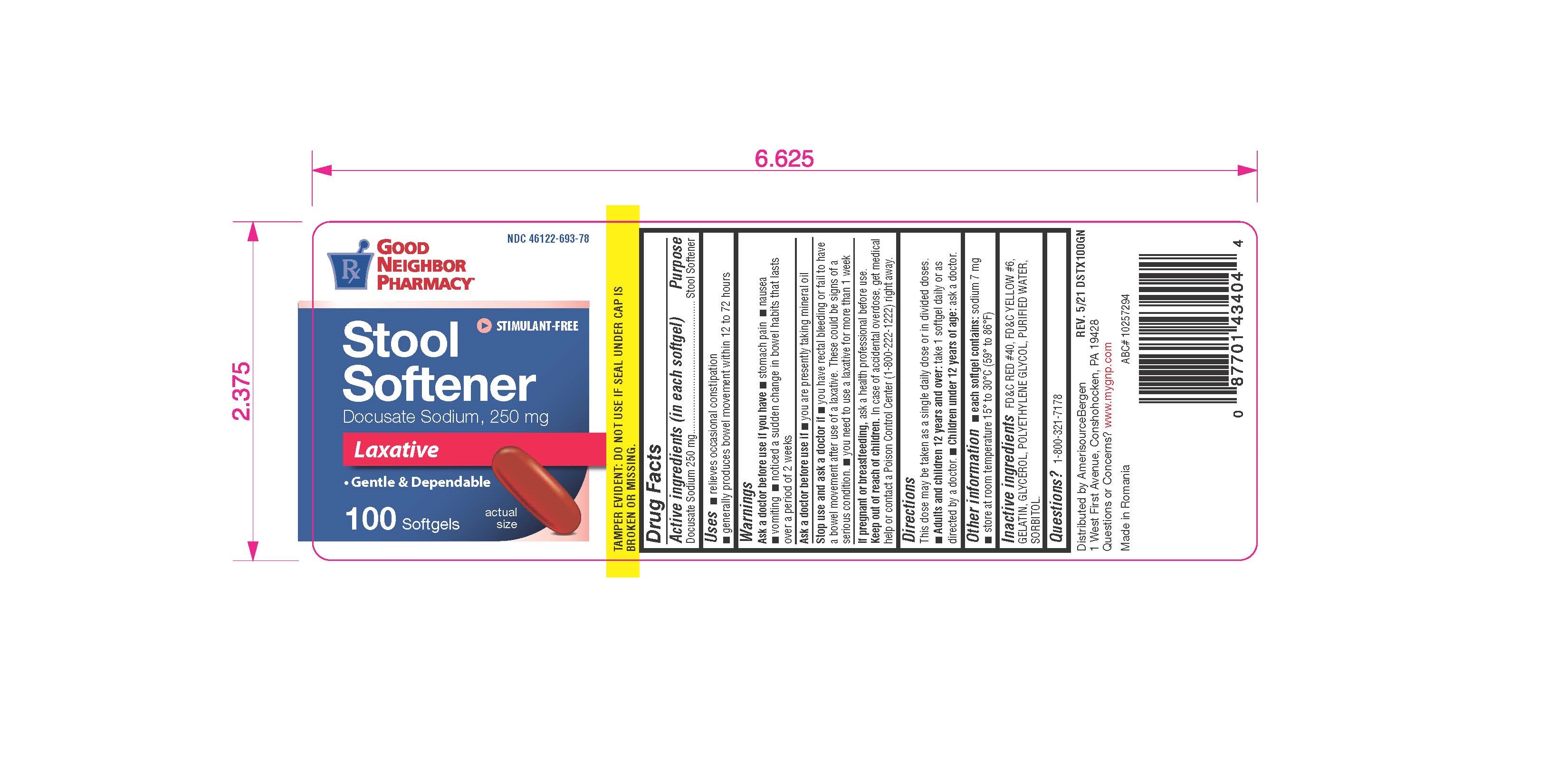
Good Neighbor Stool Softener laxative DOCUSATE SODIUM 250 mg Capsule, Liquid Filled, 100-count — NDC 46122-693-78 (Billing 46122-0693-78)
This is a package of 100 capsules of Good Neighbor Stool Softener laxative DOCUSATE SODIUM 250 mg Capsule, Liquid Filled from AmerisourceBergen Drug Corp, marketed since Jul 2021 and currently FDA-listed; retail pharmacies pay about $0.0523 per capsule (NADAC). It is this product's only package size.
NDC database record
One package, one record: these facts belong to NDC 46122-693-78 alone.
- Record
- FDA NDC Directory package listing · Human OTC drug
- Code segments
- 46122 labeler · 693 product · 78 package
- Package marketed since
- Jul 13, 2021
- Sample package
- No — commercial package
- Listing certified through
- Dec 31, 2026
- Billing quantity
- 100 EA per package
- Barcode (UPC)
- 0087701434044
- Medicaid fills, this package
- 3,092 prescriptions in the last four reported quarters
- FDA record last changed
- Jul 24, 2026
Identity & classification
Regulatory identifiers FDA, NLM and CMS codes for this package
Drug-database identifiers Medi-Span GPI and First Databank GCN / HICL / AHFS classification
- GSN (GCN sequence number): 003011
- GCN: 09102
- GPI-14 (Medi-Span): 46500010300120
- HICL (First Databank): 001326
- AHFS class code: 56:12.00.00
- RxCUI (RxNorm): 1245468
Where does this data come from?
- FDA openFDA NDC Directory · synced Oct 8, 2026
- FDA label on DailyMed · label index refreshed Oct 6, 2026
- RxNorm (NLM RxNav) · catalog refreshed Oct 1, 2026
- Medi-Span GPI (licensed)
- First Databank (licensed) · refreshed Oct 8, 2026
RxNorm drug class
This medicine belongs to the Softeners, emollients class.
Where does this data come from?
- RxClass (NLM) · catalog refreshed Oct 1, 2026
Clinical
Good Neighbor Stool Softener is an over-the-counter liquid-filled capsule taken by mouth. It contains docusate sodium, a stool softener that is commonly used to help soften stools and make bowel movements easier. This product is marketed as an OTC monograph drug, meaning it is sold under established FDA rules for this category of laxative products rather than as an individually approved application.
Patient education
Supplement & herbal interactions
Some supplements/herbs that may interact with Docusate Sodium — tap one for details:
Where does this data come from?
- MedlinePlus (NLM) · refreshed Oct 1, 2026
- FDA label on DailyMed · label index refreshed Oct 6, 2026
Ask a licensed pharmacist directly — free, answered by our team.
Pricing
A drug doesn't have one price. Each row is a different public payment system, and none is what you'd pay at the counter — that depends on your insurance. The ⓘ on each row explains what it measures.
| Price system | Per ea | Per package |
|---|---|---|
| Retail pharmacies payNADAC · weekly | $0.052 | $5.23 / 100 capsules |
| Medicaid paysCMS SDUD · 12 mo | $0.1298 | $12.98 / 100 capsules |
| Medicare drug plans payPart D · quarterly | No Part D plan price is available for this NDC in our data. | |
Where does this data come from?
- CMS NADAC weekly file · file of Oct 7, 2026
- CMS ASP pricing files · refreshed Sep 20, 2026
- CMS Medicaid State Drug Utilization Data · through Q1 2026
- CMS Part D plan pricing files · refreshed Sep 24, 2026
- VA National Acquisition Center price file
Packaging — all sizes for this product
| Package NDC | Description | Marketing start | Marketing end | Status |
|---|---|---|---|---|
| 46122-0693-78 You're viewing this Main listing | 100 CAPSULE, LIQUID FILLED in 1 BOTTLE | 2021-07-13 | — | Active |
Therapeutic equivalents
| Product | Labeler | Pack | NADAC/unit | TE | Status | Price vs. this |
|---|---|---|---|---|---|---|
| Stool Softener Laxative 250 mg 00904-7281-60 | Major | 100 capsules | $0.052 | — | Availability likely | — |
| Good Neighbor Stool Softener laxative 250 mgthis 46122-0693-78 | AmerisourceBergen | 100 capsules | $0.052 | — | Availability likely | — |
| Stool Softener 250 mg 46122-0826-74 | Amerisource | 100 capsules | $0.052 | — | Availability likely | — |
| Docusate Sodium 250 mg 50268-0268-15 | AvPAK | 1 capsule | $0.052 | — | Availability likely | — |
| Stool Softener 250 mg 70677-1096-01 | Strategic | 100 capsules | $0.052 | — | Availability likely | — |
| Preferred Stool Softener laxative 250 mg 10956-0781-00 | Reese | 140 capsules | — | — | FDA listed | — |
| Stool Softener Laxative 250 mg 17856-7281-01 | ATLANTIC | 1 capsule | — | — | FDA listed | — |
| Stool Softener Laxative Extra Strength 250 mg 36800-0568-10 | TOP | 100 capsules | — | — | Discontinued | — |
| Stool Softener 250 mg 36800-0640-10 | TOP | 100 capsules | — | — | FDA listed | — |
| H E B Stool Softener laxative 250 mg 37808-0293-88 | H | 140 capsules | — | — | FDA listed | — |
| Stool Softener 250 mg 37808-0585-14 | HEB | 140 capsules | — | — | FDA listed | — |
| Stool Softener 250 mg 37808-0879-14 | H | 140 capsules | — | — | FDA listed | — |
| Stool Softener 250 mg 37835-0223-01 | Bi-Mart | 100 capsules | — | — | FDA listed | — |
| Stool Softener Extra Strength 250 mg 41250-0859-10 | MEIJER, | 100 capsules | — | — | FDA listed | — |
| Stool Softener Extra Strength 250 mg 49035-0378-14 | EQUATE | 140 capsules | — | — | Discontinued | — |
| Prolaxa 250 mg 53225-2001-01 | Terrain | 100 capsules | — | — | FDA listed | — |
| Docusate Sodium 250 mg 53345-0035-01 | Humanwell | 7000 capsules | — | — | FDA listed | — |
| Docusate Sodium 250 mg 54629-0601-01 | National | 100 capsules | — | — | FDA listed | — |
| Docusate Sodium 250 mg 55154-4341-00 | Cardinal | 1 capsule | — | — | Discontinued | — |
| Stool Softener Extra Strength 250 mg 55910-0879-10 | Dolgencorp, | 100 capsules | — | — | FDA listed | — |
| Stool Softener 250 mg 57896-0426-01 | Geri-Care | 100 capsules | — | — | FDA listed | — |
| Stool Softener Extra Strength 250 mg 59726-0058-25 | P | 250 capsules | — | — | FDA listed | — |
| Stool Softener Laxative Extra Strength 250 mg 59726-0059-10 | P | 100 capsules | — | — | FDA listed | — |
| Stool Softener Laxative Extra Strength 250 mg 59726-0879-10 | P | 100 capsules | — | — | FDA listed | — |
| Quality Choice Stool Softener laxative 250 mg 63868-0662-01 | Chain | 100 capsules | — | — | FDA listed | — |
| Colace Extra Strength Stool Softner 250 mg 67618-0201-12 | Atlantis | 60 capsules | — | — | FDA listed | — |
| Stool Softener Laxative 250 mg 68016-0471-01 | Chain | 100 capsules | — | — | FDA listed | — |
| Stool Softener Extra Strength 250 mg 68016-0587-00 | Chain | 100 capsules | — | — | FDA listed | — |
| Stool Softener 250 mg 68071-5297-06 | NuCare | 60 capsules | — | — | FDA listed | — |
| Stool Softener Extra Strength 250 mg 69842-0740-25 | CVS | 250 capsules | — | — | FDA listed | — |
| Stool Softener Extra Strength 250 mg 69842-0879-25 | CVS | 250 capsules | — | — | FDA listed | — |
| Stool Softener 250 mg 71335-1677-01 | Bryant | 30 capsules | — | — | FDA listed | — |
| Docusate Sodium 250 mg 72789-0166-60 | PD-Rx | 60 capsules | — | — | FDA listed | — |
| Topcare Stool Softener laxative 250 mg 76162-0764-10 | TOPCO | 100 capsules | — | — | FDA listed | — |
| Stool Softener Laxative Extra Strength 250 mg 79903-0073-14 | WALMART | 140 capsules | — | — | FDA listed | — |
| Prolaxa 250 mg 80425-0540-01 | Advanced | 100 capsules | — | — | FDA listed | — |
| Docusate Sodium, Extra Strength 250 Mg 80513-0100-01 | Advanced | 100 capsules | — | — | FDA listed | — |
| Docusate Sodium, Extra Strength 250 Mg 80513-0101-01 | Advanced | 100 capsules | — | — | FDA listed | — |
| Stool Softener Laxative 250 mg 71335-2313-01 | Bryant | 30 capsules | — | — | FDA listed | — |
Where does this data come from?
- FDA openFDA NDC Directory · synced Oct 8, 2026
- FDA Orange Book · refreshed Oct 3, 2026
- CMS NADAC weekly file · file of Oct 7, 2026
Availability & generic status
We did not find an FDA-approved generic match for this exact strength, form and route.
Where does this data come from?
- FDA Orange Book · refreshed Oct 3, 2026
Inactive Ingredients / Excipients
Inactive ingredients, also called excipients, are components of the drug product other than the active ingredient. They may include fillers, dyes, coatings, preservatives, flavors, or other formulation ingredients.
Where does this data come from?
IACT rows and label-wide narrative are kept separate; availability and product-level specificity depend on the submitted label.- FDA label on DailyMed · label index refreshed Oct 6, 2026
- FDA openFDA NDC Directory · synced Oct 8, 2026
Inactive ingredient FAQ
Are inactive ingredients the same for every manufacturer?
Why might an inactive ingredient be missing?
Can inactive ingredients matter?
Manufacturer & labeler
More NDCs from AmerisourceBergen Drug Corp labeler code 46122
- Omeprazole 20.6 mg Capsule, Delayed Release NDC 46122-686-03
- Good Neighbor Pharmacy Stool Softener Docusate Calcium 240 mg Capsule, Liquid Filled NDC 46122-688-78
- good neighbor pharmacy nasal four Phenylephrine hydrochloride 1 g/100mL Spray NDC 46122-689-03
- Headache Relief Acetaminophen, Aspirin, Caffeine 250 mg; 250 mg; 65 mg Tablet, Film Coated NDC 46122-690-78
- Aspirin 325 mg Tablet, Film Coated NDC 46122-691-78
- Good Neighbor Stool Softener DOCUSATE SODIUM 100 mg Capsule, Liquid Filled NDC 46122-692-72
- Fexofenadine Hydrochloride and Pseudoephedrine 60 mg; 120 mg Tablet, Film Coated, Extended Release NDC 46122-694-65
- Nighttime Sleep-Aid Diphenhydramine HCl 50 mg Capsule, Liquid Filled NDC 46122-695-72
- Pain Relief Acetaminophen 500 mg Tablet, Coated NDC 46122-696-62
- Good Neighbor Pharmacy Medicated Chest Rub camphor, menthol, eucalyptus oil .012 g/g; .048 g/g; .026 g/g Ointment NDC 46122-697-26
- good neighbor pharmacy lansoprazole 15 mg Capsule, Delayed Release NDC 46122-698-04
- Good Neighbor Allergy Relief diphenhydramine hydrochloride 25 mg Capsule, Liquid Filled NDC 46122-699-62
Where does this data come from?
- FDA openFDA NDC Directory · synced Oct 8, 2026
- Drugs@FDA
FDA label — Drug Facts FDA SPL
🎯 Indications and Usage ▾
Uses relieves occasional constipation (irregularity) generally produces a bowel movement in 12 to 72 hours
⏱️ Dosage and Administration ▾
Directions Take only by mouth. Doses may be taken as a single daily dose or in divided doses. adults and children 12 years and over take 1 to 3 softgels daily children 2 to under 12 years of age take 1 softgel daily children under 2 years ask a doctor
⚠️ Warnings ▾
Warnings Do not use if you are presently taking mineral oil, unless told to do so by a doctor Ask a doctor before use if you have stomach pain nausea vomiting noticed a sudden change in bowel movements that lasts over 2 weeks Stop use and ask a doctor if you have rectal bleeding or fail to have a bowel movement after use of a laxative. These could be signs of a serious condition. you need to use a stool softener laxative for more than 1 week If pregnant or breast-feeding, ask a health professional before use. Keep out of reach of children.
In case of overdose, get medical help or contact a Poison Control Center right away.
📦 Storage and Handling ▾
Other information each softgel contains: sodium 5 mg VERY LOW SODIUM store at room temperature 15°-30°C (59°-86°F) and avoid excessive heat Image of carton
🧪 Active Ingredient ▾
Active ingredient (in each softgel) Docusate Sodium 250 mg
🧪 Inactive Ingredients ▾
Inactive Ingredients D&C Red No. 33, FD&C Red No. 40, FD&C Yellow No. 6, gelatin, glycerol, Polyethylene glycol, purified water, sorbitol, titanium dioxide
🎯 Purpose ▾
Purpose Stool softener
📄 Do Not Use ▾
Do not use if you are presently taking mineral oil, unless told to do so by a doctor
📄 Ask a Doctor Before Use If ▾
Ask a doctor before use if you have stomach pain nausea vomiting noticed a sudden change in bowel movements that lasts over 2 weeks
📄 Stop Use and Ask a Doctor If ▾
Stop use and ask a doctor if you have rectal bleeding or fail to have a bowel movement after use of a laxative. These could be signs of a serious condition. you need to use a stool softener laxative for more than 1 week
🤰 If Pregnant or Breast-Feeding ▾
If pregnant or breast-feeding, ask a health professional before use.
📄 Keep Out of Reach of Children ▾
Keep out of reach of children. In case of overdose, get medical help or contact a Poison Control Center right away.