
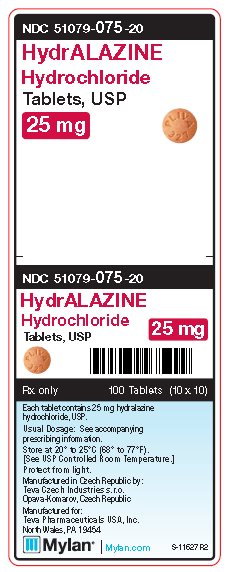
NDC 51079-0075-20: Hydralazine Hydrochloride 25 mg Tablet, Carton of 100
This is a package of 100 tablets of Hydralazine Hydrochloride 25 mg Tablet from Mylan Institutional Inc., first listed with the FDA Dec 2007 and currently FDA-listed; retail pharmacies pay about $0.0337 per tablet (NADAC). It is this product's only package size.
NDC database record
One package, one record: these facts belong to NDC 51079-075-20 alone.
- Record
- FDA NDC Directory package listing · Human prescription drug
- Code segments
- 51079 labeler · 075 product · 20 package
- Package marketed since
- Dec 26, 2007
- Sample package
- No — commercial package
- Listing certified through
- Dec 31, 2027
- Billing quantity
- 100 EA per package
- Barcode (UPC-A, from the NDC)
- 3 5107907520 9
- FDA record last changed
- Oct 15, 2026
Identity & classification
Regulatory identifiers FDA, NLM and CMS codes for this package
Drug-database identifiers Medi-Span GPI and First Databank GCN / HICL / AHFS classification
- GSN (GCN sequence number): 000286
- GCN: 01243
- GPI-14 (Medi-Span): 36400010100310
- HICL (First Databank): 000089
- AHFS class code: 24:08.16.00
- RxCUI (RxNorm): 905199
Where does this data come from?
- FDA openFDA NDC Directory · synced Nov 19, 2026
- FDA label on DailyMed · label index refreshed Nov 21, 2026
- RxNorm (NLM RxNav) · catalog refreshed Nov 19, 2026
- Medi-Span GPI (licensed)
- First Databank (licensed) · refreshed Nov 19, 2026
RxNorm drug class
This medicine belongs to the Arteriolar Vasodilator class.
Where does this data come from?
- RxClass (NLM) · catalog refreshed Nov 19, 2026
Clinical
Hydralazine is used to treat high blood pressure. Hydralazine is in a class of medications called vasodilators. It works by relaxing the blood vessels so that blood can flow more easily through the body. High blood pressure is a common condition and when not treated, can cause damage to the brain, heart, blood vessels, kidneys and other parts of the body. Damage to these organs may cause heart disease, a heart attack, heart failure, stroke, kidney failure, loss of vision, and other problems. In addition to taking medication, making lifestyle changes will also help to control your blood pressur...
Read the full MedlinePlus article ↗- It lowers essential hypertension, the common type of high blood pressure. The tablets are used alone or with other blood pressure medicines. The injection is for severe cases or wh...
- Tablets are taken by mouth, usually four times a day. Your prescriber raises the amount gradually and aims for the lowest effective amount. Follow your label and check with me or y...
- Headache, nausea, vomiting, diarrhea, loss of appetite, pounding or fast heartbeat and chest pain are the common ones. They often ease if the dose is lowered. Tell your doctor if t...
- Call for joint pain, fever, chills, rash, numbness or tingling, unusual bruising, or mood changes. These can be signs of a lupus-like reaction or other serious problems. Get help r...
Patient education
Drug interactions
Supplement & herbal interactions
Hydralazine may be associated with lower levels of 2 nutrients — worth a chat with your pharmacist, not a cause for alarm.
Where does this data come from?
- MedlinePlus (NLM) · refreshed Nov 19, 2026
- FDA label on DailyMed · label index refreshed Nov 21, 2026
Ask a licensed pharmacist directly — free, answered by our team.
Pricing
A drug doesn't have one price. Each row is a different public payment system, and none is what you'd pay at the counter — that depends on your insurance. The ⓘ on each row explains what it measures.
| Price system | Per ea | Per package |
|---|---|---|
| Retail pharmacies payNADAC · weekly | $0.034 | $3.37 / 100 tablet |
| Medicaid paysCMS SDUD · 12 mo | No recent Medicaid claims on file for this NDC — rare and low-volume NDCs are suppressed in the public data. | |
| Medicare drug plans payPart D · Q2 2026 | $0.0607 | $6.07 / 100 tablet |
Where does this data come from?
- CMS NADAC weekly file · file of Nov 18, 2026
- CMS ASP pricing files · refreshed Nov 20, 2026
- CMS Medicaid State Drug Utilization Data · refreshed Nov 19, 2026
- CMS Part D plan pricing files · refreshed Oct 24, 2026
- VA National Acquisition Center price file
Packaging — all sizes for this product
| Package NDC | Description | Marketing start | Marketing end | Status |
|---|---|---|---|---|
| 51079-0075-20 You're viewing this Main listing | 100 BLISTER PACK in 1 CARTON / 1 TABLET in 1 BLISTER PACK Inner NDC 51079-075-01 · each blister pack (1 tablet) | 2007-12-26 | — | Active |
Therapeutic equivalents
| Product | Labeler | Pack | NADAC/unit | TE | Status | Price vs. this |
|---|---|---|---|---|---|---|
| Hydralazine Hydrochloride 25 mg 00904-7448-61 | Major | 100 tablets | $0.034 | AA | Availability likely | — |
| Hydralazine Hydrochloride 25 mg 23155-0002-01 | Heritage | 100 tablets | $0.034 | — | Discontinued | — |
| Hydralazine Hydrochloride 25 mg 23155-0833-01 | Heritage | 100 tablets | $0.034 | AA | Availability likely | — |
| Hydralazine Hydrochloride 25 mg 31722-0520-01 | Camber | 100 tablets | $0.034 | AA | Availability likely | — |
| Hydralazine Hydrochloride 25 mg 50111-0327-01 | Teva | 100 tablets | $0.034 | AA | Availability likely | — |
| Hydralazine Hydrochloride 25 mg 50228-0183-01 | ScieGen | 100 tablets | $0.034 | AA | Availability likely | — |
| Hydralazine Hydrochloride 25 mgthis 51079-0075-20 | Mylan | 100 tablets | $0.034 | AA | Availability likely | — |
| Hydralazine Hydrochloride 25 mg 60687-0822-01 | American | 100 tablets | $0.034 | AA | Availability likely | — |
| Hydralazine Hydrochloride 25 mg 62135-0580-12 | Chartwell | 120 tablets | $0.034 | — | Availability likely | — |
| HydrALAZINE Hydrochloride 25 mg 64380-0734-06 | Strides | 100 tablets | $0.034 | AA | Availability likely | — |
| HydrALAZINE Hydrochloride 25 mg 76282-0310-01 | Exelan | 100 tablets | $0.034 | — | Availability likely | — |
| Hydralazine Hydrochloride 25 mg 33342-0375-11 | Macleods | 100 tablets | — | — | FDA listed | — |
| Hydralazine Hydrochloride 25 mg 48433-0047-20 | Safecor | 100 tablets | — | AA | FDA listed | — |
| Hydralazine Hydrochloride 25 mg 50090-0137-00 | A-S | 100 tablets | — | AA | Discontinued | — |
| Hydralazine Hydrochloride 25 mg 51655-0305-26 | Northwind | 90 tablets | — | — | Discontinued | — |
| Hydralazine Hydrochloride 25 mg 55154-0186-00 | Cardinal | 10 tablets | — | AA | FDA listed | — |
| Hydralazine Hydrochloride 25 mg 55154-2141-00 | Cardinal | 10 tablets | — | AA | FDA listed | — |
| Hydralazine Hydrochloride 25 mg 55154-5689-00 | Cardinal | 10 tablets | — | AA | FDA listed | — |
| Hydralazine Hydrochloride 25 mg 55289-0133-60 | PD-Rx | 60 tablets | — | — | Discontinued | — |
| Hydralazine Hydrochloride 25 mg 63187-0901-30 | Proficient | 30 tablets | — | — | FDA listed | — |
| Hydralazine Hydrochloride 25 mg 63629-5696-01 | Bryant | 30 tablets | — | — | Discontinued | — |
| Hydralazine Hydrochloride 25 mg 63629-8496-01 | Bryant | 1000 tablets | — | AA | FDA listed | — |
| Hydralazine Hydrochloride 25 mg 63629-8757-01 | Bryant | 1000 tablets | — | AA | FDA listed | — |
| Hydralazine Hydrochloride 25 mg 67046-1660-03 | Coupler | 30 tablets | — | AA | FDA listed | — |
| Hydralazine Hydrochloride 25 mg 67544-0657-60 | Aphena | 90 tablets | — | AA | FDA listed | — |
| Hydralazine Hydrochloride 25 mg 67877-0292-01 | Ascend | 100 tablets | — | AA | FDA listed | — |
| Hydralazine Hydrochloride 25 mg 68462-0342-01 | Glenmark | 100 tablets | — | AA | Discontinued | — |
| Hydralazine Hydrochloride 25 mg 70518-2551-00 | REMEDYREPACK | 30 tablets | — | AA | FDA listed | — |
| Hydralazine Hydrochloride 25 mg 70518-3852-00 | REMEDYREPACK | 30 tablets | — | AA | FDA listed | — |
| Hydralazine Hydrochloride 25 mg 70518-4064-02 | REMEDYREPACK | 180 tablets | — | AA | FDA listed | — |
| Hydralazine Hydrochloride 25 mg 71209-0016-05 | Cadila | 100 tablets | — | AA | FDA listed | — |
| Hydralazine Hydrochloride 25 mg 71335-0202-01 | Bryant | 30 tablets | — | AA | FDA listed | — |
| Hydralazine Hydrochloride 25 mg 71335-2352-01 | Bryant | 30 tablets | — | AA | FDA listed | — |
| Hydralazine Hydrochloride 25 mg 71610-0561-60 | Aphena | 90 tablets | — | AA | FDA listed | — |
| Hydralazine Hydrochloride 25 mg 72162-1521-00 | Bryant | 1000 tablets | — | AA | FDA listed | — |
| Hydralazine Hydrochloride 25 mg 72162-1536-00 | Bryant | 1000 tablets | — | AA | FDA listed | — |
| Hydralazine Hydrochloride 25 mg 72241-0004-05 | Modavar | 100 tablets | — | AA | FDA listed | — |
| Hydralazine 25 mg 75834-0126-00 | Nivagen | 1000 tablets | — | AA | Discontinued | — |
| Hydralazine Hydrochloride 25 mg 77771-0183-01 | Radha | 100 tablets | — | AA | FDA listed | — |
| Hydralazine Hydrochloride 25 mg 82804-0081-30 | Proficient | 30 tablets | — | AA | FDA listed | — |
| Hydralazine Hydrochloride 25 mg 82868-0045-30 | Northwind | 30 tablets | — | AA | FDA listed | — |
Where does this data come from?
- FDA openFDA NDC Directory · synced Nov 19, 2026
- FDA Orange Book · refreshed Nov 6, 2026
- CMS NADAC weekly file · file of Nov 18, 2026
Availability & generic status
This product is an FDA-approved generic. Other versions of the same drug are listed under Therapeutic equivalents, least expensive first.
Where does this data come from?
- FDA Orange Book · refreshed Nov 6, 2026
What it looks like
Where does this data come from?
- FDA label on DailyMed · label index refreshed Nov 21, 2026
Inactive Ingredients / Excipients
Inactive ingredients, also called excipients, are components of the drug product other than the active ingredient. They may include fillers, dyes, coatings, preservatives, flavors, or other formulation ingredients.
🧪 Avoiding an ingredient? See Hydralazine inactive ingredients by manufacturer: every current product's list side by side, so you can ask your pharmacy for the version that does not list it.
💡 Tap an ingredient (hover on desktop) to see what it is and why it’s used.
-
UNII 3SY5LH9PMK
Anhydrous lactose is a milk sugar with no water content. It acts as a filler and binder in tablets and capsules, adding bulk and helping ingredients stick together.
-
UNII H77VEI93A8
A synthetic yellow dye used to color medications. It helps identify the drug and make it visually distinctive, with no effect on how the medicine works.
-
UNII OP1R32D61U
Microcrystalline cellulose is a purified form of cellulose, a natural fiber from plant sources. It acts as a binder and filler in tablets and capsules, helping hold ingredients together and give the medicine its shape and size.
-
UNII 5856J3G2A2
A starch-based powder made from potatoes and processed with sodium. It acts as a disintegrant, helping the tablet or capsule break apart quickly in the stomach so the medicine can be absorbed.
-
UNII 4ELV7Z65AP
Stearic acid is a fatty acid derived from plant or animal sources. It acts as a binder and lubricant in tablets and capsules, helping them hold together and flow smoothly during manufacturing.
5 inactive ingredients listed in the exact product block matched to this NDC.
Where does this data come from?
ingredient classCode="IACT" elements from the exact product block matched by this NDC. Label-section narrative from DailyMed / the openFDA label index is shown separately when available.- FDA label on DailyMed · label index refreshed Nov 21, 2026
- FDA openFDA NDC Directory · synced Nov 19, 2026
Inactive ingredient FAQ
Are inactive ingredients the same for every manufacturer?
Why might an inactive ingredient be missing?
Can inactive ingredients matter?
Manufacturer & labeler
More NDCs from Mylan Institutional Inc. labeler code 51079
- Metolazone 2.5 mg Tablet NDC 51079-023-20
- Metolazone 5 mg Tablet NDC 51079-024-20
- Tacrolimus 5 mg Capsule NDC 51079-028-20
- Pantoprazole Sodium 40 mg Tablet, Delayed Release NDC 51079-051-20
- Chlorthalidone 25 mg Tablet NDC 51079-058-20
- Hydralazine Hydrochloride 10 mg Tablet NDC 51079-074-20
- Hydralazine Hydrochloride 50 mg Tablet NDC 51079-076-20
- Isoniazid 300 mg Tablet NDC 51079-083-20
- Mirtazapine 15 mg Tablet, Film Coated NDC 51079-086-20
- Mirtazapine 30 mg Tablet, Film Coated NDC 51079-087-20
- Mirtazapine 45 mg Tablet, Film Coated NDC 51079-088-20
- Valacyclovir Hydrochloride 500 mg Tablet, Film Coated NDC 51079-093-03
Where does this data come from?
- FDA openFDA NDC Directory · synced Nov 19, 2026
- Drugs@FDA
Full prescribing information FDA SPL
🎯 Indications and Usage ▾
INDICATIONS AND USAGE Essential hypertension, alone or as an adjunct.
⏱️ Dosage and Administration ▾
DOSAGE AND ADMINISTRATION Initiate therapy in gradually increasing dosages; adjust according to individual response. Start with 10 mg four times daily for the first 2 to 4 days, increase to 25 mg four times daily for the balance of the first week. For the second and subsequent weeks, increase dosage to 50 mg four times daily.
For maintenance, adjust dosage to the lowest effective levels. The incidence of toxic reactions, particularly the L.E. cell syndrome, is high in the group of patients receiving large doses of hydralazine hydrochloride tablets. In a few resistant patients, up to 300 mg of hydralazine hydrochloride tablets daily may be required for a significant antihypertensive effect.
In such cases, a lower dosage of hydralazine hydrochloride tablets combined with a thiazide and/or reserpine or a beta blocker may be considered. However, when combining therapy, individual titration is essential to ensure the lowest possible therapeutic dose of each drug.
⛔ Contraindications ▾
CONTRAINDICATIONS Hypersensitivity to hydralazine; coronary artery disease; mitral valvular rheumatic heart disease.
⚠️ Warnings ▾
WARNINGS In a few patients hydralazine may produce a clinical picture simulating systemic lupus erythematosus including glomerulonephritis. In such patients hydralazine should be discontinued unless the benefit-to-risk determination requires continued antihypertensive therapy with this drug. Symptoms and signs usually regress when the drug is discontinued but residua have been detected many years later.
Long-term treatment with steroids may be necessary. (See PRECAUTIONS , Laboratory Tests .)
🤒 Adverse Reactions ▾
ADVERSE REACTIONS Adverse reactions with hydralazine are usually reversible when dosage is reduced. However, in some cases it may be necessary to discontinue the drug. The following adverse reactions have been observed, but there has not been enough systematic collection of data to support an estimate of their frequency.
Common headache, anorexia, nausea, vomiting, diarrhea, palpitations, tachycardia, angina pectoris. Less Frequent Digestive constipation, paralytic ileus. Cardiovascular hypotension, paradoxical pressor response, edema.
Respiratory dyspnea. Neurologic peripheral neuritis, evidenced by paresthesia, numbness, and tingling, dizziness; tremors; muscle cramps; psychotic reactions characterized by depression, disorientation, or anxiety. Genitourinary difficulty in urination.
Hematologic blood dyscrasias, consisting of reduction in hemoglobin and red cell count, leukopenia, agranulocytosis, purpura, lymphadenopathy; splenomegaly. Hypersensitive Reactions rash, urticaria, pruritus, fever, chills, arthralgia, eosinophilia, and rarely, hepatitis. Other nasal congestion, flushing, lacrimation, conjunctivitis.
🤰 Pregnancy ▾
Pregnancy Teratogenic Effects Pregnancy Category C Animal studies indicate that hydralazine is teratogenic in mice at 20 to 30 times the maximum daily human dose of 200 to 300 mg and possibly in rabbits at 10 to 15 times the maximum daily human dose, but that it is nonteratogenic in rats. Teratogenic effects observed were cleft palate and malformations of facial and cranial bones. There are no adequate and well-controlled studies in pregnant women.
Although clinical experience does not include any positive evidence of adverse effects on the human fetus, hydralazine should be used during pregnancy only if the expected benefit justifies the potential risk to the fetus.
🧒 Pediatric Use ▾
Pediatric Use Safety and effectiveness in pediatric patients have not been established in controlled clinical trials, although there is experience with the use of hydralazine in pediatric patients. The usual recommended oral starting dosage is 0.75 mg/kg of body weight daily in four divided doses. Dosage may be increased gradually over the next 3 to 4 weeks to a maximum of 7.5 mg/kg or 200 mg daily.
🆘 Overdosage ▾
OVERDOSAGE Acute Toxicity No deaths due to acute poisoning have been reported. Highest known dose survived: adults, 10 g orally. Oral LD 50 in rats: 173 and 187 mg/kg.
Signs and Symptoms Signs and symptoms of overdosage include hypotension, tachycardia, headache, and generalized skin flushing. Complications can include myocardial ischemia and subsequent myocardial infarction, cardiac arrhythmia, and profound shock. Treatment There is no specific antidote.
The gastric contents should be evacuated, taking adequate precautions against aspiration and for protection of the airway. An activated charcoal slurry may be instilled if conditions permit. These manipulations may have to be omitted or carried out after cardiovascular status has been stabilized, since they might precipitate cardiac arrhythmias or increase the depth of shock.
Support of the cardiovascular system is of primary importance. Shock should be treated with plasma expanders. If possible, vasopressors should not be given, but if a vasopressor is required, care should be taken not to precipitate or aggravate cardiac arrhythmia.
Tachycardia responds to beta blockers. Digitalization may be necessary, and renal function should be monitored and supported as required. No experience has been reported with extracorporeal or peritoneal dialysis.
🧬 Clinical Pharmacology ▾
CLINICAL PHARMACOLOGY Although the precise mechanism of action of hydralazine is not fully understood, the major effects are on the cardiovascular system. Hydralazine apparently lowers blood pressure by exerting a peripheral vasodilating effect through a direct relaxation of vascular smooth muscle. Hydralazine, by altering cellular calcium metabolism, interferes with the calcium movements within the vascular smooth muscle that are responsible for initiating or maintaining the contractile state.
The peripheral vasodilating effect of hydralazine results in decreased arterial blood pressure (diastolic more than systolic); decreased peripheral vascular resistance; and an increased heart rate, stroke volume, and cardiac output. The preferential dilatation of arterioles, as compared to veins, minimizes postural hypotension and promotes the increase in cardiac output. Hydralazine usually increases renin activity in plasma, presumably as a result of increased secretion of renin by the renal juxtaglomerular cells in response to reflex sympathetic discharge.
This increase in renin activity leads to the production of angiotensin II, which then causes stimulation of aldosterone and consequent sodium reabsorption. Hydralazine also maintains or increases renal and cerebral blood flow. Hydralazine is rapidly absorbed after oral administration, and peak plasma levels are reached at 1 to 2 hours.
Plasma levels of apparent hydralazine decline with a half-life of 3 to 7 hours. Binding to human plasma protein is 87%. Plasma levels of hydralazine vary widely among individuals.
Hydralazine is subject to polymorphic acetylation; slow acetylators generally have higher plasma levels of hydralazine and require lower doses to maintain control of blood pressure. Hydralazine undergoes extensive hepatic metabolism; it is excreted mainly in the form of metabolites in the urine.
📦 How Supplied / Storage and Handling ▾
HOW SUPPLIED: Hydralazine Hydrochloride Tablets USP are available as: 10 mg Orange, round, convex, unscored tablets, debossed with “PLIVA 398” on one side and plain on the other side. They are available as follows: NDC 51079-074-20 – Unit dose blister packages of 100 (10 cards of 10 tablets each). 25 mg Orange, round, convex, unscored tablets, debossed with “PLIVA 327” on one side and plain on the other side.
They are available as follows: NDC 51079-075-20 – Unit dose blister packages of 100 (10 cards of 10 tablets each). 50 mg Orange, round, convex, unscored tablets, debossed with “PLIVA 328” on one side and plain on the other side. They are available as follows: NDC 51079-076-20 – Unit dose blister packages of 100 (10 cards of 10 tablets each).
Store at 20° to 25°C (68° to 77°F). [See USP Controlled Room Temperature.] Protect from light. KEEP THIS AND ALL MEDICATIONS OUT OF THE REACH OF CHILDREN. Manufactured in Czech Republic by: TEVA CZECH INDUSTRIES s.r.o.
Opava-Komarov, Czech Republic Manufactured for: TEVA PHARMACEUTICALS USA, Inc. North Wales, PA 19454 Distributed by: Mylan Institutional Inc. Rockford, IL 61103 U.S.A.
S-11344 R3 4/20
📋 Description ▾
DESCRIPTION Hydralazine Hydrochloride Tablets USP is an antihypertensive, for oral administration. Its chemical name is 1-hydrazinophthalazine monohydrochloride, and its structural formula is: C 8 H 8 N 4 ·HCl M.W. 196.64 Hydralazine hydrochloride, USP is a white to off-white, odorless crystalline powder.
It is soluble in water, slightly soluble in alcohol, and very slightly soluble in ether. It melts at about 275°C, with decomposition. Each tablet for oral administration contains 10 mg, 25 mg, 50 mg or 100 mg hydralazine hydrochloride, USP.
Tablets also contain anhydrous lactose, FD&C yellow no. 6 aluminum lake, microcrystalline cellulose, sodium starch glycolate, and stearic acid. Chem structure
💬 Information for Patients ▾
Information for Patients Patients should be informed of possible side effects and advised to take the medication regularly and continuously as directed.
⚠️ Precautions ▾
PRECAUTIONS General Myocardial stimulation produced by hydralazine can cause anginal attacks and ECG changes of myocardial ischemia. The drug has been implicated in the production of myocardial infarction. It must, therefore, be used with caution in patients with suspected coronary artery disease.
The “hyperdynamic” circulation caused by hydralazine may accentuate specific cardiovascular inadequacies. For example, hydralazine may increase pulmonary artery pressure in patients with mitral valvular disease. The drug may reduce the pressor responses to epinephrine.
Postural hypotension may result from hydralazine but is less common than with ganglionic blocking agents. It should be used with caution in patients with cerebral vascular accidents. In hypertensive patients with normal kidneys who are treated with hydralazine, there is evidence of increased renal blood flow and a maintenance of glomerular filtration rate.
In some instances where control values were below normal, improved renal function has been noted after administration of hydralazine. However, as with any antihypertensive agent, hydralazine should be used with caution in patients with advanced renal damage. Peripheral neuritis, evidenced by paresthesia, numbness, and tingling, has been observed.
Published evidence suggests an antipyridoxine effect, and that pyridoxine should be added to the regimen if symptoms develop. Information for Patients Patients should be informed of possible side effects and advised to take the medication regularly and continuously as directed. Laboratory Tests Complete blood counts and antinuclear antibody titer determinations are indicated before and periodically during prolonged therapy with hydralazine even though the patient is asymptomatic.
These studies are also indicated if the patient develops arthralgia, fever, chest pain, continued malaise, or other unexplained signs or symptoms. A positive antinuclear antibody titer requires that the physician carefully weigh the implications of the test results against the benefits to be derived from antihypertensive therapy with hydralazine. Blood dyscrasias, consisting of reduction in hemoglobin and red cell count, leukopenia, agranulocytosis, and purpura, have been reported.
If such abnormalities develop, therapy should be discontinued. Drug/Drug Interactions MAO inhibitors should be used with caution in patients receiving hydralazine. When other potent parenteral antihypertensive drugs, such as diazoxide, are used in combination with hydralazine, patients should be continuously observed for several hours for any excessive fall in blood pressure.
Profound hypotensive episodes may occur when diazoxide injection and hydralazine are used concomitantly. Drug/Food Interactions Administration of hydralazine with food results in higher plasma levels. Carcinogenesis, Mutagenesis, Impairment of Fertility In a lifetime study in Swiss albino mice, there was a statistically significant increase in the incidence of lung tumors (adenomas and adenocarcinomas) of both male and female mice given hydralazine continuously in their drinking water at a dosage of about 250 mg/kg per day (about 80 times the maximum recommended human dose).
In a 2-year carcinogenicity study of rats given hydralazine by gavage at dose levels of 15, 30, and 60 mg/kg/day (approximately 5 to 20 times the recommended human daily dosage), microscopic examination of the liver revealed a small, but statistically significant, increase in benign neoplastic nodules in male and female rats from the high-dose group and in female rats from the intermediate-dose group. Benign interstitial cell tumors of the testes were also significantly increased in male rats from the high-dose group.
The tumors observed are common in aged rats and a significantly increased incidence was not observed until 18 months of treatment. Hydralazine was shown to be mutagenic in bacterial systems (Gene Mutation and DNA Repair) and in one of two rats and one rabbit hepatoc… [Excerpted — this section continues on DailyMed.]
🍼 Nursing Mothers ▾
Nursing Mothers Hydralazine has been shown to be excreted in breast milk.
📄 Carcinogenesis, Mutagenesis, Impairment of Fertility ▾
Carcinogenesis, Mutagenesis, Impairment of Fertility In a lifetime study in Swiss albino mice, there was a statistically significant increase in the incidence of lung tumors (adenomas and adenocarcinomas) of both male and female mice given hydralazine continuously in their drinking water at a dosage of about 250 mg/kg per day (about 80 times the maximum recommended human dose). In a 2-year carcinogenicity study of rats given hydralazine by gavage at dose levels of 15, 30, and 60 mg/kg/day (approximately 5 to 20 times the recommended human daily dosage), microscopic examination of the liver revealed a small, but statistically significant, increase in benign neoplastic nodules in male and female rats from the high-dose group and in female rats from the intermediate-dose group.
Benign interstitial cell tumors of the testes were also significantly increased in male rats from the high-dose group. The tumors observed are common in aged rats and a significantly increased incidence was not observed until 18 months of treatment. Hydralazine was shown to be mutagenic in bacterial systems (Gene Mutation and DNA Repair) and in one of two rats and one rabbit hepatocyte in vitro DNA repair studies.
Additional in vivo and in vitro studies using lymphoma cells, germinal cells, and fibroblasts from mice, bone marrow cells from Chinese hamsters and fibroblasts from human cell lines did not demonstrate any mutagenic potential for hydralazine. The extent to which these findings indicate a risk to man is uncertain. While long-term clinical observation has not suggested that human cancer is associated with hydralazine use, epidemiologic studies have so far been insufficient to arrive at any conclusions.
📄 Package Label / Principal Display Panel ▾
PRINCIPLE DISPLAY PANEL – 10 MG NDC 51079-074-20 HydrALAZINE Hydrochloride Tablets USP 10 mg 100 Tablets (10 x 10) Each tablet contains 10 mg hydralazine hydrochloride, USP. Usual Dosage: See accompanying prescribing information. Store at 20° to 25°C (68° to 77°F). [See USP Controlled Room Temperature.] Protect from light.
Manufactured in Czech Republic by: Teva Czech Industries s.r.o. Opava-Komarov, Czech Republic Manufactured for: Teva Pharmaceuticals USA, Inc. North Wales, PA 19454 Rx only S-11541 R2 Distributed by: Mylan Institutional Inc.
Rockford, IL 61103 U.S.A. This unit dose package is not child resistant. For institutional use only.
Keep this and all drugs out of the reach of children. This container provides light-resistance. See window for lot number and expiration date.
Hydralazine Hydrochloride 10 mg Tablets Unit Carton Label Serialized Unit Carton
PRINCIPLE DISPLAY PANEL – 25 mg NDC 51079-075-20 HydrALAZINE Hydrochloride Tablets USP 25 mg 100 Tablets (10 x 10) Each tablet contains 25 mg hydralazine hydrochloride, USP. Usual Dosage: See accompanying prescribing information. Store at 20° to 25°C (68° to 77°F). [See USP Controlled Room Temperature.] Protect from light.
Manufactured in Czech Republic by: Teva Czech Industries s.r.o. Opava-Komarov, Czech Republic Manufactured for: Teva Pharmaceuticals USA, Inc. North Wales, PA 19454 Rx only S-11627 R2 Distributed by: Mylan Institutional Inc.
Rockford, IL 61103 U.S.A. This unit dose package is not child resistant. For institutional use only.
Keep this and all drugs out of the reach of children. This container provides light-resistance. See window for lot number and expiration date.
Hydralazine Hydrochloride 25 mg Tablets Unit Carton Label Serialized Unit Carton
PRINCIPLE DISPLAY PANEL – 50 mg NDC 51079-076-20 HydrALAZINE Hydrochloride Tablets USP 50 mg 100 Tablets (10 x 10) Each tablet contains 50 mg hydralazine hydrochloride, USP. Usual Dosage: See accompanying prescribing information. Store at 20° to 25°C (68° to 77°F). [See USP Controlled Room Temperature.] Protect from light.
Manufactured in Czech Republic by: Teva Czech Industries s.r.o. Opava-Komarov, Czech Republic Manufactured for: Teva Pharmaceuticals USA, Inc. North Wales, PA 19454 Rx only S-11749 R1 Distributed by: Mylan Institutional Inc.
Rockford, IL 61103 U.S.A. This unit dose package is not child resistant. For institutional use only.
Keep this and all drugs out of the reach of children. This container provides light-resistance. See window for lot number and expiration date.
Hydralazine Hydrochloride 50 mg Tablets Unit Carton Label Serialized Unit Carton