
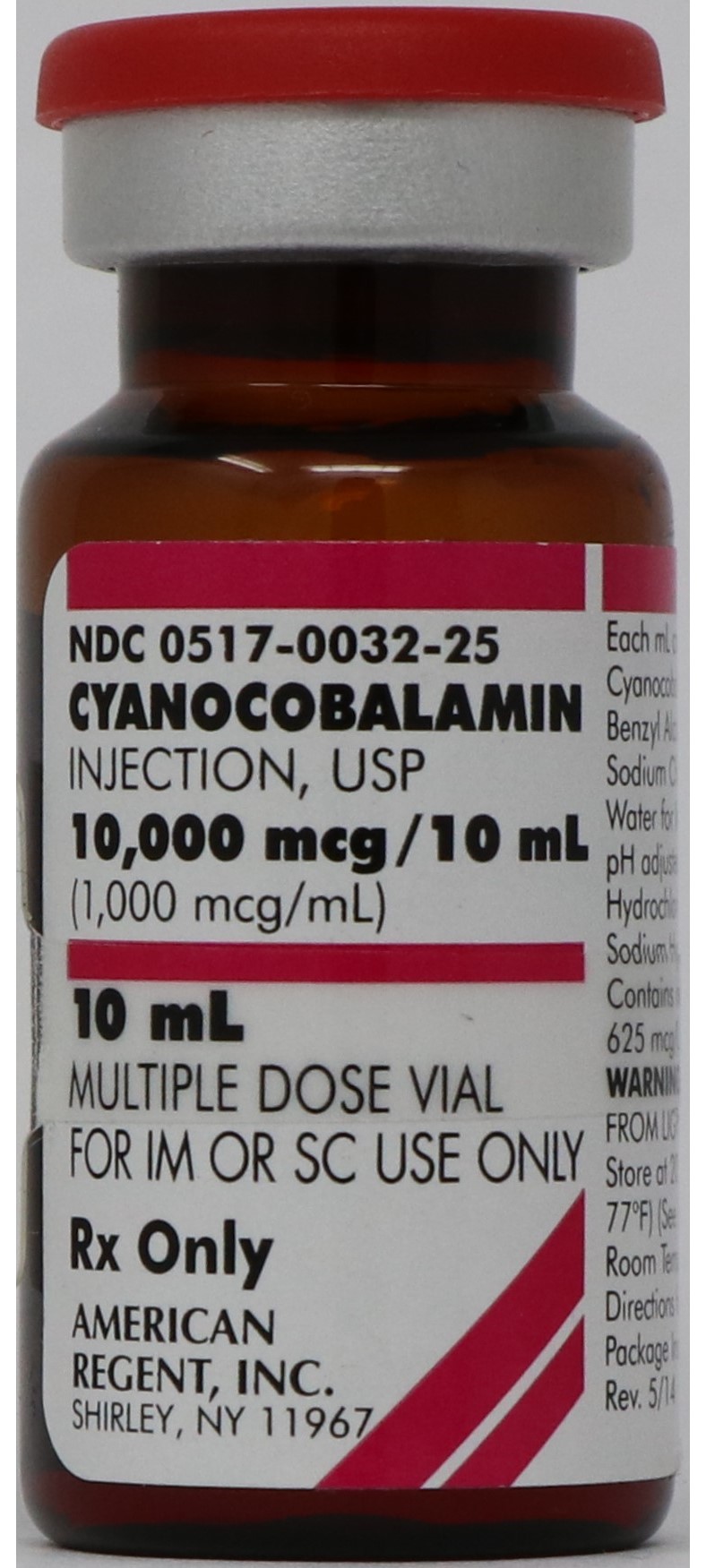
CYANOCOBALAMIN 1000 ug/mL Injection, Solution, 10 mL
Other active recalls for Cyanocobalamin (different manufacturers) — 2 · tap to view
🆔 Identity & classification
Where does this data come from?
🏷️ RxNorm drug class
This medicine belongs to the Vitamin B12 class.
Where does this data come from?
🏭 Manufacturer & labeler
Where does this data come from?
🩺 Clinical
- It's a prescription form of vitamin B12, used when your body can't get enough B12 on its own. That can happen because of a condition called pernicious anemia — where your stomach c...
- What is cyanocobalamin actually used for?
- The injection goes directly into a muscle or under the skin, bypassing the gut entirely — which makes it the most reliable option, especially for pernicious anemia, where lifelong...
- What's the difference between the shot and the nasal spray?
Patient education
Supplement & herbal interactions
Where does this data come from?
Ask a licensed pharmacist directly — free, answered by our team.
🧪 Inactive Ingredients / Excipients
Inactive ingredients, also called excipients, are components of the drug product other than the active ingredient. They may include fillers, dyes, coatings, preservatives, flavors, or other formulation ingredients.
💡 Tap an ingredient (hover on desktop) to see what it is and why it’s used.
-
UNII LKG8494WBH
Benzyl alcohol is a clear liquid used as a preservative and solvent in medicines. It helps prevent bacterial and fungal growth and dissolves other ingredients to create uniform liquid formulations.
-
UNII 451W47IQ8X
Sodium chloride is common table salt. It's used in medicines as a buffer to maintain proper pH, as a filler to add bulk, or to adjust the osmotic balance in liquid formulations.
-
UNII 059QF0KO0R
Water is a liquid solvent that dissolves and mixes ingredients together in liquid medicines, syrups, and injections. It helps distribute the active drug evenly throughout the product.
3 inactive ingredients listed in the exact product block matched to this NDC.
Where does this data come from?
ingredient classCode="IACT" elements from the exact product block matched by this NDC. Label-section narrative from DailyMed / the openFDA label index is shown separately when available.Inactive ingredient FAQ
Are inactive ingredients the same for every manufacturer?
Why might an inactive ingredient be missing?
Can inactive ingredients matter?
💲 Pricing
A drug doesn't have one price. Each row is a different public payment system, and none is what you'd pay at the counter — that depends on your insurance. The ⓘ on each row explains what it measures.
| Price system | Per mL | Per package |
|---|---|---|
| Retail pharmacies payNADAC · weekly | Not in the retail survey — common for institutional, discontinued, or low-volume packs. | |
| Medicaid paysCMS SDUD · 12 mo | No recent Medicaid claims on file for this NDC — rare and low-volume NDCs are suppressed in the public data. | |
| Medicare drug plans payPart D · quarterly | No Part D plan price is available for this NDC in our data. | |
Where does this data come from?
🔁 Therapeutic equivalents
| Product | Labeler | Pack | NADAC/unit | TE | Status | Price vs. this |
|---|---|---|---|---|---|---|
| Cyanocobalamin 1000 ug/mL 00143-9619-10 | Hikma | 10 vials | $0.328 | AP | Availability likely | — |
| Cyanocobalamin 1000 ug/mL 69680-0121-05 | Vitruvias | 5 vials | $0.552 | AP | Availability likely | — |
| Cyanocobalamin 1000 ug/mL 00143-9620-10 | Hikma | 10 vials | $0.739 | AP | Availability likely | — |
| Cyanocobalamin 1000 ug/mL 69680-0113-99 | Vitruvias | 10 vials | $0.739 | AP | Availability likely | — |
| cyanocobalamin 1000 ug/mL 70069-0172-10 | Somerset | 10 vials | $0.739 | AP | Availability likely | — |
| Cyanocobalamin 1000 ug/mL 71288-0301-11 | Meitheal | 10 vials | $0.739 | AP | Availability likely | — |
| cyanocobalamin 1000 ug/mL 70710-1665-01 | Zydus | 1 vial | $0.761 | AP | Availability likely | — |
| Cyanocobalamin 1000 ug/mL 00517-0130-01 | American | 1 vial | $0.787 | AP | Availability likely | — |
| Cyanocobalamin 1000 ug/mL 71288-0302-30 | Meitheal | 1 vial | $0.787 | AP | Availability likely | — |
| cyanocobalamin 1000 ug/mL 70710-1664-06 | Zydus | 10 vials | $0.819 | AP | Availability likely | — |
| Cyanocobalamin 1000 ug/mL 00143-9621-25 | Hikma | 25 vials | $1.474 | AP | Availability likely | — |
| Cyanocobalamin 1000 ug/mL 00517-0031-25 | American | 25 vials | $1.474 | AP | Availability likely | — |
| Cyanocobalamin 1000 ug/mL 25021-0502-01 | Sagent | 25 vials | $1.474 | AP | Availability likely | — |
| Cyanocobalamin 1000 ug/mL 63323-0044-01 | Fresenius | 25 vials | $1.474 | AP | Availability likely | — |
| Cyanocobalamin 1000 ug/mL 68001-0542-60 | BluePoint | 25 vials | $1.474 | AP | Availability likely | — |
| Cyanocobalamin 1000 ug/mL 68001-0640-60 | BluePoint | 25 vials | $1.474 | AP | Availability likely | — |
| cyanocobalamin 1000 ug/mL 70069-0005-10 | Somerset | 25 vials | $1.474 | AP | Availability likely | — |
| Cyanocobalamin 1000 ug/mL 70512-0840-25 | SOLA | 25 vials | $1.474 | AP | Availability likely | — |
| Cyanocobalamin 1000 ug/mL 71288-0300-92 | Meitheal | 25 vials | $1.474 | AP | Availability likely | — |
| Cyanocobalamin 1000 ug/mL 71288-0303-02 | Meitheal | 25 vials | $1.474 | AP | Availability likely | — |
| Cyanocobalamin 1000 ug/mL 72603-0650-25 | NorthStar | 25 vials | $1.474 | AP | Availability likely | — |
| cyanocobalamin 1000 ug/mL 70710-1663-07 | Zydus | 25 vials | $1.491 | AP | Availability likely | — |
| Cyanocobalamin 1000 ug/mL 00517-0032-25 | American | 25 vials | $2.134 | AP | Availability likely | — |
| Cyanocobalamin 1000 ug/mL 69680-0112-10 | Vitruvias | 10 vials | $2.970 | AP | Availability likely | — |
| Cyanocobalamin 1000 ug/mL 00404-9783-30 | Henry | 1 vial | — | AP | FDA listed | — |
| Cyanocobalamin 1000 ug/mL 00404-9786-10 | Henry | 1 vial | — | AP | FDA listed | — |
| Cyanocobalamin 1000 ug/mL 50090-6229-00 | A-S | 25 vials | — | AP | FDA listed | — |
| Cyanocobalamin 1000 ug/mL 51662-1394-01 | HF | 30 ml | — | AP | FDA listed | — |
| Cyanocobalamin 1000 ug/mLthis 51662-1440-01 | HF | 10 ml | — | AP | FDA listed | — |
| Cyanocobalamin 1000 ug/mL 51662-1647-03 | HF | 25 pouches | — | AP | FDA listed | — |
| Cyanocobalamin 1000 ug/mL 51662-1703-03 | HF | 10 pouches | — | AP | FDA listed | — |
| Cyanocobalamin 1000 ug/mL 55150-0364-01 | AuroMedics | 1 vial | — | AP | FDA listed | — |
| Cyanocobalamin 1000 ug/mL 68083-0449-25 | Gland | 25 vials | — | AP | FDA listed | — |
| cyanocobalamin 1000 ug/mL 68083-0561-25 | Gland | 25 vials | — | AP | FDA listed | — |
| cyanocobalamin 1000 ug/mL 68083-0562-01 | Gland | 1 vial | — | AP | FDA listed | — |
| Cyanocobalamin 1000 ug/mL 70069-0171-05 | Somerset | 5 vials | — | AP | FDA listed | — |
| Cyanocobalamin 1000 ug/mL 70756-0635-10 | Lifestar | 10 vials | — | AP | FDA listed | — |
| Cyanocobalamin 1000 ug/mL 70756-0636-10 | Lifestar | 10 vials | — | AP | FDA listed | — |
| Cyanocobalamin 1000 ug/mL 70756-0637-05 | Lifestar | 5 vials | — | AP | FDA listed | — |
| cyanocobalamin 1000 ug/mL 70771-1688-07 | Zydus | 25 vials | — | AP | FDA listed | — |
| cyanocobalamin 1000 ug/mL 70771-1689-06 | Zydus | 10 vials | — | AP | FDA listed | — |
| cyanocobalamin 1000 ug/mL 70771-1690-01 | Zydus | 1 vial | — | AP | FDA listed | — |
| cyanocobalamin 1000 ug/mL 76420-0075-25 | Asclemed | 25 vials | — | AP | FDA listed | — |
| Cyanocobalamin 1000 ug/mL 76420-0111-25 | Asclemed | 25 vials | — | AP | FDA listed | — |
| Cyanocobalamin 1000 ug/mL 76420-0618-25 | Asclemed | 25 vials | — | AP | FDA listed | — |
| cyanocobalamin 1000 ug/mL 85766-0029-25 | Sportpharm | 25 vials | — | AP | FDA listed | — |
| Cyanocobalamin 1000 ug/mL 87188-0111-90 | Plano | 25 vials | — | AP | FDA listed | — |
| cyanocobalamin 1000 ug/mL 87188-0112-01 | Plano | 1 vial | — | AP | FDA listed | — |
| cyanocobalamin 1000 ug/mL 87188-0113-01 | Plano | 1 vial | — | AP | FDA listed | — |
Where does this data come from?
⏳ Availability & generic status
This product is an FDA-approved generic. Other versions of the same drug are listed under Therapeutic equivalents, least expensive first.
Where does this data come from?
📦 Packaging — all sizes for this product
| Package NDC | Description | Marketing start | Status |
|---|---|---|---|
| 51662-1440-01 You're viewing this | 10 mL in 1 VIAL, MULTI-DOSE (51662-1440-1) | 2020-01-29 | Active |
🧭 About this NDC listing & data coverage
What data is (and isn’t) available for this NDC — tap to expand
| NDC identity (package / product / labeler codes) | ✓ Available |
| Labeler | ✓ Available |
| Product & package description | ✓ Available |
| Marketing category & status | ✓ Available |
| Active ingredient / dosage form / route | ✓ Available |
| FDA label (SPL via DailyMed) | ✓ Available |
| Package photos | ✓ Available |
| Inactive ingredients (structured) | ✓ Available |
| NADAC pharmacy acquisition price (CMS) | — Not published for this NDC CMS publishes NADAC only for NDCs reported in its retail-pharmacy survey. |
| Orange Book / therapeutic-equivalence data | ✓ Available |
| HCPCS J-code billing crosswalk | — Not published for this NDC Most self-administered / retail products have no J-code — that is normal. |
| Medicaid utilization (CMS SDUD) | — Not published for this NDC CMS reports utilization only for NDCs with Medicaid claims above its privacy threshold. |
Questions about this listing
Why is there no price listed?
Is the NDC printed on the package the same as the 11-digit billing NDC?
What do the three segments of this NDC mean?
Is this package still being marketed?
Who lists this product with the FDA?
Do I need a prescription for this product?
Where does this data come from?
📄 Full prescribing information FDA SPL
🎯 Indications and Usage ▾
INDICATIONS & USAGE Cyanocobalamin is indicated for vitamin B12 deficiencies due to malabsorption which may be associated with the following conditions: Addisonian (pernicious) anemia Gastrointestinal pathology, dysfunction, or surgery, including gluten enteropathy or sprue, small bowel bacteria overgrowth, total or partial gastrectomy Fish tapeworm infestation Malignancy of pancreas or bowel Folic acid deficiency It may be possible to treat the underlying disease by surgical correction of anatomic lesions leading to small bowel bacterial overgrowth, expulsion of fish tapeworm, discontinuation of drugs leading to vitamin malabsorption (see PRECAUTIONS- Drug Interactions), use of a gluten-free diet in nontropical sprue, or administration of antibiotics in tropical sprue.
Such measures remove the need for long-term administration of cyanocobalamin. Requirements of vitamin B12 in excess of normal (due to pregnancy, thyrotoxicosis, hemolytic anemia, hemorrhage, malignancy, hepatic and renal disease) can usually be met with oral supplementation. Cyanocobalamin Injection, USP is also suitable for the vitamin B12 absorption test ( DOSAGE & ADMINISTRATION- Schilling test).
⏱️ Dosage and Administration ▾
DOSAGE & ADMINISTRATION Avoid using the intravenous route. Use of this product intravenously will result in almost all of the vitamin being lost in the urine. Pernicious Anemia: Parenteral vitamin B12 is the recommended treatment and will be required for the remainder of the patient's life.
The oral form is not dependable. A dose of 100 mcg daily for 6 or 7 days should be administered by intramuscular or deep subcutaneous injection. If there is clinical improvement and if a reticulocyte response is observed, the same amount may be given on alternate days for seven doses, then every 3 to 4 days for another 2 to 3 weeks.
By this time hematologic values should have become normal. This regimen should be followed by 100 mcg monthly for life. Folic acid should be administered concomitantly if needed.
Patients with Normal Intestinal Absorption: Where the oral route is not deemed adequate, initial treatment similar to that for patients with pernicious anemia may be indicated depending on the severity of the deficiency. Chronic treatment should be with an oral B12 preparation. If other vitamin deficiencies are present, they should be treated.
Schilling Test: The flushing dose is 1000 mcg. Parenteral drug products should be inspected visually for particulate matter and discoloration prior to administration, whenever solution and container permit.
⛔ Contraindications ▾
CONTRAINDICATIONS Sensitivity to cobalt and/or vitamin B12 is a contraindication.
⚠️ Warnings ▾
WARNINGS Patients with early Leber's disease (hereditary optic nerve atrophy) who were treated with cyanocobalamin suffered severe and swift optic atrophy. Hypokalemia and sudden death may occur in severe megaloblastic anemia which is treated intensely. Anaphylactic shock and death have been reported after parenteral vitamin B12 administration.
An intradermal test dose is recommended before Cyanocobalamin Injection, USP is administered to patients suspected of being sensitive to this drug. This product contains Benzyl Alcohol. Benzyl Alcohol has been reported to be associated with a fatal "Gasping Syndrome" in premature infants.
This product contains aluminum that may be toxic. Aluminum may reach toxic levels with prolonged parenteral administration if kidney function is impaired. Premature neonates are particularly at risk because their kidneys are immature, and they require large amounts of calcium and phosphate solutions, which contain aluminum.
Research indicates that patients with impaired kidney function, including premature neonates, who receive parenteral levels of aluminum at greater than 4 to 5 mcg/kg/day accumulate aluminum at levels associated with central nervous system and bone toxicity. Tissue loading may occur at even lower rates of administration.
🤒 Adverse Reactions ▾
ADVERSE REACTIONS Generalized: Anaphylactic shock and death have been reported with administration of parenteral vitamin B12 (see WARNINGS ). Cardiovascular: Pulmonary edema and congestive heart failure early in treatment; peripheral vascular thrombosis. Hematological: Polycythemia vera Gastrointestinal: Mild transient diarrhea Dermatological: Itching; transitory exanthema Miscellaneous: Feeling of swelling of entire body
🆘 Overdosage ▾
OVERDOSAGE No overdosage has been reported with this drug.
🧬 Clinical Pharmacology ▾
CLINICAL PHARMACOLOGY Vitamin B12 is essential to growth, cell reproduction, hematopoiesis, and nucleoprotein and myelin synthesis. Cyanocobalamin is quantitatively and rapidly absorbed from intramuscular and subcutaneous sites of injection; the plasma level of the compound reaches its peak within 1 hour after intramuscular injection. Absorbed vitamin B12 is transported via specific B12 binding proteins, transcobalamin I and II to the various tissues.
The liver is the main organ for vitamin B12 storage. Within 48 hours after injection of 100 or 1000 mcg of vitamin B12, 50 to 98% of the injected dose may appear in the urine. The major portion is excreted within the first eight hours.
Intravenous administration results in even more rapid excretion with little opportunity for liver storage. Gastrointestinal absorption of vitamin B12 depends on the presence of sufficient intrinsic factor and calcium ions. Intrinsic factor deficiency causes pernicious anemia, which may be associated with subacute combined degeneration of the spinal cord.
Prompt parenteral administration of vitamin B12 prevents progression of neurologic damage. The average diet supplies about 5 to 15 mcg/day of vitamin B12 in a protein-bound form that is available for absorption after normal digestion. Vitamin B12 is not present in foods of plant origin, but is abundant in foods of animal origin.
In people with normal absorption, deficiencies have been reported only in strict vegetarians who consume no products of animal origin (including no milk products or eggs). Vitamin B12 is bound to intrinsic factor during transit through the stomach; separation occurs in the terminal ileum in the presence of calcium, and vitamin B12 enters the mucosal cell for absorption. It is then transported by the transcobalamin binding proteins.
A small amount (approximately 1% of the total amount ingested) is absorbed by simple diffusion, but this mechanism is adequate only with very large doses. Oral absorption is considered too undependable to rely on in patients with pernicious anemia or other conditions resulting in malabsorption of vitamin B12. Cyanocobalamin is the most widely used form of vitamin B12, and has hematopoietic activity apparently identical to that of the antianemia factor in purified liver extract.
Hydroxycobalamin is equally as effective as cyanocobalamin, and they share the cobalamin molecular structure.
📦 How Supplied / Storage and Handling ▾
HOW SUPPLIED CYANOCOBALAMIN INJECTION, USP is supplied in the following dosage forms. NDC 51662-1440-1 CYANOCOBALAMIN INJECTION, USP 10,000mcg/10mL (1,000mcg/mL) 10mL VIAL HF Acquisition Co LLC, DBA HealthFirst Mukilteo, WA 98275 Also supplied in the following manufacture supplied dosage forms Cyanocobalamin Injection, USP 1000 mcg/mL NDC 0517-0031-25 1 mL Fill in a 2 mL Vial Boxes of 25 NDC 0517-0032-25 10 mL Multiple Dose Vial Boxes of 25 NDC 0517-0130-01 30 mL Multiple Dose Vial Boxes of 1 Store at 20°-25°C (68°-77°F); excursions permitted to 15°-30°C (59°-86°F) (See USP Controlled Room Temperature).
PROTECT THE PRODUCT FROM LIGHT. IN0031 Rev. 10/18 MG #10565 AMERICAN REGENT, INC.
SHIRLEY, NY 11967
📋 Description ▾
DESCRIPTION Cyanocobalamin Injection, USP is a sterile solution of cyanocobalamin for intramuscular or subcutaneous injection. Each mL contains 1000 mcg cyanocobalamin. Each vial also contains Sodium Chloride, 0.9%.
Benzyl Alcohol, 1.5%, is present as a preservative. Hydrochloric acid and/or sodium hydroxide may have been added during manufacture to adjust the pH (range 4.5-7.0). Cyanocobalamin appears as dark red crystals or as an amorphous or crystalline red powder.
It is very hygroscopic in the anhydrous form, and sparingly soluble in water (1:80). It is stable to autoclaving for short periods at 121°C. The vitamin B12 coenzymes are very unstable in light.
The chemical name is 5,6-dimethyl-benzimidazolyl cyanocobamide; the molecular formula is C63H88CoN14O14P. The cobalt content is 4.34%. The molecular weight is 1355.39.
The structural formula is represented below. STRUCTURE