
cyanocobalamin 1000 ug/mL Injection, Solution — NDC 70710-1664-6 (Billing 70710-1664-06)
This is a package of cyanocobalamin 1000 ug/mL Injection, Solution from Zydus Pharmaceuticals USA Inc., marketed since May 2022 and currently FDA-listed; retail pharmacies pay about $0.8188 per mL (NADAC). It is the main listing for this product, which comes in 2 package sizes.
Other active recalls for Cyanocobalamin (different manufacturers) — 2 · tap to view
Identity & classification
Regulatory identifiers FDA, NLM and CMS codes for this package
Drug-database identifiers Medi-Span GPI and First Databank GCN / HICL / AHFS classification
- GSN (GCN sequence number): 002329
- GCN: 94594
- HICL (First Databank): 001053
- AHFS class code: 88:08.00.00
- RxCUI (RxNorm): 309594
Where does this data come from?
- FDA openFDA NDC Directory · synced Oct 1, 2026
- FDA label on DailyMed · label index refreshed Oct 1, 2026
- RxNorm (NLM RxNav) · catalog refreshed Oct 1, 2026
- Medi-Span GPI (licensed)
- First Databank (licensed) · refreshed Oct 1, 2026
RxNorm drug class
This medicine belongs to the Vitamin B12 class.
Where does this data come from?
- RxClass (NLM) · catalog refreshed Oct 1, 2026
Clinical
Cyanocobalamin injection is used to treat and prevent a lack of vitamin B12 that may be caused by any of the following: pernicious anemia (lack of a natural substance needed to absorb vitamin B12 from the intestine); certain diseases, infections, or medications that decrease the amount of vitamin B12 absorbed from food; or a vegan diet (strict vegetarian diet that does not allow any animal products, including dairy products and eggs). Lack of vitamin B12 may cause anemia (condition in which the red blood cells do not bring enough oxygen to the organs) and permanent damage to the nerves. Cyanoc...
Read the full MedlinePlus article ↗- It replaces vitamin B12 when you are low. Doctors use it for deficiency from poor absorption, pernicious anemia, or a diet low in B12. The injection and the nasal spray are approve...
- The usual approach is one spray in one nostril once a week. Use it at least an hour before or after hot foods or drinks. Follow your prescriber and your product label.
- Some injection products are labeled to be given by a healthcare professional and not for self-administration. Ask your prescriber how yours should be given. It should never go into...
- With the nasal spray, people reported colds, headache, weakness, nausea, a sore tongue, tingling and a runny nose. Call your doctor about anything that bothers you. Get emergency h...
Patient education
Supplement & herbal interactions
Where does this data come from?
- MedlinePlus (NLM) · refreshed Oct 1, 2026
- FDA label on DailyMed · label index refreshed Oct 1, 2026
Ask a licensed pharmacist directly — free, answered by our team.
Pricing
A drug doesn't have one price. Each row is a different public payment system, and none is what you'd pay at the counter — that depends on your insurance. The ⓘ on each row explains what it measures.
| Price system | Per mL | Per package |
|---|---|---|
| Retail pharmacies payNADAC · weekly | $0.819 | $81.88 / 100 ml |
| Medicaid paysCMS SDUD · 12 mo | No recent Medicaid claims on file for this NDC — rare and low-volume NDCs are suppressed in the public data. | |
| Medicare drug plans payPart D · quarterly | No Part D plan price is available for this NDC in our data. | |
| Medicare Part B allowsASP · J3420 | $0.683 / J3420 unit | — |
Where does this data come from?
- CMS NADAC weekly file · file of Jul 1, 2026
- CMS ASP pricing files · refreshed Sep 20, 2026
- CMS Medicaid State Drug Utilization Data · refreshed Oct 2, 2026
- CMS Part D plan pricing files · refreshed Sep 24, 2026
- VA National Acquisition Center price file
Billing & reimbursement
Where does this data come from?
- CMS ASP NDC-HCPCS crosswalk · refreshed Sep 22, 2026
- DMEPDAC NDC-HCPCS crosswalk
- openFDA NSDE billing units · refreshed Sep 7, 2026
Packaging — all sizes for this product
| Package NDC | Description | Per unit | Per pack | Marketing start | Marketing end | Status |
|---|---|---|---|---|---|---|
| 70710-1664-06 You're viewing this Main listing | 10 VIAL, MULTI-DOSE in 1 CARTON / 10 mL in 1 VIAL, MULTI-DOSE | $0.8188 / mL | $81.88 | 2022-05-05 | — | Active |
| 70710-1664-07 70710-1664-7 | 25 VIAL, MULTI-DOSE in 1 CARTON / 10 mL in 1 VIAL, MULTI-DOSE | $1.97 / mL | $493.29 | 2022-05-05 | — | Active |
This pack has the lowest per-mL cost of the 2 priced pack sizes ($0.8188 NADAC).
Pack size FAQ
What quantity is in this package?
What NDC number is used to bill for this package of cyanocobalamin 1000 ug/mL Injection, Solution?
Prices are the latest CMS NADAC pharmacy acquisition cost per NDC; per-pack figures are per-unit × pack quantity, shown only when the pack is denominated in the same measure NADAC prices.
Therapeutic equivalents
| Product | Labeler | Pack | NADAC/unit | TE | Status | Price vs. this |
|---|---|---|---|---|---|---|
| Cyanocobalamin 1000 ug/mL 00143-9619-10 | Hikma | 10 vials | $0.328 | AP | Availability likely | save 60% |
| Cyanocobalamin 1000 ug/mL 69680-0121-05 | Vitruvias | 5 vials | $0.552 | AP | Availability likely | save 33% |
| Cyanocobalamin 1000 ug/mL 00143-9620-10 | Hikma | 10 vials | $0.739 | AP | Availability likely | save 10% |
| Cyanocobalamin 1000 ug/mL 69680-0113-99 | Vitruvias | 10 vials | $0.739 | AP | Availability likely | save 10% |
| cyanocobalamin 1000 ug/mL 70069-0172-10 | Somerset | 10 vials | $0.739 | AP | Availability likely | save 10% |
| Cyanocobalamin 1000 ug/mL 71288-0301-11 | Meitheal | 10 vials | $0.739 | AP | Availability likely | save 10% |
| cyanocobalamin 1000 ug/mL 70710-1665-01 | Zydus | 1 vial | $0.761 | AP | Availability likely | save 7% |
| Cyanocobalamin 1000 ug/mL 00517-0130-01 | American | 1 vial | $0.787 | AP | Availability likely | save 4% |
| Cyanocobalamin 1000 ug/mL 71288-0302-30 | Meitheal | 1 vial | $0.787 | AP | Availability likely | save 4% |
| cyanocobalamin 1000 ug/mLthis 70710-1664-06 | Zydus | 10 vials | $0.819 | AP | Availability likely | — |
| Cyanocobalamin 1000 ug/mL 00143-9621-25 | Hikma | 25 vials | $1.474 | AP | Availability likely | +80% |
| Cyanocobalamin 1000 ug/mL 00517-0031-25 | American | 25 vials | $1.474 | AP | Availability likely | +80% |
| Cyanocobalamin 1000 ug/mL 25021-0502-01 | Sagent | 25 vials | $1.474 | AP | Availability likely | +80% |
| Cyanocobalamin 1000 ug/mL 63323-0044-01 | Fresenius | 25 vials | $1.474 | AP | Availability likely | +80% |
| Cyanocobalamin 1000 ug/mL 68001-0542-60 | BluePoint | 25 vials | $1.474 | AP | Availability likely | +80% |
| Cyanocobalamin 1000 ug/mL 68001-0640-60 | BluePoint | 25 vials | $1.474 | AP | Availability likely | +80% |
| cyanocobalamin 1000 ug/mL 70069-0005-10 | Somerset | 25 vials | $1.474 | AP | Availability likely | +80% |
| Cyanocobalamin 1000 ug/mL 70512-0840-25 | SOLA | 25 vials | $1.474 | AP | Availability likely | +80% |
| Cyanocobalamin 1000 ug/mL 71288-0300-92 | Meitheal | 25 vials | $1.474 | AP | Availability likely | +80% |
| Cyanocobalamin 1000 ug/mL 71288-0303-02 | Meitheal | 25 vials | $1.474 | AP | Availability likely | +80% |
| Cyanocobalamin 1000 ug/mL 72603-0650-25 | NorthStar | 25 vials | $1.474 | AP | Availability likely | +80% |
| cyanocobalamin 1000 ug/mL 70710-1663-07 | Zydus | 25 vials | $1.491 | AP | Availability likely | +82% |
| Cyanocobalamin 1000 ug/mL 00517-0032-25 | American | 25 vials | $2.134 | AP | Availability likely | +161% |
| Cyanocobalamin 1000 ug/mL 69680-0112-10 | Vitruvias | 10 vials | $2.970 | AP | Availability likely | +263% |
| Cyanocobalamin 1000 ug/mL 00404-9783-30 | Henry | 1 vial | — | AP | FDA listed | — |
| Cyanocobalamin 1000 ug/mL 00404-9786-10 | Henry | 1 vial | — | AP | FDA listed | — |
| Cyanocobalamin 1000 ug/mL 50090-6229-00 | A-S | 25 vials | — | AP | FDA listed | — |
| Cyanocobalamin 1000 ug/mL 51662-1394-01 | HF | 30 ml | — | AP | FDA listed | — |
| Cyanocobalamin 1000 ug/mL 51662-1440-01 | HF | 10 ml | — | AP | FDA listed | — |
| Cyanocobalamin 1000 ug/mL 51662-1647-03 | HF | 25 pouches | — | AP | FDA listed | — |
| Cyanocobalamin 1000 ug/mL 51662-1703-03 | HF | 10 pouches | — | AP | FDA listed | — |
| Cyanocobalamin 1000 ug/mL 55150-0364-01 | AuroMedics | 1 vial | — | AP | FDA listed | — |
| Cyanocobalamin 1000 ug/mL 68083-0449-25 | Gland | 25 vials | — | AP | FDA listed | — |
| cyanocobalamin 1000 ug/mL 68083-0561-25 | Gland | 25 vials | — | AP | FDA listed | — |
| cyanocobalamin 1000 ug/mL 68083-0562-01 | Gland | 1 vial | — | AP | FDA listed | — |
| Cyanocobalamin 1000 ug/mL 70069-0171-05 | Somerset | 5 vials | — | AP | FDA listed | — |
| Cyanocobalamin 1000 ug/mL 70756-0635-10 | Lifestar | 10 vials | — | AP | FDA listed | — |
| Cyanocobalamin 1000 ug/mL 70756-0636-10 | Lifestar | 10 vials | — | AP | FDA listed | — |
| Cyanocobalamin 1000 ug/mL 70756-0637-05 | Lifestar | 5 vials | — | AP | FDA listed | — |
| cyanocobalamin 1000 ug/mL 70771-1688-07 | Zydus | 25 vials | — | AP | FDA listed | — |
| cyanocobalamin 1000 ug/mL 70771-1689-06 | Zydus | 10 vials | — | AP | FDA listed | — |
| cyanocobalamin 1000 ug/mL 70771-1690-01 | Zydus | 1 vial | — | AP | FDA listed | — |
| cyanocobalamin 1000 ug/mL 76420-0075-25 | Asclemed | 25 vials | — | AP | FDA listed | — |
| Cyanocobalamin 1000 ug/mL 76420-0111-25 | Asclemed | 25 vials | — | AP | FDA listed | — |
| Cyanocobalamin 1000 ug/mL 76420-0618-25 | Asclemed | 25 vials | — | AP | FDA listed | — |
| cyanocobalamin 1000 ug/mL 85766-0029-25 | Sportpharm | 25 vials | — | AP | FDA listed | — |
| Cyanocobalamin 1000 ug/mL 87188-0111-90 | Plano | 25 vials | — | AP | FDA listed | — |
| cyanocobalamin 1000 ug/mL 87188-0112-01 | Plano | 1 vial | — | AP | FDA listed | — |
| cyanocobalamin 1000 ug/mL 87188-0113-01 | Plano | 1 vial | — | AP | FDA listed | — |
Where does this data come from?
- FDA openFDA NDC Directory · synced Oct 1, 2026
- FDA Orange Book · refreshed Sep 3, 2026
- CMS NADAC weekly file · file of Jul 1, 2026
Availability & generic status
This product is an FDA-approved generic. Other versions of the same drug are listed under Therapeutic equivalents, least expensive first.
Where does this data come from?
- FDA Orange Book · refreshed Sep 3, 2026
Inactive Ingredients / Excipients
Inactive ingredients, also called excipients, are components of the drug product other than the active ingredient. They may include fillers, dyes, coatings, preservatives, flavors, or other formulation ingredients.
💡 Tap an ingredient (hover on desktop) to see what it is and why it’s used.
-
UNII LKG8494WBH
Benzyl alcohol is a clear liquid used as a preservative and solvent in medicines. It helps prevent bacterial and fungal growth and dissolves other ingredients to create uniform liquid formulations.
-
UNII QTT17582CB
A strong acid used to adjust and maintain the proper pH level in liquid medicines, ensuring stability and preventing breakdown of active ingredients.
-
UNII 451W47IQ8X
Sodium chloride is common table salt. It's used in medicines as a buffer to maintain proper pH, as a filler to add bulk, or to adjust the osmotic balance in liquid formulations.
-
UNII 55X04QC32I
A strong alkaline chemical used to adjust and maintain the pH balance of liquid medicines. It helps keep the medicine stable and ensures it stays effective during storage.
-
UNII 70WT22SF4B
A mineral salt that acts as a buffer to maintain the pH balance of the medication. It helps stabilize the drug's potency and prevents unwanted chemical changes during storage.
-
UNII 059QF0KO0R
Water is a liquid solvent that dissolves and mixes ingredients together in liquid medicines, syrups, and injections. It helps distribute the active drug evenly throughout the product.
6 inactive ingredients listed in the exact product block matched to this NDC.
Where does this data come from?
ingredient classCode="IACT" elements from the exact product block matched by this NDC. Label-section narrative from DailyMed / the openFDA label index is shown separately when available.- FDA label on DailyMed · label index refreshed Oct 1, 2026
- FDA openFDA NDC Directory · synced Oct 1, 2026
Inactive ingredient FAQ
Are inactive ingredients the same for every manufacturer?
Why might an inactive ingredient be missing?
Can inactive ingredients matter?
Manufacturer & labeler
Where does this data come from?
- FDA openFDA NDC Directory · synced Oct 1, 2026
- Drugs@FDA
Full prescribing information FDA SPL
🎯 Indications and Usage ▾
INDICATIONS AND USAGE Cyanocobalamin is indicated for vitamin B 12 deficiencies due to malabsorption which may be associated with the following conditions: Addisonian (pernicious) anemia Gastrointestinal pathology, dysfunction, or surgery, including gluten enteropathy or sprue, small bowel bacteria overgrowth, total or partial gastrectomy Fish tapeworm infestation Malignancy of pancreas or bowel Folic acid deficiency It may be possible to treat the underlying disease by surgical correction of anatomic lesions leading to small bowel bacterial overgrowth, expulsion of fish tapeworm, discontinuation of drugs leading to vitamin malabsorption (see Drug Interactions ), use of a gluten-free diet in nontropical sprue, or administration of antibiotics in tropical sprue.
Such measures remove the need for long-term administration of cyanocobalamin. Requirements of vitamin B 12 in excess of normal (due to pregnancy, thyrotoxicosis, hemolytic anemia, hemorrhage, malignancy, hepatic and renal disease) can usually be met with oral supplementation. Cyanocobalamin Injection, USP is also suitable for the vitamin B 12 absorption test (Schilling test).
⏱️ Dosage and Administration ▾
DOSAGE AND ADMINISTRATION Avoid using the intravenous route. Use of this product intravenously will result in almost all of the vitamin being lost in the urine. Pernicious Anemia: Parenteral vitamin B 12 is the recommended treatment and will be required for the remainder of the patient's life.
The oral form is not dependable. A dose of 100 mcg daily for 6 or 7 days should be administered by intramuscular or deep subcutaneous injection. If there is clinical improvement and if a reticulocyte response is observed, the same amount may be given on alternate days for seven doses, then every 3 to 4 days for another 2 to 3 weeks.
By this time hematologic values should have become normal. This regimen should be followed by 100 mcg monthly for life. Folic acid should be administered concomitantly if needed.
Patients with Normal Intestinal Absorption: Where the oral route is not deemed adequate, initial treatment similar to that for patients with pernicious anemia may be indicated depending on the severity of the deficiency. Chronic treatment should be with an oral B 12 preparation. If other vitamin deficiencies are present, they should be treated.
Schilling Test: The flushing dose is 1,000 mcg. Parenteral drug products should be inspected visually for particulate matter and discoloration prior to administration, whenever solution and container permit.
⛔ Contraindications ▾
CONTRAINDICATIONS Sensitivity to cobalt and/or vitamin B 12 is a contraindication.
⚠️ Warnings ▾
WARNINGS Patients with early Leber's disease (hereditary optic nerve atrophy) who were treated with cyanocobalamin suffered severe and swift optic atrophy. Hypokalemia and sudden death may occur in severe megaloblastic anemia which is treated intensely. Anaphylactic shock and death have been reported after parenteral vitamin B 12 administration.
An intradermal test dose is recommended before Cyanocobalamin Injection, USP is administered to patients suspected of being sensitive to this drug. This product contains Benzyl Alcohol. Benzyl Alcohol has been reported to be associated with a fatal "Gasping Syndrome" in premature infants.
This product contains aluminum that may be toxic. Aluminum may reach toxic levels with prolonged parenteral administration if kidney function is impaired. Premature neonates are particularly at risk because their kidneys are immature, and they require large amounts of calcium and phosphate solutions, which contain aluminum.
Research indicates that patients with impaired kidney function, including premature neonates, who receive parenteral levels of aluminum at greater than 4 to 5 mcg/kg/day accumulate aluminum at levels associated with central nervous system and bone toxicity. Tissue loading may occur at even lower rates of administration.
🤒 Adverse Reactions ▾
ADVERSE REACTIONS Generalized: Anaphylactic shock and death have been reported with administration of parenteral vitamin B 12 (see WARNINGS ). Cardiovascular: Pulmonary edema and congestive heart failure early in treatment; peripheral vascular thrombosis. Hematological: Polycythemia vera Gastrointestinal: Mild transient diarrhea Dermatological: Itching; transitory exanthema Miscellaneous : Feeling of swelling of entire body
🆘 Overdosage ▾
OVERDOSAGE No overdosage has been reported with this drug.
🧬 Clinical Pharmacology ▾
CLINICAL PHARMACOLOGY Vitamin B 12 is essential to growth, cell reproduction, hematopoiesis, and nucleoprotein and myelin synthesis. Cyanocobalamin is quantitatively and rapidly absorbed from intramuscular and subcutaneous sites of injection; the plasma level of the compound reaches its peak within 1 hour after intramuscular injection. Absorbed vitamin B 12 is transported via specific B 12 binding proteins, transcobalamin I and II to the various tissues.
The liver is the main organ for vitamin B 12 storage. Within 48 hours after injection of 100 or 1,000 mcg of vitamin B 12 , 50 to 98% of the injected dose may appear in the urine. The major portion is excreted within the first eight hours.
Intravenous administration results in even more rapid excretion with little opportunity for liver storage. Gastrointestinal absorption of vitamin B 12 depends on the presence of sufficient intrinsic factor and calcium ions. Intrinsic factor deficiency causes pernicious anemia, which may be associated with subacute combined degeneration of the spinal cord.
Prompt parenteral administration of vitamin B 12 prevents progression of neurologic damage. The average diet supplies about 5 to 15 mcg/day of vitamin B 12 in a protein-bound form that is available for absorption after normal digestion. Vitamin B 12 is not present in foods of plant origin, but is abundant in foods of animal origin.
In people with normal absorption, deficiencies have been reported only in strict vegetarians who consume no products of animal origin (including no milk products or eggs). Vitamin B 12 is bound to intrinsic factor during transit through the stomach; separation occurs in the terminal ileum in the presence of calcium, and vitamin B 12 enters the mucosal cell for absorption. It is then transported by the transcobalamin binding proteins.
A small amount (approximately 1% of the total amount ingested) is absorbed by simple diffusion, but this mechanism is adequate only with very large doses. Oral absorption is considered too undependable to rely on in patients with pernicious anemia or other conditions resulting in malabsorption of vitamin B 12 . Cyanocobalamin is the most widely used form of vitamin B 12 , and has hematopoietic activity apparently identical to that of the antianemia factor in purified liver extract.
Hydroxycobalamin is equally as effective as cyanocobalamin, and they share the cobalamin molecular structure.
📦 How Supplied / Storage and Handling ▾
HOW SUPPLIED Cyanocobalamin Injection, USP 1,000 mcg/mL Strength(s) Pack NDC 1,000 mcg/mL Carton of 25 Multiple-dose vials 70710-1663-7 1 mL Multiple-dose vial 70710-1663-1 10,000 mcg/10 mL (1,000 mcg/mL) Carton of 10 Multiple-dose vials 70710-1664-6 Carton of 25 Multiple-dose vials 70710-1664-7 10 mL Multiple-dose vial 70710-1664-1 30,000 mcg/30 mL (1,000 mcg/mL) Carton of 1 Multiple-dose vial 70710-1665-1 Carton of 5 Multiple-dose vials 70710-1665-5 30 mL Multiple-dose vial 70710-1665-1 Store at 20° to 25°C (68° to 77°F); excursions permitted to 15° to 30°C (59° to 86°F) (See USP Controlled Room Temperature).
PROTECT THE PRODUCT FROM LIGHT. Call your doctor for medical advice about side effects. You may report side effects to FDA at 1-800-FDA-1088.
Please address medical inquiries to Zydus Pharmaceuticals (USA) Inc. at [email protected] or Tel.: 1-877-993-8779. Manufactured by: Zydus Lifesciences Ltd. (formerly known as Cadila Healthcare Ltd.) Vadodara, India.
Distributed by: Zydus Pharmaceuticals (USA) Inc. Pennington, NJ 08534 Revised: 04/2022
📋 Description ▾
DESCRIPTION Cyanocobalamin Injection, USP is a sterile solution of cyanocobalamin for intramuscular or subcutaneous injection. Each mL contains 1,000 mcg cyanocobalamin. Each vial also contains Sodium Chloride USP, 0.9%.
Benzyl Alcohol NF, 1.5%, is present as a preservative. Dibasic Sodium Phosphate (Heptahydrate) USP 0.05% is present as a buffering agent. Hydrochloric acid NF and/or sodium hydroxide NF may have been added during manufacture to adjust the pH (range 4.5-7.0).
Cyanocobalamin appears as crystals or deep red colored, odorless crystalline powder. It is very hygroscopic in the anhydrous form, and sparingly soluble in water (1:80). It is stable to autoclaving for short periods at 121°C.
The vitamin B 12 coenzymes are very unstable in light. The chemical name is 5,6-dimethyl-benzimidazolyl cyanocobamide; the molecular formula is C 63 H 88 CoN 14 O 14 P. The cobalt content is 4.35%.
The molecular weight is 1355.4. The structural formula is represented below. Image
⚠️ Precautions ▾
PRECAUTIONS General Precautions: Vitamin B 12 deficiency that is allowed to progress for longer than 3 months may produce permanent degenerative lesions of the spinal cord. Doses of folic acid greater than 0.1 mg per day may result in hematologic remission in patients with vitamin B 12 deficiency. Neurologic manifestations will not be prevented with folic acid, and if not treated with vitamin B 12 , irreversible damage will result.
Doses of cyanocobalamin exceeding 10 mcg daily may produce hematologic response in patients with folate deficiency. Indiscriminate administration may mask the true diagnosis. Information for Patients : Patients with pernicious anemia should be informed that they will require monthly injections of vitamin B 12 for the remainder of their lives.
Failure to do so will result in return of the anemia and in development of incapacitating and irreversible damage to the nerves of the spinal cord. Also, patients should be warned about the danger of taking folic acid in place of vitamin B 12 , because the former may prevent anemia but allow progression of subacute combined degeneration. A vegetarian diet which contains no animal products (including milk products or eggs) does not supply any vitamin B 12 .
Patients following such a diet, should be advised to take oral vitamin B 12 regularly. The need for vitamin B 12 is increased by pregnancy and lactation. Deficiency has been recognized in infants of vegetarian mothers who were breast fed, even though the mothers had no symptoms of deficiency at the time.
Laboratory Tests: During the initial treatment of patients with pernicious anemia, serum potassium must be observed closely the first 48 hours and potassium replaced if necessary. Hematocrit, reticulocyte count, vitamin B 12 , folate and iron levels should be obtained prior to treatment. Hematocrit and reticulocyte counts should be repeated daily from the fifth to seventh days of therapy and then frequently until the hematocrit is normal.
If folate levels are low, folic acid should also be administered. If reticulocytes have not increased after treatment or if reticulocyte counts do not continue at least twice normal as long as the hematocrit is less than 35%, diagnosis or treatment should be reevaluated. Repeat determinations of iron and folic acid may reveal a complicating illness that might inhibit the response of the marrow.
Patients with pernicious anemia have about 3 times the incidence of carcinoma of the stomach as the general population, so appropriate tests for this condition should be carried out when indicated. Drug/Laboratory Test Interactions: Persons taking most antibiotics, methotrexate and pyrimethamine invalidate folic acid and vitamin B 12 diagnostic blood assays. Colchicine para-aminosalicylic acid and heavy alcohol intake for longer than 2 weeks may produce malabsorption of vitamin B 12 .
Carcinogenesis, Mutagenesis, Impairment of Fertility: Long term studies in animals to evaluate carcinogenic potential have not been done. There is no evidence from long-term use in patients with pernicious anemia that cyanocobalamin is carcinogenic. Pernicious anemia is associated with an increased incidence of carcinoma of the stomach, but this is believed to be related to the underlying pathology and not to treatment with cyanocobalamin.
Pregnancy: Teratogenic Effects. Adequate and well-controlled studies have not been done in pregnant women. However, vitamin B 12 is an essential vitamin and requirements are increased during pregnancy.
Amounts of vitamin B 12 that are recommended by the Food and Nutrition Board, National Academy of Science-National Research Council for pregnant women (4 mcg daily) should be consumed during pregnancy. Nursing Mothers: Vitamin B 12 is known to be excreted in human milk. Amounts of vitamin B 12 that are recommended by the Food and Nutrition Board, National Academy of Science-National Research Council for lactating women (4 mcg daily) should be consumed during lactation.
P… [Excerpted — this section continues on DailyMed.]
📄 Package Label / Principal Display Panel ▾
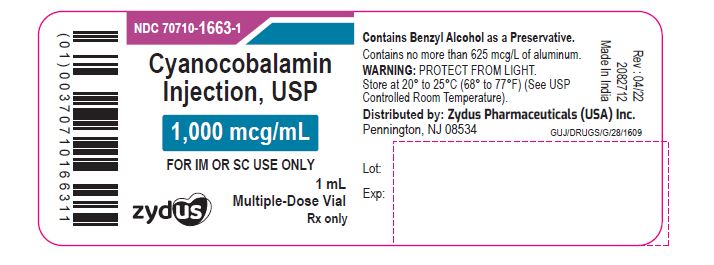
PRINCIPAL DISPLAY PANEL – 1 mL Vial Label NDC 70710-1663-1 Cyanocobalamin Injection, USP 1,000 mcg/mL FOR IM OR SC USE ONLY 1 mL Multiple-dose Vial Rx only Zydus Pharmaceuticals (USA) Inc. PRINCIPAL DISPLAY PANEL – 1 mL Carton Label NDC 70710-1663-7 Cyanocobalamin Injection, USP 1,000 mcg/mL FOR INTRAMUSCULAR OR SUBCUTANEOUS USE ONLY 25 X 1 mL Multiple-dose Vials Rx only Zydus Pharmaceuticals (USA) Inc. PRINCIPAL DISPLAY PANEL – 10 mL Vial Label NDC 70710-1664-1 Cyanocobalamin Injection, USP 10,000 mcg/10 mL (1,000 mcg/mL) FOR INTRAMUSCULAR OR SUBCUTANEOUS USE ONLY Contains Benzyl Alcohol as a Preservative.
10 mL Multiple-Dose Vial Rx only Zydus Pharmaceuticals (USA) Inc. PRINCIPAL DISPLAY PANEL – 10 mL Carton Label (10's pack) NDC 70710-1664-6 Cyanocobalamin Injection, USP 10,000 mcg/10 mL (1,000 mcg/mL) FOR INTRAMUSCULAR OR SUBCUTANEOUS USE ONLY 10 X 10 mL Multiple-Dose Vials Rx only Zydus Pharmaceuticals (USA) Inc. PRINCIPAL DISPLAY PANEL – 10 mL Carton Label (25's pack) NDC 70710-1664-7 Cyanocobalamin Injection, USP 10,000 mcg/10 mL (1,000 mcg/mL) FOR INTRAMUSCULAR OR SUBCUTANEOUS USE ONLY 25 X 10 mL Multiple-Dose Vials Rx only Zydus Pharmaceuticals (USA) Inc.
PRINCIPAL DISPLAY PANEL – 30 mL Vial Label NDC 70710-1665-1 Cyanocobalamin Injection, USP 30,000 mcg/30 mL (1,000 mcg/mL) FOR INTRAMUSCULAR OR SUBCUTANEOUS USE ONLY Contains Benzyl Alcohol as a Preservative. 30 mL Multiple-Dose Vial Rx only Zydus Pharmaceuticals (USA) Inc. PRINCIPAL DISPLAY PANEL – 30 mL Carton Label NDC 70710-1665-1 Cyanocobalamin Injection, USP 30,000 mcg/30 mL (1,000 mcg/mL) FOR INTRAMUSCULAR OR SUBCUTANEOUS USE ONLY 30 mL Multiple-Dose Vial Rx only Zydus Pharmaceuticals (USA) Inc.
PRINCIPAL DISPLAY PANEL – 30 mL Carton Label (5's pack) NDC 70710-1665-5 Cyanocobalamin Injection, USP 30,000 mcg/30 mL (1,000 mcg/mL) FOR INTRAMUSCULAR OR SUBCUTANEOUS USE ONLY 5 X 30 mL Multiple-Dose Vials Rx only Zydus Pharmaceuticals (USA) Inc. container label 1mL 25 X 1 mL Single-Dose Vials Container label 10mL 10 X 10 mL Multiple-Dose Vials 25 X 10 mL Multiple-Dose Vials Container label 30mL 30 mL Multiple-Dose Vial 5 X 30 mL Multiple-Dose Vials