
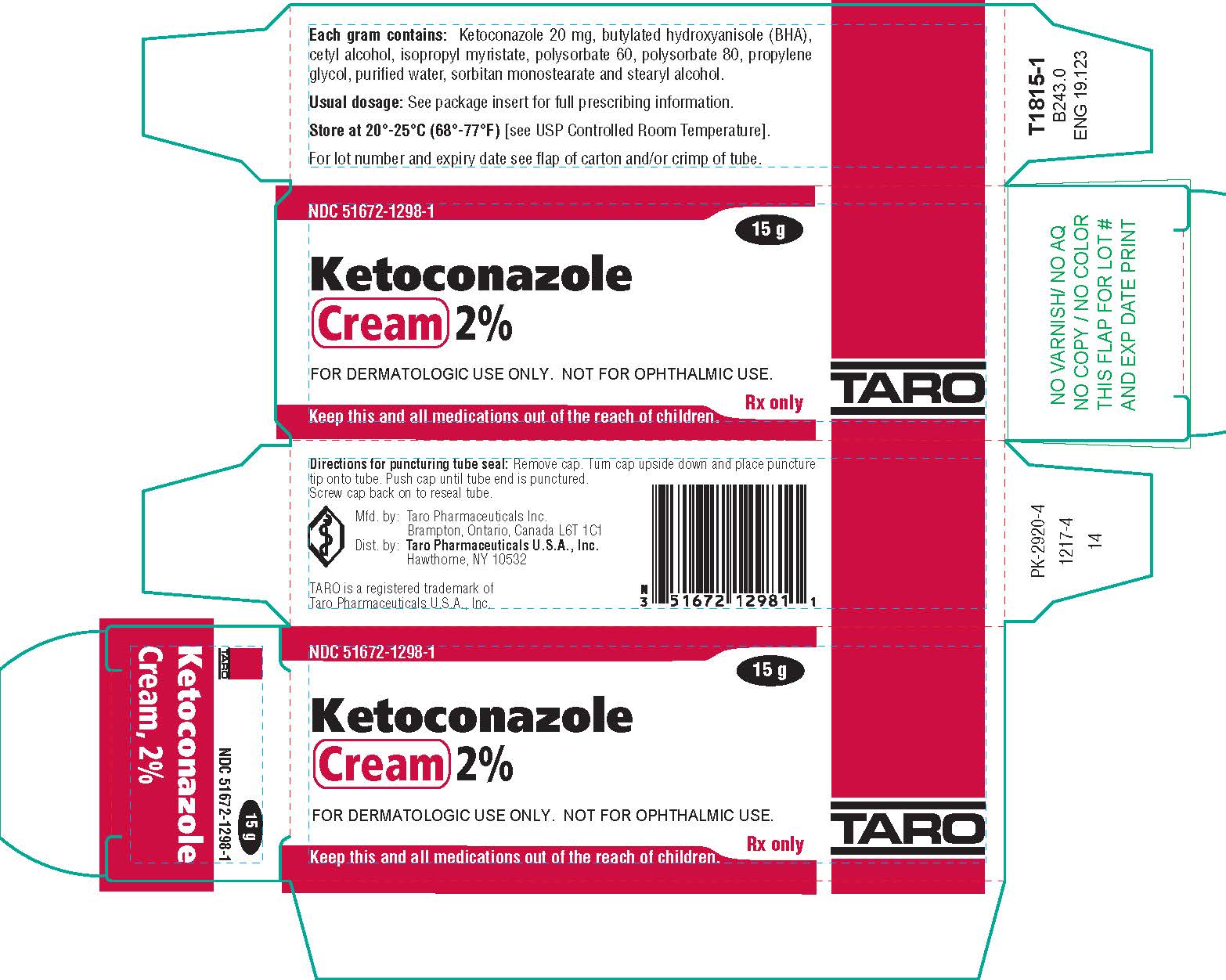
Ketoconazole 20 mg/g Cream — NDC 51672-1298-1 (Billing 51672-1298-01)
This is a package of Ketoconazole 20 mg/g Cream from Sun Pharmaceutical Industries, Inc., marketed since Dec 2002 and currently FDA-listed; retail pharmacies pay about $0.2848 per g (NADAC).
NDC database record
One package, one record: these facts belong to NDC 51672-1298-1 alone.
- Record
- FDA NDC Directory package listing · Human prescription drug
- Code segments
- 51672 labeler · 1298 product · 1 package
- Package marketed since
- Dec 18, 2002
- Sample package
- No — commercial package
- Listing certified through
- Dec 31, 2026
- Barcode (UPC-A, from the NDC)
- 3 5167212981 1
- Medicaid fills, this package
- 17,616 prescriptions in the last four reported quarters
- FDA record last changed
- Jul 24, 2026
Identity & classification
Regulatory identifiers FDA, NLM and CMS codes for this package
Drug-database identifiers Medi-Span GPI and First Databank GCN / HICL / AHFS classification
- GSN (GCN sequence number): 007334
- GCN: 31850
- GPI-14 (Medi-Span): 90154045003710
- HICL (First Databank): 004132
- AHFS class code: 08:14.08.00
- RxCUI (RxNorm): 203088
Where does this data come from?
- FDA openFDA NDC Directory · synced Oct 8, 2026
- FDA label on DailyMed · label index refreshed Oct 8, 2026
- RxNorm (NLM RxNav) · catalog refreshed Oct 1, 2026
- Medi-Span GPI (licensed)
- First Databank (licensed) · refreshed Oct 8, 2026
RxNorm drug class
This medicine belongs to the Cortisol Synthesis Inhibitor class.
Where does this data come from?
- RxClass (NLM) · catalog refreshed Oct 1, 2026
Clinical
Ketoconazole cream is used to treat tinea corporis (ringworm; fungal skin infection that causes a red scaly rash on different parts of the body), tinea cruris (jock itch; fungal infection of the skin in the groin or buttocks), tinea pedis (athlete's foot; fungal infection of the skin on the feet and between the toes), tinea versicolor (fungal infection of the skin that causes brown or light colored spots on the chest, back, arms, legs, or neck), and yeast infections of the skin. Prescription ketoconazole shampoo is used to treat tinea versicolor. Over-the-counter ketoconazole shampoo is used t...
Read the full MedlinePlus article ↗- It depends on the form. The tablets treat serious fungal infections like blastomycosis and histoplasmosis. The creams, foam and shampoos treat skin and scalp conditions like ringwo...
- Take them with a meal, since that helps your body absorb them best. Follow your prescriber's directions. If you take acid-reducing medicine, ask me how to time it, because it can l...
- Nausea, stomach upset, headache and dizziness are among the more common ones. Call your doctor right away if you notice yellow skin or eyes, dark urine, unusual tiredness, fainting...
- The tablets have caused serious liver injury, sometimes fatal, even in people with no known liver problems. That's why you'll have liver blood tests before and during treatment. Av...
Patient education
Supplement & herbal interactions
Some supplements/herbs that may interact with Ketoconazole — tap one for details:
Where does this data come from?
- MedlinePlus (NLM) · refreshed Oct 8, 2026
- FDA label on DailyMed · label index refreshed Oct 8, 2026
Ask a licensed pharmacist directly — free, answered by our team.
Pricing
A drug doesn't have one price. Each row is a different public payment system, and none is what you'd pay at the counter — that depends on your insurance. The ⓘ on each row explains what it measures.
| Price system | Per g | Per package |
|---|---|---|
| Retail pharmacies payNADAC · weekly | $0.285 | $4.27 / 15 g |
| Medicaid paysCMS SDUD · 12 mo | $0.5871 | $8.81 / 15 g |
| Medicare drug plans payPart D · Q2 2026 | $0.3356 | $5.03 / 15 g |
Where does this data come from?
- CMS NADAC weekly file · file of Oct 7, 2026
- CMS ASP pricing files · refreshed Sep 20, 2026
- CMS Medicaid State Drug Utilization Data · through Q1 2026
- CMS Part D plan pricing files · refreshed Sep 24, 2026
- VA National Acquisition Center price file
Packaging — all sizes for this product
| Package NDC | Description | Per unit | Per pack | Marketing start | Marketing end | Status |
|---|---|---|---|---|---|---|
| 51672-1298-01 You're viewing this | 1 TUBE in 1 CARTON / 15 g in 1 TUBE | $0.2848 / g | $4.27 | 2002-12-18 | — | Active |
| 51672-1298-02 51672-1298-2 | 1 TUBE in 1 CARTON / 30 g in 1 TUBE | $0.2486 / g | $7.46 | 2002-12-18 | — | Active |
| 51672-1298-03 51672-1298-3 Main listing | 1 TUBE in 1 CARTON / 60 g in 1 TUBE | $0.1622 / g | $9.73 | 2002-12-18 | — | Active |
Per g, this pack runs about 76% above the cheapest pack (NDC 51672-1298-03, $0.1622 vs $0.2848 NADAC).
This pack accounts for about 15% of this product's recent Medicaid fills; the largest share goes to a different pack size. See all packs ↓
Pack size FAQ
What quantity is in this package?
What NDC number is used to bill for this package of Ketoconazole 20 mg/g Cream?
Prices are the latest CMS NADAC pharmacy acquisition cost per NDC; per-pack figures are per-unit × pack quantity, shown only when the pack is denominated in the same measure NADAC prices.
Therapeutic equivalents
| Product | Labeler | Pack | NADAC/unit | TE | Status | Price vs. this |
|---|---|---|---|---|---|---|
| Ketoconazole 20 mg/g 71085-0008-60 | IPG | 1 tube | $0.185 | AB | FDA listed | save 35% |
| Ketoconazole 20 mg/g 00093-3219-15 | Teva | 1 tube | $0.285 | AB | Availability likely | — |
| ketoconazole 20 mg/g 00168-0099-15 | E. | 1 tube | $0.285 | AB | Availability likely | — |
| Ketoconazole 20 mg/g 16714-0955-01 | NORTHSTAR | 1 tube | $0.285 | AB | Availability likely | — |
| Ketoconazole 20 mg/g 21922-0025-04 | Encube | 1 tube | $0.285 | AB | Availability likely | — |
| Ketoconazole 20 mg/gthis 51672-1298-01 | Sun | 1 tube | $0.285 | AB | Availability likely | — |
| Ketoconazole 20 mg/g 50090-5265-00 | A-S | 1 tube | — | AB | FDA listed | — |
| Ketoconazole 20 mg/g 50090-6046-00 | A-S | 1 tube | — | AB | FDA listed | — |
| Ketoconazole 20 mg/g 50090-6069-00 | A-S | 1 tube | — | AB | FDA listed | — |
| Ketoconazole 20 mg/g 51407-0279-15 | Golden | 1 tube | — | AB | FDA listed | — |
| Ketoconazole 20 mg/g 63187-0774-15 | Proficient | 1 tube | — | AB | FDA listed | — |
| Ketoconazole 20 mg/g 63629-8819-01 | Bryant | 1 tube | — | AB | FDA listed | — |
| Ketoconazole 20 mg/g 63629-8820-01 | Bryant | 1 tube | — | AB | FDA listed | — |
| Ketoconazole 20 mg/g 68071-1709-03 | NuCare | 30 g | — | AB | FDA listed | — |
| Ketoconazole 20 mg/g 68071-3512-05 | NuCare | 15 tubes | — | AB | FDA listed | — |
| Ketoconazole 20 mg/g 68788-8233-03 | Preferred | 1 tube | — | AB | FDA listed | — |
| Ketoconazole 20 mg/g 70518-4236-00 | REMEDYREPACK | 1 tube | — | AB | FDA listed | — |
| Ketoconazole Cream 20 mg/g 72189-0422-30 | Direct_Rx | 30 g | — | AB | FDA listed | — |
| Ketoconazole 20 mg/g 82804-0091-15 | Proficient | 1 tube | — | AB | FDA listed | — |
| Ketoconazole 20 mg/g 85766-0135-15 | Sportpharm | 1 tube | — | AB | FDA listed | — |
| Ketoconazole 20 mg/g 87063-0066-15 | ASCLEMED | 1 tube | — | AB | FDA listed | — |
Where does this data come from?
- FDA openFDA NDC Directory · synced Oct 8, 2026
- FDA Orange Book · refreshed Oct 3, 2026
- CMS NADAC weekly file · file of Oct 7, 2026
Availability & generic status
This product is an FDA-approved generic. Other versions of the same drug are listed under Therapeutic equivalents, least expensive first.
Where does this data come from?
- FDA Orange Book · refreshed Oct 3, 2026
What it looks like
Where does this data come from?
- FDA label on DailyMed · label index refreshed Oct 8, 2026
Inactive Ingredients / Excipients
Inactive ingredients, also called excipients, are components of the drug product other than the active ingredient. They may include fillers, dyes, coatings, preservatives, flavors, or other formulation ingredients.
🧪 Avoiding an ingredient? See Ketoconazole inactive ingredients by manufacturer: every current product's list side by side, so you can ask your pharmacy for the version that does not list it.
💡 Tap an ingredient (hover on desktop) to see what it is and why it’s used.
-
UNII REK4960K2U
Butylated hydroxyanisole is a synthetic preservative that prevents oils and fats in medicines from spoiling or becoming rancid. It keeps the medicine stable and extends its shelf life.
-
UNII 936JST6JCN
Cetyl alcohol is a waxy, fatty substance derived from plant or animal sources. It acts as an emulsifier and thickener in medicines, helping blend oil and water components and giving products a smooth, creamy texture.
-
UNII 0RE8K4LNJS
Isopropyl myristate is an oily liquid made from coconut or palm oil. It's used in medicines as an emollient and penetration enhancer to help the medicine absorb through skin or improve spreadability in topical products.
-
UNII CAL22UVI4M
A synthetic emulsifier derived from sorbitol and fatty acids. It helps mix oil and water-based ingredients together and improves the texture and stability of the medicine.
-
UNII 6OZP39ZG8H
Polysorbate 80 is a synthetic emulsifier derived from sorbitol and oleic acid. It helps mix oil and water-based ingredients together in medications and improves how the product disperses in the body.
-
UNII 6DC9Q167V3
Propylene glycol is a clear liquid derived from petroleum or vegetable sources. It acts as a solvent, humectant, and preservative in medicines, helping dissolve active ingredients and maintain product stability.
-
UNII NVZ4I0H58X
A waxy substance made from sorbitol and stearic acid. It acts as an emulsifier and stabilizer, helping keep oil and water mixed together and preventing separation in the medicine.
-
UNII 2KR89I4H1Y
Stearyl alcohol is a waxy, fatty substance derived from natural oils or made synthetically. It acts as an emulsifier and thickener in medicines, helping mix ingredients together and give the product the right texture.
-
UNII 059QF0KO0R
Water is a liquid solvent that dissolves and mixes ingredients together in liquid medicines, syrups, and injections. It helps distribute the active drug evenly throughout the product.
9 inactive ingredients listed in the exact product block matched to this NDC.
Where does this data come from?
ingredient classCode="IACT" elements from the exact product block matched by this NDC. Label-section narrative from DailyMed / the openFDA label index is shown separately when available.- FDA label on DailyMed · label index refreshed Oct 8, 2026
- FDA openFDA NDC Directory · synced Oct 8, 2026
Inactive ingredient FAQ
Are inactive ingredients the same for every manufacturer?
Why might an inactive ingredient be missing?
Can inactive ingredients matter?
Manufacturer & labeler
More NDCs from Sun Pharmaceutical Industries, Inc. labeler code 51672
- Hydrocortisone Valerate 2 mg/g Ointment NDC 51672-1292-1
- Clobetasol Propionate .5 mg/mL Solution NDC 51672-1293-2
- Clobetasol Propionate .5 mg/g Gel NDC 51672-1294-1
- Diflorasone Diacetate .5 mg/g Ointment NDC 51672-1295-1
- Diflorasone Diacetate .5 mg/g Cream NDC 51672-1296-1
- Clobetasol Propionate .5 mg/g Cream NDC 51672-1297-1
- Ammonium Lactate 120 mg/g Lotion NDC 51672-1300-5
- Ammonium Lactate 120 mg/g Cream NDC 51672-1301-0
- Terconazole 8 mg/g Cream NDC 51672-1302-0
- Econazole Nitrate 10 mg/g Cream NDC 51672-1303-1
- Terconazole 4 mg/g Cream NDC 51672-1304-6
- Mometasone Furoate 1 mg/mL Solution NDC 51672-1305-3
Where does this data come from?
- FDA openFDA NDC Directory · synced Oct 8, 2026
- Drugs@FDA
Full prescribing information FDA SPL
🎯 Indications and Usage ▾
INDICATIONS AND USAGE Ketoconazole cream, 2% is indicated for the topical treatment of tinea corporis, tinea cruris and tinea pedis caused by Trichophyton rubrum, T. mentagrophytes and Epidermophyton floccosum; in the treatment of tinea (pityriasis) versicolor caused by Malassezia furfur (Pityrosporum orbiculare); in the treatment of cutaneous candidiasis caused by Candida spp. and in the treatment of seborrheic dermatitis.
⏱️ Dosage and Administration ▾
DOSAGE AND ADMINISTRATION Cutaneous candidiasis, tinea corporis, tinea cruris, tinea pedis, and tinea (pityriasis) versicolor It is recommended that ketoconazole cream, 2% be applied once daily to cover the affected and immediate surrounding area. Clinical improvement may be seen fairly soon after treatment is begun; however, candidal infections and tinea cruris and corporis should be treated for two weeks in order to reduce the possibility of recurrence. Patients with tinea versicolor usually require two weeks of treatment.
Patients with tinea pedis require six weeks of treatment. Seborrheic dermatitis Ketoconazole cream, 2% should be applied to the affected area twice daily for four weeks or until clinical clearing. If a patient shows no clinical improvement after the treatment period, the diagnosis should be redetermined.
⛔ Contraindications ▾
CONTRAINDICATIONS Ketoconazole cream, 2% is contraindicated in persons who have shown hypersensitivity to the active or excipient ingredients of this formulation.
⚠️ Warnings ▾
WARNINGS Ketoconazole cream, 2% is not for ophthalmic use.
🤒 Adverse Reactions ▾
ADVERSE REACTIONS During clinical trials 45 (5.0%) of 905 patients treated with ketoconazole cream, 2% and 5 (2.4%) of 208 patients treated with placebo reported side effects consisting mainly of severe irritation, pruritus and stinging. One of the patients treated with ketoconazole cream developed a painful allergic reaction. In worldwide postmarketing experience, rare reports of contact dermatitis have been associated with ketoconazole cream or one of its excipients, namely propylene glycol.
🤰 Pregnancy ▾
Pregnancy Teratogenic effects Pregnancy Category C Ketoconazole has been shown to be teratogenic (syndactylia and oligodactylia) in the rat when given orally in the diet at 80 mg/kg/day, (10 times the maximum recommended human oral dose). However, these effects may be related to maternal toxicity, which was seen at this and higher dose levels. There are no adequate and well-controlled studies in pregnant women.
Ketoconazole should be used during pregnancy only if the potential benefit justifies the potential risk to the fetus.
🧒 Pediatric Use ▾
Pediatric Use Safety and effectiveness in children have not been established.
🧬 Clinical Pharmacology ▾
CLINICAL PHARMACOLOGY When ketoconazole cream, 2% was applied dermally to intact or abraded skin of beagle dogs for 28 consecutive days at a dose of 80 mg, there were no detectable plasma levels using an assay method having a lower detection limit of 2 ng/mL. After a single topical application to the chest, back and arms of normal volunteers, systemic absorption of ketoconazole was not detected at the 5 ng/mL level in blood over a 72-hour period. Two dermal irritancy studies, a human sensitization test, a phototoxicity study and a photoallergy study conducted in 38 male and 62 female volunteers showed no contact sensitization of the delayed hypersensitivity type, no irritation, no phototoxicity and no photoallergenic potential due to ketoconazole cream, 2%.
Microbiology Ketoconazole is a broad spectrum synthetic antifungal agent which inhibits the in vitro growth of the following common dermatophytes and yeasts by altering the permeability of the cell membrane: dermatophytes: Trichophyton rubrum, T. mentagrophytes, T. tonsurans, Microsporum canis, M. audouini, M. gypseum and Epidermophyton floccosum; yeasts: Candida albicans, Malassezia ovale (Pityrosporum ovale) and C. tropicalis; and the organism responsible for tinea versicolor, Malassezia furfur (Pityrosporum orbiculare).
Only those organisms listed in the INDICATIONS AND USAGE section have been proven to be clinically affected. Development of resistance to ketoconazole has not been reported. Mode of Action In vitro studies suggest that ketoconazole impairs the synthesis of ergosterol, which is a vital component of fungal cell membranes.
It is postulated that the therapeutic effect of ketoconazole in seborrheic dermatitis is due to the reduction of M. ovale, but this has not been proven.
🧬 Mechanism of Action ▾
Mode of Action In vitro studies suggest that ketoconazole impairs the synthesis of ergosterol, which is a vital component of fungal cell membranes. It is postulated that the therapeutic effect of ketoconazole in seborrheic dermatitis is due to the reduction of M. ovale, but this has not been proven.
📦 How Supplied / Storage and Handling ▾
HOW SUPPLIED Ketoconazole cream, 2% is supplied in 15 g (NDC 51672-1298-1), 30 g (NDC 51672-1298-2), and 60 g (NDC 51672-1298-3) tubes. Store at 20°-25°C (68°-77°F) [see USP Controlled Room Temperature].
📦 Storage and Handling ▾
Store at 20°-25°C (68°-77°F) [see USP Controlled Room Temperature].
📋 Description ▾
DESCRIPTION Ketoconazole cream, 2% contains the broad-spectrum synthetic antifungal agent, ketoconazole 2%, formulated in an aqueous cream vehicle consisting of butylated hydroxyanisole (BHA), cetyl alcohol, isopropyl myristate, polysorbate 60, polysorbate 80, propylene glycol, purified water, sorbitan monostearate and stearyl alcohol. Ketoconazole is cis -1-acetyl-4-[4-[[2-(2,4-dichlorophenyl)-2-(1 H -imidazol-1-ylmethyl)-1,3-dioxolan-4-yl]methoxy]phenyl] piperazine and has the following structural formula: Molecular Formula: C 26 H 28 Cl 2 N 4 O 4 Molecular Weight: 531.43 Chemical Structure
⚠️ Precautions ▾
PRECAUTIONS General If a reaction suggesting sensitivity or chemical irritation should occur, use of the medication should be discontinued. Hepatitis (1:10,000 reported incidence) and, at high doses, lowered testosterone and ACTH induced corticosteroid serum levels have been seen with orally administered ketoconazole; these effects have not been seen with topical ketoconazole. Carcinogenesis, Mutagenesis, Impairment of Fertility A long-term feeding study in Swiss Albino mice and in Wistar rats showed no evidence of oncogenic activity.
The dominant lethal mutation test in male and female mice revealed that single oral doses of ketoconazole as high as 80 mg/kg produced no mutation in any stage of germ cell development. The Ames' salmonella microsomal activator assay was also negative. Pregnancy Teratogenic effects Pregnancy Category C Ketoconazole has been shown to be teratogenic (syndactylia and oligodactylia) in the rat when given orally in the diet at 80 mg/kg/day, (10 times the maximum recommended human oral dose).
However, these effects may be related to maternal toxicity, which was seen at this and higher dose levels. There are no adequate and well-controlled studies in pregnant women. Ketoconazole should be used during pregnancy only if the potential benefit justifies the potential risk to the fetus.
Nursing Mothers It is not known whether Ketoconazole cream, 2% administered topically could result in sufficient systemic absorption to produce detectable quantities in breast milk. Nevertheless, a decision should be made whether to discontinue nursing or discontinue the drug, taking into account the importance of the drug to the mother. Pediatric Use Safety and effectiveness in children have not been established.
🍼 Nursing Mothers ▾
Nursing Mothers It is not known whether Ketoconazole cream, 2% administered topically could result in sufficient systemic absorption to produce detectable quantities in breast milk. Nevertheless, a decision should be made whether to discontinue nursing or discontinue the drug, taking into account the importance of the drug to the mother.
📄 Carcinogenesis, Mutagenesis, Impairment of Fertility ▾
Carcinogenesis, Mutagenesis, Impairment of Fertility A long-term feeding study in Swiss Albino mice and in Wistar rats showed no evidence of oncogenic activity. The dominant lethal mutation test in male and female mice revealed that single oral doses of ketoconazole as high as 80 mg/kg produced no mutation in any stage of germ cell development. The Ames' salmonella microsomal activator assay was also negative.
📄 Package Label / Principal Display Panel ▾
PRINCIPAL DISPLAY PANEL - 15 g Tube Carton NDC 51672-1298-1 15 g Ketoconazole Cream 2% FOR DERMATOLOGIC USE ONLY. NOT FOR OPHTHALMIC USE. Rx only Keep this and all medications out of the reach of children. TARO ketoconazole-02