
Oxiconazole Nitrate 10 mg/g Cream — NDC 51672-1359-3 (Billing 51672-1359-03)
This is a package of Oxiconazole Nitrate 10 mg/g Cream from Sun Pharmaceutical Industries, Inc., marketed since Mar 2016 and currently FDA-listed; retail pharmacies pay about $4.79 per g (NADAC).
NDC database record
One package, one record: these facts belong to NDC 51672-1359-3 alone.
- Record
- FDA NDC Directory package listing · Human prescription drug
- Code segments
- 51672 labeler · 1359 product · 3 package
- Package marketed since
- Mar 7, 2016
- Sample package
- No — commercial package
- Listing certified through
- Dec 31, 2026
- Barcode (UPC-A, from the NDC)
- 3 5167213593 5
- Medicaid fills, this package
- 1,014 prescriptions in the last four reported quarters
- FDA record last changed
- Jul 24, 2026
Identity & classification
Regulatory identifiers FDA, NLM and CMS codes for this package
Drug-database identifiers Medi-Span GPI and First Databank GCN / HICL / AHFS classification
- GSN (GCN sequence number): 007375
- GCN: 46920
- GPI-14 (Medi-Span): 90154065003710
- HICL (First Databank): 003205
- AHFS class code: 84:04.08.08
- RxCUI (RxNorm): 312139
Where does this data come from?
- FDA openFDA NDC Directory · synced Oct 1, 2026
- FDA label on DailyMed · label index refreshed Oct 5, 2026
- RxNorm (NLM RxNav) · catalog refreshed Oct 1, 2026
- Medi-Span GPI (licensed)
- First Databank (licensed) · refreshed Oct 1, 2026
RxNorm drug class
This medicine belongs to the Azole Antifungal class.
Where does this data come from?
- RxClass (NLM) · catalog refreshed Oct 1, 2026
Clinical
Oxiconazole, an antifungal agent, is used to treat skin infections such as athlete's foot, jock itch, and ringworm. This medication is sometimes prescribed for other uses; ask your doctor or pharmacist for more information.
Read the full MedlinePlus article ↗- It treats fungal skin infections — specifically athlete's foot (the itchy, scaly rash between your toes), jock itch (a rash in the groin area), ringworm (a ring-shaped rash on the...
- What kinds of infections does oxiconazole actually treat?
- You may start to see improvement before you finish the full course, but it's important to keep using it for the entire recommended period — 2 weeks for ringworm, jock itch, and tin...
- How long do I need to use it before it starts working?
Patient education
Supplement & herbal interactions
Where does this data come from?
- MedlinePlus (NLM) · refreshed Oct 1, 2026
- FDA label on DailyMed · label index refreshed Oct 5, 2026
Ask a licensed pharmacist directly — free, answered by our team.
Pricing
A drug doesn't have one price. Each row is a different public payment system, and none is what you'd pay at the counter — that depends on your insurance. The ⓘ on each row explains what it measures.
| Price system | Per g | Per package |
|---|---|---|
| Retail pharmacies payNADAC · weekly | $4.789 | $287.31 / 60 g |
| Medicaid paysCMS SDUD · 12 mo | $4.61 | $276.49 / 60 g |
| Medicare drug plans payPart D · Q2 2026 | $5.21 | $312.52 / 60 g |
Where does this data come from?
- CMS NADAC weekly file · file of Jun 10, 2026
- CMS ASP pricing files · refreshed Sep 20, 2026
- CMS Medicaid State Drug Utilization Data · through Q1 2026
- CMS Part D plan pricing files · refreshed Sep 24, 2026
- VA National Acquisition Center price file
Packaging — all sizes for this product
| Package NDC | Description | Per unit | Per pack | Marketing start | Marketing end | Status |
|---|---|---|---|---|---|---|
| 51672-1359-01 51672-1359-1 | 1 TUBE in 1 CARTON / 15 g in 1 TUBE | — | — | 2016-03-07 | — | Active |
| 51672-1359-02 51672-1359-2 Main listing | 1 TUBE in 1 CARTON / 30 g in 1 TUBE | $4.10 / g | $123.07 | 2016-03-07 | — | Active |
| 51672-1359-03 You're viewing this | 1 TUBE in 1 CARTON / 60 g in 1 TUBE | $4.79 / g | $287.31 | 2016-03-07 | — | Active |
| 51672-1359-08 51672-1359-8 | 1 TUBE in 1 CARTON / 90 g in 1 TUBE | $3.73 / g | $335.77 | 2016-03-07 | — | Active |
Per g, this pack runs about 28% above the cheapest pack (NDC 51672-1359-08, $3.73 vs $4.79 NADAC).
This pack accounts for about 12% of this product's recent Medicaid fills; the largest share goes to a different pack size. See all packs ↓
Pack size FAQ
What quantity is in this package?
What NDC number is used to bill for this package of Oxiconazole Nitrate 10 mg/g Cream?
Prices are the latest CMS NADAC pharmacy acquisition cost per NDC; per-pack figures are per-unit × pack quantity, shown only when the pack is denominated in the same measure NADAC prices.
Therapeutic equivalents
| Product | Labeler | Pack | NADAC/unit | TE | Status | Price vs. this |
|---|---|---|---|---|---|---|
| Oxiconazole Nitrate 10 mg/g 00168-0358-30 | E. | 30 g | $4.102 | AB | Availability likely | save 14% |
| Oxiconazole Nitrate 10 mg/gthis 51672-1359-03 | Sun | 1 tube | $4.789 | AB | Availability likely | — |
Where does this data come from?
- FDA openFDA NDC Directory · synced Oct 1, 2026
- FDA Orange Book · refreshed Oct 3, 2026
- CMS NADAC weekly file · file of Jun 10, 2026
Availability & generic status
This product is an FDA-approved generic. Other versions of the same drug are listed under Therapeutic equivalents, least expensive first.
Where does this data come from?
- FDA Orange Book · refreshed Oct 3, 2026
What it looks like
Where does this data come from?
- FDA label on DailyMed · label index refreshed Oct 5, 2026
Inactive Ingredients / Excipients
Inactive ingredients, also called excipients, are components of the drug product other than the active ingredient. They may include fillers, dyes, coatings, preservatives, flavors, or other formulation ingredients.
🧪 Avoiding an ingredient? See Oxiconazole inactive ingredients by manufacturer: every current product's list side by side, so you can ask your pharmacy for the version that does not list it.
💡 Tap an ingredient (hover on desktop) to see what it is and why it’s used.
-
UNII 8SKN0B0MIM
Benzoic acid is a naturally occurring organic acid used as a preservative in medicines and foods. It helps prevent bacterial and fungal growth to extend shelf life and maintain product stability.
-
UNII 936JST6JCN
Cetyl alcohol is a waxy, fatty substance derived from plant or animal sources. It acts as an emulsifier and thickener in medicines, helping blend oil and water components and giving products a smooth, creamy texture.
-
UNII 4T6H12BN9U
Petrolatum is a purified mineral oil-based jelly derived from petroleum. In medicines, it acts as an emollient, lubricant, and moisture barrier to soften skin, reduce friction, and help prevent water loss from formulations.
-
UNII CAL22UVI4M
A synthetic emulsifier derived from sorbitol and fatty acids. It helps mix oil and water-based ingredients together and improves the texture and stability of the medicine.
-
UNII 6DC9Q167V3
Propylene glycol is a clear liquid derived from petroleum or vegetable sources. It acts as a solvent, humectant, and preservative in medicines, helping dissolve active ingredients and maintain product stability.
-
UNII 2KR89I4H1Y
Stearyl alcohol is a waxy, fatty substance derived from natural oils or made synthetically. It acts as an emulsifier and thickener in medicines, helping mix ingredients together and give the product the right texture.
-
UNII 059QF0KO0R
Water is a liquid solvent that dissolves and mixes ingredients together in liquid medicines, syrups, and injections. It helps distribute the active drug evenly throughout the product.
7 inactive ingredients listed in the exact product block matched to this NDC.
Where does this data come from?
ingredient classCode="IACT" elements from the exact product block matched by this NDC. Label-section narrative from DailyMed / the openFDA label index is shown separately when available.- FDA label on DailyMed · label index refreshed Oct 5, 2026
- FDA openFDA NDC Directory · synced Oct 1, 2026
Inactive ingredient FAQ
Are inactive ingredients the same for every manufacturer?
Why might an inactive ingredient be missing?
Can inactive ingredients matter?
Manufacturer & labeler
More NDCs from Sun Pharmaceutical Industries, Inc. labeler code 51672
- Ciclopirox 10 mg/.96mL Shampoo NDC 51672-1351-8
- Desoximetasone .5 mg/g Ointment NDC 51672-1352-1
- Fluocinonide 1 mg/g Cream NDC 51672-1353-2
- Fluocinolone Acetonide .11 mg/118.28mL Oil NDC 51672-1356-8
- Fluocinolone Acetonide .11 mg/118.28mL Oil NDC 51672-1357-8
- Diclofenac Sodium 16.05 mg/mL Solution NDC 51672-1358-2
- Acyclovir 50 mg/g Ointment NDC 51672-1360-1
- Acyclovir 50 mg/g Cream NDC 51672-1361-5
- Naftifine Hydrochloride 10 mg/g Cream NDC 51672-1362-1
- Diclofenac sodium 30 mg/g Gel NDC 51672-1363-3
- Adapalene and Benzoyl Peroxide 1 mg/g; 25 mg/g Gel NDC 51672-1364-3
- Fluocinolone Acetonide .1 mg/mL Solution NDC 51672-1365-2
Where does this data come from?
- FDA openFDA NDC Directory · synced Oct 1, 2026
- Drugs@FDA
Full prescribing information FDA SPL
🎯 Indications and Usage ▾
INDICATIONS AND USAGE Oxiconazole nitrate cream is indicated for the topical treatment of the following dermal infections: tinea pedis, tinea cruris, and tinea corporis due to Trichophyton rubrum , Trichophyton mentagrophytes , or Epidermophyton floccosum . Oxiconazole nitrate cream is indicated for the topical treatment of tinea (pityriasis) versicolor due to Malassezia furfur (see DOSAGE AND ADMINISTRATION and CLINICAL STUDIES ). Oxiconazole nitrate cream may be used in pediatric patients for tinea corporis, tinea cruris, tinea pedis, and tinea (pityriasis) versicolor; however, these indications for which oxiconazole nitrate cream has been shown to be effective rarely occur in children below the age of 12.
⏱️ Dosage and Administration ▾
DOSAGE AND ADMINISTRATION Oxiconazole nitrate cream should be applied to affected and immediately surrounding areas once to twice daily in patients with tinea pedis, tinea corporis, or tinea cruris. Oxiconazole nitrate cream should be applied once daily in the treatment of tinea (pityriasis) versicolor. Tinea corporis, tinea cruris, and tinea (pityriasis) versicolor should be treated for 2 weeks and tinea pedis for 1 month to reduce the possibility of recurrence.
If a patient shows no clinical improvement after the treatment period, the diagnosis should be reviewed. Note: Tinea (pityriasis) versicolor may give rise to hyperpigmented or hypopigmented patches on the trunk that may extend to the neck, arms, and upper thighs. Treatment of the infection may not immediately result in restoration of pigment to the affected sites.
Normalization of pigment following successful therapy is variable and may take months, depending on individual skin type and incidental sun exposure. Although tinea (pityriasis) versicolor is not contagious, it may recur because the organism that causes the disease is part of the normal skin flora.
⛔ Contraindications ▾
CONTRAINDICATIONS Oxiconazole nitrate cream is contraindicated in individuals who have shown hypersensitivity to any of their components.
⚠️ Warnings ▾
WARNINGS Oxiconazole nitrate cream is not for ophthalmic or intravaginal use.
🤒 Adverse Reactions ▾
ADVERSE REACTIONS During clinical trials, of 955 patients treated with oxiconazole nitrate cream , 1%, 41 (4.3%) reported adverse reactions thought to be related to drug therapy. These reactions included pruritus (1.6%); burning (1.4%); irritation and allergic contact dermatitis (0.4% each); folliculitis (0.3%); erythema (0.2%); and papules, fissure, maceration, rash, stinging, and nodules (0.1% each). In a controlled, multicenter clinical trial of 269 patients treated with oxiconazole nitrate lotion , 1%, 7 (2.6%) reported adverse reactions thought to be related to drug therapy.
These reactions included burning and stinging (0.7% each) and pruritus, scaling, tingling, pain, and dyshidrotic eczema (0.4% each).
🔄 Drug Interactions ▾
Drug Interactions Potential drug interactions between oxiconazole nitrate cream and other drugs have not been systematically evaluated.
🤰 Pregnancy ▾
Pregnancy Teratogenic Effects Pregnancy Category B Reproduction studies have been performed in rabbits, rats, and mice at oral doses up to 100, 150, and 200 mg/kg/day (57, 40, and 27 times the human dose based on mg/m 2 ), respectively, and revealed no evidence of harm to the fetus due to oxiconazole nitrate. There are, however, no adequate and well-controlled studies in pregnant women. Because animal reproduction studies are not always predictive of human response, this drug should be used during pregnancy only if clearly needed.
🧒 Pediatric Use ▾
Pediatric Use Oxiconazole nitrate cream may be used in pediatric patients for tinea corporis, tinea cruris, tinea pedis, and tinea (pityriasis) versicolor; however, these indications for which oxiconazole nitrate cream has been shown to be effective rarely occur in children below the age of 12.
🧓 Geriatric Use ▾
Geriatric Use A limited number of patients at or above 60 years of age (n ~ 396) have been treated with oxiconazole nitrate cream in US and non-US clinical trials, and a limited number (n = 43) have been treated with oxiconazole nitrate lotion in US clinical trials. The number of patients is too small to permit separate analysis of efficacy and safety. No adverse events were reported with oxiconazole nitrate lotion in geriatric patients, and the adverse reactions reported with oxiconazole nitrate cream in this population were similar to those reported by younger patients.
Based on available data, no adjustment of dosage of oxiconazole nitrate cream in geriatric patients is warranted.
🆘 Overdosage ▾
OVERDOSAGE When 5% oxiconazole cream (5 times the concentration of the marketed product) was applied at a rate of 1 g/kg to approximately 10% of body surface area of a group of 40 male and female rats for 35 days, 3 deaths and severe dermal inflammation were reported. No overdoses in humans have been reported with use of oxiconazole nitrate cream or lotion.
🧬 Clinical Pharmacology ▾
CLINICAL PHARMACOLOGY Pharmacokinetics The penetration of oxiconazole nitrate into different layers of the skin was assessed using an in vitro permeation technique with human skin. Five hours after application of 2.5 mg/cm 2 of oxiconazole nitrate cream onto human skin, the concentration of oxiconazole nitrate was demonstrated to be 16.2 μmol in the epidermis, 3.64 μmol in the upper corium, and 1.29 μmol in the deeper corium. Systemic absorption of oxiconazole nitrate is low.
Using radiolabeled drug, less than 0.3% of the applied dose of oxiconazole nitrate was recovered in the urine of volunteer subjects up to 5 days after application of the cream formulation. Neither in vitro nor in vivo studies have been conducted to establish relative activity between the lotion and cream formulations. Microbiology Oxiconazole nitrate is an imidazole derivative whose antifungal activity is derived primarily from the inhibition of ergosterol biosynthesis, which is critical for cellular membrane integrity.
It has in vitro activity against a wide range of pathogenic fungi. Oxiconazole has been shown to be active against most strains of the following organisms both in vitro and in clinical infections at indicated body sites (see INDICATIONS AND USAGE ): Epidermophyton floccosum Trichophyton mentagrophytes Trichophyton rubrum Malassezia furfur The following in vitro data are available; however, their clinical significance is unknown. Oxiconazole exhibits satisfactory in vitro minimum inhibitory concentrations (MICs) against most strains of the following organisms; however, the safety and efficacy of oxiconazole in treating clinical infections due to these organisms have not been established in adequate and well-controlled clinical trials: Candida albicans Microsporum audouini Microsporum canis Microsporum gypseum Trichophyton tonsurans Trichophyton violaceum
📦 How Supplied / Storage and Handling ▾
HOW SUPPLIED Oxiconazole Nitrate Cream, 1% is supplied in: 15 g tubes - (NDC 51672-1359-1) 30 g tubes - (NDC 51672-1359-2) 60 g tubes - (NDC 51672-1359-3) 90 g tubes - (NDC 51672-1359-8) Store at 20° – 25°C (68° – 77°F) [See USP Controlled Room Temperature].
📦 Storage and Handling ▾
Store at 20° – 25°C (68° – 77°F) [See USP Controlled Room Temperature].
📋 Description ▾
DESCRIPTION Oxiconazole nitrate cream, 1% contains the antifungal active compound oxiconazole nitrate. This formulation is for topical dermatologic use only. Chemically, oxiconazole nitrate is 2',4'-dichloro-2-imidazol-1-ylacetophenone (Z) -[ 0 -(2,4-dichlorobenzyl)oxime], mononitrate.
The compound has the molecular formula C 18 H 13 ON 3 CI 4 •HNO 3 , a molecular weight of 492.15, and the following structural formula: Oxiconazole nitrate is a nearly white crystalline powder, soluble in methanol; sparingly soluble in ethanol, chloroform, and acetone; and very slightly soluble in water. Oxiconazole nitrate cream, 1% contains 10 mg of oxiconazole per gram of cream in a white to off-white cream base of cetyl alcohol, polysorbate 60, propylene glycol, purified water, stearyl alcohol, white petrolatum, and benzoic acid 0.2% as a preservative.
Chemical Structure
💬 Information for Patients ▾
Information for Patients The patient should be instructed to: Use oxiconazole nitrate cream as directed by the physician. The hands should be washed after applying the medication to the affected area(s). Avoid contact with the eyes, nose, mouth, and other mucous membranes.
Oxiconazole nitrate cream is for external use only. Use the medication for the full treatment time recommended by the physician, even though symptoms may have improved. Notify the physician if there is no improvement after 2 to 4 weeks, or sooner if the condition worsens (see below).
Inform the physician if the area of application shows signs of increased irritation, itching, burning, blistering, swelling, or oozing. Avoid the use of occlusive dressings unless otherwise directed by the physician. Do not use this medication for any disorder other than that for which it was prescribed.
⚠️ Precautions ▾
PRECAUTIONS General Oxiconazole nitrate cream is for external dermal use only. Avoid introduction of oxiconazole nitrate cream into the eyes or vagina. If a reaction suggesting sensitivity or chemical irritation should occur with the use of oxiconazole nitrate cream, treatment should be discontinued and appropriate therapy instituted.
If signs of epidermal irritation should occur, the drug should be discontinued. Information for Patients The patient should be instructed to: Use oxiconazole nitrate cream as directed by the physician. The hands should be washed after applying the medication to the affected area(s).
Avoid contact with the eyes, nose, mouth, and other mucous membranes. Oxiconazole nitrate cream is for external use only. Use the medication for the full treatment time recommended by the physician, even though symptoms may have improved.
Notify the physician if there is no improvement after 2 to 4 weeks, or sooner if the condition worsens (see below). Inform the physician if the area of application shows signs of increased irritation, itching, burning, blistering, swelling, or oozing. Avoid the use of occlusive dressings unless otherwise directed by the physician.
Do not use this medication for any disorder other than that for which it was prescribed. Drug Interactions Potential drug interactions between oxiconazole nitrate cream and other drugs have not been systematically evaluated. Carcinogenesis, Mutagenesis, Impairment of Fertility Although no long-term studies in animals have been performed to evaluate carcinogenic potential, no evidence of mutagenic effect was found in 2 mutation assays (Ames test and Chinese hamster V79 in vitro cell mutation assay) or in 2 cytogenetic assays (human peripheral blood lymphocyte in vitro chromosome aberration assay and in vivo micronucleus assay in mice).
Reproductive studies revealed no impairment of fertility in rats at oral doses of 3 mg/kg/day in females (1 time the human dose based on mg/m 2 ) and 15 mg/kg/day in males (4 times the human dose based on mg/m 2 ). However, at doses above this level, the following effects were observed: a reduction in the fertility parameters of males and females, a reduction in the number of sperm in vaginal smears, extended estrous cycle, and a decrease in mating frequency. Pregnancy Teratogenic Effects Pregnancy Category B Reproduction studies have been performed in rabbits, rats, and mice at oral doses up to 100, 150, and 200 mg/kg/day (57, 40, and 27 times the human dose based on mg/m 2 ), respectively, and revealed no evidence of harm to the fetus due to oxiconazole nitrate.
There are, however, no adequate and well-controlled studies in pregnant women. Because animal reproduction studies are not always predictive of human response, this drug should be used during pregnancy only if clearly needed. Nursing Mothers Because oxiconazole is excreted in human milk, caution should be exercised when the drug is administered to a nursing woman.
Pediatric Use Oxiconazole nitrate cream may be used in pediatric patients for tinea corporis, tinea cruris, tinea pedis, and tinea (pityriasis) versicolor; however, these indications for which oxiconazole nitrate cream has been shown to be effective rarely occur in children below the age of 12. Geriatric Use A limited number of patients at or above 60 years of age (n ~ 396) have been treated with oxiconazole nitrate cream in US and non-US clinical trials, and a limited number (n = 43) have been treated with oxiconazole nitrate lotion in US clinical trials.
The number of patients is too small to permit separate analysis of efficacy and safety. No adverse events were reported with oxiconazole nitrate lotion in geriatric patients, and the adverse reactions reported with oxiconazole nitrate cream in this population were similar to those reported by younger patients. Based on available data, no adjustment of dosage of oxiconazole nitrate cream in geriatric patients is warranted.
🍼 Nursing Mothers ▾
Nursing Mothers Because oxiconazole is excreted in human milk, caution should be exercised when the drug is administered to a nursing woman.
🧬 Pharmacokinetics ▾
Pharmacokinetics The penetration of oxiconazole nitrate into different layers of the skin was assessed using an in vitro permeation technique with human skin. Five hours after application of 2.5 mg/cm 2 of oxiconazole nitrate cream onto human skin, the concentration of oxiconazole nitrate was demonstrated to be 16.2 μmol in the epidermis, 3.64 μmol in the upper corium, and 1.29 μmol in the deeper corium. Systemic absorption of oxiconazole nitrate is low.
Using radiolabeled drug, less than 0.3% of the applied dose of oxiconazole nitrate was recovered in the urine of volunteer subjects up to 5 days after application of the cream formulation. Neither in vitro nor in vivo studies have been conducted to establish relative activity between the lotion and cream formulations.
🔬 Clinical Studies ▾
CLINICAL STUDIES The following definitions were applied to the clinical and microbiological outcomes in patients enrolled in the clinical trials that form the basis for the approvals of Oxiconazole nitrate lotion and Oxiconazole nitrate cream. Definitions Mycological Cure: No evidence (culture and KOH preparation) of the baseline (original) pathogen in a specimen from the affected area taken at the 2-week post-treatment visit (for tinea [pityriasis] versicolor, mycological cure was limited to KOH only). Treatment Success: Both a global evaluation of ≥90% clinical improvement and a microbiologic eradication (see above) at the 2-week post-treatment visit.
Tinea Pedis THERE ARE NO HEAD-TO-HEAD COMPARISON TRIALS OF THE OXICONAZOLE NITRATE CREAM AND LOTION FORMULATIONS IN THE TREATMENT OF TINEA PEDIS. Lotion Formulation The clinical trial for the lotion formulation line extension involved 332 evaluable patients with clinically and microbiologically established tinea pedis. Of these evaluable patients, 64% were diagnosed with hyperkeratotic plantar tinea pedis and 28% with interdigital tinea pedis.
Seventy-seven percent (77%) had disease secondary to infection with Trichophyton rubrum , 18% had disease secondary to infection with Trichophyton mentagrophytes , and 4% had disease secondary to infection with Epidermophyton floccosum . The results of this clinical trial at the 2-week post-treatment follow-up visit are shown in the following table: Patient Outcome Oxiconazole nitrate lotion Vehicle b.i.d q.d. Myocological cure 67% 64% 28% Treatment success 41% 34% 10% In this study, the improvement and cure rates of the b.i.d.- and q.d.-treated groups did not differ significantly (95% confidence interval) from each other but were statistically (95% confidence interval) superior to the vehicle-treated group.
Cream Formulation The two pivotal trials for the cream formulation involved 281 evaluable patients (total from both trials) with clinically and microbiologically established tinea pedis. The combined results of these two clinical trials at the 2-week post-treatment follow-up visit are shown in the following table: Patient Outcome Oxiconazole nitrate cream Vehicle b.i.d q.d. Myocological cure 77% 79% 33% Treatment success 52% 43% 14% All the improvement and cure rates of the b.i.d.- and q.d.- treated groups did not differ significantly (95% confidence interval) from each other but were statistically (95% confidence interval) superior to the vehicle-treated group.
In addition, pediatric data (95 children ages 10 and under) available with the cream formulation indicate that it is safe and effective for use in children when used as directed. Adverse events were reported in 2 children; 1 child was reported to have reddening of the skin and 1 child was reported to have eczema-like skin alterations. Tinea (pityriasis) Versicolor Two pivotal clinical trials of oxiconazole nitrate cream in tinea (pityriasis) versicolor involved 219 evaluable patients in the q day oxiconazole nitrate and vehicle arms of the trial with clinical and mycological evidence of tinea (pityriasis) versicolor.
Patients were treated for 2 weeks with oxiconazole nitrate cream once daily, or with cream vehicle. The combined results of these clinical trials at the 2-week post-treatment follow-up visit are shown in the following table. These results are based on 207 patients (110 in the oxiconazole nitrate group and 97 in the vehicle group) with efficacy evaluations at this visit.
Patient Outcome Oxiconazole nitrate cream Vehicle q.d. Myocological cure 88% 67% Treatment success 83% 62% Only once a day was shown in both studies to be statistically superior to vehicle for all efficacy parameters at 2 weeks and follow-up.
📄 Carcinogenesis, Mutagenesis, Impairment of Fertility ▾
Carcinogenesis, Mutagenesis, Impairment of Fertility Although no long-term studies in animals have been performed to evaluate carcinogenic potential, no evidence of mutagenic effect was found in 2 mutation assays (Ames test and Chinese hamster V79 in vitro cell mutation assay) or in 2 cytogenetic assays (human peripheral blood lymphocyte in vitro chromosome aberration assay and in vivo micronucleus assay in mice). Reproductive studies revealed no impairment of fertility in rats at oral doses of 3 mg/kg/day in females (1 time the human dose based on mg/m 2 ) and 15 mg/kg/day in males (4 times the human dose based on mg/m 2 ).
However, at doses above this level, the following effects were observed: a reduction in the fertility parameters of males and females, a reduction in the number of sperm in vaginal smears, extended estrous cycle, and a decrease in mating frequency.
📄 Package Label / Principal Display Panel ▾
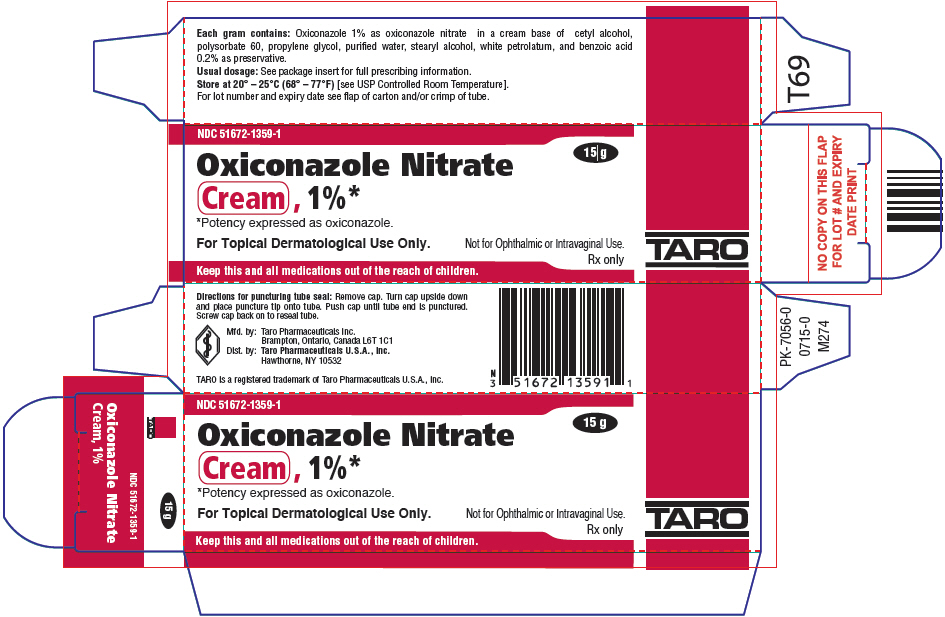
PRINCIPAL DISPLAY PANEL - 15 g Tube Carton NDC 51672-1359-1 15 g Oxiconazole Nitrate Cream , 1%* *Potency expressed as oxiconazole. For Topical Dermatological Use Only. Not for Ophthalmic or Intravaginal Use. Rx only Keep this and all medications out of the reach of children. TARO PRINCIPAL DISPLAY PANEL - 15 g Tube Carton