
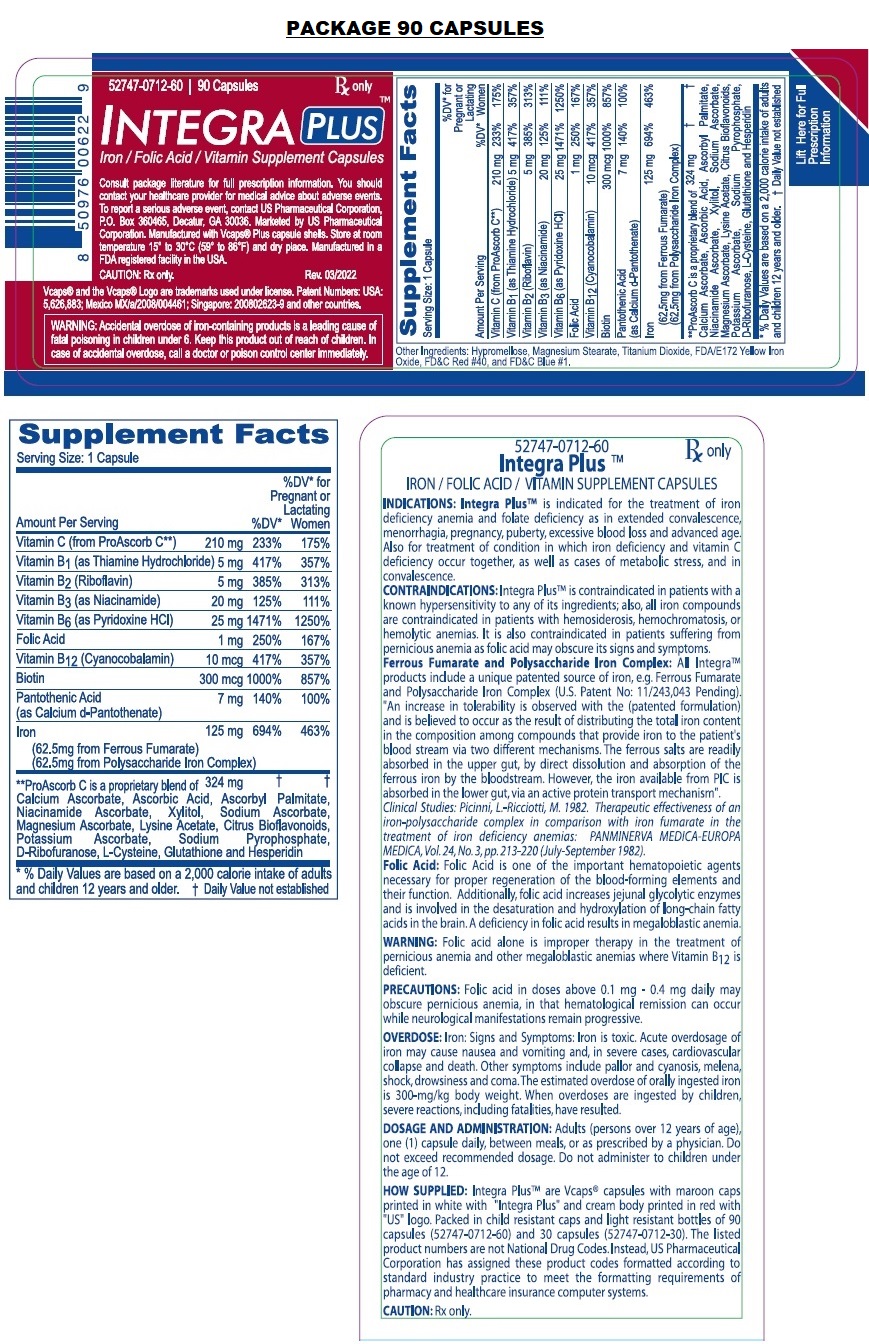
Integra Plus Ferrous Fumarate and Polysacchride Iron Vitamin Mineral Complex Supplement 62.5 mg; 62.5 mg; 1 mg; 210 mg; 20 mg; 5 mg; 5 mg; 5 mg; 25 mg; 300 ug Capsule, 30-count
🆔 Identity & classification
Where does this data come from?
🏭 Manufacturer & labeler
Where does this data come from?
🩺 Clinical
Integra Plus is an oral capsule dietary supplement containing iron in two forms (ferrous fumarate and ferrous aspartoglycinate) along with B vitamins and vitamin C. The iron compounds are typically used to support red blood cell formation and oxygen transport in the body. The B vitamins (thiamine, riboflavin, niacin, pantothenic acid, pyridoxine, biotin, and folic acid) and vitamin C are commonly included in mineral supplements to support energy metabolism and various body functions. This product is marketed without an approved FDA application.
Patient education
Supplement & herbal interactions
Where does this data come from?
Ask a licensed pharmacist directly — free, answered by our team.
💊 What it looks like
Where does this data come from?
🧪 Inactive Ingredients / Excipients
Inactive ingredients, also called excipients, are components of the drug product other than the active ingredient. They may include fillers, dyes, coatings, preservatives, flavors, or other formulation ingredients.
💡 Tap an ingredient (hover on desktop) to see what it is and why it’s used.
-
UNII H3R47K3TBD
FD&C Blue No. 1 is a synthetic blue dye approved for use in foods and medicines. It serves as a colorant to give the medication its distinctive appearance and help with product identification.
-
UNII WZB9127XOA
A synthetic red dye used to color medications and make them easier to identify. It serves as a colorant in tablets, capsules, and liquid formulations.
-
UNII EX438O2MRT
Ferric oxide yellow is a naturally occurring iron compound used as a colorant in medications. It gives tablets, capsules, and other forms a yellow or golden hue for identification and appearance.
-
UNII 3NXW29V3WO
Hypromellose is a plant-based thickener made from cellulose. It's used in medicines as a binder to hold ingredients together, a coating for tablets, and a thickener for liquids.
-
UNII 70097M6I30
Magnesium stearate is a salt made from magnesium and stearic acid, a fatty substance. It's used in tablets and capsules as a lubricant and glidant to help ingredients flow smoothly during manufacturing and prevent sticking.
-
UNII 15FIX9V2JP
Titanium dioxide is a bright white mineral powder commonly used as a colorant and opacifying agent. It makes pills and tablets white or lighter in color and helps make coatings non-transparent.
6 inactive ingredients listed in the exact product block matched to this NDC.
Where does this data come from?
ingredient classCode="IACT" elements from the exact product block matched by this NDC. Label-section narrative from DailyMed / the openFDA label index is shown separately when available.Inactive ingredient FAQ
Are inactive ingredients the same for every manufacturer?
Why might an inactive ingredient be missing?
Can inactive ingredients matter?
💲 Pricing
A drug doesn't have one price. Each row is a different public payment system, and none is what you'd pay at the counter — that depends on your insurance. The ⓘ on each row explains what it measures.
| Price system | Per ea | Per package |
|---|---|---|
| Retail pharmacies payNADAC · weekly | $0.695 | $20.85 / 30 capsules |
| Medicaid paysCMS SDUD · 12 mo | $0.7346 | $22.04 / 30 capsules |
| Medicare drug plans payPart D · quarterly | No Part D plan price is available for this NDC in our data. | |
Where does this data come from?
🔁 Therapeutic equivalents
| Product | Labeler | Pack | NADAC/unit | TE | Status | Price vs. this |
|---|---|---|---|---|---|---|
| Integra Plus 62.5 mg/1; 62.5 mg/1; 1 mg/1; 210 mg/1; 20 mg/1; 5 mg/1; 5 mg/1; 5 mg/1; 25 mg/1; 300 ugthis 52747-0712-30 | U.S. | 30 capsules | $0.695 | — | Availability likely | — |
Where does this data come from?
⏳ Availability & generic status
We did not find an FDA-approved generic match for this exact strength, form and route.
Where does this data come from?
🗺️ Medicaid utilization & spend
💊 Medicaid utilization by pack size
📦 Packaging — all sizes for this product
| Package NDC | Description | Per unit | Per pack | Marketing start | Status |
|---|---|---|---|---|---|
| 52747-0712-10 | 40 BLISTER PACK in 1 BOX (52747-712-10) / 4 BOTTLE, PLASTIC in 1 BLISTER PACK (52747-712-04) / 90 CAPSULE in 1 BOTTLE, PLASTIC (52747-712-60) | — | — | 2009-04-27 | Active |
| 52747-0712-30 You're viewing this | 30 CAPSULE in 1 BOTTLE, PLASTIC (52747-712-30) | $0.6949 / ea | $20.85 | 2009-04-27 | Active |
| 52747-0712-60 | 90 CAPSULE in 1 BOTTLE, PLASTIC (52747-712-60) | $0.6553 / ea | $58.97 | 2009-04-27 | Active |
Per ea, this pack runs about 6% above the cheapest pack (90-count, $0.6553 vs $0.6949 NADAC).
In Medicaid, this is the most-dispensed pack of this product — about 56% of fills over the last four reported quarters. See all packs ↓
Pack size FAQ
What quantity is in NDC 52747-0712-30?
What is the difference between NDC 52747-0712-30 and NDC 52747-0712-60?
What NDC number is used to bill for this package of Integra Plus Ferrous Fumarate and Polysacchride Iron Vitamin Mineral Complex Supplement 62.5 mg; 62.5 mg; 1 mg; 210 mg; 20 mg; 5 mg; 5 mg; 5 mg; 25 mg; 300 ug Capsule?
Prices are the latest CMS NADAC pharmacy acquisition cost per NDC; per-pack figures are per-unit × pack quantity, shown only when the pack is denominated in the same measure NADAC prices.
🧭 About this NDC listing & data coverage
Listed without an FDA application
This product's marketing category indicates it is marketed without an approved FDA application (no NDA, ANDA, or BLA on file). Having an NDC does not by itself establish FDA approval — the NDC Directory is a listing system, not an approval decision. Approval-linked data such as Orange Book therapeutic-equivalence ratings therefore does not apply.
What data is (and isn’t) available for this NDC — tap to expand
| NDC identity (package / product / labeler codes) | ✓ Available |
| Labeler | ✓ Available |
| Product & package description | ✓ Available |
| Marketing category & status | ✓ Available |
| Active ingredient / dosage form / route | ✓ Available |
| FDA label (SPL via DailyMed) | ✓ Available |
| Package photos | ✓ Available |
| Inactive ingredients (structured) | ✓ Available |
| NADAC pharmacy acquisition price (CMS) | ✓ Available |
| Orange Book / therapeutic-equivalence data | — Not published for this NDC Applies only to products approved under an NDA/ANDA; many listings are out of scope. |
| HCPCS J-code billing crosswalk | — Not published for this NDC Most self-administered / retail products have no J-code — that is normal. |
| Medicaid utilization (CMS SDUD) | ✓ Available |
Questions about this listing
Is this NDC FDA-approved?
Is the NDC printed on the package the same as the 11-digit billing NDC?
What do the three segments of this NDC mean?
Is this package still being marketed?
Does this product come in other package sizes?
Who lists this product with the FDA?
Do I need a prescription for this product?
Where does this data come from?
📄 Full prescribing information FDA SPL
⏱️ Dosage and Administration ▾
DOSAGE AND ADMINISTRATION: Adults (persons over 12 years of age), One (1) capsule daily, between meals, or as prescribed by a physician. Do not exceed recommended dosage. Do not administer to children under the age of 12.
⛔ Contraindications ▾
CONTRAINDICATIONS: Integra PlusTM is contraindicated in patients with a known hypersensitivity to any of its ingredients; also, all iron compounds are contraindicated in patients with hemosiderosis, hemochromatosis, or hemolytic anemias. Pernicious anemia is a contraindication, as folic acid may obscure its signs and symptoms.
⚠️ Warnings and Cautions ▾
WARNING: Accidental overdose of iron-containing products is a leading cause of fatal poisoning in children under 6. Keep this product out of reach of children. In case of accidental overdose, call a doctor or poison control center immediately.
WARNING: Folic acid alone is improper therapy in the treatment of pernicious anemia and other megaloblastic anemias where Vitamin B12 is deficient. PRECAUTIONS: General: Folic acid in doses above 0.1 mg - 0.4 mg daily may obscure pernicious anemia, in that hematological remission can occur while neurological manifestations remain progressive. Pediatric Use: Safety and effectiveness of this product have not been established in pediatric patients.
Geriatric Use: No clinical studies have been performed in patients age 65 and over to determine whether older persons respond differently from younger persons. Dosage should always begin at the low end of the dosage scale and should consider that elderly persons may have decreased hepatic, renal, or cardiac function and or concomitant diseases.
🤒 Adverse Reactions ▾
Adverse Reactions: Folic Acid: Allergic sensitizations have been reported following both oral and parenteral administration of folic acid. Ferrous Fumarate: Gastrointestinal disturbances (anorexia, nausea, diarrhea, constipation) occur occasionally, but are usually mild and may subside with continuation of therapy. Although the absorption of iron is best when taken between meals, giving Integra PlusTM after meals may control occasional G.I. disturbances.
Integra PlusTM is best absorbed when taken at bedtime.
🧒 Pediatric Use ▾
Pediatric Use: Safety and effectiveness of this product have not been established in pediatric patients.
🧓 Geriatric Use ▾
Enter section text here
🆘 Overdosage ▾
OVERDOSE: Iron: Signs and Symptoms: Iron is toxic. Acute overdosage of iron may cause nausea and vomiting and, in severe cases, cardiovascular collapse and death. Other symptoms include pallor and cyanosis, melena, shock, drowsiness and coma.
The estimated overdose of orally ingested iron is 300-mg/kg body weight. When overdoses are ingested by children, severe reactions, including fatalities, have resulted. Integra PlusTM should be stored beyond the reach of children to prevent against accidental iron poisoning.
Keep this and all other drugs out of the reach of children. Treatment: For specific therapy, exchange transfusion and chelating agents should be used. For general management, perform gastric lavage with sodium bicarbonate solution or milk.
Administer intravenous fluids and electrolytes and use oxygen.
🧬 Clinical Pharmacology ▾
CLINICAL PHARMACOLOGY: Integra PlusTM is unique in that it utilizes two (2) different forms of iron, i.e., Ferrous Fumarate and Polysaccharide Iron Complex (as cell-contracted akaganèite), making available a total of 125 mg of elemental iron per capsule as follows: Ferrous Fumarate (anhydrous) 191.1 mg Polysaccharide iron complex (PIC) 135.9 mg Subclinical B-Group vitamin deficiencies have greatly increased in recent years, due to changes in dietetic habits, increase in the use of sugar, and the excessive milling of flour and cereals.
With thiamine deficiencies in a healthy populous, it is self-evident that the unwell person is particularly prone to thiamine avitaminosis. This is true of the anemic individual with his/her poor appetite and disturbed digestive functions. Folic acid is best known for its role in megaloblastic anemias.
Zinc has been recognized in the nutrition of animals and humans, even though the evidence for an uncomplicated zinc deficiency in humans is limited. Ferrous Fumarate: Provides about 62.5 mg of elemental iron per dose. Ferrous Fumarate is an anhydrous salt of a combination of ferrous iron and fumaric acid, containing 33% of iron per weight.
The acute toxicity in experimental animals is low and Ferrous Fumarate is well tolerated clinically. As a ferrous salt, it is more efficiently absorbed in the duodenum. Ferrous Fumarate contrasts very favorably with the availability of the 20% of elemental iron of ferrous sulfate, and the 13% of elemental iron of ferrous gluconate.
Polysaccharide Iron Complex: Provides about 62.5 mg elemental iron, as a cell-contracted akaganèite. It is a product of ferric iron complexed to a low molecular weight polysaccharide. This polysaccharide is produced by the extensive hydrolysis of starch and is a dark brown powder that dissolves in water to form a very dark brown solution, which is virtually odorless and tasteless.
Folic Acid: Folic Acid is one of the important hematopoetic agents necessary for proper regeneration of the blood-forming elements and their function. Folic acid is a precursor of a large family of compounds which serve as coenzymes in carbon transfer reactions. These reactions are required for the synthesis of purine and pyrimidine bases, inter-conversion of glycine and serine, biosynthesis of methionine methyl groups and degradation of histidine.
Additionally, folic acid increases jejunal glycolytic enzymes and is involved in the desaturation and hydroxylation of long-chain fatty acids in the brain. A deficiency in folic acid results in megaloblastic anemia. All IntegraTM products include a unique patented source of iron, e.g.
Ferrous Fumarate and Polysaccharide Iron Complex (U.S. Patent No: 11/243,043 Pending). "An increase in tolerability is observed with the (patented formulation) and is believed to occur as the result of distributing the total iron content in the composition among compounds that provide iron to the patient's blood stream via two different mechanisms. The ferrous salts are readily absorbed in the upper gut, by direct dissolution and absorption of the ferrous iron by the bloodstream.
However, the iron available from PIC is absorbed in the lower gut, via an active protein transport mechanism".
📦 How Supplied / Storage and Handling ▾
HOW SUPPLIED: Integra Plus TM are Vcaps ® capsules with maroon caps printed in white with "Integra Plus" and cream body printed in red with "US" logo. Packed in child resistant caps and light resistant bottles of 90 capsules (52747-0712-60) and 30 capsules (52747-0712-30). The listed product numbers are not National Drug Codes.
Instead, US Pharmaceutical Corporation has assigned these product codes formatted according to standard industry practice to meet the formatting requirements of pharmacy and healthcare insurance computer systems. CAUTION: Rx only.
📋 Description ▾
DESCRIPTION: Each capsule contains: Ferrous Fumarate (anhydrous) ......191.1 mg Polysaccharide Iron Complex... 135.9 mg (Equivalent to about 125 mg of elemental iron) Vitamin C (from ProAscorb C‡)....210 mg Folic Acid .....1 mg Thiamine Mononitrate (B1)...5 mg Riboflavin (B2)....5 mg Niacin (B3) . 20 mg d-Calcium Pantothenate (B5)..7 mg Pyridoxine HCl (B6) ...25 mg Biotin (B7)......300 mcg Cyanocobalamin (B12) ..
10 mcg CLINICAL PHARMACOLOGY: Integra PlusTM is unique in that it utilizes two (2) different forms of iron, i.e., Ferrous Fumarate and Polysaccharide Iron Complex (as cell-contracted akaganèite), making available a total of 125 mg of elemental iron per capsule as follows: Ferrous Fumarate (anhydrous) 191.1 mg Polysaccharide iron complex (PIC) 135.9 mg Subclinical B-Group vitamin deficiencies have greatly increased in recent years, due to changes in dietetic habits, increase in the use of sugar, and the excessive milling of flour and cereals.
With thiamine deficiencies in a healthy populous, it is self-evident that the unwell person is particularly prone to thiamine avitaminosis. This is true of the anemic individual with his/her poor appetite and disturbed digestive functions. Folic acid is best known for its role in megaloblastic anemias.
Zinc has been recognized in the nutrition of animals and humans, even though the evidence for an uncomplicated zinc deficiency in humans is limited. Ferrous Fumarate: Provides about 62.5 mg of elemental iron per dose. Ferrous Fumarate is an anhydrous salt of a combination of ferrous iron and fumaric acid, containing 33% of iron per weight.
The acute toxicity in experimental animals is low and Ferrous Fumarate is well tolerated clinically. As a ferrous salt, it is more efficiently absorbed in the duodenum. Ferrous Fumarate contrasts very favorably with the availability of the 20% of elemental iron of ferrous sulfate, and the 13% of elemental iron of ferrous gluconate.
Polysaccharide Iron Complex: Provides about 62.5 mg elemental iron, as a cell-contracted akaganèite. It is a product of ferric iron complexed to a low molecular weight polysaccharide. This polysaccharide is produced by the extensive hydrolysis of starch and is a dark brown powder that dissolves in water to form a very dark brown solution, which is virtually odorless and tasteless.
Folic Acid: Folic Acid is one of the important hematopoetic agents necessary for proper regeneration of the blood-forming elements and their function. Folic acid is a precursor of a large family of compounds which serve as coenzymes in carbon transfer reactions. These reactions are required for the synthesis of purine and pyrimidine bases, inter-conversion of glycine and serine, biosynthesis of methionine methyl groups and degradation of histidine.
Additionally, folic acid increases jejunal glycolytic enzymes and is involved in the desaturation and hydroxylation of long-chain fatty acids in the brain. A deficiency in folic acid results in megaloblastic anemia. All IntegraTM products include a unique patented source of iron, e.g.
Ferrous Fumarate and Polysaccharide Iron Complex (U.S. Patent No: 11/243,043 Pending). "An increase in tolerability is observed with the (patented formulation) and is believed to occur as the result of distributing the total iron content in the composition among compounds that provide iron to the patient's blood stream via two different mechanisms. The ferrous salts are readily absorbed in the upper gut, by direct dissolution and absorption of the ferrous iron by the bloodstream.
However, the iron available from PIC is absorbed in the lower gut, via an active protein transport mechanism". Clinical Studies: Because Ferrous Fumarate is an organic complex, it contains no free ions, either ferric or ferrous. Polysaccharide Iron Complex is clinically non-toxic.
Prior studies in rats demonstrated that Polysaccharide Iron Complex (PIC), administered as a single oral dose to Sprague Dawley rats did not produce evidence of to…