
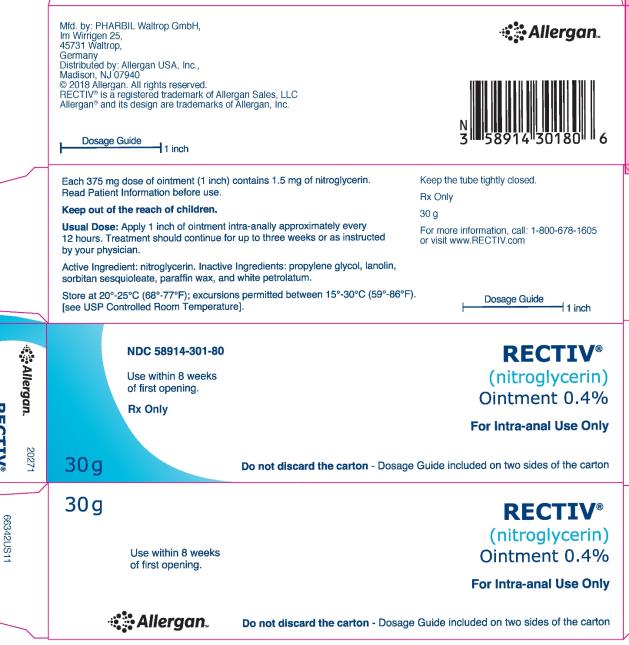
Rectiv nitroglycerin 4 mg/g Ointment — NDC 58914-301-80 (Billing 58914-0301-80)
This is a package of Rectiv nitroglycerin 4 mg/g Ointment from Allergan, Inc., marketed since Jun 2011 and currently FDA-listed, this package's marketing is listed to end Feb 2027; retail pharmacies pay about $20.59 per g (NADAC). It is this product's only package size.
Other active recalls for Nitroglycerin (different manufacturers) — 3 · tap to view
Identity & classification
Regulatory identifiers FDA, NLM and CMS codes for this package
Drug-database identifiers Medi-Span GPI and First Databank GCN / HICL / AHFS classification
- GSN (GCN sequence number): 059201
- GCN: 24745
- HICL (First Databank): 000159
- AHFS class code: 24:08.08.00
- RxCUI (RxNorm): 1114466
Where does this data come from?
- FDA openFDA NDC Directory · synced Oct 1, 2026
- FDA label on DailyMed · label index refreshed Oct 1, 2026
- RxNorm (NLM RxNav) · catalog refreshed Oct 1, 2026
- Medi-Span GPI (licensed)
- First Databank (licensed) · refreshed Oct 1, 2026
RxNorm drug class
This medicine belongs to the Nitrate Vasodilator class.
Where does this data come from?
- RxClass (NLM) · catalog refreshed Oct 1, 2026
Clinical
- The 0.4% ointment treats moderate to severe pain from a chronic anal fissure, which is a long-lasting tear in the anal lining. It is applied to the anal canal, so follow your presc...
- Headache is the big one. It can come back after each dose, but it is usually short and an analgesic like acetaminophen can help. Dizziness and light-headedness can also happen.
- Call if headaches are severe, if you feel faint or very dizzy, or if you get a rash or peeling skin. Low blood pressure is uncommon but can be serious enough to stop treatment.
- No. Sildenafil, vardenafil and tadalafil can make your blood pressure drop dangerously low with nitroglycerin. Tell me or your doctor about any of them, even if you took one a few...
Patient education
Supplement & herbal interactions
Some supplements/herbs that may interact with Nitroglycerin — tap one for details:
Where does this data come from?
- MedlinePlus (NLM) · refreshed Oct 1, 2026
- FDA label on DailyMed · label index refreshed Oct 1, 2026
Ask a licensed pharmacist directly — free, answered by our team.
Pricing
A drug doesn't have one price. Each row is a different public payment system, and none is what you'd pay at the counter — that depends on your insurance. The ⓘ on each row explains what it measures.
| Price system | Per g | Per package |
|---|---|---|
| Retail pharmacies payNADAC · weekly | $20.586 | $617.57 / 30 g |
| Medicaid paysCMS SDUD · 12 mo | $19.72 | $591.71 / 30 g |
| Medicare drug plans payPart D · Q2 2026 | $20.84 | $625.11 / 30 g |
Where does this data come from?
- CMS NADAC weekly file · file of Sep 30, 2026
- CMS ASP pricing files · refreshed Sep 20, 2026
- CMS Medicaid State Drug Utilization Data · through Q4 2025
- CMS Part D plan pricing files · refreshed Sep 24, 2026
- VA National Acquisition Center price file
Packaging — all sizes for this product
| Package NDC | Description | Marketing start | Marketing end | Status |
|---|---|---|---|---|
| 58914-0301-80 You're viewing this Main listing | 1 TUBE in 1 CARTON / 30 g in 1 TUBE | 2011-06-21 | Feb 28, 2027 | Active |
Therapeutic equivalents
| Product | Labeler | Pack | NADAC/unit | TE | Status | Price vs. this |
|---|---|---|---|---|---|---|
| Nitroglycerin 4 mg/g 00713-0564-31 | Cosette | 1 tube | $8.315 | AB | Availability likely | save 60% |
| Nitroglycerin 4 mg/g 21922-0048-05 | Encube | 1 tube | $8.315 | AB | Availability likely | save 60% |
| Nitroglycerin 4 mg/g 52817-0835-30 | Trupharma, | 1 tube | $8.315 | AB | Availability likely | save 60% |
| Nitroglycerin 4 mg/g 73473-0500-30 | Solaris | 30 g | $8.315 | AB | Availability likely | save 60% |
| Nitroglycerin 4 mg/g 45802-0932-94 | Padagis | 1 tube | $8.315 | AB | Availability likely | save 60% |
| Rectiv 4 mg/gthis 58914-0301-80 | Allergan, | 1 tube | $20.586 | — | Availability likely | — |
| Nitroglycerin 4 mg/g 72162-2643-03 | Bryant | 30 g | — | AB | FDA listed | — |
Where does this data come from?
- FDA openFDA NDC Directory · synced Oct 1, 2026
- FDA Orange Book · refreshed Sep 3, 2026
- CMS NADAC weekly file · file of Sep 30, 2026
Availability & generic status
FDA-approved generic versions are listed, and recent pricing/market data suggests they may be available — see Therapeutic equivalents.
Where does this data come from?
- FDA Orange Book · refreshed Sep 3, 2026
Inactive Ingredients / Excipients
Inactive ingredients, also called excipients, are components of the drug product other than the active ingredient. They may include fillers, dyes, coatings, preservatives, flavors, or other formulation ingredients.
💡 Tap an ingredient (hover on desktop) to see what it is and why it’s used.
-
UNII 7EV65EAW6H
Lanolin is a waxy substance derived from sheep's wool. It's used in medicines as an emollient and skin-conditioning agent to soften formulations and improve spreadability in topical products like creams and ointments.
-
UNII I9O0E3H2ZE
Paraffin is a waxy, petroleum-derived substance used as a coating, lubricant, and hardening agent in tablets and capsules. It helps protect the medicine from moisture and gives pills a smooth finish.
-
UNII 6DC9Q167V3
Propylene glycol is a clear liquid derived from petroleum or vegetable sources. It acts as a solvent, humectant, and preservative in medicines, helping dissolve active ingredients and maintain product stability.
-
UNII 0W8RRI5W5A
A fatty acid derivative used as an emulsifier and surfactant in medications. It helps blend oily and water-based ingredients together to create a stable, uniform product.
-
UNII B6E5W8RQJ4
White petrolatum is a purified mineral oil product used as a lubricant and skin protectant in medications. It helps pills slide through manufacturing equipment and can soften or protect the skin when applied topically.
5 inactive ingredients listed in the exact product block matched to this NDC.
Where does this data come from?
ingredient classCode="IACT" elements from the exact product block matched by this NDC. Label-section narrative from DailyMed / the openFDA label index is shown separately when available.- FDA label on DailyMed · label index refreshed Oct 1, 2026
- FDA openFDA NDC Directory · synced Oct 1, 2026
Inactive ingredient FAQ
Are inactive ingredients the same for every manufacturer?
Why might an inactive ingredient be missing?
Can inactive ingredients matter?
Manufacturer & labeler
Where does this data come from?
- FDA openFDA NDC Directory · synced Oct 1, 2026
- Drugs@FDA
Full prescribing information FDA SPL
🎯 Indications and Usage ▾
1 INDICATIONS AND USAGE RECTIV ® (nitroglycerin) Ointment 0.4% is indicated for the treatment of moderate to severe pain associated with chronic anal fissure. RECTIV is a nitrate vasodilator indicated for the treatment of moderate to severe pain associated with chronic anal fissure ( 1 ).
⏱️ Dosage and Administration ▾
2 DOSAGE AND ADMINISTRATION Apply 1 inch of ointment (375 mg of ointment equivalent to 1.5 mg of nitroglycerin) intra-anally every 12 hours for up to 3 weeks. A finger covering, such as plastic-wrap, disposable surgical glove or a finger cot, should be placed on the finger to apply the ointment. To obtain a 1.5 mg dose of nitroglycerin, the covered finger is laid alongside the 1 inch dosing line on the carton.
Refer to carton for accurate dosage guide. The tube is gently squeezed until a line of ointment the length of the measuring line is expressed onto the covered finger. The ointment is gently inserted into the anal canal using the covered finger no further than to the first finger joint and the ointment is applied around the side of the anal canal.
If this cannot be achieved due to pain, application of the ointment should be made directly to the outside of the anus. Treatment may be continued for up to three weeks. RECTIV ointment is not for oral, ophthalmic, or intravaginal use.
Hands should be washed after application of the ointment [see Patient Instruction ] . Apply 1 inch of ointment (375 mg of ointment equivalent to 1.5 mg of nitroglycerin) intra-anally every 12 hours for up to 3 weeks ( 2 ). RECTIV ointment is not for oral, ophthalmic, or intravaginal use ( 2 ) 01image
💊 Dosage Forms and Strengths ▾
3 DOSAGE FORMS AND STRENGTHS Ointment, 0.4% w/w (4 mg /1 g) in 30 g tubes. Ointment 0.4% w/w (4 mg nitroglycerin/1 g ointment) ( 3 )
⛔ Contraindications ▾
4 CONTRAINDICATIONS Use of PDE5 inhibitors (e.g. sildenafil, vardenafil and tadalafil) as these are shown to potentiate the hypotensive effects of organic nitrates. ( 4.1 ). Severe anemia ( 4.2 ) Increased intracranial pressure ( 4.3 ) Known hypersensitivity to nitroglycerin, other nitrates and nitrites, or any components of the ointment. ( 4.4 )
4.1PDE5 inhibitor use Administration of RECTIV is contraindicated in patients who are using a selective inhibitor of cyclic guanosine monophosphate (cGMP)-specific phosphodiesterase type 5 (PDE5), such as sildenafil, vardenafil, and tadalafil, as these are shown to potentiate the hypotensive effects of organic nitrates [see DRUG INTERACTIONS ( 7.1 ) ] .
4.2Severe anemia RECTIV is contraindicated in patients with severe anemia.
4.3Increased intracranial pressure RECTIV is contraindicated in patients with increased intracranial pressure.
4.4Hypersensitivity RECTIV is contraindicated in patients who have shown hypersensitivity to it or to other nitrates or nitrites. Skin reactions consistent with hypersensitivity have been observed with organic nitrates.
⚠️ Warnings and Cautions ▾
5 WARNINGS AND PRECAUTIONS Cardiovascular Disorders: Venous and arterial dilatation as a consequence of nitroglycerin treatment can result in hypotension. Exercise caution when treating patients with any of the following conditions: blood volume depletion, existing hypotension, cardiomyopathies, congestive heart failure, acute myocardial infarction, or poor cardiac function for other reasons ( 5.1 ). Headache: Nitroglycerin produces dose-related headaches which may be severe ( 5.2 ) 5.
1 Cardi ovascular disorders Venous and arterial dilatation as a consequence of nitroglycerin treatment including RECTIV, can decrease venous blood returning to the heart and reduce arterial vascular resistance and systolic pressure. Exercise caution when treating patients with any of the following conditions: blood volume depletion, existing hypotension, cardiomyopathies, congestive heart failure, acute myocardial infarction, or poor cardiac function for other reasons. If patients with any of these conditions are treated with RECTIV, monitor cardiovascular status and clinical condition.
The adverse reactions of RECTIV are likely to be more pronounced in the elderly. 5. 2 Headache RECTIV produces dose-related headaches, which may be severe.
Tolerance to headaches occurs.
🤒 Adverse Reactions ▾
6 ADVERSE REACTIONS Because clinical trials are conducted under widely varying conditions, adverse reaction rates observed in the clinical trials of a drug cannot be directly compared to rates in the clinical trials of another drug and may not reflect the rates observed in practice. The most common adverse reaction of RECTIV ointment applied to the anal canal is headache. Headache may be recurrent following each dose.
Headaches are typically of short duration and can be treated with an analgesic, e.g. acetaminophen, and are reversible upon discontinuation of treatment. In Study REC-C-001, a double-blind, placebo-controlled trial in patients with a painful chronic anal fissure, the most frequent (≥ 2%) adverse reactions reported were as follows (Table 1): Table 1: Incidence of Adverse Reactions (≥ 2%) in Study REC-C-001 RECTIV N = 123 Placebo N = 124 System Organ Class Preferred term Patients n (%) Events n Patients n (%) Events n Nervous system disorders Headache 79 (64) 938 51 (41) 225 Dizziness 6 (5) 26 0 0 Hypotension Transient episodes of light-headedness, occasionally related to blood pressure changes, also may occur.
Hypotension (including orthostatic hypotension) occurs infrequently, but in some patients may be severe enough to warrant discontinuation of therapy. Allergic Reactions Flushing, allergic reactions and application site reactions (including drug rash and exfoliative dermatitis) have been reported rarely. Methemoglobinemia In rare cases, therapeutic doses of organic nitrates have caused methemoglobinemia [ see OVERDOSAGE ( 10 ) ] .
Most common adverse reactions are headache and dizziness. ( 6 ) To report SUSPECTED ADVERSE REACTIONS, contact AbbVie Inc. at 1-800-678-1605 or FDA at 1-800-FDA-1088 or www.fda.gov/medwatch.
🔄 Drug Interactions ▾
7 DRUG INTERACTIONS PDE5 inhibitors: potentiation of hypotensive effects of organic nitrates; concomitant use is contraindicated. ( 4.1 , 7.1 ) Antihypertensives: possible additive hypotensive effects. ( 7.2 ) Aspirin: increased nitroglycerin levels.
( 7.3 ) Tissue-type Plasminogen Activator (t-PA): decreased thrombolytic effect. ( 7.4 ) Heparin: anticoagulant effect of heparin may be reduced. Monitor APTT.
( 7.5 ) Ergotamine: increased bioavailability of ergotamine. ( 7.6 ) Alcohol: Additive vasodilatory effects to nitroglycerin. Consumption of alcohol should be avoided.
( 7.7 )
7.1PDE5 inhibitors Phosphodiesterase type 5 (PDE5) inhibitors such as sildenafil, vardenafil, and tadalafil have been shown to potentiate the hypotensive effects of organic nitrates. The time course of the interaction appears to be related to the half-life of the PDE5 inhibitor, however, the dose dependence of this interaction has not been studied. Use of RECTIV within a few days of PDE5 inhibitors is contraindicated.
7.2Antihypertensives Patients receiving antihypertensive drugs, beta-adrenergic blockers, and other nitrates should be observed for possible additive hypotensive effects when using RECTIV. Marked orthostatic hypotension has been reported when calcium channel blockers and organic nitrates were used concomitantly. Beta-blockers blunt the reflex tachycardia produced by nitroglycerin without preventing its hypotensive effects.
If beta-blockers are used with RECTIV in patients with angina pectoris, additional hypotensive effects may occur.
7.3Aspirin Coadministration of aspirin (at doses between 500 mg and 1000 mg) and nitroglycerin has been reported to result in increased nitroglycerin maximum concentrations by as much as 67% and AUC by 73% when administered as a single dose. The pharmacological effects of RECTIV may be enhanced by concomitant administration of aspirin.
7.4Tissue-type Plasminogen Activator (t-PA) Intravenous administration of nitroglycerin decreases the thrombolytic effect of tissue-type plasminogen activator (t-PA). Plasma levels of t-PA are reduced when coadministered with nitroglycerin. Therefore, caution should be observed in patients receiving RECTIV during t-PA therapy.
7.5Heparin Although an interaction has been reported between intravenous heparin and intravenous nitroglycerin (resulting in a decrease in the anticoagulant effect of heparin), the data are not consistent. If patients are to receive intravenous heparin and RECTIV concurrently, the anticoagulation status of the patient must be checked.
7.6Ergotamine Oral administration of nitroglycerin markedly decreases the first-pass metabolism of dihydroergotamine and consequently increases its oral bioavailability. Ergotamine is known to precipitate angina pectoris. Therefore the possibility of ergotism in patients receiving RECTIV should be considered.
7.7Alcohol The vasodilating effects of nitroglycerin have been shown to be additive to the effects observed with alcohol.
👥 Use in Specific Populations ▾
8 USE IN SPECIFIC POPULATIONS
8.1Pregnancy Risk Summary There are no data on the use of nitroglycerin ointment intra-anally during pregnancy to determine a drug-associated risk of major birth defects, miscarriage or other adverse maternal or fetal outcomes. In animal reproduction studies, no malformations were observed in offspring of pregnant rats and rabbits administered nitroglycerin by topical or dietary route during the period of organogenesis (see Data). The background risk of major birth defects and miscarriage for the indicated population is unknown.
All pregnancies have a background risk of birth defect, loss, or other adverse outcomes. In the U.S. general population, the estimated background risk of major birth defects and miscarriage in clinically recognized pregnancies is 2% to 4% and 15% to 20%, respectively. Data Animal Data Animal reproduction studies in rats and rabbits were conducted with topically applied nitroglycerin ointment at doses up to 80 mg/kg/day and 240 mg/kg/day, respectively.
No toxic effects on dams or fetuses were seen at any dose tested. An animal reproduction study was conducted in rats with nitroglycerin administered in the diet at levels up to 1% content (approximately 430 mg/kg/day) on days 6 to 15 of gestation. In offspring of the high-dose group, an increased but not statistically significant incidence of diaphragmatic hernias was noted together with decreased hyoid bone ossification.
The latter finding probably reflects delayed development, thus indicating no clear evidence of a potential teratogenic effect of nitroglycerin. 8. 2 Lactation Risk Summary There are no data on the presence of nitroglycerin in either human or animal milk following topical administration, or the effects of nitroglycerin on milk production.
A publication describing 40 lactating patients who used nitroglycerin ointment to treat chronic anal fissures for varied durations did not report signs of adverse effects in their breastfed infants, however, the dosing regimens were not described. The developmental and health benefits of breastfeeding should be considered along with the clinical need for RECTIV and any potential adverse effects on the breastfed infant from RECTIV or from the underlying maternal condition.
8.4Pediatric Use The safety and effectiveness of RECTIV in pediatric patients under 18 years of age have not been established.
8.5Geriatric Use Clinical studies of RECTIV did not include sufficient numbers of subjects aged 65 and over to determine whether they respond differently from younger subjects. Clinical data from the published literature indicate that the elderly demonstrate increased sensitivity to nitrates, which may be therapeutic but also manifest by more frequent or severe hypotension and related dizziness or fainting. Increased sensitivity may reflect the greater frequency of decreased hepatic, renal, or cardiac function, and of concomitant disease or other drug therapy.
🤰 Pregnancy ▾
8.1Pregnancy Risk Summary There are no data on the use of nitroglycerin ointment intra-anally during pregnancy to determine a drug-associated risk of major birth defects, miscarriage or other adverse maternal or fetal outcomes. In animal reproduction studies, no malformations were observed in offspring of pregnant rats and rabbits administered nitroglycerin by topical or dietary route during the period of organogenesis (see Data). The background risk of major birth defects and miscarriage for the indicated population is unknown.
All pregnancies have a background risk of birth defect, loss, or other adverse outcomes. In the U.S. general population, the estimated background risk of major birth defects and miscarriage in clinically recognized pregnancies is 2% to 4% and 15% to 20%, respectively. Data Animal Data Animal reproduction studies in rats and rabbits were conducted with topically applied nitroglycerin ointment at doses up to 80 mg/kg/day and 240 mg/kg/day, respectively.
No toxic effects on dams or fetuses were seen at any dose tested. An animal reproduction study was conducted in rats with nitroglycerin administered in the diet at levels up to 1% content (approximately 430 mg/kg/day) on days 6 to 15 of gestation. In offspring of the high-dose group, an increased but not statistically significant incidence of diaphragmatic hernias was noted together with decreased hyoid bone ossification.
The latter finding probably reflects delayed development, thus indicating no clear evidence of a potential teratogenic effect of nitroglycerin.
🧒 Pediatric Use ▾
8.4Pediatric Use The safety and effectiveness of RECTIV in pediatric patients under 18 years of age have not been established.
🧓 Geriatric Use ▾
8.5Geriatric Use Clinical studies of RECTIV did not include sufficient numbers of subjects aged 65 and over to determine whether they respond differently from younger subjects. Clinical data from the published literature indicate that the elderly demonstrate increased sensitivity to nitrates, which may be therapeutic but also manifest by more frequent or severe hypotension and related dizziness or fainting. Increased sensitivity may reflect the greater frequency of decreased hepatic, renal, or cardiac function, and of concomitant disease or other drug therapy.
🆘 Overdosage ▾
10 OVERDOSAGE Nitroglycerin toxicity is generally mild. The estimated adult oral lethal dose of nitroglycerin is 200 mg to 1,200 mg. Infants may be more susceptible to toxicity from nitroglycerin.
Consultation with a poison center should be considered. Laboratory determinations of serum levels of nitroglycerin and its metabolites are not widely available, and such determinations have, in any event, no established role in the management of nitroglycerin overdose. No data are available to suggest physiological maneuvers (e.g., maneuvers to change the pH of the urine) that might accelerate elimination of nitroglycerin and its active metabolites.
Similarly, it is not known which, if any, of these substances can usefully be removed from the body by hemodialysis. No specific antagonist to the vasodilator effects of nitroglycerin is known, and no intervention has been subject to controlled study as a therapy of nitroglycerin overdose. Because the hypotension associated with nitroglycerin overdose is the result of venodilatation and arterial hypovolemia, prudent therapy in this situation should be directed toward increase in central fluid volume.
Passive elevation of the patient’s legs may be sufficient, but intravenous infusion of normal saline or similar fluid may also be necessary. The use of epinephrine or other arterial vasoconstrictors in this setting is not recommended. In patients with renal disease or congestive heart failure, therapy resulting in central volume expansion is not without hazard.
Treatment of RECTIV overdose in these patients may be subtle and difficult, and invasive monitoring may be required. Methemoglobinemia Methemoglobinemia has been rarely reported with organic nitrates. The diagnosis should be suspected in patients who exhibit signs of impaired oxygen delivery despite adequate arterial PO2.
Classically, methemoglobinemic blood is described as chocolate brown, without color change on exposure to air. If methemoglobinemia is present, intravenous administration of methylene blue, 1 to 2 mg/kg of body weight, may be required.
🧬 Clinical Pharmacology ▾
12 CLINICAL PHARMACOLOGY
12.1Mechanism of Action Nitroglycerin forms free radical nitric oxide (NO), which activates guanylate cyclase, resulting in an increase of guanosine 3’,5’-monophosphate (cyclic GMP) in smooth muscle and other tissues. This leads to dephosphorylation of myosin light chains, which regulates the contractile state in smooth muscle and results in vasodilatation.
12.2Pharmacodynamics The principal pharmacological action of nitroglycerin is relaxation of vascular smooth muscle. Intra-anal application of nitroglycerin reduces sphincter tone and resting intra-anal pressure.
12.3Pharmacokinetics Absorption: In six healthy subjects, the average absolute bioavailability of nitroglycerin applied to the anal canal as a 0.2% w/w ointment was approximately 50% of the 0.75 mg nitroglycerin dose. Distribution: The volume of distribution of nitroglycerin following intravenous administration is about 3 L/kg. At plasma concentrations between 50 and 500 ng/mL, the binding of nitroglycerin to plasma proteins is approximately 60%, while that of 1,2- and 1,3-dinitroglycerin is 60% and 30%, respectively.
Metabolism: Nitroglycerin is metabolized by a liver reductase enzyme to glycerol di- and mononitrate metabolites and ultimately to glycerol and organic nitrate. Known sites of extrahepatic metabolism include red blood cells and vascular walls. In addition to nitroglycerin, the two major metabolites, 1,2- and 1,3- dinitroglycerols are found in plasma.
The contribution of metabolites to the relaxation of the internal anal sphincter is unknown. The dinitrates are further metabolized to nonvasoactive mononitrates and ultimately to glycerol and carbon dioxide. Elimination: Metabolism is the primary route of drug elimination.
Nitroglycerin plasma concentrations decrease rapidly with a mean elimination half-life of two to three minutes. Half-life values range from 1.5 to 7.5 minutes. Clearance (13.6 L/min) greatly exceeds hepatic blood flow.
🧬 Mechanism of Action ▾
12.1Mechanism of Action Nitroglycerin forms free radical nitric oxide (NO), which activates guanylate cyclase, resulting in an increase of guanosine 3’,5’-monophosphate (cyclic GMP) in smooth muscle and other tissues. This leads to dephosphorylation of myosin light chains, which regulates the contractile state in smooth muscle and results in vasodilatation.
📦 How Supplied / Storage and Handling ▾
16 HOW SUPPLIED/STORAGE AND HANDLING RECTIV (nitroglycerin) Ointment 0.4% is available in 30 g (NDC 58914-301-80) aluminum tubes with polyethylene screw caps. Store at 20°-25°C (68°-77°F); excursions permitted between 15°-30°C (59°-86°F). [See USP Controlled Room Temperature]. Keep the tube tightly closed. Use within 8 weeks of first opening.
📋 Description ▾
11 DESCRIPTION Nitroglycerin is 1,2,3,-propanetriol trinitrate, an organic nitrate whose structural formula is as follows: and whose molecular weight is 227.09. RECTIV (nitroglycerin) Ointment 0.4% contains 0.4% nitroglycerin w/w (4 mg nitroglycerin/1 g ointment), propylene glycol, lanolin, sorbitan sesquioleate, paraffin wax, and white petrolatum. RECTIV (nitroglycerin) Ointment 0.4% is available in tubes with a one-inch dosing line on the carton allowing the measurement of approximately 375 mg of nitroglycerin ointment 0.4% (1.5 mg nitroglycerin) for application.
Nitroglycerin is 1,2,3,-propanetriol trinitrate, an organic nitrate whose structural formula is as follows:
💬 Information for Patients ▾
17 PATIENT COUNSELING INFORMATION Advise the patient to read the FDA-approved patient labeling ( Patient Information and Instructions for Use ). Interaction with PDE5 inhibitors Advise patient not to use RECTIV with medications for erectile dysfunction such as Viagra (sildenafil), Levitra (vardenafil), and Cialis (tadalafil). These products have been shown to increase the hypotensive effects of RECTIV and other nitrate drugs [see Contraindications ( 4 )] .
Hypotension Advise patients that treatment with RECTIV may be associated with light-headedness on standing, especially just after rising from a lying or seated position. The effect may be more frequent in patients who have also consumed alcohol, since alcohol use contributes to hypotension. Advise patients to stand up from the supine or sitting position slowly.
Headaches Advise patients that headaches sometimes accompany treatment with RECTIV. For patients who get these headaches, the headaches may indicate the activity of the drug. Tolerance to headaches develops.
Advise patients that if they experience headache they should not alter the schedule of their RECTIV treatment to avoid the occurrence of headache. An analgesic, such as acetaminophen, may be used to prevent or relieve the headaches. Dizziness Advise patients that dizziness has been reported as a side-effect of treatment with RECTIV.
Advise patients not to drive or operate machinery immediately after applying RECTIV. Manufactured by: PHARBIL Waltrop-GmbH Im Wirrigen 25 45731 Waltrop Germany Distributed by: AbbVie Inc. North Chicago, IL 60064 © 2024 AbbVie.
All rights reserved. RECTIV and its design are trademarks of Allergan Sales, LLC, an AbbVie company.
🧬 Pharmacokinetics ▾
12.3Pharmacokinetics Absorption: In six healthy subjects, the average absolute bioavailability of nitroglycerin applied to the anal canal as a 0.2% w/w ointment was approximately 50% of the 0.75 mg nitroglycerin dose. Distribution: The volume of distribution of nitroglycerin following intravenous administration is about 3 L/kg. At plasma concentrations between 50 and 500 ng/mL, the binding of nitroglycerin to plasma proteins is approximately 60%, while that of 1,2- and 1,3-dinitroglycerin is 60% and 30%, respectively.
Metabolism: Nitroglycerin is metabolized by a liver reductase enzyme to glycerol di- and mononitrate metabolites and ultimately to glycerol and organic nitrate. Known sites of extrahepatic metabolism include red blood cells and vascular walls. In addition to nitroglycerin, the two major metabolites, 1,2- and 1,3- dinitroglycerols are found in plasma.
The contribution of metabolites to the relaxation of the internal anal sphincter is unknown. The dinitrates are further metabolized to nonvasoactive mononitrates and ultimately to glycerol and carbon dioxide. Elimination: Metabolism is the primary route of drug elimination.
Nitroglycerin plasma concentrations decrease rapidly with a mean elimination half-life of two to three minutes. Half-life values range from 1.5 to 7.5 minutes. Clearance (13.6 L/min) greatly exceeds hepatic blood flow.
🧬 Pharmacodynamics ▾
12.2Pharmacodynamics The principal pharmacological action of nitroglycerin is relaxation of vascular smooth muscle. Intra-anal application of nitroglycerin reduces sphincter tone and resting intra-anal pressure.
🔬 Clinical Studies ▾
14 CLINICAL STUDIES RECTIV ointment was evaluated in a 3-week double-blind, randomized, multi-center, placebo-controlled study. Patients with a painful chronic anal fissure for at least 6 weeks and moderate or severe pain prior to treatment (≥ 50 mm on the 100mm visual analog scale, VAS) were randomized to receive 0.4% (1.5mg) nitroglycerin or placebo ointment applied to the anal canal every 12 hours. Pain as assessed by the change in VAS from baseline to Days 14-18 was lower in patients receiving 0.4% ointment compared to placebo.
The mean change from baseline was 44mm for RECTIV and 37mm for placebo. The difference in the mean change in pain between RECTIV and placebo was -7.0mm (95% Confidence Interval: -13.6 to -0.4mm).
🧪 Nonclinical Toxicology ▾
13 NONCLINICAL TOXICOLOGY
13.1Carcinogenesis, Mutagenesis, Impairment of Fertility Carcinogenesis Animal carcinogenicity studies with topically applied nitroglycerin have not been performed. Rats receiving up to 434 mg/kg/day of dietary nitroglycerin for 2 years developed dose-related fibrotic and neoplastic changes in liver, including carcinomas, and interstitial cell tumors in testes. At the highest dose, the incidence of hepatocellular carcinomas was 52% compared to 0% in untreated controls.
Incidence of testicular tumors were 52% vs. 8% in controls. Lifetime dietary administration of up to 1058 mg/kg/day of nitroglycerin was not tumorigenic in mice.
Mutagenesis Nitroglycerin was mutagenic in the in vitro bacterial reverse mutation (Ames) assay with Salmonella typhimurium . A similar mutation in this S. typhimurium was also reported with other NO donors. There was no evidence of clastogenic potential in multiple assays including a rodent dominant lethal assay, an in vitro Chinese Hamster Ovary assay that was conducted in the absence of metabolic activation, and several in vivo chromosomal aberration assays conducted in rats and dogs.
Impairment of Fertility In a three-generation reproduction study, rats received dietary nitroglycerin at doses up to approximately 434 mg/kg/day for 6 months prior to mating of the F 0 generation with treatment continuing through successive F 1 and F 2 generations. The high dose was associated with decreased feed intake and body weight gain in both sexes at all matings. No specific effect on the fertility of the F 0 generation was seen.
Infertility noted in subsequent generations, however, was attributed to increased interstitial cell tissue and aspermatogenesis in the high-dose males.
📄 Carcinogenesis, Mutagenesis, Impairment of Fertility ▾
13.1Carcinogenesis, Mutagenesis, Impairment of Fertility Carcinogenesis Animal carcinogenicity studies with topically applied nitroglycerin have not been performed. Rats receiving up to 434 mg/kg/day of dietary nitroglycerin for 2 years developed dose-related fibrotic and neoplastic changes in liver, including carcinomas, and interstitial cell tumors in testes. At the highest dose, the incidence of hepatocellular carcinomas was 52% compared to 0% in untreated controls.
Incidence of testicular tumors were 52% vs. 8% in controls. Lifetime dietary administration of up to 1058 mg/kg/day of nitroglycerin was not tumorigenic in mice.
Mutagenesis Nitroglycerin was mutagenic in the in vitro bacterial reverse mutation (Ames) assay with Salmonella typhimurium . A similar mutation in this S. typhimurium was also reported with other NO donors. There was no evidence of clastogenic potential in multiple assays including a rodent dominant lethal assay, an in vitro Chinese Hamster Ovary assay that was conducted in the absence of metabolic activation, and several in vivo chromosomal aberration assays conducted in rats and dogs.
Impairment of Fertility In a three-generation reproduction study, rats received dietary nitroglycerin at doses up to approximately 434 mg/kg/day for 6 months prior to mating of the F 0 generation with treatment continuing through successive F 1 and F 2 generations. The high dose was associated with decreased feed intake and body weight gain in both sexes at all matings. No specific effect on the fertility of the F 0 generation was seen.
Infertility noted in subsequent generations, however, was attributed to increased interstitial cell tissue and aspermatogenesis in the high-dose males.
📄 Patient Package Insert ▾
Patient Information RECTIV ® [ REC-tiv ] (Nitroglycerin) Ointment 0.4% I MPORTANT: For intra-anal use only Read the Patient Information that comes with RECTIV before you start using the product and each time you get a refill because there may be new information. This information does not take the place of talking to your healthcare provider about your medical condition or your treatment. If you have any questions about RECTIV, ask your healthcare provider.
What is RECTIV ? RECTIV is a prescription medicine used to treat moderate to severe pain caused by chronic anal fissures. An anal fissure is a tear in the skin lining the anal canal.
RECTIV is not suitable for children and adolescents under the age of 18 years because it has not been assessed in people in this age group. Who should not use RECTIV ? Do not use RECTIV if you: are taking a medicine for erectile dysfunction (male impotence), for example Viagra (sildenafil), Cialis (tadalafil) or Levitra (vardenafil). have been told by your doctor that you have severe anemia (low numbers of red blood cells in your blood) have increased intracranial pressure or high pressure within your skull e.g. following head trauma or bleeding in your brain are allergic to any of the ingredients in RECTIV or if you have had allergic reactions to similar medicines in the past.
See the end of this leaflet for a list of ingredients in RECTIV. What should I tell my healthcare provider before using RECTIV ? Tell your healthcare provider about all your medical conditions, including if you: have low blood pressure have recently had a heart attack have heart or blood vessel disorders suffer from migraine or recurrent headaches are pregnant or plan to become pregnant.
It is not known if RECTIV will harm your unborn baby. are breast-feeding or plan to breast-feed. It is not known if the components of RECTIV will harm your child if you breast-feed. RECTIV may lower your blood pressure.
When getting up from a lying or sitting position, you should get up slowly, otherwise you might feel faint. Tell your healthcare provider about all the medicines you take , including prescription and non-prescription medicines, vitamins and herbal supplements. Other medicines may affect how RECTIV works.
RECTIV may also affect how other medicines work. Specifically, tell your doctor if you are taking any of the following: other nitroglycerin containing products a medicine for erectile dysfunction (male impotence), for example sildenafil, tadalafil or vardenafil (see the section above ‘Who should not use RECTIV’) medicines used to treat high blood pressure are taking aspirin, ergotamine (used to treat migraine) or are receiving tissue-type plasminogen activator (used to help dissolve blood clots formed in blood vessels in the heart, lungs and brain) are to be given heparin.
If so, close monitoring of your blood will be required as your dose of heparin may need to be altered. Please discuss with your doctor before stopping RECTIV. How should RECTIV be used?
Use RECTIV exactly as prescribed . See detailed Patient Instructions for Applying RECTIV at the end of this Patient Information leaflet. Treatment may be continued for up to 3 weeks.
If your anal pain does not get better after using RECTIV you should talk to your doctor. What should I avoid while using RECTIV ? Do not drive or operate machinery immediately after applying RECTIV.
If you feel dizzy or light-headed after applying the ointment do not drive or operate machinery until the dizziness has stopped. Avoid consuming alcohol while you are being treated with RECTIV as your blood pressure is more likely to be affected if you consume alcoholic beverages. What are the possible side effects of RECTIV ?
RECTIV can cause serious side-effects: Stop using the ointment and seek medical attention immediately if you have an allergic reaction. You may have swelling of the face, lips, tongue or throat, or difficulty breathing. Common side-effects of RECTIV are: Headaches, which can… [Excerpted — this section continues on DailyMed.]
📖 Instructions for Use ▾
Patient Instructions for Use When do I apply the ointment? Apply the ointment every 12 hours exactly as your doctor has told you to. How do I apply the ointment?
Cover your finger with plastic-wrap, a disposable surgical glove or a finger cot. Lay the covered finger alongside the 1 inch dosing line marked on the side of the medicine box (see figure below) so that the tip of your finger is at one end of the dosing line. Starting at the tip of the finger, squeeze the ointment onto your finger for the same length marked on the box.
Refer to carton for accurate dosage guide. Gently insert the finger with the ointment into the anal canal, up to the first finger joint. Carefully smear the ointment around the inner sides of the anal canal.
If this cannot be achieved due to pain, application of the ointment should be made directly to the outside of the anus. What do I do after I have applied the ointment? Throw away the finger covering in the garbage, out of the reach of children and pets.
Wash your hands. What are the ingredients in RECTIV ? Active ingredient: nitroglycerin Inactive ingredients: propylene glycol, lanolin, sorbitan sesquioleate, paraffin wax and white petrolatum.
Manufactured by: PHARBIL Waltrop GmbH Im Wirrigen 25 45731 Waltrop Germany Distributed by: AbbVie Inc. North Chicago, IL 60064 © 2024 AbbVie. All rights reserved.
RECTIV and its design are trademarks of Allergan Sales, LLC, an AbbVie company. Refer to carton for accurate dosage guide.
📄 Package Label / Principal Display Panel ▾
PRINCIPAL DISPLAY PANEL NDC 58914-301-80 RECTIV ® (nitroglycerin) Ointment 0.4% For Intra-anal Use only Do not discard the carton – Dosage Guide included on two sides of the carton 30 g Use within 8 weeks of first opening. Rx Only NDC 58914-301-80 RECTIV® (nitroglycerin) Ointment 0.4% For Intra-anal Use only Do not discard the carton – Dosage Guide included on two sides of the carton 30 g Use within 8 weeks of first opening