
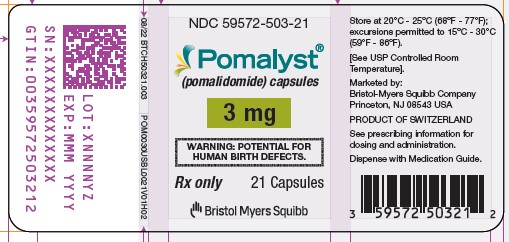
Pomalyst pomalidomide 3 mg Capsule, 21-count — NDC 59572-503-21 (Billing 59572-0503-21)
This is a package of 21 capsules of Pomalyst pomalidomide 3 mg Capsule from Celgene Corporation, marketed since Feb 2013 and currently FDA-listed. It is the main listing for this product, which comes in 2 package sizes.
NDC database record
One package, one record: these facts belong to NDC 59572-503-21 alone.
- Record
- FDA NDC Directory package listing · Human prescription drug
- Code segments
- 59572 labeler · 503 product · 21 package
- Package marketed since
- Feb 18, 2013
- Sample package
- No — commercial package
- Listing certified through
- Dec 31, 2026
- Billing quantity
- 21 EA per package
- Barcode (UPC-A, from the NDC)
- 3 5957250321 2
- Medicaid fills, this package
- 406 prescriptions in the last four reported quarters
- FDA record last changed
- Jul 24, 2026
Identity & classification
Regulatory identifiers FDA, NLM and CMS codes for this package
Drug-database identifiers Medi-Span GPI and First Databank GCN / HICL / AHFS classification
- GSN (GCN sequence number): 070571
- GCN: 34149
- GPI-14 (Medi-Span): 21450080000120
- HICL (First Databank): 039996
- AHFS class code: 10:00.00.00
- RxCUI (RxNorm): 1369718
Where does this data come from?
- FDA openFDA NDC Directory · synced Oct 1, 2026
- FDA label on DailyMed · label index refreshed Oct 5, 2026
- RxNorm (NLM RxNav) · catalog refreshed Oct 1, 2026
- Medi-Span GPI (licensed)
- First Databank (licensed) · refreshed Oct 1, 2026
RxNorm drug class
This medicine belongs to the Thalidomide Analog class.
Where does this data come from?
- RxClass (NLM) · catalog refreshed Oct 1, 2026
Clinical
- It treats multiple myeloma, taken with dexamethasone after at least two earlier treatments. It also treats Kaposi sarcoma, either AIDS-related after HIV therapy has failed or in pe...
- You take one capsule by mouth once a day, with or without food, for Days 1 through 21 of each 28-day cycle. Follow your prescriber's schedule exactly. Your dose may change dependin...
- It is never safe during pregnancy because it can cause severe birth defects. Women who can become pregnant need pregnancy tests and two forms of birth control. Men must use a condo...
- Is it safe if I could become pregnant, or if my partner could?
Patient education
Supplement & herbal interactions
Some supplements/herbs that may interact with Pomalidomide — tap one for details:
Where does this data come from?
- MedlinePlus (NLM) · refreshed Oct 1, 2026
- FDA label on DailyMed · label index refreshed Oct 5, 2026
Ask a licensed pharmacist directly — free, answered by our team.
Pricing
A drug doesn't have one price. Each row is a different public payment system, and none is what you'd pay at the counter — that depends on your insurance. The ⓘ on each row explains what it measures.
| Price system | Per each | Per package |
|---|---|---|
| Retail pharmacies payNADAC · weekly | Not in the retail survey — common for institutional, discontinued, or low-volume packs. | |
| Medicaid paysCMS SDUD · 12 mo | $1,146.98 | $24,086.60 / 21 capsules |
| Medicare drug plans payPart D · Q2 2026 | $1,174.39 | $24,662.19 / 21 capsules |
Where does this data come from?
- CMS NADAC weekly file
- CMS ASP pricing files · refreshed Sep 20, 2026
- CMS Medicaid State Drug Utilization Data · through Q1 2026
- CMS Part D plan pricing files · refreshed Sep 24, 2026
- VA National Acquisition Center price file
Packaging — all sizes for this product
| Package NDC | Description | Marketing start | Marketing end | Status |
|---|---|---|---|---|
| 59572-0503-00 59572-503-00 | 100 CAPSULE in 1 BOTTLE | 2013-02-18 | — | Active |
| 59572-0503-21 You're viewing this Main listing | 21 CAPSULE in 1 BOTTLE | 2013-02-18 | — | Active |
You're viewing the smallest of 2 pack sizes for this product.
In Medicaid, this is the most-dispensed pack of this product — about 100% of fills over the last four reported quarters. See all packs ↓
Pack size FAQ
What quantity is in this package?
How does this package differ from NDC 59572-0503-00?
What NDC number is used to bill for this package of Pomalyst pomalidomide 3 mg Capsule?
Therapeutic equivalents
| Product | Labeler | Pack | NADAC/unit | TE | Status | Price vs. this |
|---|---|---|---|---|---|---|
| Pomalidomide 3 mg 00480-2601-21 | Teva | 21 capsules | — | AB | FDA listed | — |
| Pomalidomide 3 mg 31722-0772-01 | Camber | 100 capsules | — | AB | FDA listed | — |
| Pomalidomide 3 mg 51991-0344-21 | Breckenridge | 21 capsules | — | AB | FDA listed | — |
| Pomalyst 3 mgthis 59572-0503-21 | Celgene | 21 capsules | — | AB | FDA listed | — |
| Pomalidomide 3 mg 59651-0196-01 | Aurobindo | 100 capsules | — | AB | FDA listed | — |
| Pomalidomide 3 mg 60505-4499-02 | Apotex | 21 capsules | — | AB | FDA listed | — |
| Pomalidomide 3 mg 63850-0133-01 | Natco | 21 capsules | — | AB | FDA listed | — |
| pomalidomide 3 mg 43598-0518-01 | Dr. | 100 capsules | — | AB | FDA listed | — |
| Pomalidomide 3 mg 00781-2366-27 | Sandoz | 21 capsules | — | AB | FDA listed | — |
| Pomalidomide 3 mg 69097-0038-07 | Cipla | 100 capsules | — | AB | FDA listed | — |
| Pomalidomide 3 mg 70095-0059-01 | Sun | 21 capsules | — | AB | FDA listed | — |
| pomalidomide 3 mg 72205-0178-21 | Novadoz | 21 capsules | — | AB | FDA listed | — |
Where does this data come from?
- FDA openFDA NDC Directory · synced Oct 1, 2026
- FDA Orange Book · refreshed Oct 3, 2026
- CMS NADAC weekly file
Availability & generic status
The FDA lists approved generic versions of this medicine, but that does not always mean a pharmacy can get one today. Patent rules, launch agreements, supply and pricing can affect when generics actually arrive.
Why the date isn’t exact: Generic timing can change because patents may be challenged, settled, licensed, added, removed, or worked around with a narrower label — and FDA approval does not always mean a pharmacy can get the generic today.
🛈 What do these terms mean?
- Patent
- Legal protection listed in the Orange Book that may delay generic approval or launch. Issued by the U.S. Patent & Trademark Office.
- Substance patent
- Covers the active drug molecule itself — the hardest to design around. A generic generally can’t launch until it expires.
- Formulation (product) patent
- Covers a specific formulation or dosage form. A generic can sometimes work around it with a different formulation.
- Method-of-use patent
- A patent covering one specific approved use of the drug — not necessarily the whole molecule. A generic can sometimes launch with a “skinny label” that carves out the protected use and keeps the others.
- Skinny label
- A generic label that omits a still-patented use when the FDA allows it — letting a generic reach the market for the unprotected uses.
- Exclusivity
- FDA-granted marketing protection, separate from patents — e.g. 5-yr new chemical entity, 7-yr orphan drug, or a +6-month pediatric extension.
- Paragraph IV
- A generic applicant’s formal challenge to a listed patent. It can potentially lead to earlier generic entry, but often involves litigation or a settlement.
- RLD / RS
- Reference Listed Drug — the brand product the FDA uses as the reference for generic applications. Reference Standard — the product the FDA expects generics to compare against in bioequivalence testing.
- TE / AB rating
- FDA therapeutic-equivalence rating. An AB rating generally means the FDA considers a generic therapeutically equivalent to — and substitutable for — the brand.
- LOE (loss of exclusivity)
- The latest patent or exclusivity currently listed — the loss-of-exclusivity / latest-listed-protection date shown on this page. Paragraph-IV challenges and settlements can move the real date earlier; FDA approval and a manufacturer’s decision to market can move it later.
Built from the FDA Orange Book. The bars above are scaled to each protection’s expiry; the red LOE marker is the last one to lapse.
| Patent | Type | Use code | Expires |
|---|---|---|---|
| US 8828427 ↗ | Drug substance | — | Jun 21, 2031 |
| US 10555939 ↗ | Drug product | — | May 19, 2030 |
| US 8828427 ↗ | Drug substance | — | Jun 21, 2031 |
| US 10555939 ↗ | Drug product | — | May 19, 2030 |
| US 10555939 ↗ | Drug product | — | May 19, 2030 |
| US 8828427 ↗ | Drug substance | — | Jun 21, 2031 |
| US 9993467 ↗ | Drug product | — | May 19, 2030 |
| US 9993467 ↗ | Drug product | — | May 19, 2030 |
| US 9993467 ↗ | Drug product | — | May 19, 2030 |
| US 8828427 ↗ | Drug substance | — | Jun 21, 2031 |
| US 10555939 ↗ | Drug product | — | May 19, 2030 |
| US 9993467 ↗ | Drug product | — | May 19, 2030 |
| US 8828427*PED ↗ | Drug product | — | Dec 21, 2031 |
| US 8828427*PED ↗ | Drug product | — | Dec 21, 2031 |
| US 8828427*PED ↗ | Drug product | — | Dec 21, 2031 |
| US 8828427*PED ↗ | Drug product | — | Dec 21, 2031 |
| US 9993467*PED ↗ | Drug product | — | Nov 19, 2030 |
| US 9993467*PED ↗ | Drug product | — | Nov 19, 2030 |
| US 9993467*PED ↗ | Drug product | — | Nov 19, 2030 |
| US 9993467*PED ↗ | Drug product | — | Nov 19, 2030 |
| US 10555939*PED ↗ | Drug product | — | Nov 19, 2030 |
| US 10555939*PED ↗ | Drug product | — | Nov 19, 2030 |
| US 10555939*PED ↗ | Drug product | — | Nov 19, 2030 |
| US 10555939*PED ↗ | Drug product | — | Nov 19, 2030 |
| Code | What it grants | Expires |
|---|---|---|
| ODE-296 | Orphan Drug Exclusivity (7-year) | May 14, 2027 |
| ODE-297 | Orphan Drug Exclusivity (7-year) | May 14, 2027 |
| ODE-296 | Orphan Drug Exclusivity (7-year) | May 14, 2027 |
| ODE-297 | Orphan Drug Exclusivity (7-year) | May 14, 2027 |
| ODE-296 | Orphan Drug Exclusivity (7-year) | May 14, 2027 |
| ODE-297 | Orphan Drug Exclusivity (7-year) | May 14, 2027 |
| ODE-296 | Orphan Drug Exclusivity (7-year) | May 14, 2027 |
| ODE-297 | Orphan Drug Exclusivity (7-year) | May 14, 2027 |
| PED | Pediatric Exclusivity (+6 months) | Nov 14, 2027 |
| PED | Pediatric Exclusivity (+6 months) | Nov 14, 2027 |
| PED | Pediatric Exclusivity (+6 months) | Nov 14, 2027 |
| PED | Pediatric Exclusivity (+6 months) | Nov 14, 2027 |
| PED | Pediatric Exclusivity (+6 months) | Nov 14, 2027 |
| PED | Pediatric Exclusivity (+6 months) | Nov 14, 2027 |
| PED | Pediatric Exclusivity (+6 months) | Nov 14, 2027 |
| PED | Pediatric Exclusivity (+6 months) | Nov 14, 2027 |
Is there a generic version of POMALYST 3 MG CAPSULE?
The FDA approved a generic — why can’t I get it at my pharmacy yet?
Why do different websites show different generic release dates?
What does “FDA listed” mean?
What does a patent or protection date mean here?
What does “current Orange Book estimate” mean?
Can a generic come out before the last patent expires?
Can a generic come out after the listed dates?
What is the difference between patents and exclusivity?
Why are there multiple patent dates?
Where does this data come from?
- FDA Orange Book · refreshed Oct 3, 2026
What it looks like
Where does this data come from?
- FDA label on DailyMed · label index refreshed Oct 5, 2026
Inactive Ingredients / Excipients
Inactive ingredients, also called excipients, are components of the drug product other than the active ingredient. They may include fillers, dyes, coatings, preservatives, flavors, or other formulation ingredients.
💡 Tap an ingredient (hover on desktop) to see what it is and why it’s used.
-
UNII 3OWL53L36A
A natural sugar alcohol derived from seaweed or synthesized in the lab. It's used as a filler to add bulk, a sweetener in sugar-free formulas, and a disintegrant to help tablets break apart in the stomach.
-
UNII 7CV7WJK4UI
Sodium stearyl fumarate is a synthetic compound made from stearyl alcohol and fumaric acid. It acts as a lubricant and glidant in tablets and capsules, helping ingredients flow smoothly during manufacturing and preventing sticking.
-
UNII O8232NY3SJ
A plant-based carbohydrate derived from corn kernels. It acts as a filler to add bulk, a binder to hold ingredients together, and a disintegrant to help the tablet break apart in your stomach for absorption.
3 inactive ingredients listed in the exact product block matched to this NDC.
Where does this data come from?
ingredient classCode="IACT" elements from the exact product block matched by this NDC. Label-section narrative from DailyMed / the openFDA label index is shown separately when available.- FDA label on DailyMed · label index refreshed Oct 5, 2026
- FDA openFDA NDC Directory · synced Oct 1, 2026
Inactive ingredient FAQ
Are inactive ingredients the same for every manufacturer?
Why might an inactive ingredient be missing?
Can inactive ingredients matter?
Manufacturer & labeler
More NDCs from Celgene Corporation labeler code 59572
- Revlimid Lenalidomide 10 mg Capsule NDC 59572-410-00
- Revlimid Lenalidomide 15 mg Capsule NDC 59572-415-00
- Revlimid Lenalidomide 20 mg Capsule NDC 59572-420-00
- Revlimid Lenalidomide 25 mg Capsule NDC 59572-425-00
- Pomalyst pomalidomide 1 mg Capsule NDC 59572-501-00
- Pomalyst pomalidomide 2 mg Capsule NDC 59572-502-00
- Pomalyst pomalidomide 4 mg Capsule NDC 59572-504-00
- Abecma idecabtagene vicleucel 300000000 1/1 Suspension NDC 59572-515-01
- Idhifa enasidenib mesylate 50 mg Tablet, Film Coated NDC 59572-705-30
- Idhifa enasidenib mesylate 100 mg Tablet, Film Coated NDC 59572-710-30
- Reblozyl Luspatercept 25 mg Injection, Powder, Lyophilized, For Solution NDC 59572-711-01
- Inrebic Fedratinib Hydrochloride 100 mg Capsule NDC 59572-720-12
Where does this data come from?
- FDA openFDA NDC Directory · synced Oct 1, 2026
- Drugs@FDA
Full prescribing information FDA SPL
🚨 Boxed Warning ▾
WARNING: EMBRYO-FETAL TOXICITY and VENOUS AND ARTERIAL THROMBOEMBOLISM WARNING: EMBRYO-FETAL TOXICITY and VENOUS AND ARTERIAL THROMBOEMBOLISM See full prescribing information for complete boxed warning EMBRYO-FETAL TOXICITY • POMALYST is contraindicated in pregnancy. POMALYST is a thalidomide analogue. Thalidomide is a known human teratogen that causes severe life-threatening birth defects ( 4 , 5.1 , 8.1 ). • For females of reproductive potential: Exclude pregnancy before start of treatment.
Prevent pregnancy during treatment by the use of 2 reliable methods of contraception ( 5.1 , 8.3 ). POMALYST is available only through a restricted program called PS-Pomalidomide REMS ( 5.2 ). VENOUS AND ARTERIAL THROMBOEMBOLISM • Deep venous thrombosis (DVT), pulmonary embolism (PE), myocardial infarction, and stroke occur in patients with multiple myeloma treated with POMALYST.
Antithrombotic prophylaxis is recommended ( 5.3 ). Embryo-Fetal Toxicity • POMALYST is contraindicated in pregnancy. POMALYST is a thalidomide analogue.
Thalidomide is a known human teratogen that causes severe birth defects or embryo-fetal death. In females of reproductive potential, obtain 2 negative pregnancy tests before starting POMALYST treatment. • Females of reproductive potential must use 2 forms of contraception or continuously abstain from heterosexual sex during and for 4 weeks after stopping POMALYST treatment [see Contraindications (4) , Warnings and Precautions (5.1) and Use in Specific Populations (8.1 , 8.3) ]. POMALYST is only available through a restricted distribution program called PS-Pomalidomide REMS [see Warnings and Precautions (5.2) ].
Information about PS-Pomalidomide REMS is available at www.PS-PomalidomideREMS.com or by calling the REMS Call Center at 1-888-423-5436. Venous and Arterial Thromboembolism • Deep venous thrombosis (DVT), pulmonary embolism (PE), myocardial infarction, and stroke occur in patients with multiple myeloma treated with POMALYST. Prophylactic antithrombotic measures were employed in clinical trials.
Thromboprophylaxis is recommended, and the choice of regimen should be based on assessment of the patient's underlying risk factors [see Warnings and Precautions (5.3) ].
🎯 Indications and Usage ▾
1 INDICATIONS AND USAGE POMALYST is a thalidomide analogue indicated for the treatment of adult patients: • in combination with dexamethasone, for patients with multiple myeloma (MM) who have received at least two prior therapies including lenalidomide and a proteasome inhibitor and have demonstrated disease progression on or within 60 days of completion of the last therapy ( 1.1 ). • with AIDS-related Kaposi sarcoma (KS) after failure of highly active antiretroviral therapy (HAART) or in patients with KS who are HIV-negative.
This indication is approved under accelerated approval based on overall response rate. Continued approval for this indication may be contingent upon verification and description of clinical benefit in a confirmatory trial(s) ( 1.2 ).
1.1Multiple Myeloma POMALYST, in combination with dexamethasone, is indicated for adult patients with multiple myeloma (MM) who have received at least two prior therapies including lenalidomide and a proteasome inhibitor and have demonstrated disease progression on or within 60 days of completion of the last therapy.
1.2Kaposi Sarcoma POMALYST is indicated for the treatment of: • Adult patients with AIDS-related Kaposi sarcoma (KS) after failure of highly active antiretroviral therapy (HAART). • Kaposi sarcoma (KS) in adult patients who are HIV-negative. This indication is approved under accelerated approval based on overall response rate [see Clinical Studies (14.2) ] . Continued approval for this indication may be contingent upon verification and description of clinical benefit in a confirmatory trial(s).
⏱️ Dosage and Administration ▾
2 DOSAGE AND ADMINISTRATION • MM: 4 mg per day taken orally on Days 1 through 21 of repeated 28-day cycles until disease progression ( 2.2 ). Refer to section 14.1 for dexamethasone dosing ( 14.1 ). • KS: 5 mg per day taken orally on Days 1 through 21 of repeated 28-day cycles until disease progression or unacceptable toxicity ( 2.3 ). • Modify the dosage for certain patients with renal impairment ( 2.7 , 8.6 ) or hepatic impairment ( 2.8 , 8.7 ).
2.1Pregnancy Testing Prior to Administration Females of reproductive potential must have negative pregnancy testing and use contraception methods before initiating POMALYST [see Warnings and Precautions (5.1) and Use in Specific Populations (8.1 , 8.3) ] .
2.2Recommended Dosage for Multiple Myeloma The recommended dosage of POMALYST is 4 mg once daily orally with or without food on Days 1 through 21 of each 28-day cycle until disease progression. Give POMALYST in combination with dexamethasone [see Clinical Studies (14.1) ] .
2.3Recommended Dosage for Kaposi Sarcoma The recommended dosage of POMALYST is 5 mg once daily taken orally with or without food on Days 1 through 21 of each 28-day cycle until disease progression or unacceptable toxicity. Continue HAART as HIV treatment in patients with AIDS-related Kaposi sarcoma (KS) [see Clinical Studies (14.2) ] .
2.4Dosage Modifications for Hematologic Adverse Reactions Multiple Myeloma: Dosage Modifications for Hematologic Adverse Reactions Initiate a new cycle of POMALYST in patients with multiple myeloma (MM) when the neutrophil count is at least 500 per mcL and the platelet count is at least 50,000 per mcL. Dosage modification for POMALYST for hematologic adverse reactions in patients with MM are summarized in Table 1. Table 1: Dosage Modifications for POMALYST for Hematologic in MM Adverse Reaction Severity Dosage Modification * Permanently discontinue POMALYST if unable to tolerate 1 mg once daily.
ANC= absolute neutrophil count Neutropenia [see Warnings and Precautions (5.5) ] • ANC less than 500 per mcL or febrile neutropenia (fever greater than or equal to 38.5°C and ANC less than 1,000 per mcL) • Withhold POMALYST until ANC is greater than or equal to 500 per mcL; follow CBC weekly. • Resume POMALYST dose at 1 mg less than the previous dose.* • For each subsequent drop of ANC less than 500 per mcL • Withhold POMALYST until ANC is greater than or equal to 500 mcL. • Resume POMALYST dose at 1 mg less than the previous dose.* Thrombocytopenia [see Warnings and Precautions (5.5) ] • Platelets less than 25,000 per mcL • Withhold POMALYST until platelets are greater than or equal to 50,000 per mcL; follow CBC weekly. • Resume POMALYST dose at 1 mg less than the previous dose* • For each subsequent drop of platelets less than 25,000 per mcL • Withhold POMALYST until platelets are greater than or equal to 50,000 per mcL. • Resume POMALYST at 1 mg less than the previous dose* Kaposi Sarcoma: Dosage Modifications for Hematologic Adverse Reactions Initiate a new cycle of POMALYST in patients with KS when the neutrophil count is at least 1000 per mcL and the platelet count is at least 75,000 per mcL.
Dose modifications for POMALYST for hematologic adverse reactions in patients with KS are summarized in Table 2. Table 2: Dosage Modifications for POMALYST for Hematologic Adverse Reactions in KS Adverse Reaction Severity Dosage Modification * Permanently discontinue POMALYST if unable to tolerate 1mg once daily. ANC= absolute neutrophil count Neutropenia [see Warnings and Precautions (5.5) ] ANC 500 to less than 1,000 per mcL Day 1 of cycle • Withhold POMALYST until ANC is greater than or equal to 1,000 per mcL. • Resume POMALYST at the same dose.
During cycle • Continue POMALYST at the current dose. ANC less than 500 per mcL • Withhold POMALYST until ANC is greater than or equal to 1,000 per mcL. • Resume POMALYST at the same dose. Febrile Neutropenia [see Warnings and Precautions (5.5) ] ANC less than 1,000 per mcL and single temperature… [Excerpted — this section continues on DailyMed.]
💊 Dosage Forms and Strengths ▾
3 DOSAGE FORMS AND STRENGTHS • Capsules:1 mg, dark blue opaque cap and yellow opaque body, imprinted "POML" on the cap in white ink and "1 mg" on the body in black ink • 2 mg, dark blue opaque cap and orange opaque body, imprinted "POML" on the cap and "2 mg" on the body in white ink • 3 mg, dark blue opaque cap and green opaque body, imprinted "POML" on the cap and "3 mg" on the body in white ink • 4 mg, dark blue opaque cap and blue opaque body, imprinted "POML" on the cap and "4 mg" on the body in white ink Capsules: 1 mg, 2 mg, 3 mg, and 4 mg ( 3 )
⛔ Contraindications ▾
4 CONTRAINDICATIONS • Pregnancy ( 4.1 ) • Hypersensitivity ( 4.2 )
4.1Pregnancy POMALYST is contraindicated in females who are pregnant. POMALYST can cause fetal harm when administered to a pregnant female [see Warnings and Precautions (5.1) and Use in Specific Populations (8.1) ]. Pomalidomide is a thalidomide analogue and is teratogenic in both rats and rabbits when administered during the period of organogenesis.
If the patient becomes pregnant while taking this drug, the patient should be apprised of the potential risk to a fetus.
4.2Hypersensitivity POMALYST is contraindicated in patients who have demonstrated severe hypersensitivity (e.g., angioedema, anaphylaxis) to pomalidomide or any of the excipients [see Warnings and Precautions (5.7) , Description (11) ] .
⚠️ Warnings and Cautions ▾
5 WARNINGS AND PRECAUTIONS • Increased Mortality: Observed in patients with MM when pembrolizumab was added to dexamethasone and a thalidomide analogue ( 5.4 ). • Hematologic Toxicity: Neutropenia was the most frequently reported Grade 3/4 adverse event. Monitor patients for hematologic toxicities, especially neutropenia ( 5.5 ). • Hepatotoxicity: Hepatic failure including fatalities; monitor liver function tests monthly ( 5.6 ). • Severe Cutaneous Reactions: Discontinue POMALYST for severe reactions ( 5.7 ). • Tumor Lysis Syndrome (TLS): Monitor patients at risk of TLS (i.e., those with high tumor burden) and take appropriate precautions ( 5.11 ). • Hypersensitivity: Monitor patients for potential hypersensitivity.
Discontinue POMALYST for angioedema and anaphylaxis ( 5.12 ).
5.1Embryo-Fetal Toxicity POMALYST is a thalidomide analogue and is contraindicated for use during pregnancy. Thalidomide is a known human teratogen that causes severe birth defects or embryo-fetal death [see Use in Specific Populations (8.1) ] . POMALYST is only available through PS-Pomalidomide REMS [see Warnings and Precautions (5.2) ].
Females of Reproductive Potential Females of reproductive potential must avoid pregnancy for at least 4 weeks before beginning POMALYST therapy, during therapy, during dose interruptions and for at least 4 weeks after completing therapy. Females must commit either to abstain continuously from heterosexual sexual intercourse or to use 2 methods of reliable birth control, beginning 4 weeks prior to initiating treatment with POMALYST, during therapy, during dose interruptions, and continuing for 4 weeks following discontinuation of POMALYST therapy.
Two negative pregnancy tests must be obtained prior to initiating therapy. The first test should be performed within 10-14 days and the second test within 24 hours prior to prescribing POMALYST therapy and then weekly during the first month, then monthly thereafter in females with regular menstrual cycles, or every 2 weeks in females with irregular menstrual cycles [see Use in Specific Populations (8.3) ]. Males Pomalidomide is present in the semen of patients receiving the drug.
Therefore, males must always use a latex or synthetic condom during any sexual contact with females of reproductive potential while taking POMALYST and for up to 4 weeks after discontinuing POMALYST, even if they have undergone a successful vasectomy. Male patients taking POMALYST must not donate sperm [see Use in Specific Populations (8.3) ] . Blood Donation Patients must not donate blood during treatment with POMALYST and for 4 weeks following discontinuation of the drug because the blood might be given to a pregnant female patient whose fetus must not be exposed to POMALYST.
5.2PS-Pomalidomide REMS Because of the embryo-fetal risk [see Warnings and Precautions (5.1) ] , POMALYST is available only through a restricted program under a Risk Evaluation and Mitigation Strategy (REMS), "PS-Pomalidomide REMS" . Required components of PS-Pomalidomide REMS include the following: • Prescribers must be certified with PS-Pomalidomide REMS by enrolling and complying with the REMS requirements. • Patients must sign a Patient-Physician Agreement Form and comply with the REMS requirements. In particular, female patients of reproductive potential who are not pregnant must comply with the pregnancy testing and contraception requirements [see Use in Specific Populations (8.3) ] and males must comply with contraception requirements [see Use in Specific Populations (8.3) ] . • Pharmacies must be certified with PS-Pomalidomide REMS , must only dispense to patients who are authorized to receive POMALYST and comply with REMS requirements.
Further information about PS-Pomalidomide REMS is available at www.PS-PomalidomideREMS.com or by telephone at 1-888-423-5436.
5.3Venous and Arterial Thromboembolism Venous thromboembolic events (deep venous thrombosis and pulmonary embolism) and arterial thromboembolic events (myocardi… [Excerpted — this section continues on DailyMed.]
🤒 Adverse Reactions ▾
6 ADVERSE REACTIONS The following clinically significant adverse reactions are described in detail in other labeling sections: • Embryo-Fetal Toxicity [see Warnings and Precautions (5.1 , 5.2) ] • Venous and Arterial Thromboembolism [see Warnings and Precautions (5.3) ] • Increased Mortality in Patients with Multiple Myeloma When Pembrolizumab Is Added to a Thalidomide Analogue and Dexamethasone [see Warnings and Precautions (5.4) ] • Hematologic Toxicity [see Warnings and Precautions (5.5)] • Hepatotoxicity [see Warnings and Precautions (5.6) ] • Severe Cutaneous Reactions [see Warnings and Precautions (5.7) ] • Dizziness and Confusional State [see Warnings and Precautions (5.8) ] • Neuropathy [see Warnings and Precautions (5.9) ] • Risk of Second Primary Malignancies [see Warnings and Precautions (5.10) ] • Tumor Lysis Syndrome [see Warnings and Precautions (5.11) ] • Hypersensitivity [see Warnings and Precautions (5.12) ] • MM: Most common adverse reactions (≥30%) included fatigue and asthenia, neutropenia, anemia, constipation, nausea, diarrhea, dyspnea, upper-respiratory tract infections, back pain, and pyrexia ( 6.1 ). • KS: Most common adverse reactions including laboratory abnormalities (≥30%) are decreased absolute neutrophil count or white blood cells, elevated creatinine or glucose, rash, constipation, fatigue, decreased hemoglobin, platelets, phosphate, albumin, or calcium, increased ALT, nausea, and diarrhea ( 6.1 ).
To report SUSPECTED ADVERSE REACTIONS, contact Bristol Myers Squibb at 1-800-721-5072 or FDA at 1-800-FDA-1088 or www.fda.gov/medwatch.
6.1Clinical Trials Experience Because clinical trials are conducted under widely varying conditions, adverse reaction rates observed in the clinical trials of a drug cannot be directly compared to rates in the clinical trials of another drug and may not reflect the rates observed in practice. Multiple Myeloma (MM) In Trial 1, data were evaluated from 219 patients (safety population) who received treatment with POMALYST + Low-dose Dex (112 patients) or POMALYST alone (107 patients). Median number of treatment cycles was 5.
Sixty-seven percent of patients in the study had a dose interruption of either drug due to adverse reactions. Forty-two percent of patients in the study had a dose reduction of either drug due to adverse reactions. The discontinuation rate due to adverse reactions was 11%.
In Trial 2, data were evaluated from 450 patients (safety population) who received treatment with POMALYST + Low-dose Dex (300 patients) or High-dose Dexamethasone (High-dose Dex) (150 patients). The median number of treatment cycles for the POMALYST + Low-dose Dex arm was 5. In the POMALYST + Low-dose Dex arm, 67% of patients had a dose interruption of POMALYST, the median time to the first dose interruption of POMALYST was 4.1 weeks.
Twenty-seven percent of patients had a dose reduction of POMALYST, the median time to the first dose reduction of POMALYST was 4.5 weeks. Eight percent of patients discontinued POMALYST due to adverse reactions. Tables 3 and 4 summarize the adverse reactions reported in Trials 1 and 2, respectively.
Table 3: Adverse Reactions in Any POMALYST Treatment Arm in Trial 1* * Regardless of attribution of relatedness to POMALYST. a POMALYST alone arm includes all patients randomized to the POMALYST alone arm who took study drug; 61 of the 107 patients had dexamethasone added during the treatment period. b Serious adverse reactions were reported in at least 2 patients in any POMALYST treatment arm. Data cutoff: 01 March 2013 All Adverse Reactions ≥10% in Either Arm Grade 3 or 4 ≥5% in Either Arm Body System Adverse Reaction POMALYST a (N=107) POMALYST + Low-dose Dex (N=112) POMALYST (N=107) POMALYST + Low-dose Dex (N=112) Number (%) of patients with at least one adverse reaction 107 (100) 112 (100) 98 (92) 102 (91) Blood and lymphatic system disorders Neutropenia b 57 (53) 55 (49) 51 (48) 46 (41) Anemia b 41 (38) 47 (42) 25 (23) 24 (21) Thrombocytopenia b 28… [Excerpted — this section continues on DailyMed.]
🔄 Drug Interactions ▾
7 DRUG INTERACTIONS Strong CYP1A2 Inhibitors: Avoid concomitant use of strong CYP1A2 inhibitors. If concomitant use of a strong CYP1A2 inhibitor is unavoidable, reduce POMALYST dose to 2 mg ( 2.6 , 7.1 , 12.3 ).
7.1Drugs That Affect Pomalidomide Plasma Concentrations CYP1A2 inhibitors : In healthy subjects, co-administration of fluvoxamine, a strong CYP1A2 inhibitor, increased C max and AUC of pomalidomide by 24% and 125% respectively [see Clinical Pharmacology (12.3) ] . Increased pomalidomide exposure may increase the risk of exposure related toxicities. Avoid co-administration of strong CYP1A2 inhibitors (e.g. ciprofloxacin and fluvoxamine) .
If co-administration is unavoidable, reduce the POMALYST dose [see Dosage and Administration (2.6) ] .
👥 Use in Specific Populations ▾
8 USE IN SPECIFIC POPULATIONS • Lactation: Advise women not to breastfeed ( 8.2 ).
8.1Pregnancy Pregnancy Exposure Registry There is a pregnancy exposure registry that monitors pregnancy outcomes in females exposed to POMALYST during pregnancy as well as female partners of male patients who are exposed to POMALYST. This registry is also used to understand the root cause for the pregnancy. Report any suspected fetal exposure to POMALYST to the FDA via the MedWatch program at 1-800-FDA-1088 and also to the REMS Call Center at 1-888-423-5436.
Risk Summary Based on the mechanism of action [see Clinical Pharmacology (12.1) ] and findings from animal studies, POMALYST can cause embryo-fetal harm when administered to a pregnant female and is contraindicated during pregnancy [see Contraindications (4) , and Warnings and Precautions (5.1) ] . POMALYST is a thalidomide analogue. Thalidomide is a human teratogen, inducing a high frequency of severe and life-threatening birth defects such as amelia (absence of limbs), phocomelia (short limbs), hypoplasticity of the bones, absence of bones, external ear abnormalities (including anotia, micropinna, small or absent external auditory canals), facial palsy, eye abnormalities (anophthalmos, microphthalmos), and congenital heart defects.
Alimentary tract, urinary tract, and genital malformations have also been documented, and mortality at or shortly after birth has been reported in about 40% of infants. Pomalidomide was teratogenic in both rats and rabbits when administered during the period of organogenesis. Pomalidomide crossed the placenta after administration to pregnant rabbits (see Data ) .
If this drug is used during pregnancy or if the patient becomes pregnant while taking this drug, the patient should be apprised of the potential risk to a fetus. If pregnancy does occur during treatment, immediately discontinue the drug. Under these conditions, refer patient to an obstetrician/gynecologist experienced in reproductive toxicity for further evaluation and counseling.
Report any suspected fetal exposure to POMALYST to the FDA via the MedWatch program at 1-800-FDA-1088 and also to the REMS Call Center at 1-888-423-5436. The estimated background risk of major birth defects and miscarriage for the indicated population is unknown. The estimated background risk in the U.S. general population of major birth defects is 2%-4% and of miscarriage is 15%-20% of clinically recognized pregnancies.
Data Animal Data Pomalidomide was teratogenic in both rats and rabbits in the embryo-fetal developmental studies when administered during the period of organogenesis. In rats, pomalidomide was administered orally to pregnant animals at doses of 25 to 1000 mg/kg/day. Malformations or absence of urinary bladder, absence of thyroid gland, and fusion and misalignment of lumbar and thoracic vertebral elements (vertebral, central, and/or neural arches) were observed at all dose levels.
There was no maternal toxicity observed in this study. The lowest dose in rats resulted in an exposure (AUC) approximately 85-fold of the human exposure at the recommended dose of 4 mg/day. Other embryo-fetal toxicities included increased resorptions leading to decreased number of viable fetuses.
In rabbits, pomalidomide was administered orally to pregnant animals at doses of 10 to 250 mg/kg/day. Increased cardiac malformations such as interventricular septal defect were seen at all doses with significant increases at 250 mg/kg/day. Additional malformations observed at 250 mg/kg/day included anomalies in limbs (flexed and/or rotated fore- and/or hindlimbs, unattached or absent digit) and associated skeletal malformations (not ossified metacarpal, misaligned phalanx and metacarpal, absent digit, not ossified phalanx, and short not ossified or bent tibia), moderate dilation of the lateral ventricle in the brain, abnormal placement of the right subclavian artery, absent intermediate lobe in the lungs, low-set kidney, altered liver morph… [Excerpted — this section continues on DailyMed.]
🤰 Pregnancy ▾
8.1Pregnancy Pregnancy Exposure Registry There is a pregnancy exposure registry that monitors pregnancy outcomes in females exposed to POMALYST during pregnancy as well as female partners of male patients who are exposed to POMALYST. This registry is also used to understand the root cause for the pregnancy. Report any suspected fetal exposure to POMALYST to the FDA via the MedWatch program at 1-800-FDA-1088 and also to the REMS Call Center at 1-888-423-5436.
Risk Summary Based on the mechanism of action [see Clinical Pharmacology (12.1) ] and findings from animal studies, POMALYST can cause embryo-fetal harm when administered to a pregnant female and is contraindicated during pregnancy [see Contraindications (4) , and Warnings and Precautions (5.1) ] . POMALYST is a thalidomide analogue. Thalidomide is a human teratogen, inducing a high frequency of severe and life-threatening birth defects such as amelia (absence of limbs), phocomelia (short limbs), hypoplasticity of the bones, absence of bones, external ear abnormalities (including anotia, micropinna, small or absent external auditory canals), facial palsy, eye abnormalities (anophthalmos, microphthalmos), and congenital heart defects.
Alimentary tract, urinary tract, and genital malformations have also been documented, and mortality at or shortly after birth has been reported in about 40% of infants. Pomalidomide was teratogenic in both rats and rabbits when administered during the period of organogenesis. Pomalidomide crossed the placenta after administration to pregnant rabbits (see Data ) .
If this drug is used during pregnancy or if the patient becomes pregnant while taking this drug, the patient should be apprised of the potential risk to a fetus. If pregnancy does occur during treatment, immediately discontinue the drug. Under these conditions, refer patient to an obstetrician/gynecologist experienced in reproductive toxicity for further evaluation and counseling.
Report any suspected fetal exposure to POMALYST to the FDA via the MedWatch program at 1-800-FDA-1088 and also to the REMS Call Center at 1-888-423-5436. The estimated background risk of major birth defects and miscarriage for the indicated population is unknown. The estimated background risk in the U.S. general population of major birth defects is 2%-4% and of miscarriage is 15%-20% of clinically recognized pregnancies.
Data Animal Data Pomalidomide was teratogenic in both rats and rabbits in the embryo-fetal developmental studies when administered during the period of organogenesis. In rats, pomalidomide was administered orally to pregnant animals at doses of 25 to 1000 mg/kg/day. Malformations or absence of urinary bladder, absence of thyroid gland, and fusion and misalignment of lumbar and thoracic vertebral elements (vertebral, central, and/or neural arches) were observed at all dose levels.
There was no maternal toxicity observed in this study. The lowest dose in rats resulted in an exposure (AUC) approximately 85-fold of the human exposure at the recommended dose of 4 mg/day. Other embryo-fetal toxicities included increased resorptions leading to decreased number of viable fetuses.
In rabbits, pomalidomide was administered orally to pregnant animals at doses of 10 to 250 mg/kg/day. Increased cardiac malformations such as interventricular septal defect were seen at all doses with significant increases at 250 mg/kg/day. Additional malformations observed at 250 mg/kg/day included anomalies in limbs (flexed and/or rotated fore- and/or hindlimbs, unattached or absent digit) and associated skeletal malformations (not ossified metacarpal, misaligned phalanx and metacarpal, absent digit, not ossified phalanx, and short not ossified or bent tibia), moderate dilation of the lateral ventricle in the brain, abnormal placement of the right subclavian artery, absent intermediate lobe in the lungs, low-set kidney, altered liver morphology, incompletely or not ossified pelvis, an increased average for supernumerary… [Excerpted — this section continues on DailyMed.]
🧒 Pediatric Use ▾
8.4Pediatric Use The safety and effectiveness of POMALYST have not been established in pediatric patients. The safety and effectiveness were assessed but not established in two open-label studies: a dose escalation study in 25 pediatric patients aged 5 to <17 with recurrent, progressive or refractory CNS tumors [NCT02415153] and a parallel-group study conducted in 47 pediatric patients aged 4 to <17 years with recurrent or progressive high-grade glioma, medulloblastoma, ependymoma, or diffuse intrinsic pontine glioma (DIPG) [NCT03257631].
No new safety signals were observed in pediatric patients across these studies. At the same dose by body surface area, pomalidomide exposure in 55 pediatric patients aged 4 to < 17 years old was within the range observed in adult patients with MM but higher than the exposure observed in adult patients with KS [see Clinical Pharmacology (12.3) ] .
🧓 Geriatric Use ▾
8.5Geriatric Use Multiple Myeloma Of the total number of patients in clinical studies of POMALYST, 44% were aged older than 65 years, while 10% were aged older than 75 years. No overall differences in effectiveness were observed between these patients and younger patients. In these studies, patients older than 65 years were more likely than patients less than or equal to 65 years of age to experience pneumonia.
Kaposi Sarcoma Of the 28 patients who received POMALYST, 11% were 65 years or older, and 3.6% were 75 years of age or older. The clinical study did not include sufficient numbers of patients aged 65 and over to determine whether they respond differently from younger patients.
🆘 Overdosage ▾
10 OVERDOSAGE Hemodialysis can remove pomalidomide from circulation.
🧬 Clinical Pharmacology ▾
12 CLINICAL PHARMACOLOGY
12.1Mechanism of Action Pomalidomide is an analogue of thalidomide with immunomodulatory, antiangiogenic, and antineoplastic properties. Cellular activities of pomalidomide are mediated through its target cereblon, a component of a cullin ring E3 ubiquitin ligase enzyme complex. In vitro, in the presence of drug, substrate proteins (including Aiolos and Ikaros) are targeted for ubiquitination and subsequent degradation leading to direct cytotoxic and immunomodulatory effects.
In in vitro cellular assays, pomalidomide inhibited proliferation and induced apoptosis of hematopoietic tumor cells. Additionally, pomalidomide inhibited the proliferation of lenalidomide-resistant multiple myeloma (MM) cell lines and synergized with dexamethasone in both lenalidomide-sensitive and lenalidomide-resistant cell lines to induce tumor cell apoptosis. Pomalidomide enhanced T cell- and natural killer (NK) cell-mediated immunity and inhibited production of pro-inflammatory cytokines (e.g., TNF-α and IL-6) by monocytes.
Pomalidomide demonstrated anti-angiogenic activity in a mouse tumor model and in the in vitro umbilical cord model.
12.2Pharmacodynamics Pomalidomide exposure-response analyses showed that there was no relationship between systemic pomalidomide exposure level and efficacy or safety following pomalidomide dose of 4 mg. Cardiac Electrophysiology The QTc prolongation potential of pomalidomide was evaluated in a single center, randomized, double-blind crossover study (N=72) using 4 mg pomalidomide, 20 mg pomalidomide, placebo, and 400 mg moxifloxacin (positive control). No significant QTc prolongation effect of pomalidomide was observed following pomalidomide doses of 4 and 20 mg.
12.3Pharmacokinetics In patients with MM who received POMALYST 4 mg daily alone or in combination with dexamethasone, pomalidomide steady-state drug exposure was characterized by AUC (CV%) of 860 (37%) ng∙h/mL and C max (CV%) of 75 (32%) ng/mL. In patients with Kaposi sarcoma (KS) who received POMALYST 5 mg daily, pomalidomide steady-state drug exposure was characterized by AUC of 462.3 ng∙h/mL (82%) and C max of 53.1 ng/mL (50%). Absorption Following administration of single oral doses of POMALYST, the maximum plasma concentration (C max ) for pomalidomide occurs at 2 to 3 hours postdose in patients with MM or KS.
Effect of Food Co-administration of POMALYST with a high-fat meal (approximately 50% of the total caloric content) and high-calorie meal (approximately 800 to 1000 calories) (the meal contained approximately 150, 250, and 500 to 600 calories from protein, carbohydrates, and fat, respectively) delays the T max by 2.5 hours, decreased mean plasma C max and AUC in healthy subjects by about 27% and 8%, respectively. Distribution Pomalidomide has a mean apparent volume of distribution (Vd/F) between 62 and 138 L at steady state in patients with MM or KS.
Pomalidomide is distributed in semen of healthy subjects at a concentration of approximately 67% of plasma level at 4 hours postdose (~T max ) after 4 days of 2 mg once-daily dosing. Human plasma protein binding of pomalidomide ranges from 12% to 44% and is not concentration dependent. Pomalidomide is a substrate for P-gp.
Elimination Pomalidomide has a mean total body clearance (CL/F) of 7-10 L/h in patients with MM or KS. Pomalidomide is eliminated with a median plasma half-life of 9.5 hours in healthy subjects and 7.5 hours in patients with MM or KS. Metabolism Pomalidomide is primarily metabolized in the liver by CYP1A2 and CYP3A4.
Minor contributions from CYP2C19 and CYP2D6 were also observed in vitro . Excretion Following a single oral administration of [ 14 C]-pomalidomide to healthy subjects, approximately 73% and 15% of the radioactive dose was eliminated in urine and feces, respectively, with approximately 2% and 8% of the radiolabeled dose eliminated unchanged as pomalidomide in urine and feces. Specific Populations Age (61 to 85 years old), sex and race have no… [Excerpted — this section continues on DailyMed.]
🧬 Mechanism of Action ▾
12.1Mechanism of Action Pomalidomide is an analogue of thalidomide with immunomodulatory, antiangiogenic, and antineoplastic properties. Cellular activities of pomalidomide are mediated through its target cereblon, a component of a cullin ring E3 ubiquitin ligase enzyme complex. In vitro, in the presence of drug, substrate proteins (including Aiolos and Ikaros) are targeted for ubiquitination and subsequent degradation leading to direct cytotoxic and immunomodulatory effects.
In in vitro cellular assays, pomalidomide inhibited proliferation and induced apoptosis of hematopoietic tumor cells. Additionally, pomalidomide inhibited the proliferation of lenalidomide-resistant multiple myeloma (MM) cell lines and synergized with dexamethasone in both lenalidomide-sensitive and lenalidomide-resistant cell lines to induce tumor cell apoptosis. Pomalidomide enhanced T cell- and natural killer (NK) cell-mediated immunity and inhibited production of pro-inflammatory cytokines (e.g., TNF-α and IL-6) by monocytes.
Pomalidomide demonstrated anti-angiogenic activity in a mouse tumor model and in the in vitro umbilical cord model.
📦 How Supplied / Storage and Handling ▾
16 HOW SUPPLIED/STORAGE AND HANDLING Dark blue opaque cap and yellow opaque body, imprinted "POML" on the cap in white ink and "1 mg" on the body in black ink 1 mg bottles of 21 (NDC 59572-501-21) 1 mg bottles of 100 (NDC 59572-501-00) Dark blue opaque cap and orange opaque body, imprinted "POML" on the cap and "2 mg" on the body in white ink 2 mg bottles of 21 (NDC 59572-502-21) 2 mg bottles of 100 (NDC 59572-502-00) Dark blue opaque cap and green opaque body, imprinted "POML" on the cap and "3 mg" on the body in white ink 3 mg bottles of 21 (NDC 59572-503-21) 3 mg bottles of 100 (NDC 59572-503-00) Dark blue opaque cap and blue opaque body, imprinted "POML" on the cap and "4 mg" on the body in white ink 4 mg bottles of 21 (NDC 59572-504-21) 4 mg bottles of 100 (NDC 59572-504-00) Store at 20°C-25°C (68°F-77°F); excursions permitted to 15°C-30°C (59°F-86°F) [see USP Controlled Room Temperature].
Care should be exercised in handling of POMALYST. Do not open or crush POMALYST capsules. If powder from POMALYST contacts the skin, wash the skin immediately and thoroughly with soap and water.
If POMALYST contacts the mucous membranes, flush thoroughly with water. Follow procedures for proper handling and disposal of hazardous drugs. 1
📦 Storage and Handling ▾
Store at 20°C-25°C (68°F-77°F); excursions permitted to 15°C-30°C (59°F-86°F) [see USP Controlled Room Temperature]. Care should be exercised in handling of POMALYST. Do not open or crush POMALYST capsules. If powder from POMALYST contacts the skin, wash the skin immediately and thoroughly with soap and water. If POMALYST contacts the mucous membranes, flush thoroughly with water. Follow procedures for proper handling and disposal of hazardous drugs. 1
📋 Description ▾
11 DESCRIPTION Pomalidomide is a thalidomide analog. The chemical name is (RS)-4-Amino-2-(2,6-dioxo-piperidin-3-yl)-isoindoline-1,3-dione and it has the following chemical structure: The empirical formula for pomalidomide is C 13 H 11 N 3 O 4 and the gram molecular weight is 273.24. Pomalidomide is a yellow solid powder.
It has limited to low solubility into organic solvents and it has low solubility in all pH solutions (about 0.01 mg/mL). Pomalidomide has a chiral carbon atom which exists as a racemic mixture of the R(+) and S(-) enantiomers. POMALYST is available in 1-mg, 2-mg, 3-mg, and 4-mg capsules for oral administration.
Each capsule contains pomalidomide as the active ingredient and the following inactive ingredients: mannitol, pregelatinized starch, and sodium stearyl fumarate. The 1-mg capsule shell contains gelatin, titanium dioxide, FD&C blue 2, yellow iron oxide, white ink, and black ink. The 2-mg capsule shell contains gelatin, titanium dioxide, FD&C blue 2, yellow iron oxide, FD&C red 3, and white ink.
The 3-mg capsule shell contains gelatin, titanium dioxide, FD&C blue 2, yellow iron oxide, and white ink. The 4-mg capsule shell contains gelatin, titanium dioxide, FD&C blue 1, FD&C blue 2, and white ink. pom-chem-structure
💬 Information for Patients ▾
17 PATIENT COUNSELING INFORMATION Advise the patient to read the FDA-approved patient labeling (Medication Guide). Embryo-Fetal Toxicity Advise patients that POMALYST is contraindicated in pregnancy [see Contraindications (4) ] . POMALYST is a thalidomide analogue and may cause serious birth defects or death to a developing baby [see Warnings and Precautions (5.1) and Use in Specific Populations (8.1) ] . • Advise females of reproductive potential that they must avoid pregnancy while taking POMALYST and for at least 4 weeks after completing therapy. • Initiate POMALYST treatment in females of reproductive potential only following a negative pregnancy test. • Advise females of reproductive potential of the importance of monthly pregnancy tests and the need to use 2 different forms of contraception, including at least 1 highly effective form, simultaneously during POMALYST therapy, during dose interruptions, and for 4 weeks after she has completely finished taking POMALYST.
Highly effective forms of contraception other than tubal ligation include IUD and hormonal (birth control pills, injections, patch, or implants) and a partner's vasectomy. Additional effective contraceptive methods include latex or synthetic condom, diaphragm, and cervical cap. • Instruct patient to immediately stop taking POMALYST and contact her healthcare provider if she becomes pregnant while taking this drug, if she misses her menstrual period or experiences unusual menstrual bleeding, if she stops taking birth control, or if she thinks FOR ANY REASON that she may be pregnant. • Advise patient that if her healthcare provider is not available, she should call the REMS Call Center at 1-888-423-5436 [see Warnings and Precautions (5.1) and Use in Specific Populations (8.3) ]. • Advise males to always use a latex or synthetic condom during any sexual contact with females of reproductive potential while taking POMALYST and for up to 4 weeks after discontinuing POMALYST, even if they have undergone a successful vasectomy. • Advise male patients taking POMALYST that they must not donate sperm [see Warnings and Precautions (5.1) and Use in Specific Populations (8.3) ] . • All patients must be instructed to not donate blood while taking POMALYST and for 4 weeks following discontinuation of POMALYST [see Warnings and Precautions (5.1) ] .
PS-Pomalidomide REMS Because of the risk of embryo-fetal toxicity, POMALYST is only available through a restricted program called PS-Pomalidomide REMS [see Warnings and Precautions (5.2) ] . • Patients must sign a Patient-Physician Agreement Form and comply with the requirements to receive POMALYST. In particular, females of reproductive potential must comply with the pregnancy testing, contraception requirements, and participate in monthly telephone surveys. Males must comply with the contraception requirements [see Use in Specific Populations (8.3) ] . • POMALYST is available only from pharmacies that are certified in PS-Pomalidomide REMS.
Provide patients with the telephone number and website for information on how to obtain the product. Pregnancy Exposure Registry Inform females that there is a Pregnancy Exposure Registry that monitors pregnancy outcomes in females exposed to POMALYST during pregnancy and that they can contact the Pregnancy Exposure Registry by calling 1-888-423-5436 [see Use in Specific Populations (8.1) ] . Venous and Arterial Thromboembolism Inform patients of the risk of developing DVT, PE, MI, and stroke and to report immediately any signs and symptoms suggestive of these events for evaluation [see Warnings and Precautions (5.3) ] .
Hematologic Toxicities Inform patients on the risks of developing neutropenia, thrombocytopenia, and anemia and the need to report signs and symptoms associated with these events to their healthcare provider for further evaluation [see Warnings and Precautions (5.5) ] . Hepatotoxicity Inform patients on the risks of developing hepatotoxicity, including hepatic failure and deat… [Excerpted — this section continues on DailyMed.]
💬 Medication Guide ▾
This Medication Guide has been approved by the U.S. Food and Drug Administration. Revised: Feb 2025 MEDICATION GUIDE POMALYST ® (POM-uh-list) (pomalidomide) capsules What is the most important information I should know about POMALYST?
Before you begin taking POMALYST, you must read and agree to all of the instructions in PS-Pomalidomide REMS. For more information, call 1-888-423-5436 or go to www.PS-PomalidomideREMS.com. Before prescribing POMALYST, your healthcare provider will explain PS-Pomalidomide REMS to you and have you sign the Patient-Physician Agreement Form.
POMALYST can cause serious side effects including: • Possible birth defects (deformed babies) or death of an unborn baby. Females who are pregnant or who plan to become pregnant must not take POMALYST. POMALYST is similar to the medicine thalidomide (THALOMID).
We know thalidomide can cause severe life-threatening birth defects. POMALYST has not been tested in pregnant females. POMALYST has harmed unborn animals in animal testing.
Females must not get pregnant: ∘ For at least 4 weeks before starting POMALYST ∘ While taking POMALYST ∘ During any breaks (interruptions) in your treatment with POMALYST ∘ For at least 4 weeks after stopping POMALYST Females who can become pregnant: ∘ Will have pregnancy tests weekly for 4 weeks, then every 4 weeks if your menstrual cycle is regular, or every 2 weeks if your menstrual cycle is irregular. If you miss your period or have unusual bleeding, you will need to have a pregnancy test and receive counseling. ∘ Must agree to use two acceptable forms of birth control at the same time, for at least 4 weeks before, while taking, during any breaks (interruptions) in your treatment, and for at least 4 weeks after stopping POMALYST. ∘ Talk with your healthcare provider to find out about options for acceptable forms of birth control that you may use to prevent pregnancy before, during, and after treatment with POMALYST.
If you become pregnant while taking POMALYST, stop taking it right away and call your healthcare provider. If your healthcare provider is not available, you can call the REMS Call Center at 1-888-423-5436. Healthcare providers and patients should report all cases of pregnancy to: ∘ FDA MedWatch at 1-800-FDA-1088, and ∘ REMS Call Center at 1-888-423-5436 There is a pregnancy exposure registry that monitors the outcomes of females who take POMALYST during pregnancy, or if their male partner takes POMALYST and they are exposed during pregnancy.
You can enroll in this registry by calling the REMS Call Center at the phone number listed above. POMALYST can pass into human semen: ∘ Males, including those who have had a vasectomy, must always use a latex or synthetic condom during any sexual contact with a pregnant female or a female that can become pregnant while taking POMALYST, during any breaks (interruptions) in your treatment with POMALYST, and for 4 weeks after stopping POMALYST. ∘ Do not have unprotected sexual contact with a female who is or could become pregnant.
Tell your healthcare provider if you do have unprotected sexual contact with a female who is or could become pregnant. ∘ Do not donate sperm while taking POMALYST, during any breaks (interruptions) in your treatment, and for 4 weeks after stopping POMALYST. If a female becomes pregnant with your sperm, the baby may be exposed to POMALYST and may be born with birth defects. Men, if your female partner becomes pregnant, you should call your healthcare provider right away. • Blood clots in your arteries, veins, and lungs, heart attack, and stroke can happen if you take POMALYST.
Most people who take POMALYST will also take a blood thinner medicine to help prevent blood clots. Before taking POMALYST, tell your healthcare provider: ∘ If you have had a blood clot in the past ∘ If you have high blood pressure, smoke, or if you have been told you have a high level of fat in your blood (hyperlipidemia) ∘ About all the medicines you take. Certain other medicines can al… [Excerpted — this section continues on DailyMed.]
🧬 Pharmacokinetics ▾
12.3Pharmacokinetics In patients with MM who received POMALYST 4 mg daily alone or in combination with dexamethasone, pomalidomide steady-state drug exposure was characterized by AUC (CV%) of 860 (37%) ng∙h/mL and C max (CV%) of 75 (32%) ng/mL. In patients with Kaposi sarcoma (KS) who received POMALYST 5 mg daily, pomalidomide steady-state drug exposure was characterized by AUC of 462.3 ng∙h/mL (82%) and C max of 53.1 ng/mL (50%). Absorption Following administration of single oral doses of POMALYST, the maximum plasma concentration (C max ) for pomalidomide occurs at 2 to 3 hours postdose in patients with MM or KS.
Effect of Food Co-administration of POMALYST with a high-fat meal (approximately 50% of the total caloric content) and high-calorie meal (approximately 800 to 1000 calories) (the meal contained approximately 150, 250, and 500 to 600 calories from protein, carbohydrates, and fat, respectively) delays the T max by 2.5 hours, decreased mean plasma C max and AUC in healthy subjects by about 27% and 8%, respectively. Distribution Pomalidomide has a mean apparent volume of distribution (Vd/F) between 62 and 138 L at steady state in patients with MM or KS.
Pomalidomide is distributed in semen of healthy subjects at a concentration of approximately 67% of plasma level at 4 hours postdose (~T max ) after 4 days of 2 mg once-daily dosing. Human plasma protein binding of pomalidomide ranges from 12% to 44% and is not concentration dependent. Pomalidomide is a substrate for P-gp.
Elimination Pomalidomide has a mean total body clearance (CL/F) of 7-10 L/h in patients with MM or KS. Pomalidomide is eliminated with a median plasma half-life of 9.5 hours in healthy subjects and 7.5 hours in patients with MM or KS. Metabolism Pomalidomide is primarily metabolized in the liver by CYP1A2 and CYP3A4.
Minor contributions from CYP2C19 and CYP2D6 were also observed in vitro . Excretion Following a single oral administration of [ 14 C]-pomalidomide to healthy subjects, approximately 73% and 15% of the radioactive dose was eliminated in urine and feces, respectively, with approximately 2% and 8% of the radiolabeled dose eliminated unchanged as pomalidomide in urine and feces. Specific Populations Age (61 to 85 years old), sex and race have no clinically significant effect on the systemic exposure of pomalidomide.
Patients with Renal Impairment Pomalidomide pharmacokinetic parameters were not significantly affected in patients with moderate (30 mL/min ≤ CLcr< 60 mL/min) or severe (15 mL/min ≤ CLcr< 30 mL/min) renal impairment relative to patients with normal renal function (CLcr ≥ 60 mL/min). Mean exposure (AUC) to pomalidomide increased by 38% in patients with severe renal impairment requiring dialysis (CLcr< 30 mL/min requiring dialysis) and 40% in patients with end stage renal disease (CLcr< 15 mL/min) on non-dialysis days.
In patients with severe renal impairment requiring dialysis, the estimated dialysis clearance is approximately 12 L/h which is higher than pomalidomide total body clearance, indicating hemodialysis will remove pomalidomide from the blood circulation. Patients with Hepatic Impairment Mean exposure (AUC) of pomalidomide increased by 51%, 58% and 72% in subjects with mild, moderate or severe hepatic impairment as defined by Child-Pugh criteria, respectively. Drug Interaction Studies Clinical Studies Co-administration of POMALYST with the following drugs did not increase pomalidomide exposure to a clinically significant extent: ketoconazole (a strong CYP3A4 and P-gp inhibitor), carbamazepine (a strong CYP3A4 inducer) and dexamethasone (a weak to moderate CYP3A4 inducer).
Co-administration of POMALYST with drugs that are CYP1A2 inducers has not been studied. CYP1A2 Inhibitors: Co-administration of fluvoxamine (a strong CYP1A2 inhibitor) with POMALYST increased mean [90% confidence interval] pomalidomide exposure by 125% [98% to 157%] compared to POMALYST alone in healthy subjects. Co-administration of fluvoxamine in the pr… [Excerpted — this section continues on DailyMed.]
🧬 Pharmacodynamics ▾
12.2Pharmacodynamics Pomalidomide exposure-response analyses showed that there was no relationship between systemic pomalidomide exposure level and efficacy or safety following pomalidomide dose of 4 mg. Cardiac Electrophysiology The QTc prolongation potential of pomalidomide was evaluated in a single center, randomized, double-blind crossover study (N=72) using 4 mg pomalidomide, 20 mg pomalidomide, placebo, and 400 mg moxifloxacin (positive control). No significant QTc prolongation effect of pomalidomide was observed following pomalidomide doses of 4 and 20 mg.
🔬 Clinical Studies ▾
14 CLINICAL STUDIES
14.1Multiple Myeloma Trial 1 Trial 1 was a phase 2, multicenter, randomized open-label study in patients with relapsed multiple myeloma (MM) who were refractory to their last myeloma therapy and had received lenalidomide and bortezomib. Patients were considered relapsed if they had achieved at least stable disease for at least 1 cycle of treatment to at least 1 prior regimen and then developed progressive disease. Patients were considered refractory if they experienced disease progression on or within 60 days of their last therapy.
A total of 221 patients were randomized to receive POMALYST alone or POMALYST with Low-dose Dex. In Trial 1, the safety and efficacy of POMALYST 4 mg, once daily for 21 of 28 days, until disease progression, were evaluated alone and in combination with Low-dose Dex (40 mg/day given only on Days 1, 8, 15, and 22 of each 28-day cycle for patients aged 75 years or younger, or 20 mg/day given only on Days 1, 8, 15, and 22 of each 28-day cycle for patients aged greater than 75 years). Patients in the POMALYST alone arm were allowed to add Low-dose Dex upon disease progression.
Table 7 summarizes the baseline patient and disease characteristics in Trial 1. The baseline demographics and disease characteristics were balanced and comparable between the study arms. Table 7: Baseline Demographic and Disease-Related Characteristics – Trial 1 POMALYST (n=108) POMALYST + Low-dose Dex (n=113) Data cutoff: 01 April 2011 Patient Characteristics Median age, years (range) 61 (37-88) 64 (34-88) Age distribution, n (%) <65 years 65 (60.2) 60 (53.1) ≥65 years 43 (39.8) 53 (46.9) Sex, n (%) Male 57 (52.8) 62 (54.9) Female 51 (47.2) 51 (45.1) Race/ethnicity, n (%) White 86 (79.6) 92 (81.4) Black or African American 16 (14.8) 17 (15) All other race 6 (5.6) 4 (3.6) ECOG Performance, n (%) Status 0-1 95 (87.9) 100 (88.5) Disease Characteristics Number of prior therapies Median (min, max) 5 (2, 12) 5 (2, 13) Prior transplant, n (%) 82 (75.9) 84 (74.3) Refractory to bortezomib and lenalidomide, n (%) 64 (59.3) 69 (61.1) Table 8 summarizes the analysis results of overall response rate (ORR) and duration of response (DOR), based on assessments by the Independent Review Adjudication Committee for the treatment arms in Trial 1.
ORR did not differ based on type of prior antimyeloma therapy. Table 8: Trial 1 Results a Results are prior to the addition of dexamethasone. b ORR = PR + CR per EBMT criteria. CI, confidence interval; NE, not established (the median has not yet been reached).
Data cutoff: 01 April 2011 POMALYST a (n=108) POMALYST + Low-dose Dex (n=113) Response Overall Response Rate (ORR), b n (%) 8 (7.4) 33 (29.2) 95% CI for ORR (%) (3.3, 14.1) (21.0, 38.5) Complete Response (CR), n (%) 0 (0.0) 1 (0.9) Partial Response (PR), n (%) 8 (7.4) 32 (28.3) Duration of Response (DOR) Median, months NE 7.4 95% CI for DOR (months) NE (5.1, 9.2) Trial 2 Trial 2 was a Phase 3 multi-center, randomized, open-label study, where POMALYST + Low-dose Dex therapy was compared to High-dose Dex in adult patients with relapsed and refractory MM, who had received at least two prior treatment regimens, including lenalidomide and bortezomib, and demonstrated disease progression on or within 60 days of the last therapy.
Patients with creatinine clearance ≥ 45mL/min qualified for the trial. A total of 455 patients were enrolled in the trial: 302 in the POMALYST + Low-dose Dex arm and 153 in the High-dose Dex arm. Patients in the POMALYST + Low-dose Dex arm were administered 4 mg POMALYST orally on Days 1 to 21 of each 28-day cycle.
Dexamethasone (40 mg) was administered once per day on Days 1, 8, 15 and 22 of a 28-day cycle. Patients > 75 years of age started treatment with 20 mg dexamethasone using the same schedule. For the High-dose Dex arm, dexamethasone (40 mg) was administered once per day on Days 1 through 4, 9 through 12, and 17 through 20 of a 28-day cycle.
Patients > 75 years of age started treatment with 20 mg dexameth… [Excerpted — this section continues on DailyMed.]
🧪 Nonclinical Toxicology ▾
13 NONCLINICAL TOXICOLOGY
13.1Carcinogenesis, Mutagenesis, Impairment of Fertility Studies examining the carcinogenic potential of pomalidomide have not been conducted. One of 12 monkeys dosed with 1 mg/kg of pomalidomide (an exposure approximately 15-fold of the exposure in patients at the recommended dose of 4 mg/day) developed acute myeloid leukemia in a 9-month repeat-dose toxicology study. Pomalidomide was not mutagenic or clastogenic in a battery of tests, including the bacteria reverse mutation assay (Ames test), the in vitro assay using human peripheral blood lymphocytes, and the micronucleus test in orally treated rats administered doses up to 2000 mg/kg/day.
In a fertility and early embryonic development study in rats, drug-treated males were mated with untreated or treated females. Pomalidomide was administered to males and females at doses of 25 to 1000 mg/kg/day. When treated males were mated with treated females, there was an increase in post-implantation loss and a decrease in mean number of viable embryos at all dose levels.
There were no other effects on reproductive functions or the number of pregnancies. The lowest dose tested in animals resulted in an exposure (AUC) approximately 100-fold of the exposure in patients at the recommended dose of 4 mg/day. When treated males in this study were mated with untreated females, all uterine parameters were comparable to the controls.
Based on these results, the observed effects were attributed to the treatment of females.
📄 Carcinogenesis, Mutagenesis, Impairment of Fertility ▾
13.1Carcinogenesis, Mutagenesis, Impairment of Fertility Studies examining the carcinogenic potential of pomalidomide have not been conducted. One of 12 monkeys dosed with 1 mg/kg of pomalidomide (an exposure approximately 15-fold of the exposure in patients at the recommended dose of 4 mg/day) developed acute myeloid leukemia in a 9-month repeat-dose toxicology study. Pomalidomide was not mutagenic or clastogenic in a battery of tests, including the bacteria reverse mutation assay (Ames test), the in vitro assay using human peripheral blood lymphocytes, and the micronucleus test in orally treated rats administered doses up to 2000 mg/kg/day.
In a fertility and early embryonic development study in rats, drug-treated males were mated with untreated or treated females. Pomalidomide was administered to males and females at doses of 25 to 1000 mg/kg/day. When treated males were mated with treated females, there was an increase in post-implantation loss and a decrease in mean number of viable embryos at all dose levels.
There were no other effects on reproductive functions or the number of pregnancies. The lowest dose tested in animals resulted in an exposure (AUC) approximately 100-fold of the exposure in patients at the recommended dose of 4 mg/day. When treated males in this study were mated with untreated females, all uterine parameters were comparable to the controls.
Based on these results, the observed effects were attributed to the treatment of females.
📚 References ▾
15 REFERENCES 1. OSHA Hazardous Drugs. OSHA. http://www.osha.gov/SLTC/hazardousdrugs/index.html
📄 Recent Major Changes ▾
Boxed Warning 2/2025 Warnings and Precautions ( 5.1 , 5.2 ) 2/2025
📄 Package Label / Principal Display Panel ▾
POMALYST 1 mg Representative Packaging NDC 59572-501-21 Pomalyst® (pomalidomide) capsules 1 mg WARNING: POTENTIAL FOR HUMAN BIRTH DEFECTS. Rx only 21 Capsules Bristol Myers Squibb pom-1mg-21ct
POMALYST 2 mg Representative Packaging NDC 59572-502-21 Pomalyst® (pomalidomide) capsules 2 mg WARNING: POTENTIAL FOR HUMAN BIRTH DEFECTS. Rx only 21 Capsules Bristol Myers Squibb pom-2mg-21ct
POMALYST 3 mg Representative Packaging NDC 59572-503-21 Pomalyst® (pomalidomide) capsules 3 mg WARNING: POTENTIAL FOR HUMAN BIRTH DEFECTS. Rx only 21 Capsules Bristol Myers Squibb pom-3mg-21ct
POMALYST 4 mg Representative Packaging NDC 59572-504-21 Pomalyst® (pomalidomide) capsules 4 mg WARNING: POTENTIAL FOR HUMAN BIRTH DEFECTS. Rx only 21 Capsules Bristol Myers Squibb pom-4mg-21ct
Medicaid utilization & spend
Medicaid utilization by pack size
Medicare Part D spend CMS · PART D · 2026 (Q1)
About this NDC listing & data coverage
What data is (and isn’t) available for this NDC — tap to expand
| NDC identity (package / product / labeler codes) | ✓ Available |
| Labeler | ✓ Available |
| Product & package description | ✓ Available |
| Marketing category & status | ✓ Available |
| Active ingredient / dosage form / route | ✓ Available |
| FDA label (SPL via DailyMed) | ✓ Available |
| Package photos | ✓ Available |
| Inactive ingredients (structured) | ✓ Available |
| NADAC pharmacy acquisition price (CMS) | — Not published for this NDC CMS publishes NADAC only for NDCs reported in its retail-pharmacy survey. |
| Orange Book / therapeutic-equivalence data | ✓ Available |
| HCPCS J-code billing crosswalk | — Not published for this NDC Most self-administered / retail products have no J-code — that is normal. |
| Medicaid utilization (CMS SDUD) | ✓ Available |