
Travoprost .04 mg/mL Solution — NDC 60505-0593-1 (Billing 60505-0593-01)
This is a package of Travoprost .04 mg/mL Solution from Apotex Corp., marketed since Dec 2019 and currently FDA-listed; retail pharmacies pay about $9.75 per mL (NADAC).
NDC database record
One package, one record: these facts belong to NDC 60505-0593-1 alone.
- Record
- FDA NDC Directory package listing · Human prescription drug
- Code segments
- 60505 labeler · 0593 product · 1 package
- Package marketed since
- Dec 18, 2019
- Sample package
- No — commercial package
- Listing certified through
- Dec 31, 2027
- Barcode (UPC-A, from the NDC)
- 3 6050505931 7
- Medicaid fills, this package
- 704 prescriptions in the last four reported quarters
- FDA record last changed
- Oct 8, 2026
Identity & classification
Regulatory identifiers FDA, NLM and CMS codes for this package
Drug-database identifiers Medi-Span GPI and First Databank GCN / HICL / AHFS classification
- GSN (GCN sequence number): 047612
- GCN: 13002
- HICL (First Databank): 021996
- AHFS class code: 52:40.28.00
Where does this data come from?
- FDA openFDA NDC Directory · synced Oct 8, 2026
- FDA label on DailyMed · label index refreshed Oct 8, 2026
- RxNorm (NLM RxNav) · catalog refreshed Oct 1, 2026
- Medi-Span GPI (licensed)
- First Databank (licensed) · refreshed Oct 8, 2026
Clinical
Travoprost ophthalmic is used to treat glaucoma (a condition in which increased pressure in the eye can lead to gradual loss of vision) and ocular hypertension (a condition which causes increased pressure in the eye). Travoprost is in a class of medications called prostaglandin analogs. It works to lower pressure in the eye by increasing the flow of natural eye fluids out of the eye.
Read the full MedlinePlus article ↗- Travoprost is used to lower the pressure inside your eye — what doctors call intraocular pressure. You might be prescribed it if you have open-angle glaucoma (where the eye's drain...
- What is travoprost eye drops actually used for?
- Evening dosing is intentional — the drop reaches its peak pressure-lowering effect about 12 hours after you use it, so an evening dose gives you the most coverage through the night...
- Why do I have to use it in the evening? Can't I just use it whenever I remember?
Patient education
Supplement & herbal interactions
Some supplements/herbs that may interact with Travoprost — tap one for details:
Where does this data come from?
- MedlinePlus (NLM) · refreshed Oct 8, 2026
- FDA label on DailyMed · label index refreshed Oct 8, 2026
Ask a licensed pharmacist directly — free, answered by our team.
Pricing
A drug doesn't have one price. Each row is a different public payment system, and none is what you'd pay at the counter — that depends on your insurance. The ⓘ on each row explains what it measures.
| Price system | Per mL | Per package |
|---|---|---|
| Retail pharmacies payNADAC · weekly | $9.748 | $48.74 / 5 ml |
| Medicaid paysCMS SDUD · 12 mo | $15.83 | $79.15 / 5 ml |
| Medicare drug plans payPart D · Q2 2026 | $21.30 | $106.48 / 5 ml |
Where does this data come from?
- CMS NADAC weekly file · file of Oct 7, 2026
- CMS ASP pricing files · refreshed Sep 20, 2026
- CMS Medicaid State Drug Utilization Data · through Q1 2026
- CMS Part D plan pricing files · refreshed Sep 24, 2026
- VA National Acquisition Center price file
Packaging — all sizes for this product
| Package NDC | Description | Per unit | Per pack | Marketing start | Marketing end | Status |
|---|---|---|---|---|---|---|
| 60505-0593-01 You're viewing this | 1 BOTTLE in 1 CARTON / 5 mL in 1 BOTTLE | $9.75 / mL | $48.74 | 2019-12-18 | — | Active |
| 60505-0593-04 60505-0593-4 Main listing | 1 BOTTLE in 1 CARTON / 2.5 mL in 1 BOTTLE | $8.39 / mL | $20.99 | 2019-12-18 | — | Active |
Per mL, this pack runs about 16% above the cheapest pack (NDC 60505-0593-04, $8.39 vs $9.75 NADAC).
This pack accounts for about 29% of this product's recent Medicaid fills; most go to a different pack size. See all packs ↓
Pack size FAQ
What quantity is in this package?
What NDC number is used to bill for this package of Travoprost .04 mg/mL Solution?
Prices are the latest CMS NADAC pharmacy acquisition cost per NDC; per-pack figures are per-unit × pack quantity, shown only when the pack is denominated in the same measure NADAC prices.
Therapeutic equivalents
| Product | Labeler | Pack | NADAC/unit | TE | Status | Price vs. this |
|---|---|---|---|---|---|---|
| Travoprost Ophthalmic Solution, 0.004% .04 mg/mL 00378-9651-32 | Mylan | 1 bottle | $8.394 | AT2 | Availability likely | save 14% |
| Travoprost Ophthalmic Soluton .04 mg/mL 25021-0002-02 | Sagent | 1 bottle | $8.394 | AT2 | Availability likely | save 14% |
| Travoprost Ophthalmic Solution .04 mg/mL 68462-0943-03 | GLENMARK | 1 bottle | $8.394 | AT2 | Availability likely | save 14% |
| Travoprost .04 mg/mL 70069-0586-01 | Somerset | 1 bottle | $8.394 | AT2 | Availability likely | save 14% |
| Travoprost Ophthalmic .04 mg/mL 42571-0130-21 | Micro | 5 bottles | $9.747 | AT2 | Availability likely | — |
| Travoprost .04 mg/mLthis 60505-0593-01 | Apotex | 1 bottle | $9.747 | AT2 | Availability likely | — |
| Travoprost .04 mg/mL 70069-0587-01 | Somerset | 1 bottle | $9.747 | AT2 | Availability likely | — |
| Travatan Z .04 mg/mL 00078-0946-25 | Novartis | 1 bottle | $86.459 | AT2 | Discontinued | +787% |
| Travatan Z .04 mg/mL 66758-0095-56 | Sandoz | 1 bottle | $94.231 | AT2 | Availability likely | +867% |
| Travoprost ophthalmic solution .04 mg/mL 46708-0625-02 | Alembic | 1 bottle | — | AT2 | FDA listed | — |
| Travoprost .04 mg/mL 51407-0731-05 | Golden | 1 bottle | — | AT2 | FDA listed | — |
| Travoprost Ophthalmic Solution USP, 0.004% Travoprost .04 mg/mL 62332-0510-05 | Alembic | 1 bottle | — | — | FDA listed | — |
| Travoprost ophthalmic solution .04 mg/mL 62332-0625-02 | Alembic | 1 bottle | — | AT2 | FDA listed | — |
| Travoprost Ophthalmic Solution .04 mg/mL 68083-0601-01 | Gland | 1 bottle | — | AT2 | FDA listed | — |
| Travoprost Ophthalmic Solution .04 mg/mL 68083-0602-01 | Gland | 1 bottle | — | AT2 | FDA listed | — |
| Travoprost Ophthalmic .04 mg/mL 71335-2738-01 | Bryant | 1 bottle | — | AT2 | FDA listed | — |
| Travoprost Ophthalmic .04 mg/mL 71335-2888-01 | Bryant | 1 bottle | — | AT2 | FDA listed | — |
| Travoprost Ophthalmic .04 mg/mL 72162-2432-02 | Bryant | 1 bottle | — | AT2 | FDA listed | — |
Where does this data come from?
- FDA openFDA NDC Directory · synced Oct 8, 2026
- FDA Orange Book · refreshed Oct 3, 2026
- CMS NADAC weekly file · file of Oct 7, 2026
Availability & generic status
This product is an FDA-approved generic. Other versions of the same drug are listed under Therapeutic equivalents, least expensive first.
Where does this data come from?
- FDA Orange Book · refreshed Oct 3, 2026
Inactive Ingredients / Excipients
Inactive ingredients, also called excipients, are components of the drug product other than the active ingredient. They may include fillers, dyes, coatings, preservatives, flavors, or other formulation ingredients.
🧪 Avoiding an ingredient? See Travoprost Ophthalmic inactive ingredients by manufacturer: every current product's list side by side, so you can ask your pharmacy for the version that does not list it.
💡 Tap an ingredient (hover on desktop) to see what it is and why it’s used.
-
UNII R57ZHV85D4
Boric acid is a weak acid derived from boron. In medicines, it typically serves as a buffer to help maintain the product's pH level and may act as a preservative in certain formulations.
-
UNII QTT17582CB
A strong acid used to adjust and maintain the proper pH level in liquid medicines, ensuring stability and preventing breakdown of active ingredients.
-
UNII 4ERD2076EF
A synthetic liquid made by combining polyethylene glycol with castor oil. It works as a solubilizer and emulsifier to help mix water and oil-based ingredients, keeping the medicine uniform throughout the product.
-
UNII 6DC9Q167V3
Propylene glycol is a clear liquid derived from petroleum or vegetable sources. It acts as a solvent, humectant, and preservative in medicines, helping dissolve active ingredients and maintain product stability.
-
UNII 55X04QC32I
A strong alkaline chemical used to adjust and maintain the pH balance of liquid medicines. It helps keep the medicine stable and ensures it stays effective during storage.
-
UNII 506T60A25R
Sorbitol is a natural sugar alcohol derived from glucose. It serves as a sweetener, humectant, and bulking agent in medications to improve taste and help maintain moisture in the product.
-
UNII 059QF0KO0R
Water is a liquid solvent that dissolves and mixes ingredients together in liquid medicines, syrups, and injections. It helps distribute the active drug evenly throughout the product.
-
UNII 86Q357L16B
Zinc chloride is a mineral salt used as a buffer and pH regulator in medications. It helps maintain the chemical stability and proper acidity level of the drug formulation.
8 inactive ingredients listed in the exact product block matched to this NDC.
Where does this data come from?
ingredient classCode="IACT" elements from the exact product block matched by this NDC. Label-section narrative from DailyMed / the openFDA label index is shown separately when available.- FDA label on DailyMed · label index refreshed Oct 8, 2026
- FDA openFDA NDC Directory · synced Oct 8, 2026
Inactive ingredient FAQ
Are inactive ingredients the same for every manufacturer?
Why might an inactive ingredient be missing?
Can inactive ingredients matter?
Manufacturer & labeler
More NDCs from Apotex Corp. labeler code 60505
- Brimonidine Tartrate 1.5 mg/mL Solution/ Drops NDC 60505-0564-1
- Brimonidine Tartrate 1 mg/mL Solution/ Drops NDC 60505-0577-1
- AZELASTINE HYDROCHLORIDE .5 mg/mL Solution/ Drops NDC 60505-0578-4
- Moxifloxacin 5 mg/mL Solution/ Drops NDC 60505-0582-4
- Bimatoprost .3 mg/mL Solution/ Drops NDC 60505-0583-1
- Brimonidine Tartrate/Timolol Maleate Ophthalmic Solution 2 mg/mL; 5 mg/mL Solution NDC 60505-0589-1
- Butorphanol Tartrate 10 mg/mL Spray NDC 60505-0813-1
- Desmopressin Acetate 10 ug Spray NDC 60505-0815-0
- Calcitonin Salmon 200 [iU]/1 Spray, Metered NDC 60505-0823-0
- Ipratropium Bromide 21 ug Spray, Metered NDC 60505-0826-1
- Ipratropium Bromide 42 ug Spray, Metered NDC 60505-0827-1
- Fluticasone Propionate 50 ug Spray, Metered NDC 60505-0829-1
Where does this data come from?
- FDA openFDA NDC Directory · synced Oct 8, 2026
- Drugs@FDA
Full prescribing information FDA SPL
🎯 Indications and Usage ▾
1 INDICATIONS AND USAGE Travoprost ophthalmic solution (ionic buffered solution) 0.004% is indicated for the reduction of elevated intraocular pressure (IOP) in patients with open angle glaucoma or ocular hypertension. Travoprost ophthalmic solution (ionic buffered solution) 0.004% is a prostaglandin analog indicated for the reduction of elevated intraocular pressure (IOP) in patients with open-angle glaucoma or ocular hypertension. (1)
⏱️ Dosage and Administration ▾
2 DOSAGE AND ADMINISTRATION The recommended dosage is one drop in the affected eye(s) once daily in the evening. Travoprost ophthalmic solution (ionic buffered solution) should not be administered more than once daily since it has been shown that more frequent administration of prostaglandin analogs may decrease the IOP lowering effect. Reduction of the IOP starts approximately 2 hours after the first administration with maximum effect reached after 12 hours.
Travoprost ophthalmic solution (ionic buffered solution) may be used concomitantly with other topical ophthalmic drug products to lower intraocular pressure (IOP). If more than one topical ophthalmic drug is being used, the drugs should be administered at least five (5) minutes apart. One drop in the affected eye(s) once daily in the evening.
(2)
💊 Dosage Forms and Strengths ▾
3 DOSAGE FORMS AND STRENGTHS Ophthalmic solution containing travoprost 0.04 mg/mL. Ophthalmic solution containing travoprost 0.04 mg/mL (3)
⛔ Contraindications ▾
4 CONTRAINDICATIONS None None ( 4 )
⚠️ Warnings and Cautions ▾
5 WARNINGS AND PRECAUTIONS Pigmentation. Pigmentation of the iris, periorbital tissue (eyelid) and eyelashes can occur. Iris pigmentation likely to be permanent. (5.1) Eyelash Changes. Gradual change to eyelashes including increased length, thickness and number of lashes. Usually reversible. (5.2)
5.1Pigmentation Travoprost ophthalmic solution has been reported to cause changes to pigmented tissues. The most frequently reported changes have been increased pigmentation of the iris, periorbital tissue (eyelid), and eyelashes. Pigmentation is expected to increase as long as travoprost is administered.
The pigmentation change is due to increased melanin content in the melanocytes rather than to an increase in the number of melanocytes. After discontinuation of travoprost, pigmentation of the iris is likely to be permanent, while pigmentation of the periorbital tissue and eyelash changes have been reported to be reversible in some patients. Patients who receive treatment should be informed of the possibility of increased pigmentation.
The long term effects of increased pigmentation are not known. Iris color change may not be noticeable for several months to years. Typically, the brown pigmentation around the pupil spreads concentrically towards the periphery of the iris and the entire iris or parts of the iris become more brownish.
Neither nevi nor freckles of the iris appear to be affected by treatment. While treatment with travoprost ophthalmic solution (ionic buffered solution) 0.004% can be continued in patients who develop noticeably increased iris pigmentation, these patients should be examined regularly [see Patient Counseling Information ( 17 )].
5.2Eyelash Changes Travoprost ophthalmic solution (ionic buffered solution) may gradually change eyelashes and vellus hair in the treated eye. These changes include increased length, thickness, and number of lashes. Eyelash changes are usually reversible upon discontinuation of treatment [see Patient Counseling Information (17)].
5.3Intraocular Inflammation Travoprost ophthalmic solution (ionic buffered solution) should be used with caution in patients with active intraocular inflammation (e.g., uveitis) because the inflammation may be exacerbated.
5.4Macular Edema Macular edema, including cystoid macular edema, has been reported during treatment with travoprost ophthalmic solution. Travoprost ophthalmic solution (ionic buffered solution) should be used with caution in aphakic patients, in pseudophakic patients with a torn posterior lens capsule, or in patients with known risk factors for macular edema.
5.5Angle-closure, Inflammatory or Neovascular Glaucoma Travoprost ophthalmic solution (ionic buffered solution) has not been evaluated for the treatment of angle-closure, inflammatory or neovascular glaucoma.
5.6Bacterial Keratitis There have been reports of bacterial keratitis associated with the use of multiple-dose containers of topical ophthalmic products. These containers had been inadvertently contaminated by patients who, in most cases, had a concurrent corneal disease or a disruption of the ocular epithelial surface [see Patient Counseling Information ( 17 )].
5.7Use with Contact Lenses Contact lenses should be removed prior to instillation of travoprost ophthalmic solution (ionic buffered solution) and may be reinserted 15 minutes following its administration.
🤒 Adverse Reactions ▾
6 ADVERSE REACTIONS Most common adverse reaction (30% to 50%) is conjunctival hyperemia. (6.1) To report SUSPECTED ADVERSE REACTIONS, contact Apotex Corp. at 1-800- 706-5575 or FDA at 1-800-FDA-1088 or www.fda.gov/medwatch.
6.1Clinical Trials Experience Because clinical trials are conducted under widely varying conditions, adverse reaction rates observed in the clinical trials of a drug cannot be directly compared to rates in the clinical trials of another drug and may not reflect the rates observed in practice. The most common adverse reaction observed in controlled clinical trials with travoprost ophthalmic solution 0.004% and travoprost ophthalmic solution (ionic buffered solution) 0.004% was ocular hyperemia, which was reported in 30% to 50% of patients.
Up to 3% of patients discontinued therapy due to conjunctival hyperemia. Ocular adverse reactions reported at an incidence of 5% to 10% in these clinical trials included decreased visual acuity, eye discomfort, foreign body sensation, pain, and pruritus. Ocular adverse reactions reported at an incidence of 1% to 4% in clinical trials with travoprost ophthalmic solution or travoprost ophthalmic solution (ionic buffered solution) included abnormal vision, blepharitis, blurred vision, cataract, conjunctivitis, corneal staining, dry eye, iris discoloration, keratitis, lid margin crusting, ocular inflammation, photophobia, subconjunctival hemorrhage, and tearing.
Non-ocular adverse reactions reported at an incidence of 1% to 5% in these clinical studies were allergy, angina pectoris, anxiety, arthritis, back pain, bradycardia, bronchitis, chest pain, cold/flu syndrome, depression, dyspepsia, gastrointestinal disorder, headache, hypercholesterolemia, hypertension, hypotension, infection, pain, prostate disorder, sinusitis, urinary incontinence, and urinary tract infections.
6.2Postmarketing Experience Additional adverse reactions have been identified during post approval use of travoprost ophthalmic solution or travoprost ophthalmic solution (ionic buffered solution) in clinical practice. Because they are reported voluntarily from a population of unknown size, estimates of frequency cannot be made. The reactions, which have been chosen for inclusion due to either their seriousness, frequency of reporting, possible causal connection to travoprost ophthalmic solution or travoprost ophthalmic solution (ionic buffered solution), or a combination of these factors, include: arrhythmia, vomiting, epistaxis, tachycardia, and insomnia.
In postmarketing use with prostaglandin analogs, periorbital and lid changes including deepening of the eyelid sulcus have been observed.
👥 Use in Specific Populations ▾
8 USE IN SPECIFIC POPULATIONS Use in pediatric patients below the age of 16 years is not recommended because of potential safety concerns related to increased pigmentation following long-term chronic use. (8.4)
8.1Pregnancy Risk Summary There are no adequate and well-controlled studies in pregnant women to inform a drug-associated risk. In animal reproduction studies, subcutaneous (SC) administration of travoprost to pregnant mice and rats throughout the period of organogenesis produced embryo-fetal lethality, spontaneous abortion, and premature delivery at potentially clinically relevant doses. Advise pregnant women of a potential risk to a fetus.
Because animal reproductive studies are not always predictive of human response, travoprost should be administered during pregnancy only if the potential benefit justifies the potential risk to the fetus. The background risk of major birth defects and miscarriage for the indicated population is unknown; however, in the U.S. general population, the estimated background risk of major birth defects is 2% to 4% and of miscarriage is 15% to 20% of clinically recognized pregnancies. Data Animal Data An embryo-fetal study was conducted in pregnant rats administered travoprost once daily by SC injection from gestation day (GD) 6 to 18, to target the period of organogenesis.
At 10 mcg/kg (60 times the maximum recommended human ocular dose [MRHOD], based on estimated plasma C max ), travoprost was teratogenic in rats, evidenced by an increase in the incidence of skeletal malformations as well as external and visceral malformations, including fused sternebrae, domed head and hydrocephaly. Travoprost caused post-implantation loss at 10 mcg/kg. The no observed adverse effect level (NOAEL) for post-implantation loss was 3 mcg/kg (18 times the MRHOD, based on estimated plasma C max ).
The maternal NOAEL was 10 mcg/kg. An embryo-fetal study was conducted in pregnant mice administered travoprost once daily by SC injection from GD 6 to 11, to target the period of organogenesis. At 1 mcg/kg (6 times the MRHOD, based on estimated plasma C max ), travoprost caused post-implantation loss and decreased fetal weight.
The no observed adverse effect level (NOAEL) for malformations was 0.3 mcg/kg (2 times the MRHOD, based on estimated plasma C max ). The maternal NOAEL was 1 mcg/kg. Pre/postnatal studies were conducted in rats administered travoprost once daily by subcutaneous injection from GD 7 (early embryonic period) to postnatal Day 21 (end of lactation period).
At doses of greater than or equal to 0.12 mcg/kg/day (0.7 times the MRHOD, based on estimated plasma C max) , adverse pregnancy outcomes (embryo-fetal lethality, abortion, and early delivery), low-birth weight and developmental delays were observed. The NOAEL for adverse pregnancy outcomes, low-birth weight and developmental delay was 0.1 mcg/kg (0.6 times the MHROD, based on estimated plasma C max ). The NOAEL for maternal toxicity was 0.72 mcg/kg (4 times the MHROD, based on estimated plasma C max ).
8.2Lactation Risk Summary There are no data on the effects of travoprost on the breastfed child or milk production. It is not known if travoprost is present in human milk following ophthalmic administration. A study in lactating rats demonstrated that radio-labeled travoprost and/or its metabolites were excreted in milk following subcutaneous administration.
The developmental and health benefits of breastfeeding should be considered along with the mother’s clinical need for travoprost ophthalmic solution 0.004% and any potential adverse effects on the breast-fed child from travoprost ophthalmic solution 0.004%.
8.4Pediatric Use Use in pediatric patients below the age of 16 years is not recommended because of potential safety concerns related to increased pigmentation following long-term chronic use.
8.5Geriatric Use No overall clinical differences in safety or effectiveness have been observed between elderly and other adult patients.
8.6Hepati… [Excerpted — this section continues on DailyMed.]
🤰 Pregnancy ▾
8.1Pregnancy Risk Summary There are no adequate and well-controlled studies in pregnant women to inform a drug-associated risk. In animal reproduction studies, subcutaneous (SC) administration of travoprost to pregnant mice and rats throughout the period of organogenesis produced embryo-fetal lethality, spontaneous abortion, and premature delivery at potentially clinically relevant doses. Advise pregnant women of a potential risk to a fetus.
Because animal reproductive studies are not always predictive of human response, travoprost should be administered during pregnancy only if the potential benefit justifies the potential risk to the fetus. The background risk of major birth defects and miscarriage for the indicated population is unknown; however, in the U.S. general population, the estimated background risk of major birth defects is 2% to 4% and of miscarriage is 15% to 20% of clinically recognized pregnancies. Data Animal Data An embryo-fetal study was conducted in pregnant rats administered travoprost once daily by SC injection from gestation day (GD) 6 to 18, to target the period of organogenesis.
At 10 mcg/kg (60 times the maximum recommended human ocular dose [MRHOD], based on estimated plasma C max ), travoprost was teratogenic in rats, evidenced by an increase in the incidence of skeletal malformations as well as external and visceral malformations, including fused sternebrae, domed head and hydrocephaly. Travoprost caused post-implantation loss at 10 mcg/kg. The no observed adverse effect level (NOAEL) for post-implantation loss was 3 mcg/kg (18 times the MRHOD, based on estimated plasma C max ).
The maternal NOAEL was 10 mcg/kg. An embryo-fetal study was conducted in pregnant mice administered travoprost once daily by SC injection from GD 6 to 11, to target the period of organogenesis. At 1 mcg/kg (6 times the MRHOD, based on estimated plasma C max ), travoprost caused post-implantation loss and decreased fetal weight.
The no observed adverse effect level (NOAEL) for malformations was 0.3 mcg/kg (2 times the MRHOD, based on estimated plasma C max ). The maternal NOAEL was 1 mcg/kg. Pre/postnatal studies were conducted in rats administered travoprost once daily by subcutaneous injection from GD 7 (early embryonic period) to postnatal Day 21 (end of lactation period).
At doses of greater than or equal to 0.12 mcg/kg/day (0.7 times the MRHOD, based on estimated plasma C max) , adverse pregnancy outcomes (embryo-fetal lethality, abortion, and early delivery), low-birth weight and developmental delays were observed. The NOAEL for adverse pregnancy outcomes, low-birth weight and developmental delay was 0.1 mcg/kg (0.6 times the MHROD, based on estimated plasma C max ). The NOAEL for maternal toxicity was 0.72 mcg/kg (4 times the MHROD, based on estimated plasma C max ).
🧒 Pediatric Use ▾
8.4Pediatric Use Use in pediatric patients below the age of 16 years is not recommended because of potential safety concerns related to increased pigmentation following long-term chronic use.
🧓 Geriatric Use ▾
8.5Geriatric Use No overall clinical differences in safety or effectiveness have been observed between elderly and other adult patients.
🧬 Clinical Pharmacology ▾
12 CLINICAL PHARMACOLOGY
12.1Mechanism of Action Travoprost free acid, a prostaglandin analog is a selective FP prostanoid receptor agonist which is believed to reduce IOP by increasing uveoscleral outflow. The exact mechanism of action is unknown at this time.
12.3Pharmacokinetics Travoprost is absorbed through the cornea and is hydrolyzed to the active free acid. Data from four multiple dose pharmacokinetic studies (totaling 107 subjects) have shown that plasma concentrations of the free acid are below 0.01 ng/mL (the quantitation limit of the assay) in two-thirds of the subjects. In those individuals with quantifiable plasma concentrations (N = 38), the mean plasma C max was 0.018 ± 0.007 ng/mL (ranged 0.01 to 0.052 ng/mL) and was reached within 30 minutes.
From these studies, travoprost is estimated to have a plasma half-life of 45 minutes. There was no difference in plasma concentrations between Days 1 and 7, indicating steady-state was reached early and that there was no significant accumulation. Travoprost, an isopropyl ester prodrug, is hydrolyzed by esterases in the cornea to its biologically active free acid.
Systemically, travoprost free acid is metabolized to inactive metabolites via beta-oxidation of the α (carboxylic acid) chain to give the 1,2-dinor and 1,2,3,4-tetranor analogs, via oxidation of the 15-hydroxyl moiety, as well as via reduction of the 13, 14 double bond. The elimination of travoprost free acid from plasma was rapid and levels were generally below the limit of quantification within one hour after dosing. The terminal elimination half-life of travoprost free acid was estimated from fourteen subjects and ranged from 17 minutes to 86 minutes with the mean half-life of 45 minutes.
Less than 2% of the topical ocular dose of travoprost was excreted in the urine within 4 hours as the travoprost free acid.
🧬 Mechanism of Action ▾
12.1Mechanism of Action Travoprost free acid, a prostaglandin analog is a selective FP prostanoid receptor agonist which is believed to reduce IOP by increasing uveoscleral outflow. The exact mechanism of action is unknown at this time.
📦 How Supplied / Storage and Handling ▾
16 HOW SUPPLIED/STORAGE AND HANDLING Travoprost ophthalmic solution, USP (ionic buffered solution) 0.004% is a sterile, isotonic, buffered, preserved, aqueous solution of travoprost (0.04 mg/mL). Travoprost ophthalmic solution, USP (ionic buffered solution) 0.004% is supplied as a 2.5 mL solution and a 5 mL solution in a 5 mL translucent polypropylene ophthalmic bottle with a translucent polypropylene ophthalmic dropper and a turquoise, opaque polypropylene cap. 2.5 mL fill NDC 60505-0593-4 5 mL fill NDC 60505-0593-1 Storage: Store at 2°C to 25°C (36°F to 77°F).
After opening, travoprost ophthalmic solution, USP (ionic buffered solution) 0.004% can be used until the expiration date on the bottle.
📋 Description ▾
11 DESCRIPTION Travoprost is a synthetic prostaglandin F analogue. Its chemical name is [1 R -[1α( Z ),2β(1 E ,3 R *),3α,5α]]-7-[3,5-Dihydroxy-2-[3-hydroxy-4-[3-(trifluoromethyl) phenoxy]-1-butenyl]cyclopentyl]-5-heptenoic acid, 1-methylethylester. It has a molecular formula of C 26 H 35 F 3 O 6 and a molecular weight of 500.55 g/mol.
The chemical structure of travoprost is: Travoprost is a clear, colorless to slightly yellow oil that is very soluble in acetonitrile, methanol, octanol, and chloroform. It is practically insoluble in water. Travoprost ophthalmic solution, USP (ionic buffered solution) 0.004% is supplied as sterile, buffered aqueous solution of travoprost with a pH of approximately 5.7 and an osmolality of approximately 290 mOsmol/kg.
Travoprost ophthalmic solution, USP (ionic buffered solution) contains Active: travoprost 0.04 mg/mL; Inactives: polyoxyl 40 hydrogenated castor oil, ionic buffered system (boric acid, propylene glycol, sorbitol, zinc chloride), sodium hydroxide and/or hydrochloric acid (to adjust pH), and water for injection. Preserved in the bottle with an ionic buffered system. chemical
💬 Information for Patients ▾
17 PATIENT COUNSELING INFORMATION Potential for Pigmentation Advise the patient about the potential for increased brown pigmentation of the iris, which may be permanent. Inform the patient about the possibility of eyelid skin darkening, which may be reversible after discontinuation of travoprost ophthalmic solution (ionic buffered solution) 0.004% [see Warnings and Precautions (5.1)]. Potential for Eyelash Changes Inform the patient about the possibility of eyelash and vellus hair changes in the treated eye during treatment with travoprost ophthalmic solution (ionic buffered solution).
These changes may result in a disparity between eyes in length, thickness, pigmentation, number of eyelashes or vellus hairs, and/or direction of eyelash growth. Eyelash changes are usually reversible upon discontinuation of treatment [ see Warnings and Precautions (5.2)]. Handling the Container Instruct the patient to avoid allowing the tip of the dispensing container to contact the eye, surrounding structures, fingers, or any other surface in order to avoid contamination of the solution by common bacteria known to cause ocular infections.
Serious damage to the eye and subsequent loss of vision may result from using contaminated solutions [see Warnings and Precautions (5.6)]. When to Seek Physician Advice Advise the patient that if they develop an intercurrent ocular condition (e.g., trauma or infection), have ocular surgery, or develop any ocular reactions, particularly conjunctivitis and eyelid reactions, they should immediately seek their physician's advice concerning the continued use of travoprost ophthalmic solution (ionic buffered solution) [see Warnings and Precautions (5.3, 5.4, 5.5)].
Use with Contact Lenses Contact lenses should be removed prior to instillation of travoprost ophthalmic solution (ionic buffered solution) and may be reinserted 15 minutes following its administration [see Warnings and Precautions (5.7)]. Use with Other Ophthalmic Drugs If more than one topical ophthalmic drug is being used, the drugs should be administered at least five (5) minutes between applications. Rx Only * TIMOPTIC is a registered trademark of Merck & Co., Inc.
Manufactured by: Manufactured for: Apotex Inc. Apotex Corp. Toronto, Ontario Weston, Florida Canada, M9L 1T9 33326 March 2021
🧬 Pharmacokinetics ▾
12.3Pharmacokinetics Travoprost is absorbed through the cornea and is hydrolyzed to the active free acid. Data from four multiple dose pharmacokinetic studies (totaling 107 subjects) have shown that plasma concentrations of the free acid are below 0.01 ng/mL (the quantitation limit of the assay) in two-thirds of the subjects. In those individuals with quantifiable plasma concentrations (N = 38), the mean plasma C max was 0.018 ± 0.007 ng/mL (ranged 0.01 to 0.052 ng/mL) and was reached within 30 minutes.
From these studies, travoprost is estimated to have a plasma half-life of 45 minutes. There was no difference in plasma concentrations between Days 1 and 7, indicating steady-state was reached early and that there was no significant accumulation. Travoprost, an isopropyl ester prodrug, is hydrolyzed by esterases in the cornea to its biologically active free acid.
Systemically, travoprost free acid is metabolized to inactive metabolites via beta-oxidation of the α (carboxylic acid) chain to give the 1,2-dinor and 1,2,3,4-tetranor analogs, via oxidation of the 15-hydroxyl moiety, as well as via reduction of the 13, 14 double bond. The elimination of travoprost free acid from plasma was rapid and levels were generally below the limit of quantification within one hour after dosing. The terminal elimination half-life of travoprost free acid was estimated from fourteen subjects and ranged from 17 minutes to 86 minutes with the mean half-life of 45 minutes.
Less than 2% of the topical ocular dose of travoprost was excreted in the urine within 4 hours as the travoprost free acid.
🔬 Clinical Studies ▾
14 CLINICAL STUDIES In clinical studies, patients with open-angle glaucoma or ocular hypertension and baseline pressure of 25 to 27 mmHg, who were treated with travoprost ophthalmic solution 0.004% or travoprost ophthalmic solution (ionic buffered solution) 0.004% dosed once daily in the evening, demonstrated 7 to 8 mmHg reductions in IOP. In sub-group analyses of these studies, mean IOP reduction in black patients was up to 1.8 mmHg greater than in non-black patients. It is not known at this time whether this difference is attributed to race or to heavily pigmented irides.
In a multi-center, randomized, controlled trial, patients with mean baseline IOP of 24 to 26 mmHg on TIMOPTIC** 0.5% twice daily who were treated with travoprost ophthalmic solution 0.004% dosed daily adjunctively to TIMOPTIC** 0.5% twice daily demonstrated 6 to 7 mmHg reductions in IOP.
🧪 Nonclinical Toxicology ▾
13 NONCLINICAL TOXICOLOGY
13.1Carcinogenesis, Mutagenesis, Impairment of Fertility Two-year carcinogenicity studies in mice and rats at subcutaneous doses of 10, 30, or 100 mcg/kg/day did not show any evidence of carcinogenic potential. However, at 100 mcg/kg/day, male rats were only treated for 82 weeks, and the maximum tolerated dose (MTD) was not reached in the mouse study. The high dose (100 mcg/kg) corresponds to exposure levels 326 times (mouse) and 547 times (rat) the human exposure at the MRHOD of 0.04 mcg/kg, based on estimated plasma C max for active travoprost free acid.
Travoprost was not mutagenic in the Ames test, mouse micronucleus test or rat chromosome aberration assay. A slight increase in the mutant frequency was observed in one of two mouse lymphoma assays in the presence of rat S-9 activation enzymes. Travoprost did not affect mating or fertility indices in male or female rats at subcutaneous doses up to 3 mcg/kg/day (18 times the MRHOD based on estimated plasma C max ).
At 10 mcg/kg/day (60 times the MRHOD, based on estimated plasma C max ), the mean number of corpora lutea was reduced, and the post-implantation losses were increased.
📄 Carcinogenesis, Mutagenesis, Impairment of Fertility ▾
13.1Carcinogenesis, Mutagenesis, Impairment of Fertility Two-year carcinogenicity studies in mice and rats at subcutaneous doses of 10, 30, or 100 mcg/kg/day did not show any evidence of carcinogenic potential. However, at 100 mcg/kg/day, male rats were only treated for 82 weeks, and the maximum tolerated dose (MTD) was not reached in the mouse study. The high dose (100 mcg/kg) corresponds to exposure levels 326 times (mouse) and 547 times (rat) the human exposure at the MRHOD of 0.04 mcg/kg, based on estimated plasma C max for active travoprost free acid.
Travoprost was not mutagenic in the Ames test, mouse micronucleus test or rat chromosome aberration assay. A slight increase in the mutant frequency was observed in one of two mouse lymphoma assays in the presence of rat S-9 activation enzymes. Travoprost did not affect mating or fertility indices in male or female rats at subcutaneous doses up to 3 mcg/kg/day (18 times the MRHOD based on estimated plasma C max ).
At 10 mcg/kg/day (60 times the MRHOD, based on estimated plasma C max ), the mean number of corpora lutea was reduced, and the post-implantation losses were increased.
📄 Package Label / Principal Display Panel ▾
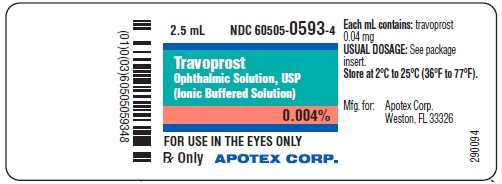
BOTTLE LABEL - PRINCIPAL DISPLAY PANEL - 2.5 mL APOTEX CORP. NDC 60505-0593-4 Travoprost Ophthalmic Solution, USP (Ionic Buffered Solution) 0.004% Equivalent to 0.04 mg travoprost Rx Only carton.jpg bottle-label.jpg
CARTON LABEL - PRINCIPAL DISPLAY PANEL - 2.5 mL APOTEX CORP. NDC 60505-0593-4 Travoprost Ophthalmic Solution, USP (Ionic Buffered Solution) 0.004% Equivalent to 0.04 mg travoprost Rx Only