
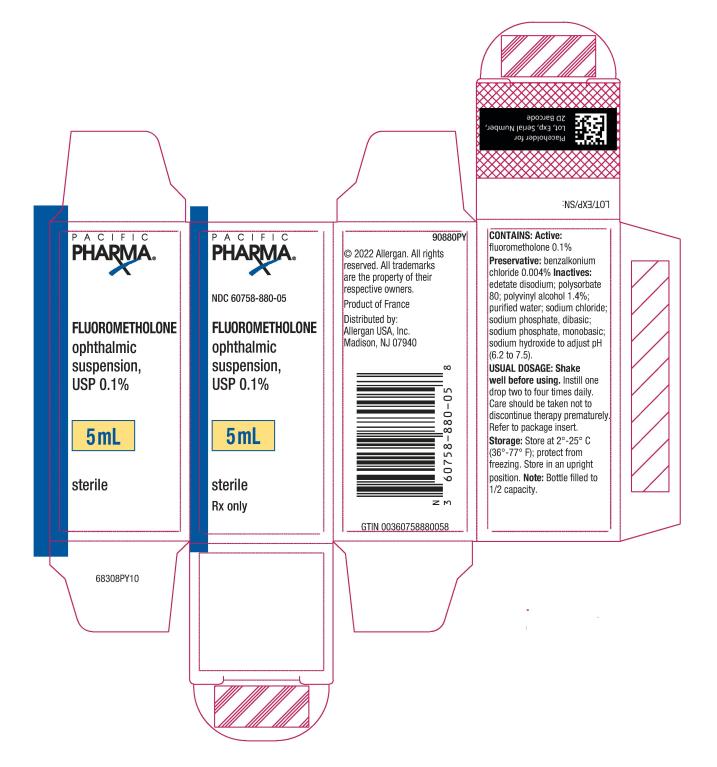
FLUOROMETHOLONE 1 mg/mL Solution/ Drops — NDC 60758-880-10 (Billing 60758-0880-10)
This is a package of FLUOROMETHOLONE 1 mg/mL Solution/ Drops from Pacific Pharma, Inc., marketed since Oct 1997 and currently FDA-listed; retail pharmacies pay about $11.43 per mL (NADAC).
NDC database record
One package, one record: these facts belong to NDC 60758-880-10 alone.
- Record
- FDA NDC Directory package listing · Human prescription drug
- Code segments
- 60758 labeler · 880 product · 10 package
- Package marketed since
- Oct 31, 1997
- Sample package
- No — commercial package
- Listing certified through
- Dec 31, 2027
- Barcode (UPC-A, from the NDC)
- 3 6075888010 2
- Medicaid fills, this package
- 2,683 prescriptions in the last four reported quarters
- FDA record last changed
- Sep 10, 2026
Identity & classification
Regulatory identifiers FDA, NLM and CMS codes for this package
Drug-database identifiers Medi-Span GPI and First Databank GCN / HICL / AHFS classification
- GSN (GCN sequence number): 007902
- GCN: 33250
- HICL (First Databank): 003316
- AHFS class code: 52:08.08.00
- RxCUI (RxNorm): 310377
Where does this data come from?
- FDA openFDA NDC Directory · synced Oct 1, 2026
- FDA label on DailyMed · label index refreshed Oct 3, 2026
- RxNorm (NLM RxNav) · catalog refreshed Oct 1, 2026
- Medi-Span GPI (licensed)
- First Databank (licensed) · refreshed Oct 1, 2026
RxNorm drug class
This medicine belongs to the Corticosteroid class.
Where does this data come from?
- RxClass (NLM) · catalog refreshed Oct 1, 2026
Clinical
Patient education
Supplement & herbal interactions
Some supplements/herbs that may interact with Fluorometholone — tap one for details:
Where does this data come from?
- MedlinePlus (NLM) · refreshed Oct 1, 2026
- FDA label on DailyMed · label index refreshed Oct 3, 2026
Ask a licensed pharmacist directly — free, answered by our team.
Pricing
A drug doesn't have one price. Each row is a different public payment system, and none is what you'd pay at the counter — that depends on your insurance. The ⓘ on each row explains what it measures.
| Price system | Per mL | Per package |
|---|---|---|
| Retail pharmacies payNADAC · weekly | $11.431 | $114.31 / 10 ml |
| Medicaid paysCMS SDUD · 12 mo | $13.07 | $130.74 / 10 ml |
| Medicare drug plans payPart D · quarterly | No Part D plan price is available for this NDC in our data. | |
Where does this data come from?
- CMS NADAC weekly file · file of Sep 30, 2026
- CMS ASP pricing files · refreshed Sep 20, 2026
- CMS Medicaid State Drug Utilization Data · through Q1 2026
- CMS Part D plan pricing files · refreshed Sep 24, 2026
- VA National Acquisition Center price file
Packaging — all sizes for this product
| Package NDC | Description | Per unit | Per pack | Marketing start | Marketing end | Status |
|---|---|---|---|---|---|---|
| 60758-0880-05 60758-880-05 Main listing | 1 BOTTLE, DROPPER in 1 CARTON / 5 mL in 1 BOTTLE, DROPPER | $11.55 / mL | $57.76 | 1997-10-31 | — | Active |
| 60758-0880-10 You're viewing this | 1 BOTTLE, DROPPER in 1 CARTON / 10 mL in 1 BOTTLE, DROPPER | $11.43 / mL | $114.31 | 1997-10-31 | — | Active |
This pack has the lowest per-mL cost of the 2 priced pack sizes ($11.43 NADAC).
This pack accounts for about 8.9% of this product's recent Medicaid fills; most go to a different pack size. See all packs ↓
Pack size FAQ
What quantity is in this package?
What NDC number is used to bill for this package of FLUOROMETHOLONE 1 mg/mL Solution/ Drops?
Prices are the latest CMS NADAC pharmacy acquisition cost per NDC; per-pack figures are per-unit × pack quantity, shown only when the pack is denominated in the same measure NADAC prices.
Therapeutic equivalents
| Product | Labeler | Pack | NADAC/unit | TE | Status | Price vs. this |
|---|---|---|---|---|---|---|
| fluorometholone 1 mg/mL 00781-6187-70 | Sandoz | 1 bottle | $11.431 | AB | Availability likely | — |
| fluorometholone ophthalmic suspension 1 mg/mL 60219-1586-06 | Amneal | 1 bottle | $11.431 | AB | Availability likely | — |
| Fluorometholone 1 mg/mLthis 60758-0880-10 | Pacific | 1 bottle | $11.431 | AB | Availability likely | — |
| fluorometholone ophthalmic suspension 1 mg/mL 60219-1585-03 | Amneal | 1 bottle | $11.552 | AB | Availability likely | +1% |
| Fml 1 mg/mL 11980-0211-05 | Allergan, | 1 bottle | $32.160 | AB | Availability likely | +181% |
Where does this data come from?
- FDA openFDA NDC Directory · synced Oct 1, 2026
- FDA Orange Book · refreshed Oct 3, 2026
- CMS NADAC weekly file · file of Sep 30, 2026
Availability & generic status
FDA-approved generic versions are listed, and recent pricing/market data suggests they may be available — see Therapeutic equivalents.
Where does this data come from?
- FDA Orange Book · refreshed Oct 3, 2026
Inactive Ingredients / Excipients
Inactive ingredients, also called excipients, are components of the drug product other than the active ingredient. They may include fillers, dyes, coatings, preservatives, flavors, or other formulation ingredients.
💡 Tap an ingredient (hover on desktop) to see what it is and why it’s used.
-
UNII F5UM2KM3W7
Benzalkonium chloride is a chemical compound that works as a preservative and antimicrobial agent in medications. It prevents bacterial and fungal growth in liquid formulations to keep the product safe during storage and use.
-
UNII 7FLD91C86K
Edetate disodium is a chemical compound that binds and removes certain metal ions. In medicines, it acts as a preservative and stabilizer by preventing metals like calcium from interfering with the product's shelf life and consistency.
-
UNII 6OZP39ZG8H
Polysorbate 80 is a synthetic emulsifier derived from sorbitol and oleic acid. It helps mix oil and water-based ingredients together in medications and improves how the product disperses in the body.
-
UNII 532B59J990
Polyvinyl alcohol is a synthetic polymer made from plant-derived materials. It's used as a binder to hold ingredients together, a film-former in coatings, and a thickener in liquid formulations.
-
UNII 451W47IQ8X
Sodium chloride is common table salt. It's used in medicines as a buffer to maintain proper pH, as a filler to add bulk, or to adjust the osmotic balance in liquid formulations.
-
UNII 55X04QC32I
A strong alkaline chemical used to adjust and maintain the pH balance of liquid medicines. It helps keep the medicine stable and ensures it stays effective during storage.
-
UNII GR686LBA74
Sodium phosphate, dibasic is a salt derived from phosphoric acid. It acts as a buffer to help maintain the medicine's pH balance and may serve as a binder or filler in tablets and capsules.
-
UNII 3980JIH2SW
A salt form of phosphoric acid that acts as a buffer and pH adjuster in medicines. It helps keep the product at the correct acidity level for stability and effectiveness.
-
UNII 059QF0KO0R
Water is a liquid solvent that dissolves and mixes ingredients together in liquid medicines, syrups, and injections. It helps distribute the active drug evenly throughout the product.
9 inactive ingredients listed in the exact product block matched to this NDC.
Where does this data come from?
ingredient classCode="IACT" elements from the exact product block matched by this NDC. Label-section narrative from DailyMed / the openFDA label index is shown separately when available.- FDA label on DailyMed · label index refreshed Oct 3, 2026
- FDA openFDA NDC Directory · synced Oct 1, 2026
Inactive ingredient FAQ
Are inactive ingredients the same for every manufacturer?
Why might an inactive ingredient be missing?
Can inactive ingredients matter?
Manufacturer & labeler
More NDCs from Pacific Pharma, Inc. labeler code 60758
Where does this data come from?
- FDA openFDA NDC Directory · synced Oct 1, 2026
- Drugs@FDA
Full prescribing information FDA SPL
🎯 Indications and Usage ▾
INDICATIONS AND USAGE Fluorometholone ophthalmic suspension 0.1% is indicated for the treatment of corticosteroid-responsive inflammation of the palpebral and bulbar conjunctiva, cornea and anterior segment of the globe.
⏱️ Dosage and Administration ▾
DOSAGE AND ADMINISTRATION Shake well before using. Instill one drop into the conjunctival sac two to four times daily. During the initial 24 to 48 hours, the dosing frequency may be increased to one application every four hours.
Care should be taken not to discontinue therapy prematurely. If signs and symptoms fail to improve after two days, the patient should be re-evaluated (see PRECAUTIONS ). The dosing of fluorometholone ophthalmic suspension 0.1% may be reduced, but care should be taken not to discontinue therapy prematurely.
In chronic conditions, withdrawal of treatment should be carried out by gradually decreasing the frequency of applications.
⛔ Contraindications ▾
CONTRAINDICATIONS Fluorometholone ophthalmic suspension 0.1% is contraindicated in most viral diseases of the cornea and conjunctiva, including epithelial herpes simplex keratitis (dendritic keratitis), vaccinia, and varicella, and also in mycobacterial infection of the eye, and fungal diseases of ocular structures. Fluorometholone ophthalmic suspension 0.1% is also contraindicated in individuals with known or suspected hypersensitivity to any of the ingredients of this preparation and to other corticosteroids.
⚠️ Warnings ▾
WARNINGS Prolonged use of corticosteroids may increase intraocular pressure in susceptible individuals, resulting in glaucoma with damage to the optic nerve, defects in visual acuity and fields of vision, and in posterior subcapsular cataract formation. Prolonged use may also suppress the host immune response and thus increase the hazard of secondary ocular infections. Various ocular diseases and long-term use of topical corticosteroids have been known to cause corneal and scleral thinning.
Use of topical corticosteroids in the presence of thin corneal or scleral tissue may lead to perforation. Acute purulent infections of the eye may be masked or activity enhanced by the presence of corticosteroid medication. If this product is used for 10 days or longer, intraocular pressure should be routinely monitored even though it may be difficult in children and uncooperative patients.
Steroids should be used with caution in the presence of glaucoma. Intraocular pressure should be checked frequently. The use of steroids after cataract surgery may delay healing and increase the incidence of bleb formation.
Use of ocular steroids may prolong the course and may exacerbate the severity of many viral infections of the eye (including herpes simplex). Employment of a corticosteroid medication in the treatment of patients with a history of herpes simplex requires great caution; frequent slit lamp microscopy is recommended.
🤒 Adverse Reactions ▾
ADVERSE REACTIONS Adverse reactions include, in decreasing order of frequency, elevation of intraocular pressure (IOP) with possible development of glaucoma and infrequent optic nerve damage, posterior subcapsular cataract formation, and delayed wound healing. Although systemic effects are extremely uncommon, there have been rare occurrences of systemic hypercorticoidism after use of topical dermatologic steroids applied to the skin. Corticosteroid-containing preparations have also been reported to cause acute anterior uveitis and perforation of the globe.
Keratitis, conjunctivitis, corneal ulcers, mydriasis, conjunctival hyperemia, loss of accommodation and ptosis have occasionally been reported following local use of corticosteroids. The development of secondary ocular infection (bacterial, fungal and viral) has occurred. Fungal and viral infections of the cornea are particularly prone to develop coincidentally with long-term applications of steroids.
The possibility of fungal invasion should be considered in any persistent corneal ulceration where steroid treatment has been used (see WARNINGS ). Transient burning and stinging upon instillation and other minor symptoms of ocular irritation have been reported with the use of fluorometholone suspension. Other adverse events reported with the use of fluorometholone include: allergic reactions; foreign body sensation; erythema of eyelid; eyelid edema/eye swelling; eye discharge; eye pain; eye pruritus; lacrimation increased; rash; taste perversion; visual disturbance (blurry vision); and visual field defect.
🤰 Pregnancy ▾
Pregnancy Teratogenic effects Fluorometholone has been shown to be embryocidal and teratogenic in rabbits when administered at low multiples of the human ocular dose. Fluorometholone was applied ocularly to rabbits daily on days 6-18 of gestation, and dose-related fetal loss and fetal abnormalities including cleft palate, deformed rib cage, anomalous limbs and neural abnormalities such as encephalocele, craniorachischisis, and spina bifida were observed. There are no adequate and well-controlled studies of fluorometholone in pregnant women, and it is not known whether fluorometholone can cause fetal harm when administered to a pregnant woman.
Fluorometholone should be used during pregnancy only if the potential benefit justifies the potential risk to the fetus.
🧒 Pediatric Use ▾
Pediatric Use Safety and effectiveness in infants below the age of two years have not been established.
🧓 Geriatric Use ▾
Geriatric Use No overall differences in safety or effectiveness have been observed between elderly and younger patients.
🧬 Clinical Pharmacology ▾
CLINICAL PHARMACOLOGY Corticosteroids inhibit the inflammatory response to a variety of inciting agents and probably delay or slow healing. They inhibit the edema, fibrin deposition, capillary dilation, leukocyte migration, capillary proliferation, fibroblast proliferation, deposition of collagen, and scar formation associated with inflammation. There is no generally accepted explanation for the mechanism of action of ocular corticosteroids.
However, corticosteroids are thought to act by the induction of phospholipase A 2 inhibitory proteins, collectively called lipocortins. It is postulated that these proteins control the biosynthesis of potent mediators of inflammation such as prostaglandins and leukotrienes by inhibiting the release of their common precursor, arachidonic acid. Arachidonic acid is released from membrane phospholipids by phospholipase A 2 .
Corticosteroids are capable of producing a rise in intraocular pressure. In clinical studies of documented steroid-responders, fluorometholone demonstrated a significantly longer average time to produce a rise in intraocular pressure than dexamethasone phosphate; however, in a small percentage of individuals, a significant rise in intraocular pressure occurred within one week. The ultimate magnitude of the rise was equivalent for both drugs.
📦 How Supplied / Storage and Handling ▾
HOW SUPPLIED Fluorometholone ophthalmic suspension, USP 0.1% is supplied sterile in opaque white LDPE plastic bottles with white high impact polystyrene (HIPS) caps as follows: 5 mL in 10 mL bottle NDC 60758-880-05 10 mL in 15 mL bottle NDC 60758-880-10 15 mL in 15 mL bottle NDC 60758-880-15 Pacific Pharma Storage: Store at 2°-25°C (36°-77°F); protect from freezing. Store in an upright position. Revised : 12/20 23 For more information, call 1-800-678-1605 Distributed for: AbbVie Inc.
North Chicago, IL 60064 © 2023 AbbVie. All rights reserved. PACIFIC PHARMA and its design are trademarks of Allergan, Inc., an AbbVie company.
V2.0USPI880
📦 Storage and Handling ▾
Storage: Store at 2°-25°C (36°-77°F); protect from freezing. Store in an upright position. Revised : 12/20 23 For more information, call 1-800-678-1605 Distributed for: AbbVie Inc. North Chicago, IL 60064 © 2023 AbbVie. All rights reserved. PACIFIC PHARMA and its design are trademarks of Allergan, Inc., an AbbVie company. V2.0USPI880
📋 Description ▾
DESCRIPTION Fluorometholone ophthalmic suspension, USP 0.1% is a sterile topical anti-inflammatory agent for ophthalmic use. Chemical Name Fluorometholone: 9-Fluoro-11β,17-dihydroxy-6α-methylpregna-1,4-diene-3,20-dione. Contains Active: fluorometholone 0.1%.
Preservative: benzalkonium chloride 0.004%. Inactives: edetate disodium; polysorbate 80; polyvinyl alcohol 1.4%; purified water; sodium chloride; sodium phosphate, dibasic; sodium phosphate, monobasic; and sodium hydroxide to adjust pH. Fluorometholone suspension is formulated with a pH from 6.2 to 7.5.
It has an osmolality range of 290-350 mOsm/kg. Structural Formula f luorometholone Structural Formula
💬 Information for Patients ▾
Information for Patients If inflammation or pain persists longer than 48 hours or becomes aggravated, the patient should be advised to discontinue use of the medication and consult a physician. This product is sterile when packaged. To prevent contamination, care should be taken to avoid touching the bottle tip to eyelids or to any other surface.
The use of this bottle by more than one person may spread infection. Keep bottle tightly closed when not in use. Keep out of the reach of children.
The preservative in fluorometholone ophthalmic suspension, benzalkonium chloride, may be absorbed by soft contact lenses. Patients wearing soft contact lenses should be instructed to wait at least 15 minutes after instilling fluorometholone ophthalmic suspension to insert soft contact lenses.
⚠️ Precautions ▾
PRECAUTIONS General The initial prescription and renewal of the medication order beyond 20 milliliters of fluorometholone ophthalmic suspension 0.1% should be made by a physician only after examination of the patient with the aid of magnification, such as slit lamp biomicroscopy and, where appropriate, fluorescein staining. If signs and symptoms fail to improve after two days, the patient should be re-evaluated. As fungal infections of the cornea are particularly prone to develop coincidentally with long-term local corticosteroid applications, fungal invasion should be suspected in any persistent corneal ulceration where a corticosteroid has been used or is in use.
Fungal cultures should be taken when appropriate. If this product is used for 10 days or longer, intraocular pressure should be monitored (see WARNINGS ). Information for Patients If inflammation or pain persists longer than 48 hours or becomes aggravated, the patient should be advised to discontinue use of the medication and consult a physician.
This product is sterile when packaged. To prevent contamination, care should be taken to avoid touching the bottle tip to eyelids or to any other surface. The use of this bottle by more than one person may spread infection.
Keep bottle tightly closed when not in use. Keep out of the reach of children. The preservative in fluorometholone ophthalmic suspension, benzalkonium chloride, may be absorbed by soft contact lenses.
Patients wearing soft contact lenses should be instructed to wait at least 15 minutes after instilling fluorometholone ophthalmic suspension to insert soft contact lenses. Carcinogenesis, M utagenesis, I mpairment of F ertility No studies have been conducted in animals or in humans to evaluate the possibility of these effects with fluorometholone. Pregnancy Teratogenic effects Fluorometholone has been shown to be embryocidal and teratogenic in rabbits when administered at low multiples of the human ocular dose.
Fluorometholone was applied ocularly to rabbits daily on days 6-18 of gestation, and dose-related fetal loss and fetal abnormalities including cleft palate, deformed rib cage, anomalous limbs and neural abnormalities such as encephalocele, craniorachischisis, and spina bifida were observed. There are no adequate and well-controlled studies of fluorometholone in pregnant women, and it is not known whether fluorometholone can cause fetal harm when administered to a pregnant woman. Fluorometholone should be used during pregnancy only if the potential benefit justifies the potential risk to the fetus.
Nursing Mothers It is not known whether topical ophthalmic administration of corticosteroids could result in sufficient systemic absorption to produce detectable quantities in human milk. Systemically-administered corticosteroids appear in human milk and could suppress growth, interfere with endogenous corticosteroid production, or cause other untoward effects. Because of the potential for serious adverse reactions in nursing infants from fluorometholone, a decision should be made whether to discontinue nursing or to discontinue the drug, taking into account the importance of the drug to the mother.
Pediatric Use Safety and effectiveness in infants below the age of two years have not been established. Geriatric Use No overall differences in safety or effectiveness have been observed between elderly and younger patients.
🍼 Nursing Mothers ▾
Nursing Mothers It is not known whether topical ophthalmic administration of corticosteroids could result in sufficient systemic absorption to produce detectable quantities in human milk. Systemically-administered corticosteroids appear in human milk and could suppress growth, interfere with endogenous corticosteroid production, or cause other untoward effects. Because of the potential for serious adverse reactions in nursing infants from fluorometholone, a decision should be made whether to discontinue nursing or to discontinue the drug, taking into account the importance of the drug to the mother.
📄 Carcinogenesis, Mutagenesis, Impairment of Fertility ▾
Carcinogenesis, M utagenesis, I mpairment of F ertility No studies have been conducted in animals or in humans to evaluate the possibility of these effects with fluorometholone.
📄 Package Label / Principal Display Panel ▾
PRINCIPAL DISPLAY PANEL NDC 60758-880-05 PACIFIC PHARMA ® FLUOROMETHOLONE ophthalmic suspension, USP 0.1% 5 mL sterile Rx only NDC 60758-880-05 PACIFIC PHARMA® FLUOROMETHOLONE ophthalmic suspension, USP 0.1% 5 mL sterile Rx only