
NDC 62135-0474-05: Baclofen 20 mg Tablet, Bottle of 500
This is a package of 500 tablets of Baclofen 20 mg Tablet from Chartwell RX, LLC, first listed with the FDA Dec 2005 and currently FDA-listed; retail pharmacies pay about $0.0569 per tablet (NADAC). It is the main listing for this product, which comes in 2 package sizes.
NDC Database Record
One package, one record: these facts belong to NDC 62135-474-05 alone.
- Record
- FDA NDC Directory package listing · Human prescription drug
- Code segments
- 62135 labeler · 474 product · 05 package
- Package marketed since
- Mar 3, 2023
- Sample package
- No — commercial package
- Listing certified through
- Dec 31, 2027
- Billing quantity
- 500 EA per package
- Barcode (UPC)
- 0362135474904, 0362135472900, 0362135474058, 0362135473051 +1 more
- FDA record last changed
- Nov 26, 2026
Other active recalls for Baclofen (different manufacturers) — 1 · tap to view
Identity & Classification
Regulatory identifiers FDA, NLM and CMS codes for this package
Drug-database identifiers Medi-Span GPI and First Databank GCN / HICL / AHFS classification
- GSN (GCN sequence number): 004680
- GCN: 18011
- HICL (First Databank): 001949
- AHFS class code: 12:20.12.00
- RxCUI (RxNorm): 197391
Where does this data come from?
- FDA openFDA NDC Directory · synced Nov 26, 2026
- FDA label on DailyMed · label index refreshed Nov 26, 2026
- RxNorm (NLM RxNav) · catalog refreshed Nov 26, 2026
- Medi-Span GPI (licensed)
- First Databank (licensed) · refreshed Nov 26, 2026
RxNorm Drug Class
This medicine belongs to the gamma-Aminobutyric Acid-ergic Agonist class.
Where does this data come from?
- RxClass (NLM) · catalog refreshed Nov 26, 2026
Clinical
Baclofen is used to treat pain and certain types of spasticity (muscle stiffness and tightness) from multiple sclerosis, spinal cord injuries, or other spinal cord diseases. Baclofen is in a class of medications called skeletal muscle relaxants. Baclofen acts on the spinal cord nerves and decreases the number and severity of muscle spasms caused by multiple sclerosis or spinal cord conditions. It also relieves pain and improves muscle movement.
Read the full MedlinePlus article ↗- Baclofen eases muscle stiffness and spasms (spasticity), mostly from multiple sclerosis and spinal cord conditions. The injection form is for severe spasticity and is given through...
- No. Oral baclofen should be lowered slowly under your prescriber’s guidance. Stopping intrathecal baclofen suddenly can cause high fever, confusion, severe stiffness and can be lif...
- It can. Drowsiness and dizziness are among the most common effects. Be careful driving or doing anything that needs alertness until you know how you react.
- It is best to be careful. Alcohol and other CNS depressants can add to the drowsiness, as the label notes for intrathecal baclofen. Ask your prescriber what is safe for you.
Patient education
Drug interactions
Supplement & herbal interactions
Some supplements/herbs that may interact with Baclofen — tap one for details:
Where does this data come from?
- MedlinePlus (NLM) · refreshed Nov 26, 2026
- FDA label on DailyMed · label index refreshed Nov 26, 2026
Ask a licensed pharmacist directly — free, answered by our team.
Pricing
A drug doesn't have one price. Each row is a different public payment system, and none is what you'd pay at the counter — that depends on your insurance. The ⓘ on each row explains what it measures.
| Price system | Per ea | Per package |
|---|---|---|
| Retail pharmacies payNADAC · weekly | $0.057 | $28.45 / 500 tablets |
| Medicaid paysCMS SDUD · 12 mo | No recent Medicaid claims on file for this NDC — rare and low-volume NDCs are suppressed in the public data. | |
| Medicare drug plans payPart D · Q2 2026 | $0.1147 | $57.35 / 500 tablets |
See this NDC in the NADAC Price Lookup: every NDC at its price and what a fill costs the pharmacy →
Where does this data come from?
- CMS NADAC weekly file · file of Nov 25, 2026
- CMS ASP pricing files · refreshed Nov 20, 2026
- CMS Medicaid State Drug Utilization Data · refreshed Nov 27, 2026
- CMS Part D plan pricing files · refreshed Nov 24, 2026
- VA National Acquisition Center price file
Packaging — All Sizes for This Product
| Package NDC | Description | Per unit | Per pack | Marketing start | Marketing end | Status |
|---|---|---|---|---|---|---|
| 62135-0474-05 You're viewing this Main listing | 500 TABLET in 1 BOTTLE | $0.0569 / ea | $28.47 | 2023-03-03 | — | Active |
| 62135-0474-90 62135-474-90 | 90 TABLET in 1 BOTTLE | $0.0569 / ea | $5.12 | 2023-03-03 | — | Active |
You're viewing the largest of 2 pack sizes for this product.
This pack has the lowest per-ea cost of the 2 priced pack sizes ($0.0569 NADAC).
Pack size FAQ
What quantity is in this package?
How does this package differ from NDC 62135-0474-90?
What NDC number is used to bill for this package of Baclofen 20 mg Tablet?
Prices are the latest CMS NADAC pharmacy acquisition cost per NDC; per-pack figures are per-unit × pack quantity, shown only when the pack is denominated in the same measure NADAC prices.
Therapeutic Equivalents
| Product | Labeler | Pack | NADAC/unit | TE | Status | Price vs. this |
|---|---|---|---|---|---|---|
| Baclofen 20 mg 00172-4097-60 | Teva | 100 tablets | $0.057 | AB | Availability likely | — |
| Baclofen 20 mg 00527-1337-01 | Lannett | 100 tablets | $0.057 | AB | Availability likely | — |
| Baclofen 20 mg 00603-2407-21 | Par | 100 tablets | $0.057 | AB | Availability likely | — |
| Baclofen 20 mg 00904-6476-61 | Major | 100 tablets | $0.057 | AB | Availability likely | — |
| Baclofen 20 mg 00904-7553-61 | Major | 100 tablets | $0.057 | AB | Availability likely | — |
| Baclofen 20 mg 16571-0172-01 | Rising | 100 tablets | $0.057 | AB | Availability likely | — |
| Baclofen 20 mg 16714-0072-04 | Northstar | 100 tablets | $0.057 | AB | Availability likely | — |
| Baclofen 20 mg 29300-0344-01 | Unichem | 100 tablets | $0.057 | AB | Availability likely | — |
| Baclofen 20 mg 50268-0107-15 | AvPAK | 50 tablets | $0.057 | AB | Availability likely | — |
| Baclofen 20 mg 52817-0321-00 | TruPharma | 1000 tablets | $0.057 | AB | Availability likely | — |
| Baclofen 20 mg 58657-0732-01 | Method | 100 tablets | $0.057 | AB | Availability likely | — |
| Baclofen 20 mg 58657-0932-01 | Method | 100 tablets | $0.057 | AB | Availability likely | — |
| Baclofen 20 mg 59651-0395-01 | Aurobindo | 100 tablets | $0.057 | AB | Availability likely | — |
| Baclofen 20 mg 60687-0826-01 | American | 100 tablets | $0.057 | AB | Availability likely | — |
| Baclofen 20 mgthis 62135-0474-05 | Chartwell | 500 tablets | $0.057 | AB | Availability likely | — |
| Baclofen 20 mg 70710-1286-00 | Zydus | 1000 tablets | $0.057 | AB | Availability likely | — |
| Baclofen 20 mg 70756-0289-11 | Lifestar | 100 tablets | $0.057 | AB | Availability likely | — |
| Baclofen 20 mg 71930-0007-12 | Eywa | 100 tablets | $0.057 | AB | Availability likely | — |
| Baclofen 20 mg 72888-0011-00 | Advagen | 1000 tablets | $0.057 | AB | Availability likely | — |
| Baclofen 20 mg 00832-1055-10 | Upsher-Smith | 1000 tablets | $0.093 | AB | Discontinued | +63% |
| Baclofen 20 mg 00615-8467-39 | NCS | 30 tablets | — | AB | FDA listed | — |
| Baclofen 20 mg 10135-0533-01 | Marlex | 100 tablets | — | AB | FDA listed | — |
| Baclofen 20 mg 42571-0429-01 | Micro | 100 tablets | — | — | Discontinued | — |
| Baclofen 20 mg 43063-0865-30 | PD-Rx | 30 tablets | — | AB | FDA listed | — |
| Baclofen 20 mg 50090-4682-00 | A-S | 20 tablets | — | AB | FDA listed | — |
| Baclofen 20 mg 51407-0974-01 | Golden | 100 tablets | — | AB | FDA listed | — |
| Baclofen 20 mg 55154-7876-00 | Cardinal | 10 tablets | — | AB | FDA listed | — |
| Baclofen 20 mg 63187-0274-30 | Proficient | 30 tablets | — | AB | FDA listed | — |
| Baclofen 20 mg 63187-0280-30 | Proficient | 30 tablets | — | AB | FDA listed | — |
| Baclofen 20 mg 63629-1227-01 | Bryant | 1000 tablets | — | AB | FDA listed | — |
| Baclofen 20 mg 63629-1228-01 | Bryant | 100 tablets | — | AB | FDA listed | — |
| Baclofen 20 mg 63629-2083-01 | Bryant | 500 tablets | — | AB | FDA listed | — |
| Baclofen 20 mg 63629-2084-01 | Bryant | 100 tablets | — | AB | FDA listed | — |
| Baclofen 20 mg 63629-2130-01 | Bryant | 1000 tablets | — | AB | Discontinued | — |
| Baclofen 20 mg 63629-2131-01 | Bryant | 100 tablets | — | AB | FDA listed | — |
| Baclofen 20 mg 68788-8575-03 | Preferred | 30 tablets | — | AB | FDA listed | — |
| Baclofen 20 mg 68788-8737-01 | Preferred | 100 tablets | — | AB | FDA listed | — |
| Baclofen 20 mg 70518-3467-00 | REMEDYREPACK | 30 tablets | — | AB | FDA listed | — |
| Baclofen 20 mg 70518-4235-00 | REMEDYREPACK | 30 tablets | — | AB | FDA listed | — |
| Baclofen 20 mg 70518-4290-00 | REMEDYREPACK | 30 tablets | — | AB | FDA listed | — |
| Baclofen 20 mg 70518-4378-00 | REMEDYREPACK | 90 tablets | — | AB | FDA listed | — |
| Baclofen 20 mg 70518-4530-00 | REMEDYREPACK | 30 tablets | — | AB | FDA listed | — |
| Baclofen 20 mg 70771-1449-00 | Zydus | 1000 tablets | — | AB | FDA listed | — |
| Baclofen 20 mg 71335-0103-00 | Bryant | 120 tablets | — | AB | FDA listed | — |
| Baclofen 20 mg 71335-0949-00 | Bryant | 120 tablets | — | AB | FDA listed | — |
| Baclofen 20 mg 71335-1356-00 | Bryant | 120 tablets | — | AB | FDA listed | — |
| Baclofen 20 mg 71335-1796-00 | Bryant | 120 tablets | — | AB | FDA listed | — |
| Baclofen 20 mg 71335-2219-00 | Bryant | 120 tablets | — | AB | FDA listed | — |
| Baclofen 20 mg 71335-2482-01 | Bryant | 60 tablets | — | AB | FDA listed | — |
| Baclofen 20 mg 71335-2497-00 | Bryant | 120 tablets | — | AB | FDA listed | — |
| Baclofen 20 mg 71335-2668-00 | Bryant | 120 tablets | — | AB | FDA listed | — |
| Baclofen 20 mg 71335-2669-01 | Bryant | 100 tablets | — | AB | FDA listed | — |
| Baclofen 20 mg 71335-2756-00 | Bryant | 120 tablets | — | AB | FDA listed | — |
| Baclofen 20 mg 71335-9681-00 | Bryant | 120 tablets | — | AB | FDA listed | — |
| Baclofen 20 mg 71610-0444-45 | Aphena | 45 tablets | — | AB | FDA listed | — |
| Baclofen 20 mg 71610-0446-45 | Aphena | 45 tablets | — | AB | FDA listed | — |
| Baclofen 20 mg 71610-0921-60 | Aphena | 90 tablets | — | AB | FDA listed | — |
| Baclofen 20 mg 72162-1080-00 | Bryant | 120 tablets | — | AB | FDA listed | — |
| Baclofen 20 mg 72162-2374-00 | Bryant | 1000 tablets | — | AB | FDA listed | — |
| Baclofen 20 mg 72162-2450-00 | Bryant | 1000 tablets | — | AB | FDA listed | — |
| Baclofen 20 mg 72189-0504-60 | Direct_Rx | 60 tablets | — | AB | FDA listed | — |
| Baclofen 20 mg 72189-0565-60 | Direct_rx | 60 tablets | — | AB | FDA listed | — |
| Baclofen 20 mg 72789-0312-30 | PD-Rx | 30 tablets | — | AB | FDA listed | — |
| Baclofen 20 mg 72789-0480-01 | PD-Rx | 100 tablets | — | AB | FDA listed | — |
| Baclofen 20 mg 72865-0298-01 | XLCare | 100 tablets | — | AB | FDA listed | — |
| Baclofen 20 mg 76420-0242-30 | Asclemed | 30 tablets | — | AB | FDA listed | — |
| Baclofen 20 mg 76420-0359-00 | Asclemed | 1000 tablets | — | AB | FDA listed | — |
| Baclofen 20 mg 80425-0081-02 | Advanced | 60 tablets | — | AB | FDA listed | — |
| Baclofen 20 mg 80425-0112-01 | Advanced | 30 tablets | — | AB | FDA listed | — |
| Baclofen 20 mg 80425-0157-01 | Advanced | 30 tablets | — | AB | FDA listed | — |
| Baclofen 20 mg 80425-0205-01 | Advanced | 30 tablets | — | AB | FDA listed | — |
| Baclofen 20 mg 80425-0282-01 | Advanced | 30 tablets | — | AB | FDA listed | — |
| Baclofen 20 mg 80425-0459-01 | Advanced | 30 tablets | — | AB | FDA listed | — |
| Baclofen 20 mg 80425-0466-01 | Advanced | 30 tablets | — | AB | FDA listed | — |
| Baclofen 20 mg 80425-0467-01 | Advanced | 30 tablets | — | AB | FDA listed | — |
| Baclofen 20 mg 80425-0478-01 | Advanced | 30 tablets | — | AB | FDA listed | — |
| Baclofen 20 mg 82461-0718-10 | Medcore | 100 tablets | — | AB | FDA listed | — |
| Baclofen 20 mg 83008-0062-30 | Quality | 30 tablets | — | AB | FDA listed | — |
| Baclofen 20 mg 85509-1344-03 | PHOENIX | 30 tablets | — | AB | FDA listed | — |
| Baclofen 20 mg 85534-0004-00 | HAWAII | 100 tablets | — | AB | FDA listed | — |
| Baclofen 20 mg 70518-3115-00 | REMEDYREPACK | 90 tablets | — | AB | Discontinued | — |
| Baclofen 20 mg 68788-4162-01 | Preferred | 100 tablets | — | AB | FDA listed | — |
| Baclofen 20 mg 71335-1664-00 | Bryant | 120 tablets | — | AB | FDA listed | — |
Where does this data come from?
- FDA openFDA NDC Directory · synced Nov 26, 2026
- FDA Orange Book · refreshed Nov 6, 2026
- CMS NADAC weekly file · file of Nov 25, 2026
Availability & Generic Status
This product is an FDA-approved generic. Other versions of the same drug are listed under Therapeutic equivalents, least expensive first.
Where does this data come from?
- FDA Orange Book · refreshed Nov 6, 2026
What It Looks Like
Where does this data come from?
- FDA label on DailyMed · label index refreshed Nov 26, 2026
Inactive Ingredients / Excipients
Inactive ingredients, also called excipients, are components of the drug product other than the active ingredient. They may include fillers, dyes, coatings, preservatives, flavors, or other formulation ingredients.
Avoiding an ingredient? See Baclofen inactive ingredients by manufacturer: every current product's list side by side, so you can ask your pharmacy for the version that does not list it.
Tap an ingredient (hover on desktop) to see what it is and why it’s used.
-
UNII 70097M6I30
Magnesium stearate is a salt made from magnesium and stearic acid, a fatty substance. It's used in tablets and capsules as a lubricant and glidant to help ingredients flow smoothly during manufacturing and prevent sticking.
-
UNII OP1R32D61U
Microcrystalline cellulose is a purified form of cellulose, a natural fiber from plant sources. It acts as a binder and filler in tablets and capsules, helping hold ingredients together and give the medicine its shape and size.
-
UNII ETJ7Z6XBU4
Silicon dioxide is a naturally occurring mineral used as a glidant and anti-caking agent. It helps powder ingredients flow smoothly and prevents clumping during manufacturing and storage.
-
UNII O8232NY3SJ
A plant-based carbohydrate derived from corn kernels. It acts as a filler to add bulk, a binder to hold ingredients together, and a disintegrant to help the tablet break apart in your stomach for absorption.
4 inactive ingredients listed in the exact product block matched to this NDC.
Where does this data come from?
ingredient classCode="IACT" elements from the exact product block matched by this NDC. Label-section narrative from DailyMed / the openFDA label index is shown separately when available.- FDA label on DailyMed · label index refreshed Nov 26, 2026
- FDA openFDA NDC Directory · synced Nov 26, 2026
Inactive ingredient FAQ
Are inactive ingredients the same for every manufacturer?
Why might an inactive ingredient be missing?
Can inactive ingredients matter?
Manufacturer & Labeler
More NDCs from Chartwell RX, LLC labeler code 62135
- Primidone 50 mg Tablet NDC 62135-468-90
- Diclofenac Potassium 25 mg Capsule, Liquid Filled NDC 62135-469-12
- Prednisone 1 mg Tablet NDC 62135-470-18
- Prednisone 5 mg Tablet NDC 62135-471-18
- Baclofen 5 mg Tablet NDC 62135-472-90
- Baclofen 10 mg Tablet NDC 62135-473-05
- Danazol 50 mg Capsule NDC 62135-475-60
- Danazol 100 mg Capsule NDC 62135-476-60
- Danazol 200 mg Capsule NDC 62135-477-60
- Clindamycin Phosphate 10 mg/mL Solution NDC 62135-478-30
- Cephalexin 125 mg/5mL Powder, For Suspension NDC 62135-480-42
- Cephalexin 250 mg/5mL Powder, For Suspension NDC 62135-481-42
Where does this data come from?
- FDA openFDA NDC Directory · synced Nov 26, 2026
- Drugs@FDA
Full Prescribing Information FDA SPL
Indications and Usage
INDICATIONS AND USAGE Baclofen tablets are useful for the alleviation of signs and symptoms of spasticity resulting from multiple sclerosis, particularly for the relief of flexor spasms and concomitant pain, clonus, and muscular rigidity. Patients should have reversible spasticity so that baclofen treatment will aid in restoring residual function. Baclofen tablets may also be of some value in patients with spinal cord injuries and other spinal cord diseases.
Baclofen tablets are not indicated in the treatment of skeletal muscle spasm resulting from rheumatic disorders. The efficacy of baclofen in stroke, cerebral palsy, and Parkinson's disease has not been established and, therefore, it is not recommended for these conditions.
Dosage and Administration
DOSAGE AND ADMINISTRATION The determination of optimal dosage requires individual titration. Start therapy at a low dosage and increase gradually until optimum effect is achieved (usually between 40 to 80 mg daily). The following dosage titration schedule is suggested: 5 mg t.i.d. for 3 days 10 mg t.i.d. for 3 days 15 mg t.i.d. for 3 days 20 mg t.i.d. for 3 days Thereafter additional increases may be necessary but the total daily dose should not exceed a maximum of 80 mg daily (20 mg q.i.d.).
The lowest dose compatible with an optimal response is recommended. If benefits are not evident after a reasonable trial period, patients should be slowly withdrawn from the drug (see WARNINGS , Abrupt Drug Withdrawal ).
Contraindications
CONTRAINDICATIONS Hypersensitivity to baclofen.
Warnings
WARNINGS a. Neonatal Withdrawal Symptoms : Withdrawal symptoms have been reported starting hours to days after delivery in neonates whose mothers were treated with oral baclofen throughout pregnancy. The symptoms of withdrawal in these infants have included increased muscle tone, tremor, jitteriness, and seizure.
If the potential benefit justifies the potential risk to the fetus and oral baclofen is continued during pregnancy, gradually reduce the dose and discontinue baclofen before delivery. If slow withdrawal is not feasible, advise the parents or caregivers of the potential for neonatal withdrawal. b. Abrupt Drug Withdrawal : Hallucinations and seizures have occurred on abrupt withdrawal of baclofen.
Therefore, except for serious adverse reactions, the dose should be reduced slowly when the drug is discontinued. c. Impaired Renal Function : Because baclofen is primarily excreted unchanged through the kidneys, it should be given with caution, and it may be necessary to reduce the dosage. d. Stroke : Baclofen has not significantly benefited patients with stroke.
These patients have also shown poor tolerability to the drug. e. Pregnancy : Baclofen has been shown to increase the incidence of omphaloceles (ventral hernias) in fetuses of rats given approximately 13 times the maximum dose recommended for human use, at a dose which caused significant reductions in food intake and weight gain in dams. This abnormality was not seen in mice or rabbits.
There was also an increased incidence of incomplete sternebral ossification in fetuses of rats given approximately 13 times the maximum recommended human dose, and an increased incidence of unossified phalangeal nuclei of forelimbs and hindlimbs in fetuses of rabbits given approximately 7 times the maximum recommended human dose. In mice, no teratogenic effects were observed, although reductions in mean fetal weight with consequent delays in skeletal ossification were present when dams were given 17 and 34 times the human daily dose.
There are no studies in pregnant women. Baclofen should be used during pregnancy only if the benefit clearly justifies the potential risk to the fetus.
Adverse Reactions
ADVERSE REACTIONS The most common is transient drowsiness (10 to 63%). In one controlled study of 175 patients, transient drowsiness was observed in 63% of those receiving baclofen compared to 36% of those in the placebo group. Other common adverse reactions are dizziness (5 to 15%), weakness (5 to 15%) and fatigue (2 to 4%).
Others reported: Neuropsychiatric : Confusion (1 to 11%), headache (4 to 8%), insomnia (2 to 7%); and, rarely, euphoria, excitement, depression, hallucinations, paresthesia, muscle pain, tinnitus, slurred speech, coordination disorder, tremor, rigidity, dystonia, ataxia, blurred vision, nystagmus, strabismus, miosis, mydriasis, diplopia, dysarthria, epileptic seizure. Cardiovascular : Hypotension (0 to 9%). Rare instances of dyspnea, palpitation, chest pain, syncope.
Gastrointestinal : Nausea (4 to 12%), constipation (2 to 6%); and rarely, dry mouth, anorexia, taste disorder, abdominal pain, vomiting, diarrhea, and positive test for occult blood in stool. Genitourinary : Urinary frequency (2 to 6%); and rarely, enuresis, urinary retention, dysuria, impotence, inability to ejaculate, nocturia, hematuria. Other : Instances of rash, pruritus, ankle edema, excessive perspiration, weight gain, nasal congestion.
Some of the CNS and genitourinary symptoms may be related to the underlying disease rather than to drug therapy. The following laboratory tests have been found to be abnormal in a few patients receiving baclofen: increased SGOT, elevated alkaline phosphatase, and elevation of blood sugar.
Overdosage
OVERDOSAGE Signs and Symptoms : Vomiting, muscular hypotonia, drowsiness, accommodation disorders, coma, respiratory depression and seizures. Treatment : In the alert patient, empty the stomach promptly by induced emesis followed by lavage. In the obtunded patient, secure the airway with a cuffed endotracheal tube before beginning lavage (do not induce emesis). Maintain adequate respiratory exchange, do not use respiratory stimulants.
Clinical Pharmacology
CLINICAL PHARMACOLOGY The precise mechanism of action of baclofen is not fully known. Baclofen is capable of inhibiting both monosynaptic and polysynaptic reflexes at the spinal level, possibly by hyperpolarization of afferent terminals, although actions at supraspinal sites may also occur and contribute to its clinical effect. Although baclofen is an analog of the putative inhibitory neurotransmitter gamma-aminobutyric acid (GABA), there is no conclusive evidence that actions on GABA systems are involved in the production of its clinical effects.
In studies with animals baclofen has been shown to have general CNS depressant properties as indicated by the production of sedation with tolerance, somnolence, ataxia, and respiratory and cardiovascular depression. Baclofen is rapidly and extensively absorbed and eliminated. Absorption may be dose-dependent, being reduced with increasing doses.
Baclofen is excreted primarily by the kidney in unchanged form and there is relatively large intersubject variation in absorption and/or elimination.
How Supplied / Storage and Handling
HOW SUPPLIED Baclofen Tablets USP, 5 mg are available as a white round convex tablet debossed with “LCI” on one side and “1333” on the other side. Available in bottles of 90 (NDC 62135-472-90). Baclofen Tablets USP, 10 mg are available as a white round flat-faced beveled edge bisected tablet debossed with "LCI" over "1330" on one side and plain on the other side, containing 10 mg Baclofen USP.
Available in bottles of 90 (NDC 62135-473-90) and 500 (NDC 62135-473-05). Baclofen Tablets USP, 20 mg are available as a white round flat-faced beveled edge bisected tablet debossed with "LCI" over "1337" on one side and plain on the other side, containing 20 mg Baclofen USP. Available in bottles of 90 (NDC 62135-474-90) and 500 (NDC 62135-474-05).
PHARMACIST: Dispense in a well-closed container as defined in the USP, with a child-resistant closure (as required). Store at 20° to 25°C (68° to 77°F) [see USP Controlled Room Temperature]. Manufactured for: Chartwell RX, LLC.
Congers, NY 10920 L71279 Rev. 02/2023
Description
DESCRIPTION Baclofen, USP is a muscle relaxant and antispastic. Its chemical name is 4-amino-3-(4-chlorophenyl)-butanoic acid. The structural formula is: Baclofen USP is a white to off-white, odorless or practically odorless crystalline powder.
It is slightly soluble in water, very slightly soluble in methanol and insoluble in chloroform. Each tablet, for oral administration, contains 5 mg, 10 mg or 20 mg baclofen. In addition, each tablet contains the following inactive ingredients: microcrystalline cellulose, pregelatinized starch, colloidal silicon dioxide, and magnesium stearate. baclofen, usp
Precautions
PRECAUTIONS Because of the possibility of sedation, patients should be cautioned regarding the operation of automobiles or other dangerous machinery, and activities made hazardous by decreased alertness. Patients should also be cautioned that the central nervous system effects of baclofen may be additive to those of alcohol and other CNS depressants. Baclofen should be used with caution where spasticity is utilized to sustain upright posture and balance in locomotion or whenever spasticity is utilized to obtain increased function.
In patients with epilepsy, the clinical state and electroencephalogram should be monitored at regular intervals, since deterioration in seizure control and EEG have been reported occasionally in patients taking baclofen. It is not known whether this drug is excreted in human milk. As a general rule, nursing should not be undertaken while a patient is on a drug since many drugs are excreted in human milk.
A dose-related increase in incidence of ovarian cysts and a less marked increase in enlarged and/or hemorrhagic adrenal glands was observed in female rats treated chronically with baclofen. Ovarian cysts have been found by palpation in about 4% of the multiple sclerosis patients that were treated with baclofen for up to one year. In most cases these cysts disappeared spontaneously while patients continued to receive the drug.
Ovarian cysts are estimated to occur spontaneously in approximately 1% to 5% of the normal female population. Pediatric Use Safety and effectiveness in pediatric patients below the age of 12 years have not been established.
Package Label / Principal Display Panel
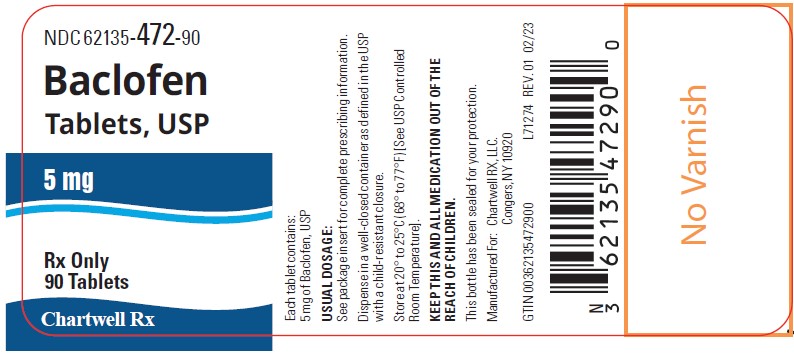
PACKAGE LABEL.PRINCIPAL DISPLAY PANEL Baclofen Tablets, USP 5 mg- NDC 62135-472-90 - 90s-bottle label Baclofen Tablets, USP 10 mg- NDC 62135-473-90 - 90s-bottle label Baclofen Tablets, USP 10 mg- NDC 62135-473-05 - 500s-bottle label Baclofen Tablets, USP 20 mg- NDC 62135-474-90 - 90s-bottle label Baclofen Tablets, USP 20 mg- NDC 62135-474-05 - 500s-bottle label Baclofen Tablets USP Baclofen Tablets USP Baclofen Tablets USP Baclofen Tablets USP Baclofen Tablets USP