
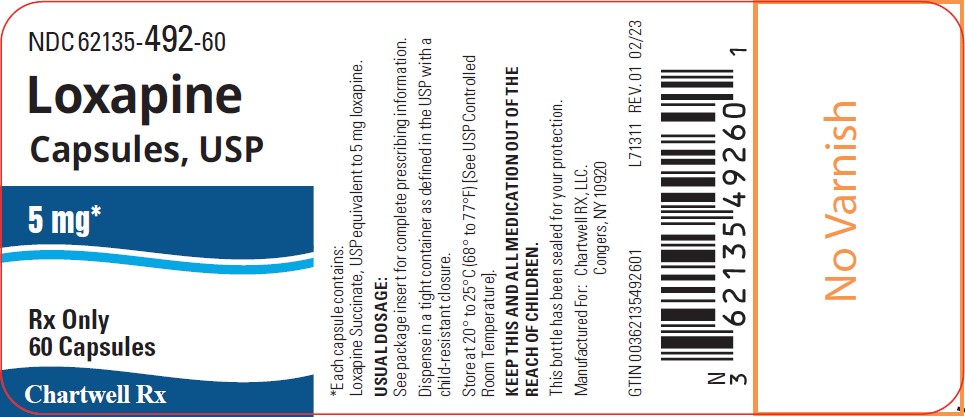
NDC 62135-0492-60: Loxapine 5 mg Capsule, Bottle of 60
This is a package of 60 capsules of Loxapine 5 mg Capsule from Chartwell RX, LLC, first listed with the FDA Sep 2011 and currently FDA-listed; retail pharmacies pay about $0.3341 per capsule (NADAC). It is this product's only package size.
NDC Database Record
One package, one record: these facts belong to NDC 62135-492-60 alone.
- Record
- FDA NDC Directory package listing · Human prescription drug
- Code segments
- 62135 labeler · 492 product · 60 package
- Package marketed since
- Mar 1, 2023
- Sample package
- No — commercial package
- Listing certified through
- Dec 31, 2027
- Billing quantity
- 60 EA per package
- Barcode (UPC)
- 0362135493608, 0362135492601
- FDA record last changed
- Nov 19, 2026
Identity & Classification
Regulatory identifiers FDA, NLM and CMS codes for this package
Drug-database identifiers Medi-Span GPI and First Databank GCN / HICL / AHFS classification
- GSN (GCN sequence number): 003983
- GCN: 15562
- HICL (First Databank): 001664
- AHFS class code: 28:16.08.26
- RxCUI (RxNorm): 311386
Where does this data come from?
- FDA openFDA NDC Directory · synced Nov 26, 2026
- FDA label on DailyMed · label index refreshed Nov 26, 2026
- RxNorm (NLM RxNav) · catalog refreshed Nov 26, 2026
- Medi-Span GPI (licensed)
- First Databank (licensed) · refreshed Nov 26, 2026
RxNorm Drug Class
This medicine belongs to the Diazepines, oxazepines, thiazepines and oxepines class.
Where does this data come from?
- RxClass (NLM) · catalog refreshed Nov 26, 2026
Clinical
Loxapine is used to treat the symptoms of schizophrenia (a mental illness that affects how a person thinks, feels and behaves). Loxapine is in a group of medications called antipsychotics. It works by decreasing abnormal excitement in the brain.
Read the full MedlinePlus article ↗- Loxapine capsules treat schizophrenia. A separate inhaled product, Adasuve, calms sudden agitation linked to schizophrenia or bipolar I disorder in adults. A healthcare professiona...
- They are taken by mouth, usually split into two to four doses a day. Your prescriber sets and adjusts the amount based on your symptoms. Take them exactly as directed and do not ch...
- Sleepiness, dizziness and lightheadedness are common. Movement effects like tremor, stiffness or restlessness can happen. With Adasuve, an unusual taste and throat irritation are c...
- Seek help for wheezing, shortness of breath or chest tightness after Adasuve. Also get help for high fever with severe stiffness and confusion, seizures, fainting, neck or throat m...
Patient education
Drug interactions
Supplement & herbal interactions
Some supplements/herbs that may interact with Loxapine — tap one for details:
Where does this data come from?
- MedlinePlus (NLM) · refreshed Nov 26, 2026
- FDA label on DailyMed · label index refreshed Nov 26, 2026
Ask a licensed pharmacist directly — free, answered by our team.
Pricing
A drug doesn't have one price. Each row is a different public payment system, and none is what you'd pay at the counter — that depends on your insurance. The ⓘ on each row explains what it measures.
| Price system | Per ea | Per package |
|---|---|---|
| Retail pharmacies pay NADAC · weekly | $0.334 | $20.05 / 60 capsules |
| Medicaid paysCMS SDUD · 12 mo | No recent Medicaid claims on file for this NDC — rare and low-volume NDCs are suppressed in the public data. | |
| Medicare drug plans payPart D · Q2 2026 | $0.4575 | $27.45 / 60 capsules |
See this NDC in the NADAC Price Lookup: every NDC at its price and what a fill costs the pharmacy →
Where does this data come from?
- CMS NADAC weekly file · file of Nov 25, 2026
- CMS ASP pricing files · refreshed Nov 20, 2026
- CMS Medicaid State Drug Utilization Data · refreshed Nov 29, 2026
- CMS Part D plan pricing files · refreshed Nov 24, 2026
- VA National Acquisition Center price file
Packaging — All Sizes for This Product
| Package NDC | Description | Marketing start | Marketing end | Status |
|---|---|---|---|---|
| 62135-0492-60 You're viewing this Main listing | 60 CAPSULE in 1 BOTTLE | 2023-03-01 | — | Active |
Therapeutic Equivalents
| Product | Labeler | Pack | NADAC/unit | TE | Status | Price vs. this |
|---|---|---|---|---|---|---|
| Loxapine 5 mg 00527-1394-01 | Lannett | 100 capsules | $0.334 | AB | Availability likely | — |
| Loxapine 5 mg 00591-0369-01 | Actavis | 100 capsules | $0.334 | — | Availability likely | — |
| Loxapine 5 mgthis 62135-0492-60 | Chartwell | 60 capsules | $0.334 | AB | Availability likely | — |
| Loxapine 5 mg 64850-0890-01 | Elite | 100 capsules | $0.334 | AB | Availability likely | — |
| Loxapine 5 mg 67046-1479-03 | Coupler | 30 capsules | — | AB | FDA listed | — |
| Loxapine 5 mg 70518-0346-00 | REMEDYREPACK | 30 capsules | — | AB | FDA listed | — |
| Loxapine 5 mg 82804-0051-30 | Proficient | 30 capsules | — | AB | FDA listed | — |
Where does this data come from?
- FDA openFDA NDC Directory · synced Nov 26, 2026
- FDA Orange Book · refreshed Nov 6, 2026
- CMS NADAC weekly file · file of Nov 25, 2026
Availability & Generic Status
This product is an FDA-approved generic. Other versions of the same drug are listed under Therapeutic equivalents, least expensive first.
Where does this data come from?
- FDA Orange Book · refreshed Nov 6, 2026
What It Looks Like
Where does this data come from?
- FDA label on DailyMed · label index refreshed Nov 26, 2026
Inactive Ingredients / Excipients
Inactive ingredients, also called excipients, are components of the drug product other than the active ingredient. They may include fillers, dyes, coatings, preservatives, flavors, or other formulation ingredients.
Avoiding an ingredient? See Loxapine inactive ingredients by manufacturer: every current product's list side by side, so you can ask your pharmacy for the version that does not list it.
Tap an ingredient (hover on desktop) to see what it is and why it’s used.
-
UNII 3K9958V90M
A liquid solvent derived from fermentation or chemical synthesis. In medicines, alcohol dissolves active ingredients, helps preserve the product, and improves how the body absorbs certain drugs.
-
UNII 5138Q19F1X
Ammonia is a colorless gas made from nitrogen and hydrogen. It's used in medicines as a pH buffer to maintain the correct acidity level and help keep the product stable.
-
UNII 3SY5LH9PMK
Anhydrous lactose is a milk sugar with no water content. It acts as a filler and binder in tablets and capsules, adding bulk and helping ingredients stick together.
-
UNII 8PJ61P6TS3
Butyl alcohol is a clear liquid organic solvent derived from petroleum or natural sources. In medicines, it helps dissolve active ingredients and serves as a solvent in liquid formulations and some topical products.
-
UNII 9DBA0SBB0L
A synthetic red dye derived from coal tar used as a colorant in medicines and cosmetics. It gives tablets, capsules, and liquids their red or pink appearance for identification and visual appeal.
-
UNII 35SW5USQ3G
A synthetic yellow dye used to color medicines. It helps make tablets, capsules, and liquids visually distinct so patients can easily identify their medication.
-
UNII H3R47K3TBD
FD&C Blue No. 1 is a synthetic blue dye approved for use in foods and medicines. It serves as a colorant to give the medication its distinctive appearance and help with product identification.
-
UNII 2G86QN327L
Gelatin is a protein derived from animal collagen, commonly used in medicines as a gelling agent and capsule material. It helps create soft or hard capsule shells that hold and release medication, and can also thicken liquid formulations.
-
UNII ND2M416302
Isopropyl alcohol is a clear liquid solvent derived from petroleum. In medicines, it dissolves active ingredients and other components, helps the product flow smoothly, and aids in sterilization during manufacturing.
-
UNII 70097M6I30
Magnesium stearate is a salt made from magnesium and stearic acid, a fatty substance. It's used in tablets and capsules as a lubricant and glidant to help ingredients flow smoothly during manufacturing and prevent sticking.
-
UNII 0BZ5A00FQU
Polacrilin potassium is a synthetic polymer that absorbs water and swells. It acts as a disintegrant, helping tablets or capsules break apart quickly so the active ingredient can be absorbed in your body.
-
UNII 6DC9Q167V3
Propylene glycol is a clear liquid derived from petroleum or vegetable sources. It acts as a solvent, humectant, and preservative in medicines, helping dissolve active ingredients and maintain product stability.
-
UNII 46N107B71O
Shellac is a natural resin secreted by the lac beetle. It's used as a coating on tablets and capsules to control how quickly the medicine dissolves and to improve appearance and stability.
-
UNII ETJ7Z6XBU4
Silicon dioxide is a naturally occurring mineral used as a glidant and anti-caking agent. It helps powder ingredients flow smoothly and prevents clumping during manufacturing and storage.
-
UNII 368GB5141J
A detergent and foaming agent derived from coconut or palm oil. In medications, it helps break down and mix oil and water-based ingredients, aids in tablet disintegration, and improves how the drug dissolves and spreads in the mouth or digestive system.
-
UNII 7SEV7J4R1U
A powder made from a naturally occurring mineral. In medicines, talc works as a glidant and anti-caking agent, helping tablets and capsules flow smoothly during manufacturing and preventing clumping.
-
UNII 15FIX9V2JP
Titanium dioxide is a bright white mineral powder commonly used as a colorant and opacifying agent. It makes pills and tablets white or lighter in color and helps make coatings non-transparent.
17 inactive ingredients listed in the exact product block matched to this NDC.
Where does this data come from?
ingredient classCode="IACT" elements from the exact product block matched by this NDC. Label-section narrative from DailyMed / the openFDA label index is shown separately when available.- FDA label on DailyMed · label index refreshed Nov 26, 2026
- FDA openFDA NDC Directory · synced Nov 26, 2026
Inactive ingredient FAQ
Are inactive ingredients the same for every manufacturer?
Why might an inactive ingredient be missing?
Can inactive ingredients matter?
Manufacturer & Labeler
More NDCs from Chartwell RX, LLC labeler code 62135
- Quinapril 20 mg Tablet, Film Coated NDC 62135-486-90
- Quinapril 40 mg Tablet, Film Coated NDC 62135-487-90
- Diethylpropion Hydrochloride 25 mg Tablet NDC 62135-488-90
- Diethylpropion Hydrochloride ER 75 mg Tablet, Extended Release NDC 62135-489-30
- Anastrozole 1 mg Tablet NDC 62135-490-30
- Letrozole 2.5 mg Tablet, Film Coated NDC 62135-491-30
- Loxapine 10 mg Capsule NDC 62135-493-60
- Ultramicrosize Griseofulvin 125 mg Tablet NDC 62135-494-01
- Ultramicrosize Griseofulvin 250 mg Tablet NDC 62135-495-01
- Griseofulvin MICROSIZE 500 mg Tablet NDC 62135-496-01
- Niacin 500 mg Tablet, Extended Release NDC 62135-497-90
- Niacin 1000 mg Tablet, Extended Release NDC 62135-498-90
Where does this data come from?
- FDA openFDA NDC Directory · synced Nov 26, 2026
- Drugs@FDA
Full Prescribing Information FDA SPL
Boxed Warning
WARNING Increased Mortality in Elderly Patients with Dementia-Related Psychosis Elderly patients with dementia-related psychosis treated with antipsychotic drugs are at an increased risk of death. Analyses of seventeen placebo-controlled trials (modal duration of 10 weeks), largely in patients taking atypical antipsychotic drugs, revealed a risk of death in drug-treated patients of between 1.6 to 1.7 times the risk of death in placebo-treated patients. Over the course of a typical 10-week controlled trial, the rate of death in drug-treated patients was about 4.5%, compared to a rate of about 2.6% in the placebo group.
Although the causes of death were varied, most of the deaths appeared to be either cardiovascular (e.g., heart failure, sudden death) or infectious (e.g., pneumonia) in nature. Observational studies suggest that, similar to atypical antipsychotic drugs, treatment with conventional antipsychotic drugs may increase mortality. The extent to which the findings of increased mortality in observational studies may be attributed to the antipsychotic drug as opposed to some characteristic(s) of the patients is not clear.
Loxapine is not approved for the treatment of patients with dementia-related psychosis ( see WARNINGS ).
Indications and Usage
INDICATIONS AND USAGE Loxapine Capsules are indicated for the treatment of schizophrenia. The efficacy of loxapine in schizophrenia was established in clinical studies which enrolled newly hospitalized and chronically hospitalized acutely ill schizophrenic patients as subjects.
Dosage and Administration
DOSAGE AND ADMINISTRATION Loxapine Capsules, USP are administered, usually in divided doses, two to four times a day. Daily dosage (in terms of base equivalents) should be adjusted to the individual patient's needs as assessed by the severity of symptoms and previous history of response to antipsychotic drugs. Oral Administration Initial dosage of 10 mg twice daily is recommended, although in severely disturbed patients initial dosage up to a total of 50 mg daily may be desirable.
Dosage should then be increased fairly rapidly over the first seven to ten days until there is effective control of symptoms of schizophrenia. The usual therapeutic and maintenance range is 60 mg to 100 mg daily. However, as with other drugs used to treat schizophrenia, some patients respond to lower dosage and others require higher dosage for optimal benefit.
Daily dosage higher than 250 mg is not recommended. Maintenance Therapy For maintenance therapy, dosage should be reduced to the lowest level compatible with symptom control; many patients have been maintained satisfactorily at dosages in the range of 20 to 60 mg daily.
Contraindications
CONTRAINDICATIONS Loxapine is contraindicated in comatose or severe drug-induced depressed states (alcohol, barbiturates, narcotics, etc.). Loxapine is contraindicated in individuals with known hypersensitivity to dibenzoxazepines.
Warnings
WARNINGS Increased Mortality in Elderly Patients with Dementia-Related Psychosis Elderly patients with dementia-related psychosis treated with antipsychotic drugs are at an increased risk of death. Loxapine is not approved for the treatment of patients with dementia-related psychosis ( see BOXED WARNING ). Tardive Dyskinesia Tardive dyskinesia, a syndrome consisting of potentially irreversible, involuntary, dyskinetic movements, may develop in patients treated with antipsychotic drugs.
Although the prevalence of the syndrome appears to be highest among the elderly, especially elderly women, it is impossible to rely upon prevalence estimates to predict, at the inception of antipsychotic treatment, which patients are likely to develop the syndrome. Whether antipsychotic drug products differ in their potential to cause tardive dyskinesia is unknown. Both the risk of developing the syndrome and the likelihood that it will become irreversible are believed to increase as the duration of treatment and the total cumulative dose of antipsychotic drugs administered to the patient increase.
However, the syndrome can develop, although much less commonly, after relatively brief treatment periods at low doses. There is no known treatment for established cases of tardive dyskinesia, although the syndrome may remit, partially or completely, if antipsychotic treatment is withdrawn. Antipsychotic treatment itself, however, may suppress (or partially suppress) the signs and symptoms of the syndrome and thereby may possibly mask the underlying disease process.
The effect that symptomatic suppression has upon the long-term course of the syndrome is unknown. Given these considerations, antipsychotics should be prescribed in a manner that is most likely to minimize the occurrence of tardive dyskinesia. Chronic antipsychotic treatment should generally be reserved for patients who suffer from a chronic illness that, 1) is known to respond to antipsychotic drugs, and 2) for whom alternative, equally effective, but potentially less harmful treatments are not available or appropriate.
In patients who do require chronic treatment, the smallest dose and the shortest duration of treatment producing a satisfactory clinical response should be sought. The need for continued treatment should be reassessed periodically. If signs and symptoms of tardive dyskinesia appear in a patient on antipsychotics, drug discontinuation should be considered.
However, some patients may require treatment despite the presence of the syndrome. (See ADVERSE REACTIONS and Information for Patients sections). Neuroleptic Malignant Syndrome (NMS) A potentially fatal symptom complex sometimes referred to as Neuroleptic Malignant Syndrome (NMS) has been reported in association with antipsychotic drugs.
Clinical manifestations of NMS are hyperpyrexia, muscle rigidity, altered mental status, and evidence of autonomic instability (irregular pulse or blood pressure, tachycardia, diaphoresis, and cardiac dysrhythmias). The diagnostic evaluation of patients with this syndrome is complicated. In arriving at a diagnosis, it is important to identify cases where the clinical presentation includes both serious medical illness (e.g., pneumonia, systemic infection, etc.) and untreated or inadequately treated extrapyramidal signs and symptoms (EPS).
Other important considerations in the differential diagnosis include central anticholinergic toxicity, heat stroke, drug fever, and primary central nervous system (CNS) pathology. The management of NMS should include: 1) immediate discontinuation of antipsychotic drugs and other drugs not essential to concurrent therapy, 2) intensive symptomatic treatment and medical monitoring, and 3) treatment of any concomitant serious medical problems for which specific treatments are available. There is no general agreement about specific pharmacological treatment regimens for uncomplicated NMS.
If a patient requires antipsychotic drug treatment after recovery from NM… [Excerpted — this section continues on DailyMed.]
Adverse Reactions
ADVERSE REACTIONS CNS Effects: Manifestations of adverse effects on the central nervous system, other than extrapyramidal effects, have been seen infrequently. Drowsiness, usually mild, may occur at the beginning of therapy or when dosage is increased. It usually subsides with continued loxapine therapy.
The incidence of sedation has been less than that of certain aliphatic phenothiazines and slightly more than the piperazine phenothiazines. Dizziness, faintness, staggering gait, shuffling gait, muscle twitching, weakness, insomnia, agitation, tension, seizures, akinesia, slurred speech, numbness, and confusional states have been reported. Neuroleptic malignant syndrome (NMS) has been reported (see WARNINGS ).
Extrapyramidal Symptoms - Neuromuscular (extrapyramidal) reactions during the administration of loxapine have been reported frequently, often during the first few days of treatment. In most patients, these reactions involved parkinsonian-like symptoms such as tremor, rigidity, excessive salivation, and masked facies. Akathisia (motor restlessness) also has been reported relatively frequently.
These symptoms are usually not severe and can be controlled by reduction of loxapine dosage or by administration of antiparkinson drugs in usual dosage. Dystonia - Class effect: Symptoms of dystonia, prolonged abnormal contractions of muscle groups, may occur in susceptible individuals during the first few days of treatment. Dystonic symptoms include: spasm of the neck muscles, sometimes progressing to tightness of the throat, swallowing difficulty, difficulty breathing, and/or protrusion of the tongue.
While these symptoms can occur at low doses, they occur more frequently and with greater severity with high potency and at higher doses of first generation antipsychotic drugs. An elevated risk of acute dystonia is observed in males and younger age groups. Persistent Tardive Dyskinesia - As with all antipsychotic agents, tardive dyskinesia may appear in some patients on long-term therapy or may appear after drug therapy has been discontinued.
The risk appears to be greater in elderly patients on high-dose therapy, especially females. The symptoms are persistent and in some patients appear to be irreversible. The syndrome is characterized by rhythmical involuntary movement of the tongue, face, mouth or jaw (e.g., protrusion of tongue, puffing of cheeks, puckering of mouth, chewing movements).
Sometimes these may be accompanied by involuntary movements of extremities. There is no known effective treatment for tardive dyskinesia; antiparkinson agents usually do not alleviate the symptoms of this syndrome. It is suggested that all antipsychotic agents be discontinued if these symptoms appear.
Should it be necessary to reinstitute treatment, or increase the dosage of the agent, or switch to a different antipsychotic agent, the syndrome may be masked. It has been suggested that fine vermicular movements of the tongue may be an early sign of the syndrome, and if the medication is stopped at that time the syndrome may not develop. Cardiovascular Effects: Tachycardia, hypotension, hypertension, orthostatic hypotension, lightheadedness, and syncope have been reported.
A few cases of ECG changes similar to those seen with phenothiazines have been reported. It is not known whether these were related to loxapine administration. Hematologic: Rarely, agranulocytosis, thrombocytopenia, leukopenia.
Skin: Dermatitis, edema (puffiness of face), pruritus, rash, alopecia, and seborrhea have been reported with loxapine. Anticholinergic Effects: Dry mouth, nasal congestion, constipation, blurred vision, urinary retention, and paralytic ileus have occurred. Gastrointestinal: Nausea and vomiting have been reported in some patients.
Hepatocellular injury (i.e., SGOT/SGPT elevation) has been reported in association with loxapine administration and rarely, jaundice and/or hepatitis questionably related to loxapine treatment. Other Adverse Reactions: Weight gain… [Excerpted — this section continues on DailyMed.]
Overdosage
OVERDOSAGE Signs and symptoms of overdosage will depend on the amount ingested and individual patient tolerance. As would be expected from the pharmacologic actions of the drug, the clinical findings may range from mild depression of the CNS and cardiovascular systems to profound hypotension, respiratory depression, and unconsciousness. The possibility of occurrence of extrapyramidal symptoms and/or convulsive seizures should be kept in mind.
Renal failure following loxapine overdosage has also been reported. The treatment of overdosage is essentially symptomatic and supportive. Early gastric lavage and extended dialysis might be expected to be beneficial.
Centrally-acting emetics may have little effect because of the antiemetic action of loxapine. In addition, emesis should be avoided because of the possibility of aspiration of vomitus. Avoid analeptics, such as pentylenetetrazol, which may cause convulsions.
Severe hypotension might be expected to respond to the administration of norepinephrine or phenylephrine. EPINEPHRINE SHOULD NOT BE USED SINCE ITS USE IN A PATIENT WITH PARTIAL ADRENERGIC BLOCKADE MAY FURTHER LOWER THE BLOOD PRESSURE. Severe extrapyramidal reactions should be treated with anticholinergic antiparkinson agents or diphenhydramine hydrochloride, and anticonvulsant therapy should be initiated as indicated.
Additional measures include oxygen and intravenous fluids.
Clinical Pharmacology
CLINICAL PHARMACOLOGY Pharmacodynamics Pharmacologically, loxapine is an antipsychotic for which the exact mode of action has not been established. However, changes in the level of excitability of subcortical inhibitory areas have been observed in several animal species in association with such manifestations of tranquilization as calming effects and suppression of aggressive behavior. In normal human volunteers, signs of sedation were seen within 20 to 30 minutes after administration, were most pronounced within one and one-half to three hours, and lasted through 12 hours.
Similar timing of primary pharmacologic effects was seen in animals. Absorption, Distribution, Metabolism, and Excretion Absorption of loxapine following oral or parenteral administration is virtually complete. The drug is removed rapidly from the plasma and distributed in tissues.
Animal studies suggest an initial preferential distribution in lungs, brain, spleen, heart, and kidney. Loxapine is metabolized extensively and is excreted mainly in the first 24 hours. Metabolites are excreted in the urine in the form of conjugates and in the feces unconjugated.
How Supplied / Storage and Handling
HOW SUPPLIED Loxapine Capsules, USP are available in the following strengths: Loxapine Succinate, USP 6.8 mg equivalent to 5 mg loxapine, opaque, with a dark green body and cap, imprinted with logo "LANNETT" on the cap and "1394" on the body are supplied as follows: NDC 62135-492-60 –Bottle of 60s Loxapine Succinate, USP 13.6 mg equivalent to 10 mg loxapine, yellow opaque body and dark green opaque cap, imprinted with logo "LANNETT" on the cap and "1395" on the body are supplied as follows: NDC 62135-493-60 –Bottle of 60s Store at 20°-25°C (68°-77°F). [See USP controlled room temperature.] Dispense in a tight, child-resistant container.
Manufactured for: Chartwell RX, LLC. Congers, NY 10920 L71313 Revised 02/2023
Description
DESCRIPTION Loxapine, a dibenzoxazepine compound, represents a subclass of tricyclic antipsychotic agents, chemically distinct from the thioxanthenes, butyrophenones, and phenothiazines. Chemically, it is 2-Chloro-11-(4-methyl-1-piperazinyl)dibenz[ b,f ][1,4]oxazepine. It is present as the succinate salt.
Each capsule for oral administration, contains loxapine succinate, USP 6.8 or 13.6 mg equivalent to 5 or 10 mg of loxapine base respectively. It also contains the following inactive ingredients: anhydrous lactose, colloidal silicon dioxide, gelatin, magnesium stearate, polacrilin potassium, sodium lauryl sulfate, talc, titanium dioxide, D&C Yellow #10 and FD&C Blue #1. Additionally, the 5 mg capsule contains D&C Red #33 and the 10 mg capsule contains D&C Red #33 and D&C Red #28.
In addition, the black imprinting ink contains shellac glace in ethanol, iron oxide black, n-butyl alcohol, propylene glycol, FD&C Blue #2/indigo carmine aluminum lake, FD&C Red #40/Allurea Red AC aluminum lake, FD&C Blue #1/brilliant Blue FCF aluminum lake, D&C Yellow #10 aluminum lake, SDA 3A alcohol, and methanol. The white imprinting ink contains pharmaceutical glaze in SD-45, titanium dioxide, isopropyl alcohol, ammonium hydroxide, propylene glycol, n-butyl alcohol and simethicone. Loxapine Capsules, USP
Precautions
PRECAUTIONS Leukopenia, Neutropenia and Agranulocytosis In clinical trial and postmarketing experience, events of leukopenia/neutropenia and agranulocytosis have been reported temporally related to antipsychotic agents. Possible risk factors for leukopenia/neutropenia include preexisting low white blood cell count (WBC) and history of drug induced leukopenia/neutropenia. Patients with a preexisting low WBC or a history of drug induced leukopenia/neutropenia should have their complete blood count (CBC) monitored frequently during the first few months of therapy and should discontinue Loxapine Succinate Capsules at the first sign of a decline in WBC in the absence of other causative factors.
Patients with neutropenia should be carefully monitored for fever or other symptoms or signs of infection and treated promptly if such symptoms or signs occur. Patients with severe neutropenia (absolute neutrophil count <1000/mm 3 ) should discontinue Loxapine Succinate Capsules and have their WBC followed until recovery. General Loxapine should be used with extreme caution in patients with a history of convulsive disorders since it lowers the convulsive threshold.
Seizures have been reported in patients receiving loxapine at antipsychotic dose levels, and may occur in epileptic patients even with maintenance of routine anticonvulsant drug therapy. Loxapine has an antiemetic effect in animals. Since this effect may also occur in man, loxapine may mask signs of overdosage of toxic drugs and may obscure conditions such as intestinal obstruction and brain tumor.
Loxapine should be used with caution in patients with cardiovascular disease. Increased pulse rates have been reported in the majority of patients receiving antipsychotic doses; transient hypotension has been reported. In the presence of severe hypotension requiring vasopressor therapy, the preferred drugs may be norepinephrine or angiotensin.
Usual doses of epinephrine may be ineffective because of inhibition of its vasopressor effect by loxapine. The possibility of ocular toxicity from loxapine cannot be excluded at this time. Therefore, careful observation should be made for pigmentary retinopathy and lenticular pigmentation since these have been observed in some patients receiving certain other antipsychotic drugs for prolonged periods.
Because of possible anticholinergic action, the drug should be used cautiously in patients with glaucoma or a tendency to urinary retention, particularly with concomitant administration of anticholinergic-type antiparkinson medication. Experience to date indicates the possibility of a slightly higher incidence of extrapyramidal effects following intramuscular administration than normally anticipated with oral formulations. The increase may be attributable to higher plasma levels following intramuscular injection.
Antipsychotic drugs elevate prolactin levels; the elevation persists during chronic administration. Tissue culture experiments indicate that approximately one-third of human breast cancers are prolactin-dependent in vitro , a factor of potential importance if the prescription of these drugs is contemplated in a patient with a previously detected breast cancer. Although disturbances such as galactorrhea, amenorrhea, gynecomastia, and impotence have been reported, the clinical significance of elevated serum prolactin levels is unknown for most patients.
An increase in mammary neoplasms has been found in rodents after chronic administration of antipsychotic drugs. Neither clinical studies nor epidemiologic studies conducted to date, however, have shown an association between chronic administration of these drugs and mammary tumorigenesis; the available evidence is considered too limited to be conclusive at this time. Information for Patients Given the likelihood that some patients exposed chronically to antipsychotics will develop tardive dyskinesia, it is advised that all patients in whom chronic use is contemplated be given, if possible, full… [Excerpted — this section continues on DailyMed.]
Package Label / Principal Display Panel
PACKAGE LABEL.PRINCIPAL DISPLAY PANEL Loxapine Capsules, USP 5 mg - NDC 62135-492-60 – 60s Bottle Label Loxapine Capsules, USP 10 mg - NDC 62135-493-60 – 60s Bottle Label Loxapine-5mg-Capsules Loxapine-10mg-Capsules