
Felodipine 10 mg Tablet, Extended Release, 90-count — NDC 62135-648-90 (Billing 62135-0648-90)
This is a package of 90 tablets of Felodipine 10 mg Tablet, Extended Release from Chartwell RX, LLC, marketed since Aug 2019 and currently FDA-listed; retail pharmacies pay about $0.1352 per tablet (NADAC). It is this product's only package size.
Identity & classification
Regulatory identifiers FDA, NLM and CMS codes for this package
Drug-database identifiers Medi-Span GPI and First Databank GCN / HICL / AHFS classification
- GSN (GCN sequence number): 016296
- GCN: 02622
- GPI-14 (Medi-Span): 34000013007520
- HICL (First Databank): 006205
- AHFS class code: 24:28.08.00
- RxCUI (RxNorm): 402695
Where does this data come from?
- FDA openFDA NDC Directory · synced Oct 1, 2026
- FDA label on DailyMed · label index refreshed Oct 1, 2026
- RxNorm (NLM RxNav) · catalog refreshed Oct 1, 2026
- Medi-Span GPI (licensed)
- First Databank (licensed) · refreshed Oct 1, 2026
RxNorm drug class
This medicine belongs to the Dihydropyridine Calcium Channel Blocker class.
Where does this data come from?
- RxClass (NLM) · catalog refreshed Oct 1, 2026
Clinical
Felodipine is used to treat high blood pressure. Felodipine is in a class of medications called calcium channel blockers. It works by relaxing the blood vessels so your heart does not have to pump as hard. High blood pressure is a common condition and when not treated, can cause damage to the brain, heart, blood vessels, kidneys and other parts of the body. Damage to these organs may cause heart disease, a heart attack, heart failure, stroke, kidney failure, loss of vision, and other problems. In addition to taking medication, making lifestyle changes will also help to control your blood press...
Read the full MedlinePlus article ↗- It treats high blood pressure. Keeping your blood pressure down lowers your risk of stroke and heart attack. Many people take it with other blood pressure medicines.
- Take it once a day, either without food or with a light meal. Swallow the tablet whole and never crush or chew it. Follow your prescriber's directions.
- No, avoid it. Grapefruit juice can more than double the amount of felodipine in your body. That can drop your blood pressure too much.
- The most common are swelling in the legs or feet, headache, flushing and dizziness. Tell me or your doctor if the swelling bothers you. Call right away for chest pain, fainting or...
Patient education
Supplement & herbal interactions
Some supplements/herbs that may interact with Felodipine — tap one for details:
Felodipine may be associated with lower levels of 2 nutrients — worth a chat with your pharmacist, not a cause for alarm.
Where does this data come from?
- MedlinePlus (NLM) · refreshed Oct 1, 2026
- FDA label on DailyMed · label index refreshed Oct 1, 2026
Ask a licensed pharmacist directly — free, answered by our team.
Pricing
A drug doesn't have one price. Each row is a different public payment system, and none is what you'd pay at the counter — that depends on your insurance. The ⓘ on each row explains what it measures.
| Price system | Per ea | Per package |
|---|---|---|
| Retail pharmacies payNADAC · weekly | $0.135 | $12.17 / 90 tablets |
| Medicaid paysCMS SDUD · 12 mo | No recent Medicaid claims on file for this NDC — rare and low-volume NDCs are suppressed in the public data. | |
| Medicare drug plans payPart D · Q2 2026 | $0.3632 | $32.69 / 90 tablets |
Where does this data come from?
- CMS NADAC weekly file · file of Sep 30, 2026
- CMS ASP pricing files · refreshed Sep 20, 2026
- CMS Medicaid State Drug Utilization Data · refreshed Oct 3, 2026
- CMS Part D plan pricing files · refreshed Sep 24, 2026
- VA National Acquisition Center price file
Packaging — all sizes for this product
| Package NDC | Description | Marketing start | Marketing end | Status |
|---|---|---|---|---|
| 62135-0648-90 You're viewing this Main listing | 90 TABLET, EXTENDED RELEASE in 1 BOTTLE | 2023-06-05 | — | Active |
Therapeutic equivalents
| Product | Labeler | Pack | NADAC/unit | TE | Status | Price vs. this |
|---|---|---|---|---|---|---|
| Felodipine 10 mg 00603-3583-21 | Endo | 100 tablets | $0.135 | AB | Availability likely | — |
| Felodipine 10 mg 13668-0134-01 | Torrent | 100 tablets | $0.135 | AB | Availability likely | — |
| Felodipine 10 mg 23155-0050-01 | Heritage | 100 tablets | $0.135 | AB | Availability likely | — |
| Felodipine 10 mg 57237-0110-01 | Rising | 100 tablets | $0.135 | AB | Availability likely | — |
| Felodipine 10 mgthis 62135-0648-90 | Chartwell | 90 tablets | $0.135 | AB | Availability likely | — |
| Felodipine 10 mg 68462-0235-01 | Glenmark | 100 tablets | $0.135 | AB | Availability likely | — |
| Felopdipine 10 mg 69367-0266-01 | Westminster | 100 tablets | $0.135 | AB | Availability likely | — |
| Felodipine 10 mg 50090-1124-00 | A-S | 30 tablets | — | AB | FDA listed | — |
| Felodipine 10 mg 50090-5870-00 | A-S | 30 tablets | — | AB | FDA listed | — |
| Felopdipine 10 mg 50090-7206-00 | A-S | 30 tablets | — | AB | FDA listed | — |
| Felodipine 10 mg 51407-0089-01 | Golden | 100 tablets | — | AB | FDA listed | — |
| Felodipine 10 mg 61442-0433-01 | Carlsbad | 100 tablets | — | AB | FDA listed | — |
| Felodipine 10 mg 63629-2016-01 | Bryant | 500 tablets | — | AB | FDA listed | — |
| Felodipine 10 mg 63629-2191-01 | Bryant | 100 tablets | — | AB | FDA listed | — |
| Felodipine 10 mg 63629-2192-01 | Bryant | 500 tablets | — | AB | Discontinued | — |
| Felodipine 10 mg 65862-0675-01 | Aurobindo | 100 tablets | — | — | FDA listed | — |
| Felodipine 10 mg 69117-0030-01 | Yiling | 100 tablets | — | AB | FDA listed | — |
| Felodipine 10 mg 71205-0922-00 | Proficient | 100 tablets | — | AB | FDA listed | — |
| Felodipine 10 mg 72162-1160-01 | Bryant | 100 tablets | — | AB | FDA listed | — |
| Felodipine 10 mg 72162-1744-05 | Bryant | 500 tablets | — | AB | FDA listed | — |
Where does this data come from?
- FDA openFDA NDC Directory · synced Oct 1, 2026
- FDA Orange Book · refreshed Sep 3, 2026
- CMS NADAC weekly file · file of Sep 30, 2026
Availability & generic status
This product is an FDA-approved generic. Other versions of the same drug are listed under Therapeutic equivalents, least expensive first.
Where does this data come from?
- FDA Orange Book · refreshed Sep 3, 2026
What it looks like
Where does this data come from?
- FDA label on DailyMed · label index refreshed Oct 1, 2026
Inactive Ingredients / Excipients
Inactive ingredients, also called excipients, are components of the drug product other than the active ingredient. They may include fillers, dyes, coatings, preservatives, flavors, or other formulation ingredients.
💡 Tap an ingredient (hover on desktop) to see what it is and why it’s used.
-
UNII 3SY5LH9PMK
Anhydrous lactose is a milk sugar with no water content. It acts as a filler and binder in tablets and capsules, adding bulk and helping ingredients stick together.
-
UNII REK4960K2U
Butylated hydroxyanisole is a synthetic preservative that prevents oils and fats in medicines from spoiling or becoming rancid. It keeps the medicine stable and extends its shelf life.
-
UNII 1P9D0Z171K
BHT is a synthetic antioxidant that prevents fats and oils in medicines from breaking down and becoming rancid. It helps keep the product stable and effective during storage.
-
UNII 1K09F3G675
Ferric oxide red is an inorganic iron compound used as a colorant in medicines. It gives tablets, capsules, or other dosage forms a red or reddish tint for identification and appearance.
-
UNII EX438O2MRT
Ferric oxide yellow is a naturally occurring iron compound used as a colorant in medications. It gives tablets, capsules, and other forms a yellow or golden hue for identification and appearance.
-
UNII XM0M87F357
A dark iron oxide compound that gives medicines their black or dark color. It's used as a colorant in tablets and capsules to help identify the product and make it visually distinctive.
-
UNII 3NXW29V3WO
Hypromellose is a plant-based thickener made from cellulose. It's used in medicines as a binder to hold ingredients together, a coating for tablets, and a thickener for liquids.
-
UNII 7CVR7L4A2D
A starch-derived carbohydrate produced by breaking down corn, potato, or tapioca starch. It functions as a filler and binder to give the medicine bulk and texture, and sometimes as a mild sweetener or texture enhancer in powders and tablets.
-
UNII C9H2L21V7U
A fat derived from coconut or palm oil containing shorter fatty acid chains. It serves as a solvent and carrier to help dissolve or suspend active ingredients, improving absorption and stability in liquid formulations.
-
UNII OP1R32D61U
Microcrystalline cellulose is a purified form of cellulose, a natural fiber from plant sources. It acts as a binder and filler in tablets and capsules, helping hold ingredients together and give the medicine its shape and size.
-
UNII VH2XOU12IE
Polydextrose is a synthetic polymer made from dextrose (sugar) that acts as a bulking agent and filler in medicines. It helps give tablets and capsules proper volume and texture while often adding slight sweetness.
-
UNII 7YC686GQ8F
A synthetic oily substance made from castor oil. It works as a solubilizer and emulsifier to help mix oily and water-based ingredients together in the medicine.
-
UNII U725QWY32X
Povidone K30 is a synthetic polymer made from petroleum. It acts as a binder to hold tablet ingredients together and as a disintegrant to help the tablet break apart in the stomach so the medicine can be absorbed.
-
UNII ETJ7Z6XBU4
Silicon dioxide is a naturally occurring mineral used as a glidant and anti-caking agent. It helps powder ingredients flow smoothly and prevents clumping during manufacturing and storage.
-
UNII 7CV7WJK4UI
Sodium stearyl fumarate is a synthetic compound made from stearyl alcohol and fumaric acid. It acts as a lubricant and glidant in tablets and capsules, helping ingredients flow smoothly during manufacturing and preventing sticking.
-
UNII 7SEV7J4R1U
A powder made from a naturally occurring mineral. In medicines, talc works as a glidant and anti-caking agent, helping tablets and capsules flow smoothly during manufacturing and preventing clumping.
-
UNII 15FIX9V2JP
Titanium dioxide is a bright white mineral powder commonly used as a colorant and opacifying agent. It makes pills and tablets white or lighter in color and helps make coatings non-transparent.
17 inactive ingredients listed in the exact product block matched to this NDC.
Where does this data come from?
ingredient classCode="IACT" elements from the exact product block matched by this NDC. Label-section narrative from DailyMed / the openFDA label index is shown separately when available.- FDA label on DailyMed · label index refreshed Oct 1, 2026
- FDA openFDA NDC Directory · synced Oct 1, 2026
Inactive ingredient FAQ
Are inactive ingredients the same for every manufacturer?
Why might an inactive ingredient be missing?
Can inactive ingredients matter?
Manufacturer & labeler
Where does this data come from?
- FDA openFDA NDC Directory · synced Oct 1, 2026
- Drugs@FDA
Full prescribing information FDA SPL
⏱️ Dosage and Administration ▾
DOSAGE AND ADMINISTRATION The recommended starting dose is 5 mg once a day. Depending on the patient's response, the dosage can be decreased to 2.5 mg or increased to 10 mg once a day. These adjustments should occur generally at intervals of not less than 2 weeks.
The recommended dosage range is 2.5–10 mg once daily. In clinical trials, doses above 10 mg daily showed an increased blood pressure response but a large increase in the rate of peripheral edema and other vasodilatory adverse events (see ADVERSE REACTIONS ). Modification of the recommended dosage is usually not required in patients with renal impairment.
Felodipine should regularly be taken either without food or with a light meal (see CLINICAL PHARMACOLOGY, Pharmacokinetics and Metabolism ). Felodipine should be swallowed whole and not crushed or chewed. Geriatric Use —Patients over 65 years of age are likely to develop higher plasma concentrations of felodipine (see CLINICAL PHARMACOLOGY ).
In general, dose selection for an elderly patient should be cautious, usually starting at the low end of the dosing range (2.5 mg daily). Elderly patients should have their blood pressure closely monitored during any dosage adjustment. Patients with Impaired Liver Function —Patients with impaired liver function may have elevated plasma concentrations of felodipine and may respond to lower doses of Felodipine; therefore, patients should have their blood pressure monitored closely during dosage adjustment of Felodipine (see CLINICAL PHARMACOLOGY ).
⛔ Contraindications ▾
CONTRAINDICATIONS Felodipine is contraindicated in patients who are hypersensitive to this product.
🤒 Adverse Reactions ▾
ADVERSE REACTIONS In controlled studies in the United States and overseas, approximately 3000 patients were treated with felodipine as either the extended-release or the immediate-release formulation. The most common clinical adverse events reported with Felodipine administered as monotherapy at the recommended dosage range of 2.5 mg to 10 mg once a day were peripheral edema and headache. Peripheral edema was generally mild, but it was age and dose related and resulted in discontinuation of therapy in about 3% of the enrolled patients.
Discontinuation of therapy due to any clinical adverse event occurred in about 6% of the patients receiving Felodipine, principally for peripheral edema, headache, or flushing. Adverse events that occurred with an incidence of 1.5% or greater at any of the recommended doses of 2.5 mg to 10 mg once a day (Felodipine, N = 861; Placebo, N = 334), without regard to causality, are compared to placebo and are listed by dose in the table below. These events are reported from controlled clinical trials with patients who were randomized to a fixed dose of Felodipine or titrated from an initial dose of 2.5 mg or 5 mg once a day.
A dose of 20 mg once a day has been evaluated in some clinical studies. Although the antihypertensive effect of Felodipine is increased at 20 mg once a day, there is a disproportionate increase in adverse events, especially those associated with vasodilatory effects (see DOSAGE AND ADMINISTRATION ). Percent of Patients with Adverse Events in Controlled Trials* of Felodipine (N = 861) as Monotherapy without Regard to Causality (Incidence of discontinuations shown in parentheses) * Patients in titration studies may have been exposed to more than one dose level of Felodipine.
Body System Adverse Events Placebo N = 334 2.5 mg N = 255 5 mg N = 581 10 mg N = 408 Body as a Whole Peripheral Edema 3.3 (0.0) 2.0 (0.0) 8.8 (2.2) 17.4 (2.5) Asthenia 3.3 (0.0) 3.9 (0.0) 3.3 (0.0) 2.2 (0.0) Warm Sensation 0.0 (0.0) 0.0 (0.0) 0.9 (0.2) 1.5 (0.0) Cardiovascular Palpitation 2.4 (0.0) 0.4 (0.0) 1.4 (0.3) 2.5 (0.5) Digestive Nausea 1.5 (0.9) 1.2 (0.0) 1.7 (0.3) 1.0 (0.7) Dyspepsia 1.2 (0.0) 3.9 (0.0) 0.7 (0.0) 0.5 (0.0) Constipation 0.9 (0.0) 1.2 (0.0) 0.3 (0.0) 1.5 (0.2) Nervous Headache 10.2 (0.9) 10.6 (0.4) 11.0 (1.7) 14.7 (2.0) Dizziness 2.7 (0.3) 2.7 (0.0) 3.6 (0.5) 3.7 (0.5) Paresthesia 1.5 (0.3) 1.6 (0.0) 1.2 (0.0) 1.2 (0.2) Respiratory Upper Respiratory Infection Cough 0.3 (0.0) 0.8 (0.0) 1.2 (0.0) 1.7 (0.0) Rhinorrhea 0.0 (0.0) 1.6 (0.0) 0.2 (0.0) 0.2 (0.0) Sneezing 0.0 (0.0) 1.6 (0.0) 0.0 (0.0) 0.0 (0.0) Skin Rash 0.9 (0.0) 2.0 (0.0) 0.2 (0.0) 0.2 (0.0) Flushing 0.9 (0.3) 3.9 (0.0) 5.3 (0.7) 6.9 (1.2) Adverse events that occurred in 0.5 up to 1.5% of patients who received Felodipine in all controlled clinical trials at the recommended dosage range of 2.5 mg to 10 mg once a day, and serious adverse events that occurred at a lower rate, or events reported during marketing experience (those lower rate events are in italics) are listed below.
These events are listed in order of decreasing severity within each category, and the relationship of these events to administration of Felodipine is uncertain: Body as a Whole: Chest pain, facial edema, flu-like illness; Cardiovascular: Myocardial infarction, hypotension, syncope, angina pectoris , arrhythmia , tachycardia, premature beats; Digestive: Abdominal pain, diarrhea, vomiting, dry mouth, flatulence, acid regurgitation; Endocrine : Gynecomastia; Hematologic : Anemia ; Metabolic : ALT (SGPT) increased; Musculoskeletal : Arthralgia, back pain, leg pain, foot pain, muscle cramps, myalgia, arm pain, knee pain, hip pain; Nervous/Psychiatric : Insomnia, depression, anxiety disorders, irritability, nervousness, somnolence, decreased libido; Respiratory : Dyspnea, pharyngitis, bronchitis, influenza, sinusitis, epistaxis, respiratory infection; Skin : Angioedema , contusion, erythema, urticaria, leukocytoclastic vasculitis ; Special Senses : Visual distu… [Excerpted — this section continues on DailyMed.]
🆘 Overdosage ▾
OVERDOSAGE Oral doses of 240 mg/kg and 264 mg/kg in male and female mice, respectively, and 2390 mg/kg and 2250 mg/kg in male and female rats, respectively, caused significant lethality. In a suicide attempt, one patient took 150 mg felodipine together with 15 tablets each of atenolol and spironolactone and 20 tablets of nitrazepam. The patient's blood pressure and heart rate were normal on admission to hospital; he subsequently recovered without significant sequelae.
Overdosage might be expected to cause excessive peripheral vasodilation with marked hypotension and possibly bradycardia. If severe hypotension occurs, symptomatic treatment should be instituted. The patient should be placed supine with the legs elevated.
The administration of intravenous fluids may be useful to treat hypotension due to overdosage with calcium antagonists. In case of accompanying bradycardia, atropine (0.5–1 mg) should be administered intravenously. Sympathomimetic drugs may also be given if the physician feels they are warranted.
It has not been established whether felodipine can be removed from the circulation by hemodialysis. To obtain up-to-date information about the treatment of overdose, consult your Regional Poison-Control Center. Telephone numbers of certified poison-control centers are listed in the Physicians’ Desk Reference (PDR).
In managing overdose, consider the possibilities of multiple-drug overdoses, drug-drug interactions, and unusual drug kinetics in your patient.
🧬 Clinical Pharmacology ▾
CLINICAL PHARMACOLOGY Mechanism of Action Felodipine is a member of the dihydropyridine class of calcium channel antagonists (calcium channel blockers). It reversibly competes with nitrendipine and/or other calcium channel blockers for dihydropyridine binding sites, blocks voltage-dependent Ca ++ currents in vascular smooth muscle and cultured rabbit atrial cells, and blocks potassium-induced contracture of the rat portal vein. In vitro studies show that the effects of felodipine on contractile processes are selective, with greater effects on vascular smooth muscle than cardiac muscle.
Negative inotropic effects can be detected in vitro , but such effects have not been seen in intact animals. The effect of felodipine on blood pressure is principally a consequence of a dose-related decrease of peripheral vascular resistance in man, with a modest reflex increase in heart rate (see Cardiovascular Effects ). With the exception of a mild diuretic effect seen in several animal species and man, the effects of felodipine are accounted for by its effects on peripheral vascular resistance.
Pharmacokinetics and Metabolism Following oral administration, felodipine is almost completely absorbed and undergoes extensive first-pass metabolism. The systemic bioavailability of Felodipine, is approximately 20%. Mean peak concentrations following the administration of Felodipine are reached in 2.5 to 5 hours.
Both peak plasma concentration and the area under the plasma concentration time curve (AUC) increase linearly with doses up to 20 mg. Felodipine is greater than 99% bound to plasma proteins. Following intravenous administration, the plasma concentration of felodipine declined triexponentially with mean disposition half-lives of 4.8 minutes, 1.5 hours, and 9.1 hours.
The mean contributions of the three individual phases to the overall AUC were 15, 40, and 45%, respectively, in the order of increasing t 1/2 . Following oral administration of the immediate-release formulation, the plasma level of felodipine also declined polyexponentially with a mean terminal t 1/2 of 11 to 16 hours. The mean peak and trough steady-state plasma concentrations achieved after 10 mg of the immediate-release formulation given once a day to normal volunteers, were 20 and 0.5 nmol/L, respectively.
The trough plasma concentration of felodipine in most individuals was substantially below the concentration needed to effect a half-maximal decline in blood pressure (EC 50 ) [4–6 nmol/L for felodipine], thus precluding once-a-day dosing with the immediate-release formulation. Following administration of a 10-mg dose of Felodipine, the extended-release formulation, to young, healthy volunteers, mean peak and trough steady-state plasma concentrations of felodipine were 7 and 2 nmol/L, respectively. Corresponding values in hypertensive patients (mean age 64) after a 20-mg dose of Felodipine were 23 and 7 nmol/L.
Since the EC 50 for felodipine is 4 to 6 nmol/L, a 5- to 10-mg dose of Felodipine in some patients, and a 20-mg dose in others, would be expected to provide an antihypertensive effect that persists for 24 hours (see Cardiovascular Effects below and DOSAGE AND ADMINISTRATION ). The systemic plasma clearance of felodipine in young healthy subjects is about
0.8L/min, and the apparent volume of distribution is about 10 L/kg. Following an oral or intravenous dose of 14 C-labeled felodipine in man, about 70% of the dose of radioactivity was recovered in urine and 10% in the feces. A negligible amount of intact felodipine is recovered in the urine and feces (< 0.5%).
Six metabolites, which account for 23% of the oral dose, have been identified; none has significant vasodilating activity. Following administration of Felodipine to hypertensive patients, mean peak plasma concentrations at steady state are about 20% higher than after a single dose. Blood pressure response is correlated with plasma concentrations of felodipine.
The bioavailability of Felodipine is influenced by… [Excerpted — this section continues on DailyMed.]
📦 How Supplied / Storage and Handling ▾
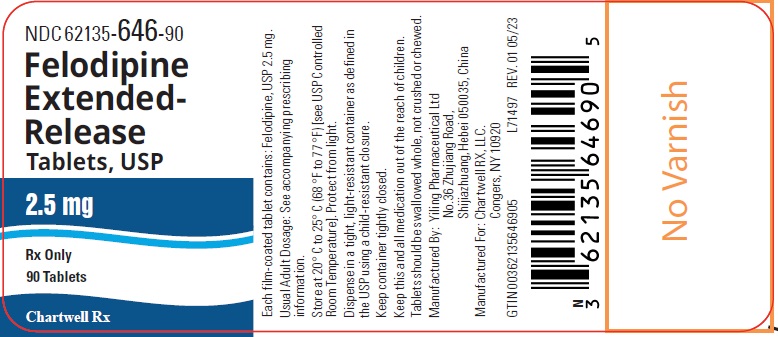
HOW SUPPLIED Felodipine Extended-release Tablets, USP 2.5 mg, are yellow film-coated, round convex tablets, with code Y161 on one side. They are supplied as follows: NDC 62135-646-90 bottles of 90’s Felodipine Extended-release Tablets, USP 5 mg, are pink film-coated, round convex tablets, with code Y162 on one side. They are supplied as follows: NDC 62135-647-90 bottles of 90’s Felodipine Extended-release Tablets, USP 10 mg, are red film-coated, round convex tablets, with code Y163 on one side.
They are supplied as follows: NDC 62135-648-90 bottles of 90’s Storage: Store at 20°C to 25°C (68°F to 77°F) [see USP Controlled Room Temperature]. Keep container tightly closed. Protect from light.
Manufactured by: Yiling Pharmaceutical Ltd No.36 Zhujiang Road, Shijiazhuang, Hebei 050035, China Manufactured for: Chartwell RX, LLC. Congers, NY 10920 Revised: 05/2023 L71500
📋 Description ▾
DESCRIPTION Felodipine, USP is a calcium antagonist (calcium channel blocker). Felodipine, USP is a dihydropyridine derivative that is chemically described as ± ethyl methyl 4-(2,3-dichlorophenyl) -1,4-dihydro-2, 6-dimethyl-3, 5- pyridinedicarboxylate. Its empirical formula is C 18 H 19 Cl 2 NO 4 and its structural formula is: Felodipine, USP is a slightly yellowish, crystalline powder with a molecular weight of 384.26.
It is insoluble in water and is freely soluble in dichloromethane and ethanol. Felodipine, USP is a racemic mixture. Felodipine Extended-release Tablets, USP provide extended release of felodipine.
They are available as tablets containing 2.5 mg, 5 mg, or 10 mg of felodipine for oral administration. Inactive ingredients for core tablets are: anhydrous lactose, butylated hydroxyanisole, butylated hydroxytoluene, colloidal silicon dioxide, hypromellose, polyoxyl 40 hydrogenated castor oil, microcrystalline cellulose, povidone K30 and sodium stearyl fumarate. Film coating materials of 2.5mg: ferrosoferric oxide, hypromellose, iron oxide red, iron oxide yellow, maltodextrin, medium chain triglycerides, polydextrose, talc and titanium dioxide.
Film coating materials of 5mg: ferrosoferric oxide, hypromellose, iron oxide red, iron oxide yellow, maltodextrin, medium chain triglycerides, polydextrose, talc and titanium dioxide. Film coating materials of 10mg: ferrosoferric oxide, hypromellose, iron oxide red, iron oxide yellow, maltodextrin, medium chain triglycerides, polydextrose, talc and titanium dioxide. Chemical Structure
⚠️ Precautions ▾
PRECAUTIONS General Hypotension— Felodipine, like other calcium antagonists, may occasionally precipitate significant hypotension and, rarely, syncope. It may lead to reflex tachycardia which in susceptible individuals may precipitate angina pectoris. (See ADVERSE REACTIONS .) Heart Failure— Although acute hemodynamic studies in a small number of patients with NYHA Class II or III heart failure treated with felodipine have not demonstrated negative inotropic effects, safety in patients with heart failure has not been established.
Caution, therefore, should be exercised when using Felodipine in patients with heart failure or compromised ventricular function, particularly in combination with a beta blocker. Patients with Impaired Liver Function— Patients with impaired liver function may have elevated plasma concentrations of felodipine and may respond to lower doses of Felodipine; therefore, a starting dose of 2.5 mg once a day is recommended. These patients should have their blood pressure monitored closely during dosage adjustment of Felodipine.
(See CLINICAL PHARMACOLOGY and DOSAGE AND ADMINISTRATION .) Peripheral Edema — Peripheral edema, generally mild and not associated with generalized fluid retention, was the most common adverse event in the clinical trials. The incidence of peripheral edema was both dose and age dependent. Frequency of peripheral edema ranged from about 10% in patients under 50 years of age taking 5 mg daily to about 30% in those over 60 years of age taking 20 mg daily.
This adverse effect generally occurs within 2–3 weeks of the initiation of treatment. Information for Patients Patients should be instructed to take Felodipine whole and not to crush or chew the tablets. They should be told that mild gingival hyperplasia (gum swelling) has been reported.
Good dental hygiene decreases its incidence and severity. NOTE: As with many other drugs, certain advice to patients being treated with Felodipine is warranted. This information is intended to aid in the safe and effective use of this medication.
It is not a disclosure of all possible adverse or intended effects. Drug Interactions CYP3A4 Inhibitors —Felodipine is metabolized by CYP3A4. Co-administration of CYP3A4 inhibitors (eg, ketoconazole, itraconazole, erythromycin, grapefruit juice, cimetidine) with felodipine may lead to several-fold increases in the plasma levels of felodipine, either due to an increase in bioavailability or due to a decrease in metabolism.
These increases in concentration may lead to increased effects, (lower blood pressure and increased heart rate). These effects have been observed with co-administration of itraconazole (a potent CYP3A4 inhibitor). Caution should be used when CYP3A4 inhibitors are co-administered with felodipine.
A conservative approach to dosing felodipine should be taken. The following specific interactions have been reported: Itraconazole —Co-administration of another extended release formulation of felodipine with itraconazole resulted in approximately 8-fold increase in the AUC, more than 6-fold increase in the C max , and 2-fold prolongation in the half-life of felodipine. Erythromycin— Co-administration of felodipine with erythromycin resulted in approximately 2.5-fold increase in the AUC and C max , and about 2-fold prolongation in the half-life of felodipine.
Grapefruit juice —Co-administration of felodipine with grapefruit juice resulted in more than 2-fold increase in the AUC and C max , but no prolongation in the half-life of felodipine. Cimetidine —Co-administration of felodipine with cimetidine (a non-specific CYP-450 inhibitor) resulted in an increase of approximately 50% in the AUC and the C max, of felodipine. Beta-Blocking Agents — A pharmacokinetic study of felodipine in conjunction with metoprolol demonstrated no significant effects on the pharmacokinetics of felodipine.
The AUC and C max of metoprolol, however, were increased approximately 31 and 38%, respectively. In controlled clinical tri… [Excerpted — this section continues on DailyMed.]
📄 Package Label / Principal Display Panel ▾
PACKAGE LABEL.PRINCIPAL DISPLAY PANEL Felodipine Extended-release Tablets, USP 2.5 mg - NDC 62135-646-90 - 90’s Bottle Label Felodipine Extended-release Tablets, USP 5 mg - NDC 62135-647-90 - 90’s Bottle Label Felodipine Extended-release Tablets, USP 10 mg - NDC 62135-648-90 - 90’s Bottle Label FELODIPINE-ER-TABLET-2PT5-MG-CONTAINER-LABEL FELODIPINE-ER-TABLET-5-MG-CONTAINER-LABEL FELODIPINE-ER-TABLET-10-MG-CONTAINER-LABEL