
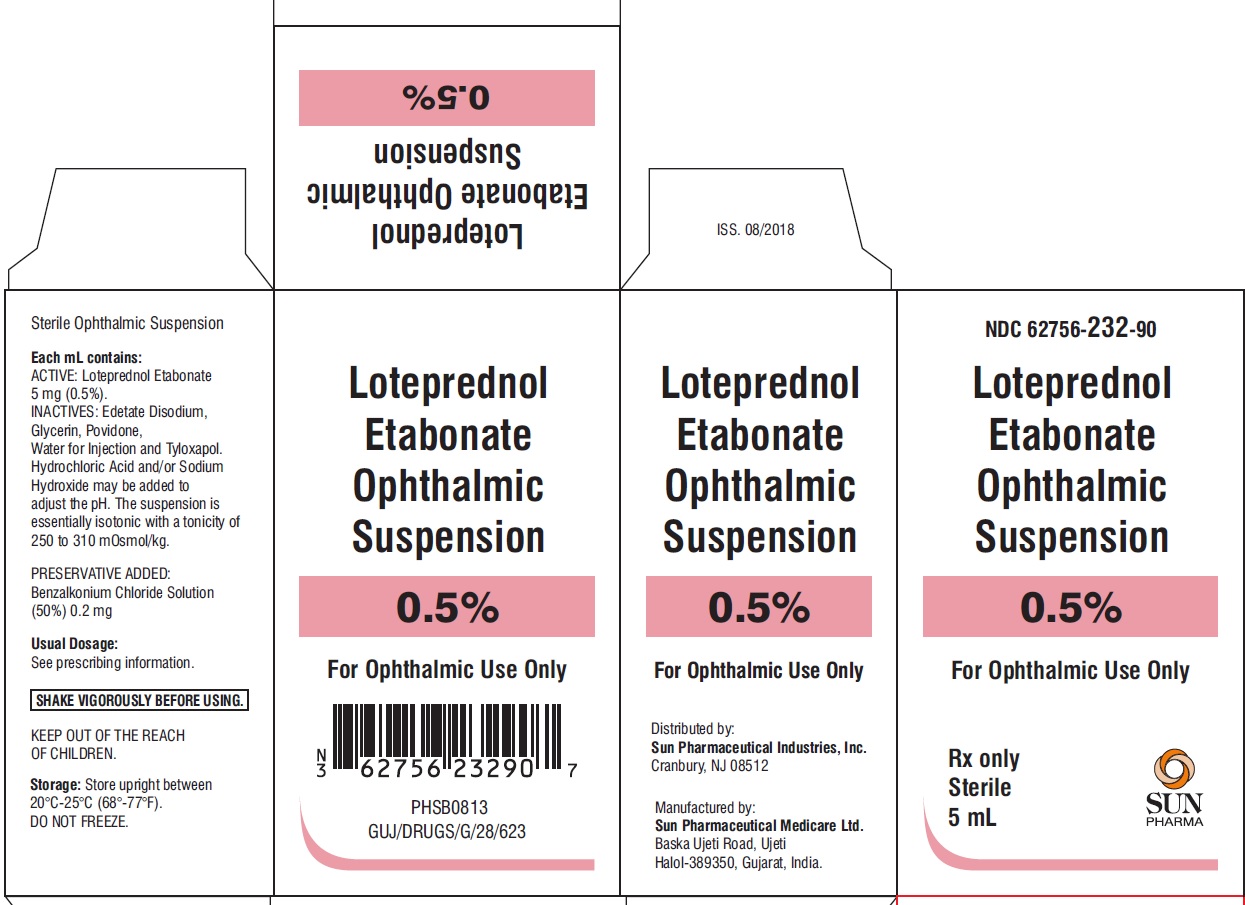
Loteprednol Etabonate 5 mg/mL Suspension/ Drops — NDC 62756-232-90 (Billing 62756-0232-90)
This is a package of Loteprednol Etabonate 5 mg/mL Suspension/ Drops from Sun Pharmaceutical Industries, Inc., marketed since May 2021 and currently FDA-listed, this package's marketing is listed to end Dec 2026; retail pharmacies pay about $10.47 per mL (NADAC). It is the main listing for this product, which comes in 3 package sizes.
NDC database record
One package, one record: these facts belong to NDC 62756-232-90 alone.
- Record
- FDA NDC Directory package listing · Human prescription drug
- Code segments
- 62756 labeler · 232 product · 90 package
- Package marketed since
- May 1, 2021
- Package marketing ended
- Dec 31, 2026
- Sample package
- No — commercial package
- Barcode (UPC)
- 0362756232907
- Medicaid fills, this package
- 1,492 prescriptions in the last four reported quarters
- FDA record last changed
- Jul 24, 2026
Past resolved recalls for this product (1)
Identity & classification
Regulatory identifiers FDA, NLM and CMS codes for this package
Drug-database identifiers Medi-Span GPI and First Databank GCN / HICL / AHFS classification
- GSN (GCN sequence number): 039106
- GCN: 95464
- GPI-14 (Medi-Span): 86300035101830
- HICL (First Databank): 018026
- AHFS class code: 52:08.08.00
- RxCUI (RxNorm): 311382
Where does this data come from?
- FDA openFDA NDC Directory · synced Oct 8, 2026
- FDA label on DailyMed · label index refreshed Oct 8, 2026
- RxNorm (NLM RxNav) · catalog refreshed Oct 1, 2026
- Medi-Span GPI (licensed)
- First Databank (licensed) · refreshed Oct 8, 2026
Clinical
Ophthalmic loteprednol products are used to treat different eye conditions: Loteprednol (Inveltys, Lotemax, Lotemax SM) is used to treat swelling and pain after cataract surgery (procedure to treat clouding of the lens in the eye). Loteprednol (Alrex) is used to reduce eye redness, itching, and swelling caused by seasonal allergies. Loteprednol (Lotemax) is used to reduce eye swelling caused by allergies, certain eye infections, ocular rosacea (condition that can cause swelling, redness, and itching of the eye), herpes zoster (shingles; a rash that can occur in people who have had chickenp...
Read the full MedlinePlus article ↗- It is a steroid eye medicine. Depending on the product, it treats inflammation and pain after eye surgery, steroid-responsive eye inflammation, seasonal allergic conjunctivitis (Al...
- Wash your hands first and follow the directions for your product. Suspensions need to be shaken, and gels need the closed bottle inverted and shaken once. If you use other eye drop...
- Eye pain and clouding behind the lens were the most common in trials after surgery, and surgery may have caused them. Steroid eye medicines can also raise eye pressure or cause cat...
- Call if your vision changes, your eye pain or redness gets worse, or you see discharge. Also call if symptoms do not improve after two days when using the suspension for inflammati...
Patient education
Supplement & herbal interactions
Where does this data come from?
- MedlinePlus (NLM) · refreshed Oct 8, 2026
- FDA label on DailyMed · label index refreshed Oct 8, 2026
Ask a licensed pharmacist directly — free, answered by our team.
Pricing
A drug doesn't have one price. Each row is a different public payment system, and none is what you'd pay at the counter — that depends on your insurance. The ⓘ on each row explains what it measures.
| Price system | Per mL | Per package |
|---|---|---|
| Retail pharmacies payNADAC · weekly | $10.474 | $52.37 / 5 ml |
| Medicaid paysCMS SDUD · 12 mo | $20.03 | $100.14 / 5 ml |
| Medicare drug plans payPart D · Q2 2026 | $22.55 | $112.76 / 5 ml |
Where does this data come from?
- CMS NADAC weekly file · file of Oct 7, 2026
- CMS ASP pricing files · refreshed Sep 20, 2026
- CMS Medicaid State Drug Utilization Data · through Q1 2026
- CMS Part D plan pricing files · refreshed Sep 24, 2026
- VA National Acquisition Center price file
Packaging — all sizes for this product
| Package NDC | Description | Per unit | Per pack | Marketing start | Marketing end | Status |
|---|---|---|---|---|---|---|
| 62756-0232-55 62756-232-55 | 1 BOTTLE in 1 CARTON / 10 mL in 1 BOTTLE | $21.20 / mL | $211.99 | 2021-05-01 | Dec 31, 2026 | Active |
| 62756-0232-56 62756-232-56 | 1 BOTTLE in 1 CARTON / 15 mL in 1 BOTTLE | $17.17 / mL | $257.52 | 2021-05-01 | Dec 31, 2026 | Active |
| 62756-0232-90 You're viewing this Main listing | 1 BOTTLE in 1 CARTON / 5 mL in 1 BOTTLE | $10.47 / mL | $52.37 | 2021-05-01 | Dec 31, 2026 | Active |
This pack has the lowest per-mL cost of the 3 priced pack sizes ($10.47 NADAC).
In Medicaid, this is the most-dispensed pack of this product — about 83% of fills over the last four reported quarters. See all packs ↓
Pack size FAQ
What quantity is in this package?
What NDC number is used to bill for this package of Loteprednol Etabonate 5 mg/mL Suspension/ Drops?
Prices are the latest CMS NADAC pharmacy acquisition cost per NDC; per-pack figures are per-unit × pack quantity, shown only when the pack is denominated in the same measure NADAC prices.
Therapeutic equivalents
| Product | Labeler | Pack | NADAC/unit | TE | Status | Price vs. this |
|---|---|---|---|---|---|---|
| Loteprednol Etabonate 5 mg/mL 00574-4135-05 | Padagis | 1 bottle | $10.474 | AB | Availability likely | — |
| Loteprednol Etabonate 5 mg/mL 60219-1362-01 | Amneal | 1 bottle | $10.474 | AB | Availability likely | — |
| Loteprednol Etabonate 5 mg/mLthis 62756-0232-90 | Sun | 1 bottle | $10.474 | AB | Availability likely | — |
| Loteprednol Etabonate 5 mg/mL 70244-0034-01 | Sentiss | 1 bottle | $10.474 | AB | Availability likely | — |
| loteprednol etabonate 5 mg/mL 70748-0300-01 | Lupin | 1 bottle | $10.474 | AB | Availability likely | — |
| Loteprednol Etabonate 5 mg/mL 72485-0665-05 | ARMAS | 1 bottle | $10.474 | AB | Availability likely | — |
| Loteprednol Etabonate 5 mg/mL 72603-0324-01 | NorthStar | 1 bottle | $10.474 | AB | Availability likely | — |
| Loteprednol Etabonate 5 mg/mL 82260-0299-05 | Bausch | 1 bottle | $10.474 | AB | Availability likely | — |
| Lotemax 5 mg/mL 24208-0299-01 | Bausch | 1 bottle | — | AB | FDA listed | — |
Where does this data come from?
- FDA openFDA NDC Directory · synced Oct 8, 2026
- FDA Orange Book · refreshed Oct 3, 2026
- CMS NADAC weekly file · file of Oct 7, 2026
Availability & generic status
This product is an FDA-approved generic. Other versions of the same drug are listed under Therapeutic equivalents, least expensive first.
Where does this data come from?
- FDA Orange Book · refreshed Oct 3, 2026
Inactive Ingredients / Excipients
Inactive ingredients, also called excipients, are components of the drug product other than the active ingredient. They may include fillers, dyes, coatings, preservatives, flavors, or other formulation ingredients.
🧪 Avoiding an ingredient? See Loteprednol Etabonate inactive ingredients by manufacturer: every current product's list side by side, so you can ask your pharmacy for the version that does not list it.
💡 Tap an ingredient (hover on desktop) to see what it is and why it’s used.
-
0.2 mg / 1 mL
UNII F5UM2KM3W7
Benzalkonium chloride is a chemical compound that works as a preservative and antimicrobial agent in medications. It prevents bacterial and fungal growth in liquid formulations to keep the product safe during storage and use.
-
UNII 7FLD91C86K
Edetate disodium is a chemical compound that binds and removes certain metal ions. In medicines, it acts as a preservative and stabilizer by preventing metals like calcium from interfering with the product's shelf life and consistency.
-
UNII PDC6A3C0OX
Glycerin is a clear, thick liquid derived from plant oils or fats. It acts as a humectant to retain moisture, a sweetener, and a solvent in medications.
-
UNII QTT17582CB
A strong acid used to adjust and maintain the proper pH level in liquid medicines, ensuring stability and preventing breakdown of active ingredients.
-
UNII FZ989GH94E
Povidone is a synthetic polymer made from a plastic-like material. It acts as a binder to hold tablet ingredients together and as a disintegrant to help the tablet break apart in your stomach so the medicine can be absorbed.
-
UNII 55X04QC32I
A strong alkaline chemical used to adjust and maintain the pH balance of liquid medicines. It helps keep the medicine stable and ensures it stays effective during storage.
-
UNII Y27PUL9H56
Tyloxapol is a synthetic detergent and surfactant used in medications as a solubilizer and emulsifier. It helps dissolve or blend ingredients that don't naturally mix well, improving how the medicine disperses in liquid formulations.
-
UNII 059QF0KO0R
Water is a liquid solvent that dissolves and mixes ingredients together in liquid medicines, syrups, and injections. It helps distribute the active drug evenly throughout the product.
8 inactive ingredients listed in the exact product block matched to this NDC.
Where does this data come from?
ingredient classCode="IACT" elements from the exact product block matched by this NDC. Label-section narrative from DailyMed / the openFDA label index is shown separately when available.- FDA label on DailyMed · label index refreshed Oct 8, 2026
- FDA openFDA NDC Directory · synced Oct 8, 2026
Inactive ingredient FAQ
Are inactive ingredients the same for every manufacturer?
Why might an inactive ingredient be missing?
Can inactive ingredients matter?
Manufacturer & labeler
More NDCs from Sun Pharmaceutical Industries, Inc. labeler code 62756
- IBANDRONATE SODIUM 3 mg/3mL Injection, Solution NDC 62756-218-40
- Ranolazine 25 kg/25kg Powder NDC 62756-220-11
- Ibrutinib (Form S4) 25 kg/25kg Powder NDC 62756-221-11
- Fluticasone Propionate 25 kg/25kg Powder NDC 62756-223-11
- Tiagabine Hydrochloride 4 mg Tablet, Film Coated NDC 62756-224-08
- Cetirizine Dihydrochloride 25 kg/25kg Powder NDC 62756-226-16
- Amphotericin B 50 mg Injectable, Liposomal NDC 62756-233-01
- Regadenoson 25 kg/25kg Powder NDC 62756-234-11
- Letrozole 25 kg/25kg Powder NDC 62756-235-12
- Capecitabine 150 mg Tablet, Film Coated NDC 62756-238-18
- Capecitabine 500 mg Tablet, Film Coated NDC 62756-239-18
- ondansetron 4 mg Tablet, Orally Disintegrating NDC 62756-240-64
Where does this data come from?
- FDA openFDA NDC Directory · synced Oct 8, 2026
- Drugs@FDA
Full prescribing information FDA SPL
🎯 Indications and Usage ▾
INDICATIONS AND USAGE: Loteprednol etabonate ophthalmic suspension is indicated for the treatment of steroid responsive inflammatory conditions of the palpebral and bulbar conjunctiva, cornea and anterior segment of the globe such as allergic conjunctivitis, acne rosacea, superficial punctate keratitis, herpes zoster keratitis, iritis, cyclitis, selected infective conjunctivitides, when the inherent hazard of steroid use is accepted to obtain an advisable diminution in edema and inflammation. Loteprednol etabonate ophthalmic suspension is less effective than prednisolone acetate 1% in two 28-day controlled clinical studies in acute anterior uveitis, where 72% of patients treated with loteprednol etabonate ophthalmic suspension experienced resolution of anterior chamber cells, compared to 87% of patients treated with prednisolone acetate 1%.
The incidence of patients with clinically significant increases in IOP (≥10 mmHg) was 1% with loteprednol etabonate ophthalmic suspension and 6% with prednisolone acetate 1%. Loteprednol etabonate ophthalmic suspension should not be used in patients who require a more potent corticosteroid for this indication. Loteprednol etabonate ophthalmic suspension is also indicated for the treatment of post-operative inflammation following ocular surgery.
⏱️ Dosage and Administration ▾
DOSAGE AND ADMINISTRATION: SHAKE VIGOROUSLY BEFORE USING. Steroid Responsive Disease Treatment: Apply one to two drops of loteprednol etabonate ophthalmic suspension into the conjunctival sac of the affected eye(s) four times daily. During the initial treatment within the first week, the dosing may be increased, up to 1 drop every hour, if necessary.
Care should be taken not to discontinue therapy prematurely. If signs and symptoms fail to improve after two days, the patient should be re-evaluated (See PRECAUTIONS). Post-Operative Inflammation: Apply one to two drops of loteprednol etabonate ophthalmic suspension into the conjunctival sac of the operated eye(s) four times daily beginning 24 hours after surgery and continuing throughout the first 2 weeks of the post-operative period.
⛔ Contraindications ▾
CONTRAINDICATIONS: Loteprednol etabonate ophthalmic suspension, as with other ophthalmic corticosteroids, is contraindicated in most viral diseases of the cornea and conjunctiva including epithelial herpes simplex keratitis (dendritic keratitis), vaccinia, and varicella, and also in mycobacterial infection of the eye and fungal diseases of ocular structures. Loteprednol etabonate ophthalmic suspension is also contraindicated in individuals with known or suspected hypersensitivity to any of the ingredients of this preparation and to other corticosteroids.
⚠️ Warnings ▾
WARNINGS: Prolonged use of corticosteroids may result in glaucoma with damage to the optic nerve, defects in visual acuity and fields of vision, and in posterior subcapsular cataract formation. Steroids should be used with caution in the presence of glaucoma. Prolonged use of corticosteroids may suppress the host response and thus increase the hazard of secondary ocular infections.
In those diseases causing thinning of the cornea or sclera, perforations have been known to occur with the use of topical steroids. In acute purulent conditions of the eye, steroids may mask infection or enhance existing infection. Use of ocular steroids may prolong the course and may exacerbate the severity of many viral infections of the eye (including herpes simplex).
Employment of a corticosteroid medication in the treatment of patients with a history of herpes simplex requires great caution. The use of steroids after cataract surgery may delay healing and increase the incidence of bleb formation.
🤒 Adverse Reactions ▾
ADVERSE REACTIONS: Reactions associated with ophthalmic steroids include elevated intraocular pressure, which may be associated with optic nerve damage, visual acuity and field defects, posterior subcapsular cataract formation, secondary ocular infection from pathogens including herpes simplex, and perforation of the globe where there is thinning of the cornea or sclera. Ocular adverse reactions occurring in 5% to 15% of patients treated with loteprednol etabonate ophthalmic suspension (0.2% to 0.5%) in clinical studies included abnormal vision/blurring, burning on instillation, chemosis, discharge, dry eyes, epiphora, foreign body sensation, itching, injection, and photophobia.
Other ocular adverse reactions occurring in less than 5% of patients include conjunctivitis, corneal abnormalities, eyelid erythema, keratoconjunctivitis, ocular irritation/pain/discomfort, papillae, and uveitis. Some of these events were similar to the underlying ocular disease being studied. Non-ocular adverse reactions occurred in less than 15% of patients.
These include headache, rhinitis and pharyngitis. In controlled, randomized studies of individuals treated for 28 days or longer with loteprednol etabonate, the incidence of significant elevation of intraocular pressure (≥10 mmHg) was 2% (15/901) among patients receiving loteprednol etabonate, 7% (11/164) among patients receiving 1% prednisolone acetate and 0.5% (3/583) among patients receiving placebo. To report SUSPECTED ADVERSE REACTIONS, contact Sun Pharmaceutical Industries, Inc. at 1-800-818-4555 or FDA at 1-800-FDA-1088 or www.fda.gov/medwatch.
🤰 Pregnancy ▾
Pregnancy: Teratogenic Effects: Pregnancy Category C. Loteprednol etabonate has been shown to be embryotoxic (delayed ossification) and teratogenic (increased incidence of meningocele, abnormal left common carotid artery, and limb flexures) when administered orally to rabbits during organogenesis at a dose of 3 mg/kg/day (35 times the maximum daily clinical dose), a dose which caused no maternal toxicity. The no-observed-effect-level (NOEL) for these effects was 0.5 mg/kg/day (6 times the maximum daily clinical dose).
Oral treatment of rats during organogenesis with 50 mg/kg/day or 100 mg/kg/day (600 and 1,200 times the maximum clinical dose) resulted in embryotoxicity (increased post-implantation losses with 100 mg/kg/day, and decreased fetal body weight and skeletal ossification with 50 mg/kg/day and 100 mg/kg/day); doses of 5 mg/kg/day (60 times the maximum daily clinical dose), 50 mg/kg/day and 100 mg/kg/day caused teratogenicity (absent innominate artery at all doses, and cleft palate and umbilical hernia at 50 mg/kg/day and 100 mg/kg/day).
Loteprednol etabonate was maternally toxic (significantly reduced body weight gain during treatment) when administered to pregnant rats during organogenesis at doses of 5 mg/kg/day to 100 mg/kg/day but not at 0.5 mg/kg/day. The NOELs for the embryotoxic and teratogenic effects in rats were 5 mg/kg/day and 0.5 mg/kg/day (60 and 6 times the maximum daily clinical dose) for embryotoxicity and teratogenicity, respectively. Oral exposure of pregnant rats to 5 mg/kg/day and 50 mg/kg/day of loteprednol etabonate during the fetal period, a maternally toxic treatment regimen (significantly decreased body weight gain), resulted in teratogenicity (umbilical herniation) and embryotoxicity (decreased fetal birth weight); the NOEL for these effects was 0.5 mg/kg/day.
Oral exposure of female rats to 50 mg/kg/day of loteprednol etabonate from the start of the fetal period through the end of lactation, a maternally toxic treatment regimen (significantly decreased body weight gain), gave rise to decreased growth and survival, and retarded development in the offspring during lactation; the NOEL for these effects was 5 mg/kg/day. Loteprednol etabonate had no effect on the duration of gestation or parturition when administered orally to pregnant rats at doses up to 50 mg/kg/day during the fetal period.
🧒 Pediatric Use ▾
Pediatric Use: Safety and effectiveness in pediatric patients have not been established.
🧬 Clinical Pharmacology ▾
CLINICAL PHARMACOLOGY: Corticosteroids inhibit the inflammatory response to a variety of inciting agents and probably delay or slow healing. They inhibit the edema, fibrin deposition, capillary dilation, leukocyte migration, capillary proliferation, fibroblast proliferation, deposition of collagen, and scar formation associated with inflammation. There is no generally accepted explanation for the mechanism of action of ocular corticosteroids.
However, corticosteroids are thought to act by the induction of phospholipase A 2 inhibitory proteins, collectively called lipocortins. It is postulated that these proteins control the biosynthesis of potent mediators of inflammation such as prostaglandins and leukotrienes by inhibiting the release of their common precursor arachidonic acid. Arachidonic acid is released from membrane phospholipids by phospholipase A 2 .
Corticosteroids are capable of producing a rise in intraocular pressure. Loteprednol etabonate is structurally similar to other corticosteroids. However, the number 20 position ketone group is absent.
It is highly lipid soluble which enhances its penetration into cells. Loteprednol etabonate is synthesized through structural modifications of prednisolone-related compounds so that it will undergo a predictable transformation to an inactive metabolite. Based upon in vivo and in vitro preclinical metabolism studies, loteprednol etabonate undergoes extensive metabolism to inactive carboxylic acid metabolites.
Results from a bioavailability study in normal volunteers established that plasma levels of loteprednol etabonate and Δ 1 cortienic acid etabonate (PJ 91), its primary, inactive metabolite, were below the limit of quantitation (1 ng/mL) at all sampling times. The results were obtained following the ocular administration of one drop in each eye of 0.5% loteprednol etabonate 8 times daily for 2 days or 4 times daily for 42 days. This study suggests that limited (<1 ng/mL) systemic absorption occurs with loteprednol etabonate ophthalmic suspension.
CLINICAL STUDIES: Post-operative Inflammation: Placebo-controlled clinical studies demonstrated that loteprednol etabonate ophthalmic suspension is effective for the treatment of anterior chamber inflammation as measured by cell and flare. Uveitis: Controlled clinical studies of patients with uveitis demonstrated that loteprednol etabonate ophthalmic suspension was less effective than prednisolone acetate 1%. Overall, 72% of patients treated with loteprednol etabonate ophthalmic suspension experienced resolution of anterior chamber cell by day 28, compared to 87% of patients treated with 1% prednisolone acetate.
The incidence of patients with clinically significant increases in IOP (≥10 mmHg) was 1% with loteprednol etabonate ophthalmic suspension and 6% with prednisolone acetate 1%. Giant Papillary Conjunctivitis: Placebo-controlled clinical studies demonstrated that loteprednol etabonate ophthalmic suspension was effective in reducing the signs and symptoms of giant papillary conjunctivitis after 1 week of treatment and continuing for up to 6 weeks while on treatment. Seasonal Allergic Conjunctivitis: A placebo-controlled clinical study demonstrated that loteprednol etabonate ophthalmic suspension was effective in reducing the signs and symptoms of allergic conjunctivitis during peak periods of pollen exposure.
📦 How Supplied / Storage and Handling ▾
HOW SUPPLIED: Loteprednol etabonate ophthalmic suspension is supplied in a white opaque LDPE plastic dropper bottle with LDPE white opaque plug and HDPE pilfer-proof pink cap as follows: 5 mL (NDC 62756-232-90) 10 mL (NDC 62756-232-55) 15 mL (NDC 62756-232-56) Storage: Store upright between 20°C to 25°C (68°F to 77°F). DO NOT FREEZE. KEEP OUT OF REACH OF CHILDREN.
Distributed by: Sun Pharmaceutical Industries, Inc. Cranbury, NJ 08512 Manufactured by: Sun Pharmaceutical Industries Ltd. Baska Ujeti Road, Ujeti, Halol-389350, Gujarat, India.
5255867 ISS. 12/2025
📋 Description ▾
DESCRIPTION: Loteprednol etabonate ophthalmic suspension contains a sterile, topical anti-inflammatory corticosteroid for ophthalmic use. Loteprednol etabonate is a white to off-white powder. Loteprednol etabonate is represented by the following structural formula: C 24 H 31 ClO 7 Mol.
Wt. 466.96 Chemical name: Chloromethyl 17α-[(ethoxycarbonyl)oxy]-11β-hydroxy-3-oxoandrosta-1,4-diene-17β-carboxylate Each mL contains: ACTIVE: Loteprednol Etabonate 5 mg (0.5%); INACTIVES: Edetate Disodium, Glycerin, Povidone, Water for Injection and Tyloxapol. Hydrochloric Acid and/or Sodium Hydroxide may be added to adjust the pH to 5.0 - 6.0.
The suspension is essentially isotonic with a tonicity of 250 to 310 mOsmol/kg. PRESERVATIVE ADDED: Benzalkonium Chloride Solution (50%) 0.2 mg. spl-loteprednol-structure
💬 Information for Patients ▾
Information for Patients: Patients should be advised not to allow the dropper tip to touch any surface, as this may contaminate the suspension. If pain develops, redness, itching or inflammation becomes aggravated, the patient should be advised to consult a physician. As with all ophthalmic preparations containing benzalkonium chloride, patients should be advised not to wear soft contact lenses when using loteprednol etabonate ophthalmic suspension.
⚠️ Precautions ▾
PRECAUTIONS: General: For ophthalmic use only. The initial prescription and renewal of the medication order beyond 14 days should be made by a physician only after examination of the patient with the aid of magnification, such as slit lamp biomicroscopy and, where appropriate, fluorescein staining. If signs and symptoms fail to improve after two days, the patient should be re-evaluated.
If this product is used for 10 days or longer, intraocular pressure should be monitored even though it may be difficult in children and uncooperative patients (see WARNINGS). Fungal infections of the cornea are particularly prone to develop coincidentally with long-term local steroid application. Fungus invasion must be considered in any persistent corneal ulceration where a steroid has been used or is in use.
Fungal cultures should be taken when appropriate. Information for Patients: Patients should be advised not to allow the dropper tip to touch any surface, as this may contaminate the suspension. If pain develops, redness, itching or inflammation becomes aggravated, the patient should be advised to consult a physician.
As with all ophthalmic preparations containing benzalkonium chloride, patients should be advised not to wear soft contact lenses when using loteprednol etabonate ophthalmic suspension. Carcinogenesis, Mutagenesis, Impairment of Fertility: Long-term animal studies have not been conducted to evaluate the carcinogenic potential of loteprednol etabonate. Loteprednol etabonate was not genotoxic in the Ames test, the mouse lymphoma tk assay, or in a chromosome aberration test in human lymphocytes, three in vitro tests.In vivo evidence of genotoxicity, an increased frequency of micronucleated immature erythrocytes, was not observed in mice that received a single 4 gm/kg dose of loteprednol etabonate (50,000 times the maximum daily clinical dose).
Treatment of male and female rats with up to 50 mg/kg/day and 25 mg/kg/day of loteprednol etabonate, respectively, (600 and 300 times the maximum clinical dose, respectively) prior to and during mating did not impair fertility in either gender. Pregnancy: Teratogenic Effects: Pregnancy Category C. Loteprednol etabonate has been shown to be embryotoxic (delayed ossification) and teratogenic (increased incidence of meningocele, abnormal left common carotid artery, and limb flexures) when administered orally to rabbits during organogenesis at a dose of 3 mg/kg/day (35 times the maximum daily clinical dose), a dose which caused no maternal toxicity.
The no-observed-effect-level (NOEL) for these effects was 0.5 mg/kg/day (6 times the maximum daily clinical dose). Oral treatment of rats during organogenesis with 50 mg/kg/day or 100 mg/kg/day (600 and 1,200 times the maximum clinical dose) resulted in embryotoxicity (increased post-implantation losses with 100 mg/kg/day, and decreased fetal body weight and skeletal ossification with 50 mg/kg/day and 100 mg/kg/day); doses of 5 mg/kg/day (60 times the maximum daily clinical dose), 50 mg/kg/day and 100 mg/kg/day caused teratogenicity (absent innominate artery at all doses, and cleft palate and umbilical hernia at 50 mg/kg/day and 100 mg/kg/day).
Loteprednol etabonate was maternally toxic (significantly reduced body weight gain during treatment) when administered to pregnant rats during organogenesis at doses of 5 mg/kg/day to 100 mg/kg/day but not at 0.5 mg/kg/day. The NOELs for the embryotoxic and teratogenic effects in rats were 5 mg/kg/day and 0.5 mg/kg/day (60 and 6 times the maximum daily clinical dose) for embryotoxicity and teratogenicity, respectively. Oral exposure of pregnant rats to 5 mg/kg/day and 50 mg/kg/day of loteprednol etabonate during the fetal period, a maternally toxic treatment regimen (significantly decreased body weight gain), resulted in teratogenicity (umbilical herniation) and embryotoxicity (decreased fetal birth weight); the NOEL for these effects was 0.5 mg/kg/day.
Oral exposure of female rats to 50 mg/kg/day of lotepred… [Excerpted — this section continues on DailyMed.]
🍼 Nursing Mothers ▾
Nursing Mothers: It is not known whether topical ophthalmic administration of corticosteroids could result in sufficient systemic absorption to produce detectable quantities in human milk. Systemic steroids appear in human milk and could suppress growth, interfere with endogenous corticosteroid production, or cause other untoward effects. Caution should be exercised when loteprednol etabonate ophthalmic suspension is administered to a nursing woman.
📄 Carcinogenesis, Mutagenesis, Impairment of Fertility ▾
Carcinogenesis, Mutagenesis, Impairment of Fertility: Long-term animal studies have not been conducted to evaluate the carcinogenic potential of loteprednol etabonate. Loteprednol etabonate was not genotoxic in the Ames test, the mouse lymphoma tk assay, or in a chromosome aberration test in human lymphocytes, three in vitro tests.In vivo evidence of genotoxicity, an increased frequency of micronucleated immature erythrocytes, was not observed in mice that received a single 4 gm/kg dose of loteprednol etabonate (50,000 times the maximum daily clinical dose).
Treatment of male and female rats with up to 50 mg/kg/day and 25 mg/kg/day of loteprednol etabonate, respectively, (600 and 300 times the maximum clinical dose, respectively) prior to and during mating did not impair fertility in either gender.
📄 Package Label / Principal Display Panel ▾
PACKAGE LABEL.PRINCIPAL DISPLAY PANEL-Carton NDC 62756-232-90 Loteprednol Etabonate Ophthalmic Suspension 0.5% For Ophthalmic Use Only Rx only Sterile 5 mL SUN PHARMA spl-loteprednol-carton
PACKAGE LABEL.PRINCIPAL DISPLAY PANEL-Label NDC 62756-232-90 Loteprednol Etabonate Ophthalmic Suspension 0.5% For Ophthalmic Use Only 5 mL spl-loteprednol-label