
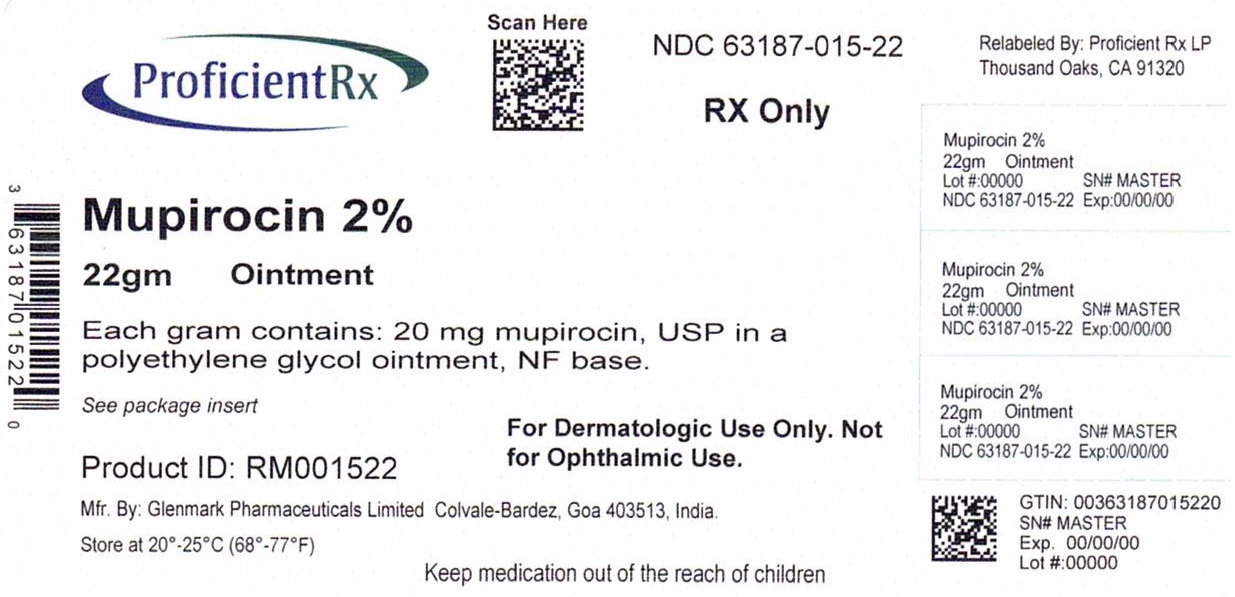
Mupirocin 20 mg/g Ointment, 22 g — NDC 63187-015-22 (Billing 63187-0015-22)
This is a package of 22 g of Mupirocin 20 mg/g Ointment from Proficient Rx LP, marketed since Jun 2011 and currently FDA-listed. It is this product's only package size.
Identity & classification
Regulatory identifiers FDA, NLM and CMS codes for this package
Drug-database identifiers Medi-Span GPI and First Databank GCN / HICL / AHFS classification
- GSN (GCN sequence number): 007732
- GCN: 47450
- GPI-14 (Medi-Span): 90100065104210
- HICL (First Databank): 003385
- AHFS class code: 84:04.04.00
- RxCUI (RxNorm): 106346
Where does this data come from?
- FDA openFDA NDC Directory · synced Oct 1, 2026
- FDA label on DailyMed · label index refreshed Oct 1, 2026
- RxNorm (NLM RxNav) · catalog refreshed Oct 1, 2026
- Medi-Span GPI (licensed)
- First Databank (licensed) · refreshed Oct 1, 2026
RxNorm drug class
This medicine belongs to the RNA Synthetase Inhibitor Antibacterial class.
Where does this data come from?
- RxClass (NLM) · catalog refreshed Oct 1, 2026
Clinical
Mupirocin, an antibiotic, is used to treat impetigo as well as other skin infections caused by bacteria. It is not effective against fungal or viral infections. This medication is sometimes prescribed for other uses; ask your doctor or pharmacist for more information.
Read the full MedlinePlus article ↗- It treats certain bacterial skin infections. The ointment is for impetigo. The cream is for small infected cuts or wounds. Both target Staphylococcus aureus and Streptococcus pyoge...
- Put a small amount on the infected area with a cotton swab or gauze, 3 times a day. You can cover it with gauze if you like. Follow your prescriber’s directions for how many days.
- Check back with your prescriber if you don’t see improvement within 3 to 5 days. Stop and call if you have severe irritation. Get emergency help for hives, swelling or trouble brea...
- No. It is not for the nose, eyes or other moist body surfaces. If it gets in your eyes, rinse well with water.
Patient education
Supplement & herbal interactions
Some supplements/herbs that may interact with Mupirocin — tap one for details:
Where does this data come from?
- MedlinePlus (NLM) · refreshed Oct 1, 2026
- FDA label on DailyMed · label index refreshed Oct 1, 2026
Ask a licensed pharmacist directly — free, answered by our team.
Pricing
A drug doesn't have one price. Each row is a different public payment system, and none is what you'd pay at the counter — that depends on your insurance. The ⓘ on each row explains what it measures.
| Price system | Per g | Per package |
|---|---|---|
| Retail pharmacies payNADAC · weekly | Not in the retail survey — common for institutional, discontinued, or low-volume packs. | |
| Medicaid paysCMS SDUD · 12 mo | No recent Medicaid claims on file for this NDC — rare and low-volume NDCs are suppressed in the public data. | |
| Medicare drug plans payPart D · Q2 2026 | $0.3533 | $7.77 / 22 g |
Where does this data come from?
- CMS NADAC weekly file
- CMS ASP pricing files · refreshed Sep 20, 2026
- CMS Medicaid State Drug Utilization Data · refreshed Oct 3, 2026
- CMS Part D plan pricing files · refreshed Sep 24, 2026
- VA National Acquisition Center price file
Packaging — all sizes for this product
| Package NDC | Description | Marketing start | Marketing end | Status |
|---|---|---|---|---|
| 63187-0015-22 You're viewing this Main listing | 22 g in 1 TUBE | 2018-11-01 | — | Active |
Therapeutic equivalents
| Product | Labeler | Pack | NADAC/unit | TE | Status | Price vs. this |
|---|---|---|---|---|---|---|
| Mupirocin 20 mg/g 00093-1010-42 | Teva | 1 tube | $0.146 | AB | Availability likely | — |
| Mupirocin 20 mg/g 51672-1312-00 | Sun | 1 tube | $0.146 | AB | Availability likely | — |
| Mupirocin 20 mg/g 68462-0180-22 | Glenmark | 22 g | $0.146 | AB | Availability likely | — |
| Mupirocin 20 mg/g 21922-0073-04 | Encube | 1 tube | $0.298 | AB | Availability likely | — |
| mupirocin 20 mg/g 45802-0112-14 | Padagis | 1 tube | $0.298 | AB | Availability likely | — |
| Mupirocin 20 mg/g 00121-1076-00 | PAI | 100 tubes | — | AB | FDA listed | — |
| mupirocin 20 mg/g 17856-0112-01 | ATLANTIC | 1 g | — | AB | FDA listed | — |
| mupirocin 20 mg/g 50090-1587-00 | A-S | 1 tube | — | AB | FDA listed | — |
| Mupirocin 20 mg/g 50268-0568-15 | AvPAK | 50 tubes | — | AB | FDA listed | — |
| mupirocin 20 mg/g 60760-0960-22 | St. | 1 tube | — | AB | FDA listed | — |
| Mupirocin 20 mg/g 61919-0158-22 | DIRECT | 20 g | — | AB | FDA listed | — |
| Mupirocin 20 mg/gthis 63187-0015-22 | Proficient | 22 g | — | AB | FDA listed | — |
| Mupirocin 20 mg/g 63187-0151-22 | Proficient | 1 tube | — | AB | FDA listed | — |
| mupirocin 20 mg/g 63187-0261-22 | Proficient | 1 tube | — | AB | FDA listed | — |
| Mupirocin 20 mg/g 63187-0525-22 | Proficient | 1 tube | — | AB | FDA listed | — |
| mupirocin 20 mg/g 63629-8687-01 | Bryant | 1 tube | — | AB | FDA listed | — |
| Mupirocin 20 mg/g 67296-2211-01 | Redpharm | 1 tube | — | AB | FDA listed | — |
| Mupirocin 20 mg/g 68071-4111-02 | NuCare | 22 g | — | AB | FDA listed | — |
| Mupirocin 20 mg/g 68071-4321-02 | NuCare | 22 g | — | AB | FDA listed | — |
| mupirocin 20 mg/g 68071-4789-02 | NuCare | 22 g | — | AB | FDA listed | — |
| Mupirocin 20 mg/g 68788-8534-02 | Preferred | 22 g | — | AB | FDA listed | — |
| mupirocin 20 mg/g 68788-8642-02 | Preferred | 1 tube | — | AB | FDA listed | — |
| Mupirocin 20 mg/g 70166-0355-10 | Lohxa | 100 tubes | — | AB | FDA listed | — |
| mupirocin 20 mg/g 70518-1808-00 | REMEDYREPACK | 1 tube | — | AB | FDA listed | — |
| mupirocin 20 mg/g 71335-2829-01 | Bryant | 1 tube | — | AB | FDA listed | — |
| mupirocin 20 mg/g 72162-2270-02 | Bryant | 1 tube | — | AB | FDA listed | — |
| mupirocin 20 mg/g 76420-0128-22 | Asclemed | 22 g | — | AB | FDA listed | — |
| Mupirocin 20 mg/g 80425-0246-01 | Advanced | 1 tube | — | AB | FDA listed | — |
| Mupirocin 20 mg/g 80425-0254-01 | Advanced | 1 tube | — | AB | FDA listed | — |
| Mupirocin 20 mg/g 81033-0032-50 | Kesin | 50 tubes | — | AB | FDA listed | — |
| Mupirocin 20 mg/g 85766-0207-15 | Sportpharm | 1 tube | — | AB | FDA listed | — |
| mupirocin 20 mg/g 85534-0038-00 | HAWAII | 1 tube | — | AB | FDA listed | — |
Where does this data come from?
- FDA openFDA NDC Directory · synced Oct 1, 2026
- FDA Orange Book · refreshed Sep 3, 2026
- CMS NADAC weekly file
Availability & generic status
This product is an FDA-approved generic. Other versions of the same drug are listed under Therapeutic equivalents, least expensive first.
Where does this data come from?
- FDA Orange Book · refreshed Sep 3, 2026
Inactive Ingredients / Excipients
Inactive ingredients, also called excipients, are components of the drug product other than the active ingredient. They may include fillers, dyes, coatings, preservatives, flavors, or other formulation ingredients.
💡 Tap an ingredient (hover on desktop) to see what it is and why it’s used.
-
UNII G2M7P15E5P
Polyethylene glycol 3350 is a synthetic polymer used as a solvent, humectant, and thickening agent in medicines. It helps dissolve other ingredients, retain moisture in the product, and achieve the desired consistency.
-
UNII B697894SGQ
Polyethylene glycol 400 is a clear, thick liquid made from petroleum-derived polymers. It acts as a solvent and humectant in medicines, helping dissolve active ingredients and retain moisture in the formulation.
2 inactive ingredients listed in the exact product block matched to this NDC.
Where does this data come from?
ingredient classCode="IACT" elements from the exact product block matched by this NDC. Label-section narrative from DailyMed / the openFDA label index is shown separately when available.- FDA label on DailyMed · label index refreshed Oct 1, 2026
- FDA openFDA NDC Directory · synced Oct 1, 2026
Inactive ingredient FAQ
Are inactive ingredients the same for every manufacturer?
Why might an inactive ingredient be missing?
Can inactive ingredients matter?
Manufacturer & labeler
Where does this data come from?
- FDA openFDA NDC Directory · synced Oct 1, 2026
- Drugs@FDA
Full prescribing information FDA SPL
🎯 Indications and Usage ▾
INDICATIONS AND USAGE Mupirocin ointment USP, 2% is indicated for the topical treatment of impetigo due to: S. aureus and S. pyogenes.
⏱️ Dosage and Administration ▾
DOSAGE AND ADMINISTRATION A small amount of mupirocin ointment should be applied to the affected area 3 times daily. The area treated may be covered with a gauze dressing if desired. Patients not showing a clinical response within 3 to 5 days should be re-evaluated.
⛔ Contraindications ▾
CONTRAINDICATIONS This drug is contraindicated in individuals with a history of sensitivity reactions to any of its components.
⚠️ Warnings ▾
WARNINGS Mupirocin ointment is not for ophthalmic use.
🤒 Adverse Reactions ▾
ADVERSE REACTIONS The following local adverse reactions have been reported in connection with the use of mupirocin ointment : Burning, stinging, or pain in 1.5% of patients; itching in 1% of patients; rash, nausea, erythema, dry skin, tenderness, swelling, contact dermatitis, and increased exudate in less than 1% of patients. Systemic reactions to mupirocin ointment have occurred rarely.
🔄 Drug Interactions ▾
Drug Interactions The effect of the concurrent application of mupirocin ointment and other drug products has not been studied.
🤰 Pregnancy ▾
Pregnancy Teratogenic Effects Reproduction studies have been performed in rats and rabbits with mupirocin administrated subcutaneously at doses up to 22 and 43 times, respectively, the human topical dose (approximately 60 mg mupirocin per day) on a mg/m 2 basis and revealed no evidence of harm to the fetus due to mupirocin. There are, however, no adequate and well-controlled studies in pregnant women. Because animal studies are not always predictive of human response, this drug should be used during pregnancy only if clearly needed.
🧒 Pediatric Use ▾
Pediatric Use The safety and effectiveness of mupirocin ointment have been established in the age range of 2 months to 16 years. Use of mupirocin ointment in these age groups is supported by evidence from adequate and well-controlled studies of mupirocin ointment in impetigo in pediatric patients studied as a part of the pivotal clinical trials (see CLINICAL STUDIES ).
🧬 Clinical Pharmacology ▾
CLINICAL PHARMACOLOGY Application of 14 C-labeled mupirocin ointment to the lower arm of normal male subjects followed by occlusion for 24 hours showed no measurable systemic absorption (<1.1 nanogram mupirocin per milliliter of whole blood). Measurable radioactivity was present in the stratum corneum of these subjects 72 hours after application. Following intravenous or oral administration, mupirocin is rapidly metabolized.
The principal metabolite, monic acid, is eliminated by renal excretion, and demonstrates no antibacterial activity. In a study conducted in 7 healthy adult male subjects, the elimination half-life after intravenous administration of mupirocin was 20 to 40 minutes for mupirocin and 30 to 80 minutes for monic acid. The pharmacokinetics of mupirocin has not been studied in individuals with renal insufficiency.
Microbiology: Mupirocin is an antibacterial agent produced by fermentation using the organism Pseudomonas fluorescens. It is active against a wide range of gram-positive bacteria including methicillin-resistant Staphylococcus aureus (MRSA). It is also active against certain gram-negative bacteria.
Mupirocin inhibits bacterial protein synthesis by reversibly and specifically binding to bacterial isoleucyl transfer-RNA synthetase. Due to unique mode of action, mupirocin demonstrates no in vitro cross-resistance with other classes of antimicrobial agents. Resistance occurs rarely.
However, when mupirocin resistance does occur, it appears to result from the production of a modified isoleucyl-tRNA synthetase. High-level plasmid-mediated resistance (MIC > 1024 mcg/mL) has been reported in some strains of S. aureus and coagulase-negative staphylococci. Mupirocin is bactericidal at concentrations achieved by topical administration.
However, the minimum bactericidal concentration (MBC) against relevant pathogens is generally 8-fold to 30-fold higher than the minimum inhibitory concentration (MIC). In addition, mupirocin is highly protein-bound (>97%), and the effect of wound secretions on the MICs of mupirocin has not been determined. Mupirocin has been shown to be active against most strains of S. aureus and Streptococcus pyogenes ,both in vitro and in clinical studies (see INDICATIONS AND USAGE ).The following in vitro data are available, BUT THEIR CLINICAL SIGNIFICANCE IS UNKNOWN.
Mupirocin is active against most strains of Staphylococcus epidermidis and Staphylococcus saprophyticus .
📦 How Supplied / Storage and Handling ▾
HOW SUPPLIED Mupirocin ointment USP, 2% is supplied in 22 gram tubes. NDC 63187-015-22 (22-gram tube) Store at 20 o to 25 o C (68 o to 77 o F) [see USP Controlled Room Temperature]. *Bactroban ® Nasal is a registered trademark of GlaxoSmithKline. Manufactured by: Glenmark Generics Ltd.
Colvale-Bardez, Goa 403 513, India Manufactured for: Glenmark Generics Inc., USA Mahwah, NJ 07430 Questions? 1 (888)721-7115 www.glenmarkgenerics.com Relabeled by: Proficient Rx LP Thousand Oaks, CA 91320 June 2011 Glenmark logo
📋 Description ▾
DESCRIPTION Each gram of mupirocin ointment USP, 2% contains 20 mg mupirocin USP in a bland water miscible ointment base (polyethylene glycol ointment, N.F.) consisting of polyethylene glycol 400 and polyethylene glycol 3350. Mupirocin is a naturally occurring antibiotic. The chemical name is (E)-( 2 S, 3 R, 4 R, 5 S)- 5 -[( 2 S, 3 S, 4 S, 5 S) -2,3-Epoxy-5-hydroxy-4-methylhexyl]tetrahydro-3,4-dihydroxy-β-methyl-2 H -pyran-2-crotonic acid, ester with 9-hydroxynonanoic acid.
The molecular formula of mupirocin is C 26 H 44 O 9 , and the molecular weight is 500.63. The chemical structure is: Structure of Mupirocin
💬 Information for Patients ▾
Information for Patients Use this medication only as directed by your healthcare provider. It is for external use only. Avoid contact with the eyes. The medication should be stopped and your healthcare practitioner contacted if irritation, severe itching, or rash occurs. If impetigo has not improved in 3 to 5 days, contact your healthcare practitioner.
⚠️ Precautions ▾
PRECAUTIONS If a reaction suggesting sensitivity or chemical irritation should occur with the use of mupirocin ointment, treatment should be discontinued and appropriate alternative therapy for the infection instituted. As with other antibacterial products, prolonged use may result in overgrowth of non-susceptible organisms, including fungi. Mupirocin ointment is not formulated for use on mucosal surfaces.
Intranasal use has been associated with isolated reports of stinging and drying. A paraffin-based formulation –*Bactroban ® Nasal (mupirocin calcium ointment) – is available for intranasal use. Polyethylene glycol can be absorbed from open wounds and damaged skin and is excreted by the kidneys.
In common with other polyethylene glycol-based ointments, mupirocin ointment should not be used in conditions where absorption of large quantities of polyethylene glycol is possible, especially if there is evidence of moderate or severe renal impairment. Information for Patients Use this medication only as directed by your healthcare provider. It is for external use only.
Avoid contact with the eyes. The medication should be stopped and your healthcare practitioner contacted if irritation, severe itching, or rash occurs. If impetigo has not improved in 3 to 5 days, contact your healthcare practitioner.
Drug Interactions The effect of the concurrent application of mupirocin ointment and other drug products has not been studied. Carcinogenesis, Mutagenesis, Impairment of Fertility Long-term studies in animals to evaluate carcinogenic potential of mupirocin have not been conducted. Results of the following studies performed with mupirocin calcium or mupirocin sodium in vitroand in vivodid not indicate a potential for genotoxicity: Rat primary hepatocyte unscheduled DNA synthesis, sediment analysis for DNA strand breaks, Salmonella reversion test (Ames), Escherichia coli mutation assay, metaphase analysis of human lymphocytes, mouse lymphoma assay, and bone marrow micronuclei assay in mice.
Reproduction studies were performed in male and female rats with mupirocin administered subcutaneously at doses up to 14 times a human topical dose (approximately 60 mg mupirocin per day) on a mg/m 2 basis and revealed no evidence of impaired fertility and reproductive performance from mupirocin Pregnancy Teratogenic Effects Reproduction studies have been performed in rats and rabbits with mupirocin administrated subcutaneously at doses up to 22 and 43 times, respectively, the human topical dose (approximately 60 mg mupirocin per day) on a mg/m 2 basis and revealed no evidence of harm to the fetus due to mupirocin.
There are, however, no adequate and well-controlled studies in pregnant women. Because animal studies are not always predictive of human response, this drug should be used during pregnancy only if clearly needed. Nursing Mothers It is not known whether this drug is excreted in human milk.
Because many drugs are excreted in human milk, caution should be exercised when mupirocin ointment is administered to a nursing woman. Pediatric Use The safety and effectiveness of mupirocin ointment have been established in the age range of 2 months to 16 years. Use of mupirocin ointment in these age groups is supported by evidence from adequate and well-controlled studies of mupirocin ointment in impetigo in pediatric patients studied as a part of the pivotal clinical trials (see CLINICAL STUDIES ).
🍼 Nursing Mothers ▾
Nursing Mothers It is not known whether this drug is excreted in human milk. Because many drugs are excreted in human milk, caution should be exercised when mupirocin ointment is administered to a nursing woman.
🔬 Clinical Studies ▾
CLINICAL STUDIES The efficacy of topical mupirocin ointment in impetigo was tested in 2 studies. In the first, patients with impetigo were randomized to receive either mupirocin ointment or vehicle placebo 3 times daily for 8 to 12 days. Clinical efficacy rates at end of therapy in the evaluable populations (adults and pediatric patients included) were 71% for mupirocin ointment (n = 49) and 35% for vehicle placebo (n = 51).
Pathogen eradication rates in the evaluable populations were 94% for mupirocin ointment and 62% for vehicle placebo. There were no side effects reported in the group receiving mupirocin ointment. In the second study, patients with impetigo were randomized to receive either mupirocin ointment 3 times daily or 30 to 40 mg/kg oral erythromycin ethylsuccinate per day (this was an unblinded study) for 8 days.
There was a follow-up visit 1 week after treatment ended. Clinical efficacy rates at the follow-up visit in the evaluable populations (adults and pediatric patients included) were 93% for mupirocin ointment (n = 29) and 78.5% for erythromycin (n = 28). Pathogen eradication rates in the evaluable patient populations were 100% for both test groups.
There were no side effects reported in the group receiving mupirocin ointment. Pediatrics: There were 91 pediatric patients aged 2 months to 15 years in the first study described above. Clinical efficacy rates at end of therapy in the evaluable populations were 78% for mupirocin ointment (n = 42) and 36% for vehicle placebo (n = 49).
In the second study described above, all patients were pediatric except 2 adults in the group receiving mupirocin ointment. The age range of the pediatric patients was 7 months to 13 years. The clinical efficacy rate for mupirocin ointment (n = 27) was 96%, and for erythromycin it was unchanged (78.5%).
📄 Carcinogenesis, Mutagenesis, Impairment of Fertility ▾
Carcinogenesis, Mutagenesis, Impairment of Fertility Long-term studies in animals to evaluate carcinogenic potential of mupirocin have not been conducted. Results of the following studies performed with mupirocin calcium or mupirocin sodium in vitroand in vivodid not indicate a potential for genotoxicity: Rat primary hepatocyte unscheduled DNA synthesis, sediment analysis for DNA strand breaks, Salmonella reversion test (Ames), Escherichia coli mutation assay, metaphase analysis of human lymphocytes, mouse lymphoma assay, and bone marrow micronuclei assay in mice.
Reproduction studies were performed in male and female rats with mupirocin administered subcutaneously at doses up to 14 times a human topical dose (approximately 60 mg mupirocin per day) on a mg/m 2 basis and revealed no evidence of impaired fertility and reproductive performance from mupirocin
📄 Package Label / Principal Display Panel ▾
PACKAGE/LABEL PRINCIPAL DISPLAY PANEL 63187-015-22
Medicare Part D spend CMS · PART D · 2026 (Q1)
About this NDC listing & data coverage
What data is (and isn’t) available for this NDC — tap to expand
| NDC identity (package / product / labeler codes) | ✓ Available |
| Labeler | ✓ Available |
| Product & package description | ✓ Available |
| Marketing category & status | ✓ Available |
| Active ingredient / dosage form / route | ✓ Available |
| FDA label (SPL via DailyMed) | ✓ Available |
| Package photos | ✓ Available |
| Inactive ingredients (structured) | ✓ Available |
| NADAC pharmacy acquisition price (CMS) | — Not published for this NDC CMS publishes NADAC only for NDCs reported in its retail-pharmacy survey. |
| Orange Book / therapeutic-equivalence data | ✓ Available |
| HCPCS J-code billing crosswalk | — Not published for this NDC Most self-administered / retail products have no J-code — that is normal. |
| Medicaid utilization (CMS SDUD) | — Not published for this NDC CMS reports utilization only for NDCs with Medicaid claims above its privacy threshold. |