
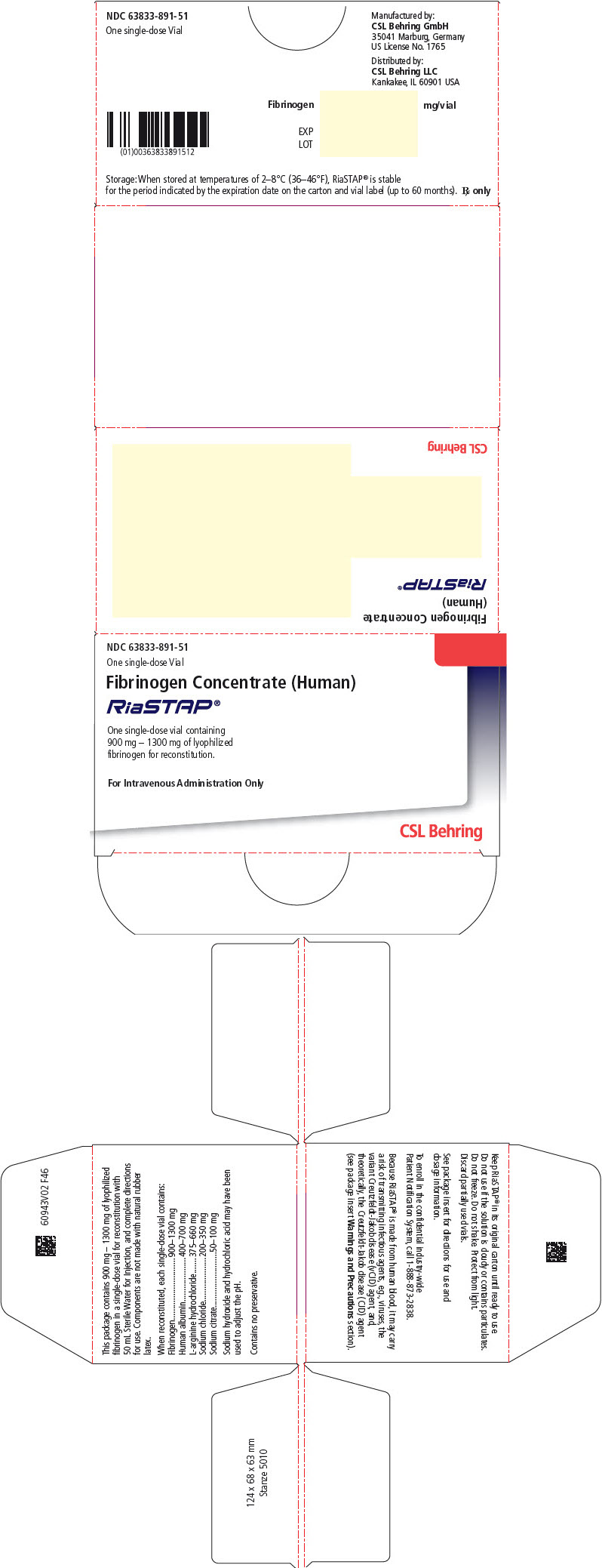
RiaSTAP FIBRINOGEN HUMAN 1300 mg/50mL Injection, Powder, Lyophilized, For Solution — NDC 63833-891-51 (Billing 63833-0891-51)
This is a package of RiaSTAP FIBRINOGEN HUMAN 1300 mg/50mL Injection, Powder, Lyophilized, For Solution from CSL Behring GmbH, marketed since Jan 2009 and currently FDA-listed. It is this product's only package size.
NDC database record
One package, one record: these facts belong to NDC 63833-891-51 alone.
- Record
- FDA NDC Directory package listing · Plasma derivative
- Code segments
- 63833 labeler · 891 product · 51 package
- Package marketed since
- Jan 16, 2009
- Sample package
- No — commercial package
- Listing certified through
- Dec 31, 2027
- Barcode (UPC-A, from the NDC)
- 3 6383389151 2
- FDA record last changed
- Oct 2, 2026
Identity & classification
Regulatory identifiers FDA, NLM and CMS codes for this package
Drug-database identifiers Medi-Span GPI and First Databank GCN / HICL / AHFS classification
- GSN (GCN sequence number): 065073
- GCN: 21666
- GPI-14 (Medi-Span): 85100035002120
- HICL (First Databank): 012033
- AHFS class code: 20:28.16.00
Where does this data come from?
- FDA openFDA NDC Directory · synced Oct 1, 2026
- FDA label on DailyMed · label index refreshed Oct 5, 2026
- RxNorm (NLM RxNav) · catalog refreshed Oct 1, 2026
- Medi-Span GPI (licensed)
- First Databank (licensed) · refreshed Oct 1, 2026
Clinical
Patient education
Supplement & herbal interactions
Where does this data come from?
- MedlinePlus (NLM) · refreshed Oct 1, 2026
- FDA label on DailyMed · label index refreshed Oct 5, 2026
Ask a licensed pharmacist directly — free, answered by our team.
Pricing
A drug doesn't have one price. Each row is a different public payment system, and none is what you'd pay at the counter — that depends on your insurance. The ⓘ on each row explains what it measures.
| Price system | Per mL | Per package |
|---|---|---|
| Retail pharmacies payNADAC · weekly | Not in the retail survey — common for institutional, discontinued, or low-volume packs. | |
| Medicaid paysCMS SDUD · 12 mo | No recent Medicaid claims on file for this NDC — rare and low-volume NDCs are suppressed in the public data. | |
| Medicare drug plans payPart D · quarterly | No Part D plan price is available for this NDC in our data. | |
| Medicare Part B allowsASP · J7178 | $1.488 / J7178 unit | — |
Where does this data come from?
- CMS NADAC weekly file
- CMS ASP pricing files · refreshed Sep 20, 2026
- CMS Medicaid State Drug Utilization Data · refreshed Oct 5, 2026
- CMS Part D plan pricing files · refreshed Sep 24, 2026
- VA National Acquisition Center price file
Billing & reimbursement
Where does this data come from?
- CMS ASP NDC-HCPCS crosswalk · refreshed Sep 22, 2026
- DMEPDAC NDC-HCPCS crosswalk
- openFDA NSDE billing units · refreshed Sep 7, 2026
Packaging — all sizes for this product
| Package NDC | Description | Marketing start | Marketing end | Status |
|---|---|---|---|---|
| 63833-0891-51 You're viewing this Main listing | 1 VIAL, SINGLE-USE in 1 CARTON / 50 mL in 1 VIAL, SINGLE-USE | 2009-01-16 | — | Active |
Therapeutic equivalents
| Product | Labeler | Pack | NADAC/unit | TE | Status | Price vs. this |
|---|---|---|---|---|---|---|
| RiaSTAP 1300 mg/50mLthis 63833-0891-51 | CSL | 1 vial | — | — | FDA listed | — |
Where does this data come from?
- FDA openFDA NDC Directory · synced Oct 1, 2026
- FDA Purple Book · refreshed Oct 5, 2026
- CMS NADAC weekly file
Availability & biosimilar status
Biologics have no small-molecule generics; biosimilar competition is tracked in the FDA Purple Book.
Where does this data come from?
- FDA Purple Book · refreshed Oct 5, 2026
Inactive Ingredients / Excipients
Inactive ingredients, also called excipients, are components of the drug product other than the active ingredient. They may include fillers, dyes, coatings, preservatives, flavors, or other formulation ingredients.
Where does this data come from?
IACT rows and label-wide narrative are kept separate; availability and product-level specificity depend on the submitted label.- FDA label on DailyMed · label index refreshed Oct 5, 2026
- FDA openFDA NDC Directory · synced Oct 1, 2026
Inactive ingredient FAQ
Are inactive ingredients the same for every manufacturer?
Why might an inactive ingredient be missing?
Can inactive ingredients matter?
Manufacturer & labeler
More NDCs from CSL Behring GmbH labeler code 63833
- Humate-P antihemophilic factor/von willebrand factor complex (human) Kit NDC 63833-615-02
- Humate-P antihemophilic factor/von willebrand factor complex (human) Kit NDC 63833-616-02
- Humate-P antihemophilic factor/von willebrand factor complex (human) Kit NDC 63833-617-02
- Berinert HUMAN C1-ESTERASE INHIBITOR Kit NDC 63833-825-02
- HAEGARDA C1 Esterase Inhibitor Subcutaneous (Human) Kit NDC 63833-828-02
- HAEGARDA C1 Esterase Inhibitor Subcutaneous (Human) Kit NDC 63833-829-02
- Riastap FIBRINOGEN HUMAN 2600 mg/100mL Injection, Solution NDC 63833-892-51
- ANDEMBRY Garadacimab 200 mg/1.2mL Injection, Solution NDC 63833-925-01
Where does this data come from?
- FDA openFDA NDC Directory · synced Oct 1, 2026
- Drugs@FDA
Full FDA label FDA SPL
🎯 Indications and Usage ▾
1 INDICATIONS AND USAGE RiaSTAP ® , Fibrinogen Concentrate (Human) is indicated for the treatment of acute bleeding episodes in patients with congenital fibrinogen deficiency, including afibrinogenemia and hypofibrinogenemia. RiaSTAP is not indicated for dysfibrinogenemia. RiaSTAP, Fibrinogen Concentrate (Human) is indicated for the treatment of acute bleeding episodes in patients with congenital fibrinogen deficiency, including afibrinogenemia and hypofibrinogenemia ( 1 ).
RiaSTAP is not indicated for dysfibrinogenemia.
⏱️ Dosage and Administration ▾
2 DOSAGE AND ADMINISTRATION For intravenous use only. Reconstitute prior to use. Should be administered under the supervision of a physician .
For intravenous use only. Reconstitute prior to use. Should be administered under the supervision of a physician.
Dose (mg/kg body weight) = [Target level (mg/dL) - measured level (mg/dL)] 1.7 (mg/dL per mg/kg body weight) Dose when fibrinogen level is unknown: 70 mg/kg body weight ( 2.1 ). Monitoring of patient's fibrinogen level is recommended during treatment. A target fibrinogen level of 100 mg/dL should be maintained until hemostasis is obtained.
The injection rate should not exceed 5 mL per minute ( 2.3 ).
2.1Treatment of Congenital Fibrinogen Deficiency RiaSTAP dosing, duration of dosing and frequency of administration should be individualized based on the extent of bleeding, laboratory values, and the clinical condition of the patient. RiaSTAP dose when baseline fibrinogen level is known Dose should be individually calculated for each patient based on the target plasma fibrinogen level based on the type of bleeding, actual measured plasma fibrinogen level and body weight , using the following formula (see Pharmacokinetics [12.3] ) : [Target level (mg/dL) - measured level (mg/dL)] 1.7 (mg/dL per mg/kg body weight) RiaSTAP dose when baseline fibrinogen level is not known If the patient's fibrinogen level is not known, the recommended dose is 70 mg per kg of body weight administered intravenously.
Monitoring of patient's fibrinogen level is recommended during treatment with RiaSTAP. A target fibrinogen level of 100 mg/dL should be maintained until hemostasis is obtained.
2.2Preparation and Reconstitution The procedures below are provided as general guidelines for preparation and reconstitution of RiaSTAP. Do not use RiaSTAP beyond the expiration date. RiaSTAP contains no preservative.
Use aseptic technique when preparing and reconstituting RiaSTAP. Reconstitute RiaSTAP at room temperature as follows: Remove the cap from the product vial to expose the central portion of the rubber stopper. Clean the surface of the rubber stopper with an antiseptic solution and allow it to dry.
Using an appropriate transfer device or syringe, transfer 50 mL of Sterile Water for Injection into the product vial. Gently swirl the product vial to ensure the product is fully dissolved. Do not shake the vial.
After reconstitution, the RiaSTAP solution should be colorless and clear to slightly opalescent. Inspect visually for particulate matter and discoloration prior to administration. Do not use if the solution is cloudy or contains particulates.
Do not freeze RiaSTAP solution. Discard partially used vials. RiaSTAP is stable for 24 hours after reconstitution when stored at 20-25ºC and should be administered within this time period.
2.3Administration Do not mix RiaSTAP with other medicinal products or intravenous solutions, and should be administered through a separate injection site. Use aseptic technique when administering RiaSTAP. Administer RiaSTAP at room temperature by slow intravenous injection at a rate not exceeding 5 mL per minute.
💊 Dosage Forms and Strengths ▾
3 DOSAGE FORMS AND STRENGTHS RiaSTAP is available as a single-use vial containing 900 mg to 1300 mg lyophilized fibrinogen concentrate powder for reconstitution with 50 mL of Sterile Water for Injection. The actual fibrinogen potency for each lot is printed on the vial label and carton. RiaSTAP is available as a single-use vial containing 900 mg to 1300 mg lyophilized fibrinogen concentrate powder for reconstitution ( 3 ).
The actual fibrinogen potency for each lot is printed on the vial label and carton ( 3 ).
⛔ Contraindications ▾
4 CONTRAINDICATIONS RiaSTAP is contraindicated in individuals who have manifested severe immediate hypersensitivity reactions, including anaphylaxis to RiaSTAP or its components. Anaphylactic or severe reactions to RiaSTAP or its components ( 4 ).
⚠️ Warnings and Cautions ▾
5 WARNINGS AND PRECAUTIONS Monitor patients for early signs of allergic or hypersensitivity reactions and if necessary, discontinue administration and institute appropriate treatment ( 5.1 ). Thrombotic events have been reported in patients receiving RiaSTAP. Weigh the benefits of administration versus the risks of thrombosis ( 5.2 ) RiaSTAP is made from pooled human plasma.
Products made from human plasma may contain infectious agents, e.g., viruses and, theoretically, the Creutzfeldt-Jakob disease (CJD) agent ( 5.3 ).
5.1Allergic Reactions Allergic reactions may occur. If symptoms of allergic or early signs of hypersensitivity reactions (including hives, generalized urticaria, tightness of the chest, wheezing, hypotension, and anaphylaxis) occur, immediately discontinue administration ( see Patient Counseling Information [17.1] ). The treatment required depends on the nature and severity of the reaction.
5.2Thrombosis Thrombosis may occur spontaneously in patients with congenital fibrinogen deficiency with or without the use of fibrinogen replacement therapy. 1 Thromboembolic events have been reported in patients treated with RiaSTAP. Weigh the benefits of RiaSTAP administration versus the risk of thrombosis. Patients receiving RiaSTAP should be monitored for signs and symptoms of thrombosis. ( see Patient Counseling Information [17.2] )
5.3Transmissible Infectious Agents RiaSTAP is made from human plasma. Products made from human plasma may contain infectious agents (e.g., viruses and theoretically the Creutzfeldt-Jakob disease agent [CJD]) that can cause disease. The risk that such products will transmit an infectious agent has been reduced by screening plasma donors for prior exposure to certain viruses, by testing for the presence of certain current virus infections, and by a process demonstrated to inactivate and/or remove certain viruses during manufacturing.
(see Description [11] ) . Despite these measures, such products may still potentially transmit disease. There is also the possibility that unknown infectious agents may be present in such products (see Patient Counseling Information [17.3] ) .
All infections thought by a physician possibly to have been transmitted by this product should be reported by the physician or other healthcare provider to CSL Behring at 1-866-915-6958.
🤒 Adverse Reactions ▾
6 ADVERSE REACTIONS The most serious adverse reactions that have been reported in clinical studies or through postmarketing surveillance following RiaSTAP treatment are allergic-anaphylactic reactions and thromboembolic episodes, including myocardial infarction, pulmonary embolism, deep vein thrombosis, and arterial thrombosis. The most common adverse reactions that have been reported in clinical studies or through postmarketing surveillance following RiaSTAP treatment are allergic reactions and generalized reactions such as chills, fever, nausea, and vomiting.
The most serious adverse reactions observed are thrombotic episodes (pulmonary embolism, myocardial infarction, deep vein thrombosis) and anaphylactic reactions. The most common adverse reactions observed in clinical studies (frequency >1%) were fever and headache ( 6 ). To report SUSPECTED ADVERSE REACTIONS, contact CSL Behring at 1-866-915-6958 or FDA at 1-800-FDA-1088 or www.fda.gov/medwatch.
6.1Clinical Studies Experience Because clinical studies are conducted under widely varying conditions, adverse reaction rates observed cannot be directly compared to rates in other clinical studies and may not reflect the rates observed in practice. The most common adverse reactions observed in more than one subject in clinical studies (frequency >1%) were fever and headache.
6.2Postmarketing Experience Because postmarketing reporting of adverse reactions is voluntary and from a population of uncertain size, it is not always possible to reliably estimate the frequency of these reactions or establish a causal relationship to product exposure. Adverse reactions reported in patients receiving RiaSTAP for treatment of fibrinogen deficiency include allergic-anaphylactic reactions (including rash, dyspnea, etc.), general reactions such as chills, fever, nausea, vomiting and thromboembolic complications such as myocardial infarction, pulmonary embolism, and deep vein thrombosis.
The following adverse reactions, identified by system organ class, have shown a possible causal relationship with RiaSTAP. Allergic-anaphylactic reactions: anaphylaxis , dyspnea, rash Cardiovascular: thromboembolism, pulmonary embolism ( see Warnings and Precautions, Thrombosis [5.2] ) General/Body as a Whole: chills, fever, nausea, vomiting
👥 Use in Specific Populations ▾
8 USE IN SPECIFIC POPULATIONS Pregnancy: No human or animal data. Use only if clearly needed ( 8.1 ). Pediatric: Shorter half life and faster clearance than in adults has been observed. These results are difficult to interpret because of the limited number of subjects (n=4)( 8.4 ).
8.1Pregnancy Pregnancy Category C. Animal reproduction studies have not been conducted with RiaSTAP. It is not known whether RiaSTAP can cause fetal harm when administered to a pregnant woman or can affect reproduction capacity. RiaSTAP should be used during pregnancy only if clearly needed.
8.2Labor and Delivery RiaSTAP has not been studied for use during labor and delivery.
8.3Nursing Mothers RiaSTAP has not been studied in nursing mothers with congenital fibrinogen deficiency.
8.4Pediatric Use RiaSTAP studies have included subjects below the age of 16 years. In the pharmacokinetic study (see Pharmacokinetics [12.3] ) , 2 children (8 and 11 years), 3 adolescents (12, 14 and 16 years), were studied. Subjects less than 16 years of age (n = 4) had shorter half-life (69.9 ± 8.5h) and faster clearance (0.7 ± 0.1 mg/L) compared to adults (half-life: 82.3 ± 20.0h, clearance: 0.53 ± 0.1 mg/L).
The number of subjects less than 16 years of age in this study limits statistical interpretation.
8.5Geriatric Use The safety and efficacy of RiaSTAP in the geriatric population has not been studied. There were an insufficient number of subjects in this age group to determine whether they respond differently from younger subjects.
🤰 Pregnancy ▾
8.1Pregnancy Pregnancy Category C. Animal reproduction studies have not been conducted with RiaSTAP. It is not known whether RiaSTAP can cause fetal harm when administered to a pregnant woman or can affect reproduction capacity. RiaSTAP should be used during pregnancy only if clearly needed.
🧒 Pediatric Use ▾
8.4Pediatric Use RiaSTAP studies have included subjects below the age of 16 years. In the pharmacokinetic study (see Pharmacokinetics [12.3] ) , 2 children (8 and 11 years), 3 adolescents (12, 14 and 16 years), were studied. Subjects less than 16 years of age (n = 4) had shorter half-life (69.9 ± 8.5h) and faster clearance (0.7 ± 0.1 mg/L) compared to adults (half-life: 82.3 ± 20.0h, clearance: 0.53 ± 0.1 mg/L).
The number of subjects less than 16 years of age in this study limits statistical interpretation.
🧓 Geriatric Use ▾
8.5Geriatric Use The safety and efficacy of RiaSTAP in the geriatric population has not been studied. There were an insufficient number of subjects in this age group to determine whether they respond differently from younger subjects.
🧬 Clinical Pharmacology ▾
12 CLINICAL PHARMACOLOGY
12.1Mechanism of Action Fibrinogen (factor I) is a soluble plasma glycoprotein with a molecular weight of about 340 kDa. The native molecule is a dimer and consists of three pairs of polypeptide chains (Aα, Bβ and γ). Fibrinogen is a physiological substrate of three enzymes: thrombin, factor XIIIa, and plasmin.
During the coagulation process, thrombin cleaves the Aα and Bβ chains releasing fibrinopeptides A and B (FPA and FPB, respectively). 2 FPA is separated rapidly and the remaining molecule is a soluble fibrin monomer (fibrin I). The slower removal of FPB results in formation of fibrin II that is capable of polymerization that occurs by aggregation of fibrin monomers.
2 The resulting fibrin is stabilized in the presence of calcium ions and by activated factor XIII, which acts as a transglutaminase. Factor XIIIa-induced cross-linking of fibrin polymers renders the fibrin clot more elastic and more resistant to fibrinolysis. 3 Cross-linked fibrin is the end result of the coagulation cascade, and provides tensile strength to a primary hemostatic platelet plug and structure to the vessel wall.
12.2Pharmacodynamic Action Administration of RiaSTAP to patients with congenital fibrinogen deficiency replaces the missing, or low coagulation factor. Normal levels are in the range of 200 to 450 mg/dL. 4
12.3Pharmacokinetics A prospective, open label, uncontrolled, multicenter pharmacokinetic study was conducted in 5 females and 9 males with congenital fibrinogen deficiency (afibrinogenemia), ranging in age from 8 to 61 years (2 children, 3 adolescents, 9 adults). Each subject received a single intravenous dose of 70 mg/kg RiaSTAP. Blood samples were drawn from the patients to determine the fibrinogen activity at baseline and up to 14 days after the infusion.
The pharmacokinetic parameters of RiaSTAP are summarized in Table 2. No statistically relevant difference was observed between males and females for fibrinogen activity. Subjects less than 16 years of age (n=4) had shorter half-life (69.9 ± 8.5) and faster clearance (0.73 ± 0.14) compared to subjects >16 years of age.
The number of subjects less than 16 years of age in this study limits statistical interpretations. The incremental in vivo recovery (IVR) was determined from levels obtained up to 4 hours post-infusion. The median incremental IVR was 1.7 mg/dL (range 1.30 – 2.73 mg/dL) increase per mg/kg.
The median in vivo recovery indicates that a dose of 70 mg/kg will increase patients' fibrinogen plasma concentration by approximately 120 mg/dL. The pharmacokinetic analysis using fibrinogen antigen data (ELISA) was concordant with the fibrinogen activity (Clauss assay). Table 2: Pharmacokinetic Parameters (n=14) for Fibrinogen Activity Parameters Mean ± SD (range) Half-life [hours] 78.7 ± 18.13 (55.73-117.26) C max [mg/dL] 140 ± 27 (100-210) AUC for dose of 70 mg/kg [mg*hr/mL] 124.3 ± 24.16 (81.73-156.40) Clearance [mL/h/kg] 0.59 ± 0.13 (0.45-0.86) Mean residence time [hours] 92.8 ± 20.11 (66.14-126.44) Volume of distribution at steady state [mL/kg] 52.7 ± 7.48 (36.22-67.67)
🧬 Mechanism of Action ▾
12.1Mechanism of Action Fibrinogen (factor I) is a soluble plasma glycoprotein with a molecular weight of about 340 kDa. The native molecule is a dimer and consists of three pairs of polypeptide chains (Aα, Bβ and γ). Fibrinogen is a physiological substrate of three enzymes: thrombin, factor XIIIa, and plasmin.
During the coagulation process, thrombin cleaves the Aα and Bβ chains releasing fibrinopeptides A and B (FPA and FPB, respectively). 2 FPA is separated rapidly and the remaining molecule is a soluble fibrin monomer (fibrin I). The slower removal of FPB results in formation of fibrin II that is capable of polymerization that occurs by aggregation of fibrin monomers.
2 The resulting fibrin is stabilized in the presence of calcium ions and by activated factor XIII, which acts as a transglutaminase. Factor XIIIa-induced cross-linking of fibrin polymers renders the fibrin clot more elastic and more resistant to fibrinolysis. 3 Cross-linked fibrin is the end result of the coagulation cascade, and provides tensile strength to a primary hemostatic platelet plug and structure to the vessel wall.
📦 How Supplied / Storage and Handling ▾
16 HOW SUPPLIED/STORAGE AND HANDLING RiaSTAP is supplied in a single-use vial. Each carton contains one vial of RiaSTAP. The components used in the packaging for RiaSTAP are latex-free.
The actual potency of fibrinogen concentrate in milligram (mg) is stated on each RiaSTAP vial label and carton. The following dosage form is available: NDC Number RiaSTAP Vial 63833-891-51 Approximately 1 g (900 – 1300 mg) When stored at temperatures of 2-25°C (36-77°F), RiaSTAP is stable for the period indicated by the expiration date on the carton and vial label (up to 30 months). Keep RiaSTAP in its original carton until ready to use.
Do not freeze. Protect from light.
📦 Storage and Handling ▾
When stored at temperatures of 2-25°C (36-77°F), RiaSTAP is stable for the period indicated by the expiration date on the carton and vial label (up to 30 months). Keep RiaSTAP in its original carton until ready to use. Do not freeze. Protect from light.
📋 Description ▾
11 DESCRIPTION RiaSTAP is a heat-treated, lyophilized fibrinogen (coagulation factor I) powder made from pooled human plasma. Each vial contains 900 to 1300 mg fibrinogen, 400 to 700 mg human albumin, 375 to 660 mg L-arginine hydrochloride, 200 to 350 mg sodium chloride and 50 to 100 mg sodium citrate. Sodium hydroxide and hydrochloric acid may have been used to adjust the pH.
All plasma used in the manufacture of RiaSTAP is tested using FDA-licensed serological assays for hepatitis B surface antigen and antibodies to HIV-1/2 and HCV. Additionally, the plasma is tested with FDA-licensed Nucleic Acid Testing (NAT) for HCV and HIV-1 and found to be non-reactive (negative). For HBV, an investigational NAT procedure is used; however, the significance of a negative result has not been established.
In addition, the plasma has been tested by NAT for HAV and B19V. Only plasma that passed virus screening is used for production, and the limit for B19V in the fractionation pool is set not to exceed 10 4 IU of B19V DNA per mL. RiaSTAP is manufactured from cryoprecipitate into a glycine precipitate, which is then further purified by multiple precipitation/adsorption steps.
The manufacturing process has been demonstrated to reduce the risk of virus transmission in an additive manner: cryoprecipitation, Al(OH) 3 adsorption/glycine precipitation/Al(OH) 3 adsorption, heat treatment (+60ºC for 20 hours in an aqueous solution), and two subsequent glycine precipitation steps (initial and main glycine precipitation steps). These steps have been validated independently in a series of in vitro experiments for their capacity to inactivate and/or remove both enveloped and non-enveloped viruses. Table 1 shows the virus clearance during the manufacturing process for RiaSTAP, expressed as the mean log 10 reduction factor (LRF).
Table 1: Cumulative (Log 10 ) Virus Inactivation/Reduction in RiaSTAP Manufacturing Step Virus Reduction Factor (log 10 ) Enveloped viruses Non-enveloped viruses HIV BVDV WNV HSV-1 PRV HAV CPV B19V B19V, human parvovirus B19, the virus elimination studies for parvovirus B19 employed a novel experimental infectivity assay utilizing clone of cell line UT7 that contains erythropoietic progeny cells. Virus titer was determined using an immunofluorescence-based detection method. BVDV, bovine viral diarrhea virus, model for HCV WNV, West Nile virus HSV-1, herpes simplex virus type 1 CPV, canine parvovirus, model for B19V n.d., not done Cryoprecipitation n.d. n.d. n.d.
1.6PRV – as HSV-1 a herpes virus – is reduced by cryoprecipitation by 1.6 log 10 2.4 2.8 n.d. Al(OH) 3 adsorption/ glycine precipitation/ Al(OH) 3 adsorption (2.8) Not included in the calculation of the cumulative virus reduction factor. (1.5) n.d. (0.9) n.d. Heat Treatment ≥ 5.7 ≥ 9.1 ≥ 8.3 ≥ 8.1 ≥ 4.3 1.6 ≥
4.5Glycine precipitation (two subsequent steps) 3.9 2.1 n.d. 1.0 (1.0) (1.6) n.d. Cumulative virus reduction (log 10 ) ≥ 9.6 ≥ 11.2 ≥ 8.3 ≥ 9.1 1.6 ≥ 6.7 4.4 ≥ 4.5
💬 Information for Patients ▾
17 PATIENT COUNSELING INFORMATION
17.1Allergic Reactions Inform patients of the early signs of allergic or hypersensitivity reactions to RiaSTAP, including hives, chest tightness, wheezing, hypotension, and anaphylaxis ( see Warnings and Precautions [5.1] ). Advise them to notify their physician immediately if they experience any of these symptoms.
17.2Thrombosis Inform patients that thrombosis with or without embolization may be due to the underlying fibrinogen deficiency and has been reported with the use of RiaSTAP. Any symptoms of thrombotic events such as unexplained pleuritic, chest and/or leg pain or edema, hemoptysis, dyspnea, tachypnea or unexplained neurologic symptoms should be reported to their physician immediately (see Warnings and Precautions [5.2] ) .
17.3Transmissible Infectious Agents Inform patients that RiaSTAP is made from human plasma (part of the blood) and may contain infectious agents that can cause disease (e.g., viruses and, theoretically, the CJD agent). Explain the risk that RiaSTAP may transmit an infectious agent has been reduced by screening the plasma donors, by testing the donated plasma for certain virus infections, and by a process demonstrated to inactivate and/or remove certain viruses during manufacturing ( see Warnings and Precautions [5.3] ).
Symptoms of a possible virus infection include headache, fever, nausea, vomiting, weakness, malaise, diarrhea, or, in the case of hepatitis, jaundice.
🍼 Nursing Mothers ▾
8.3Nursing Mothers RiaSTAP has not been studied in nursing mothers with congenital fibrinogen deficiency.
🧬 Pharmacokinetics ▾
12.3Pharmacokinetics A prospective, open label, uncontrolled, multicenter pharmacokinetic study was conducted in 5 females and 9 males with congenital fibrinogen deficiency (afibrinogenemia), ranging in age from 8 to 61 years (2 children, 3 adolescents, 9 adults). Each subject received a single intravenous dose of 70 mg/kg RiaSTAP. Blood samples were drawn from the patients to determine the fibrinogen activity at baseline and up to 14 days after the infusion.
The pharmacokinetic parameters of RiaSTAP are summarized in Table 2. No statistically relevant difference was observed between males and females for fibrinogen activity. Subjects less than 16 years of age (n=4) had shorter half-life (69.9 ± 8.5) and faster clearance (0.73 ± 0.14) compared to subjects >16 years of age.
The number of subjects less than 16 years of age in this study limits statistical interpretations. The incremental in vivo recovery (IVR) was determined from levels obtained up to 4 hours post-infusion. The median incremental IVR was 1.7 mg/dL (range 1.30 – 2.73 mg/dL) increase per mg/kg.
The median in vivo recovery indicates that a dose of 70 mg/kg will increase patients' fibrinogen plasma concentration by approximately 120 mg/dL. The pharmacokinetic analysis using fibrinogen antigen data (ELISA) was concordant with the fibrinogen activity (Clauss assay). Table 2: Pharmacokinetic Parameters (n=14) for Fibrinogen Activity Parameters Mean ± SD (range) Half-life [hours] 78.7 ± 18.13 (55.73-117.26) C max [mg/dL] 140 ± 27 (100-210) AUC for dose of 70 mg/kg [mg*hr/mL] 124.3 ± 24.16 (81.73-156.40) Clearance [mL/h/kg] 0.59 ± 0.13 (0.45-0.86) Mean residence time [hours] 92.8 ± 20.11 (66.14-126.44) Volume of distribution at steady state [mL/kg] 52.7 ± 7.48 (36.22-67.67)
🧬 Pharmacodynamics ▾
12.2Pharmacodynamic Action Administration of RiaSTAP to patients with congenital fibrinogen deficiency replaces the missing, or low coagulation factor. Normal levels are in the range of 200 to 450 mg/dL. 4
🔬 Clinical Studies ▾
14 CLINICAL STUDIES The pharmacokinetic study evaluated the single-dose PK ( see Pharmacokinetics [12.3] ) and maximum clot firmness (MCF) in subjects with afibrinogenemia. MCF was determined by thromboelastometry (ROTEM) testing. MCF was measured to demonstrate functional activity of replacement fibrinogen when a fixed dose of RiaSTAP was administered.
Clot firmness is a functional parameter that depends on: activation of coagulation, fibrinogen content of the sample and polymerization/crosslinking of the fibrin network. Thromboelastometry has been shown to be a functional marker for the assessment of fibrinogen content and for the effects of fibrinogen supplementation on clinical efficacy. 5 For each subject, the MCF was determined before (baseline) and one hour after the single dose administration of RiaSTAP.
RiaSTAP was found to be effective in increasing clot firmness in patients with congenital fibrinogen deficiency (afibrinogenemia) as measured by thromboelastometry. The study results demonstrated that the MCF values were significantly higher after administration of RiaSTAP than at baseline ( see Table 3 ). The mean change from pre-infusion to 1 hour post-infusion was 8.9 mm in the primary analysis (9.9 mm for subjects < 16 years old and 8.5 mm for subjects ≥ 16 to < 65 years old).
The mean change in MCF values closely approximated the levels expected from adding known amounts of fibrinogen to plasma in vitro. 6 Hemostatic efficacy in acute bleeding episodes, and its correlation with MCF, are being verified in a postmarketing study. Table 3: MCF [mm] (ITT population) Time point n Mean ± SD Median (range) MCF = maximum clot firmness; mm = millimeter; ITT = intention-to-treat.
Pre-infusion 13 0 ± 0 0 (0-0) 1 hour post-infusion 13 10.3 ± 2.7 10.0 (6.5-16.5) Mean change (primary analysis) p-value was <0.0001. 15 The mean change was set to 0 for 2 subjects with missing MCF data. 8.9 ± 4.4 9.5 (0-16.5)
📚 References ▾
15 REFERENCES Peyvandi F, Haertal S, Knaub S, et al. Incidence of bleeding symptoms in 100 patients with inherited afibrinogenemia or hypofibrinogenemia. J Thromb Haemost 2006; 4:1634-7.
Kreuz W, Meili E, Peter-Salonen K, et al. Pharmacokinetic properties of a pasteurized fibrinogen concentrate. Transfusion and Apheresis Science 2005;32:239-46.
Colman R, Clowes A, George J, et al. Overview of Hemostasis. In: Hemostasis and Thrombosis: Basic Principles and Clinical Practice (5 th ed.).
Colman R, Clowes A, George J, Goldhaber S, Marder VJ (eds.). Lippincott Williams & Wilkins, Philadelphia 2006:11-14. Kreuz W, Meili E, Peter-Salonen K, et al.
Efficacy and tolerability of a pasteurized human fibrinogen concentrate in patients with congenital fibrinogen deficiency. Transfusion and Apheresis Science 2005;32:247-253. Fries D, Innerhofer P, Reif C, et al.
The Effect of Fibrinogen Substitution on Reversal of Dilutional Coagulopathy: An In Vitro Model. Anesth Analg 2006; 102:347-351. Kalina U, Stöhr HA, Bickhard H, et. al .
Rotational thromboelastography for monitoring of fibrinogen concentrate therapy in fibrinogen deficiency. Blood Coagulation and Fibrinolysis . 2008; 19:777-783.
📄 Package Label / Principal Display Panel ▾
PRINCIPAL DISPLAY PANEL - One Single-use Vial Label NDC 63833-891-51 Fibrinogen Concentrate (Human) RiaSTAP ® For Intravenous Administration Only Manufactured by: CSL Behring GmbH 35041 Marburg, Germany US License No. 1765 Distributed by: CSL Behring LLC Kankakee, IL 60901 USA Principal Display Panel - One Single-use Vial Label
PRINCIPAL DISPLAY PANEL - One Single-use Vial Carton NDC 63833-891-51 One Vial Fibrinogen Concentrate (Human) RiaSTAP ® One single-use vial containing 900 mg – 1300 mg of lyophilized fibrinogen for reconstitution. For Intravenous Administration Only Rx only Manufactured by: CSL Behring GmbH 35041 Marburg, Germany US License No. 1765 CSL Behring Principal Display Panel - One Single-use Vial Carton
About this NDC listing & data coverage
What data is (and isn’t) available for this NDC — tap to expand
| NDC identity (package / product / labeler codes) | ✓ Available |
| Labeler | ✓ Available |
| Product & package description | ✓ Available |
| Marketing category & status | ✓ Available |
| Active ingredient / dosage form / route | ✓ Available |
| FDA label (SPL via DailyMed) | ✓ Available |
| Package photos | ✓ Available |
| Inactive ingredients (structured) | — Not published for this NDC The labeler did not submit a structured excipient list, or no SPL is available. |
| NADAC pharmacy acquisition price (CMS) | — Not published for this NDC CMS publishes NADAC only for NDCs reported in its retail-pharmacy survey. |
| Orange Book / therapeutic-equivalence data | — Not published for this NDC Applies only to products approved under an NDA/ANDA; many listings are out of scope. |
| HCPCS J-code billing crosswalk | ✓ Available |
| Medicaid utilization (CMS SDUD) | — Not published for this NDC CMS reports utilization only for NDCs with Medicaid claims above its privacy threshold. |