
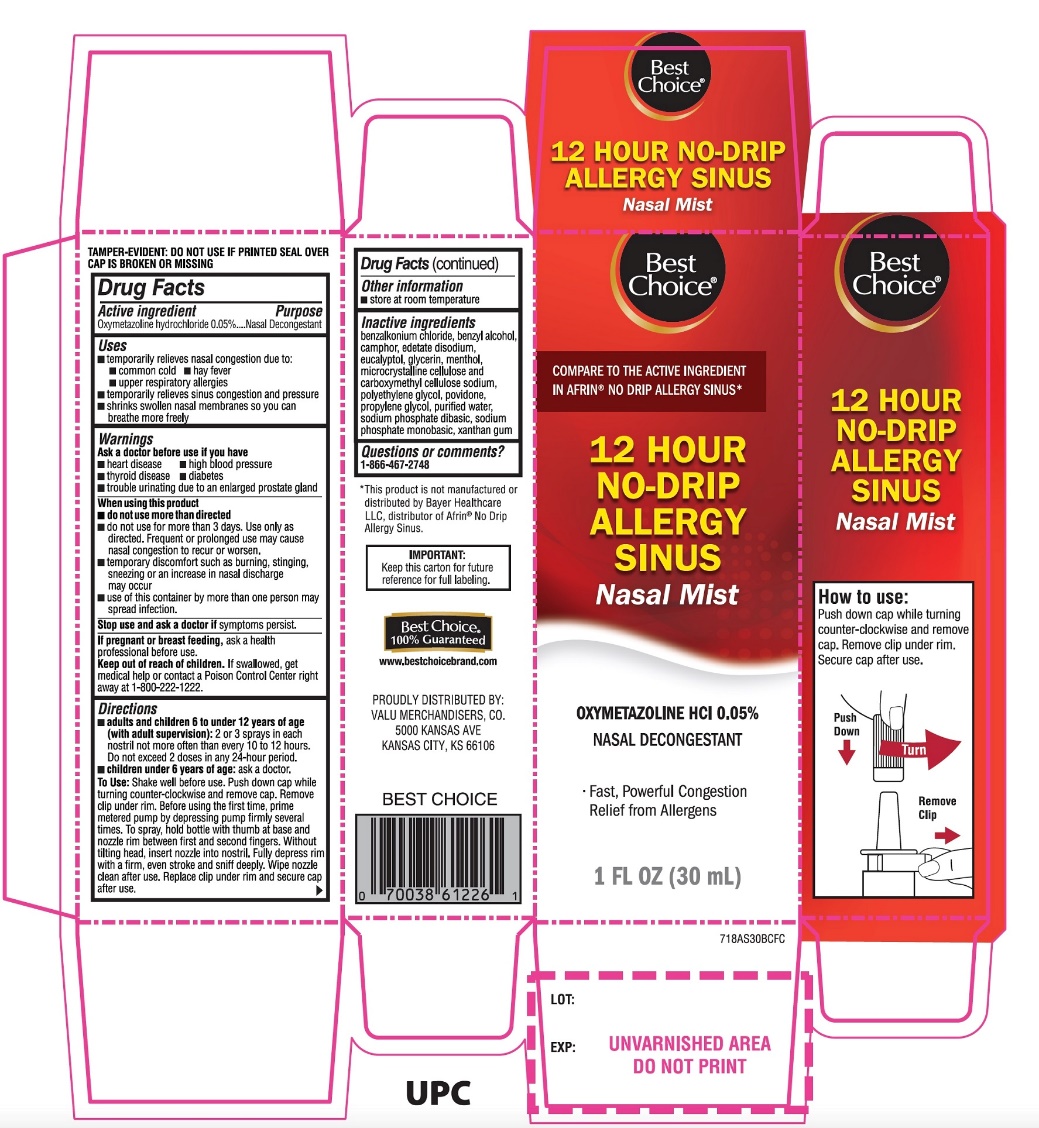
BEST CHOICE No Drip Allergy Sinus .05 mg/mL Spray
🆔 Identity & classification
Where does this data come from?
🏭 Manufacturer & labeler
Where does this data come from?
🩺 Clinical
- It's really important to stick to 3 days maximum with oxymetazoline nasal spray. Using it longer can actually make your congestion worse — this is called rebound congestion, where...
- Can I use the nasal spray for more than a few days if my congestion keeps coming back?
- Upneeq doesn't fix the underlying cause of the drooping — it temporarily lifts the lid by stimulating a small muscle in your eyelid. The effect kicks in around 2 hours after you us...
- What exactly does Upneeq do for a drooping eyelid — will it fix the problem permanently?
Patient education
Supplement & herbal interactions
Where does this data come from?
Ask a licensed pharmacist directly — free, answered by our team.
🧪 Inactive Ingredients / Excipients
Inactive ingredients, also called excipients, are components of the drug product other than the active ingredient. They may include fillers, dyes, coatings, preservatives, flavors, or other formulation ingredients.
💡 Tap an ingredient (hover on desktop) to see what it is and why it’s used.
-
UNII F5UM2KM3W7
Benzalkonium chloride is a chemical compound that works as a preservative and antimicrobial agent in medications. It prevents bacterial and fungal growth in liquid formulations to keep the product safe during storage and use.
-
UNII LKG8494WBH
Benzyl alcohol is a clear liquid used as a preservative and solvent in medicines. It helps prevent bacterial and fungal growth and dissolves other ingredients to create uniform liquid formulations.
-
UNII N20HL7Q941
Camphor is a waxy, aromatic substance derived from camphor tree wood or made synthetically. In medicines, it typically serves as a preservative, flavoring agent, or mild skin irritant in topical products.
-
UNII K679OBS311
Carboxymethylcellulose sodium is a plant-derived thickening agent made from cellulose. In medicines, it acts as a binder to hold ingredients together, a disintegrant to help the tablet break apart, or a thickener in liquids.
-
UNII 7FLD91C86K
Edetate disodium is a chemical compound that binds and removes certain metal ions. In medicines, it acts as a preservative and stabilizer by preventing metals like calcium from interfering with the product's shelf life and consistency.
-
UNII RV6J6604TK
Eucalyptol is a natural oil compound extracted from eucalyptus plants. In medicines, it serves as a flavoring agent and aromatic component to improve taste and smell.
-
UNII PDC6A3C0OX
Glycerin is a clear, thick liquid derived from plant oils or fats. It acts as a humectant to retain moisture, a sweetener, and a solvent in medications.
-
UNII L7T10EIP3A
A cooling compound from mint plants used as a flavoring agent and to create a fresh sensation in medicines. It helps mask bitter tastes and improve how the product feels in the mouth.
-
UNII OP1R32D61U
Microcrystalline cellulose is a purified form of cellulose, a natural fiber from plant sources. It acts as a binder and filler in tablets and capsules, helping hold ingredients together and give the medicine its shape and size.
-
UNII 3WJQ0SDW1A
Polyethylene glycol is a synthetic liquid or solid polymer used in medicines as a solvent, lubricant, and humectant. It helps dissolve active ingredients, reduces friction during manufacturing, and retains moisture in the final product.
-
UNII FZ989GH94E
Povidone is a synthetic polymer made from a plastic-like material. It acts as a binder to hold tablet ingredients together and as a disintegrant to help the tablet break apart in your stomach so the medicine can be absorbed.
-
UNII 6DC9Q167V3
Propylene glycol is a clear liquid derived from petroleum or vegetable sources. It acts as a solvent, humectant, and preservative in medicines, helping dissolve active ingredients and maintain product stability.
-
UNII GR686LBA74
Sodium phosphate, dibasic is a salt derived from phosphoric acid. It acts as a buffer to help maintain the medicine's pH balance and may serve as a binder or filler in tablets and capsules.
-
UNII 3980JIH2SW
A salt form of phosphoric acid that acts as a buffer and pH adjuster in medicines. It helps keep the product at the correct acidity level for stability and effectiveness.
-
UNII 059QF0KO0R
Water is a liquid solvent that dissolves and mixes ingredients together in liquid medicines, syrups, and injections. It helps distribute the active drug evenly throughout the product.
-
UNII TTV12P4NEE
Xanthan gum is a thickening and stabilizing ingredient made from fermented corn or other sugars. It's added to medicines to improve texture, prevent separation of liquids and solids, and help the product stay consistent.
16 inactive ingredients listed in the exact product block matched to this NDC.
Label-section wording can be broader than the structured product block and may mention additional formulation ingredients.
Where does this data come from?
ingredient classCode="IACT" elements from the exact product block matched by this NDC. Label-section narrative from DailyMed / the openFDA label index is shown separately when available.Inactive ingredient FAQ
Are inactive ingredients the same for every manufacturer?
Why might an inactive ingredient be missing?
Can inactive ingredients matter?
💲 Pricing
A drug doesn't have one price. Each row is a different public payment system, and none is what you'd pay at the counter — that depends on your insurance. The ⓘ on each row explains what it measures.
| Price system | Per mL | Per package |
|---|---|---|
| Retail pharmacies payNADAC · weekly | Not in the retail survey — common for institutional, discontinued, or low-volume packs. | |
| Medicaid paysCMS SDUD · 12 mo | No recent Medicaid claims on file for this NDC — rare and low-volume NDCs are suppressed in the public data. | |
| Medicare drug plans payPart D · quarterly | No Part D plan price is available for this NDC in our data. | |
Where does this data come from?
🔁 Therapeutic equivalents
| Product | Labeler | Pack | NADAC/unit | TE | Status | Price vs. this |
|---|---|---|---|---|---|---|
| Kroger No Drip .05 mg/mL 30142-0718-30 | KROGER | 1 bottle | — | — | FDA listed | — |
| BEST CHOICE No Drip .05 mg/mLthis 63941-0137-30 | BEST | 1 bottle | — | — | FDA listed | — |
Where does this data come from?
⏳ Availability & generic status
We did not find an FDA-approved generic match for this exact strength, form and route.
Where does this data come from?
🔬 Reported adverse events (FAERS)
Top reported reactions
Age at onset
Reporter sex
Serious outcomes
Where does this data come from?
📦 Packaging — all sizes for this product
| Package NDC | Description | Marketing start | Status |
|---|---|---|---|
| 63941-0137-30 You're viewing this | 1 BOTTLE, SPRAY in 1 CARTON (63941-137-30) / 30 mL in 1 BOTTLE, SPRAY | 2022-04-11 | Active |
🧭 About this NDC listing & data coverage
What data is (and isn’t) available for this NDC — tap to expand
| NDC identity (package / product / labeler codes) | ✓ Available |
| Labeler | ✓ Available |
| Product & package description | ✓ Available |
| Marketing category & status | ✓ Available |
| Active ingredient / dosage form / route | ✓ Available |
| FDA label (SPL via DailyMed) | ✓ Available |
| Package photos | ✓ Available |
| Inactive ingredients (structured) | ✓ Available |
| NADAC pharmacy acquisition price (CMS) | — Not published for this NDC CMS publishes NADAC only for NDCs reported in its retail-pharmacy survey. |
| Orange Book / therapeutic-equivalence data | — Not published for this NDC Applies only to products approved under an NDA/ANDA; many listings are out of scope. |
| HCPCS J-code billing crosswalk | — Not published for this NDC Most self-administered / retail products have no J-code — that is normal. |
| Medicaid utilization (CMS SDUD) | — Not published for this NDC CMS reports utilization only for NDCs with Medicaid claims above its privacy threshold. |
Questions about this listing
Is this NDC FDA-approved?
Why is there no price listed?
Is the NDC printed on the package the same as the 11-digit billing NDC?
What do the three segments of this NDC mean?
Is this package still being marketed?
Who lists this product with the FDA?
Do I need a prescription for this product?
Where does this data come from?
📄 FDA label — Drug Facts FDA SPL
🎯 Indications and Usage ▾
Uses ▪ temporarily relieves nasal congestion due to: ▪ common cold ▪ hay fever ▪ upper respiratory allergies ▪ temporarily relieves sinus congestion and pressure ▪ shrinks swollen nasal membranes so you can breathe more freely
⏱️ Dosage and Administration ▾
Directions • adults and children 6 to under 12 years of age (with adult supervision): 2 or 3 sprays in each nostril not more often than every 10 to 12 hours. Do not exceed 2 doses in any 24-hour period. • children under 6 years of age: ask a doctor To use: Shake well before use. Push down cap while turning counter-clockwise.
Before using the first time, prime metered pump by depressing pump firmly several times. To spray, hold bottle with thumb at base and nozzle between first and second fingers. Without tilting head, insert nozzle into nostril.
Fully depress rim with a firm, even stroke and sniff deeply. Wipe nozzle clean after use. Replace clip under rim and secure cap after use.
⚠️ Warnings ▾
Warnings
📦 Storage and Handling ▾
Other information ▪ store at room temperature No Drip Allergy Sinus Nasal Mist Nasal Decongestant Oxymetazoline HCl Nasal Solution PUMP MIST This product is a breakthrough in nasal sprays. It stays where you spray it without messy dripping from your nose or down your throat. It starts to work in seconds providing up to 12 hours of nasal congestion relief without drowsiness. Up to 12-hours relief from nasal congestion. Relief can last All-Day or All- Night.
🧪 Active Ingredient ▾
Active ingredient Oxymetazoline hydrochloride 0.05%
🧪 Inactive Ingredients ▾
Inactive ingredients benzalkonium chloride, benzyl alcohol, camphor, edetate disodium, eucalyptol, glycerin, menthol, microcrystalline cellulose and carboxymethylcellulose sodium, polyethylene glycol, povidone, propylene glycol, purified water, sodium phosphate dibasic, sodium phosphate monobasic, xanthan gum.
🎯 Purpose ▾
Purpose Nasal Decongestant