
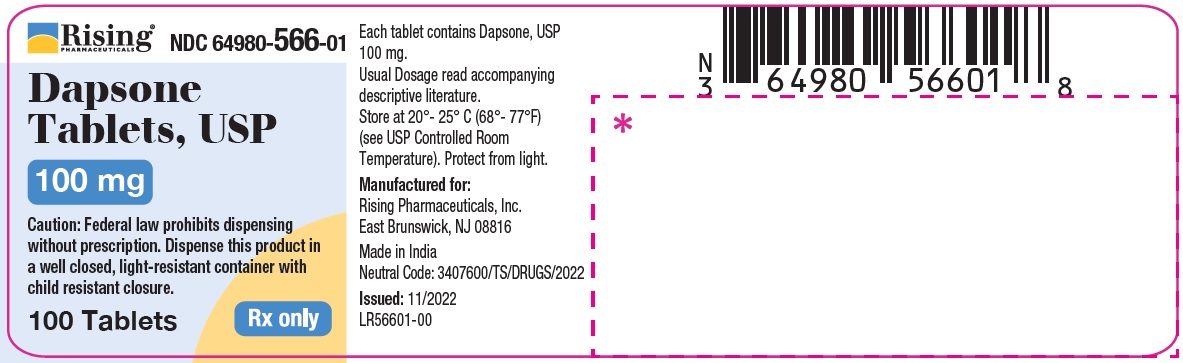
Dapsone 100 mg Tablet, 100-count — NDC 64980-566-01 (Billing 64980-0566-01)
This is a package of 100 tablets of Dapsone 100 mg Tablet from Rising Pharma Holdings, Inc., marketed since Dec 2022 and currently FDA-listed; retail pharmacies pay about $0.8061 per tablet (NADAC).
NDC database record
One package, one record: these facts belong to NDC 64980-566-01 alone.
- Record
- FDA NDC Directory package listing · Human prescription drug
- Code segments
- 64980 labeler · 566 product · 01 package
- Package marketed since
- Dec 11, 2022
- Sample package
- No — commercial package
- Listing certified through
- Dec 31, 2027
- Billing quantity
- 100 EA per package
- Barcode (UPC-A, from the NDC)
- 3 6498056601 8
- Medicaid fills, this package
- 523 prescriptions in the last four reported quarters
- FDA record last changed
- Jul 24, 2026
Other active recalls for Dapsone (different manufacturers) — 4 · tap to view
Identity & classification
Regulatory identifiers FDA, NLM and CMS codes for this package
Drug-database identifiers Medi-Span GPI and First Databank GCN / HICL / AHFS classification
- GSN (GCN sequence number): 009622
- GCN: 43360
- GPI-14 (Medi-Span): 16300010000320
- HICL (First Databank): 004177
- AHFS class code: 08:16.08.00
- RxCUI (RxNorm): 197557
Where does this data come from?
- FDA openFDA NDC Directory · synced Oct 1, 2026
- FDA label on DailyMed · label index refreshed Oct 3, 2026
- RxNorm (NLM RxNav) · catalog refreshed Oct 1, 2026
- Medi-Span GPI (licensed)
- First Databank (licensed) · refreshed Oct 1, 2026
RxNorm drug class
This medicine belongs to the Sulfone class.
Where does this data come from?
- RxClass (NLM) · catalog refreshed Oct 1, 2026
Clinical
Dapsone is used to treat leprosy and skin infections. This medication is sometimes prescribed for other uses; ask your doctor or pharmacist for more information.
Read the full MedlinePlus article ↗- It depends on the form. Tablets treat dermatitis herpetiformis and leprosy. The gel treats acne vulgaris in people 9 and older. Make sure you know which one you were given.
- Wash and gently pat your skin dry. Rub in a thin, pea-sized layer, and keep it out of your mouth, eyes and vagina. Aczone Gel 7.5% is once daily, while dapsone gel 5% is twice dail...
- With the gel, mostly dryness, redness and some oiliness or peeling where you apply it. These are the common ones. They are usually not the reason to panic, but tell us if they both...
- Call for help if your lips, mouth or nail beds turn bluish-gray, or if you notice signs of anemia. Also report sore throat, fever, pale skin, yellow skin or eyes, purple spots, sev...
Patient education
Supplement & herbal interactions
Some supplements/herbs that may interact with Dapsone — tap one for details:
Dapsone may be associated with lower levels of 7 nutrients — worth a chat with your pharmacist, not a cause for alarm.
Where does this data come from?
- MedlinePlus (NLM) · refreshed Oct 1, 2026
- FDA label on DailyMed · label index refreshed Oct 3, 2026
Ask a licensed pharmacist directly — free, answered by our team.
Pricing
A drug doesn't have one price. Each row is a different public payment system, and none is what you'd pay at the counter — that depends on your insurance. The ⓘ on each row explains what it measures.
| Price system | Per ea | Per package |
|---|---|---|
| Retail pharmacies payNADAC · weekly | $0.806 | $80.61 / 100 tablets |
| Medicaid paysCMS SDUD · 12 mo | $1.14 | $114.49 / 100 tablets |
| Medicare drug plans payPart D · Q2 2026 | $0.7885 | $78.85 / 100 tablets |
Where does this data come from?
- CMS NADAC weekly file · file of Sep 30, 2026
- CMS ASP pricing files · refreshed Sep 20, 2026
- CMS Medicaid State Drug Utilization Data · through Q1 2026
- CMS Part D plan pricing files · refreshed Sep 24, 2026
- VA National Acquisition Center price file
Packaging — all sizes for this product
| Package NDC | Description | Per unit | Per pack | Marketing start | Marketing end | Status |
|---|---|---|---|---|---|---|
| 64980-0566-01 You're viewing this | 100 TABLET in 1 BOTTLE | $0.8061 / ea | $80.61 | 2022-12-11 | — | Active |
| 64980-0566-03 64980-566-03 Main listing | 30 TABLET in 1 BOTTLE | $0.8061 / ea | $24.18 | 2023-07-12 | — | Active |
You're viewing the largest of 2 pack sizes for this product.
This pack has the lowest per-ea cost of the 2 priced pack sizes ($0.8061 NADAC).
This pack accounts for about 15% of this product's recent Medicaid fills; most go to the 30 tablets pack. See all packs ↓
Pack size FAQ
What quantity is in this package?
How does this package differ from NDC 64980-0566-03?
What NDC number is used to bill for this package of Dapsone 100 mg Tablet?
Prices are the latest CMS NADAC pharmacy acquisition cost per NDC; per-pack figures are per-unit × pack quantity, shown only when the pack is denominated in the same measure NADAC prices.
Therapeutic equivalents
| Product | Labeler | Pack | NADAC/unit | TE | Status | Price vs. this |
|---|---|---|---|---|---|---|
| Dapsone 100 mgthis 64980-0566-01 | Rising | 100 tablets | $0.806 | AB | Availability likely | — |
| Dapsone 100 mg 69367-0379-01 | Westminster | 100 tablets | $0.806 | AB | Availability likely | — |
| Dapsone 100 mg 69367-0410-01 | Westminster | 100 tablets | $0.806 | AB | Availability likely | — |
| Dapsone 100 mg 70954-0136-10 | ANI | 30 tablets | $0.806 | AB | Availability likely | — |
| Dapsone 100 mg 72578-0178-01 | Viona | 100 tablets | $0.806 | AB | Availability likely | — |
| Dapsone 100 mg 13925-0505-01 | Seton | 100 tablets | $0.942 | AB | Discontinued | +17% |
| Dapsone 100 mg 51672-4198-02 | Sun | 30 tablets | — | — | Discontinued | — |
| Dapsone 100 mg 62135-0966-30 | Chartwell | 30 tablets | — | — | FDA listed | — |
| Dapsone 100 mg 67046-1477-03 | Coupler | 30 tablets | — | AB | FDA listed | — |
| Dapsone 100 mg 70771-1980-01 | Zydus | 100 tablets | — | AB | FDA listed | — |
| Dapsone 100 mg 82804-0989-00 | Proficient | 100 tablets | — | AB | FDA listed | — |
| Dapsone 100 mg 83098-0101-01 | Everest | 100 tablets | — | AB | FDA listed | — |
| Dapsone 100 mg 83209-0566-30 | Boswell | 30 tablets | — | AB | FDA listed | — |
| Dapsone 100mg 100 mg 85185-0105-01 | Solis | 30 tablets | — | AB | FDA listed | — |
| Dapsone 100 mg 33342-0535-07 | Macleods | 30 tablets | — | AB | FDA listed | — |
Where does this data come from?
- FDA openFDA NDC Directory · synced Oct 1, 2026
- FDA Orange Book · refreshed Oct 3, 2026
- CMS NADAC weekly file · file of Sep 30, 2026
Availability & generic status
This product is an FDA-approved generic. Other versions of the same drug are listed under Therapeutic equivalents, least expensive first.
Where does this data come from?
- FDA Orange Book · refreshed Oct 3, 2026
What it looks like
Where does this data come from?
- FDA label on DailyMed · label index refreshed Oct 3, 2026
Inactive Ingredients / Excipients
Inactive ingredients, also called excipients, are components of the drug product other than the active ingredient. They may include fillers, dyes, coatings, preservatives, flavors, or other formulation ingredients.
💡 Tap an ingredient (hover on desktop) to see what it is and why it’s used.
-
UNII OP1R32D61U
Microcrystalline cellulose is a purified form of cellulose, a natural fiber from plant sources. It acts as a binder and filler in tablets and capsules, helping hold ingredients together and give the medicine its shape and size.
-
UNII 70097M6I30
Magnesium stearate is a salt made from magnesium and stearic acid, a fatty substance. It's used in tablets and capsules as a lubricant and glidant to help ingredients flow smoothly during manufacturing and prevent sticking.
-
UNII 368GB5141J
A detergent and foaming agent derived from coconut or palm oil. In medications, it helps break down and mix oil and water-based ingredients, aids in tablet disintegration, and improves how the drug dissolves and spreads in the mouth or digestive system.
-
UNII AG9B65PV6B
A starch derivative made from corn that helps tablets and capsules break apart quickly when swallowed. It acts as a disintegrant, allowing the medicine to dissolve and be absorbed in your stomach and intestines.
-
UNII O8232NY3SJ
A plant-based carbohydrate derived from corn kernels. It acts as a filler to add bulk, a binder to hold ingredients together, and a disintegrant to help the tablet break apart in your stomach for absorption.
-
UNII 4ELV7Z65AP
Stearic acid is a fatty acid derived from plant or animal sources. It acts as a binder and lubricant in tablets and capsules, helping them hold together and flow smoothly during manufacturing.
6 inactive ingredients listed in the exact product block matched to this NDC.
Where does this data come from?
ingredient classCode="IACT" elements from the exact product block matched by this NDC. Label-section narrative from DailyMed / the openFDA label index is shown separately when available.- FDA label on DailyMed · label index refreshed Oct 3, 2026
- FDA openFDA NDC Directory · synced Oct 1, 2026
Inactive ingredient FAQ
Are inactive ingredients the same for every manufacturer?
Why might an inactive ingredient be missing?
Can inactive ingredients matter?
Manufacturer & labeler
More NDCs from Rising Pharma Holdings, Inc. labeler code 64980
- Sodium Bicarbonate 650 mg Tablet NDC 64980-528-10
- Oxybutynin Chloride 2.5 mg Tablet NDC 64980-531-01
- Linezolid 600 mg Tablet NDC 64980-561-02
- Furosemide 20 mg Tablet NDC 64980-562-01
- Furosemide 40 mg Tablet NDC 64980-563-01
- Furosemide 80 mg Tablet NDC 64980-564-01
- Dapsone 25 mg Tablet NDC 64980-567-01
- Methyldopa 250 mg Tablet NDC 64980-571-01
- Methyldopa 500 mg Tablet NDC 64980-572-01
- Phenytoin 50 mg Tablet, Chewable NDC 64980-573-01
- Venlafaxine Hydrochloride 37.5 mg Tablet, Extended Release NDC 64980-578-03
- Venlafaxine Hydrochloride 75 mg Tablet, Extended Release NDC 64980-579-03
Where does this data come from?
- FDA openFDA NDC Directory · synced Oct 1, 2026
- Drugs@FDA
Full prescribing information FDA SPL
🎯 Indications and Usage ▾
INDICATIONS AND USAGE Dermatitis herpetiformis: (D.H.) Leprosy: All forms of leprosy except for cases of proven Dapsone resistance.
⏱️ Dosage and Administration ▾
DOSAGE AND ADMINISTRATION Dermatitis herpetiformis: The dosage should be individually titrated starting in adults with 50 mg daily and correspondingly smaller doses in children. If full control is not achieved within the range of 50 - 300 mg daily, higher doses may be tried. Dosage should be reduced to a minimum maintenance level as soon as possible.
In responsive patients there is a prompt reduction in pruritus followed by clearance of skin lesions. There is no effect on the gastrointestinal component of the disease. Dapsone levels are influenced by acetylation rates.
Patients with high acetylation rates, or who are receiving treatment affecting acetylation may require an adjustment in dosage. A strict gluten free diet is an option for the patient to elect, permitting many to reduce or eliminate the need for Dapsone; the average time for dosage reduction is 8 months with a range of 4 months to 2 1/2 years and for dosage elimination 29 months with a range of 6 months to 9 years. Leprosy: In order to reduce secondary Dapsone resistance, the WHO Expert Committee on Leprosy and the USPHS at Carville, LA, recommended that Dapsone should be commenced in combination with one or more anti-leprosy drugs.
In the multidrug program Dapsone should be maintained at the full dosage of 100 mg daily without interruption (with corresponding smaller doses for children) and provided to all patients who have sensitive organisms with new or recrudescent disease or who have not yet completed a two year course of Dapsone monotherapy. For advice and other drugs, the USPHS at Carville, LA (1- 800-642-2477) should be contacted. Before using other drugs consult appropriate product labeling.
In bacteriologically negative tuberculoid and indeterminate disease, the recommendation is the coadministration of Dapsone 100 mg daily with six months of Rifampin 600 mg daily. Under WHO, daily Rifampin may be replaced by 600 mg Rifampin monthly, if supervised. The Dapsone is continued until all signs of clinical activity are controlled usually after an additional six months.
Then Dapsone should be continued for an additional three years for tuberculoid and indeterminate patients and for five years for borderline tuberculoid patients. In lepromatous and borderline lepromatous patients, the recommendation is the co-administration of Dapsone 100 mg daily with two years of Rifampin 600 mg daily. Under WHO daily Rifampin may be replaced by 600 mg Rifampin monthly, if supervised.
One may elect the concurrent administration of a third anti-leprosy drug, usually either Clofazamine 50-100 mg daily or Ethionamide 250-500 mg daily. Dapsone 100 mg daily is continued 3-10 years until all signs of clinical activity are controlled with skin scrapings and biopsies negative for one year. Dapsone should then be continued for an additional 10 years for borderline patients and for life for lepromatous patients.
Secondary Dapsone resistance should be suspected whenever a lepromatous or borderline lepromatous patient receiving Dapsone treatment relapses clinically and bacteriologically, solid staining bacilli being found in the smears taken from the new active lesions. If such cases show no response to regular and supervised Dapsone therapy within three to six months or good compliance for the past 3-6 months can be assured, Dapsone resistance should be considered confirmed clinically. Determination of drug sensitivity using the mouse footpad method is recommended and, after prior arrangement, is available without charge from the USPHS, Carville, LA.
Patients with proven Dapsone resistance should be treated with other drugs.
⛔ Contraindications ▾
CONTRAINDICATION Hypersensitivity to Dapsone and/or its derivatives.
⚠️ Warnings ▾
WARNINGS The patient should be warned to respond to the presence of clinical signs such as sore throat, fever, pallor, purpura or jaundice. Deaths associated with the administration of Dapsone have been reported from agranulocytosis, aplastic anemia and other blood dyscrasias. Complete blood counts should be done frequently in patients receiving Dapsone.
The FDA Dermatology Advisory Committee recommended that, when feasible, counts should be done weekly for the first month, monthly for six months and semi-annually thereafter. If a significant reduction in leucocytes, platelets or hemopoiesis is noted, Dapsone should be discontinued and the patient followed intensively. Folic acid antagonists have similar effects and may increase the incidence of hematologic reactions; if co-administered with Dapsone the patient should be monitored more frequently.
Patients on weekly pyrimethamine and Dapsone have developed agranulocytosis during the second and third month of therapy. Severe anemia should be treated prior to initiation of therapy and hemoglobin monitored. Hemolysis and methemoglobin may be poorly tolerated by patients with severe cardiopulmonary disease.
Cutaneous reactions, especially bullous, include exfoliative dermatitis and are probably one of the most serious, though rare, complications of sulfone therapy. They are directly due to drug sensitization. Such reactions include toxic erythema, erythema multiforme, toxic epidermal necrolysis, morbilliform and scarlatiniform reactions, urticaria and erythema nodosum.
If new or toxic dermatologic reactions occur, sulfone therapy must be promptly discontinued and appropriate therapy instituted. Leprosy reactional states, including cutaneous, are not hypersensitivity reactions to Dapsone and do not require discontinuation. See special section.
🤒 Adverse Reactions ▾
ADVERSE REACTIONS In addition to the warnings listed above, the following syndromes and serious reactions have been reported in patients on Dapsone. Hematologic Effects: Dose-related hemolysis is the most common adverse effect and is seen in patients with or without G6PD deficiency. Almost all patients demonstrate the inter-related changes of a loss of 1-2g of hemoglobin, an increase in the reticulocytes (2-12%), a shortened red cell life span and a rise in methemoglobin.
G6PD deficient patients have greater responses. Nervous System Effects: Peripheral neuropathy is a definite but unusual complication of Dapsone therapy in non-leprosy patients. Motor loss is predominant.
If muscle weakness appears, Dapsone should be withdrawn. Recovery on withdrawal is usually substantially complete. The mechanism of recovery is reported by axonal regeneration.
Some recovered patients have tolerated retreatment at reduced dosage. In leprosy this complication may be difficult to distinguish from a leprosy reactional state. Falsely Reduced HbA1c: Falsely reduced HbA1c measurements have been reported with dapsone use.
Alternate measures of glycemic control (e.g., fructosamine and/or more frequent blood glucose monitoring) are recommended when a discordance between HbA1c and blood glucose concentrations are observed or suspected. Falsely reduced HbA1c may occur without overt evidence of hemolysis or anemia. Body As A Whole: In addition to the warnings and adverse effects reported above, additional adverse reactions include: nausea, vomiting, abdominal pains, pancreatitis, vertigo, blurred vision, tinnitus, insomnia, fever, headache, psychosis, phototoxicity, pulmonary eosinophilia, tachycardia, albuminuria, the nephrotic syndrome, hypoalbuminemia without proteinuria, renal papillary necrosis, male infertility, drug-induced Lupus erythematosus and an infectious mononucleosis-like syndrome.
In general, with the exception of the complications of severe anoxia from overdosage (retinal and optic nerve damage, etc.) these adverse reactions have regressed off drug. To report SUSPECTED ADVERSE REACTIONS, contact Rising Pharma Holdings, Inc. at 1-844-874-7464 or FDA at 1-800-FDA-1088 or www.fda.gov/medwatch .
🆘 Overdosage ▾
OVERDOSAGE Nausea, vomiting, hyperexcitability can appear a few minutes up to 24 hours after ingestion of an overdosage. Methemoglobin induced depression, convulsions or severe cyanosis requires prompt treatment. In normal and methemoglobin reductase deficient patients, methylene blue, 1-2 mg/kg of body weight, given slowly intravenously, is the treatment of choice.
The effect is complete in 30 minutes, but may have to be repeated if methemoglobin reaccumulates. For non-emergencies, if treatment is needed, methylene blue may be given orally in doses of 3-5 mg/kg every 4-6 hours. Methylene blue reduction depends on G6PD and should not be given to fully expressed G6PD deficient patients.
🧬 Clinical Pharmacology ▾
CLINICAL PHARMACOLOGY Actions : The mechanism of action in Dermatitis herpetiformis has not been established. By the kinetic method in mice, Dapsone is bactericidal as well as bacteriostatic against Mycobacterium leprae . Absorption and Excretion: Dapsone, when given orally, is rapidly and almost completely absorbed.
About 85 percent of the daily intake is recoverable from the urine mainly in the form of water-soluble metabolites. Excretion of the drug is slow and a constant blood level can be maintained with the usual dosage. Blood Levels: Detected a few minutes after ingestion, the drug reaches peak concentration in 4-8 hours.
Daily administration for at least eight days is necessary to achieve a plateau level. With doses of 200 mg daily, this level averaged 2.3 μg/mL with a range of 0.1-7.0 μg/mL. The half-life in the plasma in different individuals varies from ten hours to fifty hours and averages twenty-eight hours.
Repeat tests in the same individual are constant. Daily administration (50 - 100 mg) in leprosy patients will provide blood levels in excess of the usual minimum inhibitory concentration even for patients with a short Dapsone half-life.
📦 How Supplied / Storage and Handling ▾
HOW SUPPLIED Dapsone Tablets USP, 25 mg are available as round, white to off-white, biconvex tablet debossed with C119 on one side and break line on other side. Bottle of 30 Tablets NDC 64980-567-03 Bottle of 100 Tablets NDC 64980-567-01 Dapsone Tablets USP, 100 mg are available as round, white to off-white, biconvex tablet debossed with R193 on one side and break line on other side. Bottle of 30 Tablets NDC 64980-566-03 Bottle of 100 Tablets NDC 64980-566-01 Store at 20º to 25ºC (68º to 77ºF); excursions permitted to 15° to 30°C (59° to 86°F) [See USP Controlled Room Temperature].
Protect from light. Rx only. Keep this and all drugs out of the reach of children.
📋 Description ▾
DESCRIPTION Dapsone-USP, 4,4’-sulfonyl dianiline, is a primary treatment for Dermatitis herpetiformis. It is an antibacterial drug for susceptible cases of leprosy. It is a white to creamy white crystalline powder, very slightly soluble in water, sparingly soluble in alcohol, soluble in acetone and dilute mineral acids.
Dapsone is issued on prescription in tablets of 25 mg and 100 mg for oral use. Inactive Ingredients: Magnesium stearate, microcrystalline cellulose, pregelatinized starch, sodium lauryl sulfate, sodium starch glycolate (Type A), and stearic acid. dapsone-struct.jpg
⚠️ Precautions ▾
PRECAUTIONS General: Hemolysis and Heinz body formation may be exaggerated in individuals with a glucose-6-phosphate dehydrogenase (G6PD) deficiency, or methemoglobin reductase deficiency, or hemoglobin M. This reaction is frequently dose-related. Dapsone should be given with caution to these patients or if the patient is exposed to other agents or conditions such as infection or diabetic ketosis capable of producing hemolysis.
Drugs or chemicals which have produced significant hemolysis in G6PD or methemoglobin reductase deficient patients include Dapsone, sulfanil amide, nitrite, aniline, phenylhydrazine, napthalene, niridazole, nitro-furantoin and 8-amino-antimalarials such as primaquine. Toxic hepatitis and cholestatic jaundice have been reported early in therapy. Hyperbilirubinemia may occur more often in G6PD deficient patients.
When feasible, baseline and subsequent monitoring of liver function is recommended; if abnormal, Dapsone should be discontinued until the source of the abnormality is established. Falsely Reduced HbA1c: Falsely reduced HbA1c measurements have been reported with dapsone use. Alternate measures of glycemic control (e.g., fructosamine and/or more frequent blood glucose monitoring) are recommended when a discordance between HbA1c and blood glucose concentrations are observed or suspected.
Falsely reduced HbA1c may occur without overt evidence of hemolysis or anemia. Drug Interactions: Rifampin lowers Dapsone levels 7 to 10-fold by accelerating plasma clearance; in leprosy this reduction has not required a change in dosage. Folic acid antagonists such as pyrimethamine may increase the likelihood of hematologic reactions.
A modest interaction has been reported for patients receiving 100 mg Dapsone daily in combination with trimethoprim 5 mg/kg q6h. On Day 7, the serum Dapsone levels averaged 2.1 ± 1.0 μg/mL in comparison to 1.5 ± 0.5 μg/mL for Dapsone alone. On Day 7, trimethoprim levels averaged 18.4 ± 5.2 μg/mL in comparison to 12.4 ± 4.5 μg/mL for patients not receiving Dapsone.
Thus, there is a mutual interaction between Dapsone and trimethoprim in which each raises the level of the other about 1.5 times. A crossover study 1 designed to assess the potential of a drug interaction between Dapsone, 100 mg/day and trimethoprim, 200 mg every 12 hours, in eight asymptomatic HIV positive volunteers (average CD4 count 524 cells/mm 3 ) demonstrated that there was not a significant drug interaction between Dapsone and trimethoprim. However, an earlier report 2 also by Lee et al, in 78 HIV infected patients with acute Pneumocystis carinii pneumonia, receiving Dapsone, 100 mg/day and higher trimethoprim dose, 20 mg/kg/day, demonstrated that the serum levels of Dapsone were increased by 40% and trimethoprim levels were increased by 48% when the drugs were administered concurrently.
Carcinogenesis, mutagenesis: Dapsone has been found carcinogenic (sarcomagenic) for male rats and female mice causing mesenchymal tumors in the spleen and peritoneum, and thyroid carcinoma in female rats. Dapsone is not mutagenic with or without microsomal activation in S . typhimurium tester strains 1535, 1537, 1538, 98, or 100. Pregnancy: Teratogenic Effects: Animal reproduction studies have not been conducted with Dapsone.
Extensive, but uncontrolled experience and two published surveys on the use of Dapsone in pregnant women have not shown that Dapsone increases the risk of fetal abnormalities if administered during all trimesters of pregnancy or can affect reproduction capacity. Because of the lack of animal studies or controlled human experience, Dapsone should be given to a pregnant woman only if clearly needed. In general, for leprosy, USPHS at Carville recommends maintenance of Dapsone.
Dapsone has been important for the management of some pregnant D.H. patients. Nursing Mothers: Dapsone is excreted in breast milk in substantial amounts. Hemolytic reactions can occur in neonates.
See section on hemolysis. Because of the pote… [Excerpted — this section continues on DailyMed.]
📚 References ▾
REFERENCES 1. Lee, B., et al., Zidovudine, Trimethoprim, and Dapsone Pharmacokinetic Interactions in Patients with HIV Infection. Antimicrobial Agents and Chemotherapy , May 1996; 1231-1236.
2. Lee, B., et al., Dapsone, Trimethoprim, and Sulfamethoxazole Plasma Levels During Treatment of Pneumocystis Carinii Pneumonia in Patients with AIDS, Annals of Internal Medicine , 1989; 110:606-611. Manufactured for: Rising Pharma Holdings, Inc.
East Brunswick, NJ 08816 Made in India Neutral Code: 4323066/TS/DRUGS/2025 Revised : 01/2026 PIR56601-06
📄 Package Label / Principal Display Panel ▾
PACKAGE LABEL.PRINCIPAL DISPLAY PANEL Rising Pharmaceuticals, Inc. Dapsone Tablets, USP NDC 64980-566-01 100 mg (100 Tablets) Rx only Rising Pharmaceuticals, Inc. Dapsone Tablets, USP NDC 64980-567-01 25 mg (100 Tablets) Rx only dapsone-label-100mg.jpg dapsone-label-25mg.jpg